
Guillain-Barré Syndrome Market Size, Share, Trends & Forecast, 2026-2034
REPORT DETAILS
Guillain-Barré Syndrome Market Size & Forecast, 2025-2034
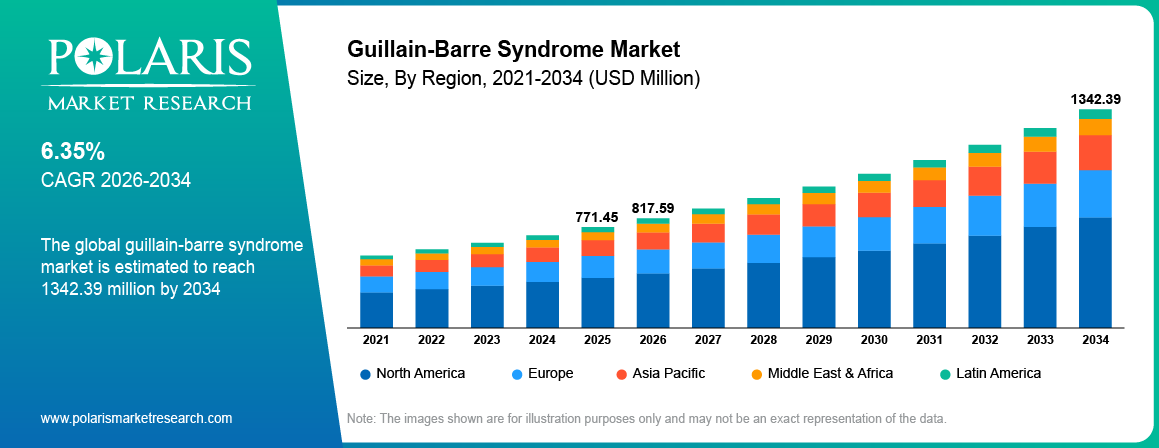
Global guillain-barre syndrome market size was valued at USD 771.45 million in 2025. The market is anticipated to grow from USD 817.59 million in 2026 to USD 1342.39 million by 2034, exhibiting the CAGR of 6.35% during the forecast period.
Market Statistics
Guillain-Barré Syndrome Market Key Takeaways: Size, Treatments & Regions
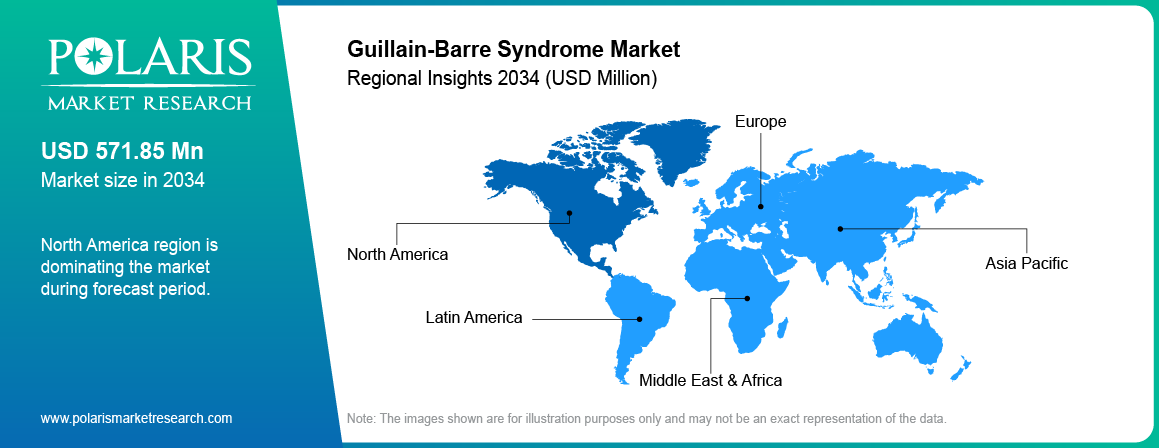
- North America held the largest market share of 42.6% in 2025. Strong research activity and better access to treatment kept the region ahead.
- Asia Pacific is expected to grow at a CAGR of 8.8% during 2026–2034. Rising awareness and expanding healthcare are driving the demand with more testing.
- The Intravenous Immunoglobulin segment is estimated to witness a CAGR of 9.4% during the period 2026–2034. This is majorly due to its quick action and easy administration.
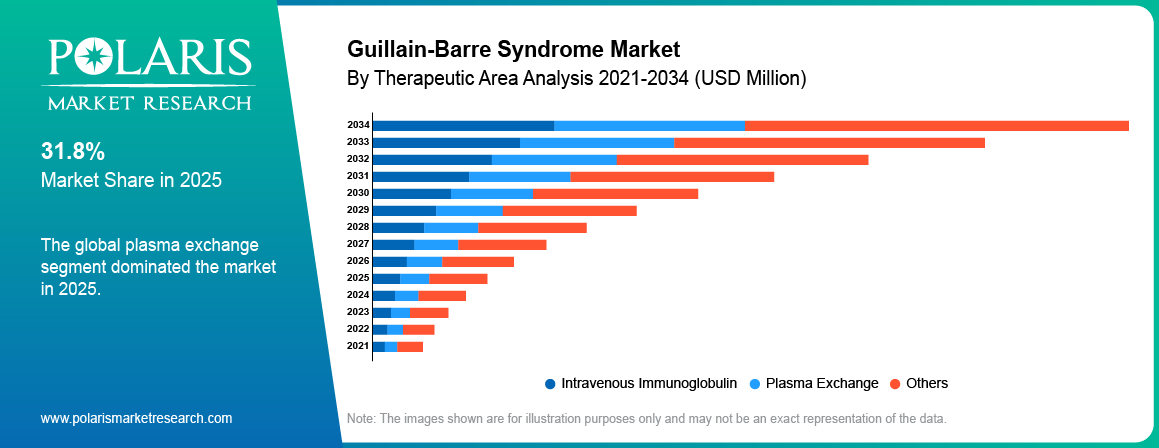
- The Plasma Exchange segment accounted for 31.8% in 2025. It remains an important treatment by removing harmful antibodies from the blood.
- The Parenteral route of administration is expected to grow at a CAGR of 9.1% during 2026–2034. It is preferred because the medicine reaches the body faster.
- Hospital pharmacies held a market share of 55.7% in 2025. More people receiving treatment in hospitals continues to drive demand.
Note: Figures and projections outlined in this report are the result of Polaris Market Research’s proprietary analytical processes, grounded in the latest available datasets and market observations.
Guillain-Barré Syndrome Market Dynamics: Drivers, Opportunities, Restraints & Challenges
- Rising Guillain-Barré syndrome cases are increasing demand for diagnosis and treatment.
- Growing use of IVIG and plasmapheresis is supporting market growth.
- Higher GBS risk linked to infections, surgeries, and some vaccinations is driving treatment demand.
- Market is expanding because of ongoing investment in diagnostics and new therapies.
- Lack of awareness of GBS and its treatment continues to limit early diagnosis and market growth.
AI in Guillain-Barré Syndrome: Diagnosis, Monitoring & Clinical Decision Support
- From clinical and imaging data AI can improve early diagnosis by identifying Guillain-Barré syndrome.
- AI powered tools can monitor disease progression and support timely treatment decisions.
- Predictive analytics can help to optimize the treatment plan with the help of patient health data.
- AI can recognize the disease pattern and improve healthcare planning with the help of insights from data.
Guillain-Barré Syndrome Treatment Market Overview & Commercial Scope
The Guillain-Barre Syndrome (GBS) market is poised for growth, driven by the rising incidence of the condition, particularly in regions with high rates of infectious diseases. GBS is a rare neurological disorder characterized by muscle weakness, and its occurrence is often associated with preceding infections, such as respiratory or gastrointestinal illnesses. The increasing prevalence of infectious diseases in certain regions is contributing to the heightened incidence of GBS, consequently propelling market expansion.
Source: Polaris Market Research Analysis
To Understand More About this Research: Download Sample Report
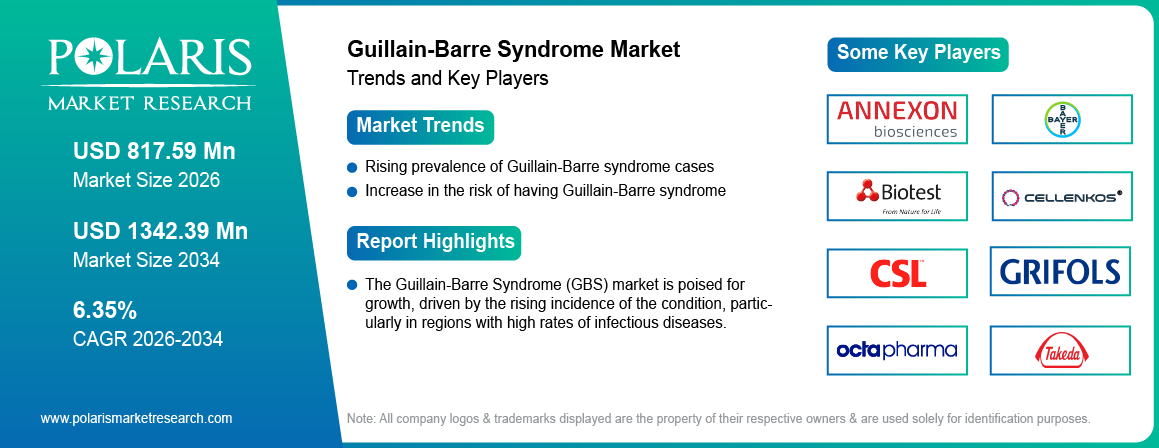
Moreover, advancements in diagnostic techniques are facilitating early and accurate diagnosis of GBS, enabling prompt initiation of treatment. This, coupled with growing research and development activities focused on novel treatments, is further fueling market growth. Immunomodulatory therapies, including intravenous immunoglobulin (IVIG) and plasmapheresis, are emerging as key treatment modalities for GBS, driving demand for these therapies and positively impacting market dynamics.
In addition, the rising investment in healthcare infrastructure and the increasing awareness about neurological disorders are creating a conducive environment for market growth. These factors, along with ongoing efforts to improve treatment outcomes and patient care, are expected to sustain the upward trajectory of the Guillain-Barre Syndrome market over the forecast period.
What Is Guillain-Barré Syndrome (GBS)? Causes, Symptoms & Disease Variants
Guillain-Barré Syndrome (GBS) is a rare autoimmune disorder that damages the peripheral nerves. It often causes muscle weakness, numbness. in some severe cases it can cause paralysis. Early diagnosis can improve recovery. Treatment usually includes intravenous immunoglobulin (IVIG), plasma exchange, supportive care, and rehabilitation. Researchers are also studying new therapies to improve treatment outcomes and meet the growing need for better disease management.
How GBS Treatment Works: IVIG, Plasma Exchange, ICU Care & Rehabilitation
An infection, surgery, or another trigger can cause the immune system to attack the peripheral nerves. This leads to muscle weakness, numbness, and, in severe cases, paralysis. Physicians diagnose Guillain-Barré syndrome using symptoms, physical examination, and nerve tests to confirm the condition.
To reduce the immune attack the typical treatment for GBS starts with intravenous immunoglobulin (IVIG) or plasma exchange. Supportive care and rehabilitation are also provided to help patients regain strength and movement. The physician tracks the patient’s recovery over time, as the nerves heal at different rates in different people.
Guillain-Barré Syndrome Market Drivers & Growth Opportunities
Post-Infectious GBS Burden and Earlier Diagnosis Increase Treatment Demand
The rising prevalence of Guillain-Barre syndrome (GBS) cases is significantly increasing the demand for products and services in the GBS market. GBS is a rare neurological disorder that affects the peripheral nervous system, leading to muscle weakness and, in severe cases, paralysis. With an increasing number of reported cases globally, there is a growing need for effective diagnostic tools, treatments, and supportive care services to address the disease burden.
Healthcare providers are increasingly seeking advanced diagnostic techniques to diagnose GBS and initiate timely interventions accurately. Additionally, the demand for immunomodulatory therapies such as intravenous immunoglobulin (IVIG) and plasmapheresis is rising as they are considered standard treatments for GBS. This growing demand for diagnostic tools and treatment options is propelling market growth and encouraging investments in research and development aimed at improving patient outcomes and quality of life.
Ageing Populations and Infection-Related Risk Support GBS Case Detection
Guillain-Barre syndrome is becoming more prevalent among people with surgeries, infections, and vaccinations. The COVID-19 pandemic influenced the penetration of Guillain-Barre syndrome and contributed to the critical need for Guillain-Barre treatment facilities. For instance, a study published in the JAMA Neurology journal in 2024 showed a significant increase in the risk of having Guillain-Barre syndrome disease with the adenovirus COVID vaccination.
Furthermore, in July 2021, the US Food and Drug Administration announced the side effects of developing Guillain-Barre syndrome with the Johnson & Johnson vaccine, which is no longer available in the United States, according to the US Centres for Disease Control and Prevention in 2023.
Restraining Factors
Lower awareness about the treatment is likely to impede the guillain-barre syndrome market growth.
The market faces a significant challenge due to lower awareness about the available treatments, which is likely to impede the guillain-barre syndrome market growth. Despite advancements in diagnostic techniques and treatment modalities, there remains a lack of widespread knowledge about GBS among healthcare providers and the general population. This lower awareness leads to delays in diagnosis and initiation of appropriate treatment, thereby impacting patient outcomes.
Efforts to enhance awareness about GBS, its symptoms, and available treatment options are crucial for addressing this challenge. Educational initiatives targeting healthcare professionals, patients, and caregivers can play a pivotal role in improving early detection and access to treatment. Collaborative efforts between healthcare organizations, advocacy groups, and government agencies are needed to raise awareness about GBS, ultimately facilitating better management of the disease and supporting guillain-barre syndrome market growth.
Early GBS Diagnosis Enables Timely IVIG or Plasma Exchange
An early diagnosis is essential for the effective management of Guillain-Barré syndrome. Early identification of the condition allows for the prompt initiation of treatment. This helps minimize nerve damage and reduce the risk of severe complications. Early administration of intravenous immunoglobulin (IVIG) or plasma exchange can lead to better recovery and a shorter overall treatment duration. Early medical care also supports better long-term patient outcomes.
Targeted Complement Research Is Expanding the GBS Therapeutic Pipeline
Research on autoimmune diseases is improving the understanding of Guillain-Barré syndrome (GBS). Researchers are investigating how the immune system attacks peripheral nerves. Also how this attack can be controlled is another important topic of research. These findings are helping in the development of targeted therapies and better treatment options. Pharmaceutical and biotechnology companies are also increasing their investment in this area. Continued research is expected to lead to better treatment outcomes and new market opportunities for Guillain-Barré syndrome.
Source: Polaris Market Research Analysis
Guillain-Barré Syndrome Market Segmentation by Treatment Modality, Care Setting & Region
The market is primarily segmented based on therapeutics, route of administration, distribution channel, and region.
| By Therapeutic Area | By Route of Administration | By Distribution Channel | By Region |
|
|
|
|
Source: Polaris Market Research Analysis
By Treatment Modality: IVIG, Plasma Exchange & Emerging Targeted Therapies
IVIG Remains a Core Acute GBS Treatment and Is Projected to Grow Rapidly
The intravenous immunoglobulin segment is projected to grow at a CAGR during the projected period, mainly driven by its capacity to lower the severity of the disease due to its potential to normalize the immune systems of people. It is cost-effective and limits the immune attack in the human nervous system, leading to a decrease in recovery duration. According to a 2025 comparative study published in Science Direct on intravenous immunoglobulin and plasma, the ease of use of intravenous immunoglobulin is likely to be the main factor driving its application in Guillain-Barre syndrome treatment procedures.
The plasma exchange segment led the industry market with a substantial guillain-barre syndrome market share in 2025, largely attributable to its ability to offer safety by taking or removing the harmful antibodies present in blood that cause nerve infection. Plasma exchange is currently gaining momentum with rising research on unraveling the side effects of intravenous immunoglobulin therapy.
IVIG vs Plasma Exchange for GBS: Mechanism, Timing, Setting & Cost
| Aspect | IVIG | Plasma Exchange |
| Treatment mechanism | Adds healthy antibodies to reduce the immune attack. | Removes harmful antibodies from the blood. |
| Administration method | Given through an IV drip over a few days. | Blood is filtered through a machine to remove harmful antibodies. |
| Recovery outcomes | Works well when treatment starts early. | Also works well when started early. |
| Hospital stay | Usually needs a shorter hospital stay. | May require a longer stay and special equipment. |
| Cost | Medicine cost is generally higher. | Costs depend on the procedure and hospital facilities. |
Source: Polaris Market Research Analysis
By Route of Administration for Pharmacologic GBS Therapies
Parenteral GBS Therapies Accounted for the Largest Drug-Route Share in 2025
The parental segment accounted for the largest guillain-barre syndrome market share. This growth is highly influenced by the increased prescription of intravenous immunoglobulin therapy, as it involves the injection of antibodies to control inflammation through the parental route of administration, which involves subcutaneous, intravenous, and intramuscular. Its ability to transmit instant medication to the target area is driving its adoption in the marketplace.
By Drug Distribution Channel / Treatment Setting
Hospital-Based Treatment Accounted for the Largest GBS Care Share in 2025
The hospital pharmacies segment garnered the largest guillain-barre syndrome market share due to the increasing number of people approaching hospitals for neurological disorders. Hospital pharmacies are showing interest in adopting significant healthcare medications with the rising prevalence of auto-immune diseases, including intravenous immunoglobulin and plasma therapeutics.
Source: Polaris Market Research Analysis
GBS Treatment Pathway: Acute Hospital Care, Respiratory Support & Rehabilitation
| Use Case | Real-World Example |
| Acute paralysis management | Patients are treated quickly after sudden muscle weakness begins. |
| Intensive care treatment | Serious cases receive round-the-clock care in the ICU. |
| Respiratory support for severe GBS | Breathing support is provided when respiratory muscles become weak. |
| IVIG administration in hospitals | IVIG is used to slow the immune attack on the nerves. |
| Plasma exchange therapy | Plasma exchange removes harmful antibodies from the blood. |
| Rehabilitation and physical therapy | Physical therapy helps patients rebuild strength and movement. |
| Long-term neurological recovery programs | Regular follow-ups monitor recovery and nerve function. |
| Autoimmune disorder management | Ongoing treatment helps manage symptoms and prevent complications. |
Source: Polaris Market Research Analysis
Guillain-Barré Syndrome Market Regional Analysis: North America, Europe, Asia Pacific, Latin America & MEA
North America Led the Guillain-Barré Syndrome Market with 42.6% Share in 2025
The North American region dominated the market. This segmentation is attributed to the presence of major players investing in research activities, primarily in the United States. For instance, Arialys Therapeutics, a biotechnology firm, raised USD 58 million in a seed financing round, aiming to develop therapeutics for autoimmune neuropsychiatric diseases.
Furthermore, government initiatives are likely to propel healthcare innovations in the region. For instance, the Rare Disease Cures Accelerator-Data and Analytics Platform will be unveiled in 2021 to promote the detection and innovation of rare diseases in partnership with the National Organization for Rare Disorders (NORD), the U.S. Food and Drug Administration (FDA), and the Critical Path Institute (C-Path).
Asia Pacific Guillain-Barré Syndrome Market to Grow at 8.8% CAGR
The Asia Pacific will grow rapidly, owing to the growing number of companies dealing with the development of early detection kits for auto-immune diseases, which is anticipated to drive market expansion positively. For instance, in September 2023, NeoDx Biotech Labs, a Bangalore-based start-up, unveiled the IVD kit aiming to detect autoimmune disorders. The country's initiatives to promote self-sufficiency in their region are optimally boosting healthcare infrastructure growth.
Source: Polaris Market Research Analysis
Guillain-Barré Syndrome Market Competitive Landscape & Leading Companies
The Guillain-Barre syndrome market is highly fragmented. The rising number of companies engaging in therapeutic formulations and growing expansion activities are likely to enhance the growth of the market in the assessment period. For instance, in 2022, NPO Microgen announced the launch of its new drug, BioGam, for the treatment of immunodeficiency.
Leading GBS Treatment Companies, IVIG Suppliers & Pipeline Developers
- Annexon Inc.
- Bayer AG
- Biotest AG
- Cellenkos Inc
- China Biologic Products Holdings Inc
- CSL Limited
- Grifols S A
- Kedrion Biopharma Inc
- Octapharma AG
- Takeda Pharmaceutical Company Limited
Rare-Disease Incentives Are Accelerating Targeted GBS Drug Development
Orphan drug programs and government initiatives are fueling the development of new treatments for rare neurological disorders including Guillain-Barre syndrome. These efforts are increasing research funding and drawing attention of pharmaceutical and biotechnology companies. New therapies are slowly moving through clinical trials, increasing the options for treatment and offering new opportunities for market growth.
GBS Market Challenges: Limited Targeted Therapies, High Acute-Care Cost & Trial Complexity
The Guillain-Barré syndrome market continues to face a few key challenges. Treatment can be expensive and this limits access for some patients. Awareness is still low and many cases are diagnosed late. The small patient numbers also make clinical trials more difficult. Furthermore, the limited number of approved therapies limits the available treatment options.
Guillain-Barré Syndrome Market Future Outlook to 2034
The Guillain-Barré syndrome market is expected to grow at a steady pace. Early diagnosis, and better treatment are improving the care to patients. Treatment options are increasing with ongoing research on new therapies. Healthcare systems are investing more in rare disease care, and neurological services. These efforts are expected to improve the access to treatment, and help the market over the coming years.
Recent GBS Pipeline, Plasma-Supply & Regulatory Developments, 2025-2026
- February 2026: CSL Behring expanded its production capacity for plasma derived therapies, including Privigen. The expansion is expected to improve the supply of immunoglobulin therapies used to treat Guillain-Barré syndrome and other immune disorders. (Source: newsroom.csl.com)
- January 2026: Annexon submitted a Marketing Authorization Application (MAA) to the European Medicines Agency (EMA) for tanruprubart for the treatment of Guillain-Barré syndrome. If approved, this would be the first targeted therapy for GBS. (Source: ir.annexonbio.com)
- In February 2025, Grifols reported positive Phase 2/3 clinical trial results for its subcutaneous immunoglobulin (SCIg) therapy in Guillain-Barré syndrome (GBS), showing improved patient physical performance as measured by the two-minute walk distance (2MWD) after one year of treatment, positioning the therapy as a more convenient and potentially effective alternative to intravenous immunoglobulin (IVIG).
Guillain-Barré Syndrome Market Report Coverage & Research Scope
The Guillain-Barre syndrome market report emphasizes key regions across the globe to provide a better understanding of the product to the users. Also, the report provides market insights into recent developments and trends and analyzes the technologies that are gaining traction around the globe. Furthermore, the report covers an in-depth qualitative analysis pertaining to various paradigm shifts associated with the transformation of these solutions.
The report provides a detailed analysis of the market while focusing on various key aspects such as competitive analysis, therapeutics, route of administration, distribution channel, and their futuristic growth opportunities.
Guillain-Barré Syndrome Market Scope, Segmentation & Forecast Period
| Report Attributes | Details |
| Market size value in 2025 | USD 771.45 million |
| Market size value in 2026 | USD 817.59 million |
| Revenue Forecast in 2034 | USD 1342.39 million |
| CAGR | 6.35% from 2026 – 2034 |
| Base year | 2025 |
| Historical data | 2021 – 2024 |
| Forecast period | 2026 – 2034 |
| Quantitative units | Revenue in USD million and CAGR from 2026 to 2034 |
| Segments Covered |
|
| Regional scope |
|
| Competitive Landscape |
|
| Report Format |
|
| Customization | Report customization as per your requirements with respect to countries, regions, and segmentation. |
Source: Polaris Market Research Analysis
Guillain-Barre Syndrome Market FAQ's
The Guillain-Barre Syndrome Market report covering key segments are therapeutics, route of administration, distribution channel, and region.
Guillain-Barre Syndrome Market Size Worth $1342.39 Million By 2034
Guillain-Barre Syndrome Market exhibiting the CAGR of 6.35% during the forecast period.
North America is leading the global market
key driving factors in Guillain-Barre Syndrome Market are • Rising prevalence of Guillain-Barre syndrome cases
Guillain-Barré syndrome is a rare autoimmune disease that targets the peripheral nerves. It can lead to muscle weakness and even paralysis in severe cases.
GBS is often preceded by an infection, surgery or some other immune trigger. The immune system mistakenly attacks healthy nerves.
Doctors diagnose GBS based on symptoms, a physical exam, and nerve tests. They may also need to perform a spinal fluid test.
IVIG is given through an intravenous infusion. It helps reduce the immune attack on the nerves.
Plasma exchange removes harmful antibodies from the blood. This helps reduce nerve damage and supports recovery.
Download Sample Report of Guillain-Barre Syndrome Market
Please fill out the form to request a customized copy of the research report.


