
Healthcare Predictive Analytics Market Demand, Industry Trends, 2026-2034
REPORT DETAILS
Healthcare Predictive Analytics Market Summary
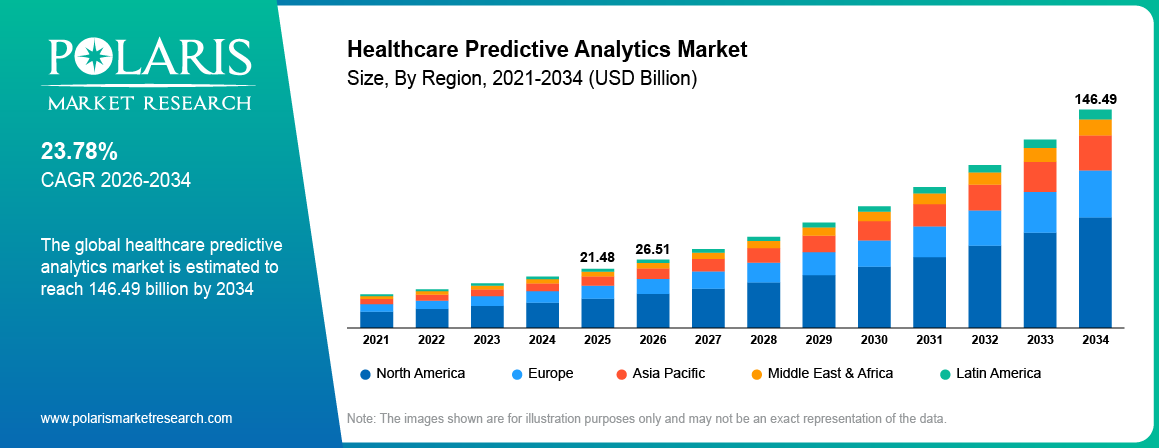
The global healthcare predictive analytics market is estimated around USD 21.48 Billion in 2025,with consistent growth anticipated during 2026–2034. This growth is driven by rising adoption of AI-powered clinical tools and increasing demand for operational efficiency across healthcare systems. The market is projected to grow at a CAGR of 23.78% during the forecast period.
Market Statistics
Key Takeaways
- North America dominated the global market in 2025 with 46.0% share, due to strong healthcare IT infrastructure.
- The software segment dominated the market in 2025 with a revenue share of 65.0% due to rising deployment of AI-powered healthcare analytics platforms.
- The cloud segment accounted for 54.0% share of the market in 2025 due to lower infrastructure costs and easier system integration.
- The financial analytics segment is projected to grow at the fastest CAGR of 23.3% during the forecast period due to rising demand for fraud detection and reimbursement optimization.
- Major companies operating in the market include Veradigm LLC, Epic Systems Corporation, Health Catalyst, Inc., International Business Machines Corporation, Microsoft Corporation, and others.
Industry Dynamics
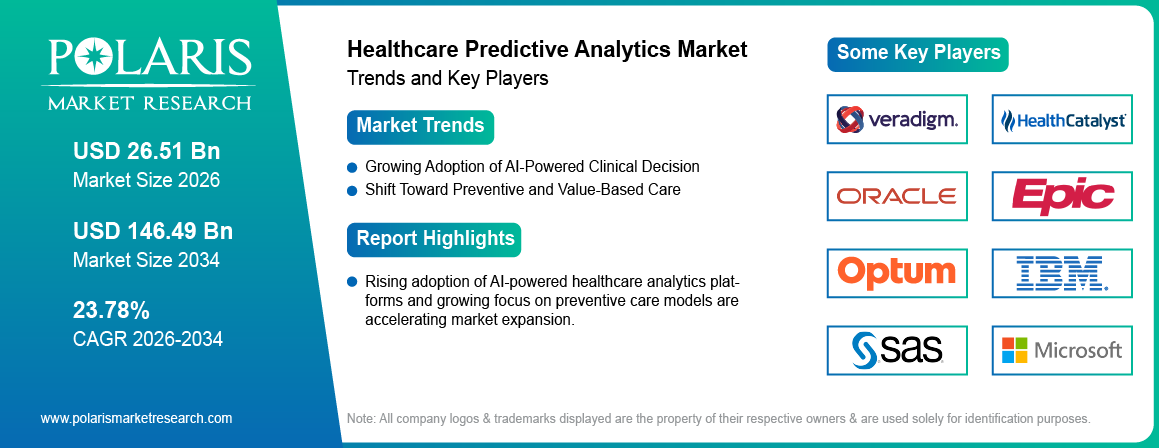
- Growing adoption of AI-powered clinical decision support systems is driving market growth.
- Rising shift toward preventive and value-based healthcare models is increasing adoption.
- Data privacy and cybersecurity concerns remain a major challenge.
- Generative AI integration is creating new market opportunities.
What is Healthcare Predictive Analytics?
Healthcare predictive analytics refers to the use of artificial intelligence, machine learning, statistical models, and advanced analytics tools to predict clinical, operational, and financial outcomes across healthcare systems. These platforms help providers identify disease risks, reduce hospital readmissions, improve patient care planning, and optimize operational workflows.
Data suppliers, providers of cloud computing services, suppliers of analytical tools, providers of healthcare IT integration services, hospitals, insurance companies, pharmaceutical companies, and healthcare service providers make up the healthcare predictive analytics value chain. All of these work together to improve decision-making through data analysis.
Source: Polaris Market Research Analysis
With the development of electronic health records systems, wearables, telehealth applications, and connected medical devices, data is rapidly being generated in the healthcare sector. Predictive analytics solutions are being used by healthcare organizations to use this data to improve efficiency in healthcare.
Drivers & Opportunities
Growing Adoption of AI-Powered Clinical Decision Support Is Driving Market Growth: The Predictive Analytics software has been adopted by the healthcare institutions as a method of enhancing diagnostic skills and determining which patients will face the risk of developing some illness. In September 2025, Epic System Company released an application named Comet which uses artificial intelligence and predictive analysis techniques to determine the risks of various illnesses and hospitalization.
Shift Toward Preventive and Value-Based Care Is Increasing Adoption: Healthcare organizations are shifting towards a preventive strategy that helps them avoid spending money on treatment costs. Predictive analytics contributes significantly to the detection of patients before the disease occurs. The need for population health management is one of the other reasons why predictive healthcare systems have high demand. The Population Health Management Initiative works with 32 health centers in California providing services to 1.1 million residents.
Restraints & Challenges
Data Privacy and Security Concerns Are Limiting Adoption: Predictive analytics solutions in the health care sector require large volumes of patient data to be accessible. The issues of cyber security risks, compliance, and confidentiality arise. Strict health care regulations have stood in the way of implementation at many health care facilities.
Opportunity
Generative AI Integration Is Creating Growth Opportunities: The growing tendency is for health care providers to integrate generative AI into predictive analytics solutions. According to Microsoft, the global adoption rate of generative AI has risen to 16.3% by the end of 2025 from 15.1% during the first half of 2025.Healthcare providers are testing AI assistants to support real-time clinical decision making.
Source: Polaris Market Research Analysis
Segmental Insights
The report offers an exhaustive analysis of the healthcare predictive analytics market by component, deployment, application, and end user is helping identify the most profitable and promising areas.
By Component
-
Software
The software segment dominated the market in 2025 with 65.0% share due to rising demand for predictive healthcare platforms and cloud-based analytics tools. Hospitals are investing in software platforms that integrate with EHR systems and remote patient monitoring tools. Rising demand for scalable analytics platforms is supporting segment growth.
-
Services
The service segment is expected to experience the highest CAGR of 24.2% during the forecast period, owing to growing demand for services related to implementation, consulting, integration, and managed analytics. Hospitals and other healthcare organizations have started outsourcing their analytics deployment services to simplify operations.
By Deployment
-
Cloud
The cloud segment held the largest share of 54.0% in 2025 owing to cheaper deployment costs, scalability, and interoperability. Hospitals have started deploying their predictive analytics on SaaS-based platforms. Cloud deployment also helps healthcare providers improve remote access to patient data.
-
On-Premise
The on-premise segment is projected to grow at the fastest CAGR of 21.9% during the forecast period due to rising demand from government healthcare institutions and large hospitals that require stronger control over patient data. These systems remain important for organizations handling highly sensitive patient information.
By Application
-
Clinical Analytics
The clinical analytics segment dominated the market in 2025 with 40.0% share due to rising demand for disease prediction, patient outcome forecasting, and treatment optimization tools. The healthcare sector is using these platforms for the betterment of diagnosis and treatment.
-
Financial Analytics
The financial analytics segment is expected to witness the highest CAGR of 22.3% throughout the forecast period owing to the rising adoption of these analytics solutions for detecting fraud, optimizing claims and reimbursements. The insurance firms have been making substantial investments in financial analytics.
By End User
-
Hospitals
Hospitals led the global market in 2025 with 44.0% share owing to high numbers of patients and increasing investments in digitizing healthcare services. Predictive tools have been adopted widely by the hospitals for enhancing workflow and care process.
-
Pharmaceutical Companies
The pharmaceutical companies segment is projected to grow at the fastest CAGR of 23.8% during the forecast period due to rising use of predictive analytics in drug discovery and clinical trial optimization. Drug manufacturers are using predictive tools to reduce development timelines and improve trial outcomes.
Source: Polaris Market Research Analysis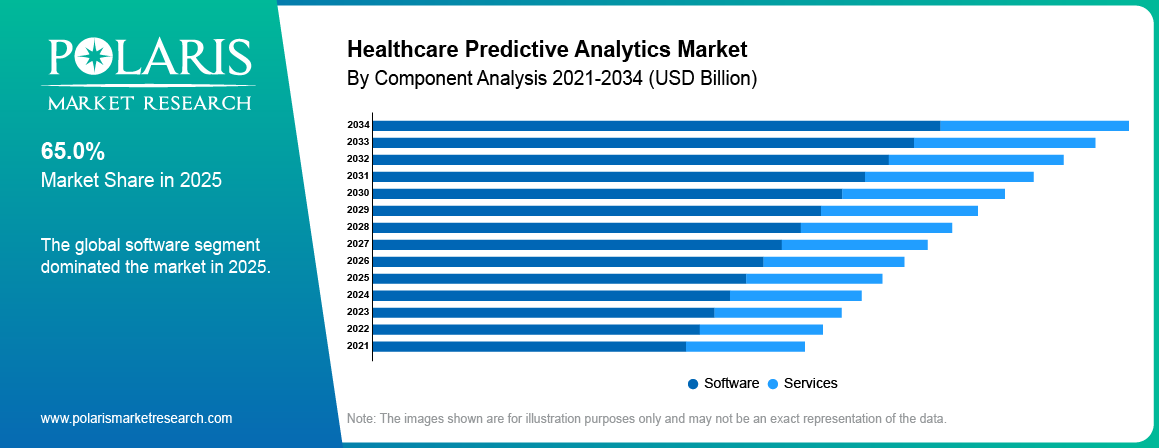
Regional Analysis
North America Healthcare Predictive Analytics Market Overview
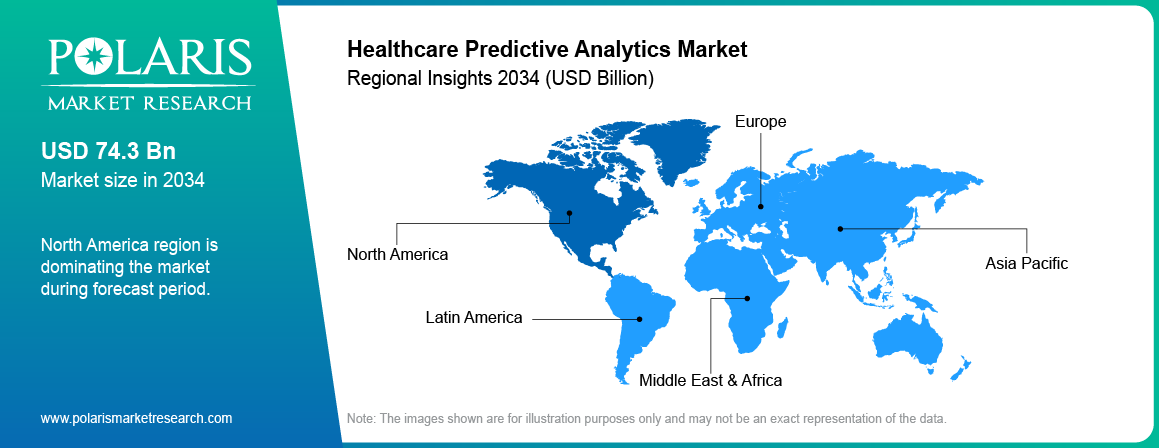
North America dominated the market in 2025 capturing 46.0% share due to advanced healthcare infrastructure, strong adoption of AI technologies, and high healthcare IT spending. For instance, in April 2026, Labcorp launched an AI-powered data platform to enhance predictive analytics for patient identification and clinical trial forecasting. Additionally, the US accounted for the largest share due to rapid digital health transformation and widespread adoption of electronic health records across hospitals.
Asia Pacific Healthcare Predictive Analytics Market Insights
Asia Pacific is projected to grow at the fastest CAGR of 26.2% during the forecast period due to rising healthcare digitization and increasing healthcare expenditure. IBEF reported that India’s healthcare sector is projected to grow from USD 110 billion in 2016 to USD 638 billion by 2025.Moreover, China, India, Japan, and South Korea are investing heavily in AI healthcare technologies.
Europe Healthcare Predictive Analytics Market Insights
Europe held a significant market share of 32.0% due to strong healthcare regulations and rising investments in AI-driven healthcare infrastructure. The European Commission stated that the EU4Health 2024 program is designed to fast-track the use of AI for predictive analytics in clinical settings.Germany, the UK, and France are implementing predictive health platforms in order to improve the efficiency of their healthcare system.
Source: Polaris Market Research Analysis
Competitive Landscape & Key Players
The healthcare predictive analytics healthcare industry is moderately fragmented owing to the existence of major healthcare IT providers and niche analytics providers. Major competitive aspects include analytical precision, interoperability, cost, cloud computing services, and services provided. Companies are focusing on partnerships, acquisitions, AI innovation, and regional expansion strategies.
Among the major companies operating in this industry are Veradigm LLC, Epic Systems Corporation, Health Catalyst, Inc., IBM Corporation, Microsoft Corporation, Oracle Corporation, Optum, Inc., SAS Institute Inc., Verisk Analytics, Inc., Wipro Limited, McKesson Corporation, Cognizant Technology Solutions Corporation, and others.
Premium Insights
AI-Future Outlook
The future of healthcare predictive analytics is being shaped by increasing adoption of advanced AI technologies across clinical and operational workflows. Health care specialists are increasingly relying on predictive analytics models to improve patient outcomes, streamline operations, and facilitate decision making.
Emerging Industry Trends
- Generative AI Model Integration: Healthcare providers are applying generative AI techniques to facilitate the automated generation of medical records, forecast patient behavior effectively, and assist physicians in making decisions.
- Federated Learning Frameworks: Hospitals are adopting federated learning approaches to improve the effectiveness of predictive models and guarantee data privacy.
- Real-Time Predictions: The increasing prevalence of wearables and remote monitoring technologies has increased the demand for real-time predictions.
- Use Cases for Predictive Analytics in Healthcare: Predictive analytics enables healthcare organizations to customize patient care and improve disease management results.
- Autonomy in Hospital Operations: Predictive models are being employed in hospitals to enhance efficiency in staffing, scheduling, and logistics.
Healthcare predictive analytics is evolving from a support technology into a core healthcare intelligence infrastructure across global healthcare systems.
Key Players
- Veradigm LLC
- Epic Systems Corporation
- Health Catalyst, Inc.
- IBM Corporation
- Microsoft Corporation
- Oracle Corporation
- Optum, Inc.
- SAS Institute Inc.
- Verisk Analytics, Inc.
- Wipro Limited
- McKesson Corporation
- Cognizant Technology Solutions Corporation
Industry Developments
- May 2026: Medline Industries launched Mpower to strengthen predictive analytics for healthcare supply chain planning and risk management. [source: medline.com]
- November 2025: Teva Pharmaceutical Industries launched Teva Rise to expand AI-driven predictive analytics in clinical forecasting and patient monitoring. [source: tevausa.com]
Healthcare Predictive Analytics Market Segmentation
By Component Outlook (Revenue, USD Billion, 2021-2034)
- Software
- Services
By Deployment Outlook (Revenue, USD Billion, 2021-2034)
- Cloud
- On-Premise
By Application Outlook (Revenue, USD Billion, 2021-2034)
- Clinical Analytics
- Financial Analytics
- Operational Analytics
- Population Health Management
By End User Outlook (Revenue, USD Billion, 2021-2034)
- Hospitals
- Insurance Providers
- Pharmaceutical Companies
- Healthcare Providers
- Others
By Regional Outlook (Revenue, USD Billion, 2021-2034)
- North America
- US
- Canada
- Europe
- Germany
- France
- UK
- Italy
- Spain
- Netherlands
- Russia
- Rest of Europe
- Asia Pacific
- China
- Japan
- India
- Malaysia
- South Korea
- Indonesia
- Australia
- Vietnam
- Rest of Asia Pacific
- Middle East & Africa
- Saudi Arabia
- UAE
- Israel
- South Africa
- Rest of Middle East & Africa
- Latin America
- Mexico
- Brazil
- Argentina
- Rest of Latin America
Healthcare Predictive Analytics Market Report Scope
| Report Attributes | Details |
| Market Size in 2025 | USD 21.48 Billion |
| Market Size in 2026 | USD 26.51 Billion |
| Revenue Forecast by 2034 | USD 146.49 Billion |
| CAGR | 23.78% from 2026 to 2034 |
| Base Year | 2025 |
| Historical Data | 2021–2024 |
| Forecast Period | 2026–2034 |
| Quantitative Units | Revenue in USD Billion and CAGR from 2026 to 2034 |
| Report Coverage | Revenue Forecast, Competitive Landscape, Growth Factors, and Industry Trends |
| Segments Covered |
|
| Regional Scope |
|
| Competitive Landscape |
|
| Report Format |
|
| Customization | Report customization as per your requirements with respect to countries, regions, and segmentation. |
Source: Polaris Market Research Analysis
Healthcare Predictive Analytics Market FAQ's
The global market size was valued at USD 21.48 Billion in 2025 and is projected to grow to USD 146.49 Billion by 2034.
North America dominated the market in 2025 capturing 46.0% share, due to strong reimbursement reforms.
Major applications include clinical analytics, financial analytics, operational analytics, and population health management.
A few of the key players in the market are Veradigm LLC, Epic Systems Corporation, Health Catalyst, Inc., International Business Machines Corporation, Microsoft Corporation, Oracle Corporation, Optum, Inc., SAS Institute Inc., Verisk Analytics, Inc., Wipro Limited, McKesson Corporation, Cognizant Technology Solutions Corporation, and others.
Growth is driven by rising adoption of AI-powered healthcare systems and preventive care models.
These are the primary applications that can be found in hospitals, health insurance companies, and drug manufacturers.
The market is expected to witness strong growth due to AI integration and increasing healthcare digital transformation.
Download Sample Report of Healthcare Predictive Analytics Market
Please fill out the form to request a customized copy of the research report.


