
High and Ultra-high-field Nuclear Magnetic Resonance Spectroscopy Market Report, 2025-2034
REPORT DETAILS
Market Statistics
What is the high and ultra-high-field nuclear magnetic resonance spectroscopy market size?
The global high and ultra-high-field nuclear magnetic resonance spectroscopy market size was valued at USD 535.77 million in 2024, growing at a CAGR of 5.5% from 2025 to 2034. Expanding pharmaceutical and biotechnology r&d pipelines along with advancements in superconducting magnet technologies is propelling the market growth.
Key Insights
- High-field NMR spectroscopy accounted for the largest share in 2024 owing to its high sensitivity and resolution in the determination of molecular structure, analysis of protein-ligand interaction, and research on metabolomics.
- Biotechnology and biopharmaceutical segment anticipated to grow rapidly, due to increasing demand for biomolecular characterization and quality assurance in the development of biologics.
- North America dominated the global market in 2024 due to strong academic research output, consistent government funding, and well-established life sciences infrastructure.
- The U.S. led the regional market due to a strong base of pharmaceutical and biotechnology companies investing in high-performance analytical instruments for drug discovery and structural biology.
- Asia Pacific projected to grow at a fast pace, supported by expanding biotechnology, pharmaceutical, and academic research sectors across China, Japan, India, and South Korea.
- South Korea dominated the market in Asia Pacific, propelled by increasing collaboration between universities and research institutions and multinational companies in the area of molecular diagnostics and bio-innovation.
Industry Dynamics
- Rising pharmaceutical and biotechnology R&D pipelines accelerate the demand for advanced NMR spectroscopy systems.
- Continuous developments in superconducting magnet technologies improve field strength and system stability, enhancing analytical precision.
- High capital and operational costs continue to restrain its wider adoption by smaller research organizations and academic institutions.
- Cryogen-free superconducting magnet systems are emerging, offering future opportunities for transformative reductions in operational complexity and long-term maintenance costs.
Market Statistics
- 2024 Market Size: USD 535.77 Million
- 2034 Projected Market Size: USD 913.00 Million
- CAGR (2025–2034): 5.5%
- North America: Largest Market Share
What is high and ultra-high-field nuclear magnetic resonance spectroscopy market?
The high and ultra-high-field NMR spectroscopy market consists of sophisticated analysis instruments that are useful in determining the structure, dynamics, and interactions of molecules at the atomic level. These systems are vital for research in drug discovery, materials science, and biochemistry. Continuous technological innovation in superconducting magnets, automation, and data analysis software enhances the accuracy, speed, and operational efficiency of the devices.
Increasing academic and institutional research investments are accelerating the adoption of high and ultra-high-field NMR systems. These tools are crucial in structural elucidation, advanced material characterization, and emerging quantum computing applications. Rising support from continual university, national laboratory, and research foundation funding is driving the growth of the market.
Source: Polaris Market Research Analysis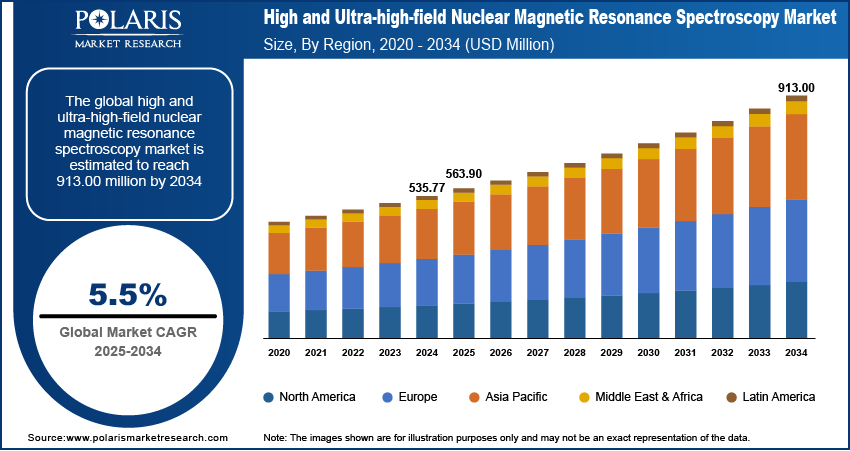
The growing demand for structural biology and biomolecular studies is enhancing the installation of high-resolution NMR systems for analyzing protein folding, drug–target interaction studies, and metabolomics profiling. In April 2025, Thermo Fisher Scientific launched the Krios 5 Cryo-TEM, the next-generation cryo-electron microscope that provides atomic-resolution imaging with up to 25% higher throughput and AI-enabled automation, further strengthening molecular-level research and driving market growth.
Drivers & Opportunities
Which are the factors driving high and ultra-high-field nuclear magnetic resonance spectroscopy market growth?
Expanding Pharmaceutical and Biotechnology R&D Pipelines: The rising number of pharmaceutical and biotechnology drug discovery and development programs increases the demand for NMR spectroscopy in the identification of compounds, quality control, and impurity profiling. According the Spanish biotech association, AseBio, the investment by the biotech firms in R&D reached USD 1,384.56 million in 2023, an increase of 5.2% compared to the previous year. These continuously expanding research programs are further driving market growth.
Advancements in Superconducting Magnet Technologies: Ongoing progress in superconducting magnet design is enabling higher magnetic field strengths, 900 MHz and above, offering enhanced spectral resolution and analytical precision. In September 2025, a world-record steady magnetic field of 35.1 tesla was achieved by researchers at the Institute of Plasma Physics, Chinese Academy of Sciences, using a fully superconducting magnet, marking a milestone in technological evolution that propels the growth of the market.
Source: Polaris Market Research Analysis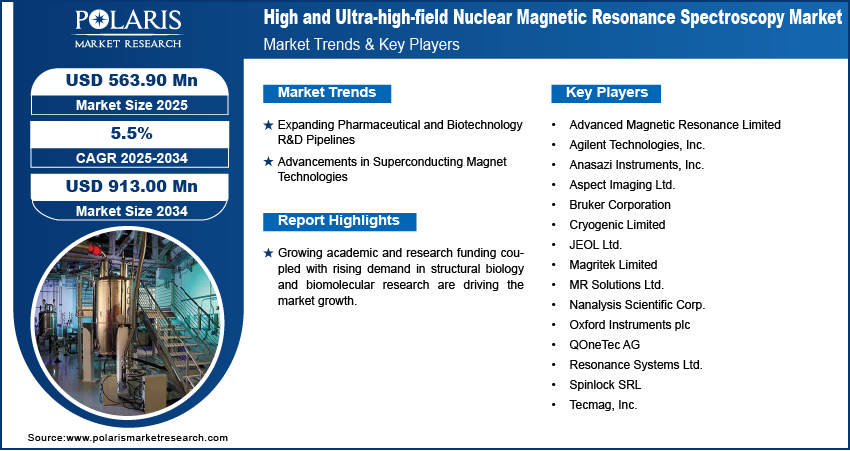
Segmental Insights
By Frequency Type
Based on the frequency type, the market is segmented into low-field NMR spectroscopy (300-600 MHz) and high-field NMR spectroscopy (600-1,200 MHz). High-field NMR spectroscopy holds a major share owing to better sensitivity and resolution for determining molecular structure, protein-ligand interaction studies, and research concerning metabolomics.
Low-field NMR systems are expected to see the fastest growth, owing to its adoption for regular quality control and material characterization at industrial and academic laboratories due to its cost-effectiveness and simplicity in operation.
By Application
Based on application the market is segmented into, into pharmaceutical applications, food and beverage testing, biotechnology and biopharmaceutical applications, environmental testing, academic research, and other applications. Pharmaceutical applications hold the largest share in the market owing to the vast usage of NMR for drug discovery services, validation of compounds, and molecular analysis.
Biotechnology and biopharmaceutical applications are growing at a rapid rate, attributed to the increasing need for biomolecular characterization and quality assurance in the development of biologics.
By End-use
Based on end-use the market is divided into academic institutions, pharmaceutical and biotech companies, agriculture and food industries, chemical industries, and others. Academic institutions held dominating share, owing to consistent investments in advanced analytical research and scientific innovation.
The pharmaceutical and biotech is anticipated to grow at a fast pace due to increasing incorporation high and ultra-high-field NMR systems into its drug discovery and formulation studies.
Source: Polaris Market Research Analysis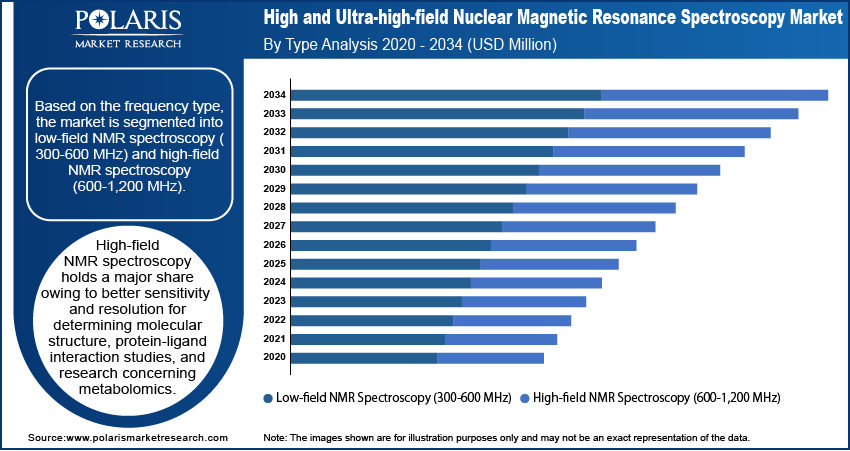
Regional Analysis
North America accounted for a major share of the high and ultra-high-field NMR spectroscopy market due to strong academic research, government funding, and advanced life sciences infrastructure. The expanding programs for metabolomics, molecular characterization, and materials science further create sustaining demand for high-resolution analytical tools. Additionally, the rapid adoption of AI-based data analysis platforms across laboratories further improves precision and workflows.
The U.S. High and Ultra-high-field Nuclear Magnetic Resonance Spectroscopy Market Overview
The U.S. dominated the regional market, due to its strong base of pharmaceutical and biotechnology companies that are continually investing in advanced analytical instruments for drug discovery and structural biology. Ongoing investments into R&D further improve access to high-value technologies. In October 2025, GSK plc announced an investment of USD 30 billion in the U.S. within five years to expand the company's R&D and manufacturing capacity. Therefore, further boosting the demand for next-generation NMR systems.
Asia Pacific High and Ultra-high-field Nuclear Magnetic Resonance Spectroscopy Market Insights
Asia Pacific projected to register strong growth, driven by the expansion of the biotechnology, pharmaceutical, and academic research sectors in China, Japan, India, and South Korea. Governments are investing heavily in scientific infrastructure to boost regional capabilities in molecular biology and materials characterization.
South Korea High and Ultra-high-field Nuclear Magnetic Resonance Spectroscopy Market Analysis
South Korea led the market share in Asia Pacific, fueled by increasing collaboration between s universities, research institutes, and multinational firms. In August 2024, Bruker Corporation installed a 1.2 GHz Avance NMR spectrometer at the Korea Basic Science Institute. It was the first installation of this kind in South Korea, and in the Asia-Pacific region.
Europe High and Ultra-high-field Nuclear Magnetic Resonance Spectroscopy Market Assessment
Europe accounted for significant share in the high and ultra-high-field nuclear magnetic resonance spectroscopy market, owing to strong financing of research and excellent scientific infrastructure. The Horizon Europe framework advocates high-field NMR applications in life sciences and materials research. The establishment of pharmaceutical R&D clusters in Germany, Switzerland, and the UK is expanding the use of instruments for quality control and molecular analysis. In June 2025, the European Commission initiated a new policy line within the proposed EU Biotech Act to attract investments in R&D worldwide, securing Europe's position as a technological leader.
Source: Polaris Market Research Analysis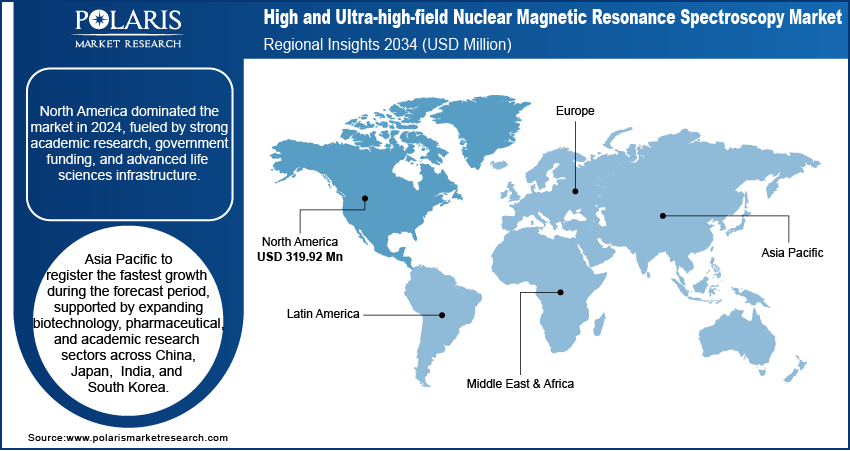
Key Players & Competitive Analysis
The global high and ultra-high-field NMR spectroscopy market is relatively consolidated, with various leading companies emphasizing advanced superconducting magnet technologies, cryogen-free systems, and enhanced spectral resolution capabilities. Market participants invest in compact benchtop instruments, AI-enabled data analysis, and multi-nuclear detection platforms to extend application areas in pharmaceuticals, materials science, and biochemistry.
Who are the major players in high and ultra-high-field NMR spectroscopy market?
Key companies operating in the global high and ultra-high-field NMR spectroscopy market include Advanced Magnetic Resonance Limited, Agilent Technologies, Inc., Anasazi Instruments, Inc., Aspect Imaging Ltd., Bruker Corporation, Cryogenic Limited, JEOL Ltd., Magritek Limited, MR Solutions Ltd., Nanalysis Scientific Corp., Oxford Instruments plc, QOneTec AG, Resonance Systems Ltd., Spinlock SRL, and Tecmag, Inc.
Key Players
- Advanced Magnetic Resonance Limited
- Agilent Technologies, Inc.
- Anasazi Instruments, Inc.
- Aspect Imaging Ltd.
- Bruker Corporation
- Cryogenic Limited
- JEOL Ltd.
- Magritek Limited
- MR Solutions Ltd.
- Nanalysis Scientific Corp.
- Oxford Instruments plc
- QOneTec AG
- Resonance Systems Ltd.
- Spinlock SRL
- Tecmag, Inc.
High and Ultra-high-field Nuclear Magnetic Resonance Spectroscopy Industry Developments
In April 2024, Bruker Corporation introduced advanced magnet technology and analytical solutions to advance NMR adoption in academic, clinical, and biopharma research. The company launched the Ascend Evo 600, a compact 600 MHz NMR magnet featuring a 1-year liquid helium hold time for fewer refills and less operational cost.
In April 2023, JEOL Ltd., in cooperation with Japan Superconductor Technology, Inc., launched the Cryogen Reclamation System as an NMR accessory that reduces the evaporation of liquid helium in superconducting magnets.
High and Ultra-high-field Nuclear Magnetic Resonance Spectroscopy Market Segmentation
By Type Outlook (Revenue, USD Million, 2020–2034)
- Low-field NMR Spectroscopy (300-600 MHz)
- High-field NMR Spectroscopy (600-1,200 MHz)
By Application Outlook (Revenue, USD Million, 2020–2034)
- Pharmaceutical Applications
- Food & Beverage Testing
- Biotechnology & Biopharmaceutical Applications
- Environmental Testing, Academic Research
- Other Applications
By End-Use Outlook (Revenue, USD Million, 2020–2034)
- Academic
- Pharmaceutical & Biotech Companies
- Agriculture and Food
- Chemical Industries
- Others
By Regional Outlook (Revenue, USD Million, 2020–2034)
- North America
- U.S.
- Canada
- Europe
- Germany
- France
- UK
- Italy
- Spain
- Netherlands
- Russia
- Rest of Europe
- Asia Pacific
- China
- Japan
- India
- Malaysia
- South Korea
- Indonesia
- Australia
- Vietnam
- Rest of Asia Pacific
- Middle East & Africa
- Saudi Arabia
- UAE
- Israel
- South Africa
- Rest of Middle East & Africa
- Latin America
- Mexico
- Brazil
- Argentina
- Rest of Latin America
High and Ultra-high-field Nuclear Magnetic Resonance Spectroscopy Market Report Scope
| Report Attributes | Details |
| Market Size in 2024 | USD 535.77 Million |
| Market Size in 2025 | USD 563.90 Million |
| Revenue Forecast by 2034 | USD 913.00 Million |
| CAGR | 5.5% from 2025 to 2034 |
| Base Year | 2024 |
| Historical Data | 2020–2023 |
| Forecast Period | 2025–2034 |
| Quantitative Units | Revenue in USD Million, Volume in Kilotons and CAGR from 2025 to 2034 |
| Report Coverage | Revenue Forecast, Competitive Landscape, Growth Factors, and Industry Trends |
| Segments Covered |
|
| Regional Scope |
|
| Competitive Landscape |
|
| Report Format |
|
| Customization | Report customization as per your requirements with respect to countries, regions, and segmentation. |
Source: Polaris Market Research Analysis
High and Ultra-high-field Nuclear Magnetic Resonance Spectroscopy Market FAQ's
The global market size was valued at USD 535.77 million in 2024 and is projected to grow to USD 913.00 million by 2034.
The global market is projected to register a CAGR of 5.5% during the forecast period.
North America dominated the market in 2024.
A few of the key players in the market are Advanced Magnetic Resonance Limited, Agilent Technologies, Inc., Anasazi Instruments, Inc., Aspect Imaging Ltd., Bruker Corporation, Cryogenic Limited, JEOL Ltd., Magritek Limited, MR Solutions Ltd., Nanalysis Scientific Corp., Oxford Instruments plc, QOneTec AG, Resonance Systems Ltd., Spinlock SRL, and Tecmag, Inc.
The high-field NMR spectroscopy segment dominated the market revenue share in 2024.
The biotechnology and biopharmaceutical segment is projected to witness the fastest growth during the forecast period.
Download Sample Report of High and Ultra-high-field Nuclear Magnetic Resonance Spectroscopy Market
Please fill out the form to request a customized copy of the research report.


