
Juice Concentrates Market Share, Size, Trends, Industry Analysis Report, 2026 - 2034
REPORT DETAILS
Juice Concentrates Market Summary
The global juice concentrates market was valued at USD 68.20 billion in 2025 and is expected to grow at a CAGR of 5.83% during the forecast period. Key factors driving demand include rising consumption of healthier products, increasing health consciousness, and cost-effective and convenient alternative for fresh drinks.
Market Statistics
Juice Concentrates Market Key Takeaways
- North America dominated the global market with a share of 34.0% in 2025. This is due to its refined food and beverage processing sector and rise in investments.
- The Asia Pacific market is expected to witness highest CAGR of 8.39% during the forecast period. This is due to the rise in demand for natural, healthy, and nutritious beverages.
- The fruit segment dominated the market with 78.0% share in 2025. This is due to their use in a variety of industries, such as bakery & confectionery, food, beverage, and alcohol.
- In 2025, the beverage segment dominated the market with 48.0% share. This is due to the wide use in the beverage industry for the production of both non-alcoholic as well as alcoholic beverages.
Note: Figures and projections outlined in this report are the result of Polaris Market Research’s proprietary analytical processes, grounded in the latest available datasets and market observations.
What are Juice Concentrates?
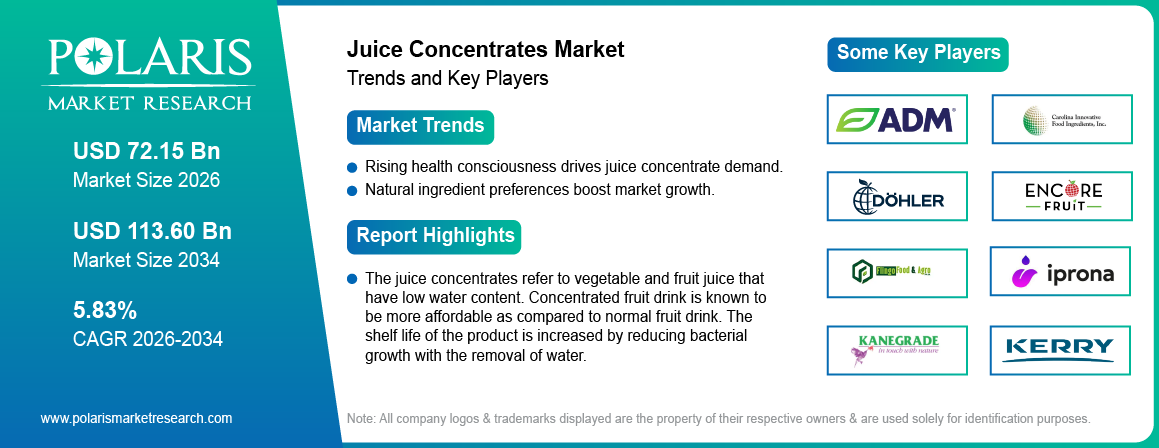
The juice concentrates refer to vegetable and fruit juice that have low water content. Concentrated fruit drink is known to be more affordable as compared to normal fruit drink. The shelf life of the product is increased by reducing bacterial growth with the removal of water. The whole fruit is thoroughly rinsed, washed, squashed, or mixed to make pulp. The water is generally extracted or evaporated, which is beneficial as the pulp is rich in nutrients. As an alternative to vegetables and fruits, juice concentrates are utilized in a variety of food industry applications such as confectionery, sauces, bread items, and soups.
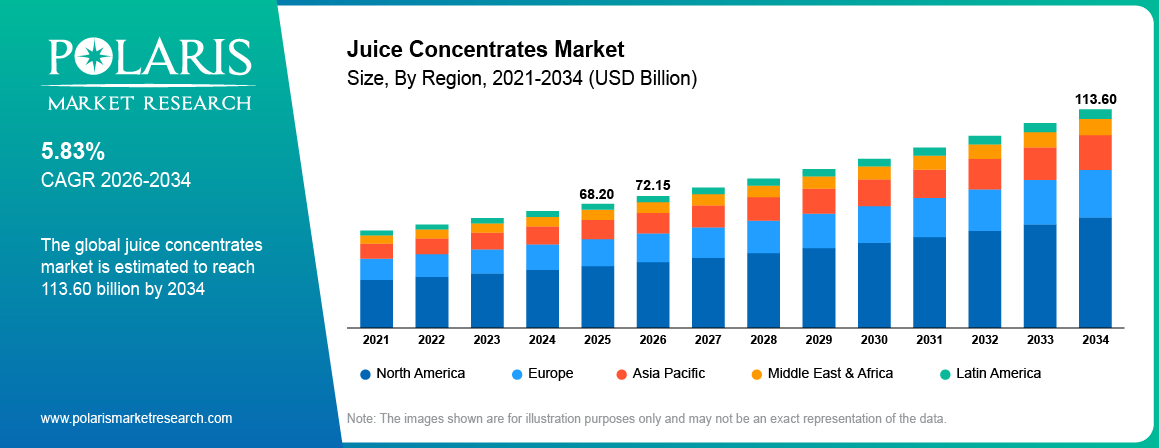
Source: Polaris Market Research Analysis
To Understand More About this Research: Download Sample Report
The global juice concentrates market is driven by the growing demand for healthy and convenient foods. They are a cost-effective and convenient alternative for fresh drinks in a variety of applications. The evolving lifestyle, growing disposable incomes, and urbanization are major factors that are responsible for the overall growing demand for fruit concentrates across the globe.
Fruit concentrates are primarily used in the beverage industry for making fruit soft drinks, nectars, and alcoholic beverages. The fruit concentrates are also used in bakery, confectionery, and dairy industries as they provide flavor, sweetness along with nutritional value to the product.
There has been an increase in demand for these drinks during the pandemic owing to greater demand for convenience food products. However, the supply and production of such fruit drink concentrate have suffered a decline owing to disruptions in the supply chain, halting of manufacturing activities, and limited availability of raw materials.
Closure of restaurants and food outlets due to lockdown, government regulations on movement and lockdowns, and lack of labor have affected the growth of the industry. E-commerce platforms have gained popularity for the sale of beverages, soups & sauces, bakery & confectionery, especially during the pandemic.
Online platforms provide a plethora of options to consumers on a single portal, offering convenience and saving time & effort. Rigorous online marketing, along with attractive offers and discounts provided by companies, has increased the popularity of e-commerce over the years. The online distribution channel is well established in regions such as North America and Europe due to higher internet proliferation and greater adoption of mobile devices.
Juice Concentrates vs Fresh Juice
Juice concentrates offer various advantages in storage stability, transportation efficiency, and cost-effectiveness. These benefits make them highly suitable for large-scale food and beverage manufacturing. In contrast, fresh juice is valued for its natural taste, minimal processing, and premium consumer appeal. It is particularly used in retail and foodservice applications. Both products serve distinct market needs. They play important roles across the global beverage and food processing industries.
| Parameter | Juice Concentrates | Fresh Juice |
| Shelf Life | Long shelf life due to water removal and easier preservation, making it suitable for storage and distribution. | Short shelf life and requires immediate consumption or refrigeration to maintain quality. |
| Transportation Efficiency | Reduced volume and weight lower transportation and storage costs, improving supply chain efficiency. | Higher transportation costs due to bulkier volume, weight, and refrigeration requirements. |
| Flavor Concentration | Contains concentrated flavors and can be reconstituted to desired strength; flavor profiles may vary depending on processing methods. | Offers natural taste and aroma directly from freshly extracted fruits with minimal processing. |
| Nutritional Retention | Retains most nutrients, although some heat-sensitive vitamins and volatile compounds may be partially reduced during concentration. | Generally preserves the original nutritional profile, including naturally occurring vitamins and antioxidants. |
| Cost | More cost-effective for manufacturers due to lower storage, transportation, and handling expenses. | Typically more expensive because of perishability, cold-chain logistics, and shorter distribution windows. |
| Industrial Applications | Widely used in beverage manufacturing, dairy products, bakery items, confectionery, sauces, infant nutrition, and foodservice industries. | Primarily consumed as a ready-to-drink beverage in households, restaurants, cafés, and premium juice segments. |
Source: Polaris Market Research Analysis
Source: Polaris Market Research Analysis
Know more about this report: Download Sample Report
Market Dynamics
Growth Drivers
The increasing health consciousness, especially in most developed and developing economies, is expected to act as one of the major factors driving the growth of the juice concentrates market. The growing adoption of vegetable & fruit juices as an alternative to aerated drinks by health-conscious consumers and the growing popularity of convenience food & beverage products is expected to accelerate the overall industry growth. The growing demand and usage of fruit juice concentrate as a substitute for sugar in the bakery sector also boost the industry growth. The growing health concerns among consumers and the demand for products made from natural & healthy ingredients will boost the industry's growth.
Moreover, the expansion of the bakery industry and confectionery, surge in disposable income, consumer preference towards convenience foods & ready meals and growing disposable income in developing economies will positively affect the juice concentrates market. Furthermore, cheaper and more convenient alternative in various applications extends profitable opportunities to the industry players over the forecast period.
Challenges in Juice Concentrate Market
The juice concentrate market faces several challenges. They can adversely impact production efficiency, profitability, and consumer demand. A few key challenges are listed below:
- Fluctuating Raw Material Prices: There are variations in fruit harvest yields caused by climate change, adverse weather conditions, pests, and diseases. These variations lead to fluctuations in raw material costs. It negatively affects manufacturers' margins and pricing strategies.
- Sugar Consumption Concerns: Consumer awareness is rising regarding sugar intake and its health-related concerns, including obesity and diabetes. It has increased scrutiny of fruit-based beverages. This factor is hindering the demand for certain juice concentrate products.
- Competition from Fresh Juice Products: Consumer preference for minimally processed and fresh beverages is rising. It has intensified competition from fresh juices, cold-pressed juices, and natural beverage alternatives. This is challenging the growth of conventional juice concentrate products.
- Seasonal Dependence of Fruit Production: Juice concentrate manufacturers are highly dependent on agricultural output. This makes them vulnerable to seasonal variations and supply shortages. It may adversely influence production consistency.
AI Impact on Juice Concentrates Market
- AI algorithms monitor real-time extraction processes and optimize them for the greatest yield with the same flavor, color, and nutritional profile each time.
- AI is expected to forecast the yields of fruit crops and potential breakdowns in the supply chain, providing the ability to source more efficiently and reduce waste and price fluctuation of raw agriculture.
- AI is expacted to analyze consumer taste behavior and industry trend data points in order to prototype and predict successful new flavor profiles much faster than traditional PL (private label) innovation cycles.
- AI will maximize energy and water usage during concentration and may provide a means of directly reducing waste, driving the industry's sustainability strategy and transition.
Report Segmentation
The market is primarily segmented based on type, application, and region.
| By Type | By Application | By Region |
|
|
|
Source: Polaris Market Research Analysis
Know more about this report: Download Sample Report
Type Analysis
The fruit segment dominated the market with 78.0% share in 2025. The fruit drink concentrates are used in a variety of industries, such as bakery & confectionery, food, beverage, and alcohol. Fruit drink concentrates, such as pear concentrates and apple concentrates, are used as sugar substitutes in the confectionery and bakery industry in the production of cookies, cakes, and pastries.
Fruit juice concentrates witness increasing demand worldwide, as there is a growing awareness regarding living a healthy life and consuming healthy products among consumers in both developing and developed economies. Fruits such as apples, oranges, and pineapple have significant demand owing to their health benefits. Fruit drinks, especially red grapes, are also used in the wine industry, which is one of the biggest opportunities to grow for the juice concentration market.
The major wine-producing countries, such as Australia, which produces wine on a huge scale, have a good market opportunity for the growth of the juice concentration market. Furthermore, the fruit drink concentrate also serves as an appropriate and convenient substitute for carbonated soft drinks and beverages.
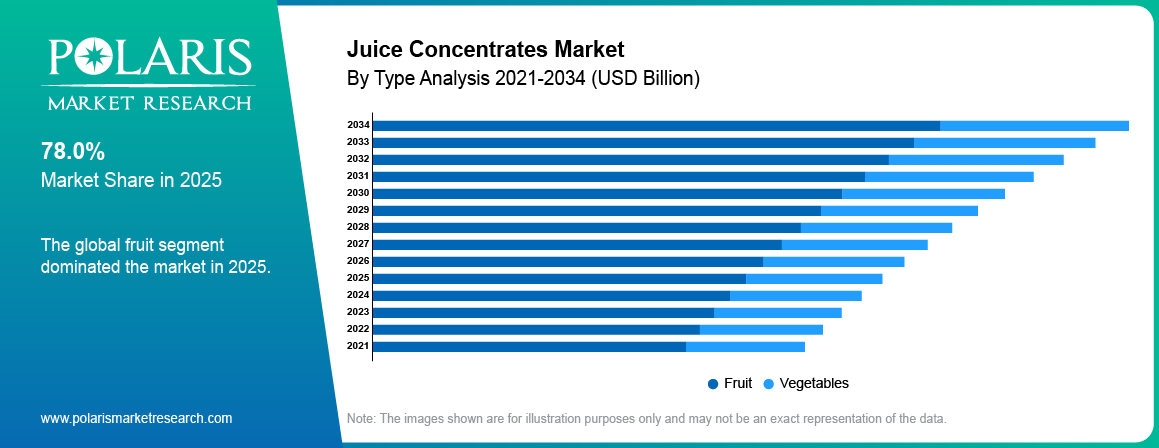
Source: Polaris Market Research Analysis
Application Insights
The beverage segment dominated the market with 48.0% share in 2025. Fruits and vegetable concentrates are widely used in the beverage industry for the production of both non-alcoholic as well as alcoholic beverages. These concentrates of fruit and vegetables are also used in various beverages such as juices, tea, energy drinks, and smoothies and are available in different forms such as crystallized, frozen, or liquid.
The fruits such as apples and grapes are common fruits used to produce alcoholic beverages. Moreover, exotic superfruits, such as passion fruits and juniper berries, are also utilized to make alcoholic beverages. The growing adaption of concentrated juices in the alcoholic industry is fueling the overall growth of the industry.
Regional Analysis
North America Juice Concentrates Market Insights
North America dominated the global market with 34.0% share in 2025 due to its refined food and beverage processing sector. This region has a large number of global manufacturers who focus on the investments for advanced technologies for concentration and vast production facilities, which has developed over the years. This fully developed industry allow scaling and rotation of economy to ensure high volume, and cost-efficient production and supply that aligns with the rise in demand by international as well as domestic consumers. Moreover, This demand is further boosted by the retail and fast food service sector, where the fruit concentrates are crucial for efficiency and consistency for the production of smoothies, bakery fillings, juices, and others. The manufacturers are repidly adopting these innovation in health trends, such as by development of concentratres which contain less sugar, added finctional benefits from superfruits to ensure their products remain relevent with the change in consumer landscape.
Asia Pacific Juice Concentrates Market Assessment
Asia Pacific market is expected to witness fastest growth at a CAGR of 8.39% during the forecast period. The demand for natural, healthy, and nutritious beverages is the driver of the growth of the market. The increasing disposable income of consumers and consumption of fast food drive the growth of this segment. The high penetration of quick-service restaurants and greater consumption of soft drinks has further increased the demand for the juice concentrates industry in this region. Moreover, superior demand for healthy and organic food products has encouraged market players to develop new products catering to the local taste of consumers.
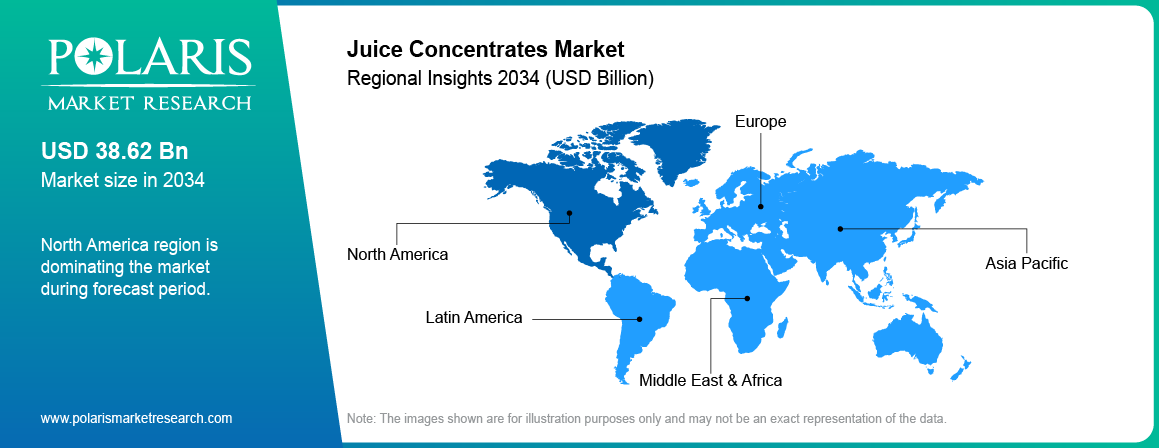
Source: Polaris Market Research Analysis
Competitive Insight
In the juice concentrates market, competition is intense. The major competitors such as Archer Daniels Midland Company, Döhler GmbH, and Kerry Group PLC are investing in the manufacturing capacity and sustainable value chain to ensure they obtain market share in the region. The strategies of these vendors include product offerings/mapping that solicit opportunities to expand into different business segments in the health and wellness categories. Furthermore, competitive intelligence and strategy have to be utilized as small & medium businesses are innovating through flavor using exotic and organic formulas to meet niche demand. Industry leaders engage in mergers, acquisitions, and joint ventures to increase their buying power, find new technologies, and limit supply chain risk. This indicates a concerted effort for strategic revenue generation and to strengthen a partner & customer ecosystem in both advanced and developing markets.
Some of the major players operating in the global market include Archer Daniels Midland Company, BMT Weiser LLC, Carolina Innovative Food Ingredients, Döhler GmbH, Encore Fruit Marketing, Inc, Flingo Foods and Agro P. Ltd, Iprona Spa, Kanegrade Ltd, Moleva, S.A, Kerry Group PLC, Milne Fruit Products, Muhtaroglu Group, Northwest Naturals, Sleaford Quality Foods, Tricom Fruit Products Limited, and Ventura Coastal, LLC.
These players are expanding their presence across various geographies and entering new markets in developing regions to expand their customer base and strengthen presence in the market. The companies are also introducing new innovative products in the market to cater to the growing consumer demands.
Industry Developments
- May 2026: AUSTRIA JUICE GmbH introduced its fermentation technology. The technology is designed to reduce sugar content in 100% fruit juice. At PLMA in Amsterdam in May 2026, the company also introduced apple juice concentrate as its flagship reduced-sugar product. (Source: PRNewswire)
Juice Concentrates Market Report Scope
| Report Attributes | Details |
| Market size value in 2025 | USD 68.20 billion |
| Market size value in 2026 | USD 72.15 billion |
| Revenue forecast in 2034 | USD 113.60 billion |
| CAGR | 5.83% from 2026 - 2034 |
| Base year | 2025 |
| Historical data | 2021 - 2024 |
| Forecast period | 2026 - 2034 |
| Quantitative units | Revenue in USD billion and CAGR from 2026 to 2034 |
| Segments covered | By Type, By Application, By Region |
| Regional scope | North America, Europe, Asia Pacific, Latin America; Middle East & Africa |
| Key companies | Archer Daniels Midland Company, BMT Weiser LLC, Carolina Innovative Food Ingredients, Döhler GmbH, Encore Fruit Marketing, Inc, Flingo Foods and Agro P. Ltd, Iprona Spa, Kanegrade Ltd, Moleva, S.A, Kerry Group PLC, Milne Fruit Products, Muhtaroglu Group, Northwest Naturals, Sleaford Quality Foods, Tricom Fruit Products Limited, and Ventura Coastal, LLC |
Source: Polaris Market Research Analysis
Juice Concentrates Market FAQ's
• The global market size was valued at USD 68.20 billion in 2025 and is projected to grow to USD 113.60 billion by 2034.
• The global market is projected to register a CAGR of 5.83% during the forecast period.
• North America dominated the market with 34.0% share in 2025.
• A few of the key players in the market are Archer Daniels Midland Company, BMT Weiser LLC, Carolina Innovative Food Ingredients, Döhler GmbH, Encore Fruit Marketing, Inc, Flingo Foods and Agro P. Ltd, Iprona Spa, Kanegrade Ltd, Moleva, S.A, Kerry Group PLC, Milne Fruit Products, Muhtaroglu Group, Northwest Naturals, Sleaford Quality Foods, Tricom Fruit Products Limited, and Ventura Coastal, LLC.
• The fruit segment dominated the market with 78.0% share in 2025.
• The beverage segment dominated the market with 48.0% share in 2025.
Download Sample Report of Juice Concentrates Market
Please fill out the form to request a customized copy of the research report.


