
Mechanical Vapor Recompression (MVR) Market Size, Share, and Forecast 2027 to 2035
REPORT DETAILS
Mechanical Vapor Recompression (MVR) Market Summary
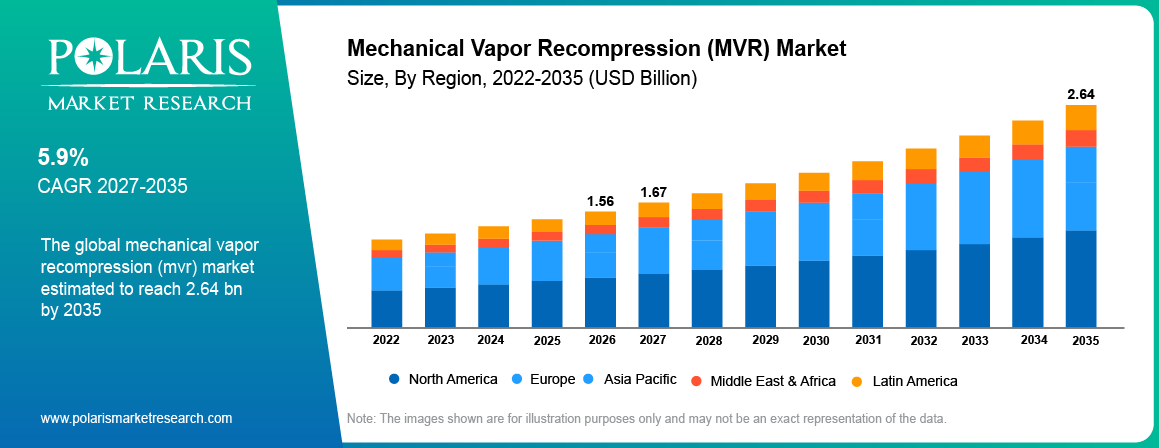
According to Polaris Market Research analysis, the mechanical vapor recompression (MVR) market was valued at USD 1.56 Billion in 2026. It is projected to reach USD 2.64 Billion by 2035, growing at a CAGR of 5.9% from 2027 to 2035. Demand comes from water treatment plants, food processors, chemical makers, and mining sites that need to boil off water at low energy cost. Centrifugal Blowers and Fans hold the largest compressor type share, while Multistage Turbo Compressors expand quickest. The market tracks revenue from compressors, blowers, and fans that lift the pressure of process vapor so it can heat the same process again, and leaves out evaporator bodies. Asia Pacific is both the leading market and the fastest growing region.
Market Statistics
Key Takeaways
- Regional revenue in 2027 is led by Asia Pacific at 38.6%, since China runs the largest base of chemical, food, and wastewater plants that boil off water at scale.
- Asia Pacific also sets the pace in growth, compounding at 7.4% through 2035 as India and China tighten wastewater rules and add new plants.
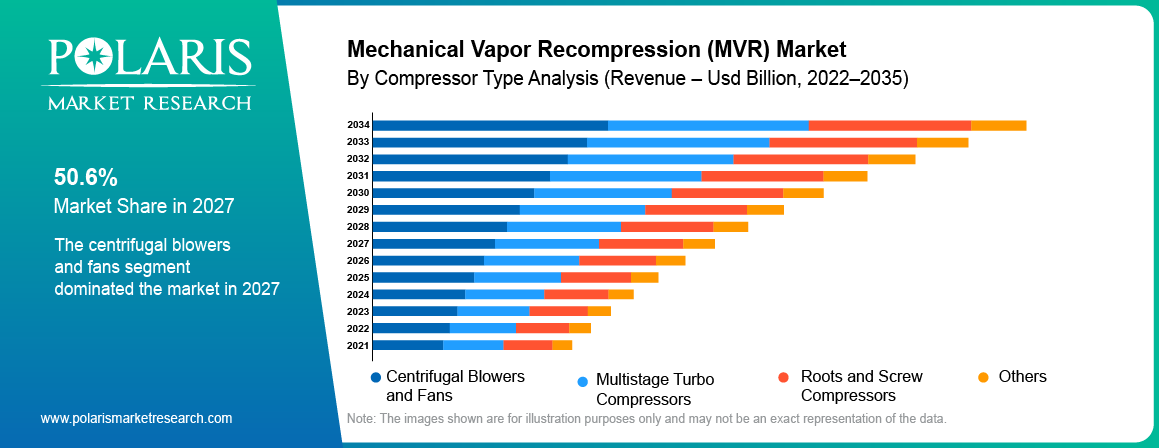
- Compressor type revenue in 2027 is led by Centrifugal Blowers and Fans with 50.6%, owing to their low cost per unit of vapor moved in large evaporators.
- Multistage Turbo Compressors show the steepest compressor CAGR, 9.6% to 2035, as plant owners seek more temperature lift and heat pump style steam.
- In the capacity split, Medium Capacity Systems earn the most in 2027 with USD 709.5 Million, while Large Capacity Systems advance quickest at 9.0% annually.
- Zero Liquid Discharge and Crystallization takes 30.6% of 2027 application value and rises 8.5% a year, since salty waste streams must be dried to a solid.
- The biggest end use slice of 2027 revenue belongs to Water and Wastewater Treatment at 26.8%, and the same industry also advances 8.0% a year, the best pace among end uses.
- India leads country growth at 10.8% a year, as new effluent rules and factory clusters raise the number of evaporation lines from a small base.
Note: Figures and projections outlined in this report are the result of Polaris Market Research’s proprietary analytical processes, grounded in the latest available datasets and market observations.
Mechanical Vapor Recompression (MVR) Market Definition
The mechanical vapor recompression (MVR) market covers compressors, blowers, and fans that compress the steam given off by a boiling liquid and send it back as the heat source for the same process. It excludes the evaporator bodies, heat exchangers, pumps, and crystallizers that are fitted around the machine.
Public figures for vapor compression vary by a wide margin. One school of analysis tallies the compressor alone, another folds in the entire evaporator, and a third includes the full effluent plant. Polaris prices the vapor machine with its motor and drive, so the total follows plant spending on that single item.
Neighboring reports take the wider view. Whole evaporation lines sit inside the industrial evaporator market, while sites that release no liquid at all belong to the zero liquid discharge system market. Any machine whose chief task is lifting vapor pressure for reuse is counted in this study.
The OST Eastern Switzerland University of Applied Sciences compares three steam compressor families. MVR blowers and turbo fans work on steam from 105 to 230 degrees Celsius with 10 to 20 degrees of lift per stage. Integrally geared machines reach 250 degrees, and oil free screw machines lift 50 to 70 degrees but serve smaller loads (Source: OST).
Three product families generate revenue. Centrifugal blowers and fans move very large vapor volumes at small pressure lifts, multistage turbo compressors stack several wheels for a higher lift, and Roots and screw machines serve smaller duties.
Contracts take three common forms. Water and chemical groups usually receive the machine inside a turnkey evaporator package, skid builders purchase compressors for their own packaged units, and plant owners later order spare wheels and service visits across the machine life.
Mechanical Vapor Recompression vs Multiple Effect Evaporation: Key Differences
| Attribute | Mechanical Vapor Recompression | Multiple Effect Evaporation |
| Heat source | Electric compressor that reuses its own vapor | Live steam from a boiler passed through several linked vessels |
| Energy input | Mainly electricity, with little fresh steam after start up | Mainly steam, with savings rising as vessels are added |
| Typical duty | Concentrating water based liquids and drying out brines | Very large or high temperature duties with cheap steam |
| Main benefit | Lower energy use and easier electrification of heat | Simple design and tolerance of fouling liquids |
| Market treatment | Counted here, with a 5.9% CAGR from 2027 to 2035 | Outside the scope of this report |
Source: Polaris Market Research Analysis
Buyers often compare the two on energy price. Where electricity is cheap and steam is costly, a compressor wins, and where cheap waste steam exists, a multiple effect line can stay in service.
Porter's Five Forces Analysis
| Force | Intensity | Rationale |
| Bargaining power of suppliers | Moderate | Motors, drives, and steel come from open markets, although high speed impellers and bearings are held by a limited set of specialists. |
| Bargaining power of customers | High | Big water, chemical, and mining groups purchase in volume and invite rival quotations, so price and performance guarantees are negotiated project by project. |
| Threat of new entrants | Moderate | Regional makers enter with low cost fans, yet high temperature lift, reliability records, and after sales networks slow credible entry into large duties. |
| Threat of substitutes | Moderate | Multiple effect evaporators, thermal vapor recompression, and closed cycle heat pumps can serve some duties, so demand shifts between technologies. |
| Competitive rivalry | High | Global engineering groups, compressor specialists, and Asian machine makers chase the same projects, so references and energy guarantees decide share. |
Source: Polaris Market Research Analysis
Track record often counts for more than quoted price. A buyer who has watched a machine run for years on a similar liquid tends to reorder, so producers spend on test rigs and long service agreements along with new designs.
Market Dynamics
Driver Impact Analysis
| Driver | Impact on Market Growth | Time Horizon |
| Electrification of industrial heat that favors compressors and heat pumps over gas fired steam | High | Short to Medium Term |
| Wastewater reuse and zero discharge rules that require evaporation of salty effluent | High | Medium to Long Term |
Source: Polaris Market Research Analysis
Driver: Electrification of Industrial Heat Is Increasing Demand for Vapor Compression, Creating Market Demand
Plants that burn gas to make steam face fuel prices and carbon rules. A compressor reuses the heat already in the vapor, so a plant that connects to cleaner power can cut the fuel burnt for evaporation by a large margin.
For example, in February 2026, Turboden, a Mitsubishi Heavy Industries group company, announced the start up of what it calls the largest steam producing heat pump in the world. The plant pairs a large heat pump with mechanical vapor recompression to raise 12 megawatts thermal of superheated steam at 3.4 bar absolute and 150 to 180 degrees Celsius (Source: Turboden).
Multistage Turbo Compressors lead growth among compressor types at 9.6% yearly to 2035, and they reached USD 422.1 Million in 2027. Steam output for drying and heating rises 6.9% yearly, as plants prefer electric steam to a gas boiler.
Power contracts add to the case. Owners that sign renewable supply agreements can price vapor compression at a fixed rate for years, whereas gas stays exposed to market swings, so finance teams favor machines that run on electricity alone.
Driver: Wastewater Reuse and Zero Discharge Rules Are Increasing Evaporation Duty, Creating Market Demand
Effluent regulation is shifting from discharge limits toward reuse and zero discharge. Salty streams that once flowed to a river or sewer must now be thickened and dried, and evaporation with vapor compression is a common low energy way to do it.
For example, in January 2026, the Indian environment ministry exempted common effluent treatment plants from prior environmental clearance, noting that the country has 222 such plants, of which 53 are zero liquid discharge units (Source: Deccan Herald). The move shortens approval time for shared treatment capacity, although the report does not name vapor compression.
Crystallization and zero discharge duty expands 8.5% a year to 2035 and was worth USD 510.0 Million in 2027. Treatment plants grow 8.0% a year, the fastest of any end use, as operators must reuse more of the water they process.
Record keeping is a second effect. Inspectors ask for measured water recovery and salt output, so plants favor machines that log performance data, and vendors able to supply those logs win repeat orders.
Restraint: High Upfront Cost and Limited Temperature Lift Are Slowing Adoption, Limiting Growth
A vapor compression line costs more to install than a simple steam heated evaporator, and the compressor is the largest single item. Owners with cheap steam or old boilers often delay purchases, and some wait for a failure before they decide to replace anything.
Temperature lift is a hard limit. The OST study lists lifts of only 10 to 20 degrees per stage for MVR blowers and turbo fans, so liquids with a high boiling point rise need several stages or a different technology (Source: OST). Fouling and corrosion in salty liquids also shorten wheel life and raise service cost.
For example, in March 2026, MEED reported that Neom cancelled plans for a major seawater reverse osmosis plant at Duba on the Red Sea coast (Source: MEED). The scheme was not a vapor recompression project, yet it shows how quickly large water capital programs can be withdrawn, and brine plants depend on those programs.
Large evaporators already use Centrifugal Blowers and Fans, and they supply 50.6% of 2027 compressor revenue yet advance by only 4.2% annually, the weakest compressor rate. Small Capacity Systems grow 3.9% a year, as small plants often keep simple heating.
Producers respond with leasing offers, performance guarantees, and corrosion resistant materials. Such offers defend sales, yet they lock up capital and lengthen the road from quotation to purchase order.
Opportunity: Food Processors Are Replacing Steam Heated Evaporators With Vapor Compression, Opening New Demand
Sugar, dairy, and starch plants evaporate huge volumes of water every day. Many still use steam from boilers or old multiple effect trains, so each plant is a candidate for a compressor retrofit that cuts fuel use and fits an electrification plan.
For example, in April 2026, Turboden signed an agreement with Co.Pro.B. Italia Zuccheri, an Italian sugar producer, to supply its first centrifugal mechanical vapor recompression system. The machine will recover low pressure vapor from the last stage of sugar juice evaporation (Source: Turboden). The release gives no contract value.
Food and Beverage brought in USD 398.7 Million in 2027 and is the second largest end use. Medium Capacity Systems, the typical size for a food plant, hold USD 709.5 Million in 2027 and lead the capacity split.
Retrofit cases are easier to approve than new plants. The evaporator body, condenser, and pumps already exist, so the buyer replaces the heat source only, and payback is judged on a single energy line.
Opportunity: Brine Treatment and Mineral Recovery Projects Are Creating New Demand in Mining and Desalination
Mines, lithium producers, and desalination plants produce brines that cannot be released. Concentrating those brines recovers water and leaves salts and minerals that can be sold, so a compressor turns a disposal cost into a revenue line.
For example, in February 2026, a water innovation notice posted on the Saudi Water Week site said that new partnerships would help deploy zero liquid discharge technologies that recover nearly all water and valuable minerals (Source: Saudi Water Week). The notice names no vapor compression supplier.
Mining and Metals grows 7.7% a year over 2027 to 2035 off USD 199.9 Million in 2027. Among countries, Argentina grows quickest in Latin America, at 6.3% a year, and the Gulf adds desalination brine work.
Vendors with pilot units can win these projects. Brine chemistry differs from mine to mine, so owners ask for test runs on their own liquid, and a supplier with a mobile test rig shortens the sales cycle.
Trend: Higher Lift Centrifugal Machines and Heat Pump Style Steam Systems Are Spreading Across Plants
Machines are getting larger and are lifting temperature further per stage. Makers are also pairing compressors with heat exchangers so that the system works like an open cycle heat pump, and that wording is spreading from research papers into buyer specifications.
For example, in December 2025, Turboden described mechanical vapor recompression as an open cycle water heat pump that upgrades waste vapor and offers a route to electrify industrial heat (Source: Turboden). The company says its new family of proprietary compressors will serve this field.
Large Capacity Systems, above 50 tons per hour, grow 9.0% a year, the highest of any capacity class, and Multistage Turbo Compressors hold 25.3% of 2027 compressor revenue. Single stage blowers remain the foundation, so many sites operate a blend of machine types for years.
Digital monitoring is part of the trend. Vibration and flow sensors feed remote platforms that warn of wheel wear, so vendors that offer condition monitoring can sell service plans along with the machine.
Value Chain Analysis
| Stage | Activities | Representative Participants |
| Components and materials | Supplying motors, drives, bearings, impeller alloys, and heat exchanger tubes | Motor makers, steel mills, and specialty alloy suppliers |
| Machine manufacturing | Building blowers, turbo compressors, and Roots and screw machines for vapor duty | Atlas Copco, Howden, PILLER, Turboden, Kobelco Compressors, and Sumitomo Heavy Industries |
| Evaporator and system engineering | Designing evaporators and crystallizers around the compressor and guaranteeing results | GEA Group, Alfa Laval, ANDRITZ, SPX FLOW, Veolia Water Technologies, and Aquatech International |
| Installation and service | Erecting plant, commissioning, spare wheels, and condition monitoring | Engineering contractors, vendor service teams, and local service firms |
| End installations | Running evaporation lines in treatment, food, chemical, and mining sites | Water utilities, food plants, chemical works, and mines |
Source: Polaris Market Research Analysis
Value gathers in system engineering and service. A firm that designs the evaporator, supplies the compressor, and guarantees water recovery earns repeat revenue, while a stand alone machine meets price pressure from cheaper makers.
Costs concentrate in impeller materials, precision machining, and testing. Common frame sizes and tested skids trim those costs, so suppliers with repeatable designs can quote sooner and hold margin.
Evaporator builders sit between machine makers and owners. They choose the compressor, size the heat exchanger, and carry the performance guarantee, so they influence brand choice on most projects.
Pricing follows the product. Blowers are sold by the unit, large turbo compressors by the project with witness testing, and service by the year, so the balance of new machines and aftermarket sets the revenue path.
Location shapes the chain. Machine factories cluster in Germany, Japan, China, and the American Midwest, evaporator builders sit near their projects, and service crews are stationed around big chemical and treatment hubs.
Mechanical Vapor Recompression (MVR) Market Segmentation Analysis
Segmentation follows the type of vapor compression machine, the evaporation capacity of the line, the process in which it works, and the industry that owns the plant. Each split changes materials, power draw, service terms, and the proof of performance a buyer asks for.
Compressor Type Insights
Market share by compressor type favored Centrifugal Blowers and Fans in 2027, at 50.6% of compressor revenue, driven by evaporators that move very large vapor volumes at a small pressure lift. A single stage wheel is cheap per unit of vapor and simple to maintain.
Multistage Turbo Compressors rise quickest among compressor types, at a CAGR of 9.6% from 2027 to 2035, as owners ask for higher lift so that a machine can supply process steam rather than only reheat an evaporator. Stacked wheels and speed control widen the working range.
Roots and Screw Compressors were worth USD 334.8 Million in 2027, owing to small and mid size duties that need a positive displacement machine. Oil free screw units reach a large lift per stage, although their capacity range is smaller.
For example, in April 2026, Turboden announced its first centrifugal mechanical vapor recompression system for a sugar producer in Italy, built on a new family of its own compressors (Source: Turboden). Such launches show established makers moving into evaporation duty from heat pump and power cycle businesses.
Others brings in USD 66.5 Million in 2027 and covers liquid ring and special design machines beyond the main product groups. Orders arrive when a liquid is too aggressive for standard materials.
Each buyer uses a different yardstick. Evaporator builders look at efficiency and guarantees, plant engineers at reliability and spare parts, and owners at ten year cost of ownership.
Materials deserve attention. Salty condensate and entrained droplets attack wheels, so suppliers offer titanium, duplex steel, and coated impellers, and the choice of alloy can change the price of a machine by a large amount.
Capacity Insights
Capacity is measured as tons of water evaporated per hour. Small lines run below 10 tons, medium lines run from 10 to 50 tons, and large lines run above 50 tons, so the class follows the evaporation rate of the line the machine serves.
Medium Capacity Systems led the capacity split in 2027 with 42.6% of revenue, driven by food, chemical, and treatment plants that fit this size. Standard frame sizes keep prices predictable.
Small Capacity Systems were worth USD 617.3 Million in 2027, owing to batch plants, pharmaceutical lines, and compact industrial wastewater systems. Packaged skids shorten installation time at these sites.
Large Capacity Systems are projected to grow at a CAGR of 9.0% from 2027 to 2035, attributed to mine brine, desalination concentrate, and big chemical evaporators that need several machines in parallel.
In February 2026, Turboden started up a plant that raises 12 megawatts thermal of superheated steam by combining a large heat pump with vapor recompression (Source: Turboden). Steam output on that scale shows how far vapor compression has moved beyond small evaporators.
Classes overlap in practice. A large site may run many small lines, and a mid size plant may ask for one large machine, so Polaris assigns each machine to the line it serves.
Capacity drives the buying route. Small units are bought through packaged equipment makers, mid size units through evaporator builders, and the largest units through direct negotiation with machine makers and engineering contractors.
Application Insights
Evaporation and Concentration accounted for 39.9% of application revenue in 2027, driven by dairy, juice, sugar, and chemical liquids that must be thickened before sale or further processing. It is the original use of the technology.
Zero Liquid Discharge and Crystallization is the fastest growing application, at a CAGR of 8.5% from 2027 to 2035, attributed to plants that must dry brine to salt and send no water to a river. The technique dries the last liquid into salt.
Distillation was worth USD 226.7 Million in 2027, supported by solvent and ethanol columns that reuse their own overhead vapor. Chemical plants value the energy saved on columns that run all year.
For example, in July 2026, China's Ministry of Ecology and Environment and seven other agencies issued a notice on pollution risk from industrial and other wastewater (Source: Enviliance). Plants that must hold back brine, rather than discharge it, add evaporation lines.
Process steam duty holds 10.0% of 2027 application revenue under the Steam Generation and Drying segment and covers machines that raise steam for heating or drying. Interest rises where owners want to replace a gas boiler.
Others adds USD 97.7 Million in 2027 and covers freeze concentration pre treatment, pharmaceutical water, and niche cooling uses.
Process duty decides the machine. A clean liquid suits a single stage fan, a salty liquid needs corrosion resistant materials, and a duty with a high boiling point rise needs several stages, so the application drives the compressor choice.
End Use Insights
Water and Wastewater Treatment captured 26.8% of 2027 end use revenue, as utilities and industrial sites thicken effluent and brine to win back water and cut disposal volume. Reuse mandates push owners toward evaporation.
Mining and Metals rise fast, at a CAGR of 7.7% from 2027 to 2035, owing to lithium, copper, and other mines that treat brine and process water in dry regions. Scarce water ties these sites to recovery plants.
Food and Beverage were worth USD 398.7 Million in 2027, supported by sugar, dairy, juice, and starch plants that evaporate huge volumes of water. Fuel savings from vapor compression help owners reach energy targets.
For example, in September 2026, Veolia signed an agreement with Ma'aden, the Saudi mining company, that covers the water cycle and industrial waste management, including the treatment and reuse of industrial water (Source: Veolia). The page does not mention brine or zero liquid discharge, so the link to this market is indirect.
Chemicals and Petrochemicals account for 22.2% of the 2027 total, with solvent recovery and salt streams as the chief duties. Plants pay for reliability, since a stopped evaporator can halt a whole production line.
Pulp and Paper brought in USD 123.7 Million in 2027, mostly from black liquor and condensate duties in older mills. The Others group contributes USD 127.0 Million in 2027 and spans drug makers, textile mills, and electronics lines.
Pilot work lengthens the sales cycle in this field. A buyer facing an unfamiliar liquid usually asks for a trial, so the supplier must ship a mobile unit, run it for several weeks, and report evaporation rate, power draw, and condensate quality before any purchase order is raised.
Purchasing routes differ by site. Utilities and mines run public or formal tenders, food plants order through evaporator builders under framework agreements, and chemical groups specify machines from approved vendor lists.
Reliability decides the sale. A compressor failure stops concentration and can halt production, so buyers pay for spare impellers, remote monitoring, and proven references in a similar liquid.
Mechanical Vapor Recompression (MVR) Market Regional Analysis
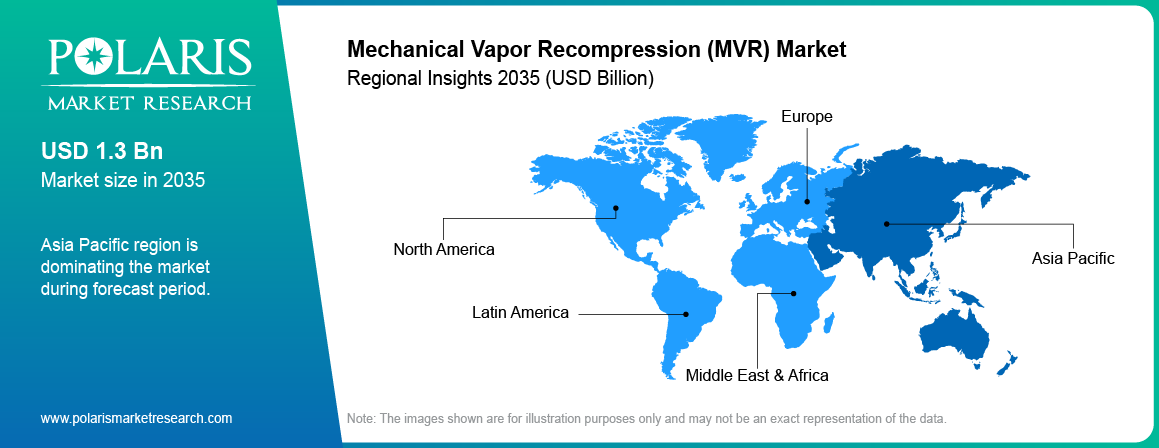
Regional demand mirrors where plants evaporate water at scale and where discharge rules tighten. Asia Pacific holds the biggest base of chemical, food, and treatment plants and grows quickest, whereas Europe and North America provide retrofit and electrification orders from an older installed base.
North America Market
North America delivers 19.8% of 2027 revenue, owing to large chemical, food, and semiconductor sites in the United States that recycle water and cut fuel use. Growth of 5.0% a year through 2035 lags Asia Pacific, since the plant base is mature.
The United States generated USD 280.5 Million in 2027, the larger part of the regional sum. Mexico climbs fastest of the three countries at 6.8% a year through 2035, as factories move closer to American buyers, and Canada follows at 5.0%.
For example, in January 2026, the United States Department of Energy selected 16 projects for USD 155 million, with process heating listed as a challenge area (Source: US Department of Energy). The page names no heat pump or evaporation project, so the announcement signals policy interest only.
Rivalry in this region favors vendors with field service teams and nearby reference plants. Buyers lean on evaporator builders that stock local spares, and machine makers partner with them to remain in the specification.
Europe Market
Europe accounts for 26.6% of 2027 revenue and advances 4.3% annually, the lowest rate of the five regions, owing to an established plant base. Germany leads the continent with USD 119.2 Million in 2027.
Russia posts the weakest growth of the named countries, at 3.0% annually, since imported machines are hard to obtain. The United Kingdom and France each record USD 48.8 Million, Italy USD 44.3 Million, Spain USD 26.6 Million, and all remaining countries together USD 138.1 Million.
For example, in March 2026, the Commission in Brussels adopted its Industrial Accelerator Act proposal, which says permitting for energy intensive industries and clean technologies should not exceed 18 months (Source: European Commission). The page does not mention heat pumps, but faster permits help owners who plan to switch from gas heat.
Energy prices set the pace for demand. Plants paying high gas rates seek compressor retrofits with quick payback, so evaporator upgrades in food and chemical sites often rank ahead of new boilers in the budget.
Machine makers are strong in the region. Several large compressor and evaporator groups have their bases in Germany, Italy, Switzerland, Denmark, and Sweden, and local supply shortens delivery and eases service.
Asia Pacific Market
Asia Pacific is the leading market with 38.6% of 2027 revenue. It is the fastest growing region, at a CAGR of 7.4% from 2027 to 2035, owing to new chemical, food, and wastewater plants in China and India.
China leads all countries with USD 351.9 Million in 2027, and India climbs quickest at 10.8% a year from a small starting point. Japan trails the larger markets at 5.0% since its plants are older, while South Korea adds USD 51.4 Million and Australia USD 19.3 Million.
In February 2026, Veolia described its operation of the first zero liquid discharge facility in Gujarat, at Ankleshwar, as a landmark for industrial wastewater handling in the state (Source: Veolia). The release gives no machine details.
The remaining Asian economies bring USD 90.6 Million in 2027, mostly from food, textile, and chemical plants across Southeast Asia.
Local machine makers shape pricing. Chinese suppliers offer low cost fans and compressors to domestic evaporator builders, while foreign groups focus on large and high lift machines, so competition differs by duty.
Latin America Market
The 2027 share of Latin America is 6.0%, and the region grows at a CAGR of 6.3% over 2027 to 2035, owing to mining, sugar, and food projects in Brazil and Argentina. The Brazilian market leads with USD 42.0 Million, while Argentina grows faster at 6.3%.
Other Latin American countries contribute USD 44.3 Million in 2027. Numerous owners buy through global evaporator builders, so local revenue tracks mine and plant projects closely.
For example, in August 2026, Chile signed its first lithium contract with a wholly private company, Quiborax, to recover lithium from historical mining waste, with an estimated investment of USD 70 million (Source: Rio Times). The contract excludes salt flat exploitation, and the report does not describe evaporation.
Exchange rate swings and import duties affect quotes. Suppliers that stock spare impellers locally and quote in local currency shield buyers from import shocks.
Middle East & Africa Market
The Middle East & Africa region supplies 9.0% of 2027 revenue and advances 5.6% a year, owing to desalination, mining, and industrial city projects around the Gulf. Saudi Arabia records the highest value, USD 45.2 Million, and the Emirates grow fastest at 6.8%.
For 2027 the Emirates reach USD 30.2 Million, Turkey stands at USD 17.9 Million, South Africa at USD 20.6 Million, and the residual group at USD 35.6 Million. Scarce water makes brine handling a core requirement.
For example, in September 2026, Veolia announced three agreements in Saudi Arabia, with Acwa on seawater desalination design, Ma'aden on industrial water reuse, and Khazeen on industrial water treatment (Source: Veolia). The release is silent on brine handling and zero discharge.
Gulf tenders increasingly tie awards to local content and joint ventures, an approach that suits vendors with regional offices and warehouses.
Sizing errors are costly, and good suppliers therefore ask for samples early. Liquid density, boiling point rise, scaling tendency, and foaming behavior all change the wheel diameter, the number of stages, and the choice of alloy, so a vague inquiry rarely produces a firm quote.
Hot weather raises the technical bar. High seawater salinity and ambient heat lower evaporator efficiency, so owners ask for corrosion resistant machines and tight performance guarantees in specifications for large plants.
Mechanical Vapor Recompression (MVR) Market Competitive Landscape
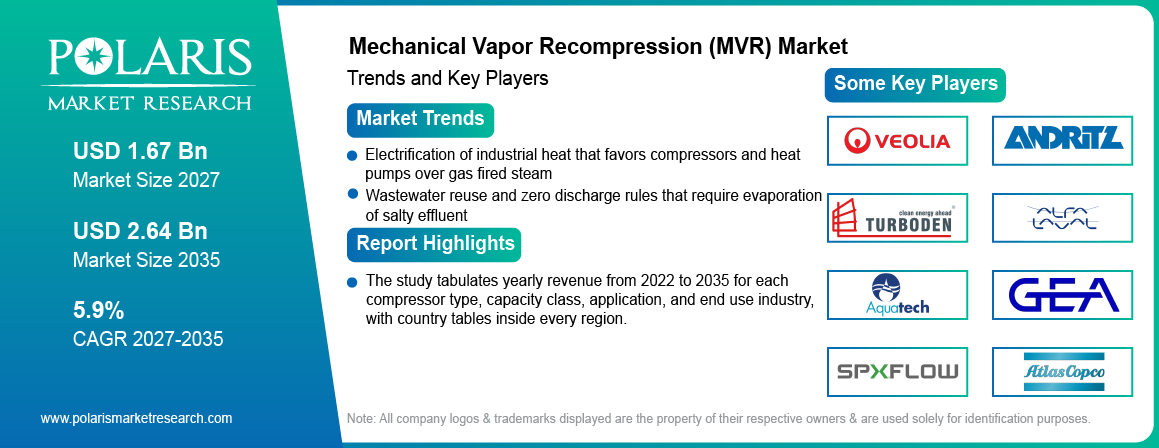
Suppliers fall into four groups. Evaporator and process groups such as GEA Group, Alfa Laval, ANDRITZ, and SPX FLOW sell complete lines with the compressor inside. Water technology firms such as Veolia Water Technologies and Aquatech International sell brine and zero discharge plants. Compressor specialists such as Howden, PILLER, Atlas Copco, and Turboden build the machines, and Asian makers such as Kobelco Compressors and Sumitomo Heavy Industries serve their home markets.
Turboden started up a large steam producing heat pump in February 2026 and signed its first centrifugal vapor recompression supply in April 2026. Veolia announced three Saudi agreements in September 2026, and Chile signed a lithium waste recovery contract in August 2026.
PILLER said in a conference presentation posted in June 2025 that it has more than 5,000 installations of vapor compression technology and builds around 600 blowers for this duty each year (Source: PILLER). Few rivals publish such counts.
Vendors do not publish vapor compression revenue as a separate line, so any ranking by share is approximate. Polaris treats launches, contracts, and project news as evidence of presence and not as measured sales.
Contests turn on energy guarantees and references. Buyers favor suppliers with test rigs, logged plant results, and engineers near the site, and share moves to firms that ship on schedule with full paperwork.
Ownership changes alter the field. Turboden is part of Mitsubishi Heavy Industries, and Veolia absorbed the water technologies of Suez, so each group draws on wider financing and service networks.
New entrants find room in mid size machines and retrofit packages. Regional builders take local projects first and move up to larger sites once their references are established.
Aftercare separates leaders from followers. A vendor that watches machines remotely, keeps spare wheels on the shelf, and reports energy gains every quarter builds lasting accounts, while a hardware only seller waits for the next project round.
Vendor Landscape Snapshot
| Company | Vendor Positioning | Role |
| GEA Group | Leader | Supplies evaporation and process lines to food, dairy, and chemical plants |
| Alfa Laval | Leader | Supplies evaporators and heat exchange equipment for process and water duties |
| Veolia Water Technologies | Leader | Signed three Saudi agreements in September 2026 and operates zero liquid discharge plants |
| Turboden | Challenger | Started up a large steam producing heat pump in February 2026 and signed its first centrifugal vapor recompression supply in April 2026 |
| PILLER | Challenger | Reports more than 5,000 vapor compression installations and about 600 blowers built each year |
| Howden | Niche Player | Builds compressors and fans for vapor recompression in chemical and environmental duties |
Source: Polaris Market Research Analysis
Mechanical Vapor Recompression (MVR) Market Technology and Innovation Landscape
Technical progress follows four aims: higher temperature lift, lower energy use, better resistance to salty liquids, and simpler integration with heat pumps. Most progress comes from compressor design, from materials, and from control software.
Lift is the main frontier. According to the OST study, integrally geared compressors handle steam up to 250 degrees Celsius, MVR blowers and turbo fans span 105 to 230 degrees, and oil free screw machines span 130 to 165 degrees (Source: OST).
Thermodynamic performance depends on compression ratio, suction temperature, and the saturation properties of the liquid being concentrated, so engineers evaluate boiling point elevation, specific volume, and polytropic efficiency before selecting impeller geometry and the number of stages.
Heat pump design is entering evaporation. Turboden's February 2026 plant joins a large heat pump to a vapor recompressor to deliver steam, and the company frames the approach as an open cycle heat pump.
Aerodynamic refinement continues alongside the thermodynamic work. Computational modeling of blade passages, diffuser configurations, and shaft sealing arrangements has improved isentropic efficiency, which directly lowers the electricity consumed per kilogram of condensate produced.
Materials are improving. Duplex steel and titanium wheels, coated casings, and droplet separators extend life in salty duties, so owners accept vapor compression for liquids that once ruined machines.
Waste heat is a growing input. Plants that already recover heat on site can feed it into vapor compression lines, and this link is covered in the waste heat recovery system market report.
Heat pumps compete and cooperate with this technology. Closed cycle high temperature heat pumps serve some duties that blowers cannot, and they are covered in the heat pump market report.
Control software is becoming standard. Vibration, flow, and temperature sensors feed models that warn of fouling and wheel wear, so operators plan maintenance instead of reacting to failures.
Evidence now sells machines. Customers ask for measured case results, and suppliers that publish them pass approval gates faster than rivals relying on brochure promises.
Technology and Innovation Landscape Snapshot
| Area | Role | Status and Representative Developers |
| Steam producing heat pump systems | Raise superheated steam from waste vapor with electric power | Turboden started up a 12 megawatt thermal plant in February 2026 |
| Centrifugal vapor recompressors | Move large vapor volumes in food and process evaporators | Turboden signed its first supply in April 2026 |
| Integrally geared steam compressors | Reach high steam temperatures and large capacities | Covered in a study by the OST Eastern Switzerland University of Applied Sciences |
| Oil free screw compressors | Deliver a large lift per stage in small duties | Covered in a study by the OST Eastern Switzerland University of Applied Sciences |
| Corrosion resistant machine design | Extend wheel life in brine and crystallizer duty | Offered by compressor specialists and evaporator builders |
Source: Polaris Market Research Analysis
Use Case Analysis
Dairy and Food Evaporation
Sugar, milk, and juice plants thicken liquids in evaporators that run for months at a time. A vapor compressor replaces most of the boiler steam, and owners record lower fuel use and steadier product quality.
Industrial Brine Concentration
Chemical and mining sites concentrate salty streams so that most of the water returns to the plant. The remaining brine goes to a crystallizer, and brine from seawater plants is covered in the desalination technologies market report.
Solvent and Ethanol Distillation
Distillation columns that run all year can reuse their own overhead vapor as the heat source. Chemical plants use turbo compressors on these columns to cut steam bills.
Process Steam Generation
Plants with low pressure waste vapor lift it to useful steam for drying or heating. Owners compare the machine with gas fired plant, and steam raising boilers are covered in the industrial boiler market report.
Lithium and Mineral Recovery
Mines concentrate process liquids to recover lithium salts and other minerals. Vapor compression cuts the energy used and returns clean condensate to the process.
Retrofit and Remote Monitoring
A plant can swap the steam coil supply of an old evaporator for a compressor and fit sensors that report to a remote desk. Technicians travel only when an alarm needs a site visit.
Gains are judged against a starting point. Fuel burned before the change is logged and compared with subsequent periods, and vendors that hand over tidy data and weather corrected reports can prove their case and earn follow on orders.
Maintenance shapes every one of these cases. Impellers are inspected for erosion, rebalanced at set intervals, and swapped on schedule, so operators stock spares and sign service terms with suppliers.
Total installed cost decides many cases. The compressor must pay back against the fuel bill, outage risk, and rebuild cost of an aging steam line, so finance teams weigh several options before approval.
Buyer Needs and Decision Criteria
| Buyer Need | Decision Criteria | Why It Matters |
| Energy savings | Measured kilowatt hours per ton of water evaporated | Energy is the largest running cost of an evaporation line |
| Reliability | Wheel life, vibration record, and service response | A stopped compressor halts concentration and may stop production |
| Material fit | Alloy choice and corrosion record in similar liquids | Salty liquids attack machines and raise maintenance cost |
| Guarantees | Performance bonds and test run results | Owners need proof before they swap a proven steam line |
| Support | Local engineers, spare wheels, and training | Slow repairs leave an evaporation line idle |
Source: Polaris Market Research Analysis
Newcomers face a high bar. Reference plants, test halls, alloy know how, and a spare parts network are slow to assemble, and owners lean on suppliers whose machines have a long run record, so entrants begin with trial units and minor conversions.
Sign off rests on test reports, material certificates, cost per ton of water, and delivery dates. A vendor with all four documents ready can cut weeks from a buyer review.
Deal scope keeps growing. Owners now ask for evaporator, compressor, and aftercare in one agreement, and suppliers offering every component are better placed for the largest accounts.
Premium Insights and Forward Outlook
Higher Lift Machines Will Gain Share
Owners will move spending toward multistage and geared machines that make real process steam. Producers with proven lift and clear savings data will win repeat orders.
Guarantees will change pricing. Owners want a fixed energy figure per ton of water, and a vendor that stands behind its machine with a written saving can take orders that a bare equipment quote would miss.
Catalog designs will gain ground. Pre built skids, factory tested frames, and ready made control panels shorten engineering work, so makers that bundle their experience can reach smaller customers without losing money.
Discharge Rules Will Drive Zero Liquid Discharge Projects
Fresh effluent limits across India, China, and Gulf states will launch evaporation projects. Suppliers with logged water recovery, trained partners, and crystallizer skills will gain, since a compliance order usually opens a fresh round of equipment choices.
Mining and Brine Duties Will Shape Product Design
Brines from lithium, copper, and seawater plants will add heavy corrosion duty. Vendors that master alloys and the control of machines in parallel will win contracts at large sites.
Electrification Will Share the Plant With Boilers
New sites will lean toward electric steam, while older plants keep boilers for peak load. Hybrid layouts with strong controls should carry most of the added revenue.
Specifications will tighten on energy and discharge. Measured water recovery, energy logs, and noise limits are turning into approval checklist items, and suppliers that document them early will sail through inspections.
Four things carry growth: zero discharge projects, steady food plant retrofits, higher lift machines, and brine work in mining. Most added revenue should reach producers with proven machines, regional service, and clear energy guarantees.
Key Players in the Mechanical Vapor Recompression (MVR) Market
- GEA Group
- Alfa Laval
- ANDRITZ
- SPX FLOW
- Veolia Water Technologies
- Aquatech International
- Turboden
- Atlas Copco
- Howden
- PILLER
- Kobelco Compressors
- Sumitomo Heavy Industries
- Ingersoll Rand
- IDE Technologies
- Dedert Corporation
Industry Developments
- September 2026: Veolia concluded memoranda with Acwa, Ma'aden, and Khazeen in Saudi Arabia, spanning desalination design and industrial water treatment (Source: Veolia).
- July 2026: Eight Chinese government bodies, led by the ecology ministry, released guidance on industrial wastewater pollution risk (Source: Enviliance).
- April 2026: Turboden won a first order for a centrifugal vapor recompressor from the Italian sugar maker Co.Pro.B. (Source: Turboden).
Mechanical Vapor Recompression (MVR) Market Report Segmentation
By Compressor Type
- Centrifugal Blwers and Fans
- Multistage Turb Compressors
- Rots and Screw Compressors
- Others
By Capacity
- Small Capacity Systems
- Medium Capacity Systems
- Large Capacity Systems
By Application
- Evapration and Concentration
- Distillatin
- Zer Liquid Discharge and Crystallization
- Steam Generatin and Drying
- Others
By End Use Industry
- Fod and Beverage
- Chemicals and Petrchemicals
- Water and Wastewater Treatment
- Pulp and Paper
- Mining and Metals
- Others
By Region
- North America
- United States
- Canada
- Mexico
- Europe
- Germany
- United Kingdm
- France
- Italy
- Spain
- Russia
- Rest of Europe
- Asia Pacific
- China
- Japan
- India
- Suth Korea
- Australia
- Rest of Asia Pacific
- Latin America
- Brazil
- Argentina
- Rest of Latin America
- Middle East & Africa
- Saudi Arabia
- United Arab Emirates
- Suth Africa
- Turkey
- Rest of Middle East & Africa
Mechanical Vapor Recompression (MVR) Market Report Scope
| Report Attribute | Details |
| Market Size in 2026 | USD 1.56 Billion |
| Market Size in 2027 | USD 1.67 Billion |
| Revenue Forecast by 2035 | USD 2.64 Billion |
| CAGR | 5.9% (2027 to 2035) |
| Base Year | 2026 |
| Historical Data | 2022 to 2025 |
| Forecast Period | 2027 to 2035 |
| Quantitative Units | Revenue in USD Billion for the market, USD Million for segments, and CAGR in percent |
| Report Coverage | Revenue Forecast, Growth Factors, Competitive Landscape, Industry Trends, and Strategic Analysis of the mechanical vapor recompression (MVR) market |
| Segments Covered | By Compressor Type, By Capacity, By Application, By End Use Industry, and By Region |
| Regional Scope | North America, Europe, Asia Pacific, Latin America, Middle East & Africa |
| Competitive Landscape | Company Profiling, Product Benchmarking, Financial Analysis, Market Developments, and Strategic Initiatives |
| Report Format | PDF and Excel |
| Customization | Available by Country, Region, and Segment |
| Research Team | Polaris Market Research & Consulting, Inc. research team |
| Last Updated | 25 November 2026 |
Source: Polaris Market Research Analysis
Why Choose Polaris Market Research
The model carries 24 country lines, five of them residual groups. Totals for each region are built from country lines, and every segment split is calibrated to match those regional sums.
Scope changes the headline number. Before comparing this figure with another published size, check whether that source counted the compressor alone, the whole evaporator, or an entire effluent plant.
Every external fact is logged with its publisher and the date on its page, where one is shown. Entries are grouped by publisher type, so that each statement leads back to the page behind it.
Tailored cuts can be ordered for one country, one compressor type, one capacity class, one application, or one end use industry.
Research Methodology
Research Approach
The count covers vapor compression machines and their drives for evaporation, distillation, and steam duties. Evaporator bodies, heat exchangers, pumps, and crystallizers stay outside the boundary.
Secondary Research
The register holds 14 sourced facts. The mix is 6 company pages, 4 public bodies, and 4 press items. Of these, 1 shows no exact page date, and the oldest dated entry comes from 2025.
Primary Research
Polaris follows its standard process of primary interviews. These interviews cover manufacturers, distributors and channel partners, and industry experts and consultants. They are used to validate secondary estimates, segment shares, regional trends, and growth drivers.
Data Structuring
Money values use US dollars and calendar years. The scope line was fixed before evidence gathering began, and a machine reported by more than one source enters the count a single time.
Market Size Estimation
Countries are summed into regions, regions are summed into the world figure, and the world figure is then allocated to the four dimensions.
Published estimates for adjacent scopes were studied prior to fixing the 2026 base of USD 1.56 Billion. Spreads are wide, because scope lines vary and few studies isolate the compressor, so these figures informed judgment without settling the answer.
Forecasting
Annual growth fades slowly toward 2035, and the whole series compounds to the stated rate. It reflects heat electrification, tighter wastewater rules, food plant retrofits, and a move toward higher lift machines.
Data Triangulation and Validation
Every forecast year is put through four checks. Segment shares must reach 100%, countries must equal their region, regions must equal the world, and the first move away from 2026 must be plausible.
Limitations
Company filings rarely isolate vapor compression revenue, so segment and country values are modeled and may shift in later editions when launches and projects evolve. A boundary that took in whole evaporators would give a bigger total. Market figures in this report are Polaris estimates.
Research Methodology Phases
| Phase | Focus | Evidence / Output |
| Scope and Setup | Market boundary, segments, and regions | Fixed scope and segment list |
| Secondary Data Collection | Agency notices, company releases, and news reports | 14 sourced facts with dates |
| Primary Research | Interviews with manufacturers, channel partners, and industry experts | Validated segment shares, regional trends, and growth drivers |
| Data Structuring | Dollar values by calendar period | Each product entered once |
| Bottom Up Estimate | Country and segment estimates | Regional and global totals |
| Top Down Estimate | Global base for 2026 and its segment mix | Base set beside published estimates |
| Forecasting | Annual growth path to 2035 | Stated CAGR |
| Triangulation and Validation | Sum checks, roll up checks, and growth tests | Tests that passed |
| Output | Report tables and text | One dataset feeding all tables |
Source: Polaris Market Research Analysis
Data Sources by Type
| Type of Source | Named Examples | Used For |
| Company pages (6) | Turboden; Veolia; PILLER | Product launches, supply agreements, and installed base |
| Agency and research institute pages (4) | European Commission; US Department of Energy; Saudi Water Week; OST | Permitting rules, funding, and technical limits |
| News and wire reports (4) | Deccan Herald; Rio Times; MEED; Enviliance | Discharge rules and project news |
Source: Polaris Market Research Analysis
Mechanical Vapor Recompression (MVR) Market FAQ's
The market covers machines that boost the pressure of vapor leaving a boiling liquid, so the same vapor can supply heat again in evaporators, distillation columns, and steam systems.
The Polaris estimate for the 2026 mechanical vapor recompression (MVR) market is USD 1.56 Billion, counted as revenue from vapor compression machines. Sales are forecast to climb to USD 2.64 Billion by 2035.
Polaris projects USD 2.64 Billion for the mechanical vapor recompression (MVR) market by 2035, a CAGR of 5.9% over 2027 to 2035, supported by electrification of industrial heat, zero discharge rules, retrofits, and brine treatment.
Asia Pacific ranks first with 38.6% of 2027 spending, since China and India operate a vast base of chemical, food, and wastewater plants.
Asia Pacific also leads regions on CAGR, at 7.4% through 2035, as new plants and stricter wastewater rules spread across China and India.
By 2027 value, 50.6% belongs to Centrifugal Blowers and Fans, the biggest type, while Multistage Turbo Compressors grow fastest, at 9.6%, owing to demand for more lift.
GEA Group, Alfa Laval, Veolia Water Technologies, Turboden, and PILLER appear most often in the evidence set, and ANDRITZ, SPX FLOW, Howden, and Atlas Copco also supply evaporation lines or compressors.
Higher lift centrifugal machines, heat pump style steam systems, corrosion resistant materials, and remote condition monitoring are spreading, while zero liquid discharge projects add large brine duties.
High upfront cost, limited temperature lift per stage, fouling in salty liquids, and cheap steam at some sites slow adoption, while cancelled water projects can delay orders.
Medium Capacity Systems lead 2027 value at 42.6%, and Large Capacity Systems grow fastest, at a CAGR of 9.0% to 2035, owing to mine brine and big chemical evaporators.
The largest is Water and Wastewater Treatment, with 26.8% of 2027 value, and the same industry grows fastest, with a CAGR of 8.0% through 2035, as plants must reuse more water.
By CAGR, Zero Liquid Discharge and Crystallization gains most, at 8.5% through 2035, since salty streams must be dried, while Evaporation and Concentration stays the largest at 39.9% of 2027 value.
Vapor recompression reuses the evaporator's own vapor with an electric compressor, whereas multiple effect evaporation passes live steam through several linked vessels, so Polaris counts only the compressor in this report.
China tops the table at USD 351.9 Million for 2027 and the United States follows at USD 280.5 Million, while India shows the highest country growth at 10.8% annually.
Electrification of industrial heat, wastewater reuse and zero discharge rules, retrofit programs in food plants, and brine treatment in mining all add demand for compressors.

Download Sample Report of Mechanical Vapor Recompression (MVR) Market
Please fill out the form to request a customized copy of the research report.


