
Microbiome Diagnostics Market Size, Share, Trends & Forecast, 2026-2034
REPORT DETAILS
Microbiome Diagnostics Market Size & Forecast, 2025-2034
Global microbiome diagnostics market size was valued at USD 181.1 million in 2025. The market is anticipated to grow from USD 205.42 million in 2026 to USD 579.6 million by 2034, exhibiting a CAGR of 13.80% during the forecast period
Market Statistics
Microbiome Diagnostics Market Key Takeaways: Size, Products, End Users & Regions
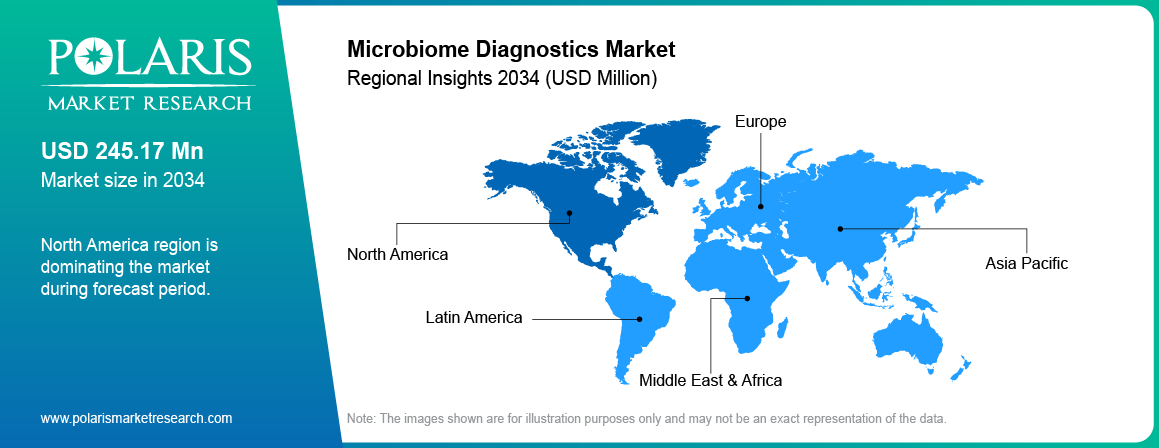
- North America dominated the global market with 42.3% share in 2025. This is propelled by increasing research and development activities across the region.
- The U.S. led the North American market with 78.2% revenue share in 2025. The dominance is attributed to robust healthcare infrastructure and rising awareness regarding the significance of microbiome equilibrium.
- The Asia Pacific market is expected to exhibit the highest CAGR of 11.9% during the forecast period. Rapid advancements in healthcare infrastructures propel the market expansion.
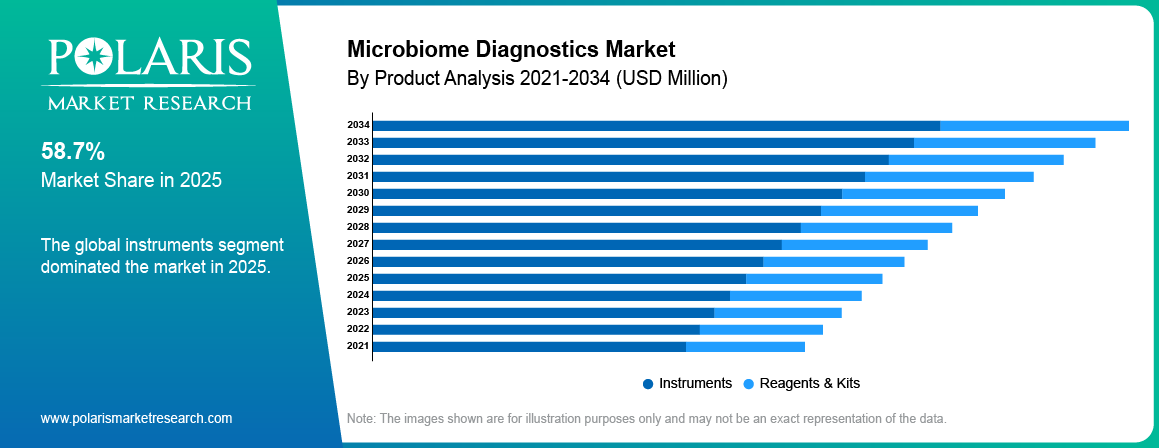
- The instruments segment dominated with 58.7% revenue share in 2025. Increasing use of instruments in identifying and quantifying microbial entities and their functions drives the segment growth.
- The pharmaceutical & biotechnology companies segment held the largest share of 46.9% in 2025. Rising investments by these companies in developing new drug targets support segment dominance.
Note: Figures and projections outlined in this report are the result of Polaris Market Research’s proprietary analytical processes, grounded in the latest available datasets and market observations.
Microbiome Diagnostics Market Dynamics: Drivers, Opportunities, Restraints & Challenges
- Increasing prevalence of chronic diseases drives the growth of the microbiome diagnostics market.
- Rising adoption of precision medicine propels the requirement for microbiome diagnostics.
- Financing concerns from end users hinder the market growth.
- Advancements in sequencing technologies are expected to provide lucrative market opportunities in the coming years.
- Surging pharmaceutical interest in microbiome therapeutics are projected to create new market trends.
What Is Microbiome Diagnostics? Definition, Clinical Scope & Test Types
Microbiome diagnostics involves the use of advanced scientific processes and technologies to analyze the composition and function of microbiomes in specific environments, particularly within the human body. These methods utilize high-throughput sequencing technologies and bioinformatics tools to identify and understand the diverse array of microorganisms, including viruses, fungi, bacteria, and other microbes, present in habitats such as the oral cavities, gut, and skin. This field aims to illuminate the complex interactions between these microorganisms and their host, significantly contributing to the understanding of health and disease states. It also offers potential pathways for novel therapeutic and diagnostic developments. Microbiome diagnostics market growth plays a crucial role in personalized medicine, allowing for more precise and individualized treatment and prevention strategies based on the unique microbiome compositions of individuals.
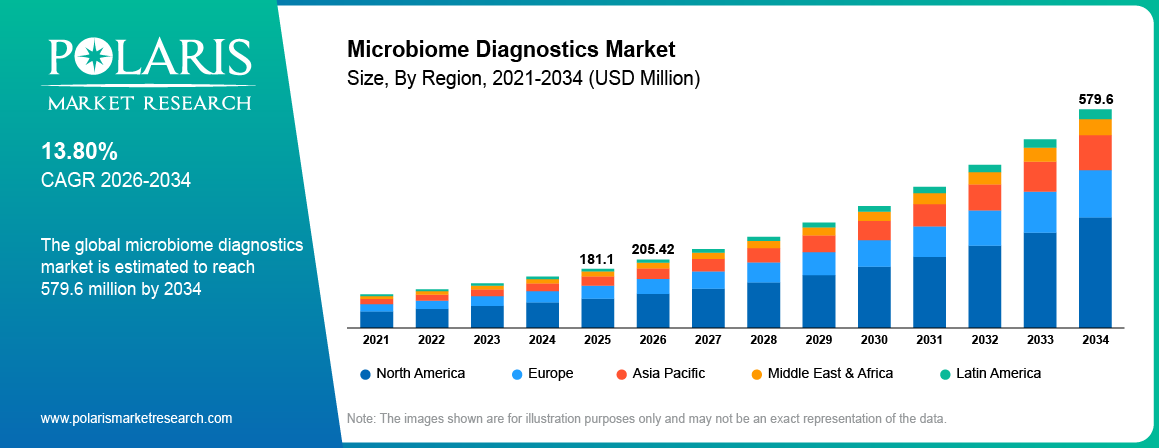
Source: Polaris Market Research Analysis
To Understand More About this Research: Download Sample Report
How Microbiome Diagnostics Work: Sampling, Sequencing, Bioinformatics & Clinical Interpretation
- Samples from the patient body are collected.
- DNA of microorganisms is extracted from the sample.
- The sequencing technique recognizes the microbial species present.
- Bioinformatics methods study the microbiome profile.
- Microbial biomarkers associated with diseases are recognized.
- The clinical data is explained using patient information.
- Individualized health solutions can be developed.
For instance, in October 2023, Predica Diagnostics BV & TenWise BV, funded by the Dutch RVO, launched the "Targeted Microbiome Profiling (TMP)" service. This innovative service combines Predica's ciRNAseq technology with TenWise's expertise in literature mining and AI, offering a thorough analysis of microbiome communities. TMP speeds up microbiome profiling and identifies the biological pathways affecting microbiome functionality by analyzing RNA from different microbiome niches.
The increasing incidence of chronic diseases and the microbiome's crucial role in diagnosing them have led to the global adoption of microbiome diagnostics methods. Government initiatives and support have significantly boosted research in this field, driving the microbiome diagnostics market development. Despite its promising growth, the market faces challenges due to the absence of reimbursement policies, potentially limiting patient access to these advanced tests. Nevertheless, the rise in investment in microbiome-based research is spurring the development of innovative diagnostic tools, shaping a promising future growth trajectory for the market.
Microbiome Diagnostics vs Traditional Diagnostics: Data, Validation, Prediction & Clinical Use
| Factor | Microbiome Diagnostics | Traditional Diagnostics |
| Data Type | Microbial genetic information | Biological markers |
| Approach | Personalized | Generalized |
| Technology | Sequencing & bioinformatics | Conventional testing |
| Disease Prediction | Emerging predictive capability | Limited predictive capability |
| Treatment Support | Precision-based recommendations | Standard treatment protocols |
Source: Polaris Market Research Analysis
Market Dynamics
Microbiome Diagnostics Market Drivers
Industry-Academia Partnerships Accelerate Microbiome Biomarker and Diagnostic Development
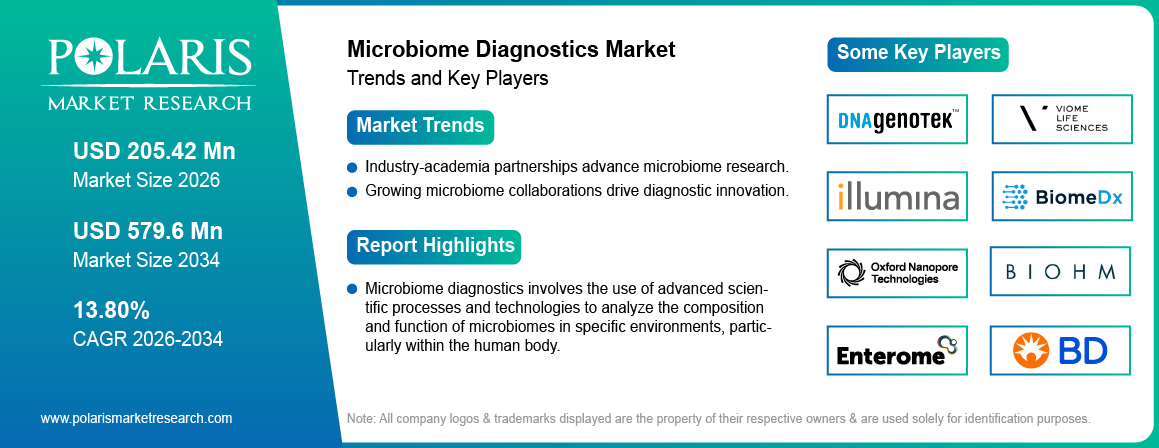
Research on the human microbiome is a fast-expanding topic, and industry-academia cooperation focused on microbiome research has significantly increased. Through these partnerships, industry partners and academic researchers work together to develop new microbiome-based diagnostic tools and expand our knowledge of the role of the microbiome in health and illness. The growing number of partnerships between industry and academia in microbiome research is driving the field's advancement. These collaborations create chances for new diagnostic products based on the microbiome and facilitate the transition of basic research discoveries into clinical use. By bridging academia and the microbiome industry, these partnerships combine diverse expertise and resources, enriching our knowledge of the human microbiome.
Microbiome Diagnostics Market Restraints & Adoption Barriers
High Equipment Cost and Limited Reimbursement Constrain Clinical Adoption
In many developing countries, academic research and development heavily rely on external funding sources. Next-generation sequencing (NGS) technology is predominantly used for microbiome analysis due to its high-throughput capabilities and ability to provide detailed insights into microbial communities. Despite ongoing efforts by governments and private organizations worldwide to allocate funds for research, many research and academic institutions still encounter budgetary limitations when it comes to acquiring and utilizing advanced and premium-priced equipment and technologies. While the cost of NGS sequencing has decreased over time, NGS sequencers remain relatively expensive, posing a significant challenge for researchers in these regions to access and utilize these technologies for microbiome research and other applications.
Key Market Growth Drivers & Challenges
| Growth Drivers | Challenges |
| Rising prevalence of chronic and gastrointestinal diseases | Lack of standardized testing protocols across providers |
| Growing industry-academia collaboration in microbiome research | Limited reimbursement and insurance coverage for testing |
| Advancements in sequencing technologies lowering costs | High cost of NGS equipment and specialized expertise |
| Increasing pharmaceutical interest in microbiome-based therapeutics | Complexity of interpreting large-scale microbiome datasets |
| Shift toward precision and personalized medicine | Regulatory uncertainty around clinical validation pathways |
Source: Polaris Market Research Analysis
Source: Polaris Market Research Analysis
Microbiome Diagnostics Market Segmentation by Sample, Product, Technology, Application, End User & Region
The market is primarily segmented based on sample, product, technology, application, end-user, and region.
| By Sample | By Product | By Technology | By Application | By End-User | By Region |
|
|
|
|
|
|
Source: Polaris Market Research Analysis
Microbiome Diagnostics Market by Product: Instruments vs Reagents & Kits
The instruments segment accounted for the largest microbiome diagnostics market share in 2025 and is likely to retain its position throughout the microbiome diagnostics market forecast period. Instruments play a critical role in microbiome diagnostics by enabling the accurate and precise analysis of microbiome samples. Next-generation sequencing (NGS) machines, mass spectrometers, and quantitative PCR (qPCR) devices are among the key instruments used in this field. NGS machines are essential for sequencing DNA and RNA from microbiome samples, providing detailed information about the composition of microbial communities.
Mass spectrometers are used to analyze the chemical composition of microbiome samples, helping to identify specific microbial species and their metabolic products. qPCR devices are used to quantify the abundance of specific microbial species in a sample, providing insights into the relative abundance of different microbes. Overall, these instruments are vital for identifying and quantifying microbial entities and their functions, making them indispensable tools in advancing our understanding of the microbiome and its role in health and disease.
NGS in Microbiome Diagnostics: 16S, Shotgun Metagenomics & Metatranscriptomics
The technology behind next-generation sequencing (NGS) makes the study of the human microbiome possible. NGS analyzes the genetic content of organisms found in a sample. The organisms themselves need not be isolated but their DNA or RNA is sequenced as they appear in the sample.
The study of human microbiome comprises three main NGS strategies: 16S rRNA sequencing, shotgun metagenomics, and metatranscriptomics. Each technique is based on the fact that all microbes have their own unique DNA sequence. However, they use different aspects of it to characterize the microbiome in question.
- DNA/RNA sequencing: direct sequencing of microbial gene
- High-throughput sequencing: processing of thousands of samples simultaneously
- Metagenomic analysis: functional insights other than species identity
- Assessment of microbial diversity: determination of diversity and balance of a community
The cost of sequencing is decreasing. Thus. NGS is increasing the application of microbiome testing from academic research laboratories into clinical and consumer applications.
Microbiome Diagnostics Market by End User: Pharma & Biotech, Hospitals, Research Institutes
Based on end-user analysis, the market has been segmented on the basis of academic & research institutes, hospitals, and pharmaceutical & biotechnological companies. The pharmaceutical & biotechnology companies segment held a significant microbiome diagnostics market share in 2025. Pharmaceutical and biotechnology firms represent a substantial portion of microbiome diagnostics end-users. Their primary goal is to utilize microbiome data to create innovative therapies, personalized medicine, and advanced probiotics. These companies are deeply invested in unraveling the intricate relationships between the human microbiome and different diseases. By employing microbiome diagnostics, they aim to pinpoint new drug targets, improve drug effectiveness, and lower the occurrence of adverse effects.
Microbiome Diagnostics Use Cases: GI Disease, Cancer, Metabolic Health, Infection & Precision Nutrition
| Application | Real-World Use Case |
| Gut Microbiome Testing for Digestive Disorders | The composition analysis of gut microflora in order to diagnose and treat disorders including irritable bowel syndrome (IBS), inflammatory bowel disease (IBD), and other gastrointestinal conditions. |
| Identifying Microbial Biomarkers Linked to Cancer | Detection of biomarkers based on microbiomes that can help screen for cancer, predict its risk, assess the prognosis, and suggest effective treatment for colorectal and other cancers. |
| Personalized Nutrition Recommendations | Analyzing individual’s profile of microbiome to personalize nutritional diets aimed at enhancing gut health and metabolism. |
| Infectious Disease Detection | Identification of disease-causing microorganisms with the use of sequencing technologies. It helps in quick detection of bacterial, viral, fungal, and parasitic infections. |
Source: Polaris Market Research Analysis
Source: Polaris Market Research Analysis
Technological Advancements in Microbiome Diagnostics
| Technology | Description | Key Benefit |
| Shotgun Metagenomics | Performs whole-community DNA sequencing to identify microbes at the strain level. | Provides comprehensive microbial profiling with high accuracy. |
| Single-Cell Sequencing | Isolates and analyzes individual microbial cells, including rare or low-abundance species. | Enables detailed characterization of complex microbial populations. |
| AI-Driven Analysis | Uses machine learning algorithms to identify clinically relevant microbial patterns from large datasets. | Improves diagnostic speed, accuracy, and predictive insights. |
| Multi-Omics Integration | Combines genomic, transcriptomic, proteomic, and metabolomic data for comprehensive analysis. | Offers deeper insights into host–microbiome interactions and disease mechanisms. |
| Real-Time Microbiome Monitoring | Continuously tracks changes in microbial composition using advanced sensing and sequencing technologies. | Supports dynamic disease monitoring and personalized treatment optimization. |
Source: Polaris Market Research Analysis
Microbiome Diagnostics Market Regional Analysis: North America, Europe, Asia Pacific, Latin America & MEA
North America Led the Market with 42.3% Share in 2025
The market is expected to maintain its dominance over the anticipated period. The microbiome diagnostics market trends in the Americas are currently undergoing substantial growth, largely fueled by heightened research and development endeavors in the United States and Canada. The region's robust healthcare infrastructure, combined with a notable prevalence of gastrointestinal diseases and an escalating awareness regarding the significance of microbiome equilibrium, are pivotal factors propelling the uptake of microbiome diagnostics within the region. This trend underscores a growing emphasis on the importance of understanding and maintaining a healthy microbiome, driving innovation and investment in diagnostic technologies within the Americas.
Asia Pacific Growth Rate - Reconcile Before Publishing Fastest-Region Claim
The Asia Pacific region is expected to be the fastest-growing region, with a healthy CAGR during the microbiome diagnostics market forecast period. The microbiome diagnostics market opportunity in China, Japan, and South Korea is witnessing notable growth attributed to the rapid enhancement of healthcare infrastructures and escalating investments in microbiome research within these countries. Additionally, the region boasts a substantial patient pool and a rising awareness regarding the significance of microbiome testing, thereby fueling the demand for microbiome diagnostics. These factors collectively underscore a growing recognition of the role microbiome balance plays in overall health, driving the adoption of microbiome diagnostic technologies in China, Japan, and South Korea.
Clinical Applications of Microbiome Diagnostics
Microbiome diagnostics is moving beyond research use into direct clinical decision-making, particularly in conditions where microbial imbalance is now understood to play a causal or contributing role.
| Disease Area | Role of Microbiome Diagnostics |
| Gastrointestinal disorders | Identification of dysbiosis patterns associated with symptoms, including bloating, abnormal bowel function, and chronic digestive conditions |
| Inflammatory bowel disease (IBD) | Assessing microbial changes related to disease flare-ups and the effectiveness of therapy |
| Diabetes and metabolic disorders | Profiling gut bacteria associated with insulin resistance and metabolic syndrome. It supports risk stratification. |
| Cancer research | Exploring the relationship between microbe community profile and cancer development as well as reaction to immunotherapy |
| Infectious diseases | Detecting pathogen overgrowth and differentiating infection from the normal variations in the microbiome |
| Autoimmune conditions | Exploring interactions between gut microbes and immune system in the context of diseases where immunity regulation is affected |
Source: Polaris Market Research Analysis
These applications are drawing sustained interest from hospitals and pharmaceutical & biotechnology companies, the two end-user segments already covered in this report's segmentation, as microbiome data increasingly informs both diagnosis and treatment selection.
Source: Polaris Market Research Analysis
Microbiome Diagnostics Market Competitive Landscape & Leading Companies
The Microbiome Diagnostics market analysis is fragmented and is anticipated to witness competition due to several players' presence. Major service providers in the market are constantly upgrading their technologies to stay ahead of the competition and to ensure efficiency, integrity, and safety. These players focus on partnership, product upgrades, and collaboration to gain a competitive edge over their peers and capture a significant microbiome diagnostics market share.
Leading Microbiome Diagnostics Companies by Role: Clinical Testing, Platforms & Sample Collection
- DNA Genotek
- Genetic Analysis AS
- Microba
- Viome Life Sciences, Inc.
- Illumina, Inc.
- Biome Diagnostics
- Oxford Nanopore Technologies plc
- BIOHM Health
- Bione Ventures Private Limited
- DayTwo
- Enterome
- Evvy
- Quantbiome, Inc.
- ViennaLab Diagnostics GmbH
- Becton, Dickinson, and Company
Recent Microbiome Diagnostics Partnerships, Product Launches & M&A, 2025-2026
- July 2026: SYNLAB entered into a new three-year agreement with Microba Life Sciences. The companies will advance their partnership in microbiome diagnostics across a few markets in Europe and Latin America.(Source: synlab.com)
- In May 2025, Mapmygenome (India) disclosed a strategic acquisition of Microbiome Insight (Canada) to bring its combined genomics and microbiome testing offerings to the North American market.
- In April 2025, Microba Life Sciences (Australia) reported two key developments, including a strategic collaboration with the Colonoscopy Clinic (Australia) and its wholly owned partner, Integrated Gut Health (Australia), along with the publication of a clinical utility outcome for its MetaPanel™, gastrointestinal pathogen test.
Microbiome Diagnostics Market Future Outlook: Clinical Validation, AI, NGS & Precision Medicine
Microbiome diagnostic industry will see growth over the next few years. Today's healthcare is leaning toward personalized and evidence-based treatment strategies. As per our observation, this market is experiencing consistent improvements in sequencing technology, AI, and bioinformatics. This will lead to more accurate analysis and adoption of the technology in clinical settings. Research into biomarkers of the gut and diseases will boost the industry growth. Microbiome-based treatments will allow for new diagnostic, medical, and preventive applications.
Microbiome Diagnostics Market Report Coverage & Research Scope
The Microbiome Diagnostics market report emphasizes key regions across the globe to provide a better understanding of the product to the users. Also, the report provides market insights into recent developments and trends and analyzes the technologies that are gaining traction around the globe. Furthermore, the report covers an in-depth qualitative analysis pertaining to various paradigm shifts associated with the transformation of these solutions.
The report provides a detailed analysis of the market while focusing on various key aspects such as competitive analysis, sample, product, technology, application, end-user, and their futuristic growth opportunities.
Report Scope
| Report Attributes | Details |
| Market size value in 2025 | USD 181.1 million |
| Market size value in 2026 | USD 205.42 million |
| Revenue Forecast in 2034 | USD 579.6 million |
| CAGR | 13.80% from 2026 – 2034 |
| Base year | 2025 |
| Historical data | 2021 – 2024 |
| Forecast period | 2026 – 2034 |
| Quantitative units | Revenue in USD million and CAGR from 2026 to 2034 |
| Segments Covered | By Sample, By Product, By Technology, By Application, By End-User, By Region |
| Regional scope | North America, Europe, Asia Pacific, Latin America; Middle East & Africa |
| Customization | Report customization as per your requirements with respect to countries, regions, and segmentation. |
Source: Polaris Market Research Analysis
Microbiome Diagnostics Market FAQ's
The Microbiome Diagnostics Market report covering key segments are sample, product, technology, application, end-user, and region.
Microbiome Diagnostics Market Size Worth $579.6 Million By 2034
Microbiome Diagnostics Market exhibiting a CAGR of 13.80% during the forecast period
North American is leading the global market
key driving factors in Microbiome Diagnostics Market are rising number of partnerships between academic and microbiome institutes
Some of the tools which can be used to perform microbiome diagnostics are 16S rRNA sequencing, whole-genome metagenomic sequencing, quantitative PCR (qPCR), NGS, and bioinformatics tools. These technologies help identify and analyze microbial communities.
Microbiome diagnostics is used in personalized treatment by performing analysis of the microbial profile of an individual. This helps in assessing the risks of diseases, determining the proper treatment, developing nutrition plans, and monitoring the treatment progress with the help of unique microbiome characteristics.
Download Sample Report of Microbiome Diagnostics Market
Please fill out the form to request a customized copy of the research report.


