
Multiplex Assays Market Size, Share Global Analysis Report, 2026-2034
REPORT DETAILS
Multiplex Assays Market Summary
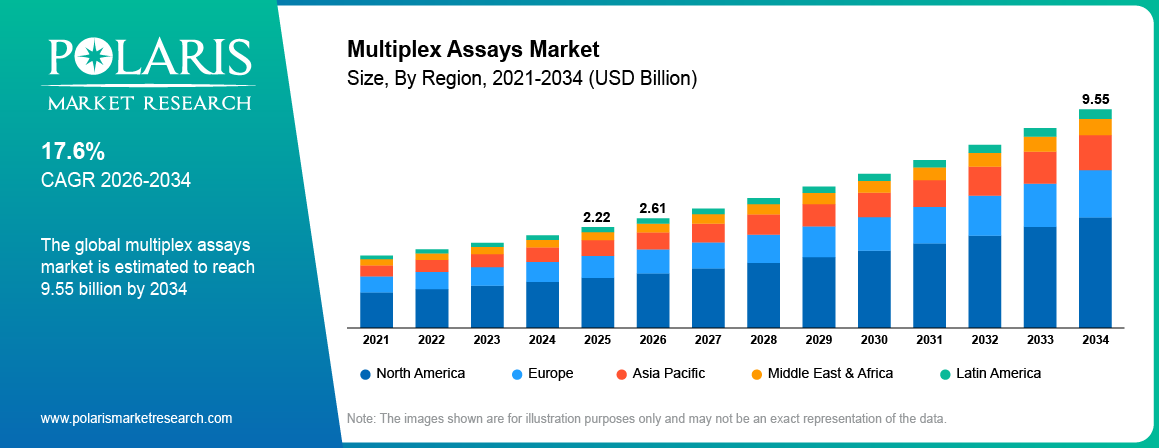
The multiplex assays market size was valued at USD 2.22 billion in 2025. The market is projected to grow at a CAGR of 17.6% from 2026 to 2034. The rising prevalence of infectious diseases and the shift towards precision medicine are among the key factors driving market demand.
Market Statistics
Multiplex Assays Market Key Takeaways
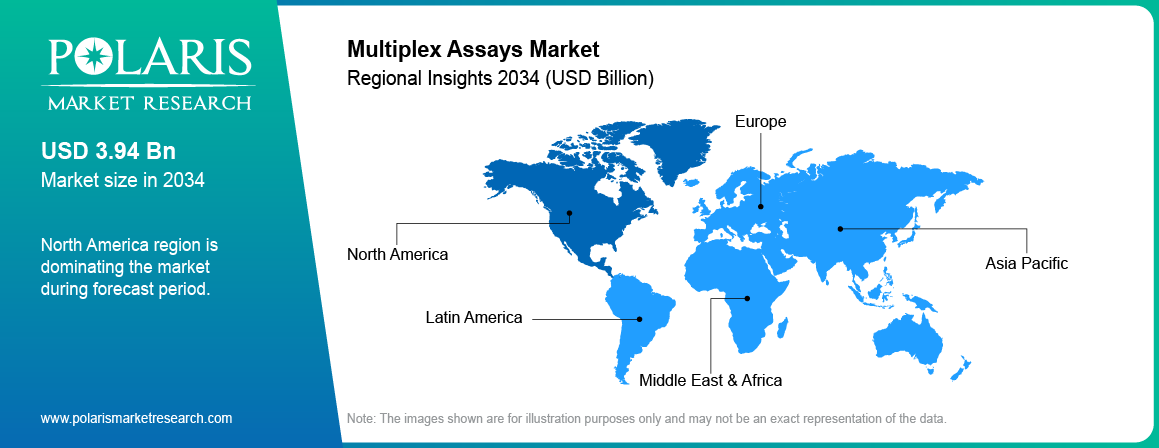
- North America held the largest market share of 41.3% in 2025. This is primarily due to the presence of a well-established healthcare infrastructure.
- Asia Pacific is projected to experience rapid growth at a 9.4% CAGR. Rising healthcare expenditure and expanding research initiatives contribute to the regional market growth.
- The consumables segment led with a 63.8% revenue share in 2025. High demand for reagents and assay kits contributes to the segment’s leading position.
- Nucleic acid multiplex assays are projected to account for a 9.1% CAGR. Genomic advancements and rising precision medicine applications drive the segment’s growth.
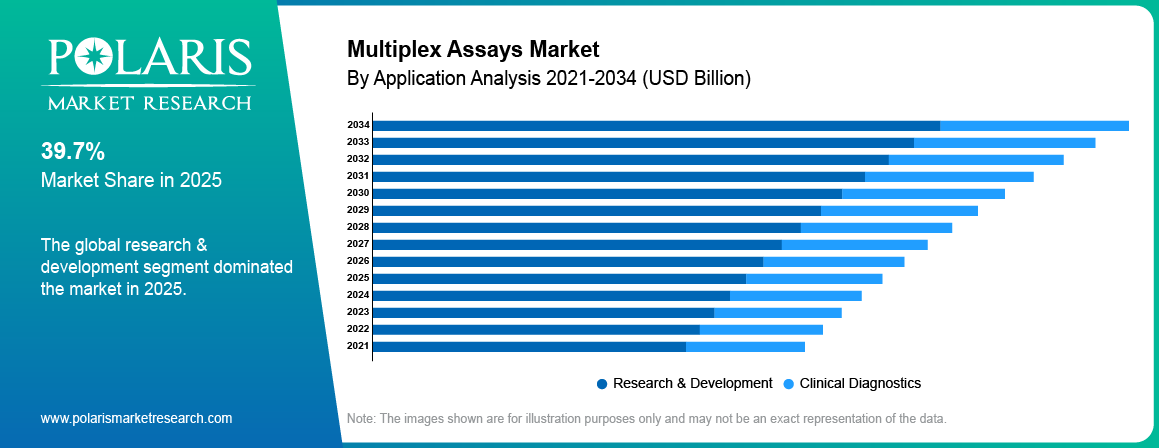
- The research & development segment dominated with a 39.7% market share in 2025. The extensive use of these assays in biomarker validation and drug discovery contributes to the segment’s leading market position
Note: Figures and projections outlined in this report are the result of Polaris Market Research’s proprietary analytical processes, grounded in the latest available datasets and market observations.
AI Impact on Multiplex Assays Market
- The use of AI improves multiplex assays since it helps analyze complex biological information faster and with increased precision.
- It helps detect illnesses faster due to the ability of AI to analyze different markers simultaneously.
- AI increases efficiency in labs by enhancing the efficiency of data analysis.
- It enables better interpretation of huge amounts of diagnostic data.
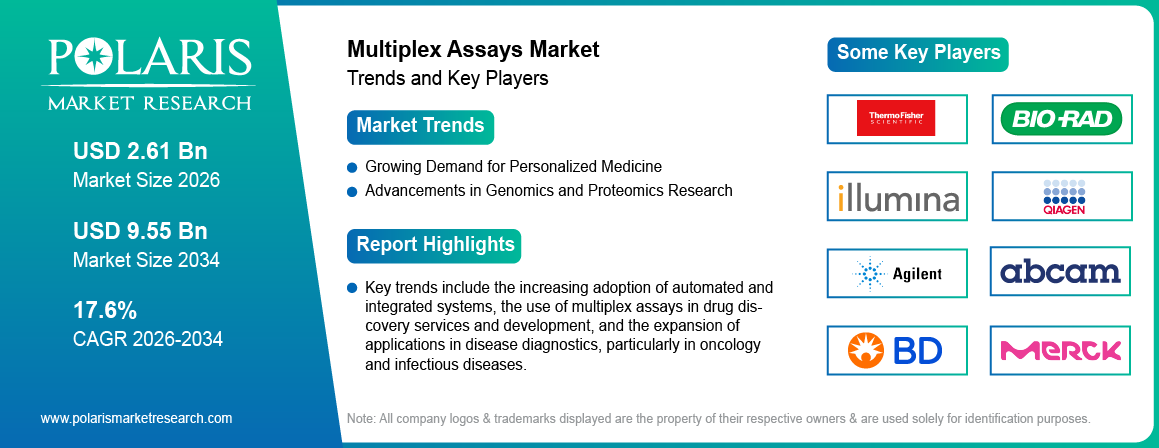
The multiplex assays market refers to the segment of the life sciences and diagnostics industry focused on the development and use of assays that can simultaneously measure multiple analytes in a single run. This market is driven by the growing need for efficient, high-throughput diagnostic tools, advancements in proteomics and genomics research, and the rising demand for personalized medicine. Key trends include the increasing adoption of automated and integrated systems, the use of multiplex assays in drug discovery services and development, and the expansion of applications in disease diagnostics, particularly in oncology and infectious diseases. The multiplex assays market growth is also supported by technological innovations that enhance assay sensitivity and specificity, enabling broader application in clinical and research settings.
Multiplex Assays vs Traditional Singleplex Assays
| Aspect | Multiplex Assays | Singleplex Assays |
| Biomarker Identification | Multiple biomarkers at once | Single biomarker at a time |
| Sample Requirement | Less sample required | More sample required |
| Time for Test | Higher throughputs in tests | Longer processing times |
| Cost Efficiency | Cost effective for multiple tests | Less cost effective for multiple tests |
| Efficiency in Lab | Higher efficiency | Lower efficiency |
Source: Polaris Market Research Analysis
Source: Polaris Market Research Analysis
To Understand More About this Research: Download Sample Report
Market Dynamics
Growing Demand for Personalized Medicine
The shift towards personalized medicine is a significant multiplex assays market driver. Personalized medicine involves tailoring medical treatment to each patient’s individual characteristics, which requires precise and comprehensive diagnostic tools. Multiplex assays enable simultaneous analysis of multiple biomarkers, which is essential for developing targeted therapies. According to a report by the Personalized Medicine Coalition, personalized treatments accounted for 42% of new drugs approved by the FDA in 2021, highlighting the increasing reliance on advanced diagnostic tools such as multiplex assays to support these therapies.
Advancements in Genomics and Proteomics Research
Advancements in genomics and proteomics research are another major driver of the multiplex assays market. These fields require the analysis of complex biological systems, necessitating tools that can measure multiple analytes efficiently. Multiplex assays offer the ability to analyze numerous genes or proteins in a single experiment, saving time and resources. The Human Genome Project, which has significantly boosted genomics research, has led to a greater understanding of genetic variations and their links to diseases, further driving the need for multiplex assays in both research and clinical applications.
Increasing Use in Drug Discovery and Development
The pharmaceutical industry increasingly relies on multiplex assays during drug discovery and development to improve efficiency and accuracy. These assays allow for the simultaneous testing of multiple compounds or biomarkers, accelerating the identification of potential drug candidates and their effects. According to a study published in Nature Reviews Drug Discovery in 2023, the use of multiplex assays can reduce the time required for preclinical testing by up to 30%, thereby enhancing the overall drug development process. This efficiency gain is crucial for pharmaceutical companies aiming to bring new drugs to market quickly and cost-effectively.
Source: Polaris Market Research Analysis
Segment Insights
Multiplex Assays Market Assessment By Product & Service
The market by product & service is segmented into consumables, instruments, and software & services. The consumables segment holds the largest multiplex assays market share of 63.8%, driven by the high demand for reagents, assay kits, and other consumable products necessary for assay procedures. This segment's dominance is attributed to the recurring nature of consumable purchases, as these products are required for every assay run, ensuring a continuous revenue stream. The growing number of research activities and diagnostic applications further fuels the demand for consumables, making them indispensable in both clinical and research laboratories.
The software & services segment is also registering the fastest growth, propelled by the increasing adoption of advanced data analysis solutions and the rising need for specialized services such as assay development, validation, and technical support. The integration of advanced software for data management and interpretation enhances the efficiency and accuracy of multiplex assays, attracting more users to this segment. Additionally, the trend towards outsourcing assay services to specialized providers is contributing to the rapid expansion of the software & services segment, as organizations seek to streamline operations and focus on core research and development activities.
Multiplex Assays Market Evaluation by Type
The multiplex assays market segmentation, based on type, includes protein multiplex assays, nucleic acid multiplex assays, and cell-based multiplex assays. Protein multiplex assays hold the largest market share, primarily due to their extensive use in clinical diagnostics, biomarker discovery, and pharmaceutical research. The ability of protein multiplex assays to simultaneously measure multiple proteins in a single sample makes them invaluable for applications in disease diagnostics, particularly in oncology and infectious diseases. The growing emphasis on personalized medicine, which often relies on protein biomarkers to tailor treatments, further drives the demand for protein multiplex assays, ensuring their dominant position in the market.
Nucleic acid multiplex assays are also registering the fastest growth with CAGR 9.1%, fueled by advancements in genomics and the rising application of these assays in precision medicine. These assays are critical for detecting and quantifying multiple genetic markers simultaneously, making them essential tools in genetic research, pathogen detection, and cancer diagnostics. The increasing focus on early and accurate disease detection, coupled with technological innovations that enhance the sensitivity and specificity of nucleic acid assays, is driving the rapid adoption of this segment. Additionally, the growing trend of integrating nucleic acid assays into point-of-care diagnostic platforms further contributes to their accelerated growth.
Multiplex Assays Market Assessment by Application
The market by application is segmented into research & development and clinical diagnostics. The research & development segment holds the largest multiplex assays market share of 39.7%, driven by the extensive use of these assays in drug discovery, biomarker validation, and various genomic biomarkers and proteomic studies. The ability to analyze multiple analytes simultaneously makes multiplex assays essential for high-throughput screening and large-scale research projects. The continuous growth in biopharmaceutical research and increasing investments in R&D by pharmaceutical companies and academic institutions further solidify the dominance of this segment.
The clinical diagnostics segment is also registering the fastest growth, propelled by the rising demand for precise and efficient diagnostic tools in the healthcare industry. Multiplex assays are increasingly utilized for disease diagnostics, particularly in oncology, infectious diseases, and genetic testing, due to their capability to provide comprehensive diagnostic insights from a single sample. The growing adoption of personalized medicine and the need for rapid, accurate diagnostics in clinical settings are significant factors contributing to the accelerated growth of the clinical diagnostics segment. Additionally, the integration of multiplex assays into point-of-care testing is further expanding their application in clinical diagnostics.
Multiplex Assays Market Evaluation by End User
The multiplex assays market segmentation, based on end user, includes pharmaceutical & biotechnology companies, hospitals & research institutes, and reference laboratories. Pharmaceutical & biotechnology companies hold the largest market share, driven by their extensive use of these assays in drug discovery, development, and biomarker validation. The ability of multiplex assays to provide comprehensive data on multiple analytes simultaneously makes them indispensable for high-throughput screening and personalized medicine initiatives. The increasing investment in research and development by these companies to develop targeted therapies and innovative drugs further supports the dominance of this segment.
Hospitals & research institutes are also registering the fastest growth, primarily due to the expanding use of multiplex assays in clinical diagnostics and translational research. The rising demand for advanced diagnostic tools for disease identification and monitoring, particularly in oncology and infectious diseases, is fueling the adoption of multiplex assays in hospital laboratories. Additionally, research institutes are leveraging these assays for various genomic and proteomic studies, contributing to the rapid expansion of this segment. The integration of multiplex assays into routine diagnostic workflows and the growing emphasis on precision medicine are key factors driving this segment’s growth.
Source: Polaris Market Research Analysis
Regional Insights
By region, the study provides multiplex assays market insights into North America, Europe, Asia Pacific, Latin America, and the Middle East & Africa. North America holds the largest market share of 41.3% in 2025, primarily due to the presence of a well-established healthcare infrastructure, significant investment in research and development, and the early adoption of advanced diagnostic technologies. The region's strong focus on personalized medicine, coupled with the high prevalence of chronic diseases such as cancer and infectious diseases, drives the multiplex assays market demand. Additionally, the support from government and private organizations for innovative diagnostic tools and the presence of major pharmaceutical and biotechnology companies further enhance the market's growth in North America. Europe and Asia Pacific also show promising growth due to increasing healthcare investments and expanding research activities.
The multiplex assays market in Europe is driven by the growing focus on precision medicine and the increasing prevalence of chronic diseases such as cancer and cardiovascular conditions. The region benefits from robust healthcare systems, significant government support for research and development, and a strong presence of pharmaceutical and biotechnology companies. Countries such as Germany, the UK, and France are leading in adopting advanced diagnostic technologies, further propelling market growth.
Asia Pacific market is experiencing rapid growth of CAGR 9.4% due to rising healthcare expenditure, expanding research initiatives, and increasing demand for advanced diagnostic tools. The region's large population base, coupled with the growing prevalence of infectious and chronic diseases, drives the need for efficient diagnostic solutions such as multiplex assays. Key countries such as China, Japan, and India are investing heavily in healthcare infrastructure and research, which significantly contributes to the multiplex assays market expansion. The increasing adoption of personalized medicine and government initiatives supporting biotechnology research further enhance the growth prospects in Asia Pacific.
Cost and Accessibility Considerations
While multiplex systems have many benefits like higher efficiency in testing, high-throughput, and reduction in sample volumes, the sophisticated hardware, reagents, and software associated with these tests usually require significant initial investments. Small laboratories, diagnostic clinics, and healthcare institutions, particularly those from emerging markets, might find it challenging to implement such technologies due to financial and logistical limitations. Besides the cost of the technology itself, the recurrent costs linked to the reagents used, software updates, maintenance of the device, calibration, and training are likely to raise the total price for their implementation. Moreover, limited coverage by insurance companies and restricted access to molecular diagnostics infrastructure might limit the expansion of these technologies to certain regions. For that reason, manufacturers are striving to design more affordable and compact multiplex devices.
Source: Polaris Market Research Analysis
Key Players and Competitive Insights
Key players in the multiplex assays market include Thermo Fisher Scientific, Inc.; Bio-Rad Laboratories, Inc.; Luminex Corporation (a part of DiaSorin); Illumina, Inc.; QIAGEN N.V.; Agilent Technologies, Inc.; Abcam plc; Becton; Dickinson and Company; Merck KgaA; PerkinElmer, Inc.; Meso Scale Diagnostics, LLC; Randox Laboratories Ltd.; Seegene Inc.; Quanterix Corporation; and Olink Holding AB. These companies are actively engaged in developing innovative multiplex assay solutions, catering to the growing demand for advanced diagnostic and research tools.
The competitive landscape of the multiplex assays industry is characterized by continuous innovation and strategic collaborations. Companies such as Thermo Fisher Scientific and Bio-Rad Laboratories focus on expanding their product portfolios through research and development, aiming to enhance the sensitivity and specificity of their assays. Luminex Corporation, now part of DiaSorin, leverages its proprietary xMAP technology to provide flexible and scalable solutions for various diagnostic and research applications. Additionally, QIAGEN and Illumina are at the forefront of integrating next-generation sequencing technologies with multiplex assays, further advancing the capabilities of molecular diagnostics.
Insights into the competitive dynamics reveal that companies are increasingly adopting strategies such as mergers, acquisitions, and partnerships to strengthen their market presence and broaden their customer base. The emphasis on technological advancements, including automation and integration of artificial intelligence, plays a crucial role in maintaining competitiveness. Moreover, the growing focus on personalized medicine and the expansion of multiplex assays into emerging markets create opportunities for both established players and new entrants to capture market share and drive growth in this evolving sector.
Thermo Fisher Scientific, Inc. is a multiplex assays market key player, known for its extensive range of products in life sciences and diagnostics. The company focuses on providing innovative multiplexing solutions for research and clinical applications. Bio-Rad Laboratories, Inc. is another prominent company in the market. It offers a variety of multiplex assay technologies, including its widely used Bio-Plex system. Bio-Rad focuses on developing tools that facilitate high-throughput and accurate biomarker detection.
List of Key Companies in Multiplex Assays Market
- Thermo Fisher Scientific, Inc.
- Bio-Rad Laboratories, Inc.
- Luminex Corporation (part of DiaSorin)
- Illumina, Inc.
- QIAGEN N.V.
- Agilent Technologies, Inc.
- Abcam plc
- Becton, Dickinson and Company
- Merck KGaA
- PerkinElmer, Inc.
- Meso Scale Diagnostics, LLC
- Randox Laboratories Ltd.
- Seegene Inc.
- Quanterix Corporation
- Olink Holding AB
Industry Developments
-
March 2026: bioMérieux announced receiving IVDR CE-marking for the BIOFIRE SPOTFIRE R/STplus Panel Mini and BIOFIRE SPOTFIRE R/STplus Panel. These point-of-care, multiplex PCR tests allow rapid, near-patient detection of common respiratory and sore throat pathogens during a standard medical consultation. (source: biomerieux.com)
-
February 2026: Waters Corporation finalized a strategic merger with BD's Biosciences/Diagnostic units. According to BD, the combination will expand its multiplexed diagnostic and flow cytometry capabilities. (source: bd.com)
Market Segmentation
By Product & Service Outlook (Revenue-USD Billion, 2021–2034)
- Consumables
- Instruments
- Software & Services
By Type Outlook (Revenue-USD Billion, 2021–2034)
- Protein Multiplex Assays
- Nucleic Acid Multiplex Assays
- Cell-Based Multiplex Assays
By Technology Outlook (Revenue-USD Billion, 2021–2034)
- Flow Cytometry
- Fluorescence Detection
- Luminescence
- Multiplex Real-Time PCR
- Others
By Application Outlook (Revenue-USD Billion, 2021–2034)
- Research & Development
- Clinical Diagnostics
By End User Outlook (Revenue-USD Billion, 2021–2034)
- Pharmaceutical & Biotechnology Companies
- Hospitals & Research Institutes
- Reference Laboratories
By Regional Outlook (Revenue-USD Billion, 2021–2034)
- North America
- US
- Canada
- Europe
- Germany
- France
- UK
- Italy
- Spain
- Netherlands
- Russia
- Rest of Europe
- Asia Pacific
- China
- Japan
- India
- Malaysia
- South Korea
- Indonesia
- Australia
- Vietnam
- Rest of Asia Pacific
- Middle East & Africa
- Saudi Arabia
- UAE
- Israel
- South Africa
- Rest of Middle East & Africa
- Latin America
- Mexico
- Brazil
- Argentina
- Rest of Latin America
Report Scope
| Report Attributes | Details |
| Market Size Value in 2025 | USD 2.22 billion |
| Market Size Value in 2026 | USD 2.61 billion |
| Revenue Forecast by 2034 | USD 9.55 billion |
| CAGR | 17.6% from 2026 to 2034 |
| Base Year | 2025 |
| Historical Data | 2021–2024 |
| Forecast Period | 2026–2034 |
| Quantitative Units | Revenue in USD billion and CAGR from 2026 to 2034 |
| Report Coverage | Revenue Forecast, Market Competitive Landscape, Growth Factors, and Industry Trends |
| Segments Covered |
|
| Regional Scope |
|
| Competitive Landscape |
|
| Report Format |
|
| Customization | Report customization as per your requirements with respect to countries, regions, and segmentation. |
Source: Polaris Market Research Analysis
How is the report valuable for an organization?
Workflow/Innovation Strategy: The multiplex assays market has been segmented into detailed segments of product & service, type, technology, application, and end user. Moreover, the study provides the reader with a detailed understanding of the different segments at both the global and regional levels.
Growth/Marketing Strategy: The growth and marketing strategy of the multiplex assays market largely focuses on expanding product offerings through continuous innovation and enhancing the sensitivity and precision of assays. Companies are investing in research and development to create more advanced and automated systems, catering to the growing demand for personalized medicine and high-throughput diagnostics. Strategic partnerships and collaborations with research institutions and healthcare providers are key to increasing market reach. Additionally, market players are targeting emerging markets by improving accessibility to multiplex assays and focusing on cost-effective solutions to meet the rising demand in both clinical and research applications.
Multiplex Assays Market FAQ's
The multiplex assays market size was valued at USD 2.22 billion in 2025 and is projected to grow to USD 9.55 billion by 2034.
The market is projected to register a CAGR of 17.6% during the forecast period, 2026-2034.
North America had the largest share of 41.3% in 2025.
Key players in the multiplex assays market include Thermo Fisher Scientific, Inc.; Bio-Rad Laboratories, Inc.; Luminex Corporation (a part of DiaSorin); Illumina, Inc.; QIAGEN N.V.; Agilent Technologies, Inc.; Abcam plc; Becton; Dickinson and Company; Merck KgaA; PerkinElmer, Inc.; Meso Scale Diagnostics, LLC; Randox Laboratories Ltd.; Seegene Inc.; Quanterix Corporation; and Olink Holding AB.
The consumables segment accounted for the larger share of 63.8% in 2025.
The protein multiplex assay segment accounted for the larger share of 38.21% in 2025.
Multiplex assays are diagnostic or research tools that allow the simultaneous measurement of multiple analytes (such as proteins, nucleic acids, or cells) within a single sample. These assays are designed to detect and quantify several targets at once, making them more efficient and cost-effective compared to traditional single-analyte assays. By using specific reagents and detection systems, multiplex assays can analyze complex biological samples for various biomarkers, which is particularly useful in disease diagnostics, drug discovery, and genomic research. They offer enhanced throughput and reduced sample and reagent usage, supporting advancements in personalized medicine and high-throughput screening.
A few key trends in the market are described below: Integration with Next-Generation Sequencing (NGS): Increasing adoption of multiplex assays combined with NGS technologies for more accurate and comprehensive analysis. Rise in Personalized Medicine: Growing demand for multiplex assays in developing targeted therapies and individualized treatments. Technological Advancements: Innovation in assay sensitivity, automation, and integration with artificial intelligence for enhanced data analysis.
A new company entering the multiplex assays market should focus on developing innovative, cost-effective solutions that integrate advanced technologies such as automation, artificial intelligence, and next-generation sequencing (NGS). Emphasizing rapid and accurate point-of-care diagnostics can help meet the growing demand for timely disease detection. Additionally, the company could focus on niche applications, such as personalized medicine or rare disease diagnostics, to differentiate itself. Collaborating with research institutions or healthcare providers to ensure alignment with emerging trends and regulatory requirements would also be a strategic move to stay ahead of the competition.
Companies manufacturing, distributing, or purchasing multiplex assays and related products, and other consulting firms must buy the report.
Download Sample Report of Multiplex Assays Market
Please fill out the form to request a customized copy of the research report.


