
Neovagina Surgery Market Size, Key Players and Regional Outlook, 2027–2034
REPORT DETAILS
Neovaginal Surgery Market Summary
The global neovagina surgery market is estimated at USD 1.38 billion in 2026 and is projected to reach USD 1.45 billion in 2027, expanding to USD 2.07 billion by 2034 at a CAGR of 5.2% during 2027–2034. Neovagina surgery is used both for people born without a vagina, such as those with MRKH syndrome, and for gender-affirming care. Robotic and peritoneal-flap techniques are improving outcomes and shortening recovery, which is encouraging more specialist centres to offer the procedure.
Market Statistics
Key Takeaways
• Penile inversion vaginoplasty holds the largest procedure share, an estimated 52.5% of revenue in 2026, as the most widely practised technique.
• The peritoneal-flap vaginoplasty segment accounts for an estimated 15.0% share, supported by the use of peritoneal tissue in selected reconstructive procedures.
• Gender-affirming surgery leads by indication with an estimated 68.1% share in 2026, while congenital conditions such as MRKH syndrome form an important clinical segment.
• Non-surgical vaginal dilation remains the first-line option for many MRKH patients, so surgery is often reserved for those who need it.
• North America holds the largest regional share, at an estimated 40.4% in 2026, though policy changes are creating uncertainty.
• Europe is expected to grow steadily, currently at an estimated 29.6% share, with specialist units adopting robotic techniques.
• The market is served by a small number of specialist surgical centres and the device makers that supply robotic and grafting tools.
Neovaginal surgery processes include vagina restoration, often opted by transgender, rising cases of women suffering from vaginal agenesis. Key factors responsible for the market growth include a sudden spike in gender confirmation surgeries and legal applicability towards insurance coverage has boosted the neovaginal surgery market growth.
Know more about this report: Download Sample Report
In the last few years, there has been a rise in gender confirmation procedures and the social acceptance of transgender among society. As per the market estimates of the American Society of Plastic Surgeons (ASPS), there is a rise of more than 15 percent in gender confirmation surgeries from 2018, in the U.S.
Industry Dynamics
Growth Drivers
Many insurance firms in the developed regions are providing healthcare coverage including sex-change surgeries. For instance, an Australia-based Health Insurance Fund includes insurance coverage for neovaginal reconstruction and sex-change surgeries. Emerging countries such as India and China also provide financial assistance to individuals seeking such transformation surgeries.
Owing to such increased demand for neovaginal surgery, service providers are taking several positive initiatives to expand their geographic reach and patient inflow. For instance, in June 2018, Cedars Sinai increased their transgender services to other regions in the country.
The innovations in the surgical techniques reduce the patient journeys via reducing the time of the neovaginal surgery and its high cost. COVID-19 pandemic has also posed enormous challenges for the healthcare service providers and the patients involved in varied health conditions.
Owing to nationwide lockdown during the COVID-19 pandemic has canceled elective procedures such as sex-change surgeries to save resources and money. For instance, GRS Montreal has canceled gender-based surgeries last year to focus on COVID-19 patients. This temporary cancellation has led to fear in the mind of patients, as they are needed to go pre-authorization process, again from the beginning.
Know more about this report: Download Sample Report
Neovaginal Surgery Market Report Scope
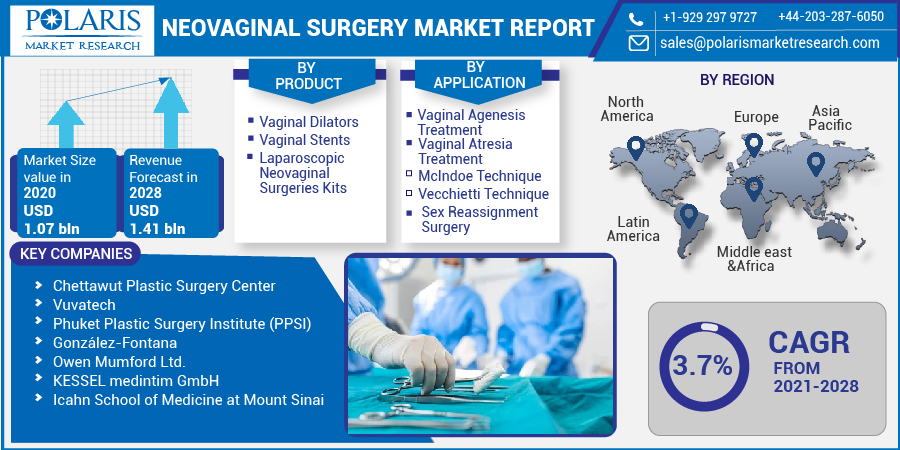
The market is primarily segmented on the basis of product, treatment type, and geographic region.
| By Product | By Treatment Type | By Region |
|
|
|
Source: Polaris Market Research Analysis
Know more about this report: Download Sample Report
Insight by Product
In 2020, the laparoscopic surgery kits market segment accounted for the majority of the share in the global market. The segment is also expected to grow at a lucrative growth rate over the assessment period owing to the rise in laparoscopic surgeries and growing preference towards minimally invasive surgeries for the treatment of vaginal agenesis in women.
The vaginal dilators market segment of neovaginal surgery industry is projected to register a lucrative growth rate over the assessment period. These dilators are used to restore damaged tissues of the vagina. Moreover, the rising adoption of silicone dilators for the women suffering from Mayer–Rokitansky–Küster–Hauser syndrome (MRKH), is continuously rising driving the overall market for neovaginal surgery.
In addition, growing patient’s preference for laparoscopic surgeries for the vaginal reconstruction over traditional techniques, which includes colitis, scarring, prolonged recovery, and excess mucous secretion is also boosting the market segment’s growth prospects in neovaginal surgery market.
Geographic Overview
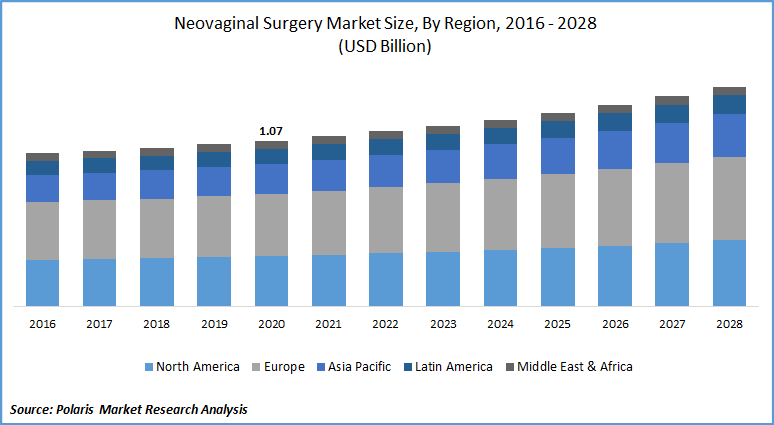
In 2020, Europe accounted for a significant revenue share of the global market. The factors responsible for such a high market share include an increase in demand for vaginoplasty, awareness among patients regarding the pros of cosmetic surgeries and inclined safety concerns and rising disposable income among women in the region are the key factors responsible for the region’s market growth for neovaginal surgery.
With rising social acceptance towards sex change and gender change surgeries among the population in the European market and an increase in the number of surgical procedures are driving the adoption of vaginal dilators, stents, and neovaginal surgery kits to perform such neovaginal surgery.
However, Asia Pacific neovaginal surgery demand is expected to witness a lucrative market growth rate over the study period. The major factors contributing to such growth of neovaginal surgery in the region include an increase in awareness regarding neovaginal surgeries and a surge in medical tourists in emerging countries, owing to a rise in healthcare costs. Moreover, rising insurance coverage and social acceptance in the region also contributing to the region’s market growth prospects for neovaginal surgery procedures.
List Of Key Companies
- Chettawut Plastic Surgery Center
- Vuvatech
- Phuket Plastic Surgery Institute (PPSI)
- González-Fontana
- Owen Mumford Ltd.
- KESSEL medintim GmbH
- Icahn School of Medicine at Mount Sinai
Recent Industry Developments
In October 2026, the Hospital das Clínicas of the Federal University of Pernambuco, Brazil, announced performing innovative neovaginoplasty procedures on three patients, using Nile tilapia skin to reconstruct and enlarge the vaginal canal. The procedures were performed on October 27 and 28, in the framework of a clinical research project linked to the Federal University of Ceará. The technique is intended to increase neovaginal depth and diameter and thus improve anatomical function and quality of life for the patient. The development is a step forward in biological graft-assisted neovaginal reconstruction, but further clinical evaluation is needed to determine its broader effectiveness. (Source: HU Brasil)
In October 2026, Researchers at the Wake Forest Institute for Regenerative Medicine presented initial results from a Phase I clinical trial at the 2026 American Urogynecologic Society meeting in patients with vaginal agenesis who received a tissue-engineered neovagina . The technique uses patients’ own epithelial and smooth muscle cells that are seeded on biodegradable scaffolds to create a vaginal tissue construct for implantation. The technology, however, is still investigational and cannot be characterized as a surgical product that has been commercially launched. (Source: American Urogynecologic Society)
In January 2026, researchers associated with University Hospitals Cleveland Medical Center and partner institutions published an early clinical assessment of a robotic-assisted neovaginoplasty technique known as Tubularized Augmented Peritoneal Cap, or TAPCap. The technique utilizes the peritoneal tissue and decellularized fish-skin grafts to create a full-depth neovaginal canal. This technique may decrease the dependence on available genital skin and the need for preoperative hair removal, supporting innovation in reconstructive and gender-affirming neovagina surgery. (Source: Translational Andrology and Urology)
Neovaginal Surgery Market FAQ'S
The neovagina surgery market is valued at USD 1.38 billion in 2026 and is expected to reach USD 1.45 billion in 2027 and USD 2.07 billion by 2034, according to Polaris Market Research.
The neovagina surgery market is projected to grow at a CAGR of 5.2% from 2027 to 2034, adding roughly USD 0.62 billion in value over the forecast period.
Neovagina surgery is used both for people born without a vagina, such as those with MRKH syndrome, and for gender-affirming care. Robotic and peritoneal-flap techniques are improving outcomes and shortening recovery, which is encouraging more specialist centres to offer the procedure.
The main applications are Mayer-Rokitansky-Küster-Hauser (MRKH) syndrome, gender-affirming surgery, and vaginal reconstruction after cancer or traumRobotic and peritoneal-flap techniques are improving outcomes.

Download Sample Report of Neovaginal Surgery Market
Please fill out the form to request a customized copy of the research report.


