
Offshore Wind Energy Market Share, Size, Trends, Industry Analysis Report, 2026 - 2034
REPORT DETAILS
Offshore Wind Energy Market Summary
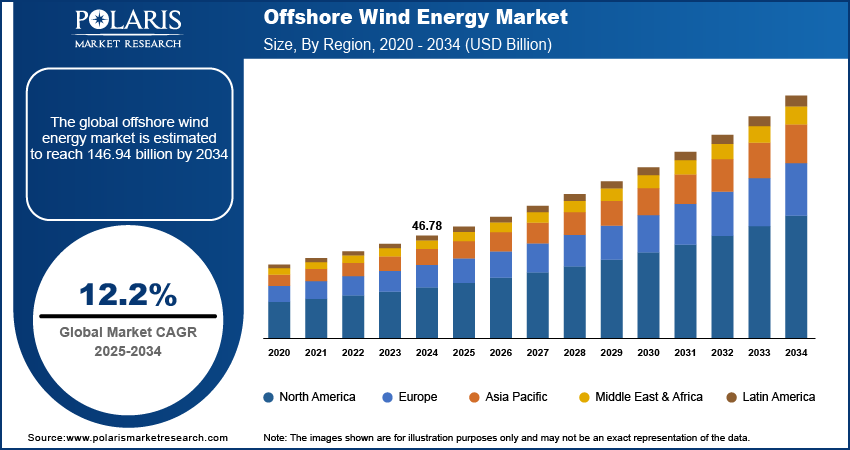
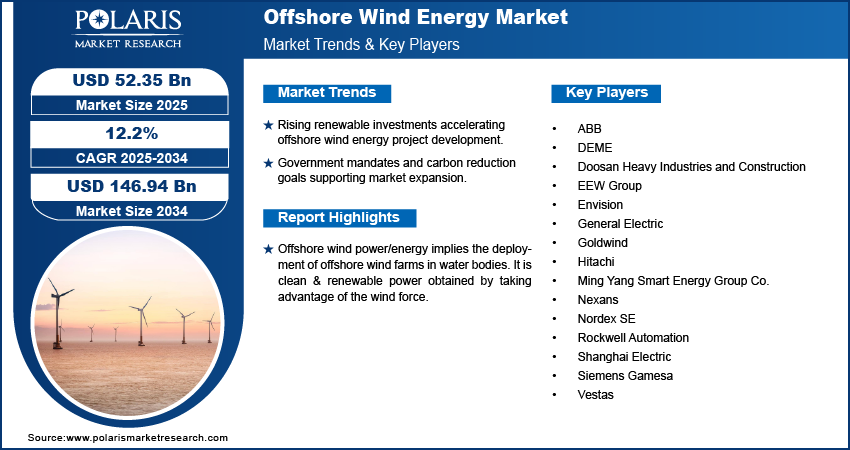
The global offshore wind energy market was valued at USD 68.05 billion in 2025 and is expected to grow at a CAGR of 12.2% during the forecast period. Key factors driving the demand includes rising investment in renewable energy, increasing government initiatives, rising demand for renewable power sources, and the increased focus on lowering the global carbon footprint.
Market Statistics
Key Takeaways
- Europe is expected to grow at a CAGR of 4.0% in 2025. This is attributed to increased investment in renewable energy.
- The Asia Pacific region lead the global market with a share of 39.9% in 2025. This is because of government policies promoting the adoption of renewable energy sources.
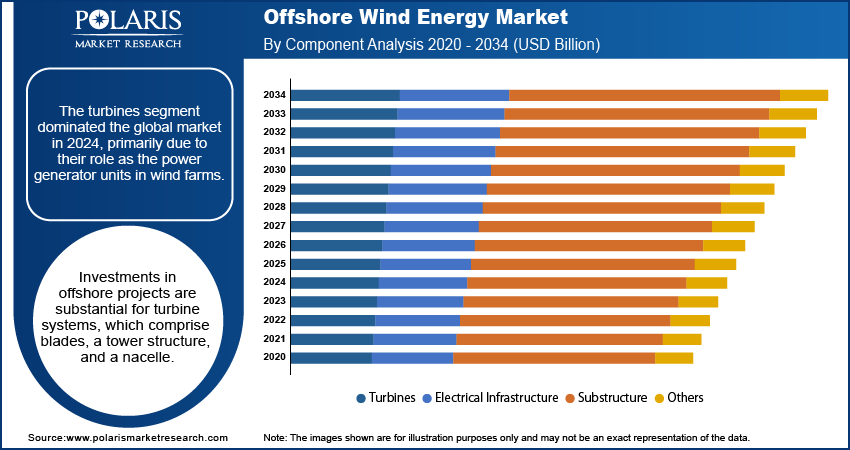
- The turbines category had the leading share of 40.0% in the global market in 2025, owing to their function as generators of power in the wind farms.
- The shallow water segment held the maximum market share of 50.0% in 2025. This is attributed to the easier installation of the offshore wind towers in the shallow waters.
- The deep water segment is expected to grow at a 11.7% CAGR during the projection period. This is due to water depths exceeding 30 meters becoming more popular.
- Note: Figures and projections outlined in this report are the result of Polaris Market Research’s proprietary analytical processes, grounded in the latest available datasets and market observations.
Industry Dynamics
- The increased investment in renewable power boosted the expansion of offshore wind energy projects. This is due to the power industry which has shifted toward green and renewable energy sources.
- Government mandates are being implemented to support renewable energy programs. This is due to industrial businesses which are making efforts to lower their carbon emissions, driving the expansion opportunities.
- High capital investment and longer development cycles, which involve supply chain logistics, maritime construction, and grid connection, create substantial challenges.
- The expansion of floating offshore wind technology creates growth opportunities for harnessing vast, unexplored deep-water wind sources for power generation.
AI Impact on Offshore Wind Energy Market
- AI helps monitor the performance of wind turbines and increase energy production.
- It is able to identify problems beforehand, preventing any failures and delays.
- Data gathered from sensors and intelligent devices assists in making decisions.
- Drones and automation enable faster and safer inspections at reduced costs.
Source: Polaris Market Research Analysis
To Understand More About this Research: Download Sample Report
Offshore wind power/energy implies the deployment of offshore wind farms in water bodies. It is clean & renewable power obtained by taking advantage of the wind force. The market for offshore wind power is expected to expand due to the rising demand for renewable power sources and the increased focus on lowering the global carbon footprint. The market’s growth is projected to be boosted by the expanding attempts by governmental organizations and power corporations to reduce carbon emissions.
According to IRENA (International Renewable Energy Agency), renewables must increase from 25% to 86% by 2050 in the yearly global power generation to satisfy the Paris Agreement's objective. Further, Bloomberg BNEF estimates that over USD 13.3 trillion will be spent on new production assets. According to BNEF, wind & solar is expected to account for half of the global electricity generation by 2050. Additionally, the rising installation of turbines globally is anticipated to drive the growth of the offshore wind energy market.
Cumulative installed offshore wind generation capacity in operation and future predictions across the world.
| Year | Cumulative Installed Offshore Wind Generation Capacity (GW) |
| 2011 | 3.3 |
| 2012 | 4.8 |
| 2013 | 6.8 |
| 2014 | 7.8 |
| 2015 | 11.5 |
| 2016 | 12.8 |
| 2017 | 17.0 |
| 2018 | 22.1 |
| 2019 | 27.3 |
| 2020 | 32.5 |
| 2030 | 260 |
| 2024 | 590 |
Source: Polaris Market Research Analysis
Source: Offshore Wind Energy Brochure, Offshore Infrastructure Regulator
These disruptions in the supply chain, lockdown measures, and limited corporate spending are anticipated to hamper offshore wind market development. However, the industry is projected to bounce back as governments lift lockdown restrictions across nations. According to the International Energy Agency, the offshore renewable power industry is predicted to grow fast post-pandemic.
Source: Polaris Market Research Analysis
Growth Drivers
The increased investment in renewable power is fueling the expansion. The power industry has shifted toward green and renewable energy sources to, among other things, slow the depletion of fossil fuels, mitigate climate change, and reduce carbon emissions due to the increased emphasis on environmental sustainability. Additionally, several government rules are being implemented to support renewable energy programs. Many industrial businesses are making efforts to lower their carbon emissions. For instance, one of Norway's top power companies, Equinor, plans to reduce its carbon emissions by more than 50% by 2025. The company plans to develop its renewable power business, which is estimated to grow to 6,000 megawatts within six years and to over 16,000 megawatts within 15 years. Additionally, another energy giant, Total, acquired a 51% stake in SSE Renewable's Seagreen 1 offshore renewable farm project. The company is further estimated to invest over EUR 70 million in this project.
Types of Offshore Wind Energy
| Types | Description | Water Depth | Benefits | Issues |
| Fixed-Bottom Offshore Wind | Fixed-bottom offshore wind energy system utilizes turbines that are attached to fixed structures that rest on the seabed | Upto 50 meters | Reliable technology and affordable | Shallow waters only |
| Floating Offshore Wind | Floating offshore wind power system has turbines set up on floating towers anchored on the seabed | more than 50 meters (deep waters) | Stronger winds available | More expensive |
| Transitional Offshore Wind | Transitional offshore wind power is a combination of both shallow and deep water technologies | 30-50 meters | Cost-efficient | Installation issues |
Source: Polaris Market Research Analysis
Report Segmentation
The market is primarily segmented on the basis of component, location, and region.
| By Component | By Location | By Region |
|
|
|
Source: Polaris Market Research Analysis
Know more about this report: Download Sample Report
Segmental Insights
Component Analysis
The turbines segment dominated the global market values at 27.22 billion in 2025, primarily due to their role as the power generator units in wind farms. Investments in offshore projects are substantial for turbine systems, which comprise blades, a tower structure, and a nacelle. Advances in technology have focused on the development of larger and more powerful turbines that can generate greater wind energy with improved capacity. This trend towards upgrading reduces the cost of energy with maximum output per turbine. Thus, increasing investments and revenue are supporting the segment's dominant position.
Source: Polaris Market Research Analysis
Location Analysis
The shallow water segment held the largest revenue share of 49.9% in 2025, as most energy projects are launched in shallow water. Installing the offshore wind tower in shallow water is more accessible and requires less capital investment. This location is the most popular offshore renewable farm development due to the ideal weather conditions and ease of maintenance. Additionally, building an electrical infrastructure in this sector is much simpler. It is predicted that these advantages of shallow water settings would boost the segment's expansion. However, turbines with smaller Megawatt capacities are placed in this area due to the lower offshore wind speed in shallow water.
Deep water segment is expected to witness significant growth during the forecast period at a CAGR of 11.7%, due to the water depth which exceeds 30 meters, are becoming increasingly popular nowadays. It is projected that rising investments in deep-water, floating offshore wind-generating projects would accelerate the segment's growth.
Regional Analysis
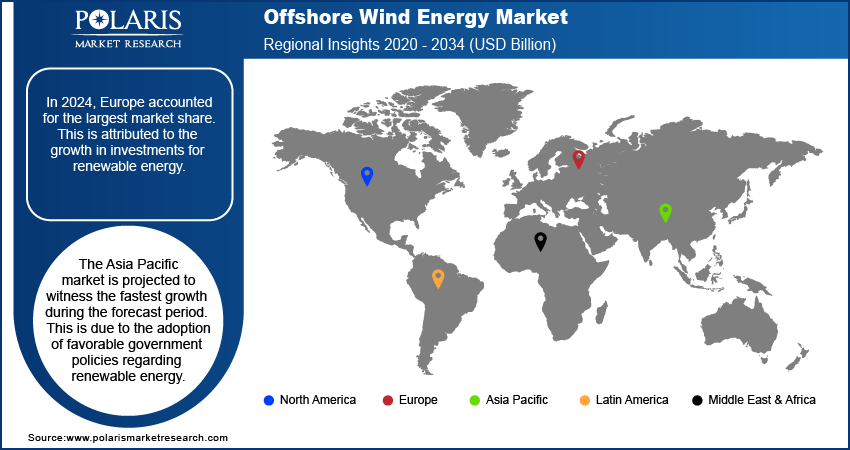
The Asia Pacific market dominated the market in 2025 with a revenue share of 39.9%. The adoption of favorable government policies regarding renewable energy throughout rising nations such as China, India, and Japan, among others, might be linked to the market expansion in the Asia Pacific region.
Europe is expected to growth at a CAGR of 4.0%. This huge market share is attributed to the growing investments in renewable energy coupled with favorable government policies. Various key offshore renewable power companies in Europe, such as Vestas, ABB, Siemens, and Nordex SE, are anticipated to boost the market's growth.
Furthermore, EWI supports offshore wind energy market development and a research & development program for renewable power. Additionally, various countries across Europe are increasing their focus on upgrading their electrical infrastructure, and the government in these nations is promoting the use of renewable energy for power generation. Thus, driving the growth of the market.
Which Region is Expected to Witness Significant Growth in the Offshore Wind Energy Market?
The North America offshore wind energy industry held a revenue share of 16.9% in 2025. Supportive government policies and rising renewable energy targets will boost the industry growth. Also, technological advancements in turbines, rising investments, and surging demand for sustainable, large-scale clean power generation are expected to drive the market in North America. The U.S. holds the largest regional market share. The U.S. offshore wind energy market will experience continuous growth, driven by state-level offshore wind procurement activities and policies. These activities estimate the requirement for deploying at least 39,298 MW of offshore wind capacity by 2040.
Offshore Wind State Procurement Policies and Activities in the U.S. as of May 31, 2021
| State | Total Capacity Commitment (MW) | Target Year | Amount Procured (MW) | Contract Type | Year Enacted | Authority |
| Massachusetts | 5,600 | 2035 | 1,604 | PPA | 2016 | An Act to Promote Energy Diversity |
| Rhode Island | 430 | – | 430 | PPA | - | - |
| New Jersey | 7,500 | 2035 | 1,100 | OREC | 2010 | Offshore Wind Economic Development Act |
| Maryland | 1,568 | 2030 | 368 | OREC | 2013 | Maryland Offshore Wind Energy Act |
| New York | 9,000 | 2035 | 6,816 | OREC | 2018 | Case 18-E0071 |
| Connecticut | 2,000 | 2030 | 1,104 | PPA | 2017 | Public Act 17-144 |
| Virginia | 5,200 | 2034 | 12 | Utility-Owned | 2020 | Virginia Clean Energy Economy Act |
| North Carolina | 8,000 | 2040 | 0 | TBD | 2021 | Executive Order 218 |
| Total | 39,298 |
| 11,434 |
|
|
|
Source: Polaris Market Research Analysis
(Source: Offshore Wind Energy Strategies, U.S. Department of Energy)
Note: PPA = power purchase agreement; OREC = offshore renewable energy certificates
Source: Polaris Market Research Analysis
Competitive Insight
Some of the major players operating in the global offshore wind energy market include ABB, DEME, Doosan Heavy Industries and Construction, EEW Group, Envision, General Electric, Goldwind, Hitachi, Ming Yang Smart Energy Group Co., Nexans, Nordex SE, Rockwell Automation, Shanghai Electric, Siemens Gamesa, and Vestas.
Industry Developments
December 2025: ABB completed the acquisition of Siemens Gamesa’s power electronics unit. As per the company, the acquisition is expected to enhance its capabilities in offshore wind electrification and grid solutions. (Source: abb.com)
December 2025: Vestas reported the installation of 200 GW wind turbines worldwide. The firm emphasized that this milestone supports its leading position in wind power technologies. (Source: vestas.com)
August 2025: Mitsubishi Corporation stated it was reassessing how to move forward with its offshore wind projects in Japan. This notable change in the business environment suggests the country may not be immune to escalating costs affecting offshore wind projects worldwide. (Source: mitsubishicorp.com)
Offshore Wind Energy Market Report Scope
| Report Attributes | Details |
| Market size value in 2025 | USD 68.05 billion |
| Market size value in 2026 | USD 76.18 billion |
| Revenue forecast in 2034 | USD 191.99 billion |
| CAGR | 12.2% from 2026 - 2034 |
| Base year | 2025 |
| Historical data | 2021 - 2024 |
| Forecast period | 2026 - 2034 |
| Quantitative units | Revenue in USD billion and CAGR from 2026 to 2034 |
| Segments covered | By Component, By Location, By Region |
| Regional scope | North America, Europe, Asia Pacific, Latin America, Middle East & Africa |
| Key companies | ABB, DEME, Doosan Heavy Industries and Construction, EEW Group, Envision, General Electric, Goldwind, Hitachi, Ming Yang Smart Energy Group Co., Nexans, Nordex SE, Rockwell Automation, Shanghai Electric, Siemens Gamesa, and Vestas. |
Source: Polaris Market Research Analysis
Offshore Wind Energy Market FAQ's
• The global market size was valued at USD 68.05 billion in 2025 and is projected to grow to USD 191.99 billion by 2034.
• The global market is projected to register a CAGR of 12.2% during the forecast period.
• Asia Pacific dominated the global market share in 2025.
• A few key market players are ABB, DEME, Doosan Heavy Industries and Construction, EEW Group, Envision, General Electric, Goldwind, Hitachi, Ming Yang Smart Energy Group Co., Nexans, Nordex SE, Rockwell Automation, Shanghai Electric, Siemens Gamesa, and Vestas.
• The turbines segment dominated the global market in 2025.
• The deep water segment is expected to witness growth during the forecast period.
Download Sample Report of Offshore Wind Energy Market
Please fill out the form to request a customized copy of the research report.


