
Pocket Printer Market Size, Trends & Share Report, 2024-2032
REPORT DETAILS
Pocket Printer Market Summary
Global pocket printer market size was valued at USD 1,596.07 million in 2023. The industry is projected to grow from USD 1,738.87 million in 2024 to USD 3,479.88 million by 2032, exhibiting a compound annual growth rate (CAGR) of 9.1% during the forecast period (2024 - 2032).
Market Statistics
A pocket printer is a compact, portable printing device designed to fit easily into a pocket or small bag, allowing users to print photos, documents, and other materials. The surge in the pocket printer market is being fueled by the growing consumer electronics industry across the globe. The increasing production of consumer electronics is rising due to the proliferation of smartphones, tablets, and other mobile accessories. For instance, according to IBEF, the electronics hardware production in India reached USD 87 billion in 2022. The consumer electronics and home appliances market in India is projected to expand by USD 2.3 billion from 2022 to 2027. This growth is creating a demand for portable accessories and fueling the production of advanced printing solutions. Thus, the synergy between the growth of consumer electronics and the demand for mobile printing solutions is driving the expansion of the pocket printer market, as pocket printer offers a way to print photos, documents, and other materials directly from electronic devices.
Furthermore, the growth of the pocket printer market is attributed to the increasing focus on wireless device integration. Pocket printers are primarily equipped with Bluetooth and Wi-Fi connectivity, enabling effortless printing from various wireless devices such as tablets, smartphones, and laptops. This wireless functionality reduces the requirement for physical connections, providing users with enhanced flexibility and convenience of printing without being restricted to a specific device or location.
Source: Polaris Market Research Analysis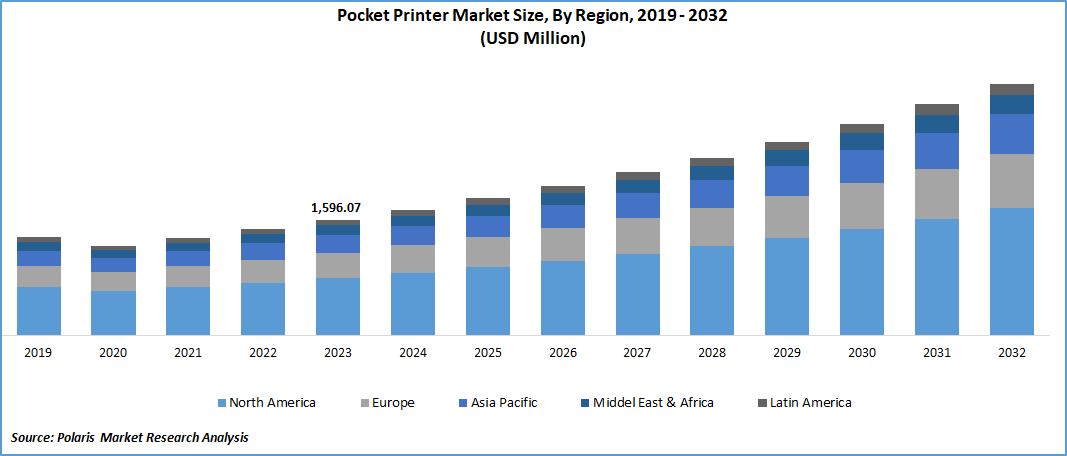
To Understand More About this Research:Download Sample Report
Pocket Printer Market Trends
Increasing Product Launches Are Driving the Market Growth
The printing solution providers are frequently launching new models of pocket printers with enhanced features to improve print quality, increase speeds, and provide greater connectivity options. For instance, in September 2022, Canon introduced the Zoemini 2, a compact and portable pocket printer targeting smartphone photographers. The ultra-portable device is designed for on-the-go printing, enabling users to instantly produce physical copies of their images for sharing and safekeeping. These types of launches are attracting a diverse customer base and catering to preferences and needs for printing solutions. Thus, the constant innovation and influx of new pocket printers are creating a dynamic and competitive market, thereby driving the growth of the pocket printer industry.
Growth of the Travel and Tourism Industry is Fueling the Market Size
Countries across the globe are experiencing growth in the travel and tourism industry due to increased global connectivity and affordable air travel. For instance, according to the Bureau of Economic Analysis, the travel and tourism industry in the United States has increased by 21.0% in 2022 after growing by 53.6% in 2021. This growth has resulted in the increasing emphasis of tourists on portable and convenient printing solutions. Travelers are demanding compact devices that easily fit into luggage and provide immediate, high-quality prints of their experiences. Pocket printers cater to this need, allowing tourists to instantly print photos directly from their smartphones or laptops. Thus, the demand for portable printing solutions is increasing due to the expanding travel and tourism industry, thereby driving the growth of the pocket printer market.
Source: Polaris Market Research Analysis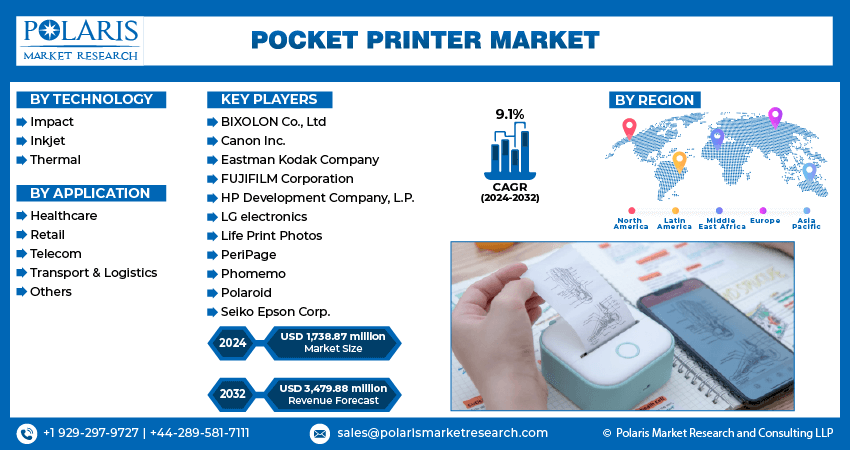
Pocket Printer Segment Insights
Pocket Printer Technology Insights
The global pocket printer market segmentation, based on technology, includes impact, inkjet, and thermal. The thermal technology segment is expected to grow with a significant CAGR due to its advantages over ink-based printing methods. Thermal printers are highly favored for their low maintenance needs, making them ideal for portable printing solutions. These printers eliminate the need for ink cartridges or ribbons and reduce long-term operational costs. Also, thermal printing offers faster print speeds and high-quality output, which is particularly attractive for users seeking instant photo prints or quick document printing. Thus, the advantages offered by thermal printers are anticipated to drive the growth of the thermal segment in the pocket printer market.
Pocket Printer Application Insights
The global pocket printer industry segmentation, based on application, includes healthcare, retail, telecom, transport & logistics, and others. In 2023, the retail segment held the largest revenue share in the global market due to the convenience, efficiency, and growing applications of these printers in the retail sector. In the retail industry, pocket printers streamline processes such as printing receipts, price tags, and promotional materials directly at the point of sale. The compact size and wireless capabilities of pocket printers enable quick and easy printing without the need for larger stationary equipment. Thus, the benefits offered by pocket printers enhance the operational efficiency of retail shops and contribute to the dominant revenue share of the retail segment in the pocket printer market.
Global Pocket Printer Market, Segmental Coverage, 2019 - 2032 (USD million)
Source: Polaris Market Research Analysis
Source: Secondary Research, Primary Research, PMR Database and Analyst Review
Pocket Printer Regional Insights
By region, the study provides the pocket printer market insights into North America, Europe, Asia-Pacific, Latin America, and Middle East & Africa. The North America pocket printer market held the highest revenue share due to the business presence of several key manufacturers such as Seiko Epson Corp., Eastman Kodak Company, HP Development Company, L.P., LG Electronics, and Canon Inc. in the region. The presence of these companies fosters innovation and promotes competitive pricing and strong distribution networks, all of which contribute to a growing pocket printer market. Also, advanced technological infrastructure and high consumer demand for portable printing solutions further contribute to North America's dominant position in the global market.
Further, the major countries studied in the market report are the US, Canada, Germany, France, the UK, Italy, Spain, China, Japan, India, Australia, South Korea, and Brazil.
Global Pocket Printer Market, Regional Coverage, 2019 - 2032 (USD million)
Source: Polaris Market Research Analysis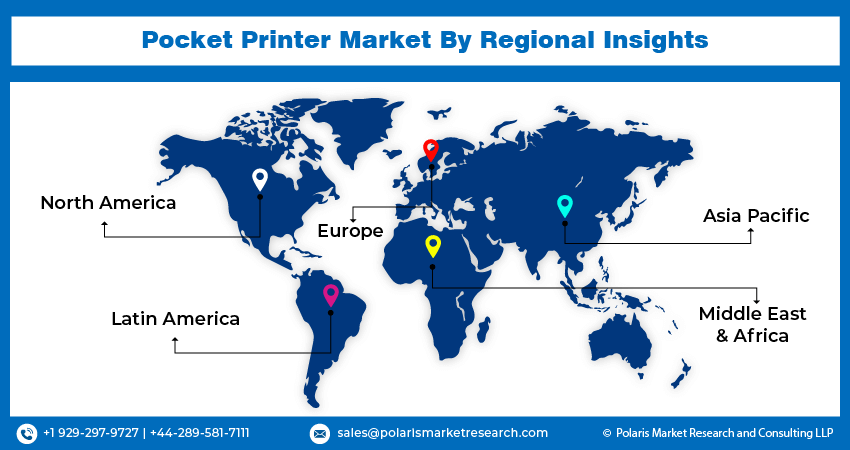
Source: Secondary Research, Primary Research, PMR Database and Analyst Review
The Asia Pacific pocket printer market is anticipated to grow significantly due to the increased adoption of these devices in the healthcare and telecom sectors. In healthcare, pocket printers are being used for printing patient records, prescriptions, and test results, which enhances efficiency and reduces paperwork. Additionally, in the telecom sector, pocket printers are employed for on-site printing of customer receipts, service agreements, and maintenance logs, which helps streamline operations and improves customer service. Therefore, the convenience and versatility offered by pocket printers in these sectors are driving market growth in the Asia Pacific region.
Furthermore, the China pocket printer market is expected to grow significantly due to the rising number of product introductions by China-based global companies. The manufacturers are leveraging their strong R&D capabilities and understanding of domestic consumer preferences to develop innovative and cost-effective pocket printer solutions. For instance, in July 2024, Xiaomi introduced an updated version of its Mijia Pocket Photo Printer, known as the 1S. The new model offers enhanced features aimed at personalization and augmented reality (AR) experiences. Thus, the launch of products integrated with augmented reality is driving the China pocket printer market.
Pocket Printer Key Market Players & Competitive Insights
Leading market players are investing heavily in research and development in order to expand their product portfolio, which will help the pocket printer market grow even more. Market participants are also undertaking a variety of strategic activities to expand their global footprint, with important market developments including innovative product launches, international collaborations, higher investments, and mergers and acquisitions between organizations. To expand and survive in a more competitive and rising market environment, the pocket printer industry must offer cost-effective solutions.
The key companies in the market are investing heavily in research and development to enhance print quality, portability, and connectivity features, aiming to cater to diverse consumer needs. Major players in the pocket printer market include BIXOLON Co., Ltd, Canon Inc., Eastman Kodak Company, FUJIFILM Corporation, HP Development Company, L.P., LG electronics, Life Print Photos, PeriPage, Phomemo, Polaroid, and Seiko Epson Corp.
Canon Inc. is a global manufacturer and seller of a diverse range of products. The company operates through multiple segments, including printing, imaging, medical systems, industrial, and others. Under the printing business unit, Canon offers a comprehensive array of products, including multifunction devices (MFDs), laser and inkjet printers, scanners, and large-format printers. The imaging business unit specializes in interchangeable-lens digital cameras, lenses, camcorders, and professional imaging equipment such as digital cinema cameras and projectors. Canon's medical system business unit provides advanced medical imaging equipment, such as CT, MRI, and X-ray systems, diagnostic ultrasound, and ophthalmic devices. The industrial business unit manufactures semiconductor lithography equipment, OLED display manufacturing tools, and vacuum deposition equipment. In February 2020, Canon introduced its compact photo printer, the Selphy Square QX10. The printer features a built-in rechargeable battery and utilizes thermal transfer dye-sublimation technology to produce high-quality image prints.
Seiko Epson Corporation and its subsidiaries specialize in the development, manufacturing, sale, and servicing of products in printing solutions, visual communications, manufacturing-related wearables, and other areas. The company was founded in 1942 and is headquartered in Suwa-shi, Japan. Epson operates through three main segments, including printing solutions, visual communications, and manufacturing-related and wearables. Seiko Epson has a global presence with operations in Japan, the United States, the Philippines, China, Indonesia, and other international locations. In October 2022, Epson announced the expansion of its portfolio of Mobilink wireless receipt printers with the introduction of three new models, including the Mobilink TM-P80II, Mobilink TM-P20II, and Mobilink TM-P80II Plus.
Key companies in the pocket printer market include:
- BIXOLON Co., Ltd
- Canon Inc.
- Eastman Kodak Company
- FUJIFILM Corporation
- HP Development Company, L.P.
- LG electronics
- Life Print Photos
- PeriPage
- Phomemo
- Polaroid
- Seiko Epson Corp.
Pocket Printer Industry Developments
- July 2024: PHOMEMO introduced the PHOMEMO Inkless Portable Printer P15, which is engineered to streamline and elevate the printing experience for creative projects.
- March 2024: Canal Toys, a company in the toy industry, launched the Photo Creator Instant Pocket Printer. The printer is a part of Canal Toys' photo creator range and is recognized for its instant print cameras.
Pocket Printer Market Segmentation:
Pocket Printer Technology Outlook
- Impact
- Inkjet
- Thermal
Pocket Printer Application Outlook
- Healthcare
- Retail
- Telecom
- Transport & Logistics
- Others
Pocket Printer Regional Outlook
- North America
- US
- Canada
- Europe
- Germany
- France
- UK
- Italy
- Spain
- Netherlands
- Russia
- Rest of Europe
- Asia-Pacific
- China
- Japan
- India
- Malaysia
- South Korea
- Indonesia
- Australia
- Rest of Asia-Pacific
- Middle East & Africa
- Saudi Arabia
- UAE
- Israel
- South Africa
- Rest of Middle East & Africa
- Latin America
- Mexico
- Brazil
- Argentina
- Rest of Latin America
Pocket Printer Report Scope:
| Report Attributes | Details |
| Market Size Value in 2023 | USD 1,596.07 million |
| Market Size Value in 2024 | USD 1,738.87 million |
| Revenue Forecast in 2032 | USD 3,479.88 million |
| CAGR | 9.1% from 2024 – 2032 |
| Base Year | 2023 |
| Historical Data | 2019 – 2022 |
| Forecast Period | 2024 – 2032 |
| Quantitative Units | Revenue in USD million and CAGR from 2024 to 2032 |
| Report Coverage | Revenue Forecast, Market Competitive Landscape, Growth Factors, and Trends |
| Segments Covered |
|
| Regional Scope |
|
| Competitive Landscape |
|
| Report Format |
|
| Customization | Report customization as per your requirements with respect to countries, region, and segmentation. |
Source: Polaris Market Research Analysis
Pocket Printer Market FAQ's
The global pocket printer market size was valued at USD 1,596.07 million in 2023 and is projected to grow to USD 3,479.88 million by 2032
The global market is projected to grow at a CAGR of 9.1% during the forecast period, 2024-2032
North America had the largest share of the global market.
The key players in the market are BIXOLON Co., Ltd, Canon Inc., Eastman Kodak Company, FUJIFILM Corporation, HP Development Company, L.P., LG Electronics, Life Print Photos, PeriPage, Phomemo, Polaroid, and Seiko Epson Corp
The thermal segment had the highest CAGR in the global market.
The retail category held the highest share in the pocket printer market in 2023.
Download Sample Report of Pocket Printer Market
Please fill out the form to request a customized copy of the research report.


