
Missile Warhead Market Size, Share, and Forecast 2026 to 2034
REPORT DETAILS
Missile Warhead Market Summary
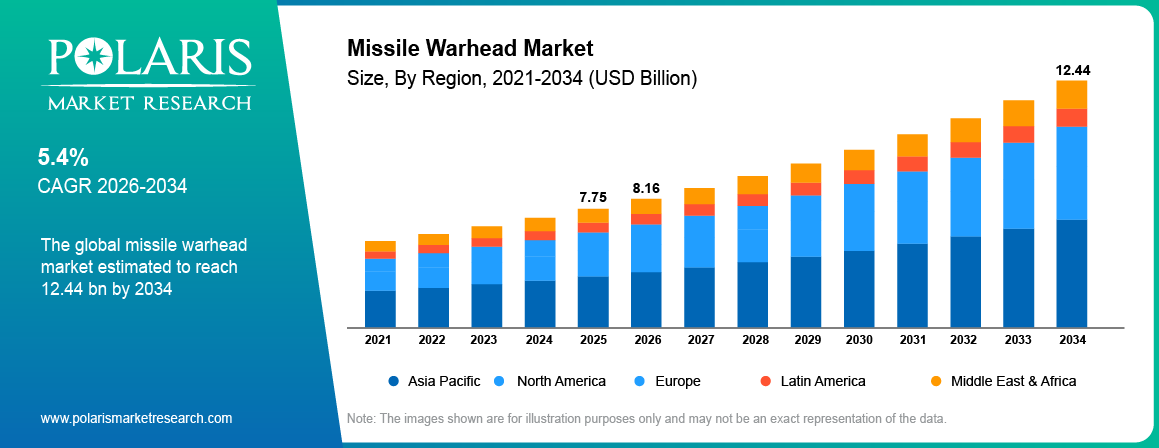
Missile warhead market size was valued at USD 7.75 billion in 2025. The market is expected to grow at a CAGR of 5.4% from 2026 to 2034 to reach USD 12.44 billion by 2034. Growth is driven by missile procurement, stockpile replenishment, interceptor production expansion, and investment in domestic warhead manufacturing capacity.
Market Statistics
Key Takeaways
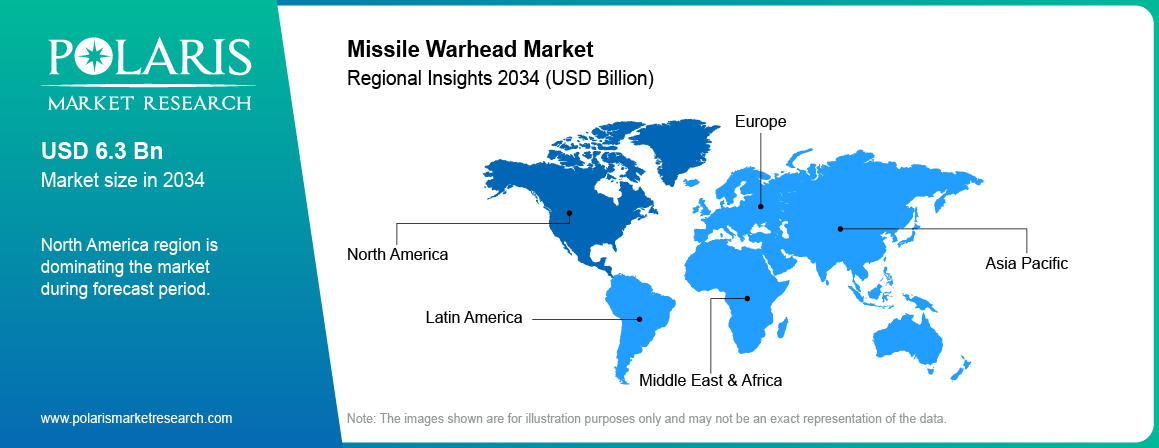
- North America dominated the missile warhead market with an estimated 35.50% share in 2025, driven by large missile procurement programs and established defense manufacturing capabilities.
- Asia Pacific is expected to register the fastest growth at 5.70% CAGR during 2026–2034, supported by domestic defense production and investment in missile manufacturing.
- High Explosive warheads accounted for an estimated 47.50% share in 2025, owing to their broad use across conventional missile applications.
- Penetrator warheads are expected to register the fastest growth at 5.90% CAGR during 2026–2034, driven by demand for capabilities designed to strike hardened and fortified targets.
- Air Defense and Air-to-Air Missiles accounted for an estimated 23.20% share in 2025, driven by interceptor procurement and production expansion.
- Naval platforms accounted for an estimated 23.05% share in 2025, supported by Tomahawk and SM-6 procurement.
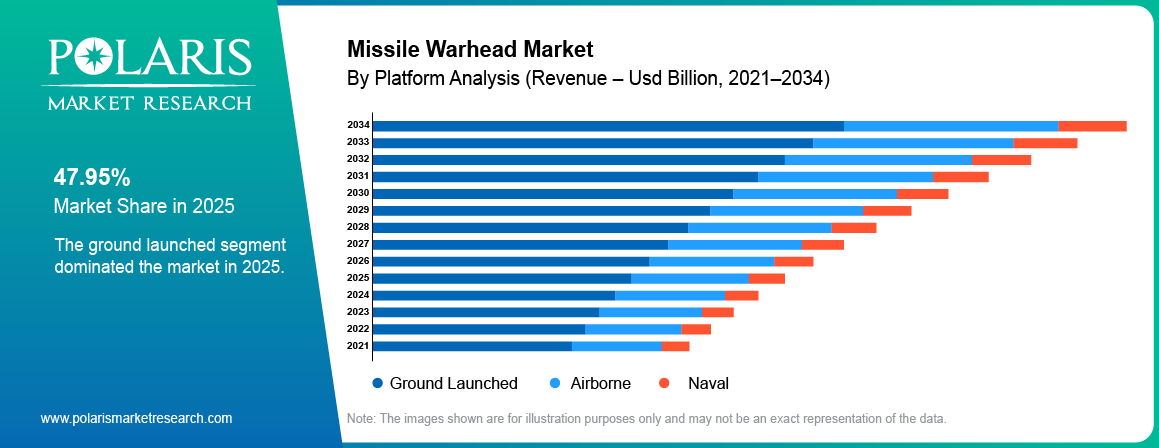
- Ground launched platforms accounted for 47.95% in 2025, supported by investment in land based strike capabilities.
Note: Figures and projections outlined in this report are the result of Polaris Market Research’s proprietary analytical processes, grounded in the latest available datasets and market observations.
What is a Missile Warhead Market?
The missile warhead market covers warhead assemblies designed to deliver explosive effects against designated targets. A missile warhead system market includes components such as the warhead case, explosive fill, fuzewell, and related assembly components. Demand is linked to missile procurement, stockpile replenishment, defense modernization, and domestic warhead manufacturing. The market scope focuses on the warhead assembly value rather than the total value of the missile system.
The missile warhead market covers applications across cruise missiles, ballistic missiles, air defense missiles, air-to-air missiles, and anti-tank missiles. Major warhead categories include high explosive, penetrator, fragmentation, thermobaric, and other conventional designs. The Tomahawk and SM-6 programs, among others, represent procurement efforts in relation to various missile applications. Procurement of increased numbers of SM-6 and warhead assemblies stresses the need for an increase in component fabrication to support higher numbers of missiles being produced. Warhead assembly demand is related to defense modernization, replacement of stockpiles, and specific production demands associated with the program itself.
The missile warhead market comprises assemblies and components that are specifically related to warhead manufacturing. The major elements are warhead bodies, explosive fills, fuzewells and related subassemblies. General Dynamics’ contract for Tomahawk warhead production included Tomahawk warhead cases and fuzewells, reflecting demand for specialized warhead components. The procurement activity highlights the role of component manufacturers in missile production programs. These products are in demand based on production schedules, procurement volumes and stockpile replenishment. Investment in manufacturing capacity and supplier networks also affects the availability of warhead assemblies across defense programs. This report counts the warhead section only and excludes rocket motors, guidance, airframes and whole missile value, which belong to the rockets and missiles market. Gun and artillery ammunition is excluded and sits within the ammunition market. Nuclear warheads are out of scope, while warheads for loitering and drone systems are in scope. Contract values for complete missiles usually include the warhead without a separate split, so a warhead sold inside a missile counts once at an analyst set warhead share. The Rheinmetall chief executive described rocket motors and warheads as separate bottlenecks, which supports sizing the warhead on its own (Source: Euronews). If an item is the warhead section or its explosive fill, it is in scope, and if it is a motor, seeker or whole missile, it is out.
Market Dynamics
Missile Warhead Market Driver & Opportunities Impact Analysis
| Factor | Type | Impact | Regions | Timeline |
| Missile production ramps and multiyear procurement | Driver | High | North America, Europe | Near term |
| Second sources and domestic warhead plants | Driver | High | Europe, Asia Pacific | Mid term |
| Bunker strike penetrator demand | Opportunity | Medium | North America | Mid term |
| Drone and loitering munition warheads | Opportunity | Medium | Europe, Asia Pacific | Mid term |
Source: Polaris Market Research Analysis. Impact ratings are provisional analyst assessments.
Driver: Rising Missile Production and Multiyear Procurement
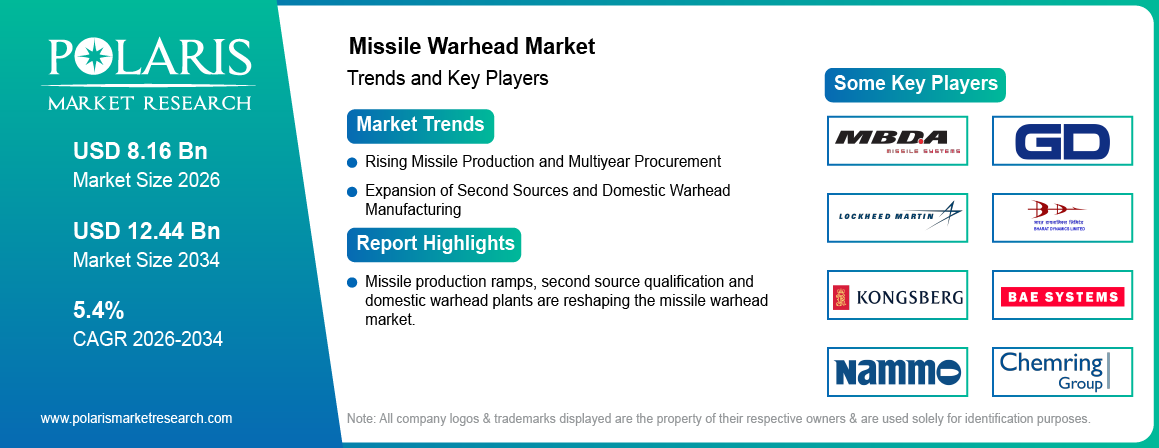
The increased missile production requires warhead assemblies for all cruise missiles, interceptors, anti-tank missiles and other weapons systems. Multi-year procurement programs and efforts to replenish stockpiles incentivize manufacturers to increase production and acquire supplies of warhead cases, explosive fills, fuzewells and associated components. Higher production volumes also allow suppliers to increase manufacturing capacity and meet delivery schedules for defense programs. In October 2026, Lockheed Martin was awarded a USD 694 million contract by the US Air Force to manufacture ARRW hypersonic missiles and to grow the company’s production plant in Alabama. These developments should provide the basis for growth in the missile warhead market and provide opportunities for established manufacturers and specialist component suppliers (Source: Air & Space Forces Magazine). In October 2026, the US Navy awarded RTX a multiyear contract of up to USD 24.4 billion for SM-6 interceptors, a five year award with two option years that supports output above 500 missiles a year (Source: Army Recognition). Under February 2026 frameworks, RTX committed to raise annual output to more than 1,000 Tomahawk, at least 1,900 AMRAAM and more than 500 SM-6 missiles, with agreements of up to seven years (Source: USNI News). The AMRAAM multiyear award of up to USD 20.7 billion followed in September 2026, although neither the Pentagon nor RTX specified how many missiles it buys (Source: Defense News). None of these awards states a warhead count or value, so the warhead share of a missile contract remains an analyst estimate, and a missile contract is not a warhead contract.
Driver: Expansion of Second Sources and Domestic Warhead Manufacturing
Defense manufacturers are broadening the production options to avoid dependence on a limited number of suppliers. A second source provides buyers with an alternate supplier for key components and helps mitigate the risk of production delays. Domestic warhead plants also offer better access to assembly capacity, energetic materials and specialist manufacturing processes. Saudi Arabia is reinforcing its Al Duwadimi missile complex in October 2026, possibly to boost domestic production of larger, longer-range solid-fuel ballistic missiles amid tensions with Iran. These investments will allow the manufacturers to respond to increased orders and changing procurement requirements. New facilities need skilled workers, safety systems, testing capacity and reliable material supplies before they reach full output. Broader supplier networks could enhance delivery resilience and unlock opportunities across the penetrator warhead market and other conventional warhead categories (Source: Reuters). On October 7, 2026, NAVAIR announced its intent to award Raytheon a sole source low rate initial production contract for the JMEWS warhead on Tomahawk Block Vb, which moves the program from development into production (Source: GovContractFinder). In August 2026, General Dynamics Ordnance and Tactical Systems received a USD 41.57 million modification for hundreds of Tomahawk warhead cases and fuzewells, with 99% of the work at Anniston, Alabama (Source: 256 Today). In March 2026, the Australian Department of Defence signed a letter of intent with German warhead manufacturer TDW to explore local manufacture of Naval Strike Missile and Joint Strike Missile warheads (Source: Australian Defence Magazine). No public source gives a warhead plant capacity figure, and the Saudi item above concerns solid propellant motor production, not warheads.
Restraint: Warhead and Energetics Production Bottlenecks
The missile warhead market is constrained by supply of energetic materials, explosive filling, fuzewells and specialist manufacturing capacity. Limited access to these inputs can delay the assembly of warheads even when orders for missiles rise. Production also relies on trained workers, safety controls, testing facilities and approved suppliers. These requirements constrain how quickly manufacturers can ramp up production. So higher demand may not immediately mean higher available supply, but rather longer delivery schedules. This helps to explain why missile warhead shortages can occur during periods of broader defense production growth. The Rheinmetall chief executive said on September 17, 2026 that missile stockpiles in Germany remain worryingly low and that rocket motors and warheads are both severe bottlenecks (Source: Defence Industry Europe). Chemring reported an Energetics order book of £917 million at April 30, 2026, with first half order intake of £54 million against £394 million a year earlier, which reflects the timing of orders and is not a warhead measure (Source: Chemring). No source quantifies the warhead shortfall or lead time.
Opportunity: Growing Demand for Penetrator Warheads for Hardened Targets
The requirement for bunker strike capabilities presents opportunities for advanced warhead designs for hardened and fortified targets. This is reflected in the JMEWS program for Tomahawk Block Vb. These systems require specialized warhead cases, explosive fills, fuzewells, and dependable detonation systems. Investment in advanced missile capabilities provides opportunities for manufacturers to develop specialized warhead assemblies and expand production capacity. Procurement programs and associated manufacturing requirements are expected to drive demand for advanced penetrator warheads and associated components. On October 7, 2026, NAVAIR published a notice of intent to award Raytheon a sole source low rate initial production contract for the JMEWS warhead on Tomahawk Block Vb. The notice discloses no value, quantity or delivery schedule, and the Navy fiscal 2027 request funds 35 recertified Block Vb missiles (Source: Army Recognition). An earlier engineering and manufacturing development contract of USD 90.4 million supported the warhead (Source: Global Defense Corp). The penetrator segment stays small until a value or quantity is published, and no source gives a penetrator unit price.
Opportunity: Drone, Loitering Munition, and Short-Range Warheads
The emergence of drones, loitering munitions, and short-range missiles creates opportunities for small warhead assemblies. Ukraine increased the production of FPV drones from a few thousand units in 2022 to more than 2 million in 2024, and the monthly production capacity is expected to reach 200,000 units in 2025. Ukraine could produce 4 million drones a year, the Ukrainian President said. These developments show the increasing size of unmanned systems manufacturing and the demand for specialized payloads. Procurement of high explosive, fragmentation and shaped-charge warhead categories can benefit manufacturers with flexible production lines and efficient filling processes (Source: Georgetown University). In October 2026, the European Commission allocated EUR 168.2 million to eight projects that are expected to enable annual output of more than 200,000 loitering munition warheads from 2027 (Source: TRT World). In November 2025, Nammo signed a letter of intent with a Ukrainian industrial partner to form an ammunition joint venture and to strengthen capacity to produce ammunition and warheads (Source: Defence Industry Europe). No source gives a drone warhead price, and no dated source covers thermobaric warheads.
Missile Warhead Market Segmentation Analysis
The report provides a comprehensive analysis of the missile warhead market by warhead type, missile type, platform, and region to identify established market segments and high-growth opportunities. The Tomahawk Block Vb JMEWS warhead sits in Penetrator, Cruise Missiles and Naval, SM-6 sits in Air Defense and Air-to-Air Missiles and Naval, and AMRAAM sits in Air-to-Air Missiles and Airborne. Guidance, range and warhead size were not used as axes because no public source ties them to warhead value. Munitions that carry warheads, such as precision guided munitions, are sized separately by Polaris.
Warhead Type Insights
High Explosive warheads accounted for 47.50% of the global market in 2025, making this the dominating segment. These warheads are used in conventional missiles intended to produce a blast effect against specific targets. Demand across defense programs is driven by their use across cruise missiles, ballistic missiles and other missile systems. Warhead cases, explosive fill, and fuzewells are needed for stockpile re-stocking and missile procurement. Defense modernization also maintains demand for established high explosive designs across multiple conventional missile applications.
Penetrator warheads are projected to record the fastest growth in the global market from 2026 to 2034, with a CAGR of 5.90%. It is applicable to the bunker strike and other specialized missions. For cruise missile applications, the warhead has to be a penetrator, meaning it will penetrate hardened structures before detonating. Demand is a reflection of the defense requirements to engage fortified facilities and protected targets. Missile accuracy and warhead design developments open up opportunities for advanced penetrator systems. Growth of the segment is expected to be aided by procurement programs and production expansion. The demand for specialized conventional warheads for precision strike missions is favoring the segment’s growth prospects over the forecast period.
Fragmentation warheads accounted for an estimated 19.50% share of the global market in 2025. The fragmentation warhead market serves air defense and other conventional missile applications that use fragments to damage designated targets. The fragmentation warhead for air defense missile applications creates demand linked to interceptor procurement, missile production, and stockpile replenishment programs. Program requirements force manufacturers to concentrate on casing design, fragment dispersal and fuze performance. Demand for fragmentation warheads is created by investments in missile defense systems for use in suitable interceptor applications. Missile procurement and expansion of defense manufacturing capacity will continue to support demand in the segment throughout the forecast period.
In 2025, thermobaric warheads were estimated to comprise 8.00% of the global market. These warheads employ fuel-rich explosive formulations to generate intense blast and heat effects under appropriate operational conditions. They are used in the form of special conventional munitions for special conditions of targets. Demand for thermobaric warhead missiles depends on defense procurement priorities, mission requirements and development of compatible missile systems. Their focus is on warhead design, explosives and reliable initiation systems. While its range of applications is smaller than that of high explosive warheads, specialized defense needs keep it in the market. Through 2034, we expect procurement activity to shape demand.
Other warhead types accounted for an estimated 11.50% of the global market in 2025. This category covers shaped-charge and other conventional warheads developed to satisfy specialized target requirements. The shaped charge design is relevant for missiles intended to engage armored vehicles and other protected targets. The demand is driven by anti-armor requirements, missile development programs and procurement decisions by defense forces. Warhead structures and explosive configurations are still being refined by manufacturers to meet particular operational requirements. The segment serves applications that require effects beyond general blast or fragmentation, creating demand across selected missile categories during the forecast period.
Missile Type Insights
Air Defense and Air-to-Air Missiles held the leading position in the global market in 2025 and are projected to record the fastest growth through 2034, with a CAGR of 5.75%. Demand is indicative of interceptor buys, modernization for air defense, and stockpile replenishment. They are equipped with warheads to target airborne threats like aircraft and incoming missiles. Programs like AMRAAM increase production which in turn creates a need for compatible warhead assemblies and associated components. Defense forces are investing in air defense readiness and availability of missiles to meet evolving threats. These priorities are expected to drive the segment demand during the forecast period.
Cruise missile warheads captured an estimated 35.80% of the global market in 2025. Cruise missiles are employed for land-attack and maritime strike missions. The warhead design is chosen based on the type of target and operational requirements. Demand for associated warhead assemblies is driven by procurement programs, stockpile replenishment and increases in missile production. The Tomahawk program shows where warhead components are located in current cruise missile systems. Warhead cases, explosive fills, and fuze assemblies are furnished by manufacturers to program specifications. Higher investment in precision strike capabilities should sustain demand for cruise missile warheads across defense applications over the forecast period.
In 2025, ballistic missile warheads held an estimated 27.00% of the global market. The warhead requirements depend on the missile range, mission profile, payload design and target. Conventional ballistic missile programs create demand for specialized warhead assemblies such as structural components and initiation systems. Demand of the segment across defense forces is driven by procurement activity and missile production plans. Modernization programs also provide opportunities to improve warhead designs and manufacturing capabilities. Demand is expected to be shaped through 2034 by investment in precision strike systems and conventional missile capacity. These factors add to the importance of ballistic missile warheads in the overall market.
Anti-Tank and Other Missiles held an estimated 14.00% share of the global market in 2025. This section contains missiles for armored targets and other special mission roles. Others are for mission-specific requirements. Anti-armor applications use shaped-charge warheads. Demand is tied to defense procurement and modernization programs and the replacement of existing missile stocks. The warhead assembly is manufactured to meet the requirements for target engagement, system compatibility, and operational reliability. Missile systems segment performance is affected by procurement of portable, vehicle-mounted and other missile systems. Continued investment in conventional weapons over the forecast period should support demand for these warheads.
Platform Insights
Naval platforms represented the significant estimated share of the global market in 2025, at V% of total revenue. Naval forces launch missiles from surface ships and submarines to attack land targets, conduct maritime strikes, and fulfill other mission requirements. Demand for naval missile warheads is driven by fleet modernization, missile procurement and stockpile replenishment. Programs involving systems such as Tomahawk create demand for compatible warhead assemblies and related components. Manufacturers supply designs that meet platform integration and operational requirements. Investment in naval strike capabilities and missile readiness is expected to maintain demand across this segment through 2034.
Ground-launched platforms are projected to record the significant growth in the global market from 2026 to 2034, with a CAGR of 5.15%. These platforms include mobile launch vehicles and fixed land-based installations used for different missile missions. The demand is driven by defense modernization, stockpile replacement and investment in land-based strike capabilities. New missile programs are leading to requirements for compatible warhead assemblies and production capacity. Manufacturers also stress the importance of a reliable component supply to meet program schedules. Procurement activity and the expansion of conventional missile inventories are expected to support segment growth. These factors position ground-launched systems as an important source of market demand during the forecast period.
Airborne platforms accounted for an estimated 29.00% share of the global market in 2025. Aircraft-launched missiles perform air-to-air and air-to-ground missions and therefore require warheads that are tailored to specific engagement requirements. Demand for this segment is fueled by procurement of combat aircraft weapons, missile replenishment and platform modernization. Warhead assemblies are manufactured to meet missile integration, performance and reliability requirements. Production programs for AMRAAM and other air-to-air missiles create demand for compatible components. Continued investment in airborne strike and air defense capabilities is expected to support the segment through 2034. Procurement schedules and missile production levels will remain important factors shaping growth.
Missile Warhead Market Segment Leadership Snapshot
| Segment | Largest Segment | Fastest Growing Segment |
| By Warhead Type | High Explosive | Penetrator |
| By Missile Type | Air Defense and Air-to-Air Missiles | Air Defense and Air-to-Air Missiles |
| By Platform | Naval | Ground Launched |
| By Region | North America | Asia Pacific |
Source: Polaris Market Research Analysis. Segment leadership is provisional until share figures are confirmed.
Regional Analysis
The missile warhead market spans North America, Europe, Asia Pacific, Middle East and Africa, and Latin America. Regional demand depends on missile procurement, stockpile replenishment, and warhead production capacity. North America is estimated to be the dominating region, while Asia Pacific is expected to grow fastest during 2026–2034. The US has the volume, Europe has the bottleneck, and Asia Pacific has the localization deals. Company evidence is concentrated in the US, Germany, Norway, the UK, India and Australia, and no Latin America source was identified.
North America Missile Warhead Market Trends
North America dominated the global market in 2025, accounting for an estimated 35.50% share. The regional demand is fueled by missile procurement, stockpile replenishment and existing defense manufacturing capacity. Production programs include some missile types, like cruise missiles and interceptors. The need for specialized strike capabilities also creates opportunities for bunker strike warheads. To meet production schedules, a steady supply of warhead cases, explosive fills and fuzewells is essential. Multi-year procurement programs help producers plan production and build up capacity. North America is predicted to be the center of growth in the forecast period, driven by ongoing investment in missile production and defense modernization. In February 2026, RTX’s Raytheon signed five agreements with the US Department of War to expand annual production of Tomahawk, AMRAAM, SM-3, and SM-6 missiles and accelerate deliveries (Source: Defense News).
Europe Missile Warhead Market Trends
Europe accounted for an estimated 22.50% share of the global market in 2025. The regional demand is being driven by defense stockpile replenishment, increased production of missiles and investment in domestic manufacturing. In October 2026 the European Commission announced an investment of USD 188.3 million across eight defense production projects, which will leverage around USD 1.41 billion of industrial investment to expand missile, drone, warhead and ammunition manufacturing capacity. Warhead producers need reliable supplies of energetic materials, specialist components and qualified filling facilities to meet production requirements. Supply constraints present opportunities for more suppliers and more manufacturing capacity. A second source would help defense programs reduce their dependency on one supplier and improve the durability of their supply. Cooperation between missile manufacturers and warhead specialists also helps strengthen production planning. Companies such as MBDA and TDW remain relevant to the regional guided weapons supply chain, including warhead development and manufacturing activities (Source: Aerospace and Defence).
Asia Pacific Missile Warhead Market Trends
Asia Pacific is projected to record the fastest growth in the global market, with an estimated CAGR of 5.70% from 2026 to 2034. Regional demand is a reflection of domestic missile production, defense modernization and investment in local manufacturing capacity. In July 2026, Adani Defense & Aerospace announced an investment of USD 262.81 million to set up an integrated missile manufacturing facility with composite propellant and TNT production in Shivpuri, Madhya Pradesh. Governments want more critical component access, and stronger domestic supply chains. The acquisition of traditional missile classes also creates a market for special warhead designs, such as fragmentation warheads. Production expansion, contract execution and investment in manufacturing facilities are expected to drive regional market growth through 2034 (Source: The Week). In March 2026, the Australian Department of Defence signed a letter of intent with TDW, a German warhead manufacturer, to explore local manufacture and maintenance of Naval Strike Missile and Joint Strike Missile warheads, within an investment of up to A$850 million for a facility near Newcastle that includes up to A$137 million for priority components such as warheads (Source: Army Recognition). No dated source covers warhead activity in China or Japan.
Middle East and Africa Missile Warhead Market Trends
Middle East and Africa accounted for an estimated 9.00% of the global market in 2025. The regional demand is influenced by defense procurement priorities, investment in domestic defense manufacturing, and stockpile replenishment. Requirements vary from country to country in accordance with the military modernization plans, the procurement budgets and the access to qualified suppliers. Local assembly work and industrial partnerships could offer opportunities for warhead components, energetic materials and specialist manufacturing services. Demand also depends on the procurement of compatible missile systems and the development of local defense capabilities. Investment in military readiness and supply chain development is expected to influence regional market performance during the forecast period. Saudi Arabia was the third largest recipient of major arms in 2021 to 2025 (Source: SIPRI). No dated warhead specific program was identified for the region in this research pass.
Latin America Missile Warhead Market Trends
Latin America accounted for an estimated 4.50% share of the global market in 2025. The regional demand is a function of defense procurement priorities, existing inventories of missiles and investment in appropriate weapon systems. Procurement and modernization programs may require conventional warhead assemblies, replacement components and specialist manufacturing services. National defense budgets and the availability of qualified suppliers also affect demand. Local industrial capacity and international defense relationships may influence the availability of missile components and related technologies. Procurement decisions, missile inventory requirements, and investment in defense manufacturing will drive the future growth of the market. These factors are expected to shape the region's contribution to the global market through 2034. No dated warhead specific program was identified for the region in this research pass.
Missile Warhead Market Regional Comparison Snapshot
| Parameter | North America | Europe | Asia Pacific | Middle East and Africa | Latin America |
| Share in 2025 | 35.50% | 22.50% | 28.50% | 9.00% | 4.50% |
| Outlook | Largest region | Shortage and capacity investment | Fastest growth | Procurement led | Procurement led |
| Main demand driver | Procurement and replenishment | Stockpile replenishment | Domestic production | Defense procurement | Defense procurement |
| Supply evidence | Tomahawk, SM-6 | Rheinmetall, EU funding | TDW letter, Adani plant | Saudi missile plant | None identified |
Source: Polaris Market Research Analysis.
Missile Warhead Import and Export Analysis
SIPRI reports transfers of major arms, not warheads, so the table below is a proxy for the supplier and recipient base of the missile warhead market. No public dataset reports missile warhead trade separately.
Major Arms Exporters and Importers, 2021 to 2025
| Country | Role | SIPRI Rank | Key Figure |
| United States | Exporter | 1 | 42% of global exports |
| France | Exporter | 2 | Not stated |
| Russia | Exporter | 3 | Not stated |
| Germany | Exporter | 4 | Not stated |
| China | Exporter | 5 | 5.6% of global exports |
| Israel | Exporter | 7 | 4.4% of global exports |
| Ukraine | Importer | 1 | 9.7% of global imports |
| India | Importer | 2 | About 8% of global imports |
| Saudi Arabia | Importer | 3 | 12% of US exports |
| Qatar and Pakistan | Importer | 4 and 5 | Not stated |
Source: SIPRI Trends in International Arms Transfers 2025. Warhead link reflects programs cited in this report.
Missile Warhead Market Competitive Landscape
The missile warhead market includes manufacturers of warhead assemblies, energetic materials, explosive filling systems, and related components. Competition depends on production capacity, technical expertise, product reliability, and the ability to meet defense procurement schedules. General Dynamics Corporation, RTX Corporation, Lockheed Martin Corporation, MBDA, Kongsberg Gruppen ASA, Nammo AS, Chemring Group PLC, Rheinmetall AG, Bharat Dynamics Limited, BAE Systems plc, Northrop Grumman Corporation, Thales S.A., and TDW Gesellschaft für verteidigungstechnische Wirksysteme mbH participate in relevant missile or defense manufacturing activities.
Competition in the missile warhead industry is also determined by access to energetic materials, specialist manufacturing facilities and qualified suppliers. A second source can also reduce your dependence on one supplier and increase continuity of production. Companies also compete through manufacturing efficiency, quality control and the ability to expand output when procurement rises. But public contracts don’t always reveal warhead quantities, component values or supplier responsibilities. These limits make direct comparisons difficult. A reliable missile warhead market share assessment must separate warhead-specific revenue from complete missile contracts and broader defense orders. General Dynamics holds the one dated warhead level award identified, and RTX is the planned sole source for the JMEWS warhead, while other companies are read through missile level contracts. Nammo differentiates on explosives filling capacity and drone warheads, and Chemring on energetics supply. Northrop Grumman Corporation is expanding missile propulsion capacity with a USD 100 million investment at Elkton, Maryland, although no warhead specific item was identified (Source: The Defense Post). BAE Systems plc operates the Holston and Radford Army Ammunition Plants, which supply explosive materials and propellants for US munitions (Source: BAE Systems). Thales S.A. has quadrupled its missile production capability in Northern Ireland since 2022 (Source: Defence Industry Europe). Company order in this report is not a ranking, and market shares are not published.
Vendor Landscape Snapshot
| Company | Market Position | Warhead Role | Differentiator |
| RTX Corporation | Leader | Missile prime | Tomahawk, SM-6, AMRAAM; JMEWS sole source notice |
| Lockheed Martin Corporation | Leader | Missile prime | PrSM, PAC-3 MSE, GMLRS |
| General Dynamics Corporation | Leader | Warhead case and fuzewell maker | Only warhead level award identified |
| Northrop Grumman Corporation | Challenger | Propulsion and components | Rocket motor capacity |
| BAE Systems plc | Challenger | Warheads and explosives | BlackThorn warheads; Holston and Radford plants |
| MBDA | Challenger | Missile prime with warhead subsidiary | TDW link |
| Thales S.A. | Challenger | Missiles and warhead subsystems | Destinus warhead supply |
| Kongsberg Gruppen ASA | Challenger | Missile prime | NSM and JSM |
| TDW Gesellschaft für verteidigungstechnische Wirksysteme mbH | Niche Player | Warhead specialist | NSM and JSM warheads |
| Nammo AS | Niche Player | Warhead and rocket motor maker | Explosives filling; drone warheads |
| Chemring Group PLC | Niche Player | Energetics supplier | Energetics order book |
| Rheinmetall AG | Emerging Player | Industrial scale up | Missile ventures |
| Bharat Dynamics Limited | Emerging Player | Missile maker | Anti tank missiles |
Source: Company disclosures and Polaris Market Research Analysis. Market position is a qualitative Polaris assessment based on dated program evidence, not revenue share.
Missile Warhead Market Technology and Innovation Landscape
Missile Warhead Technology and Innovation Landscape Snapshot
| Technology | Example | Company | Stage | Market Relevance |
| Penetrating blast, bunker strike | JMEWS, Tomahawk Block Vb | RTX Corporation | LRIP notice, Oct 2026 | Penetrator demand |
| Blast fragmentation | WDU 36/B, Tactical Tomahawk | General Dynamics Corporation | Production | Case and fuzewell supply |
| Blast fragmentation and penetration | NSM and JSM warheads | TDW (MBDA) | Letter of intent, Mar 2026 | Local production in Australia |
| Modular warheads | BlackThorn family | BAE Systems plc | LRIP for test, Jul 2026 | Drones and small missiles |
| Energetic fill | Energetics expansion | Chemring Group PLC | Capacity build | Fill supply |
| Drone warhead | Not named | Nammo AS | Capacity build | Drone warhead demand |
| Thermobaric | Not named | Not identified | Research gap | No dated source |
Source: Company disclosures and Polaris Market Research Analysis.
Warhead Design and Target Effects
Warhead development focuses on matching the intended effect to the target and missile mission. High explosive warheads serve broad conventional applications, while penetrator designs address hardened targets. Fragmentation warheads produce blast fragmentation, and shaped charge designs direct energy toward a selected target area. Thermobaric warheads have specific applications. These types of warheads are different in their design and explosive filler used. Demand for them is dictated by procurement considerations and chosen missile programs. The thermobaric warhead market remains a specialized area, and limited public procurement detail restricts precise measurement of its size and growth.
Warhead Components and Manufacturing
Warhead production relies on several components and manufacturing stages. The payload is inside the warhead case and the explosive fill produces the desired effect. The fuze assembly in the fuzewell is the correct fuze assembly. Manufacturers have to ensure the consistent quality of production and compliance with safety standards in respect of energetic materials and explosive filling. Skilled workers, testing facilities and reliable supplies of material are also required to expand production. These requirements may limit the rate of output growth after new contract awards. Increased manufacturing capacity and qualified second sources may reduce delivery risks across a variety of conventional warhead categories. Public sources do not state insensitive munitions ratings, explosive compositions or fuze types for the warheads discussed in this report, which remains a research gap.
Procurement and Production Expansion
Multiyear procurement programs give manufacturers better visibility into future production requirements. But the relationship depends on missile configuration and scope of contract, but higher missile output means potential demand for matching warhead assemblies. Programs may enter low rate initial production, followed by larger manufacturing runs as they progress through their production stages. To get output to grow companies have to ready assembly lines, obtain materials and keep quality standards. Public announcements for systems such as PrSM and AMRAAM illustrate missile procurement activity, but their full contract values should not be treated as warhead revenue without a separate component breakdown.
Missile Warhead Use Case Analysis
Conventional Strike and Bunker Penetration
Conventional strike missions create demand for warheads designed to deliver blast effects or penetrate hardened targets. The JMEWS Tomahawk Block Vb bunker strike warhead is a relevant example of specialized bunker strike development. This application requires a warhead design suited to the intended target and missile configuration. Demand depends on program procurement, production schedules, and the availability of qualified manufacturing capacity. However, a missile contract does not establish the warhead’s individual price or quantity. Market analysis must distinguish warhead-specific procurement from complete missile system spending.
Air Defense and Interceptor Applications
Air defense and air-to-air missiles create demand for warheads used to engage aerial threats. There is activity across interceptor and air to air missile categories. See procurement programs for systems such as AMRAAM and SM-6. Higher production goals could increase the demand for warhead assemblies, fuzewells and explosive fill. However, warhead configuration and its proportion of total contract value is not always disclosed. In addition, manufacturers must meet delivery schedules and technical specifications for each missile program. These factors influence demand for qualified warhead production capacity.
Anti-Tank and Specialized Missile Applications
Anti-tank missiles require warheads suited to their intended target. Shaped charge designs serve selected applications where concentrated energy is required. Other specialized missile systems may use high explosive, fragmentation, or penetrator designs according to their operational role. Procurement creates demand for compatible warhead assemblies and related components. Contract statements can reveal missile quantities but not necessarily the warhead type and its components' values. Such an approach creates a disadvantageous environment for comparing the different programs. Market estimates should therefore classify warheads according to documented applications rather than assign a specific warhead type to every missile order.
Drone, Loitering Munition, and Short-Range Applications
Drone, loitering munition, and short-range weapon programs create potential demand for compact warhead assemblies. Requirements vary by payload capacity, target type, and mission design. Manufacturers may provide different conventional warhead types for these applications. Ability to meet changing order volumes is affected by production flexibility and access to energetic materials. But not every drone is equipped with a missile warhead and sales of the platform should not automatically be included in the market calculation. Market classification must differentiate between eligible warhead assemblies and complete drones, launch systems and other weapon components.
Missile Warhead Market Premium Insights and Forward Outlook
Missile Production Growth Does Not Equal Warhead Revenue Growth
Higher missile production creates potential demand for warhead assemblies, but the relationship depends on the number and type of warheads required for each system. Contracts for Tomahawk, SM-6, and AMRAAM provide examples of wider missile procurement activity. Their total contract values also cover components and services beyond warheads. A reliable market forecast must separate confirmed warhead procurement from missile production announcements. This approach helps avoid overstating market size and provides a clearer view of demand for warhead cases, explosive fill, fuzewells, and complete assemblies. The USD 41.57 million Tomahawk modification noted above is the only public warhead level marker, and it implies about USD 74,400 per case and fuzewell set as a ceiling, because a modification can include tooling or testing and excludes the explosive fill.
Domestic Manufacturing and Second Sources
Increase access to production capacity through domestic warhead production investment and additional suppliers. These efforts can lessen the reliance on a small supplier base and improve resilience when demand is high. New facilities also create requirements for specialist equipment, energetic materials, trained workers and quality systems. But announced investment is not the same as immediate production output. It takes time for facilities to come on-line and meet program requirements. In market analysis, planned capacity should be distinguished from confirmed production and delivered warhead volumes.
Specialized Warheads and Future Demand
Applications requiring penetration, fragmentation or other specified target effects from specialized warhead designs could offer growth opportunities. The demand is driven by procurement priorities, missile development programs and choice of appropriate warhead configurations. The penetrator warhead market may benefit from requirements for hardened-target missions, but the scale of growth depends on confirmed program demand. Thermobaric designs also remain a specialized category with limited public procurement detail. Future market estimates should distinguish emerging program activity from confirmed orders and avoid assigning unsupported growth rates to individual warhead types.
Cost and Pricing Benchmarking Analysis
Pricing in the missile warhead market varies by warhead design, materials, manufacturing complexity, and order volume. High explosive, penetrator, fragmentation, and other specialized assemblies may have different production requirements. Costs also depend on explosive filling, fuzewell integration, testing, quality control, and delivery terms. Public contracts rarely provide enough detail to calculate a reliable missile warhead price per unit across the market. Complete missile contract values should not be divided by missile quantities to estimate warhead prices. A sound comparison requires disclosed warhead quantities, component values, and consistent definitions of the assembly included in each contract.
Missile Warhead Cost and Pricing Benchmarks
| Item | Value | Basis | Date |
| GD OTS Tomahawk warhead cases and fuzewells | $41,571,985 for 559 sets | Reported modification | Aug 21, 2026 |
| Value per Tomahawk warhead case and fuzewell set | About $74,400 | Derived, ceiling, a modification | Aug 21, 2026 |
| SM-6 FY2027 request | $4.3 billion for 540 missiles | Reported request, missile level | Oct 1, 2026 |
| Value per SM-6 missile in the request | About $7.96 million | Derived, missile level, not a warhead price | Oct 1, 2026 |
| SM-6 multiyear ceiling | Up to $24.4 billion | Reported, missile level | Oct 1, 2026 |
| AMRAAM multiyear ceiling | Up to $20.7 billion | Reported, missile level | Sep 28, 2026 |
| PrSM Increment 2 ceiling | Up to $1.2 billion | Reported, missile level | Sep 22, 2026 |
| GMLRS award | $3 billion | Reported, rocket level | Jun 29, 2026 |
| JSM second production lot | $240.9 million | Reported, missile level | Jun 5, 2026 |
| Australian critical components including warheads | Up to A$137 million | Reported, letter of intent | Mar 27, 2026 |
| Chemring and Diehl initial order | About £200 million | Reported, energetics | Nov 4, 2024 |
| INVAR contract | INR 20.957 billion | Reported, missile level | Nov 13, 2025 |
Source: Polaris Market Research Analysis based on the contract notices and company releases cited in this report.
Key Players in the Missile Warhead Market
- BAE Systems plc
- Bharat Dynamics Limited
- Chemring Group PLC
- General Dynamics Corporation
- Kongsberg Gruppen ASA
- Lockheed Martin Corporation
- MBDA
- Nammo AS
- Northrop Grumman Corporation
- Rheinmetall AG
- RTX Corporation
- TDW Gesellschaft für verteidigungstechnische Wirksysteme mbH
- Thales S.A.
Industry Developments
- October 2026: Lockheed Martin announced a $300 million investment to expand its Grand Prairie, Texas, manufacturing facility and increase capacity for critical missile components. Separately, its PAC-3 MSE production plan targets annual capacity of approximately 2,000 interceptors. (Source: Lockheed Martin)
- October 14, 2026: The European Commission allocated EUR 168.2 million to eight projects under the European Defence Industry Programme to expand production of energetic components used in missiles, drones and ammunition, with annual output targets that include 200,000 warheads from 2027. (Source: BTA)
- October 7, 2026: NAVAIR announced its intent to award Raytheon a sole source low rate initial production contract for the JMEWS warhead on Tomahawk Block Vb, moving the warhead from development into production. (Source: Times of Defence)
- October 2026: The US Navy awarded RTX a multiyear contract valued at up to $24.4 billion for SM-6 interceptors, covering five years and two option years. (Source: Defense Post)
- September 2026: RTX was awarded a five-year contract to build up to $20.7 billion worth of AMRAAM missiles, with two option years and a minimum production rate of 1,900 missiles per year. (Source: Air & Space Forces Magazine)
- September 2026: The US Army awarded Lockheed Martin an IDIQ contract valued at up to $1.2 billion for Precision Strike Missile Increment 2 production and related development activities. (Source: US Army)
- August 2026: The US Navy awarded Raytheon a USD 22.9 billion contract to ramp up Tomahawk production to 1,000 missiles a year. (Source: Breaking Defense)
- August 4, 2026: Northrop Grumman signed two multiyear framework agreements worth more than USD 3 billion with the Department of War and Lockheed Martin to accelerate production of PAC-3 MSE and THAAD components, including solid rocket motors. (Source: Utah Business)
- July 2026: BAE Systems unveiled the BlackThorn family of modular warheads for unmanned and missile systems at Farnborough, with production at Glascoed in Wales. (Source: Janes)
- July 2026: Thales and Destinus signed a strategic cooperation agreement under which Thales will supply subsystems including NATO standard warheads. (Source: Envanter Media)
- June 2026: Chemring said in its interim results it had a record group order book of £1.4bn, reflecting demand across its defense and energetics businesses. (Source: Chemring)
- March 2026: Australia and Germany signed a letter of intent with TDW to explore local production and maintenance of Naval Strike Missile and Joint Strike Missile warheads near Newcastle, advancing Australia domestic missile warhead production TDW initiatives. (Source: Australian Department of Defence)
- February 4, 2026: RTX's Raytheon signed five framework agreements with the Department of War to raise annual production of Tomahawk to more than 1,000, AMRAAM to at least 1,900 and SM-6 to more than 500 missiles. (Source: The Defense Watch)
Missile Warhead Market Report Segmentation
By Warhead Type Outlook (Revenue, USD Billion, 2021–2034)
- High Explosive
- Penetrator
- Fragmentation
- Thermobaric
- Others
By Missile Type Outlook (Revenue, USD Billion, 2021–2034)
- Cruise Missiles
- Ballistic Missiles
- Air Defense and Air-to-Air Missiles
- Anti-Tank and Other Missiles Anti-Tank
By Platform Outlook (Revenue, USD Billion, 2021–2034)
- Ground Launched
- Airborne
- Naval
By Regional Outlook (Revenue, USD Billion, 2021–2034)
- North America
- US
- Canada
- Europe
- Germany
- France
- UK
- Italy
- Spain
- Netherlands
- Rest of Europe
- Asia Pacific
- China
- Japan
- India
- South Korea
- Taiwan
- Australia
- Rest of Asia Pacific
- Latin America
- Brazil
- Mexico
- Argentina
- Rest of Latin America
- Middle East & Africa
- Saudi Arabia
- UAE
- South Africa
- Rest of Middle East & Africa
Missile Warhead Market Report Scope
| Report Attributes | Details |
| Market Size in 2025 | USD 7.75 Billion |
| Market Size in 2026 | USD 8.16 Billion |
| Revenue Forecast by 2034 | USD 12.44 Billion |
| CAGR | 5.4% from 2026–2034 |
| Base Year | 2025 |
| Historical Data | 2021–2024 |
| Forecast Period | 2026–2034 |
| Quantitative Units | Revenue in USD Billion and CAGR |
| Report Coverage | Revenue Forecast, Growth Factors, Competitive Landscape, Industry Trends, and Strategic Analysis |
| Segments Covered |
|
| Regional Scope | North America, Europe, Asia Pacific, Latin America, Middle East & Africa |
| Competitive Landscape | Company Profiling, Product Benchmarking, Financial Analysis, Market Developments, and Strategic Initiatives |
| Report Format | PDF + Excel |
| Customization | Available by Country, Region, and Segment |
| Companies Profiled | General Dynamics Corporation, RTX Corporation, Lockheed Martin Corporation, MBDA, Kongsberg Gruppen ASA, Nammo AS, Chemring Group PLC, Rheinmetall AG, Bharat Dynamics Limited, BAE Systems plc, Northrop Grumman Corporation, Thales S.A., and TDW Gesellschaft für verteidigungstechnische Wirksysteme mbH |
Source: Polaris Market Research Analysis
Why Choose Polaris Market Research
Polaris Market Research provides a focused assessment of the missile warhead industry, covering warhead types, missile applications, platforms, regional demand, procurement activity, and production capacity. The missile warhead market report examines key demand factors, supply chain constraints, defense modernization programs, and manufacturing developments to provide a clear view of market conditions.
The analysis can be customized by warhead type, missile type, launch platform, region, or end-use application. Buyers can also request custom missile warhead market research covering competitive positioning, supplier capabilities, procurement trends, production expansion, energetic materials, and emerging market opportunities. Every figure in the report is labeled as warhead level or missile level, which separates this study from reports that treat missile contract values as warhead revenue. The missile warhead market report can be purchased through the report details module on this page. If you need this scope cut by warhead type or by a missile type and platform crosswalk, Polaris Market Research & Consulting, Inc. will build a custom study around it.
Missile Warhead Market Research Methodology
The research process combines secondary research and market assessment to evaluate the missile warhead market. Secondary research covers company disclosures, defense procurement announcements, contract releases, official program updates, and manufacturer information. The analysis distinguishes warhead-specific procurement from complete missile system contracts to reduce the risk of overstating market revenue.
Primary research may include defense manufacturers, warhead component suppliers, procurement specialists, and industry experts, subject to access and availability. Key variables include procurement volumes, production capacity, material availability, supplier networks, contract values, and program schedules. Company developments, including those involving General Dynamics, are assessed for their relevance to the missile warhead market forecast.
Research Methodology Phases
| Phase | Activity | Primary evidence in this report |
| 1 Scoping | Warhead level versus missile level basis, overlap check with three Polaris reports | Scope boundary and overlap check |
| 2 Secondary research | Company filings, contract notices, trade press | Company disclosures and contract notices |
| 3 Estimation | Revenue sizing on a stated basis | Polaris internal data |
| 4 Validation | Contract, production and capacity evidence | Premium Insights and Cost and Pricing sections |
| 5 Quality review | Senior analyst review and quality checklist | Reviewer sign off |
Source: Polaris Market Research Analysis.
Missile Warhead Market FAQ's
The missile warhead market is valued at USD 7.75 billion in 2025 and is projected to reach USD 12.44 billion by 2034.
The missile warhead industry is projected to grow at a CAGR of 5.4% during 2026–2034.
North America is estimated to lead the missile warhead market, driven by defense procurement, stockpile replenishment, and established manufacturing capacity.
A missile warhead carries the payload designed to produce the intended effect on a target. Key components include the warhead case, explosive fill, and fuze.
The main types covered in this report are high explosive, penetrator, fragmentation, thermobaric, and other warheads, including shaped charge designs.
A penetrator warhead is designed to pierce hardened targets before detonation.
Key companies include General Dynamics, RTX, Nammo, Lockheed Martin, MBDA, Rheinmetall, BAE Systems, Northrop Grumman and TDW among others.
Supply constraints in energetic materials, explosives filling, and specialist manufacturing capacity may delay production and deliveries.
Public warhead-specific pricing is limited. A contract for Tomahawk warhead cases and fuzewells provides a procurement reference, but it does not establish a standalone warhead price.
General Dynamics Ordnance and Tactical Systems manufactures Tactical Tomahawk warhead cases and fuzewells. RTX is associated with the planned JMEWS warhead for Tomahawk Block Vb.
A thermobaric warhead uses a fuel-rich explosive to produce intense heat and blast effects.
Blast warheads primarily produce explosive pressure, whereas fragmentation warheads disperse fragments to damage targets.
Yes, missile contracts may include warheads as part of the complete weapon system, depending on the contract scope.
Growth is driven by missile production ramps, stockpile replenishment, interceptor production expansion, second source qualification and investment in domestic warhead manufacturing capacity.
High Explosive leads by warhead type with a base year share of 47.50.
Download Sample Report of Missile Warhead Market
Please fill out the form to request a customized copy of the research report.


