
Polyester Hot Melt Adhesives Market Size, Share & Trends Report, 2034
REPORT DETAILS
Polyester Hot Melt Adhesives Market
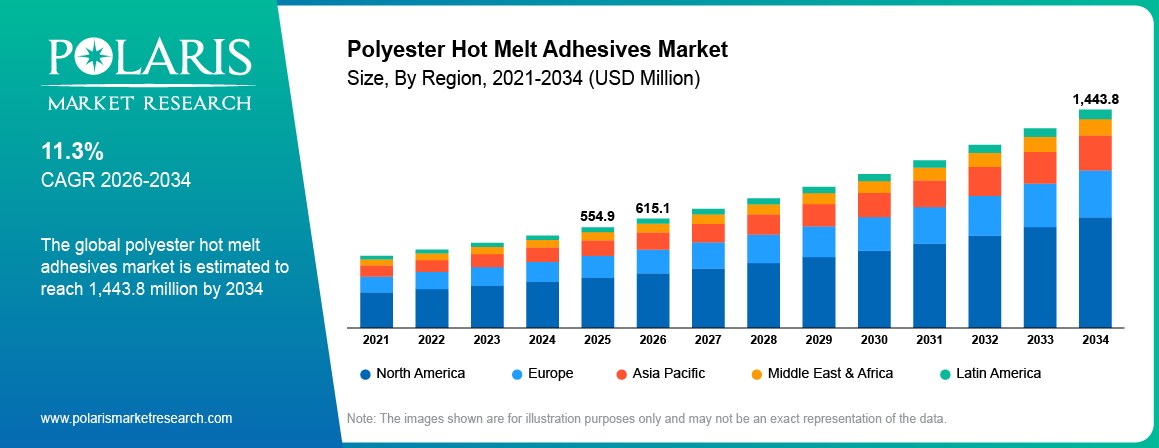
The global polyester hot melt adhesives market is estimated around USD 554.9 Million in 2025,with consistent growth anticipated during 2026–2034. Rising demand for textile lamination, flexible packaging, automotive interiors, and solvent-free bonding technologies is supporting market expansion. The market is projected to grow at a CAGR of 11.3% during the forecast period.
Market Statistics
Key Takeaways
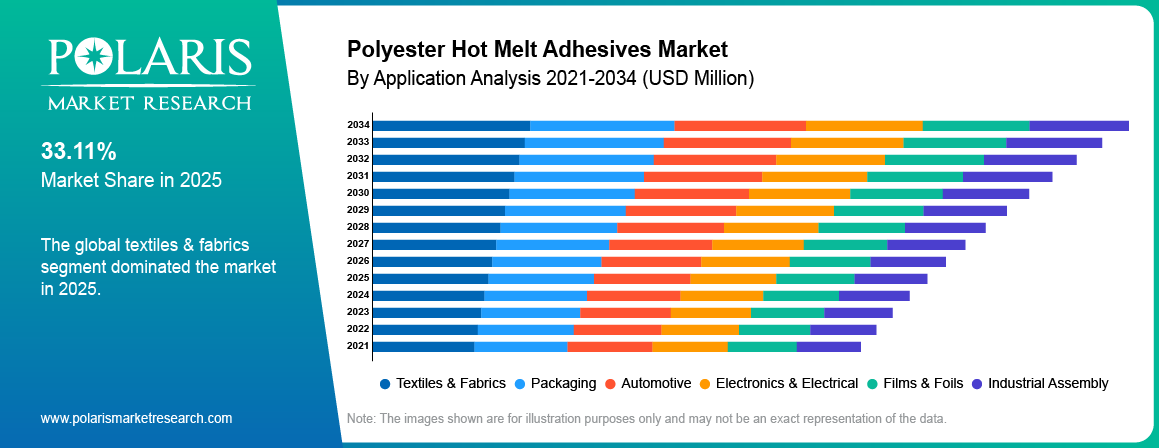
- Textiles & fabrics segment dominated the market by 33.11% share in 2025, driven by increasing use of polyester hot melt adhesives in footwear, apparel, and technical textile lamination.
- Packaging segment is projected to grow at the fastest CAGR of 12.3% during the forecast period due to rising demand for high-speed converting and flexible packaging solutions.
- Automotive interiors segment witnessed substantial demand growth of 11.7% CAGR due to rising adoption of lightweight and low-VOC bonding materials.
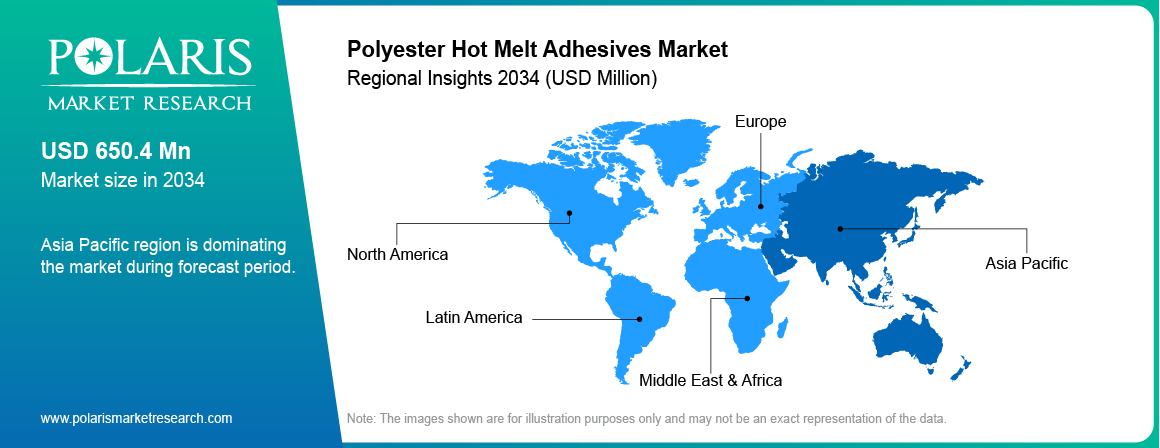
- Asia Pacific dominated the market in 2025 by 43.93% revenue share owing to strong textile manufacturing, packaging conversion, and electronics assembly activities.
- North America polyester hot melt adhesives market is witnessing stable growth of 11.5% CAGR due to strong demand from packaging and automotive interiors.
Industry Dynamics
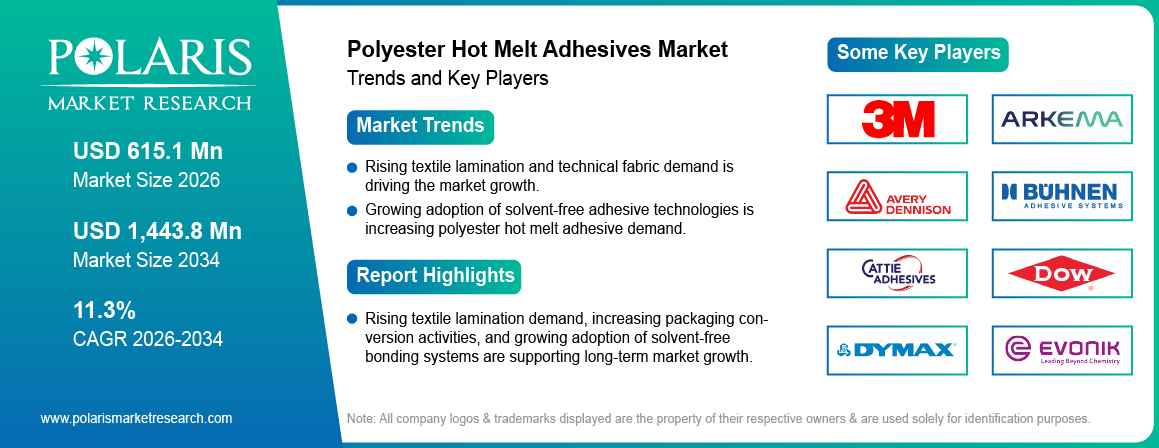
- Rising textile lamination and technical fabric demand is driving market growth.
- Growing adoption of solvent-free adhesive systems is increasing polyester hot melt adhesive demand.
- Competition from EVA and PUR adhesive technologies is restraining market expansion.
- Increasing use in premium packaging and automotive interiors is creating growth opportunities.
What is the Polyester Hot Melt Adhesives Market?
Polyester hot melt adhesives are thermoplastic bonding agents applied to textile, packaging, automotive, electronics, footwear, and general industry assemblies. The key properties of these adhesives include strength of bond formation, flexibility, washability, and thermal stability towards various substrates such as textiles, plastics, foams, metal foil, plastic components, and others. Polyester-based hot melt adhesives have been used extensively in the processes of laminating, coating, sealing, and assembling.
The value chain of polyester hot melt adhesives consists of raw material suppliers, resin manufacturers, adhesive manufacturers, distributors, converters, and end users. Polyester resins and additives are compounded to produce hot melt adhesives sold to textile producers, packaging converters, automotive suppliers, electronic assemblers, and industrial bonding firms for rapid assembly operations.
Source: Polaris Market Research Analysis
Growth in the market is driven by growing inclination toward solvent-free adhesive systems and the increasing usage of light bonding systems. The growth in technical textiles, flexible packaging, EV interior design, and automated packaging lines is fueling market demand. Advancements in low-temperature activating adhesives and lamination technologies are fueling demand for these products.
Drivers & Opportunities
Rising Textile Lamination Demand is Driving Market Growth: Increasing use of technical textiles, laminated shoes, sports garments, and breathable clothing products is leading to higher uptake of polyester hot-melt adhesives. The copolyester-based type of adhesives is witnessing growing acceptance owing to flexibility and washability. In September 2025, Polartec introduced a PFAS-free laminated fabric platform featuring air-permeable nanofiber membranes for athletic clothing.[Polartec, "Polartec Aircore delivers advanced weather protection fabric technology", www.polartec.com]
Growing Packaging Conversion Activities are Supporting Market Demand: Growing demand for polyester hot melt adhesives in applications like flexible packaging, carton sealing, labeling, laminating, and box folding is aiding market growth. Such adhesives enhance packing efficiency and do not involve any solvents. In August 2025, Henkel AG & Co. KGaA launched TECHNOMELT EM 335 RE for PET bottle labeling, offering 98% removability during recycling.[Henkel, "Henkel introduced a new hot melt adhesive for PET bottle labeling", www.henkel.com]
Restraints & Challenges
Limited Reimbursement Coverage and Patient Adherence Challenges: Lack of financing of polyester hot melt adhesives services is affecting the adoption of these services by several health care institutions. As opposed to the application of billing codes for polyester hot melt adhesives services, billing codes for physical therapy are used, which is leading to financial constraints for the hospitals and the customers. Besides, poor client compliance with exercise routines and non-participation in lengthy programs constitute operational hurdles.
Opportunity
Rising Demand for Premium Industrial Bonding Applications is Creating Opportunities: Rising application of premium fabric laminates, car interior trim systems, electronic parts, and unique packaging constructions has generated numerous opportunities for producers of polyester hot melt adhesives. Consumers are becoming increasingly concerned with adhesives that are flexible, temperature resistant, low in VOCs and have great substrate adhesion. Special attention is paid to the development of new adhesives systems, which ensures future success. In December 2025, Henkel AG & Co. KGaA launched LOCTITE MS 9650, a lightweight structural bonding solution designed for automotive display applications requiring high durability, vibration resistance, and improved assembly efficiency in next-generation vehicle interiors.[Henkel, "Henkel launches LOCTITE MS 9650 for durable lightweight structural bonding for automotive display", www.henkel.com]
Source: Polaris Market Research Analysis
Segmental Insights
The report provides a comprehensive analysis of the polyester hot melt adhesives market by application and end-use industry to identify key revenue generating and high-growth segments.
By Application
-
Textiles & Fabrics
Textiles & fabrics segment dominated the market by 33.11% share in 2025 due to increasing use of polyester hot melt adhesives across footwear lamination, apparel bonding, upholstery fabrics, and technical textile applications. Manufacturers are increasingly deploying low-temperature activation adhesives to improve production efficiency and product durability.
-
Packaging
Packaging segment is projected to grow at the fastest CAGR of 12.3% during the forecast period owing to increasing use of polyester hot melt adhesives in flexible packaging, cartons, labels, and laminates. Expansion of high-speed packaging operations and rising adoption of recyclable packaging materials are contributing to segment expansion.
By End-Use Industry
-
Automotive
Automotive interiors segment witnessed substantial demand growth of 11.7% CAGR driven by increasing demand for lightweight bonding materials across interior trim, headliners, seating systems, and acoustic laminates. In May 2026, Henkel launched the TEROSON EP 52 Series, a next-generation structural adhesive designed for automotive manufacturing applications requiring high durability, vibration damping, and lightweight performance.[Henkel, “Henkel launched the TEROSON EP 52 Series”, www.henkel.com] Automotive manufacturers are increasingly deploying low-VOC adhesive systems to improve cabin air quality and support lightweight vehicle production.
-
Electronics & Industrial Assembly
Electronics & industrial assembly segment is projected to grow at the fastest CAGR during the forecast period due to increasing deployment of polyester hot melt adhesives in cable fixing, component bonding, industrial lamination, and assembly operations.
Source: Polaris Market Research Analysis
Regional Analysis
Asia Pacific Polyester Hot Melt Adhesives Market Insights
Asia Pacific dominated the market in 2025 by 43.93% revenue share owing to strong textile manufacturing, packaging conversion, electronics assembly, and footwear production activities across China, India, Vietnam, Japan, and South Korea. China remains a major manufacturing hub for technical textiles and packaging materials, while India is witnessing rising demand due to expansion of apparel and footwear industries. Increasing industrial production and export-oriented manufacturing are supporting regional market growth. According to the Ministry of Textiles, India’s textile exports increased from ₹3,09,859.3 crore in FY 2024–25 to ₹3,16,334.9 crore in FY 2025–26, equivalent to nearly USD 38,100 million, reflecting continued expansion of the regional textile manufacturing sector.[Press Information Bureau, Government of India, "India advances initiatives related to sustainable industrial and manufacturing development", www.pib.gov.in]
North America Polyester Hot Melt Adhesives Market Overview
North America polyester hot melt adhesives market is witnessing stable growth of 11.5% CAGR due to strong demand from packaging, automotive interiors, industrial assembly, and specialty textile applications. The US leads the regional market owing to rising demand for premium adhesive formulations and automated packaging operations. Increasing focus on low-VOC industrial materials and advanced manufacturing technologies is contributing to regional expansion.
Europe Polyester Hot Melt Adhesives Market Assessment
Europe polyester hot melt adhesives market is experiencing steady growth due to increasing focus on solvent-free adhesive technologies and sustainable industrial processing. Germany, France, Italy, and other countries in the region are expected to increase demand for adhesives in technical textiles bonding, automotive interiors, and flexible packaging applications. Growing environmental regulation, along with increasing demands for efficiency drives growth in the industry. The EU Circular Economy Act is set to boost Europe’s secondary raw materials market and make Europe one of the most important circular economies worldwide by 2030.[European Union, "Circular Economy Strategy", environment.ec.europa.eu]
Source: Polaris Market Research Analysis
Competitive Landscape
Key Players & Competitive Strategies
The polyester hot melt adhesives market is moderately fragmented owing to the participation of international adhesive producers and local adhesive formulators. The competition is primarily driven by factors such as bond strength, substrate suitability, formulation capabilities, and technical assistance. Market players are emphasizing innovation, specialized formulations, alliances, and regional production to enhance their presence in the market.
Major companies operating in the polyester hot melt adhesives market include 3M Company, Arkema S.A. (Bostik), Avery Dennison Corporation, Beardow Adams Ltd., Bühnen GmbH & Co. KG, Cattie Adhesives, Dow Inc., Dymax Corporation, Evonik Industries AG, H.B. Fuller Company, Henkel AG & Co. KGaA, Jowat SE, Nihon Matai Co., Ltd., Sika AG, and Toagosei Co., Ltd.
Premium Insights
-
Premium Applications:
Highly valued prospects are found in areas such as technical textiles, specialty packaging laminates, automotive interior, and electronics assembly, where polyester hot melt adhesives are highly appreciated by users for their durability, flexibility, and good substrate adhesion properties.
-
Manufacturing Expansion:
Manufacturing setups across the Asia Pacific region are generating demand for polyester hot melt adhesives in the textile, footwear, packaging conversion, and electronics assembly industries. Regional industrial expansion and supplier localization strategies are supporting long-term market growth.
Key Players
- 3M Company
- Arkema S.A. (Bostik)
- Avery Dennison Corporation
- Beardow Adams Ltd.
- Bühnen GmbH & Co. KG
- Cattie Adhesives
- Dow Inc.
- Dymax Corporation
- Evonik Industries AG
- H.B. Fuller Company
- Henkel AG & Co. KGaA
- Jowat SE
- Nihon Matai Co., Ltd.
- Sika AG
- Toagosei Co., Ltd.
Industry Developments
- May 2025: Bostik announced a major investment in its Middleton manufacturing facility in the US to expand production capabilities for advanced adhesive technologies serving industrial and durable goods applications. [source: bostik.com]
Polyester Hot Melt Adhesives Market Segmentation
By Application Outlook (Revenue, USD Million, 2021–2034)
- Textiles & Fabrics
- Packaging
- Automotive
- Electronics & Electrical
- Films & Foils
- Industrial Assembly
- Others
By End-Use Industry Outlook (Revenue, USD Million, 2021–2034)
- Textile Industry
- Packaging Industry
- Automotive Industry
- Electronics Industry
- Industrial Manufacturing
- Others
By Regional Outlook (Revenue, USD Million, 2021-2034)
- North America
- US
- Canada
- Europe
- Germany
- France
- UK
- Italy
- Spain
- Netherlands
- Russia
- Rest of Europe
- Asia Pacific
- China
- Japan
- India
- Malaysia
- South Korea
- Indonesia
- Australia
- Vietnam
- Rest of Asia Pacific
- Middle East & Africa
- Saudi Arabia
- UAE
- Israel
- South Africa
- Rest of Middle East & Africa
- Latin America
- Mexico
- Brazil
- Argentina
- Rest of Latin America
Polyester Hot Melt Adhesives Market Report Scope
| Report Attributes | Details |
| Market Size in 2025 | USD 554.9 Million |
| Market Size in 2026 | USD 615.1 Million |
| Revenue Forecast by 2034 | USD 1,443.8 Million |
| CAGR | 11.3% from 2026 to 2034 |
| Base Year | 2025 |
| Historical Data | 2021–2024 |
| Forecast Period | 2026–2034 |
| Quantitative Units | Revenue in USD Million and CAGR from 2026 to 2034 |
| Report Coverage | Revenue Forecast, Competitive Landscape, Growth Factors, and Industry Trends |
| Segments Covered |
|
| Regional Scope |
|
| Competitive Landscape |
|
| Report Format |
|
| Customization | Report customization as per your requirements with respect to countries, regions, and segmentation. |
Source: Polaris Market Research Analysis
Polyester Hot Melt Adhesives Market FAQ's
The global market size was valued at USD 554.9 Million in 2025 and is projected to reach USD 1,443.8 Million by 2034 at a CAGR of 11.3%.
Asia Pacific dominated the market in 2025 by 43.93% revenue share owing to strong textile manufacturing and packaging conversion activities.
Major companies include Henkel AG & Co. KGaA, H.B. Fuller Company, Arkema S.A., Jowat SE, and 3M Company.
Major growth drivers include rising textile lamination demand, increasing packaging conversion activities, and growing adoption of solvent-free adhesive systems.
Textiles & fabrics segment dominated the market by 33.11% share in 2025 due to increasing use across footwear, apparel, and technical textile bonding applications.
The market outlook remains positive due to rising demand for premium industrial bonding applications and increasing adoption across automotive, packaging, and electronics industries.
Polyester hot melt adhesives are thermoplastic adhesive materials used for bonding textiles, packaging materials, films, foams, plastics, and industrial components through heat-activated processing technologies.
Download Sample Report of Polyester Hot Melt Adhesives Market
Please fill out the form to request a customized copy of the research report.


