
Preclinical CRO Market Size, Share, Trends & Forecast, 2026-2034
REPORT DETAILS
Preclinical CRO Market Size & Forecast, 2025-2034
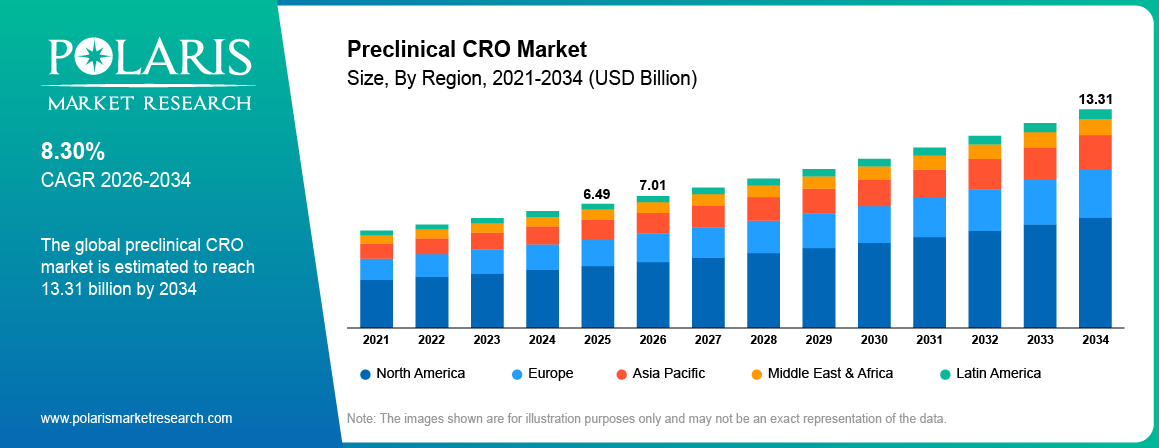
Preclinical CRO Market size was valued at USD 6.49 billion in 2025. The market is anticipated to grow from USD 7.01 billion in 2026 to USD 13.31 billion by 2034, exhibiting the CAGR of 8.30% during the forecast period.
Market Statistics
Preclinical CRO Market Key Takeaways: Services, Models, End Users & Regions
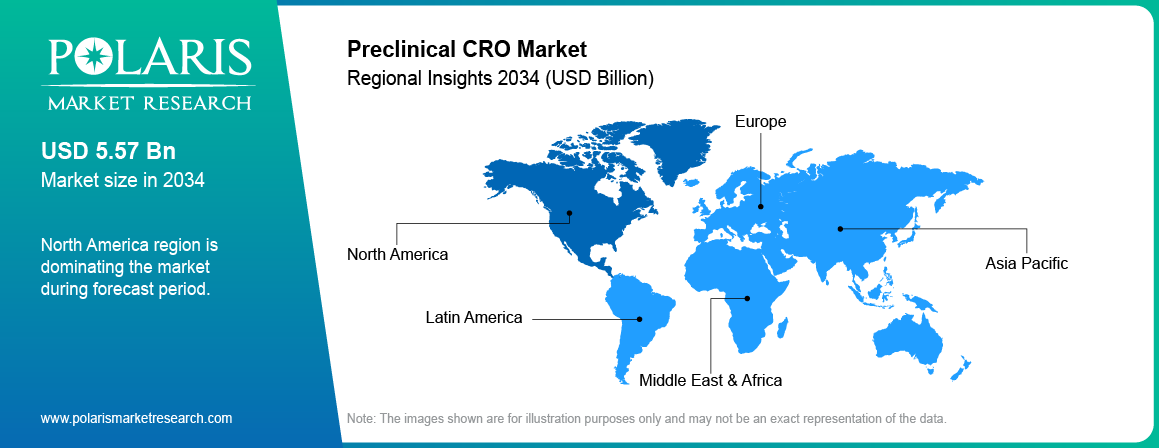
- North America contributed 41.9% to the overall market revenue in 2025. Strong R&D investment and increasing outsourcing supported growth in the region.
- Asia Pacific is expected to grow at the highest CAGR of 10.8% during 2026–2034. The cost of research in India and China is reducing the cost of outsourcing.
- Bioanalysis & DMPK studies are expected to grow at a CAGR of 11.2% during 2026–2034. The growth is due to increasing demand for pharmacokinetic and drug metabolism studies.
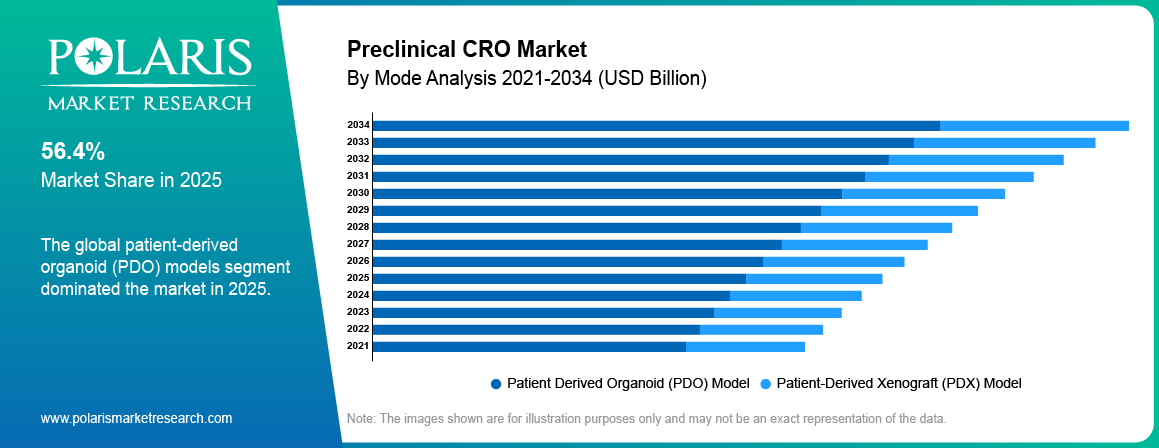
- The Patient-Derived Organoid (PDO) models held 56.4% of the market revenue in 2025. Their higher drug response prediction is increasing their use.
- Government and academic institutes are expected to grow at the fastest CAGR of 11.5% during 2026–2034. More organizations are outsourcing early-stage research to CROs.
- Biopharmaceutical companies are expected to grow at a CAGR of 10.9% during 2026–2034. Segment growth is being driven by rising outsourcing of drug development.
Note: Figures and projections outlined in this report are the result of Polaris Market Research’s proprietary analytical processes, grounded in the latest available datasets and market observations.
Preclinical CRO Market Dynamics: Drivers, Opportunities, Restraints & Challenges
- Pharmaceutical and biotechnology companies are outsourcing more preclinical research to CROs. This is reducing costs and speeding up drug development.
- Growing investment in pharmaceutical and biopharmaceutical R&D is boosting demand for preclinical CRO services. Increasing research spending is driving market growth.
- Demand for bioanalysis, DMPK and toxicology services is rising. This is encouraging more companies to work with CROs.
- The need for faster drug discovery and IND-enabling studies is rising. This is driving uptake of preclinical CRO services.
- Competition between CROs is increasing across the market. This is driving pricing pressure and impacting profit margins.
AI in Preclinical CRO Services: Study Design, Toxicology, DMPK & Digital Pathology
- AI is improving preclinical data analysis. It speeds up drug discovery and study design.
- AI is enhancing toxicology prediction. It supports identify safety risks earlier.
- AI is streamlining bioanalysis and DMPK studies. It improves accuracy and reduces manual work.
- AI is strengthening PDO and PDX research. It enables better drug response analysis.
Source: Polaris Market Research Analysis
To Understand More About this Research: Download Sample Report
What Is a Preclinical CRO? Market Definition, Scope & IND-Enabling Role
The preclinical CRO market includes contract research organizations that provide outsourced research services before clinical trials begin. These services assist pharmaceutical, biotechnology and medical device companies with drug discovery, toxicology, pharmacology, safety testing, animal studies, regulatory support and pharmacokinetic studies to help speed the development, evaluation and approval of new therapies.
How Preclinical CRO Services Work
Preclinical CRO services begin with the drug discovery stage where scientists discover and select possible drug candidates. The candidates are then tested in the lab, evaluated for pharmacology, and studied for drug metabolism to understand how they work, how the body processes them, and if they show the desired effects.
When the drug candidate has successfully passed the preclinical studies, it moves to the clinical trial preparation stage, when it is ready to start testing in human participants. In this stage, the drug candidates undergo toxicology studies and safety testing to identify any possible risks and the CROs prepare the regulatory documents needed to obtain permission to start clinical studies.
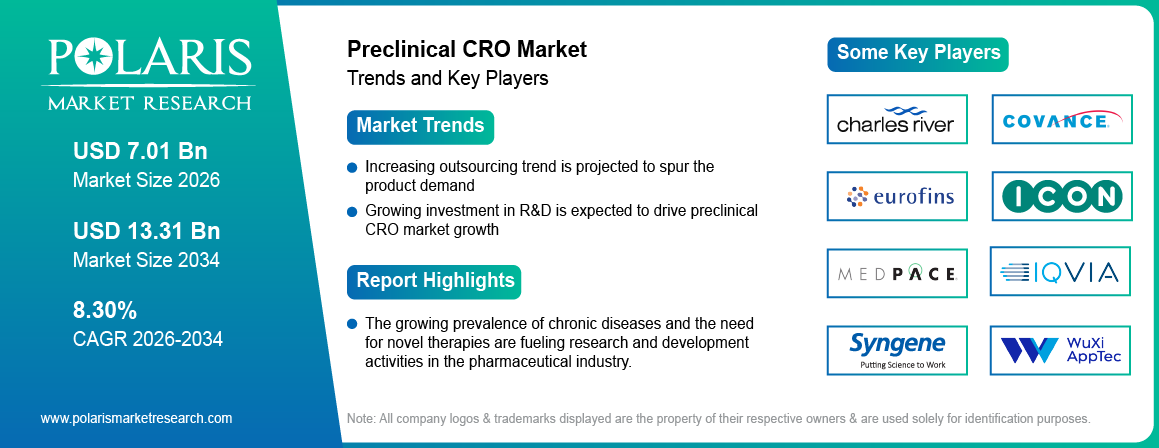
The growing prevalence of chronic diseases and the need for novel therapies are fueling research and development activities in the pharmaceutical industry. This surge in R&D activities is translating into increased demand for preclinical CRO services. CROs that can provide a comprehensive range of preclinical services, including toxicology, pharmacokinetics, and bio analytical services, are well-positioned to capitalize on this opportunity.
Regulatory agencies are placing greater emphasis on safety and efficacy assessments during the drug development process. This has led to an increased demand for high-quality preclinical studies that adhere to rigorous regulatory standards. CROs with a strong track record of regulatory compliance and the ability to navigate complex regulatory landscapes are poised to thrive in this environment.
- For instance, in November 2023, AmplifyBio, a prominent contract research organization, is unveiled the establishment of a new business division aimed at broadening its presence in the production of cutting-edge therapies, encompassing cell, gene, mRNA, and other advanced modalities.
One major trend in the preclinical CRO market is the increasing outsourcing of research activities by pharmaceutical and biotech companies. Outsourcing preclinical research to CROs allows these companies to tap into specialized expertise, reduce costs, and accelerate the drug development process. As a result, the demand for preclinical CRO services has risen, creating opportunities for CROs to expand their capabilities and cater to the evolving needs of their clients.
Advancements in technology is another significant trend shaping the preclinical CRO market. The integration of innovative technologies such as artificial intelligence, big data analytics, and high-throughput screening is enhancing the efficiency and accuracy of preclinical studies. This trend not only streamlines the drug discovery process but also allows CROs to differentiate themselves by offering cutting-edge, technology-driven solutions to their clients.
The research report offers a quantitative and qualitative analysis of the Preclinical CRO Market to enable effective decision-making. It covers the key trends and growth opportunities anticipated to have a favorable impact on the market. Besides, the study covers segment and regional revenue forecasts for market assessment.
In-House Preclinical Research vs CRO Outsourcing: Cost, Timeline, Expertise & Scalability
| Factor | In-House Research | CRO Outsourcing |
| Investment | High infrastructure cost | Lower capital requirement |
| Expertise | Limited to internal team | Access to specialized experts |
| Timeline | Longer development cycles | Faster project execution |
| Scalability | Limited flexibility | Easy to scale as needed |
| Regulatory Support | Managed internally | Regulatory support provided by CROs |
Source: Polaris Market Research Analysis
Preclinical CRO Market Growth Drivers
Rising Preclinical Outsourcing Reduces Fixed R&D Cost and Accelerates IND Timelines
The preclinical CRO market growth is greatly aided by an increasing trend of outsourcing the preclinical technologies. Pharmaceutical and biotechnology industries are increasingly outsourcing preclinical research activities to specialized Contract Research Organizations (CROs) to leverage their expertise, accelerate drug development, and manage costs effectively.
Biopharma R&D Investment Expands Demand for Specialized Preclinical Services
Continued investment by pharmaceutical companies, exemplified by organizations like PhRMA, has contributed significantly to the growth of the preclinical CRO market, making the biopharmaceutical sector the most research and development-intensive industry.
Preclinical CRO Market Restraints & Challenges
CRO Competition, Capacity, Pricing and Data-Quality Requirements Pressure Margins
A notable obstacle arises from the intensifying competition among Contract Research Organizations (CROs), resulting in heightened pricing pressures and the potential for compromises in the delivery of service quality. The intricate and variable nature of preclinical study designs and endpoints presents another challenge, necessitating continuous adaptation by CROs to meet the diverse requirements of their clients. Moreover, the dynamic regulatory landscape poses a persistent challenge, requiring CROs to remain updated on evolving compliance standards and adeptly navigate regulatory complexities. Concerns related to data quality, reproducibility, and transparency in preclinical research also persist as critical challenges that demand meticulous attention and resolution within the industry.
Impact of Biotechnology Expansion
The growth of the biotechnology industry is increasing the demand for preclinical CRO services. More biologics, gene therapies, and cell therapies are entering the development stage, creating a greater need for preclinical testing. Companies are also using advanced testing models to improve research results. Many small and emerging biotech firms are outsourcing preclinical work to CROs to access specialized expertise, reduce costs, and speed up the drug development process.
Importance of Toxicology Studies
Toxicology studies are an important part of the preclinical development of drugs. They assess the safety of a drug before it is tested on humans and it also identifies any potential adverse effects or toxic responses. These studies also identify safe dose ranges and the body’s response to various dose levels.
The results from toxicology studies are required for regulatory submissions before clinical trials can begin. They help pharmaceutical and biotechnology companies make informed decisions, reduce the risk of failure in later stages, and improve the overall safety of drug development.
Source: Polaris Market Research Analysis
Preclinical CRO Market Segmentation by Service, Model Type, End User & Region
The market is primarily segmented based on service type, mode, end-user, and region.
| By Service Type | By Mode | By End-User | By Region |
|
|
|
|
Source: Polaris Market Research Analysis
Preclinical CRO Market by Service: Toxicology, Bioanalysis/DMPK, Chemistry, Compound Management & More
Bioanalysis & DMPK studies segment is expected to witness highest growth during forecast period
The bioanalysis & DMPK studies segment is projected to grow at a CAGR during the projected period in the preclinical CRO market. The growth of this sector is propelled by an increased need for pharmacokinetic services, particularly in supporting toxicology tests for IND-enabling studies. Bioanalysis and Drug Metabolism and Pharmacokinetics (DMPK) studies play a pivotal role across the entire drug development continuum, being integral in each stage rather than limited to the preclinical phase alone. This expansive application of bioanalysis and DMPK studies, along with the growing demand for these services, serves as a significant catalyst in driving the bioanalysis & DMPK studies growth.
Preclinical CRO Market by Model Type
Patient-Derived Organoids (PDOs) segment is expected to dominate the preclinical CRO market during forecast period
In 2023, the preclinical CRO market share was predominantly influenced by Patient-Derived Organoids, commanding a significant market share. Patient-Derived Organoids (PDOs), derived from patient tissues and manifested as three-dimensional cell culture models, present a notably representative and personalized avenue for disease study and drug response testing. Their adeptness in replicating the intricacies of human tissues adds significant value to preclinical research. With the growing emphasis on precision medicine by pharmaceutical and biotech companies, there is a notable upsurge in the demand for PDO models. Contract Research Organizations (CROs) specializing in PDO models find themselves strategically positioned to seize this trend, offering clients advanced, patient-specific models that markedly improve the efficiency and efficacy of drug development processes.
By End-Users Analysis
Government and academic institutes segment is expected to witness highest growth during forecast period
The government and academic institutes segment is projected to experience the most rapid growth during the forecast period. Academic institutions and government entities play a pivotal role in the initial stages of discovery and development in the preclinical phase. The growing trend of academic organizations and government bodies outsourcing preclinical services to Contract Research Organizations (CROs) will significantly contribute to the expansion of this segment. Notably, academic institutes represent a substantial revenue source for major CROs like Charles River Laboratories and LabCorp, highlighting their pivotal role in the industry's revenue stream.
Source: Polaris Market Research Analysis
Regional Insights
North America region dominated the global preclinical CRO market in 2025
North America dominated the global preclinical CRO market in 2025 and is expected to continue to do so. The region's market growth is propelled by factors such as a rise in research and development (R&D) activities and an increasing demand for medications within the target population. The pharmaceutical sector in North America exhibits concentration, with companies increasingly outsourcing drug development activities to Contract Research Organizations (CROs). Furthermore, governmental investments in contract development and manufacturing organization (CDMO) capacities for drug substance and drug product manufacturing present opportunities for end users, fostering demand for preclinical CRO services in the region.
However, during the forecast period, Asia Pacific is poised to exhibit the most rapid growth. This acceleration is attributed to the evolving business model of multinational corporations (MNCs), where increasing R&D costs drive a surge in preclinical outsourcing within the Asia Pacific region. Countries like India and China, known for the cost-effectiveness of their Contract Research Organizations (CROs), play a pivotal role in this trend. Established companies from Western Europe and the U.S. strategically engage in analytical services, site research development, and clinical activities in the Asia Pacific, aiming to mitigate the expenses associated with research endeavors.
Source: Polaris Market Research Analysis
Preclinical CRO Market Competitive Landscape & Leading Companies
The preclinical CRO market is fragmented and is anticipated to witness competition due to several players' presence. Major service providers in the market are constantly upgrading their technologies to stay ahead of the competition and to ensure efficiency, integrity, and safety. These players focus on partnership, product upgrades, and collaboration to gain a competitive edge over their peers and capture a significant market share.
Leading Preclinical CRO Companies by Core Capability
- Charles River Laboratories
- Covance (LabCorp)
- Envigo
- Eurofins Scientific
- ICON plc
- InVentiv Health
- Medpace
- MPI Research (Envigo)
- PAREXEL International Corporation
- Pharmaceutical Product Development, LLC (PPD)
- QuintilesIMS (IQVIA)
- Syngene International
- Toxikon Corporation
- WuXi AppTec
- Laboratory Corporation of America Holdings (LabCorp)
Preclinical CRO Market Challenges: Cost, Regulation, Reproducibility & Animal-Model Ethics
The preclinical CRO market faces several challenges that can affect research and development. The cost of advanced research technologies is high which drives up the operating expenses. Regulatory requirements are changing which makes it harder to comply with them and ethical issues related to animal studies remain and continue to influence research practices.
With the increasing complexity of research, managing large volumes of research data is becoming more difficult. Moreover, the industry is experiencing a shortage of skilled scientific professionals and must adhere to stringent quality control standards to ensure that research findings are reliable and accurate.
Preclinical CRO Market Future Outlook: NAMs, AI, Advanced Modalities & Global Outsourcing
The preclinical CRO market is expected to grow as more pharmaceutical and biotechnology companies outsource early-stage research. The increasing biologics pipelines, increasing drug development activities and the requirement for faster approvals will continuously drive the demand for CRO services. The market is also expected to grow with the adoption of AI, advanced testing models and expansion of preclinical research capabilities across the globe.
Growing investment in research and development will further support market growth. Emerging biotech companies are expected to increase outsourcing to access specialized expertise and advanced technologies. In addition, expanding CRO facilities in developing countries will create new growth opportunities during the forecast period.
Recent Preclinical CRO Partnerships, M&A & Technology Developments, 2025-2026
- June 2026: Charles River Laboratories partnered with Eli Lilly’s TuneLab AI platform. The partnership will use AI technology combined with Charles River’s preclinical testing expertise. The aim is to improve drug candidate selection and accelerate early research. The collaboration also strengthens the use of AI in drug discovery.(Source: businesswire.com)
- February 2026: IQVIA signed an agreement to acquire the drug discovery assets of Charles River Laboratories. The acquisition will expand IQVIA’s preclinical research service offerings. It will include in vitro testing, AI-based drug discovery, and early safety testing. The acquisition will strengthen its early drug development capabilities.(Source: ir.iqvia.com)
Preclinical CRO Market Report Coverage & Research Scope
The preclinical CRO market report emphasizes on key regions across the globe to provide better understanding of the product to the users. Also, the report provides market insights into recent developments, trends and analyzes the technologies that are gaining traction around the globe. Furthermore, the report covers in-depth qualitative analysis pertaining to various paradigm shifts associated with the transformation of these solutions.
The report provides detailed analysis of the market while focusing on various key aspects such as competitive analysis, service type, mode, end-users, and their futuristic growth opportunities.
Preclinical CRO Market Scope, Segmentation & Forecast Period
| Report Attributes | Details |
| Market size value in 2025 | USD 6.49 billion |
| Market size value in 2026 | USD 7.01 billion |
| Revenue forecast in 2034 | USD 13.31 billion |
| CAGR | 8.30% from 2026 – 2034 |
| Base year | 2025 |
| Historical data | 2021 – 2024 |
| Forecast period | 2026 – 2034 |
| Quantitative units | Revenue in USD billion and CAGR from 2026 to 2034 |
| Segments covered |
|
| Regional scope |
|
| Competitive Landscape |
|
| Report Format |
|
| Customization | Report customization as per your requirements with respect to countries, region and segmentation. |
Source: Polaris Market Research Analysis
Report Customization
We provide our clients the option to personalize the Preclinical CRO Market report to suit their needs. By customizing the report, you can get data as per your format and definition. Also, the customization option allows you to gain a deeper dive into a specific segment, region, customer, or market competitor.
Preclinical CRO Market FAQ's
The global preclinical CRO market size is expected to reach USD 13.31 billion by 2034
Charles River Laboratories, Covance (LabCorp), Envigo, Eurofins Scientific, Pharmaceutical Product Development, LLC (PPD), are the top market players in the market
North America region contribute notably towards the global Point of Preclinical CRO Market
Preclinical CRO Market CAGR of 8.30% during the forecast period.
The Point of Preclinical CRO Market report covering key segments are service type, mode, end-user, and region.
A preclinical CRO is a company that carries out research before clinical trials begin. It helps test new drug candidates for safety and performance.
Preclinical CROs provide toxicology, pharmacology, bioanalysis, and safety testing services. They also support laboratory research and regulatory studies.
Outsourcing helps reduce costs and save time. It also gives companies access to experienced researchers and advanced facilities.
Preclinical development includes toxicology, pharmacology, bioanalysis, and drug metabolism studies. These studies evaluate a drug before human testing.
A preclinical CRO evaluates drug candidates through laboratory testing. It also generates the data needed before clinical trials begin.
Download Sample Report of Preclinical CRO Market
Please fill out the form to request a customized copy of the research report.


