
AI Data Management Market Size, Share, Trends & Forecast, 2026–2034
REPORT DETAILS
AI Data Management Market Summary
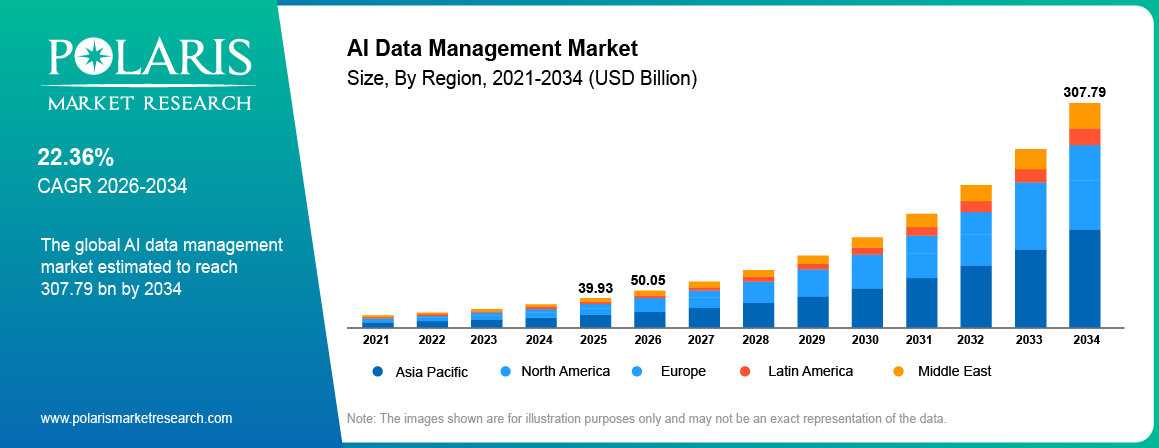
AI data management market size was valued at USD 39.93 billion in 2025. The market is expected to grow at a CAGR of 22.36% from 2026 to 2034. Growth is driven by rising enterprise data volumes, AI/ML adoption, cloud migration, data governance needs, and demand for faster access to reliable data.
Market Statistics
AI Data Management Market Key Takeaways
- North America held the largest share of 34.86% in 2025, owing to a high AI adoption rate, high spending on enterprise technology, and availability of big data and AI platform players.
- The Asia Pacific region is projected to experience a CAGR of 25.62% between 2026 and 2034 owing to digital transformation, adoption of cloud, and increased investment in AI.
- Machine learning led the AI data management market share with 31.84% in 2025, due to its applications in data classification, quality management, anomaly detection, and automation.
- In 2025, data governance held significant market share of 16.72 due to the need for controlling the quality, access, and privacy of data.
- The BFSI segment held a 20.86% share in 2025, as banks, insurers, and financial institutions handle a huge amount of financial and customer data.
Note: Figures and projections outlined in this report are the result of Polaris Market Research’s proprietary analytical processes, grounded in the latest available datasets and market observations.
What is AI Data Management?
AI data management encompasses technologies and practices used to collect, integrate, organize, govern, secure, process, and maintain data for AI applications. This is the data lifecycle management process. It includes ingestion, preparation, storage, quality management, metadata management, governance, analytics, and model development.
The AI data management market includes platforms, software, and services that manage structured, semi-structured, and unstructured data used in machine learning, deep learning, generative AI, computer vision, and natural language processing. Key AI data management market trends in AI Data Management Market Cloud Adoption Automated AI Data Integration AI-Ready Architectures Data Governance Agentic AI
The growth of the AI data management market is driven by increasing enterprise data volumes from applications, IoT devices, databases, documents, and cloud environments. That’s driving demand for cloud data management platforms, automated pipelines, data catalogs, quality monitoring and governance solutions.
The market is also moving toward AI-powered data governance and enterprise agentic AI data platforms that can automate data discovery, preparation, governance and orchestration. These developments are helping enterprises achieve better data quality, accessibility, security and readiness for increasingly complex AI workloads.
How AI Data Management Works
An AI data management process generally includes six stages:
-
Data Ingestion: Data is gathered from databases, applications, cloud services, APIs, Internet-of-things sensors, and other systems.
-
Data Integration: The information collected through different systems is integrated together to form an ecosystem of data.
-
Data Classification: Through the help of machine learning algorithms, data classification assists in finding out the type of data, patterns, relationships, and sensitive data.
-
Data Quality Management: Data quality management detects data that is duplicated, inaccurate, and incomplete.
-
Data Governance: Guidelines are set on how to access, secure, manage metadata, and use data.
-
Data Analytics and Optimization: Once the data is cleaned and governed, then it is now ready for analytics.
The above stages may work continuously within enterprise data environments. AI-driven automation ensures less human involvement and assists data professionals to handle increasing amounts of data.
Traditional Data Management vs AI Data Management
Traditional vs AI data management differs primarily in the degree of automation, intelligence, and AI-specific preparation involved. Traditional data management focuses on storing, integrating, governing, securing and analyzing enterprise data through a set of predefined processes and rules. AI data management expands these capabilities to support machine learning, generative AI, computer vision, natural language processing and autonomous AI workloads.
| Feature | Traditional Data Management | AI Data Management |
| Data Classification | Rule-based and manual | AI-assisted and automated |
| Data Quality | Manual checks and predefined rules | Automated detection and recommendations |
| Metadata Management | Manually maintained | AI-assisted generation and discovery |
| Data Integration | Predefined workflows | Intelligent integration and recommendations |
| Governance | Policy-driven manual processes | Automated monitoring and policy assistance |
| Data Analysis | Structured queries and predefined reports | AI-assisted analysis and natural language interaction |
| Scalability | Requires additional manual configuration | Greater automation across large datasets |
| User Interaction | Technical interfaces | Natural language and AI assistants |
Source: Polaris Market Research Analysis
AI data management does not replace the traditional data management systems entirely. Rather, it assists in enhancing the current data management process. Enterprises can combine AI-based tools with legacy data infrastructure to improve data quality, governance, discovery and operational efficiency.
Market Dynamics
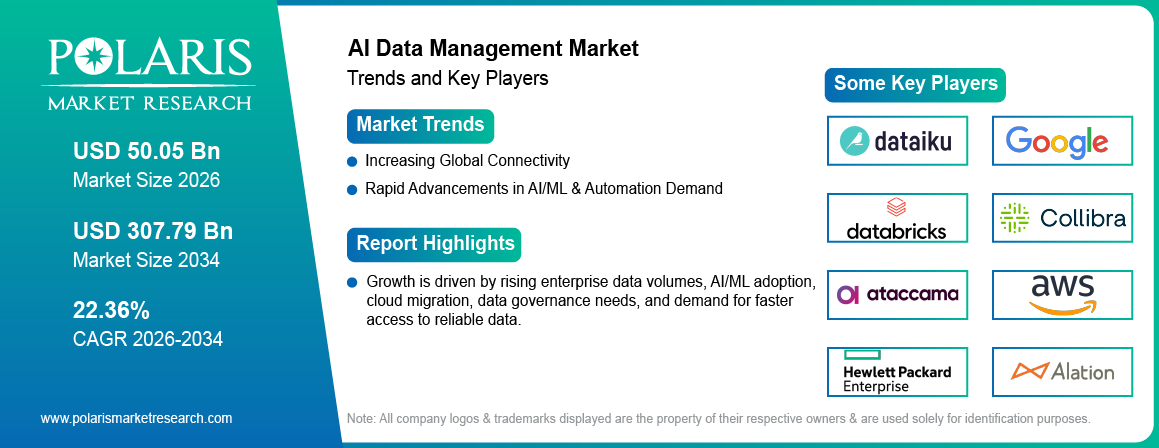
Driver: Increasing Global Connectivity
With the global nature of business and technology, organizations often need to manage and integrate data from various geographical locations. This requires effective data management strategies to ensure seamless collaboration and access to relevant data. Organizations are increasingly recognizing the importance of data governance and ethical considerations in AI. Establishing responsible data management practices ensures transparency, accountability, and ethical use of data in AI applications.
Many organizations are leveraging cloud computing services to store and process their data. Cloud-based data management solutions provide scalability, flexibility, and cost-effectiveness, contributing to the AI data management market growth. This can be the major factor for the increasing market share and market revenue thereby.
The adoption of artificial intelligence technology is being driven by the growing need for automation and optimization in a variety of industries, including manufacturing, transportation, and others. ITU’s 2026 ICT Development Index scored global connectivity at 79/100, with a 75-point gap between the highest- and lowest-scoring economies (Source: cadeproject.org).
Driver: Rapid Advancements in AI/ML & Automation Demand
Rapid advances in machine learning, generative AI, and intelligent automation are increasing the amount of enterprise data required to train, evaluate, operate, and monitor AI systems. Organizations deploying AI at scale require data that is discoverable, reliable, relevant, and accessible to authorized users and AI workloads. This is increasing demand for automated data preparation, data quality management software, feature engineering, metadata enrichment, lineage tracking, and AI-ready data pipelines.
The expansion of generative and agentic AI is creating an additional requirement for business context. Artificial intelligence systems need access to enterprise information, but that access needs to be appropriately governed. That’s why modern data platforms are combining data engineering, data governance, data analytics, and AI development capabilities. Databricks, for instance, has based its platform strategy on unified governance of data and AI assets.
Microsoft said that global generative AI adoption rose to 16.3% in H2 2025 from 15.1% in H1 2025. Adoption was 24.7 per cent in the Global North and 14.1 per cent in the Global South. AI data management platforms automate tasks like data classification, quality monitoring, metadata management, and data preparation (Source: microsoft.com).
Driver: Enterprise Digital Transformation Demand
Enterprise digital transformation is increasing the number of operational systems and digital data sources that organizations must manage. Migration to cloud applications, connected devices, digital customer channels, analytics platforms and AI-enabled workflows results in fragmented data environments that require integration and governance.
So, organizations are investing in platforms that can connect databases, applications, data lakes, warehouses, documents and other sources. Platforms that handle AI data can support companies in creating standardized pipelines, increasing data accessibility, establishing governance policies, and supporting AI workloads used in business functions.
This need is further reinforced by the transition from stand-alone AI experiments to enterprise-scale deployment. Organizations want a common data foundation to enable analytics, machine learning, generative AI, and emergent AI agents, all while ensuring security, lineage, and compliance.
Restraint: Data Privacy Concern is likely to impede the market growth
Growing concerns about data privacy and security present a significant challenge. Organizations must comply with stringent regulations, such as GDPR and CCPA, which can restrict the ways in which they collect, process, and store data for AI applications. Implementing robust AI data management systems, including storage infrastructure, security measures, and data governance protocols, can be expensive. Small and medium-sized enterprises (SMEs) may find it challenging to allocate resources for such investments.
Restraint: Integration Complexity, Cost & Skill Shortages
The problem with integrating enterprise data is that enterprise data environments are usually a mix of legacy systems, cloud platforms, databases, applications and third-party services. Connecting those systems to today’s AI data management platforms can be a large investment in infrastructure, customization and technical resources. The high cost of implementation and maintenance might act as a deterrent for SME to adopt. Furthermore, the lack of skilled professionals in data engineering, cloud infrastructure, AI, metadata management, and data governance can cause deployment delays and raise operational complexity, impeding the expansion of the AI data management market.
Opportunity: AI-Powered Data Governance
The speed of AI means that automated data governance is needed. In September 2026, Databricks pledged more than USD 350 million over three years to Singapore, where it hopes to train 20,000 in data and AI capabilities. The traditional approach to governance is characterized by manual data classification, policy management, and data assessment (Source: databricks.com).
AI-enabled data governance technologies may be utilized to discover sensitive data, monitor data consumption, detect any violation of policies, and improve metadata management. Growing regulatory requirements and faster enterprise AI adoption are creating new opportunities for AI data management platform vendors with governance, security, quality and AI capabilities.
Opportunity: Agentic AI Data Platforms
Agentic AI is the precursor of a new direction in data management platforms. AI agents can discover data, monitor pipelines, generate metadata, perform quality checks, and recommend workflows according to pre-defined policies. Enterprise data platforms that are equipped with agentic AI can reduce the manual effort involved for data professionals and shorten the response time. Vendors are designing more and more AI copilots and intelligent assistants to help users perform enterprise data queries through natural language.
AI Data Management Market Segmentation Analysis
AI data management market segmentation includes offering, data type, technology, application, vertical, and region.
By Offering Analysis
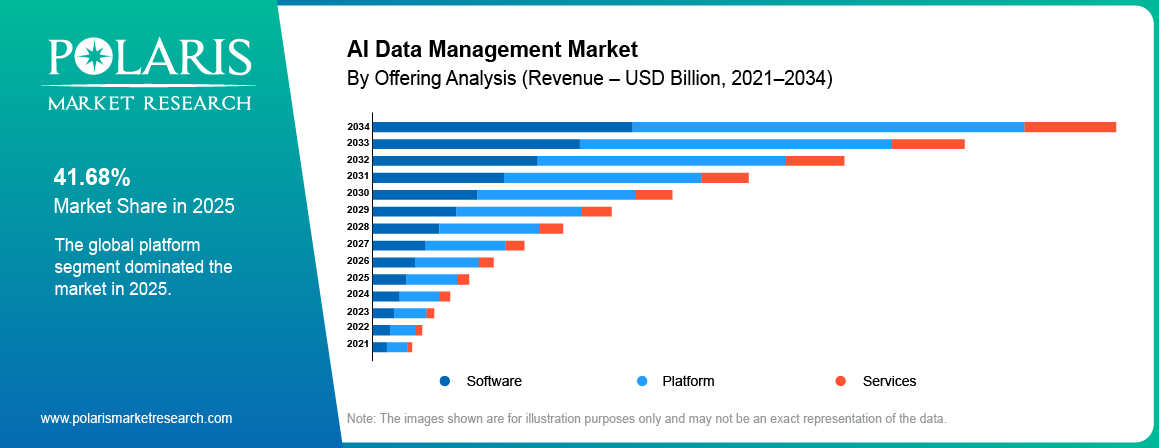
The platform segment led the market with an 41.68% share in 2025, owing to rising demand for centralized systems that manage enterprise data across multiple sources and environments. AI data management platforms provide capabilities across data integration, governance, quality, metadata, analytics, and lifecycle management. Growing adoption of cloud data management platforms is also driving the growth of the segment by enabling scalable data processing across hybrid and multi-cloud environments. As enterprises ready data for AI workloads, demand for AI data governance tools 2026, automated data quality and metadata management is also on the rise.
The services segment is expected to register a CAGR of 25.48% during 2026-2034. Enterprises need AI data management systems and therefore need consulting, implementation, integration, migration, maintenance and managed services. The increasing complexity of hybrid and multi-cloud environments is increasing the need for external expertise. Service providers help organizations deploy AI data integration workflows, improve data quality, establish governance frameworks, and manage data lifecycle management. Rising AI adoption and shortages of specialized data engineering and cloud skills are expected to further support demand for professional and managed services.
By Technology Analysis
The market is segmented on the basis of machine learning, deep learning, natural language processing, computer vision, generative AI, and context awareness, and others. In 2025, machine learning dominated the market with 31.84% share. The integration of machine learning algorithms with data management systems has been crucial for extracting valuable insights from large datasets. The algorithms can automate decision-making processes by learning from patterns in data. This is applicable in various industries, from finance to healthcare, where data-driven decisions are critical. In sectors like marketing and e-commerce, machine learning platforms helps in creating personalized experiences for users by analyzing their preferences and behaviors. This involves managing and processing large amounts of customer data.
The generative AI segment is expected to record a CAGR of 31.86% during the projected period. The growth is driven by growing adoption of large language models (LLMs), AI agents, and retrieval-augmented generation (RAG). GenAI requires high-quality, contextual, governed, and accessible data to deliver reliable outputs. It increases demand for data integration, data quality, metadata management, cataloging, lineage, and governance solutions.
By Data Type Analysis
The data type segment was dominated by the text data segment with 25.18% share in 2025 owing to its wide usage in customer records, documents, emails, enterprise applications, reports and business communications. AI tools can sort through, pull out, hunt for and evaluate vast quantities of text-based data. Rising adoption of AI data integration, natural language processing, and generative AI is further increasing demand for efficient text data management and governance.
The audio, speech and voice data segment is expected to grow at a CAGR of 22.84% during the forecast period. With the increasing adoption of voice assistants, the demand for systems that can process and handle voice information is growing, along with contact center analytics, speech recognition and conversational AI. The increasing adoption of AI data management for multimodal workloads is also boosting demand for data quality, metadata management, storage and governance for audio and speech datasets.
By Application Analysis
Data governance is holding an 16.72% share in 2025 owing to requirement to enhance data quality, access control, privacy, metadata visibility and compliance. With AI applications driving the use of ever more data across business functions, governance is gaining more attention from enterprises. Demand for integrated governance solutions is also growing due to the increasing adoption of AI-based data governance, metadata management and data lifecycle management.
The process automation segment is expected to grow at 21.92% CAGR as AI is able to automate data preparation, validation, classification, monitoring, and workflow management. Automation allows data teams to avoid mundane tasks and focus on more valuable analytical activities. Increasing need for AI data integration, automated data quality, and cloud-based workflows is expected to drive segment growth.
By Vertical Analysis
The BFSI sector accounted for 20.86% in 2025, owing to the huge amount of financial and customer data that is handled by banks, insurers and financial institutions. AI data management is a tool used for fraud detection, risk assessment, customer analytics, compliance, credit assessment, data governance. Increase in AI-powered analytics and AI data management applications in banking is driving demand for secure and governed data platforms.
Healthcare is estimated to grow at a CAGR of 25.16% over the forecast period. Healthcare organizations are dealing with increasing volumes of patient records, medical images, clinical information, research data and administrative information. AI data management can help organize these datasets, with improvements in access, quality, security, and governance. Growing adoption of AI for diagnostics and analytics is creating demand for reliable AI data integration and lifecycle management solutions.
Market Segmentation Summary Table
| Dimension | Leading Sub-Segment (2025) | Fastest-Growing Sub-Segment | Key Metric |
| By Offering | Platform | Services | Platform: 41.68% share; Services: 25.48% CAGR |
| By Data Type | Text | Audio, Speech & Voice | Image: 28.46% share; Audio/Speech: 22.84% CAGR |
| By Technology | Machine Learning | Generative AI | ML: 31.84% share; Gen AI: 31.86% CAGR |
| By Application | Data Governance | Process Automation | Data Governance: 16.72% share; Data Anonymization: 23.86% CAGR |
| By Vertical | BFSI | Healthcare | BFSI: 20.86% share; Healthcare: 25.16% CAGR |
Source: Polaris Market Research Analysis
AI-Powered Data Governance
Data governance with artificial intelligence is growing as a common aspect of modern enterprise data management. Artificial intelligence can be used to uncover sensitive information, classify datasets, monitor access patterns, and identify potential policy violations.
Natural language interfaces can also help to make governance information more accessible to non-technical users. AI assistants can help data teams discover datasets, discover metadata, determine data owners and review governance policies.
As generative AI is exploding, organizations are trying to control what information is available to AI applications and need better governance. This is fueling demand for integrated data governance solutions encompassing security, privacy, quality, metadata, and AI usage.
Cloud-Based AI Data Management Growth
Cloud deployment is changing the way that enterprises manage and access data. Cloud-based AI data management platforms enable organizations to connect data from various applications and locations and decrease dependence on physical infrastructure.
The growth of hybrid and multi-cloud environments is creating the demand for tools that offer centralized visibility across disparate systems. For organizations that are generating data at an increasing rate, cloud platforms provide an attractive option to scale storage and processing capacity as the business needs dictate.
Increasing adoption of cloud analytics, data lakes, data warehouses and AI workloads will likely drive the growth of cloud-based AI data management during the forecast period.
Big Data & IoT Integration Impact
With the increase of big data and IoT data, enterprises are dealing with more and more data sources. Connected devices can provide real-time information on equipment, operations, customers, logistics and environmental conditions.
AI data management systems can ingest, classify, process, and analyze these datasets. Integrated with Internet of Things platforms, it can also help to predict maintenance needs, monitor operations, manage supply chains and deliver real-time analytics.
The convergence of AI, big data and IoT is creating a more connected enterprise data environment and raising the need for automated data management.
Industry Use Cases
BFSI: Fraud Detection and Risk Assessment
Banks and other financial institutions use AI data management to bring together customer, transaction, credit and operational data. The clean and connected data could be used for fraud detection, risk assessment, credit evaluation, customer segmentation, and compliance processes. These AI data management use cases in banking are expanding with AI adoption, secure data governance, quality management, and controlled access.
Healthcare: Patient Data and Diagnostics
Healthcare organizations have patient records, medical images, laboratory data, and administrative data. The use of AI data management could be useful in processing this type of data and making it available for analysis and clinical use. AI data management use cases in healthcare include diagnostics, patient analytics, medical imaging, research, and predictive healthcare, supported by strong data quality and governance.
Retail: Demand Forecasting and Personalization
Retailers use information on their clients, transactions, inventory, and product lines to identify the patterns in purchases. AI data management powers demand forecasting, customer segmentation, recommendation systems, personalization, and inventory planning. AI data management use cases in retail are expanding as retailers integrate store, e-commerce, loyalty, and digital data for AI-driven customer and operational strategies.
Telecom: Network Performance and Customer Analytics
Telecom operators deal with a large amount of data on networks, subscribers, devices and services. These details can be managed through AI data management to make the networks work efficiently, customer analysis and predictive maintenance.
Manufacturing: Predictive Maintenance and Supply Chain
Manufacturers create data from production systems, sensors, equipment, suppliers and logistics networks. AI data management helps unite that information for predictive maintenance, production planning, quality monitoring and supply chain analysis.
AI Data Management Market Regional Insights
North America AI Data Management Market
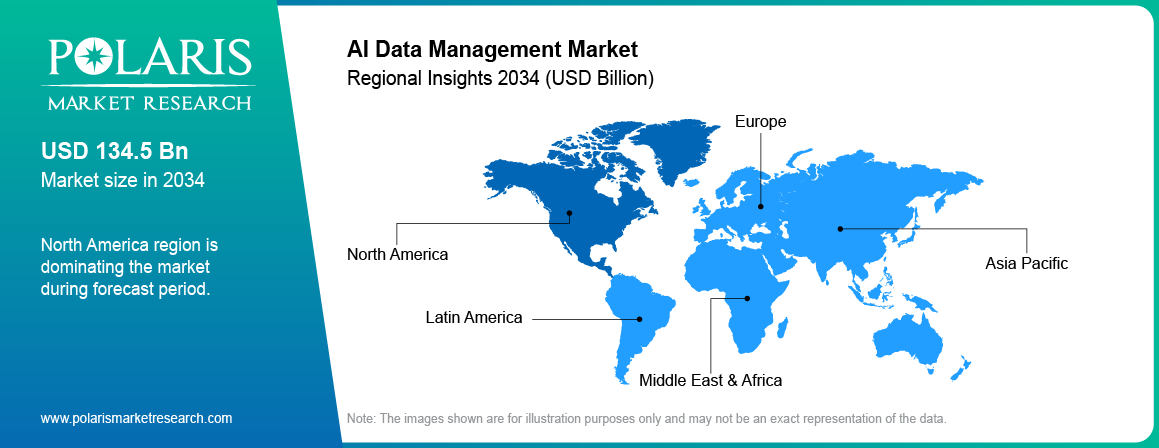
North America dominated the AI data management market share with 34.86% in 2025. North America, particularly the United States, has been a global hub for technological innovation. The region is home to many leading tech companies, startups, and research institutions that drive advancements in AI and data management. North American businesses and organizations have been early adopters of AI technologies, recognizing their potential for improving efficiency, decision-making, and competitiveness. North America is home to numerous large enterprises across various industries. These enterprises often have the resources and infrastructure to adopt and implement advanced AI data management solutions. Hence North America contributes the largest market share of AI data management in 2025 and expected to grow in the upcoming years.
In September 2026, OpenText and Cohere partnered to combine trusted enterprise data with agentic AI, with an eye toward safe AI deployment for governments and regulated industries as early as early 2027 (Source: martechseries.com).
Companies in financial services, healthcare, retail, technology and telecommunications are putting more money into data platforms to support their AI and analytics workloads. The regional market is also driven by increasing demand for AI governance and data security.
Europe AI Data Management Market
Europe is anticipated to record a CAGR of 22.14% during 2026-2034 supported by enterprise digitization, cloud adoption, data governance requirements and growing AI deployment. According to Eurostat, in 2025, about 72 % of businesses in the EU had basic digital intensity, including 71 % of SMEs and 96 % of large businesses. SMEs are 20 percentage points behind the EU 2030 target. Organizations are focused on data quality, privacy and responsible AI practices (Source: ec.europa.eu).
Germany, the UK, France and other large European economies are scaling up enterprise data and AI capabilities. Demand for structured governance and compliance systems is also being driven by regulatory requirements around data protection and AI.
Asia Pacific AI Data Management Market
The market in Asia pacific is anticipated to record a CAGR of 25.62% during the forecast period. Many countries in the Asia-Pacific region are undergoing rapid digital transformation across various industries. This transformation involves the adoption of AI and data management solutions to improve efficiency, competitiveness, and innovation. Cities such as Beijing, Shanghai, Bangalore, Singapore, and others in the Asia-Pacific region have emerged as prominent tech hubs. These hubs attract talent, startups, and investments, fostering innovation and the development of AI technologies. Governments in the Asia-Pacific region are increasingly recognizing the strategic importance of AI for economic growth and competitiveness. Many countries are rolling out initiatives and policies to support the development and adoption of AI technologies, including data management. As a result, growth in the market share is anticipated during the forecast period.
Southeast Asia attracted AI investments worth USD 55.2 billion and the total investment is expected to cross the USD 110 billion mark by 2028, at a CAGR of 25%. China, Japan, India, South Korea, Australia and Singapore are all building enterprise AI and data infrastructures (Source: eastasiaforum.org).
India's Growing AI Data Management Market
The Indian market is projected to grow at a CAGR of 27.86% during the period 2026-2034 owing to the adoption of cloud solutions, digitization, AI and other data-focused operations in organizations. Some industries include financial services, IT services, retail, telecom and health care.
An increase in enterprise AI projects and digital platforms has created a need for data integration, data governance, data quality and data analytics. India’s data center power capacity increased from 375 MW in 2020 to 1.57 GW in August 2026, with nearly 8 GW projected by 2030. Organizations are also seeking AI data management solutions that can manage distributed data environments at scale (Source: pib.gov.in).
Middle East and Africa AI Data Management Market
The Middle East and Africa market is expected to grow at a CAGR of 24.17% during 2026–2034, driven by digital transformation, cloud adoption, financial technology, telecommunications, and government digitization. Brazil and Mexico are key markets in Latin America, while the UAE, Saudi Arabia, Israel, and South Africa are developing enterprise AI and data capabilities.
Latin America AI Data Management Market
The Latin America market is expected to record a CAGR of 23.48% during the forecast period, driven by growing investments in cloud infrastructure, artificial intelligence, and digital transformation. Organizations across banking, telecommunications, retail, healthcare, and manufacturing are increasingly adopting AI applications, creating demand for reliable, governed, and accessible data. The expansion of cloud adoption and data modernization initiatives is further encouraging enterprises to implement data integration, governance, quality, and security solutions.
Competitive Insights
The global AI data management market includes large cloud providers, enterprise software companies, data platform vendors, analytics providers, and specialized data governance companies. Competition is increasingly focused on integrating data management with AI, cloud infrastructure, analytics, governance, and automation. Vendors compete through data integration capabilities, platform scalability, AI features, data governance, metadata management, security, interoperability, and industry-specific solutions. The development of AI copilots and agentic AI features is also becoming an important area of product development.
List of Key Players
-
Ataccama
-
Collibra
-
Databricks
-
Dataiku
-
Google LLC
-
Hewlett Packard Enterprise
-
IBM Corporation
-
Informatica Inc.
-
Microsoft Corporation
-
Oracle Corporation
-
Qlik
-
Reltio
-
Salesforce, Inc.
-
SAP SE
-
SAS Institute Inc.
-
Snowflake Inc.
-
Teradata Corporation
-
TIBCO Software
Competitive Benchmarking
| Company | Primary Focus | Segment Strength | Notable Product / Program |
| Microsoft Corporation | Cloud, data, analytics, and AI | Enterprise data management and AI-ready data | Microsoft Fabric, Azure AI |
| Amazon Web Services, Inc. (AWS) | Cloud infrastructure, data, and AI | Cloud data management and governance | Amazon DataZone, AWS Glue |
| Google LLC | Cloud data, analytics, and AI | Data analytics and AI workloads | BigQuery, Vertex AI |
| IBM Corporation | Enterprise AI, data, and governance | Data governance and AI-ready data | watsonx.data, IBM Knowledge Catalog |
| Oracle Corporation | Enterprise applications, databases, and cloud | Enterprise data management | Oracle Database, Oracle Cloud Infrastructure |
| SAP SE | Enterprise software and business data | Enterprise data integration and governance | SAP Business Data Cloud |
| Salesforce, Inc. | CRM data, analytics, and AI | Customer data management | Data Cloud, Einstein |
| Databricks | Data and AI platform | Lakehouse, data intelligence, and AI workloads | Databricks Data Intelligence Platform |
| Snowflake Inc. | Cloud data and AI platform | Data sharing, governance, and AI | Snowflake Data Cloud, Cortex AI |
| Informatica Inc. | Enterprise data management | Data integration, quality, governance, and AI | Intelligent Data Management Cloud, CLAIRE AI |
| SAS Institute Inc. | Analytics, AI, and data management | Enterprise analytics and data governance | SAS Viya, SAS Data Management |
| Collibra | Data intelligence and governance | Data governance, cataloging, and lineage | Collibra Data Intelligence Platform |
| Alation Inc. | Data intelligence and governance | Data cataloging, discovery, and governance | Alation Data Intelligence Platform |
| Dataiku | Data science, analytics, and AI | Enterprise AI and data preparation | Dataiku Platform |
| Ataccama | Data management and AI | Data quality, governance, and master data management | Ataccama ONE |
| Qlik | Data integration, analytics, and AI | Data integration and data quality | Qlik Talend Cloud |
| Reltio | Master data management and data intelligence | Customer and master data management | Reltio Data Cloud |
| Teradata Corporation | Enterprise data analytics and AI | Enterprise data platforms and AI workloads | VantageCloud, ClearScape Analytics |
| TIBCO Software | Data integration and analytics | Enterprise integration and data management | TIBCO Data Virtualization, TIBCO EBX |
| Hewlett Packard Enterprise | Enterprise IT, data, and AI infrastructure | Data infrastructure and AI-ready enterprise systems | HPE Ezmeral Data Fabric, HPE Private Cloud AI |
Source: Polaris Market Research Analysis
Recent Developments
-
In September 2026, Everpure announced new platform to simplify enterprise data management. The company is advancing its Data Primacy vision. The updates are expected to advance the modern data management capabilities to solve bottlenecks stalling enterprise AI at scale. (Source: PRNewswire)
-
In September 2026, Itron released its IEE Cloud AI, a meter data management solution on cloud platforms featuring workflows based on artificial intelligence, real-time processing and analytics to revolutionize utilities. (Source: quiverquant.com)
-
In September 2025, Quest Software launched a unified data management platform to help enterprises address the challenges of deploying AI, based on trusted data, secure identities and modern systems to support AI at scale. (Source: quest.com)
-
In May 2025, Informatica announced its Agentic AI strategy to introduce new capabilities into its AI-powered cloud data platform, including CLAIRE GPT, CLAIRE Copilot, and GenAI blueprints to enhance data management and AI-driven decision-making. (Source: informatica.com)
-
In March 2025, IBM and NVIDIA are partnering to integrate the NVIDIA AI Data platform, which allows organizations to manage data for generative and agentic AI, and to grow IBM Fusion, WatsonX and consulting services. (Source: ibm.com)
AI Data Management Market Segmentation
By Offering Outlook (Revenue, USD Billion, 2021–2034)
-
Type
-
Platform
-
Software
-
Services
-
-
Deployment Mode
-
Cloud
-
On Premises
-
By Data Type Outlook (Revenue, USD Billion, 2021–2034)
-
Text
-
Image
-
Video
-
Audio, Speech & Voice
-
Others
By Technology Outlook (Revenue, USD Billion, 2021–2034)
-
Machine Learning
-
Deep Learning
-
Natural Language Processing
-
Computer Vision
-
Generative AI
-
Context Awareness
-
Others
By Application Outlook (Revenue, USD Billion, 2021–2034)
-
Data Governance
-
Data Quality Management
-
Data Integration
-
Data Augmentation
-
Exploratory Data Analysis
-
Data Imputation
-
Process Automation
-
Data Anonymization
-
Others
By Vertical Outlook (Revenue, USD Billion, 2021–2034)
-
BFSI
-
Healthcare
-
Retail & E-commerce
-
IT & Telecom
-
Manufacturing
-
Government
-
Energy & Utilities
-
Media & Entertainment
-
Transportation & Logistics
-
Others
By Regional Outlook (Revenue, USD Billion, 2021-2034)
-
North America
-
U.S.
-
Canada
-
Europe
-
Germany
-
France
-
UK
-
Italy
-
Spain
-
Netherlands
-
Russia
-
Rest of Europe
-
Asia Pacific
-
China
-
Japan
-
India
-
Malaysia
-
South Korea
-
Indonesia
-
Australia
-
Vietnam
-
Rest of Asia Pacific
-
Middle East & Africa
-
Saudi Arabia
-
UAE
-
Israel
-
South Africa
-
Rest of Middle East & Africa
-
Latin America
-
Mexico
-
Brazil
-
Argentina
-
Rest of Latin America
AI Data Management Market Report Scope
| Report Attributes | Details |
| Market Size in 2025 | USD 39.93 Billion |
| Market Size in 2026 | USD 50.05 Billion |
| Revenue Forecast by 2034 | USD 307.79 Billion |
| CAGR | 22.36% from 2026 to 2034 |
| Base Year | 2025 |
| Historical Data | 2021–2024 |
| Forecast Period | 2026–2034 |
| Quantitative Units | Revenue in USD Billion and CAGR from 2026 to 2034 |
| Report Coverage | Revenue Forecast, Competitive Landscape, Growth Factors, and Industry Trends |
| Segments Covered |
|
| Regional Scope |
|
| Competitive Landscape |
|
| Report Format |
|
| Customization | Report customization as per your requirements with respect to countries, regions, and segmentation. |
Source: Polaris Market Research Analysis
Future Outlook
The AI data management market is expected to maintain strong growth through 2034 as enterprises generate more data and expand their use of artificial intelligence, machine learning, analytics, and cloud applications.
AI-powered data governance, automated data quality, natural language data interaction, and agentic AI are expected to become important areas of market development. Enterprises are also expected to increase investments in platforms that connect data from multiple cloud and on-premises environments.
The market is moving toward integrated platforms that combine data integration, governance, quality, analytics, security, and AI capabilities. Demand for reliable data is expected to remain high as organizations use generative AI and other advanced AI applications across business functions.
Research Methodology
The Polaris Market Research AI data management market report follows a four-stage analytical framework to develop consistent market estimates, segment analysis, and regional forecasts.
Secondary Research & Data Collection
The analysis uses information from company annual reports, investor presentations, product documentation, regulatory sources, technology databases, industry associations, press releases, research publications, and other verified industry sources. Historical market information covers 2021–2024.
Market Estimation & Modelling
The top-down and bottom-up approaches are used to estimate the market based on vendor revenues, platform adoption, software and service pricing, enterprise spending, deployment models, application demand, and regional market activity across the defined segments.
Primary Validation
Market assumptions are tested through discussions with AI data management vendors, cloud providers, systems integrators, technology consultants, enterprise users, data professionals, and industry experts across key markets.
Data Triangulation & Final Review
Company filings, industry databases, secondary research, and primary research are used to validate market estimates. Segment and regional estimates are reviewed against market developments and relevant industry indicators before finalization.
AI Data Management Market FAQ's
The market encompasses solutions that leverage artificial intelligence (AI) and machine learning (ML) technologies to handle enterprise data.
The market size was USD 39.93 billion in 2025 and is estimated to reach USD 307.79 billion by 2034, due to rising global connectivity.
The market is expected to grow at a 22.36% CAGR during 2026 to 2034, due to increasing advancements in AI and ML and growing demand for data-driven decision-making.
The platform category accounted for a 41.68% share in 2025, driven by rising adoption of cloud data management platforms.
Growth is driven by increasing volumes of data, adoption of AI, cloud adoption, digital transformation, and data management.
Key use cases include data governance, data integration, data quality, automation, metadata management, and AI data preparation.
Asia Pacific is expected to witness a CAGR of 25.62% during 2026-2034, owing to the growing adoption of AI, cloud technology, and digitalization.
The market is anticipated to witness growth over the forecast period, owing to the adoption of cloud platforms, AI governance, generative AI, and agentic AI.

Download Sample Report of AI Data Management Market
Please fill out the form to request a customized copy of the research report.


