
Prompt Engineering Market Size, Share, Trends & Forecast, 2026–2034
REPORT DETAILS
Prompt Engineering Market Summary
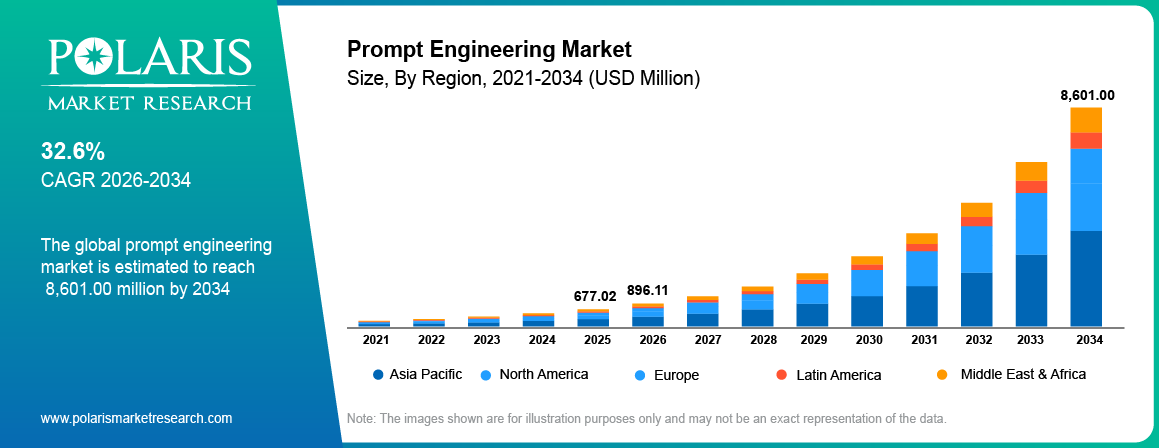
The global prompt engineering market size was valued at USD 677.02 million in 2025. The market is projected to grow at a CAGR of 32.6% from 2026 to 2034. The rising demand for personalized user experiences is one of the key factors driving market growth. The market is also benefiting from advances in artificial intelligence (AI) and natural language processing (NLP) technologies.
Market Statistics
Prompt Engineering Market Key Takeaways
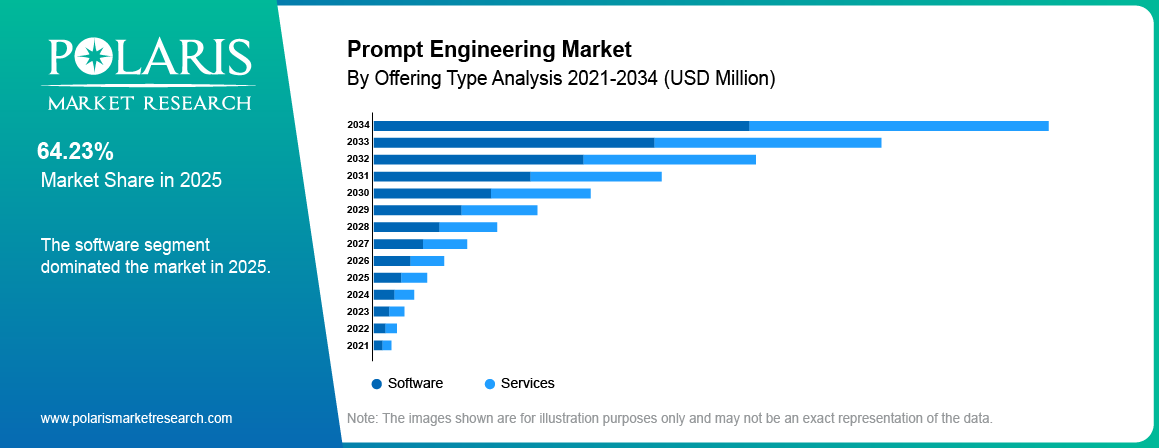
- North America led the global prompt engineering market with an 41.33% share in 2025. This is owing to the region’s strong IT infrastructure and early adoption of advanced technologies.
- Asia Pacific is projected to witness rapid growth at an 35.8% CAGR. Rapid industrialization across several sectors creates a favorable environment for the adoption of AI-driven solutions.
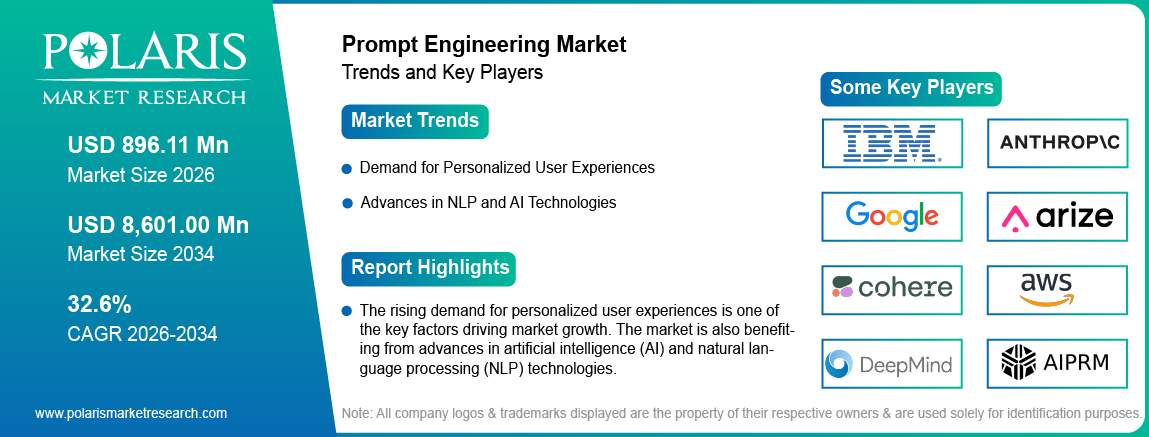
- By offering, the software segment accounted for an 64.23% prompt engineering market share in 2025. This is owing to several companies offering prompt engineering software tools.
- By application, the content generation segment held an 31.21% share in 2025. The rising demand for new content contributes to the segment’s major market share.
- By technique, the chain-of-thought prompting segment is projected to grow at an 34.2% CAGR. This is due to the rising emphasis on solving complex problems.
Note: Figures and projections outlined in this report are the result of Polaris Market Research’s proprietary analytical processes, grounded in the latest available datasets and market observations.
What is Prompt Engineering?
Prompt engineering involves the creation of instructions that are tailored for the artificial intelligence model. This enables the model to have an idea of what the user desires in return. Prompt engineering is commonly practiced on large language models (LLMs) and generative AI systems. This helps in achieving better results from the AI models.
To put it in simple terms:
- Prompt engineering entails giving the AI model instructions to receive the desired response.
- The user can alter the prompt's wording when the initial response is not satisfactory.
Prompt Engineering Market Definition and Scope
The prompt engineering market covers software and services used to develop and enhance prompts for AI systems. This market comprises software solutions that aid in development, testing, management, and optimization of prompts. Professional services for prompt engineering are also included. The prompt engineering market scope includes demand in terms of various applications, end users, techniques, and geography.
The market is measured based on vendor revenue. Vendor revenue is reported in USD million. The base year is used as the reference year. The scope covers both prompt engineering software and professional services.
How Prompt Engineering Works?
Definition of the outcome: In the first step, the user determines what the artificial intelligence model should generate.
Structure of the prompt: The instructions are presented in a structured format to provide sufficient context to the model.
Processing of the prompt by the model: The AI model interprets the instructions and creates a corresponding answer.
Evaluation of the output: The generated answer is evaluated to determine whether it satisfies the initial requirement.
Prompt revision: If the output is unclear, incomplete, or incorrect, the prompt is revised.
Repetition: This procedure continues until consistent results are achieved.
Prompt Engineering Market Dynamics
The industry’s growth is driven by increasing consumer demand for personalized AI experiences, developments in AI technology, and greater enterprise adoption of generative AI and large language models.
Driver : Demand for Personalized User Experiences
The need to personalize digital experiences has grown as users now expect AI tools to generate outputs that meet their specific requirements. This has led to an increase in prompt engineering because prompts can be changed to ensure better context for AI models. Businesses are using personalized AI interactions for customer support, search, learning, and digital assistance. In April 2026, Google introduced Personal Intelligence in Gemini in India, which allows linking services like Gmail, Photos, YouTube, and Search for better output generation (source: blog.google). The example illustrates the shift towards context-based responses by AI programs. The application of this technology requires the creation of prompts, which direct the model based on the user’s environment and desired result. As personalized AI use grows, prompt optimization will likely become a higher priority for businesses.
Driver : Advances in NLP and AI Technologies
The development of natural language processing capabilities has resulted in better understanding of human language and adherence to complex instructions on the part of AI models. Recent models have a higher capacity in terms of input length and complexity of tasks to perform. Consequently, there is a greater demand for prompts that give clear instructions and appropriate context. OpenAI released its latest model called GPT-6 Astra in September 2026, calling it the most powerful model deployed broadly to date (source: openai.com). More capable models are able to facilitate various types of interaction and workflows. However, users still need to instruct the model in order to get the desired result. Prompt engineering is becoming increasingly important as the technologies become more advanced. Improved NLP functionality is also making prompt engineering more relevant.
Driver : Enterprise Adoption of Generative AI and LLMs
Businesses have started to utilize AI and LLMs for a variety of business functions. Businesses are also progressing from experimenting with AI into applying it in practice. As a result, there is increased demand for well-written, consistent prompts for models. As OpenAI reported in August 2026, enterprises are shifting from using AI for assistance to tasking AI systems with various assignments (source: openai.com). Another finding was the increased use of AI with enterprise data and business applications. As AI assumes more responsibilities, the importance of prompt quality grows. Prompt engineering helps companies optimize prompts for specific business tasks and update them when results fail to meet requirements. This means enterprises' widespread use of generative AI drives demand for prompt engineering.
Restraints and Challenges
There are various factors that could restrict prompt engineering. The issue of data security arises because prompts might hold business or customer confidential data. The lack of trained personnel could be a problem since this would make it hard for companies to have efficient prompts. The dependence on particular AI models could also pose some challenges. Regulatory policies could also complicate things for businesses using AI in critical applications.
Restraints and Challenges : Data Privacy, Standardization, Skills, and Regulatory Challenges
Prompt security continues to pose challenges for situations where personal and business information is present in prompts. Such regulatory issues include GDPR and CCPA, which have put in place certain demands for processing personal data. Prompting can become subject to certain limitations due to regulatory demands. There are no unified standards for prompt engineering development and validation. A lack of talent in the area can make things more complicated for businesses that operate in this field. Prompt efficiency also depends on the specific models businesses use. Changes in model behavior may require prompt modification.
Opportunities : Growth of Prompt Lifecycle Management
More businesses are using prompts across a growing range of AI applications. This leads to the requirement for the management of prompts as they are used in various ways. Prompt lifecycle management software can assist in the storage and organization of all prompts in one place. It may also help in monitoring the changes that are made in prompts. Various versions of the same can be compared before deciding which one will be used in the particular application. Monitoring features can help detect changes in output quality over time. Such features can also simplify the process of managing large prompt libraries. With increasing adoption of AI in enterprises, management of the prompt lifecycle will also gain significance.
Opportunities : Industry-Specific Prompt Frameworks
Different industries have different needs for AI applications. A prompt that is used in the healthcare industry requires a different framework from that in the retail industry. Specific industry frameworks could be useful for guiding certain activities within a given industry. It enables users to generate prompts based on terminologies and processes that are specific to the industry. This will result in reduced development time for repetitive prompts. Different software providers can develop unique libraries based on the business function. This creates opportunities for prompt engineering service providers to focus on certain industries. Demand for customized AI applications can support further development of industry-specific prompt frameworks.
Trend : Automated Prompt Optimization
Prompt optimization tools are becoming increasingly valuable, considering that AI solutions need prompt testing regularly. They are capable of comparing prompts automatically and figuring out which set of instructions works better. Thus, there is reduced need to check everything manually. In addition, some platforms can provide prompt templates for repetitive tasks. A prompt management platform can combine these features into one workspace. The prompt library lets teams categorize templates based on their use cases. This method is assisting many organizations in organizing prompt creation in a systematic manner.
Trend : Prompt Chaining and Agent Orchestration
AI applications are beginning to shift from single prompts to multiple-step tasks. Prompt chaining allows one prompt to pass its output to another prompt. RAG enables the inclusion of relevant information before the model produces an output. Agent orchestration can link AI agents to tools and systems in order to accomplish various aspects of the task. This trend is raising the appeal of platforms that allow the creation of complex AI workflows. Prompt IDEs provide developers a specialized environment for developing and testing such workflows. Prompt marketplaces can enable the reuse of prompts for particular tasks. These developments are broadening the role of prompt engineering in AI application development.
Prompt Engineering vs Fine-Tuning vs RAG
The main distinction between prompt engineering vs fine-tuning is that prompt engineering alters the input, while fine-tuning changes the model by training it further. The major difference between prompt engineering vs RAG is that the former involves changing instructions, while the latter incorporates information in the model's context.
| Attribute | Prompt Engineering | Fine-Tuning | RAG |
| What is adjusted | Input instructions and examples | Model weights, via additional training | External knowledge retrieved and added to the prompt |
| Model modified? | No | Yes | No |
| Setup effort | Lowest: iterate directly on text | Highest: needs curated data and compute | Moderate: needs an index and retrieval pipeline |
| Data needed | A few examples | A labeled or curated dataset | A document corpus or knowledge base |
| Best for | Format, tone, task framing, reasoning steps | Specialized style or behavior at scale | Grounding answers in current or private data |
| Main limitation | Sensitive to wording and model version | Cost; may need repeating when the base model changes | Depends on retrieval quality; adds latency and infrastructure |
| Knowledge freshness | Limited to what the model knows | Fixed until retrained | Updates as the sources update |
| Combines with | RAG, fine-tuning | Prompts, RAG | Prompts, fine-tuning |
Source: Polaris Market Research Analysis
Prompt Engineering in the AI Stack
Prompt engineering links user prompts to the AI technology responsible for processing them. The use of prompt engineering varies in the AI stack according to the AI technology utilized.
Generative AI
Generative AI creates new content on the basis of the input provided by the user. The prompts are given to provide the required instructions about the task that needs to be done. Generative AI can be used in systems that create text, images, code, sounds, and other types of content. Its placement is primarily within the interaction layer, where users communicate their requirements to a generative AI system.
Large Language Models (LLMs)
Large language models are designed to process human language and respond accordingly. Prompt engineering acts as an input channel through which users interact with such models. It does not impact the training of the model but operates at the input level to enable users to instruct the task they would like the LLM to execute.
Natural Language Processing (NLP)
Natural language processing allows computer systems to process and understand human language. This is one of the technologies used in several AI systems that help process human language commands. Prompt engineering uses these language skills to provide instructions through human language.
Emerging Technologies: AI Agents, RAG and Automated Prompt Optimization
The development of AI solutions is moving towards the creation of workflows capable of performing multiple stages with minimal human input. Agentic AI prompt engineering is emerging as an essential process of developing instructions for the operation of AI agents, which can execute their tasks without substantial human input. Such prompts need to describe an agent's function and the actions it is supposed to take. Context engineering is also emerging as necessary for providing the appropriate context to a model to make certain decisions during a certain task. RAG facilitates such a process, as it allows relevant information to be incorporated into an AI workflow. Automated prompt optimization is the technology that can help to test various prompts and measure their performance. Such technologies may co-exist and cooperate inside AI solutions rather than existing as independent approaches. The development of these technologies is broadening the scope of prompt engineering to larger AI workflows.
Responsible AI and Prompt Governance
Responsible AI use calls for organizations to consider how prompts affect model behavior. AI governance makes it possible to set guidelines for prompt design and use within the business. This way, organizations can identify who should design prompts and how to review any changes. Output validation can be helpful in allowing teams to validate responses prior to their use in business processes. In addition to the above, prompt testing can assist organizations in AI hallucination reduction through the identification of instructions that lead to invalid responses. Prompt design can also help organizations mitigate biases in their responsible AI practices. Audit trails can document prompt alterations and the decision-making process. These measures enhance organizational transparency in prompt utilization and management.
Enterprise Adoption and Business Benefits
Prompt engineering can help enterprises keep AI systems consistent with routine business operations. The technique helps teams develop a practical approach to formulating standard instructions for performing recurring operations. This practice could save enterprises the cost of developing new instructions for each transaction since well-formulated prompts could enable employees to derive useful information without making corrections. Enterprises can use this technique to develop prompts for internal systems without altering AI model architecture. Prompts can help ensure consistency when several employees perform similar tasks within an enterprise. Organizations can also reuse prompts across departments with similar requirements. These practices can make AI more effective in enterprises' daily operations without changing the AI model architecture.
Prompt Engineering Market Segmentation
The prompt engineering market is segmented on the basis of offering, technique, application, end use, and region:
| Dimension | Segments |
| Offering | Software · Services |
| Technique | Chain-of-thought · N-shot · Generated Knowledge · Others |
| Application | Conversational AI · Software development · Content Generation · Others |
| End Use | IT & Telecom · Healthcare · Automotive & Transportation · BFSI · Retail & E-commerce · Media & Entertainment · Others |
| Region | North America (U.S., Canada) · Europe (Germany, UK, France, Italy, Spain, Netherlands, Russia, Rest of Europe) · Asia Pacific (China, Japan, India, South Korea, Malaysia, Indonesia, Australia, Rest of Asia Pacific) · Latin America (Brazil, Mexico, Argentina, Rest of Latin America) · Middle East & Africa (Saudi Arabia, UAE, Israel, South Africa, Rest of Middle East & Africa) |
Source: Polaris Market Research Analysis
By Offering
The software segment led the prompt engineering market with an 64.23% share in 2025. Prompt engineering software offers specialized environments where the prompts can be designed and then tested. The software can facilitate comparing different prompt versions and tracking their performance. Most available solutions also provide prompt libraries that enable storage and reuse of tested prompts. Prompt engineering software also develops solutions for the automation of prompt evaluation and optimization, which could help automate the process of working on the prompts. Growing demand for AI applications in organizations is driving demand for specialized prompt engineering software.
The services segment is projected to grow at an 34.1% CAGR. Prompt engineering is facilitated through organizations’ reliance on external expertise for prompt-related initiatives. Service providers can help develop prompts to meet the company's needs. They can also offer consultancy services for evaluating the current prompt-related procedures and suggest improvements. Training services will be helpful for teaching employees how to use AI models. There could be demand from organizations that do not have a prompt engineering team. This specialized service can be useful when there is a need for custom prompt solutions in an organization’s AI application. As companies implement more advanced use cases for AI, the demand for external expertise in prompt engineering could facilitate the growth of the services market.
By Technique
The n-shot segment accounted for an 34.33% prompt engineering market share in 2025. The n-shot prompting approach enables users to give a few examples inside a prompt to show the model how to execute the task. The method works well to increase the consistency of the outputs in cases where a certain style needs to be followed while executing the task. Various n-shot approaches can be used depending on the task by varying the examples given inside a prompt. This flexibility is one of the reasons why n-shot approaches are ideal for use in applications where models need to stick to particular formats. Increasing usage of example-based prompts in AI applications is driving demand for n-shot prompting methods in the prompt engineering market.
The chain-of-thought segment is projected to grow at an 34.2% CAGR. Chain-of-thought prompting is a way to help AI models think about how to solve a particular problem by following a certain reasoning process. This method is helpful when there is a need to perform multiple reasoning processes before providing a final answer. Chain-of-thought prompting is also suitable for solving problems involving calculations and logic. It is possible for users to generate prompts based on the kind of reasoning needed for the application. It can help promote a better structure of responses by AI systems performing difficult tasks. With organizations looking into advanced prompting techniques for complicated use cases, chain-of-thought prompting is expected to become more popular.
Prompt Engineering Techniques Explained and Compared
| Technique | How it works | Typical use | Strength | Limitation |
| n-shot (zero-, one-, few-shot) | Supplies zero, one or several examples in the prompt | Classification, extraction, formatting | Fast; no training | Sensitive to which examples are chosen |
| Chain-of-thought | Asks the model to reason step by step | Math, logic, multi-step problems | Better reasoning and transparency | Longer outputs; higher cost |
| Generated knowledge prompting | Model first generates relevant facts, then answers | Analysis, commonsense questions | Adds context before answering | Generated “facts” can be wrong |
| Prompt chaining (other) | Splits a task into linked prompts | Multi-step workflows, code and analytics pipelines | Control over each step | More prompts to maintain |
Source: Polaris Market Research Analysis
By Application
The conversational AI segment held an 38.44% prompt engineering market share in 2025. Prompt engineering enables conversational AI to reply in accordance with the purpose of an interaction. With well-crafted prompts, developers can determine the appropriate tone of language and level of detail required in the answer. They can even direct the ways in which the conversational AI will process various user inputs. It is beneficial in virtual assistant and customer chat interface applications. The development of conversational AI can be modified to meet certain business regulations by fine-tuning its instructions. Growing adoption of conversational AI interfaces is driving demand for prompt engineering in this application category.
The software development segment is projected to grow at an 35.1% CAGR. Prompt engineering is being used to enable AI models to complete tasks such as code generation and code completion. Developers can give a prompt that describes the programming activity and the format in which the output should appear. The prompts can also be tailored to meet various development needs. Prompt engineering assists developers in making better use of the AI code writing tools. It has proved especially effective in the case of code generated through natural language descriptions. Code explanation and code error detection are among other activities that prompt engineering will aid. With the increasing adoption of AI-assisted software development tools, there has been more need for customized prompts in these activities.
| Application | Description |
| Conversational AI (Chatbots & Virtual Assistant) | Prompt engineering helps conversational AI adhere to the set rules of interaction and generate appropriate responses for users' queries. |
| Software Development (AI Coding Tools) | Prompt engineering supports AI coding tools in understanding development requirements and generating appropriate code for the same. |
| Content Generation | Prompt engineering assists AI in generating content based on set topics and writing requirements. |
| Others | Uses of prompt engineering in other AI-driven activities other than the primary ones. |
Source: Polaris Market Research Analysis
By End Use
The BFSI segment held the largest prompt engineering market share of 22.8% in 2025. Financial organizations use AI systems in activities where precise and definite directions are needed. Prompt engineering can facilitate applications like financial analysis, documentation processing, and customer interactions. This can further help in determining the format and extent of output used in finance operations. There is a need to manage vast amounts of structured data, making it necessary to have tools that can direct AI systems effectively. Prompt-driven applications can easily be modified to perform various financial activities without needing to change the model itself. Increased use of AI in banking and finance activities is driving up the demand for prompt engineering within the BFSI segment.
The media & entertainment segment is projected to grow at an 33.7% CAGR. Prompt engineering has been used to direct AI in carrying out operations related to media operations and creation of content. The process may help users outline the required format and structure of AI-generated content. Prompt engineering may facilitate activities such as developing scripts and content ideas. In addition, this process may be useful in generating alternative versions of existing content based on their formats. Media organizations may use customized prompts to ensure consistency in recurring content-related operations. This process may also come in handy in organizations trying to use AI tools for creative production purposes. Increased adoption of AI in the media and entertainment industries may fuel demand for prompt engineering within this segment.
| End Use | Description |
| IT & Telecommunications | Prompt engineering is used to enhance the interaction of AI tools deployed in software and technology operations. |
| Healthcare | Here, prompt engineering assists AI systems in handling healthcare data per certain instructions and specifications. |
| Automotive & Transportation | By assisting models in interpreting specific instructions and inputs, prompt engineering aids the deployment of AI in vehicles and transportation systems. |
| BFSI | Businesses in the financial sector use prompt engineering to assist AI systems in achieving tasks requiring relevant output. |
| Retail & E-commerce | Here, prompt engineering helps businesses deploy AI systems according to the needs of customers and the retail industry. |
| Media & Entertainment | Prompt engineering supports AI systems in creating output as per certain specifications of media and entertainment. |
| Others | These are other industries that use prompt engineering for AI-specific business activities and processes. |
Source: Polaris Market Research Analysis
Prompt Engineering Use Cases
| Use Case | Named Example |
| Low-code prompt management | Salesforce Prompt Builder added support for creating and managing prompts within business workflows in 2026. (source: salesforce.com) |
| Generative AI application development | Amazon Bedrock expanded its prompt management and optimization capabilities in 2026 for developers building generative AI applications. (source: aws.amazon.com) |
| Prompt development environments | Google Cloud expanded prompt development capabilities in Vertex AI Studio in 2026. (source: cloud.google.com) |
| LLM troubleshooting and prompt testing | Arize continued expanding prompt testing and evaluation capabilities in Arize AX in 2026. (source: arize.com) |
| Prompt performance comparison across LLMs | Vellum provides tools for testing prompts across different models and comparing their results. |
| Automated prompt optimization | Google Cloud's Prompt Optimizer supports automated improvements to prompts based on defined evaluation criteria. |
Source: Polaris Market Research Analysis
Regional Analysis
Regional analysis of the prompt engineering market is done across North America, Europe, Asia Pacific, and Latin America. Demand varies by region due to different levels of AI implementation and use of large language models by enterprises.
North America
The North America prompt engineering market accounted for the largest share of 41.33% in 2025. The region has an extensive base of companies specializing in the development and adoption of generative AI and large language models. Companies are implementing these technologies in areas such as software development, customer support, data analytics, and content creation. As a result of the extensive implementation of these technologies, there arises a greater need for prompt engineering. The market remains significant because prominent companies offer AI technology, and many enterprises use it. The companies are also developing technologies aimed at facilitating prompt engineering. The growing usage of AI technology within business operations further drives the demand for prompt engineering.
Asia Pacific
The Asia Pacific prompt engineering market is projected to account for an 35.8% CAGR. The growth of the market is driven by the rising usage of generative AI and large language models in the region. Nations like China, Japan, South Korea, and India have been increasing their adoption of AI solutions for various business and technology applications. Companies are using AI solutions for software development, customer engagement, and content creation. This results in an increased requirement for prompt development and testing. Moreover, the region has a thriving technology industry, which has been making investments in AI-enabled applications. Increasing adoption of these applications will help drive the growth of the prompt engineering market in Asia Pacific.
Europe
The Europe prompt engineering market accounted for an 26.55% share in 2025. The demand in the region is driven by the increased adoption of generative AI and large language models by companies. Companies in Europe are leveraging AI in domains such as software development, customer support, and operational processes. This will increase demand for high-quality prompts that help AI systems perform their tasks effectively. Germany, the UK, France, and other key European economies are driving the demand in the region. The creation of AI governance frameworks also drives companies to have processes for AI adoption. As companies continue to adopt AI systems, the demand for prompt engineering services will increase.
Latin America
The Latin America prompt engineering market is projected to grow at an 28.9% CAGR. Generative AI use is increasing across businesses and digital services in the region. Various businesses have been using AI for purposes such as customer service, writing content, software development, and other business processes. There has been a growing demand for prompts for use within AI to ensure proper and accurate output from the AI. Markets such as Brazil and Mexico are some of the main markets that are contributing to this regional demand. Increased access to AI platforms has made prompt engineering increasingly significant for businesses that are integrating AI in their operations. There are anticipated future developments regarding businesses seeking prompt engineering solutions.
Middle East & Africa
The Middle East & Africa prompt engineering market is anticipated to account for an 29.8% CAGR. Generative AI adoption is on the rise among firms and governments within the region. Businesses have been using AI technologies for customer support, content generation, software engineering, and other functions within the business. This has led to the need for prompts that can be used to guide AI systems for specific business functions. Saudi Arabia, the UAE, Israel, and South Africa are some of the contributors to AI activities in the region. Efforts to transform digitally are also making it possible to adopt applications based on AI technology. As organizations integrate generative AI more deeply, demand for prompt engineering tools will rise.
Key Players and Competitive Landscape
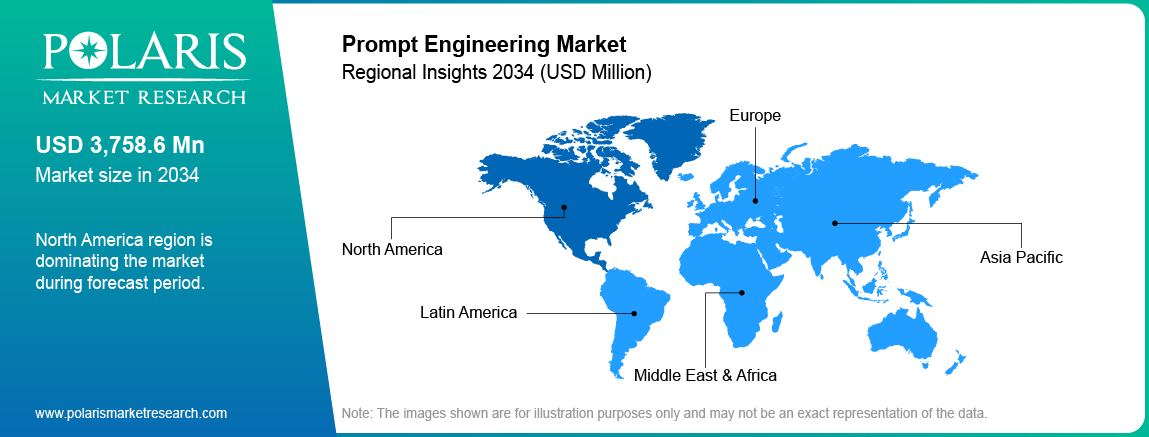
The prompt engineering market comprises technology firms, AI platforms, and specialized software vendors. The competition focuses on developing tools that assist in creating, testing, managing, and optimizing prompts. Firms have been increasing efforts to develop tools that integrate the workflow for prompt engineering into larger environments of AI development. Tool development has also been directed at easing the testing process of prompts for developers and businesses. Certain vendors have included functions for controlling and evaluating the performance of prompts. Others have also been incorporating prompt functionality into their AI and cloud platforms. Strategic alliances and product improvements also shape the competition as the top prompt engineering companies expand their market presence.
Vendor Positioning
| Role | Vendor |
| Cloud / LLM platform | Amazon Web Services (AWS); Microsoft; Google; OpenAI; Cohere; IBM; xAI |
| LLM provider / AI platform | Anthropic; Google DeepMind |
| Enterprise software | Salesforce, Inc. |
| Prompt tooling / LLMOps | Arize AI; Vellum; PROMPTMETHEUS; Promptitude; PromptGenie |
| Prompt marketplaces / libraries | AIPRM; PromptBase; PromptHero; PromptLeo |
| AI consulting / services | A3Logics; Curvestone; LeewayHertz; Nitor Infotech |
Source: Polaris Market Research Analysis
List of Key Companies
- A3Logics
- Amazon Web Services (AWS)
- Anthropic
- AIPRM
- Arize AI
- Cohere
- Curvestone
- Google DeepMind
- IBM
- LeewayHertz
- Microsoft
- Nitor Infotech
- OpenAI
- PromptBase
- PromptGenie
- PromptHero
- Promptitude
- PromptLeo
- PROMPTMETHEUS
- Salesforce, Inc.
- Vellum
- xAI
Recent Developments
- September 2026: Microsoft introduced a new Copilot experience with separate Home, Code, and Autopilot capabilities. The update also introduced a managed runtime for running AI-generated code within Microsoft 365 environments. (source: microsoft.com)
- September 2026: Anthropic introduced Claude Opus 5.5, a new model in its Claude 5.5 family. The release included changes to model safeguards and API controls related to model context. (source: anthropic.com)
- September 2026: Google DeepMind unveiled agentic video understanding in Gemini models. The capability enables the agent to pick up relevant portions of the video while analyzing instead of processing the entire video continuously. (source: blog.google)
- September 2026: Cohere launched North Small Translate, which is an open-weights model for machine translation between over 50 languages. The model is accessible through the Cohere API and offers private deployment. (source: cohere.com)
Future Outlook
The prompt engineering market is likely to evolve along with the growing implementation of generative AI and large language models. Prompt engineering’s place in the business process is likely to shift from individual prompt creation to more sophisticated activities as organizations implement increasingly complex AI applications. A need may arise for tools that help assess prompts and maintain consistent output. AI agents also create the demand for prompt instructions capable of guiding the multi-step process. Industry-specific approaches might attract interest as organizations seek prompts that fit their processes. Changes within the AI models’ landscape are also likely to have an impact on prompt engineering. With increased experience in using generative AI, prompt engineering will become part of the normal workflow of managing AI.
Research Methodology
Overview. Market size is estimated in USD million using top-down and bottom-up approaches, supported by primary and secondary research. The base year is 2025, with historical data covering 2021–2024 and forecasts from 2026–2034.
Scope definition. The market covers prompt engineering software and services used to create, test, manage, refine, and optimize prompts for AI models. The scope includes demand across techniques, applications, end uses, and regions.
Secondary research. Research covers company annual reports, investor presentations, product documentation, release notes, patents, government and regulatory AI publications, paid databases, and industry publications.
Primary research. Interviews are conducted with software vendors, enterprise AI leaders, prompt engineering service providers, and domain experts.
Estimation. The top-down approach uses spending on generative AI and large language models as a reference. The bottom-up approach considers vendor revenue, product adoption, and market participation. Estimates are segmented by offering, technique, application, end use, and region.
Forecast. Segment and regional growth rates are applied from the 2025 base year. Forecast assumptions consider AI adoption, enterprise use, regulatory developments, and changes in AI technologies. Segment estimates are reconciled with the global market total.
Validation. Estimates are validated through triangulation between top-down and bottom-up results. Cross-checks are also conducted against related generative AI and LLM market estimates. Scope-sensitivity checks and analyst review are used to assess consistency.
Update policy. Market figures are re-based annually. Company developments, product updates, and other relevant market changes are reviewed quarterly.
Limitations. Prompt engineering is a developing market with limited and inconsistent vendor revenue disclosure. Market estimates can vary based on the defined scope and treatment of prompt-related software and services. Figures may be restated when the base year or market scope is updated.
Prompt Engineering Market Report Coverage and Scope
| Report Attributes | Details |
| Market Size Value in 2025 | USD 677.02 million |
| Market Size Value in 2026 | USD 896.11 million |
| Prompt Engineering Market Forecast 2034 | USD 8,601.00 million |
| CAGR | 32.6% from 2026 to 2034 |
| Base Year | 2025 |
| Historical Data | 2021–2024 |
| Forecast Period | 2026–2034 |
| Quantitative Units | Revenue in USD million and CAGR from 2026 to 2034 |
| Report Coverage | Revenue Forecast, Market Competitive Landscape, Growth Factors, and Industry Trends |
| Segments Covered |
|
| Regional Scope |
|
| Competitive Landscape |
|
| Report Format |
|
| Customization | Report customization as per your requirements with respect to countries, regions, and segmentation. |
Source: Polaris Market Research Analysis
Prompt Engineering Market FAQ's
The prompt engineering market size was valued at USD 677.02 million in 2025. The market is projected to grow to USD 8,601.00 million by 2034.
The market is projected to account for a CAGR of 32.6% from 2026 to 2034.
The software segment held an 64.23% market share in 2025. This is due to several companies offering prompt engineering software tools.
North America led the global market with an 41.33% share in 2025. Its strong IT infrastructure contributes to the leading market position.
A few of the key market players include A3Logics; Amazon Web Services (AWS); Anthropic; AIPRM; Arize AI; Cohere; Curvestone; Google DeepMind; Google; IBM; LeewayHertz; Microsoft; Nitor Infotech; OpenAI; PromptBase; PromptGenie; PromptHero; Promptitude; PromptLeo; PROMPTMETHEUS; Salesforce, Inc.; Vellum; and xAI.
Market growth can be attributed to the increased adoption of generative AI and large language models. Additionally, demand for personalized AI interactions and use of AI in all business applications are driving the market.
Prompt engineering is used in IT & Telecom, Healthcare, Automotive & Transportation, BFSI, Retail & E-commerce, and Media & Entertainment. It can help in various activities like software development, customer engagement, creation of content, and even in data management.
Prompt engineering enables users to provide AI models with clear directions and appropriate context. Well-designed prompts can improve the quality of outputs to match their desired applications.
Download Sample Report of Prompt Engineering Market
Please fill out the form to request a customized copy of the research report.


