
Protein Bar Market Share, Size, Trends, Industry Analysis Report, 2026 - 2034
REPORT DETAILS
Protein Bar Market Summary
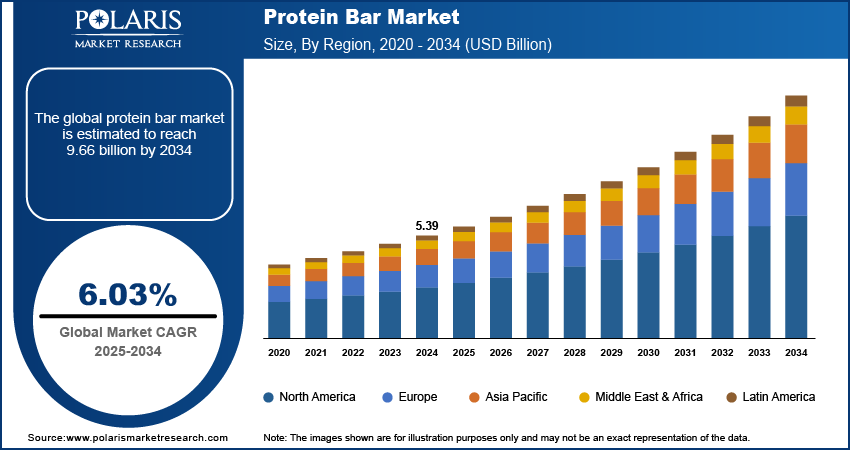
The global protein bar market was valued at USD 5.69 billion in 2025 and is expected to grow at a CAGR of 6.8% during the forecast period. Consumer preferences are shifting toward wholesome, practical snack options, such as protein bars, as health awareness increases. This is one of the primary drivers of worldwide market expansion. The growing awareness of the benefits of taking protein bars also boosts total sales. Nutrient-dense protein bars provide the body with additional protein.
Market Statistics
Key Takeaways
- In 2025, the plant-based protein bars market led the market, owing to increasing demand for vegan, sustainable, and clean-label products.
- The growing popularity of fitness trends and rising consumer demand for convenient, protein-rich snacks are driving the sports nutrition bars segment in the Protein Bar market.
- North America is expected to have significant growth due to increasing retail availability and on-the-go and functional protein bar offerings.
- The protein bar market is seeing new products come onto the market quickly from online and DTC channels that use rapid product testing and showroom models to help them reach their intended customers. This, along with the popularity of low-sugar, clean-label, and high-protein formats for protein bars, has allowed for an increase in the sales of protein bars through online and DTC channels in North America.
- While premium protein bars that contain functional ingredients (i.e., collagen, fiber, creatine, adaptogens) are rapidly growing in acceptance and availability through mass-market outlets (i.e., supermarkets, convenience stores), plant-based protein bars and sports nutrition bars are also gaining traction through these same types of retail distribution channels.
Protein bars are packaged snacks and/or functional bars that are designed to deliver a specific amount of protein. They can have one of several primary purposes: to enhance performance, provide satiety, replace a meal, or provide a nutritional supplement for an active lifestyle. Some products contain protein and are therefore considered part of a sports nutrition program; others provide protein and are considered meal replacements based on their ingredient composition and practical use. The differences in market estimates often arise from variations in definitions (protein bars versus all nutrition bars), distribution channels (online versus retail), and the definition of a premium price point. These distinctions are important because they inform analysis of the protein bar market, including its size, global market size, industry overview, future growth potential, and compound annual growth rate (CAGR).
The analysis takes the year 2024 into account as base year data will run from 2020-23 (as such data ran from 2020-2023). The protein bar market statistics include estimates for 2025 and beyond, including the 2024 market size, the 2034 forecast, and the CAGR for any year between 2025 and 2034.
Industry Dynamics
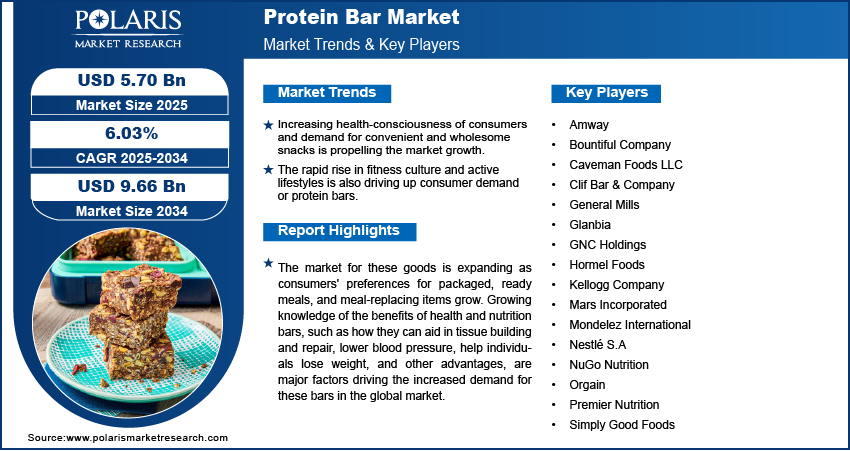
- Increasing consumer health consciousness and demand for convenient, wholesome snacks are propelling market growth.
- Increasing consumer demand for plant-based diets is driving demand for more vegan and allergen-friendly protein bars.
- The rapid rise in fitness culture and active lifestyles is also driving up consumer demand for protein bars.
- Innovation in flavors, ingredients, and packaging enhances a product's appeal while broadening its consumer base.
- In the protein bar category, brands face trade-offs in developing formulations. Meeting consumer expectations while achieving an optimal balance of taste and texture, formulating low-sugar and clean-label protein bars, and managing allergens can increase costs and slow the reformulation process.
- There are opportunities with channel-specific and function-led products. Examples of new potential product opportunities include club multipacks, single-serve convenience packs, DTC trial bundles, functional protein bars, protein-based snacks, and benefits for gut health or collagen, which are trending in packaging for the protein bar category.
To Understand More About this Research:Download Sample Report
AI Impact on Protein Bar Market
- AI enhances the speed and efficiency of product development by analyzing consumer preferences and nutrition data.
- AI enhances supply chain speed and efficiency by predicting future demand and managing inventory; thus, improving product availability while minimizing production costs.
- AI improves quality assurance and mitigation by enabling real-time monitoring of production systems, addressing inefficiencies, and mitigating potential risks while ensuring product consistency.
- AI uses consumer feedback data on purchasing behavior to provide brands with insights to effectively target consumers based on product variations.
- In retail and e-commerce, AI helps optimize protein bar assortments by predicting which flavors, claims (low sugar, high protein), and formats will perform best by channel. This supports AI-driven product development and aligns with evolving trends in e-commerce protein bars.
- For manufacturers, AI-enabled quality assurance can detect anomalies and reduce batch variation. This improves texture and shelf life while strengthening supply chain forecasting and reinforcing AI's impact on the protein bar market.
Protein bars are becoming increasingly popular among those who don't have time to sit down and eat a full meal or need an on-the-go snack or replacement for a meal. They provide many different proteins that can help your muscles recover from exercise or support weight management while also being nutrient-dense (providing vitamins, minerals, fiber, etc.) for your overall health.
For instance, according to the Viby-based company Arla Foods Ingredients, the company has developed an energy bar formulation that enables businesses to increase the protein content in every component of their protein bars, including the mass, filling, and coating, without sacrificing taste or texture. The milk chocolate mass from Arla's Lacprodan line is formulated with whey and milk proteins to maintain flavor and softness throughout the shelf life, and provides 30% protein per bar.
Despite the growing popularity of protein bars, businesses are increasingly focused on reducing sugar and artificial ingredients in their products, a trend that is expected to drive growth in the nutrition bars market in the coming years. Furthermore, it is projected that the consumption of nutrition bars by athletes and sportspeople will increase.
Customers purchase protein bars for various reasons, including energy boosts, muscular growth, and weight management. Additionally, sales of these items have increased due to fitness clubs' marketing initiatives that promote energy bars as alternatives to meal replacements. The market is expected to experience increased demand over the forecast period, driven by the growing popularity of protein bars and the proliferation of fitness clubs.
The uncertain global situation prompted consumers to increase their nutritional intake and to choose safer, healthier meals, as interest in products that support overall health and wellness grew. For instance, to complement its original energy bar range, which includes crispy and decadent bars with lower sugar and carbohydrate content, Quest Nutrition introduced the Quest snack bar in 2020. Additionally, as people began working from home or staying at home more frequently, demand for protein bars increased.
Market Dynamics
Growth Drivers
Many individuals are now using weight-loss and energy-replacement products, such as protein bars, to improve fitness and build muscle mass. This class of products is experiencing significant growth because consumers seek to improve their overall health by consuming high-protein foods. By providing consumers with high protein content in a convenient, easily digestible form, these foods will help ensure adequate protein intake to maintain a healthy lifestyle.
Furthermore, incorporating bars into meals is expected to increase protein intake without adding extra calories or carbs. It is projected that these fitness trends will increase demand for protein bars, given the crucial role of energy bars in providing essential minerals and proteins, boosting energy levels, and promoting muscle building. Athletes, gym goers, and people with physically demanding jobs are all encouraged to eat it as a post-workout snack. Weightlifters and athletes require adequate protein to maintain energy levels and improve performance.
According to industry analysts, demand for this type of product is expected to increase due to the growing popularity of fitness-related activities. There is also evidence that large corporations and small businesses in this sector have demonstrated a willingness to innovate their products to appeal to athletes' specific needs.
How Regulations on Protein Products Drive the Protein Bar Market?
The imposition of regulations ensures consumer safety, accurate labeling, and truthful marketing. This is required due to the functional and nutritional claims often associated with protein products. In many regions, “high in protein” claims must be supported by data on protein quality, digestibility, and the product's full nutritional matrix. Market players must comply with these regulations to launch or operate a protein bar brand in India (or to do so already). Industry players must adhere to these regulations to gain a competitive advantage. The following table presents regulatory information across regions.
Brands must comply with rigorous regulations governing the labeling and nutrition of protein bars. The labeling rules for protein bar products vary by region. There can be substantial differences among India's FSSAI protein bar labeling regulations, the United States FDA Allergen Protection Rules, and EFSA-applicable protein bar regulations in Europe, and substantiating both high-protein and low-sugar claims is vitally important for developing compliant formulations. The development of a claim checklist will increase consumer trust and inform teams of how compliant formulation and labeling affect both time-to-market and the cost of bringing the product to market.
| Region | Regulatory Authority | Key Compliance Focus |
| India | Food Safety and Standards Authority of India (FSSAI) | Product safety, licensing, nutritional claims, HFSS restrictions, labeling accuracy, and GMP compliance |
| U.S. | Food and Drug Administration (FDA) | Food classification, labeling, supplement claim substantiation, allergen disclosure, and CGMP compliance |
| European Union (EU) | European Food Safety Authority (EFSA) | Nutrition and health claims, ingredient transparency, protein content verification, and additive limits |
| Australia/Singapore/Japan | FSANZ/SFA/CAA | Allergen labeling, packaging transparency, marketing claims, and sugar and additive limits |
| Global Trend | — | Growing focus on protein verification, clean-label, functional ingredient substantiation, and front-of-pack labeling |
Source: Polaris Market Research Analysis
Report Segmentation
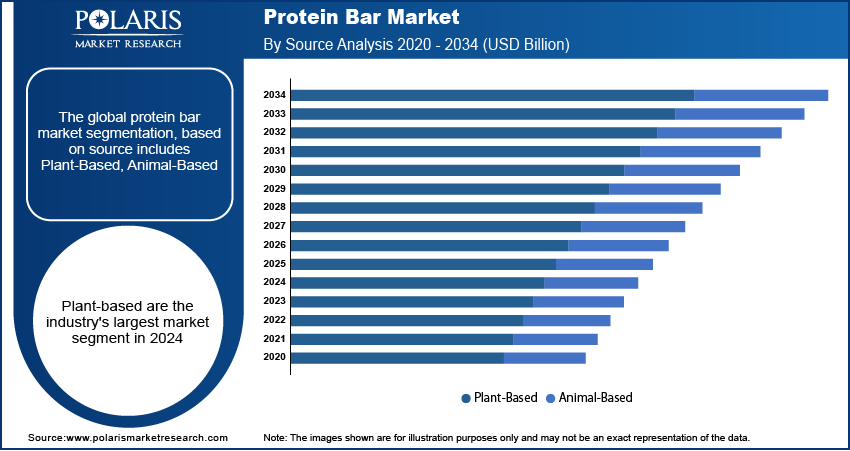
Plant-Based are Industry's Largest Market Segment in 2025
Plant-based protein bars are anticipated to dominate the industry in 2025. Considering that they are created using only organic foods like fruits, butter, seeds, and many others, which are rich in nutrients and help the body against a variety of diseases. As more individuals adopt a plant-based diet to maintain a healthier lifestyle, the number of vegetarians worldwide is increasing, thereby increasing product consumption.
Growth is also enhanced by the broader acceptance of pea, soy, and rice-based protein blends, which improve texture and digestibility while supporting clean-label and allergen-friendly product claims, where applicable. This trend is driving growth in the plant protein bar market, which comprises vegan, plant, and clean-label protein bars, all designed to meet evolving consumer dietary needs.
For instance, according to data from the Vegan Society, more than 629,000 people from 228 countries and territories signed up for the Veganuary campaign in 2022, which encourages participants to go vegan for the entire month of January. In contrast, in 2021, there were 582,000 participants; in 2020, 400,000; in 2019, 250,000; in 2018, 168,500; in 2017, 59,500; in 2016, 12,800; and in 2015, 3,300.
Additionally, the growing number of health and fitness club members who are committed to maintaining their physical health increases demand for the product, which yields better outcomes than other types of bars.
Sports Nutrition Bars Segment will Account for Higher Share of Market
In 2024, sports nutrition bars were anticipated to rule the market. Sports nutrition emphasizes the consumption of specific nutrients, including vitamins, minerals, dietary supplements, and organic compounds composed of proteins, lipids, and carbohydrates. Bodybuilders and athletes have long used sports nutrition products to enhance performance and promote muscle growth. Sports nutrition products have recently gained widespread popularity among consumers in the leisure and lifestyle sectors. The pattern shows a significant increase in the market's consumer demographic.
Routine-based consumption will continue to drive sales in this segment, with more consumers (beyond athletes) adopting the category, using sports nutrition protein bars as a post-workout snack or breakfast substitute, or for their convenience as on-the-go foods. This has led to increased demand for sports nutrition bars, post-workout protein bars, meal-replacement protein bars, and other convenient protein snacks beyond the athletic-focused consumer base.
Market expansion will be driven by increased adoption of nutrition and energy bars and by growing recognition of protein as a crucial constituent. Furthermore, the growing number of people working in hazardous occupations, such as tunneling and mining, and in other jobs that require high-protein diets to restore physical strength, is a factor driving increased use of the product.
Distribution Channel of Protein Bar Market
Protein bar distribution channels include supermarkets/hypermarkets, convenience stores, specialty nutrition stores, e-commerce marketplaces, and Direct-to-Consumer (DTC) platforms. While protein bars sold through supermarkets and convenience stores provide a large volume of sales, the rapid advancement of protein bars sold through online channels and DTC channels is being driven by testing packs, subscriptions, and influencer-driven marketing.
Protein Bar Market Based on Protein Content and Price Tier
The protein bar market can be segmented by protein content into moderate-protein/lifestyle bars and high-protein/performance bars. As protein content increases, product formulation also becomes more complex due to greater challenges for both taste and texture. Pricing tiers are determined by the protein source (whey vs. plant-based protein), any functional add-ins (e.g., collagen or fiber), the positioning of clean-label protein bars, and the type of packaging.
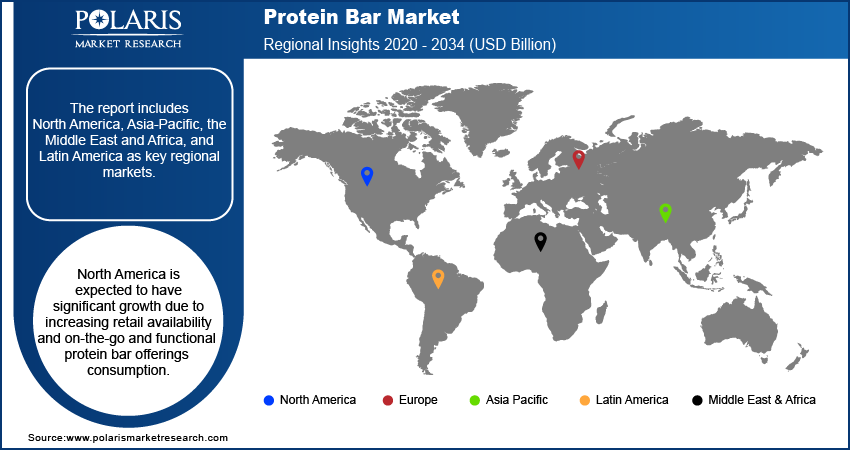
North America is Expected to Witness Significant Growth
The increase in the number of fitness enthusiasts, gyms, fitness training facilities, and health clubs in North America is expected to drive global market growth. Furthermore, due to their active lifestyles and demanding work schedules, Americans are increasingly seeking healthier options in the market. As a result, consumers are turning to snack bars, particularly energy bars, rather than traditional snacks. For instance, a deal was reached in 2021 to buy NxtBar by GenTech Holdings, an up-and-coming leader in the high-end premium coffee and functional foods markets.
The addition of distribution channels (convenience and club formats) and the demand for low-sugar, high-protein claims in functional protein bars are leading to more frequent purchases. This is stimulating growth in the North American Protein Bar Market, particularly in the U.S., and reinforcing the High Protein Snack (HPS) Market.
These nutrient-dense products also provide an optimal protein balance, which helps ensure a healthy lifestyle. The use of protein bars in conjunction with meals should provide additional dietary protein without increasing caloric or carbohydrate intake. Protein bars are important sources of protein and essential minerals, and provide energy and support muscle growth that enhances fitness awareness, as well as increasing the demand for protein bars.
Competitive Insight
In the protein bar category, protein source (plant or animal), sugar strategy (low-sugar or traditional), and channel approach (retail or direct-to-consumer) are the primary drivers of competition. These characteristics shape the competitive environment, key players, and protein bar brands.
Some of the major players operating in the global market include
- General Mills
- Simply Good Foods
- Caveman Foods
- Kellogg Company
- Nestle
- Clif Bar & Company
- Glanbia
- GNC Holdings
- Mars Incorporated
- Hormel Foods
- Mondelez International
- Premier Nutrition
- Amway
- Bountiful Company
- NuGo Nutrition and Orgain
Recent Developments
- April 2025: U.S. brand Pure Protein rolled out its new Pure Protein AMMMAZE bars, now available nationwide across 7-Eleven and Speedway stores. This suggests sustained growth in convenience retail channels, thereby increasing demand for both impulse and on-the-go protein bars. New protein bar products are likely to see increased volume through distribution within these convenience store formats.
- April 2025: U.K.-based protein bar brand Trek introduced its new high-protein, low-sugar bars, targeting the growing segment of health-conscious consumers. This illustrates the growing demand for low-sugar protein bars in developed economies. Clean-label protein bars continue to have an impact on both the shape of the protein bars’ marketplace as well as people's purchasing behaviours through clean-label and reformulation cues.
- May 2024: Gelita launched Optibar, a collagen-peptide blend that allows manufacturers to produce protein or cereal bars with increased protein while maintaining a soft texture and long-lasting softness.
- April 2024: Ready, a U.S. active nutrition brand, launched its Kids Whole Grain Protein Bars, made specifically to fuel active children.
Protein Bar Market Segmentation
By Source Outlook (Revenue – USD Billion, 2021–2034)
- Plant-Based
- Animal-Based
By Type Outlook (Revenue – USD Billion, 2021–2034)
- Sports Nutrition Bars
- Meal Replacement Bars
- Others
By Protein Content Outlook (Revenue – USD Billion, 2021–2034)
- Moderate-protein/lifestyle bars
- High-protein/performance bars
By Distribution Channel Outlook (Revenue – USD Billion, 2021–2034)
- Supermarkets/hypermarkets
- Convenience stores
- Specialty nutrition stores
- E-commerce marketplaces
- Direct-to-Consumer (DTC)
By Regional Outlook (Revenue-USD Billion, 2021–2034)
- North America
- US
- Canada
- Mexico
- Europe
- Germany
- France
- UK
- Italy
- Spain
- Netherlands
- Russia
- Rest of Europe
- Asia Pacific
- China
- Japan
- India
- Malaysia
- South Korea
- Indonesia
- Australia
- Vietnam
- Rest of Asia Pacific
- Middle East & Africa
- Saudi Arabia
- UAE
- Israel
- South Africa
- Rest of Middle East & Africa
- Latin America
- Brazil
- Argentina
- Rest of Latin America
Protein Bar Market Report Scope
| Report Attributes | Details |
| Market Size in 2025 | USD 5.69 Billion |
| Market Size in 2026 | USD 6.08 Billion |
| Revenue Forecast by 2034 | USD 10.32 Billion |
| CAGR | 6.8% from 2026 to 2034 |
| Base Year | 2025 |
| Historical Data | 2021–2024 |
| Forecast Period | 2026–2034 |
| Quantitative Units | Revenue in USD billion, 2021–2034, and CAGR from 2026 to 2034 |
| Report Coverage | Revenue Forecast, Market Competitive Landscape, Growth Factors, and Trends |
| Segments Covered |
|
| Regional Scope |
|
| Competitive Landscape |
|
| Report Format |
|
| Customization | Report customization as per your requirements with respect to countries, regions, and segmentation. |
Source: Polaris Market Research Analysis
Protein Bar Market FAQ's
The global protein bar market is valued at USD 5.69 billion in 2025, with projections reaching USD 10.32 billion by 2034.
Animal-based protein bars, particularly whey and casein, dominate the market due to their complete amino acid profiles and muscle-building benefits.
Online channels and direct-to-consumer platforms are growing fastest, driven by convenience, subscription models, and personalized product recommendations.
North America leads the market, driven by fitness culture, busy lifestyles, health awareness, and a strong presence of major brands.
Key trends include plant-based proteins, innovative flavors, clean labels, personalized nutrition, and convenient on-the-go snacking.
Download Sample Report of Protein Bar Market
Please fill out the form to request a customized copy of the research report.


