
QD-OLED Display Market Size, Share Forecast 2026-2034
REPORT DETAILS
QD-OLED Display Market Summary
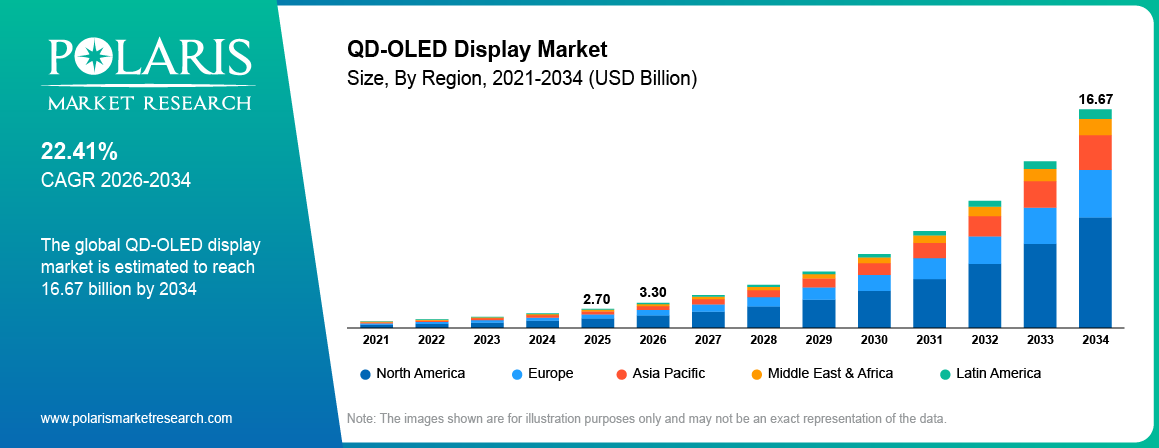
The global QD-OLED display market was valued at approximately USD 2.70 billion in 2025 and is expected to reach USD 16.67 billion by 2034, registering a CAGR of 22.41% during the forecast period. The market growth is driven due to increasing demand for premium TVs, gaming monitors, and high-performance display products. Growing investments in next-generation display solutions and consumer preference for better display features have been encouraging companies to increase QD-OLED panel production in consumer electronics markets.
Market Statistics
QD-OLED Display Market Key Takeaways 2025
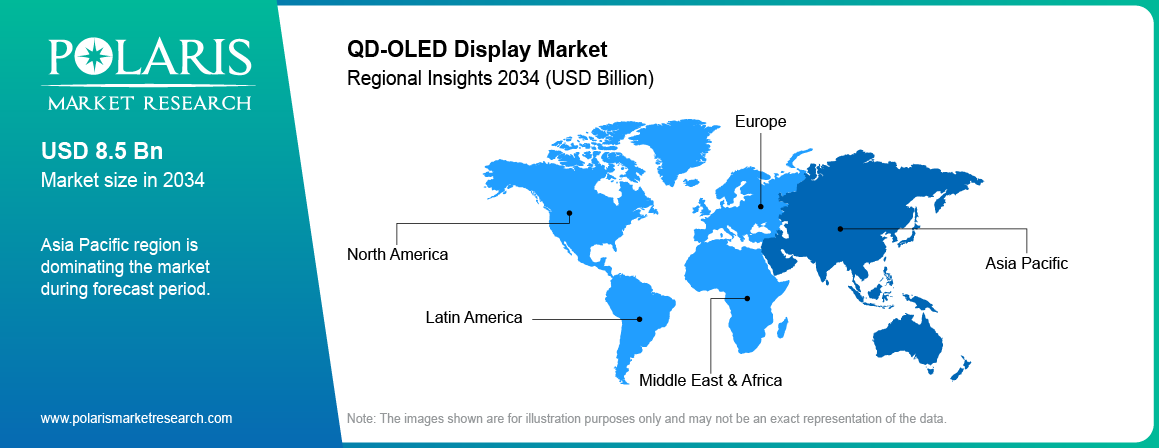
- Asia Pacific dominated the market with a 48.30% share in 2025, owing to the strong presence of display panel manufacturers and large-scale consumer electronics production.
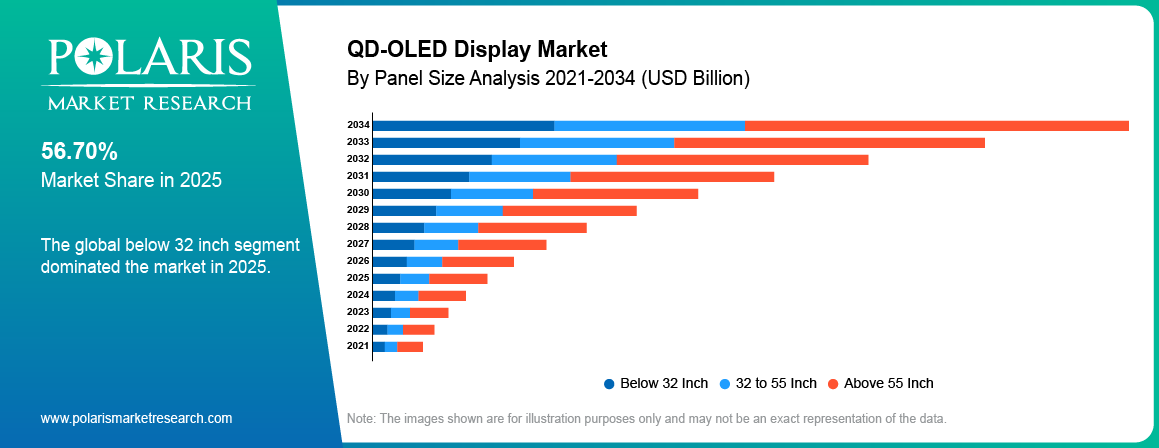
- The Below 32 Inch segment accounted for the largest market share of 56.70% in 2025, driven by rising demand for premium gaming monitors and professional display solutions.
- Consumer Electronics held the largest end-user share of 63.40% in 2025, owing to increasing adoption of premium televisions, laptops, and gaming monitors.
- The Monitor application segment is projected to register the fastest CAGR of 11.60% during the forecast period, due to increasing gaming activities and demand for high-refresh-rate displays.
Note: Figures and projections outlined in this report are the result of Polaris Market Research’s proprietary analytical processes, grounded in the latest available datasets and market observations.
What is QD-OLED Display?
QD-OLED technology stands for quantum dot organic light emitting diode. It is a display technology that uses OLED lights as a blue source and quantum dot color filters that provide better brightness, higher color gamut, improved contrast, and larger viewing angles. QD-OLEDs find wide application in premium TVs, gaming monitors, professional monitors, and premium consumer electronics devices.
The value chain consists of quantum dot material suppliers, OLED material manufacturers, display panel manufacturers, display modules manufacturers, consumer electronics firms, distributors, retailers, and consumers. The display manufacturers incorporate advanced panel technology to televisions, monitors, and other electronic gadgets before distributing them via global retail and commercial channels.
QD-OLED Display Market Size and Growth Analysis 2026-2034
Market expansion is fueled by growing demand for premium display solutions, the growth of the gaming sector, and ongoing innovation in the OLED manufacturing process. Manufacturers of consumer electronics have started developing high-resolution televisions and monitors, which are bright, accurate, and energy-efficient. Investments in next-generation semiconductor wafer fabrication, manufacturing, and quantum dot solutions are anticipated to propel market growth during the forecast period.
| Market Driver | Est. CAGR Impact | Geographic Relevance | Impact Timeline |
| Premium television demand | +2.3% | Global | Medium to long term |
| Gaming monitor adoption | +2.0% | North America, Asia Pacific | Short to medium term |
| OLED manufacturing expansion | +1.8% | Asia Pacific | Medium term |
| Display technology innovation | +1.5% | Global | Short to medium term |
| Consumer electronics demand | +1.2% | Global | Long term |
* Indicative estimates based on market context and analyst judgment. Figures reflect relative driver weight, not additive CAGR contributions. Source: Polaris Market Research Analysis.
Increasing investments in display manufacturing technology are driving efficiency in production processes in the consumer electronics industry. Display companies are ramping up their production capacities to cater to the growing demands for premium TVs, gaming monitors, and commercial displays. This is projected to boost market growth in the coming years.
Source: Polaris Market Research Analysis
QD-OLED Display Market Industry Dynamics
- Increasing demand for premium TVs and gaming monitors is fueling the use of QD-OLED display technology.
- R&D activities in OLED manufacturing technologies are enhancing display quality and efficiency.
- High cost of manufacturing and low production capability have hindered market growth.
- Rising adoption of QD-OLED displays in automotive and commercial applications is creating new growth opportunities.
QD-OLED Display Market Drivers, Restraints and Opportunities
How Is Growing Demand for Premium Consumer Electronics Driving Growth in the Market?
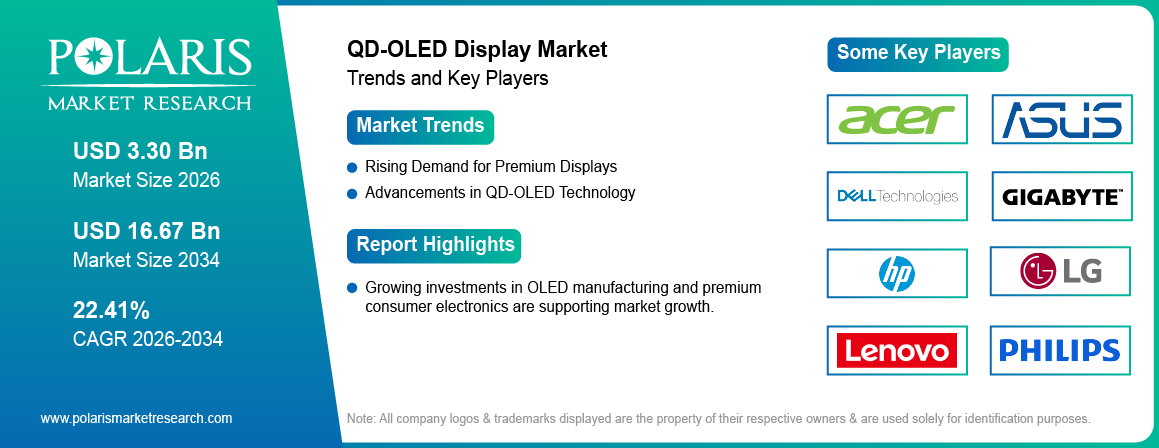
Increasing consumer demand for high-quality television sets, gaming monitors, and premium laptops has pushed the use of QD-OLED panels. In May 2026, MSI launched the world’s first 27-inch WQHD 5-layer QD-OLED Penta Tandem gaming monitor, providing improved brightness, efficiency, and 320Hz refresh rate(Source: www.msi.com).Higher preference among consumers for higher brightness and contrast along with better color accuracy has been fueling manufacturers to develop premium products using QD-OLED panels.
How Are Advancements in Display Manufacturing Supporting Market Expansion?
Continuous improvements in the field of OLED production and quantum dot technologies are contributing to the better quality and efficiency of displays. In January 2026, Drexel University scientists created an exceptionally stretchable OLED display which remains bright even after numerous times of stretching(Source: drexel.edu).New production lines are being established for increasing the number of panels produced while reducing production expenses. Improvements in panel designs contribute to better brightness, resistance, and energy efficiency. These factors are expected to contribute to faster implementation of QD-OLED displays in various industries.
What Challenges Restrict the Market Growth?
High manufacturing costs remain one of the major challenges for the market. Advanced manufacturing processes and costly raw materials needed for the manufacture of QD-OLED panels raise the costs of producing the products. Additionally, the limited availability of manufacturing capacities limits mass adoption of the products in sensitive markets. These factors are expected to hinder market growth during the forecast period.
What Opportunities Exist in the Market?
The growing use of QD-OLED screens in automotive, healthcare, and other application areas creates new growth opportunities for players in the market. For example, Samsung Display announced in May 2026 the launch of a 200 PPI stretchable Micro LED automotive screen capable of adjusting the dashboard images according to next-generation smart cockpit technologies for software-defined vehicles(Source: global.samsungdisplay.com).Manufacturers are installing high-end screens in their digital cockpits and infotainment systems to improve the experience of users. The growing demand for professional visualization and medical imaging displays creates growth opportunities.
Source: Polaris Market Research Analysis
Segment and Regional Leaders at a Glance
According to Polaris Market Research, Asia Pacific leads the market while North America the fastest-growing region.
- Dominant Region: Asia Pacific
- Fastest Growing Region: North America
- Largest Panel Size Segment: Below 32 Inch
- Largest End User Segment: Consumer Electronics
Segmentation Analysis
The report offers an in-depth assessment of the QD-OLED display market, segmented by panel size, application, and end user to determine the main revenue-generating and fastest-growing segments.
QD-OLED Display Market by Panel Size
Which Panel Size Dominated the Market in 2025?
The below 32 inch segment dominated the market in 2025 owing to strong demand for premium gaming monitors and professional displays. Manufacturers are launching smaller QD-OLED screens that have faster refresh rates and good color capabilities. The growing popularity among gamers and professionals is helping in the growth of the segment.
Which Panel Size is Growing Fastest in the Market?
The 32 to 55 inch segment is projected to grow at the fastest CAGR during the forecast period. Increasing sales of premium televisions and smart displays are driving product demand. Rising consumer spending on home entertainment devices is expected to accelerate segment growth.
QD-OLED Display Market by Application
Which Application Dominated the Market in 2025?
The television segment dominated the market in 2025 owing to growing demand for premium 4K and 8K TVs. QD-OLED television screens are becoming increasingly popular among consumers owing to the superior picture quality. Continuous product launches are supporting segment expansion.
Which Application is Growing Fastest in the Market?
The monitor segment is projected to grow at the fastest CAGR during the forecast period. Growing demand for professional and gaming screens is leading to increased adoption of QD-OLEDs. Higher refresh rates and low response times are expected to support segment growth.
QD-OLED Display Market by End User
Which End User Dominated the Market in 2025?
The consumer electronics segment dominated the market in 2025 owing to increasing sales of premium televisions, laptops, and monitors. The growing preference for advanced display solutions is compelling producers to introduce more QD-OLED products. These factors continue to support segment growth.
Which End User is Growing Fastest in the Market?
The gaming segment is projected to grow at the fastest CAGR during the forecast period. The rising engagement in esports and the growing demand for immersive gaming are propelling the adoption of such products. The rising investment in gaming equipment is likely to stimulate growth within the segment.
Segment Summary Table
| Segment | Category | 2025 Status | Forecast CAGR | Key Driver |
| Below 32 Inch | Panel Size | Largest Share | Moderate | Gaming monitor demand |
| 32 to 55 Inch | Panel Size | Fastest Growing | High | Premium television adoption |
| Television | Application | Largest Share | Moderate | Home entertainment demand |
| Monitor | Application | Fastest Growing | High | Gaming and content creation |
| Consumer Electronics | End User | Largest Share | Moderate | Premium device adoption |
| Gaming | End User | Fastest Growing | High | Esports and gaming hardware growth |
Source: Polaris Market Research Analysis
Source: Polaris Market Research Analysis
Regional Analysis
Asia Pacific QD-OLED Display Market Size and Share
Asia Pacific region dominated the market in 2025 due to the high presence of prominent display and consumer electronics manufacturers. The countries of China, South Korea, and Japan have continued to invest in advanced OLED manufacturing plants. In July 2025, Samsung released the M9, which is an AI-enabled 4K QD-OLED Smart Monitor(Source: news.samsung.com).Moreover, growing exports of premium display panels and increasing electronics manufacturing are supporting regional market growth.
North America QD-OLED Display Market Analysis
North America is projected to grow at a significant pace during the forecast period. The US and Canada are witnessing rising demand for premium gaming monitors, OLED televisions, and professional displays. Growing investments in games, digital content production, and consumer electronic devices are aiding the adoption of products. These factors are expected to drive regional market growth.
Europe QD-OLED Display Market Analysis
Europe held a substantial market share in 2025 due to rising demand for premium consumer electronics and gaming devices. Countries such as Germany, the UK, France, Italy, and Spain, there has been growing adoption of high-end display technologies. In June 2026, TCL launched its first OLED+ monitor in Europe together with its QD-Mini LED gaming monitors, as part of its premium display offerings. Growing investments in entertainment systems and commercial displays are boosting market growth.
Latin America QD-OLED Display Market Size and Share
Latin America is witnessing steady market growth due to increasing sales of premium televisions and gaming monitors. Brazil, Mexico, and Argentina are experiencing higher consumer spending on advanced electronic devices. Expansion of organized retail channels is improving product availability across the region. These factors are expected to support market growth during the forecast period.
Middle East & Africa QD-OLED Display Market Size and Share
The Middle East & Africa market is expected to grow steadily owing to increasing demand for premium consumer electronics. Saudi Arabia, the UAE, South Africa, and Israel are investing in advanced digital infrastructure and smart home technologies. Rising disposable income and expanding electronics retail networks are supporting product adoption. U.S. Energy Information Administration, Middle East & Africa disposable income per capita is projected to increase from USD 2,283 in 2025 to USD 2,402 by 2030, reflecting an approximate 5.2% growth during the same period.[Source: www.eia.gov]
Source: Polaris Market Research Analysis
Regulatory Heatmap
| Region/Country | Policy Environment | Key Regulations | Market Implication | Trend |
| US | Favorable | CHIPS and Science Act | Supports semiconductor and display manufacturing | Expanding |
| Canada | Developing | Advanced manufacturing initiatives | Encourages electronics production | Developing |
| Germany | Favorable | EU Chips Act | Supports semiconductor supply chain | Expanding |
| UK | Favorable | Digital technology strategy | Promotes display technology adoption | Stable |
| China | Favorable | Display manufacturing and industrial policies | Accelerates panel production | Expanding |
| Japan | Favorable | Semiconductor and display innovation programs | Supports advanced display development | Stable |
| South Korea | Favorable | Government support for display industry | Strengthens OLED manufacturing | Expanding |
| India | Developing | Production Linked Incentive (PLI) Scheme | Encourages electronics manufacturing | Developing |
Source: Polaris Market Research Analysis
Competitive Landscape and Key Players
The QD-OLED display market is moderately concentrated due to the presence of a limited number of display panel manufacturers and global consumer electronics companies. Competition is based on the quality of display, manufacturing capacity, product innovation, and prices. Manufacturers are making efforts toward expansion in manufacturing capacity, technological advancements, and strategic alliances in order to improve their market standing.
The major manufacturers are working on the next generation QD-OLED displays that have better brightness, energy efficiency, and increased durability. Moreover, they are diversifying their product range through televisions, gaming displays, and commercial displays.
Competitive Positioning Table
| Company | Est. Market Position | Primary Strength | Geographic Focus | In Report |
| Acer Inc. | Regional Leader | Gaming monitors | Global | Yes |
| ASUS | Top 10 | Gaming displays | Global | Yes |
| Dell Technologies | Top 10 | Premium monitors | Global | Yes |
| Gigabyte Technology | Regional Leader | Gaming hardware | Asia Pacific | Yes |
| HP Inc. | Top 10 | Commercial displays | Global | Yes |
| LG Electronics | Top 10 | Premium OLED products | Global | Yes |
| Lenovo Group | Regional Leader | Consumer electronics | Global | Yes |
| MSI | Top 10 | Gaming monitors | Global | Yes |
| Koninklijke Philips N.V. | Regional Leader | Consumer displays | Europe | Yes |
| Samsung Display | Top 5 | QD-OLED panel manufacturing | Global | Yes |
| Sony Corporation | Top 5 | Premium televisions | Global | Yes |
| TCL Technology | Top 10 | Smart televisions | Asia Pacific | Yes |
Source: Polaris Market Research Analysis
Technology and Innovation Landscape
Continuous innovation in display technology is improving the performance and efficiency of QD-OLED panels. The emphasis is on increasing brightness, decreasing power consumption, and extending the panel life span. AI-driven image processing and new generation of panel design are predicted to boost performance as well as future growth in the market.
| Technology | Adoption Stage | Key Development | Market Impact |
| AI Image Processing | Growing deployment | Real-time picture optimization | Improves viewing experience |
| Advanced QD-OLED Panels | Mainstream adoption | Higher brightness and color accuracy | Enhances display quality |
| Energy-efficient Architecture | Growing deployment | Lower power consumption | Improves energy efficiency |
| Burn-in Reduction Technology | Early commercial deployment | Improved panel durability | Extends product lifespan |
| High Refresh Rate Displays | Growing deployment | 240Hz and higher refresh rates | Supports gaming applications |
| AI Image Processing | Growing deployment | Real-time picture optimization | Improves viewing experience |
Source: Polaris Market Research Analysis
Who Buys QD-OLED Display Market Research and Why?
The QD-OLED display market research report will be useful for manufacturers, investors, and technologists for analyzing market opportunities and growth in different geographical locations.
| Buyer / Investor Type | Primary Use Case | Key Insight Sought | Decision Horizon |
| Consumer Electronics Companies | Product development | Display technology trends | 2–5 years |
| Display Manufacturers | Capacity expansion | Demand outlook | 3–7 years |
| Gaming Brands | Product sourcing | Panel performance | 1–3 years |
| Retailers & Distributors | Inventory planning | Consumer demand | 1–3 years |
| Institutional Investors | Investment evaluation | Market growth potential | 3–7 years |
Source: Polaris Market Research Analysis
What are the Barriers to Entering the Market?
- High capital investment for OLED panel manufacturing facilities.
- Complex production processes and low initial yield rates.
- Dependence on advanced semiconductor and display materials.
- Strong competition from established display manufacturers.
- High research and development expenditure.
- Limited supplier base for critical display components.
Premium Insights and Forward Outlook
Growing demand for premium consumer electronics is expected to support long-term market growth. Display manufacturers are increasing QD-OLED manufacturing capacity due to growing demand for televisions and gaming monitors. Innovation in quantum dot materials and OLED design technology is enhancing the performance of displays. These developments are expected to strengthen market expansion during the forecast period.
Cost Benchmarking Table
| Product | Est. Price Range | Key Cost Driver | Complexity Tier |
| QD-OLED Gaming Monitor | USD 700–1,800 | Panel manufacturing | High |
| QD-OLED Television | USD 1,200–5,000 | Screen size and panel quality | High |
| Professional Display | USD 2,000–8,000 | Color accuracy and calibration | Premium |
| Commercial Display | USD 3,000–10,000 | Large panel integration | Premium |
Source: Polaris Market Research Analysis
Key Players
- Acer Inc.
- ASUS
- Dell Technologies
- Gigabyte Technology
- HP Inc.
- LG Electronics
- Lenovo Group
- MSI
- Koninklijke Philips N.V.
- Samsung Display
- Sony Corporation
- TCL Technology
Industry Developments
- June 2026: ASUS added the QD-OLED gaming and creator monitors to its display range at Computex 2026, and one among them was the ProArt Display 4K QD-OLED series(source: press.asus.com).
- February 2026: Philips Evnia introduced the 27M2N6501L QD-OLED gaming monitor with a 240Hz refresh rate, collaborating with SEGA for an immersive gaming experience(source: www.prnewswire.com).
Market Segmentation
By Panel Size Outlook (Revenue, USD Billion, 2021–2034)
- Below 32 Inch
- 32 to 55 Inch
- Above 55 Inch
By Application Outlook (Revenue, USD Billion, 2021–2034)
- Television
- Monitor
- Laptop
- Others
By End User Outlook (Revenue, USD Billion, 2021–2034)
- Consumer Electronics
- Gaming
- Commercial
- Others
By Regional Outlook (Revenue, USD Billion, 2021-2034)
- North America
- US
- Canada
- Europe
- Germany
- France
- UK
- Italy
- Spain
- Netherlands
- Russia
- Rest of Europe
- Asia Pacific
- China
- Japan
- India
- Malaysia
- South Korea
- Indonesia
- Australia
- Vietnam
- Rest of Asia Pacific
- Middle East & Africa
- Saudi Arabia
- UAE
- Israel
- South Africa
- Rest of Middle East & Africa
- Latin America
- Mexico
- Brazil
- Argentina
- Rest of Latin America
Report Scope
| Report Attributes | Details |
| Market Size in 2025 | USD 2.70 Billion |
| Market Size in 2026 | USD 3.30 Billion |
| Revenue Forecast by 2034 | USD 16.67 Billion |
| CAGR | 22.41% from 2026 to 2034 |
| Base Year | 2025 |
| Historical Data | 2021–2024 |
| Forecast Period | 2026–2034 |
| Quantitative Units | Revenue in USD Billion and CAGR from 2026 to 2034 |
| Report Coverage | Revenue Forecast, Competitive Landscape, Growth Factors, and Industry Trends |
| Segments Covered |
|
| Regional Scope |
|
| Competitive Landscape |
|
| Report Format |
|
| Customization | Report customization as per your requirements with respect to countries, regions, and segmentation. |
QD-OLED Display Market FAQ's
• The global QD-OLED display market was valued at USD 2.70 billion in 2025 and is projected to witness steady growth during the forecast period.
• The market is projected to reach USD 16.67 billion by 2034, registering a CAGR of 22.41% from 2026 to 2034.
• Asia Pacific dominated the market with a 48.30% share in 2025 due to strong display manufacturing and consumer electronics production.
• The Below 32 Inch segment accounted for the largest market share of 56.70% in 2025 owing to strong demand for gaming and professional monitors.
• Leading companies include Acer Inc., ASUS, Dell Technologies, Gigabyte Technology, HP Inc., LG Electronics, Lenovo Group, MSI, Koninklijke Philips N.V., Samsung Display, Sony Corporation, TCL Technology.
• Growing demand for premium electronics, OLED advancements, and rising gaming monitor adoption.
• The opportunities include automotive displays, commercial displays, medical imaging, and AI-enabled display technologies.
Download Sample Report of QD-OLED Display Market
Please fill out the form to request a customized copy of the research report.


