
Semiconductor Assembly and Packaging Equipment Market Size, Share, Trends & Forecast, 2026-2034
REPORT DETAILS
Semiconductor Assembly And Packaging Equipment Market Summary
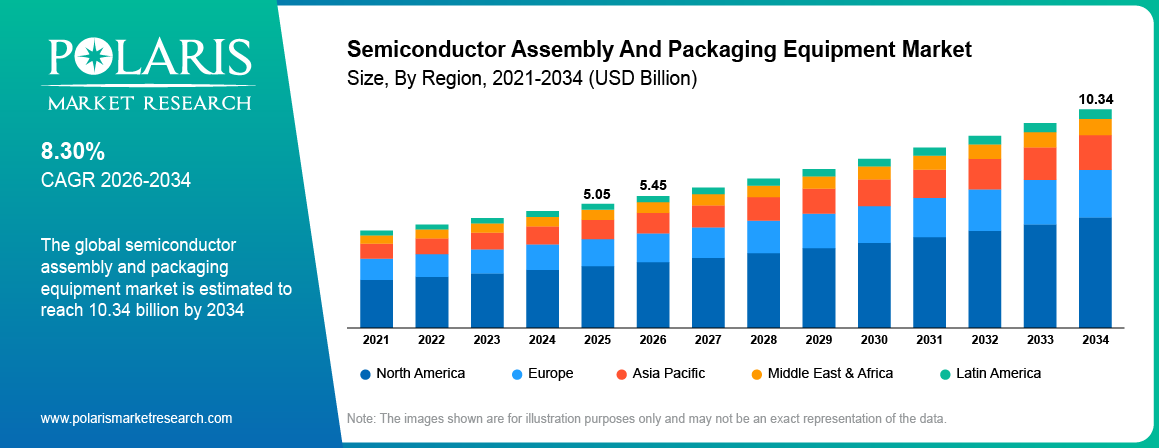
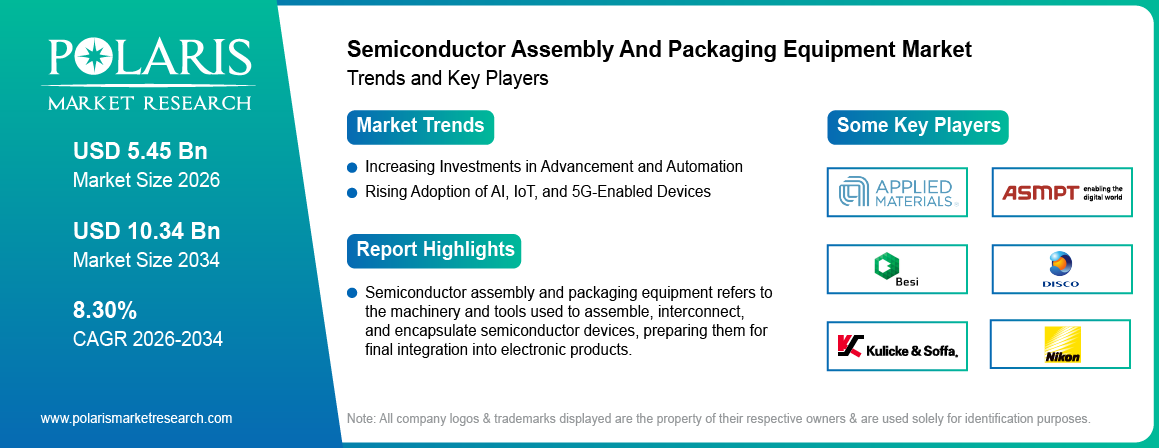
The global semiconductor assembly and packaging equipment market size was valued at USD 5.05 billion in 2025, growing at a CAGR of 8.30% from 2026 to 2034. The market is growing due to rising demand for advanced packaging solutions, growing investments in automation/technological advancements, and rapid adoption of AI, IoT and 5G devices requiring high-performance chips.
Market Statistics
Semiconductor Assembly And Packaging Equipment Market Key Takeaways
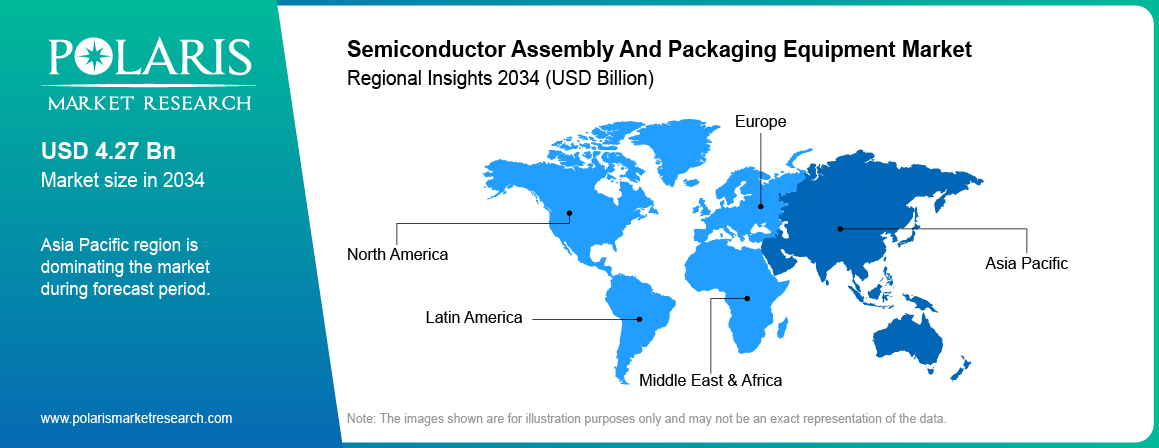
- Asia Pacific held the largest revenue share of 41.3% in 2025 in the global market owing to the well-established ecosystem for semiconductor manufacturing and the significant investments in the advanced packaging infrastructure.
- The North America semiconductor assembly and packaging equipment market is expected to witness a CAGR of 10.6% during 2026–2034, driven by the region’s strong focus on technological innovation and advanced manufacturing.
- The U.S. held a significant revenue share of 77.8% in 2025 in North America due to the strong presence of leading semiconductor manufacturers and advanced R&D infrastructure.
- The market in India is expected to grow at a CAGR of 13.2% during 2026–2034 due to increasing government initiatives aimed at developing a localized semiconductor ecosystem.
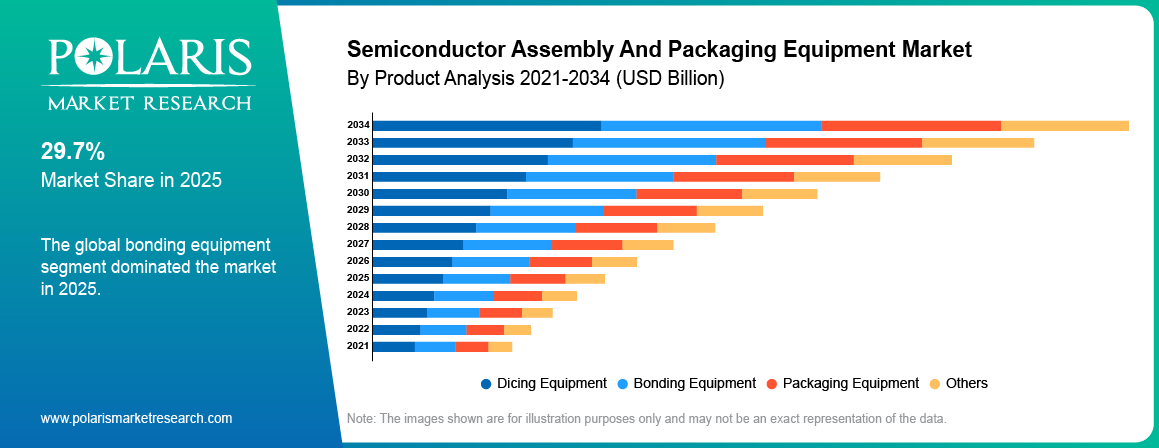
- The bonding equipment segment held the largest revenue share of 29.7% in 2025. This is probably because of the importance of bonding equipment in miniaturization and performance improvement of semiconductor devices.
- The wafer level packaging (WLP) equipment segment is expected to witness a CAGR of 12.4% during 2026–2034 owing to its ability to address compact and high-performance semiconductor designs.
- The OSAT segment accounted for a revenue share of 61.5% in 2025, driven by the increasing trend of fabless semiconductor design and the outsourcing of back-end processes.
Note: Figures and projections outlined in this report are the result of Polaris Market Research’s proprietary analytical processes, grounded in the latest available datasets and market observations.
What Is Semiconductor Assembly and Packaging Equipment? Process Steps, Equipment Types & Uses
Semiconductor assembly and packaging equipment refers to the machinery and tools used to assemble, interconnect, and encapsulate semiconductor devices, preparing them for final integration into electronic products. The market is witnessing notable growth driven by the surging demand for advanced packaging technologies. Advanced packaging, such as 2.5D/3D ICs, fan-out wafer-level packaging, and system-in-package, has become essential to ensure higher performance, better thermal management, and increased functionality as chip designs become more complex and miniaturized. In October 2024, DELO developed a new approach for fan-out wafer-level packaging, which replaces heat-cured materials with UV-curable alternatives, cutting warpage by 50% and die shift greatly. The innovation reduces viscosity to 35,000 mPa·s (versus 800,000 mPa · s) and Young's modulus to 1 GPa, while reducing curing time and energy consumption. This technological shift is driving semiconductor manufacturers to invest heavily in advanced assembly and packaging equipment to maintain a competitive edge and meet the performance requirements of next-generation applications, such as AI, 5G, and high-performance computing.
The increasing support from governments worldwide, through strategic initiatives and localization efforts aimed at strengthening domestic semiconductor manufacturing capabilities, further boosts growth opportunities. According to a July 2024 report by the Ministry of Electronics & IT, India approved USD 9.1 billion for the Semicon India programme to boost semiconductor and display manufacturing. The scheme offers financial incentives for chip production, display fabrication, and the development of the design ecosystem, thereby strengthening India's electronics manufacturing capabilities. Many countries are implementing policies that incentivize local production and reduce reliance on foreign supply chains, particularly in response to recent global disruptions. These government-led programs are encouraging the establishment of new semiconductor fabless and packaging facilities, creating demand for state-of-the-art assembly and packaging equipment. This localization push is accelerating the adoption of advanced equipment to meet both national and global supply needs.
How Does Semiconductor Assembly & Packaging Work? Dicing, Die Attach, Bonding, Encapsulation, Inspection & Test
Semiconductor assembly and packaging begins after the wafer is made. The wafer is cut into small chips called dies. Using wire bonding or flip-chip technology each chip is placed on a base and connected. These connections support the chip work properly inside electronic devices.
Then a protective coating is applied to the chip to protect it from heat and moisture. After that the chip is tested to make sure it works properly. When tests are successful, the chip is integrated into various products. These products are smartphones, computers, cars, AI devices and IoT products. This process is important to prepare the chip for everyday use and makes it more reliable.
Source: Polaris Market Research Analysis
To Understand More About this Research: Download Sample Report
Traditional vs Advanced Semiconductor Packaging: Interconnects, Bonding, Density & Equipment Requirements
| Feature | Traditional Packaging | Advanced Packaging |
| Integration | Packages a single chip | Combines multiple chips in one package |
| Performance | Suitable for standard applications | Designed for high-performance computing |
| Applications | Consumer electronics and everyday devices | AI, high-performance computing (HPC), automotive, and IoT |
| Technology | Mainly uses wire bonding | Uses 3D packaging, chiplets, and wafer-level packaging |
Source: Polaris Market Research Analysis
Market Dynamics
Driver: Increasing Investments in Advancement and Automation
Manufacturers aim to enhance production efficiency, precision, and throughput. In April 2025, Applied Materials finalized its acquisition of Besi and expanded its partnership to co-develop the first fully integrated hybrid bonding solution. This copper-to-copper chip connection technology enhances performance, reduces power consumption, and lowers costs in advanced semiconductor packaging. Automated systems are becoming increasingly essential for managing complex processes such as wafer handling, die bonding, and inspection with the continuous push for smaller, faster, and more powerful chips. Advanced automation reduces human error, ensures consistent quality, and supports high-volume manufacturing with greater scalability. These improvements reduce operational costs over time and also enable manufacturers to keep pace with rapid innovation cycles and evolving end user demands in consumer electronics, automotive, and industrial applications. Thus, increasing investments in advancement and automation is driving growth opportunities.
Driver: Rising Adoption of AI, IoT, and 5G-Enabled Devices
The increasing adoption of AI, IoT, and 5G-enabled devices is driving the demand for semiconductor assembly and packaging equipment. According to a March 2025 report by the Ministry of Commerce and Industry, India's 5G device ecosystem experienced rapid growth in 2024, with the number of active devices doubling to 271 million. The trend continues, with 90% of smartphone replacements in 2025 expected to be 5G-capable. These technologies require highly integrated, high-performance chips with efficient power management and compact form factors, pushing the boundaries of traditional packaging. As a result, there is a growing need for advanced equipment capable of supporting heterogeneous integration, multi-chip modules, and other refined packaging architectures. The expansion of connected devices and intelligent systems further boosts the demand for reliable and high-throughput packaging solutions, thereby accelerating investments in next-generation assembly and packaging tools across the semiconductor value chain.
Role of Bonding Equipment in Semiconductor Manufacturing
To connect different parts of a semiconductor chip bonding equipment is used. Wire bonding uses thin wires to make electrical connections. The flip-chip bonding is for placing the chip on the base directly for better speed and performance. The die attach firmly secures the chip until the next phase of assembly. Hybrid bonding directly bonds chips to support smaller and more powerful devices. These bonding techniques help improve the quality of chips and support modern semiconductor designs.
Growth of Outsourced Semiconductor Assembly & Test (OSAT)
The OSAT market is growing as more semiconductor companies have adopted the fabless business model and are outsourcing assembly and testing, which helps reduce costs and gain access to advanced packaging technologies. Demand for specialized packaging and outsourced back-end manufacturing is also increasing, and as a result OSAT companies are adding their advanced packaging capacity to support applications in AI, automotive and high-performance semiconductors.
Source: Polaris Market Research Analysis
Semiconductor Assembly and Packaging Equipment Market Segmentation Analysis
Product Analysis
Based on product, the segmentation includes dicing equipment, bonding equipment, packaging equipment, and others. The bonding equipment segment held the largest revenue share of 29.7% in 2025 due to its critical role in enabling the miniaturization and performance enhancement of semiconductor devices. Precision bonding technologies, such as wire bonding, flip-chip bonding, and die attach, have become essential for high-density integration as semiconductor packages become increasingly complex and multilayered. The growing demand for advanced electronic devices across various sectors, such as consumer electronics, automotive, and industrial automation, has increased the need for reliable and high-throughput bonding equipment. Additionally, innovations in bonding techniques are supporting newer packaging architectures, reinforcing the segment’s dominant position.
Packaging Type Analysis
In terms of packaging type, the segmentation includes flip chip packaging equipment, wafer level packaging (WLP) equipment, fan-out packaging equipment, system-in-package (SiP) equipment, 3D/2.5D packaging equipment, and others. The wafer level packaging (WLP) equipment segment is expected to witness a CAGR of 12.4% during 2026–2034 due to its capability to support compact, high-performance semiconductor designs. WLP enables the packaging of chips at the wafer level, improving electrical performance, reducing form factor, and minimizing manufacturing costs. The industry is shifting increasingly toward fan-in and fan-out WLP to meet the growing demand for smaller and more efficient components, with the expansion of mobile devices, wearables, and IoT applications. The scalability, cost-effectiveness, and high-yield characteristics of WLP have made it a preferred packaging solution, driving strong adoption of WLP equipment across manufacturing facilities.
End Use Analysis
The OSAT segment accounted for a revenue share of 61.5% in 2025. The segmentation, based on end use, includes IDMs (integrated device manufacturers) and OSAT (outsourced semiconductor assembly and test). The OSAT (outsourced semiconductor assembly and test) segment is expected to witness fastest growth during the forecast period, driven by the increasing trend of fabless semiconductor design and the outsourcing of back-end processes. Chipmakers are increasingly relying on OSAT providers for cost-effective, scalable, and technologically advanced assembly and testing services as they focus on core competencies such as design and innovation. OSAT players are rapidly investing in innovative packaging technologies and equipment to meet the complex requirements of AI, automotive, and high-performance computing applications. This outsourcing model enhances operational flexibility, allowing for the rapid adoption of advanced packaging tools and contributing to the segment’s accelerated growth.
Where Is Semiconductor Assembly & Packaging Equipment Used? AI/HPC, Automotive, Consumer, Telecom & Medical
| Application | Use |
| Consumer Electronics | Supports chip packaging for smartphones, laptops, and wearable devices. |
| Automotive | Used in electric vehicles, ADAS, automotive sensors, and power modules. |
| Artificial Intelligence (AI) | Enables advanced packaging for high-performance AI processors. |
| Data Centers | Supports high-speed processors and memory used in cloud infrastructure. |
| Industrial Automation | Used in robotics, factory automation, and industrial control systems. |
| Telecommunications | Packages chips used in 5G infrastructure and networking equipment. |
| Medical Devices | Supports semiconductor components used in diagnostic and monitoring systems. |
| Internet of Things (IoT) | Enables compact and efficient chips for connected devices and smart sensors. |
Source: Polaris Market Research Analysis
Source: Polaris Market Research Analysis
Semiconductor Assembly and Packaging Equipment Market by Region
The North America semiconductor assembly and packaging equipment market is expected to witness a CAGR of 10.6% during 2026–2034, driven by the region’s strong focus on technological innovation and advanced manufacturing. Continued investments in next-generation semiconductors, coupled with growing demand for high-performance computing, AI, and telecommunications infrastructure, are driving the need for refined packaging solutions. Furthermore, the presence of major industry players and research institutions, along with supportive policy initiatives aimed at strengthening domestic chip production, is boosting equipment demand and establishing North America as a hub for semiconductor advancement.
U.S. Semiconductor Assembly and Packaging Equipment Market Insights
The U.S. held a significant revenue share of 77.8% in 2025 due to its strong presence of leading semiconductor manufacturers and advanced R&D infrastructure. The country’s focus on high-performance computing, aerospace electronics, and AI-driven applications has driven continuous investments in advanced packaging technologies. Additionally, supportive national policies and strategic initiatives aimed at boosting domestic chip production have strengthened demand for equipment across major facilities.
Asia Pacific Semiconductor Assembly and Packaging Equipment Market Trends
Asia Pacific held the largest revenue share of 41.3% in 2025, driven by its well-established semiconductor manufacturing ecosystem and substantial investments in advanced packaging infrastructure. The region is home to major foundries, OSAT providers, and component suppliers, which collectively fuel demand for high-volume, cost-effective assembly and packaging equipment. Additionally, rapid digital transformation, regional government support for semiconductor self-reliance, and increasing demand for consumer electronics are driving capacity expansions and technological upgrades. According to a July 2024 NITI Aayog report, India's electronics sector reached USD 155 billion in FY23, with production doubling to USD 101 billion. Mobile phones alone accounted for 43% of this output, with 99% manufactured domestically, indicating the region's growing focus on localized production and the increasing demand for semiconductor packaging equipment. These factors have solidified Asia Pacific’s leadership in semiconductor equipment deployment and market dominance.
India Semiconductor Assembly and Packaging Equipment Market Overview
The market in India is expanding due to increasing government-backed initiatives aimed at developing a localized semiconductor ecosystem. Growing interest from global players, rising domestic electronics consumption, and emerging investments in semiconductor fabs are contributing to the demand for modern assembly and packaging tools. India’s focus on becoming a manufacturing and design hub is further accelerating the adoption of advanced equipment in the back-end semiconductor supply chain.
Europe Semiconductor Assembly and Packaging Equipment Market Outlook
The semiconductor assembly and packaging equipment industry in Europe is projected to witness fastest growth during the forecast period driven by increasing regional efforts to enhance semiconductor dominance and develop advanced chip manufacturing capabilities. Europe is promoting innovation in semiconductor packaging technologies, particularly for automotive, industrial, and telecom applications, as part of broader strategic initiatives. The push toward developing high-performance, energy-efficient electronic components is encouraging investments in modern assembly and packaging tools. For instance, in March 2024, Silicon Box announced a USD 3.6 billion investment in Northern Italy to build Europe’s first advanced chiplet-based packaging facility. The plant will meet rising demand for next-gen semiconductor packaging, with full-scale production expected by 2028. This momentum, supported by public-private collaborations and research and development (R&D) funding, is expected to accelerate expansion across the region.
Germany Semiconductor Assembly and Packaging Equipment Market
The market growth in Germany is driven by its strong industrial base and leadership in automotive electronics, which demand high-reliability and precision semiconductor components. The country’s focus on integrating advanced technologies, such as autonomous driving and Industry 4.0, has increased the need for refined chip packaging solutions. Furthermore, sustained investments in high-tech infrastructure and engineering excellence boost the adoption of next-generation semiconductor assembly and packaging equipment.
Source: Polaris Market Research Analysis
Key Players and Competitive Analysis
The semiconductor assembly and packaging equipment sector is experiencing intense competition, driven by strategic investments in both emerging and developed markets, as companies seek to capitalize on revenue opportunities. Major players are leveraging competitive intelligence and strategy to navigate economic and geopolitical shifts, while technological advancements in advanced packaging, such as chiplets and panel-level integration, are reshaping industry trends. Small and medium-sized businesses are gaining traction by focusing on niche, emerging market segments, while larger firms expand through strategic expansion, including partnerships and acquisitions. Supply chain disruptions and sustainable value chains remain critical challenges, prompting companies to optimize partner & customer ecosystems. Growth projections highlight latent demand in AI, IoT, and automotive applications, with region-wise market size variations influencing vendor strategies. Expert insights suggest that future development strategies must strike a balance between innovation and cost efficiency to maintain a competitive position in this rapidly evolving landscape.
A few major companies operating in the semiconductor assembly and packaging equipment industry include Applied Materials; ASM Pacific Technology; Besi; Disco Corporation; Kulicke & Soffa Industries, Inc. (K&S); Nikon Corporation; Plasma-Therm; Rudolph Technologies, Inc.; SCREEN Semiconductor Solutions Co., Ltd.; and SUSS MicroTec SE.
Key Players
- Applied Materials
- ASM Pacific Technology
- Besi
- Disco Corporation
- Kulicke & Soffa Industries, Inc. (K&S)
- Nikon Corporation
- Plasma-Therm
- Rudolph Technologies, Inc.
- SCREEN Semiconductor Solutions Co., Ltd.
- SUSS MicroTec SE
Semiconductor Assembly & Packaging Equipment Market Challenges
The semiconductor assembly and packaging equipment market is facing several challenges. High costs of advanced equipment restrict the ability of smaller companies to invest. The new packaging technologies are more complex and require high-precision manufacturing. The semiconductor manufacturing industry is experiencing a shortage of skilled workers and supply chain disruption may cause a delay in the supply of raw materials and equipment. Companies should continue to invest in research and development to enhance packaging technologies and address the increasing demand for advanced semiconductor devices.
Semiconductor Assembly & Packaging Equipment Market Future Outlook: HBM, Chiplets, Hybrid Bonding & Panel-Level Packaging
The semiconductor assembly and packaging equipment market is expected to grow steadily in the coming years. Increasing demand for AI chips, high-performance computing, and IoT devices will drive the growth of the market. Chiplets, 3D packaging and other advanced packaging technologies are being adopted increasingly by companies to improve chip performance and reduce size. Governments and semiconductor companies are investing in new manufacturing facilities to increase chip production. At the same time, OSAT companies are ramping up their packaging capacity to meet the growing demand. These trends will create new opportunities for equipment manufacturers and will support the long-term growth of the market.
Semiconductor Assembly & Packaging Equipment Developments: Hybrid Bonding, Panel-Level Packaging, Die Bonding & Molding
- June 2026: Hanmi Semiconductor launched the FC Bonder 3.5 for AI semiconductor production. It supports 2.5D packaging and multi-chip packaging. The system is designed for advanced AI chips. It also supports improve production efficiency. (Source: en.asiatoday.co.kr- Hanmi Semiconductor launches FC Bonder 3.5)
- May 2026: ASE (Advanced Semiconductor Engineering) introduced a 310 mm × 310 mm panel-level packaging production line. The new line supports advanced semiconductor packaging. It is designed for AI and high-performance computing chips. It also supports increase production capacity. (Source: anysilicon.com- ASE Launches 310mm Panel-Level Packaging Line)
- March 2026: Fasford Technology, a FUJI Group company, introduced the XERDIA die bonder at SEMICON China 2026. The system provides better bonding accuracy. It also improves production speed. The equipment is built for advanced semiconductor packaging. (Source: https://www.fuji.co.j)
- March 2025: iSABers launched the world’s first C2W&W2W Dual-Mode Hybrid Bonding Equipment (SAB 82CWW Series). The technology enables flexible chip-to-wafer & wafer-to-wafer bonding in advanced packaging.
- February 2025: RRP Electronics collaborated with Deca Technologies to acquire advanced wafer-level packaging tech, including M-Series and Adaptive Patterning. This enhances India’s semiconductor capabilities with real-time optimization, 10 times faster throughput, and global competitiveness in chip manufacturing.
Semiconductor Assembly and Packaging Equipment Market Segmentation
By Product Outlook (Revenue, USD Billion, 2021–2034)
- Dicing Equipment
- Scriber
- Dicer
- Wafer Mounting Equipment
- Bonding Equipment
- Die Bonder
- Wire Bonder
- Others
- Packaging Equipment
- Molding Equipment
- Solder Plating Equipment
- Deflasher
- Others
- Others
By Packaging Type Outlook (Revenue, USD Billion, 2021–2034)
- Flip Chip Packaging Equipment
- Wafer Level Packaging (WLP) Equipment
- Fan-Out Packaging Equipment
- System-in-Package (SiP) Equipment
- 3D/2.5D Packaging Equipment
- Others
By End Use Outlook (Revenue, USD Billion, 2021–2034)
- IDMs (Integrated Device Manufacturers)
- OSAT (Outsourced Semiconductor Assembly and Test)
By Regional Outlook (Revenue, USD Billion, 2021–2034)
- North America
- U.S.
- Canada
- Europe
- Germany
- France
- UK
- Italy
- Spain
- Netherlands
- Russia
- Rest of Europe
- Asia Pacific
- China
- Japan
- India
- Malaysia
- South Korea
- Indonesia
- Australia
- Vietnam
- Rest of Asia Pacific
- Middle East & Africa
- Saudi Arabia
- UAE
- Israel
- South Africa
- Rest of Middle East & Africa
- Latin America
- Mexico
- Brazil
- Argentina
- Rest of Latin America
Semiconductor Assembly and Packaging Equipment Market Report Scope
| Report Attributes | Details |
| Market Size in 2025 | USD 5.05 Billion |
| Market Size in 2026 | USD 5.45 Billion |
| Revenue Forecast by 2034 | USD 10.34 Billion |
| CAGR | 8.30% from 2026 to 2034 |
| Base Year | 2025 |
| Historical Data | 2021–2024 |
| Forecast Period | 2026–2034 |
| Quantitative Units | Revenue in USD Billion and CAGR from 2026 to 2034 |
| Report Coverage | Revenue Forecast, Competitive Landscape, Growth Factors, and Industry Trends |
| Segments Covered |
|
| Regional Scope |
|
| Competitive Landscape |
|
| Report Format |
|
| Customization | Report customization as per your requirements with respect to countries, regions, and segmentation. |
Source: Polaris Market Research Analysis
Semiconductor Assembly And Packaging Equipment Market FAQ's
The global market size was valued at USD 5.05 billion in 2025 and is projected to grow to USD 10.34 billion by 2034.
The global market is projected to register a CAGR of 8.30% during the forecast period.
Asia Pacific dominated the market with a 41.3% share in 2025, driven by rising demand and expanding market adoption
A few of the key players in the market are Applied Materials; ASM Pacific Technology; Besi; Disco Corporation; Kulicke & Soffa Industries, Inc. (K&S); Nikon Corporation; Plasma-Therm; Rudolph Technologies, Inc.; SCREEN Semiconductor Solutions Co., Ltd.; and SUSS MicroTec SE.
The wafer level packaging (WLP) equipment segment accounted for the largest revenue share of 12.4% in 2025, driven by increasing demand for advanced semiconductor packaging technologies.
The OSAT (outsourced semiconductor assembly and test) segment is expected to witness the fastest growth, accounting for a 61.5% share during the forecast period.
Semiconductor assembly and packaging equipment is used to assemble, connect and protect semiconductor chips. It prepares chips for use in electronic devices.
Typical examples are bonding, die attach, wafer dicing, molding and testing equipment. Each machine performs a different step in the packaging process.
Semiconductor packaging protects the chip from heat, humidity and damage. It also increases speed, reliability and power efficiency.
The advanced semiconductor packaging can connect multiple chips together in a small space, improving performance while reducing chip size and power consumption.
Download Sample Report of Semiconductor Assembly And Packaging Equipment Market
Please fill out the form to request a customized copy of the research report.


