
Specialty Oleochemicals Market Research Report, Industry Trends, 2026-2034
REPORT DETAILS
Specialty Oleochemicals Market Summary
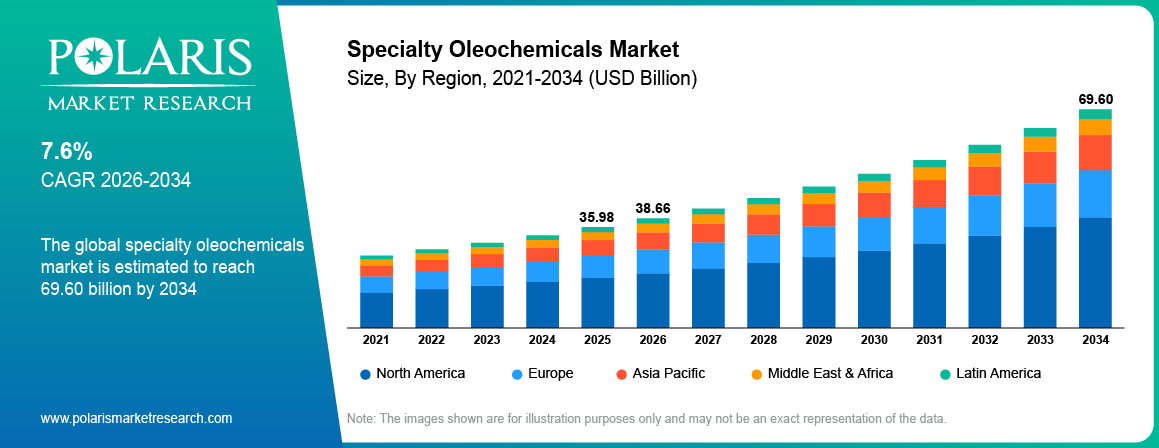
The global specialty oleochemicals market size was valued at USD 35.98 billion in 2025. The market is projected to grow from USD 38.66 billion in 2026 to USD 69.60 billion by 2034, at a CAGR of 7.6% from 2026 to 2034.
Market Statistics
Specialty Oleochemicals Market Key Takeaways
- Asia Pacific accounted for a 42.1% market share in 2025. This is because a significant amount of raw materials used in producing oleochemicals comes from nations like Indonesia, Malaysia, and Thailand.
- North America is projected to grow at a 7.8% CAGR. The presence of stringent regulations governing sustainability practices contributes to the regional market growth.
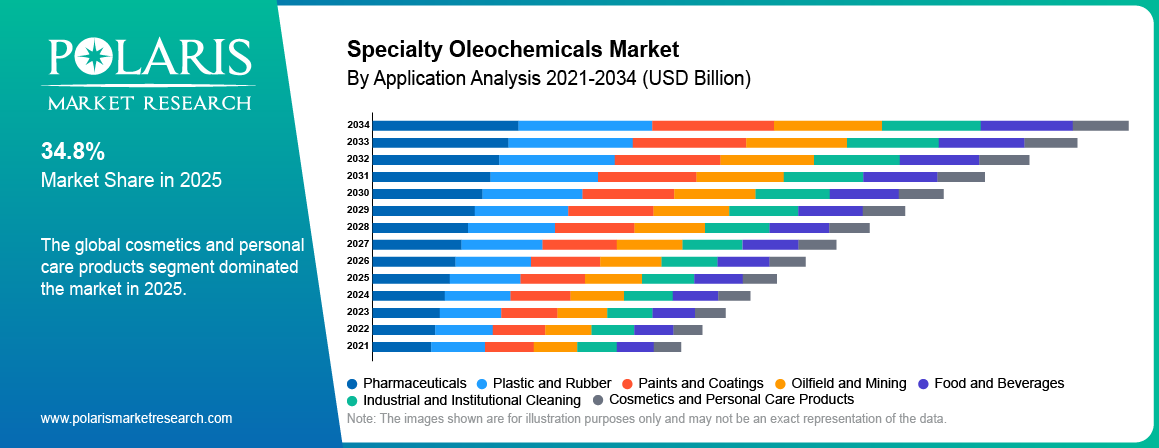
- The cosmetics and personal care products segment led with a 34.8% share in 2025. This is owing to the rising consumer demand for natural and plant-based beauty products.
- The food and beverages segment is projected to register the highest CAGR of 7.4%. The growing demand for bio-based stabilizers and other food additives contributes to the segment’s growth.
- The fatty acids & derivatives segment dominated with a 36.0% share in 2025. The main reason behind this dominance is a growing demand for fatty acids and their derivatives across industries.
Note: Figures and projections outlined in this report are the result of Polaris Market Research’s proprietary analytical processes, grounded in the latest available datasets and market observations.
What are Specialty Oleochemicals?
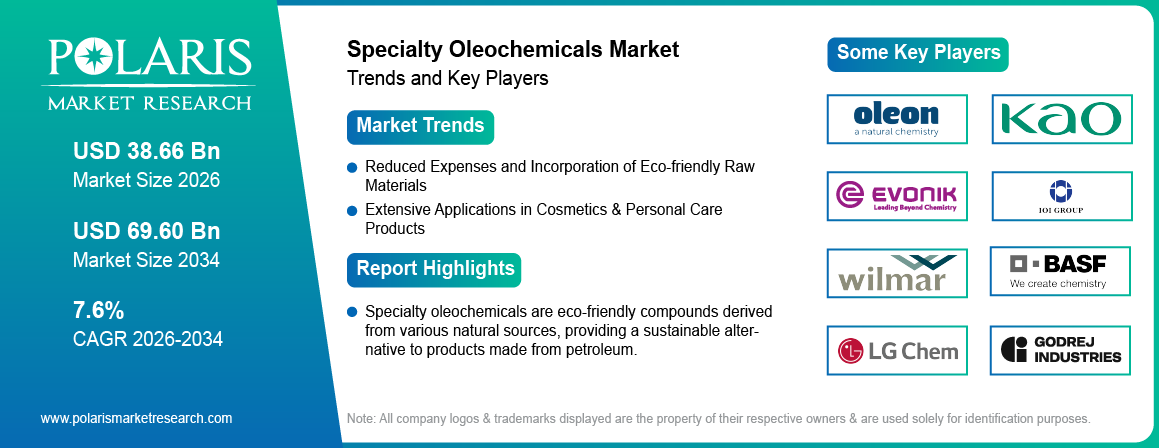
Specialty oleochemicals are eco-friendly compounds derived from various natural sources, providing a sustainable alternative to products made from petroleum. The compounds have unique properties, including emulsifying capabilities and surface activity, making them valuable in a wide range of industries such as personal care, food production, textiles, lubricants, and even bio-based polymers. A few examples of specialty oleochemicals are specialty esters, fatty acid methyl esters, glycerol esters, and alkoxylates. Plant-based feedstocks such as soybean oil, palm oil, rapeseed oil, and sunflower oil are also used to create specialty oleochemicals.
The specialty oleochemicals market demand is driven by factors such as the rising use of sustainable and renewable feedstocks, developments in genetic engineering and biotechnology, and the incorporation of advanced manufacturing and processing methods. The market for specialty oleochemicals is anticipated to benefit from rising demand for biopolymers. Manufacturers in the market are focusing on creating bio-based alternatives due to growing concerns regarding the biodegradability of polymers and plastic. Specialty oleochemical use has surged due to rapidly increasing consumer demand for biosurfactants, biodegradable polymers, and lubricants. The specialty oleochemicals market development is mostly dependent on government encouragement for the use of more environmentally friendly products and strict regulations for petroleum-based products.
Emerging opportunities in the food & beverage sector, the development of bio-based products, and the entry of key players into emerging markets are all potential possibilities for innovation. Specialty oleochemicals are also used in a variety of food products, including margarine and baked goods, and the food and beverage industry has seen growth in many nations. Additionally, specialty oleochemical use has also increased in the food processing, paint, ink, health and pharmaceutical, polymer, and plastic additive industries. Specialty chemicals are widely employed in the manufacturing of bio-based lubricants due to their ability to enhance desirable qualities, create customized formulations, and have limited property variation.
Source: Polaris Market Research Analysis
To Understand More About this Research: Download Sample Report
AI Impact on Specialty Oleochemicals Market
- AI plays a significant role in enhancing the process involved in the manufacturing of specialty oleochemicals by ensuring minimal wastage in the manufacturing process.
- AI aids in product development by assessing the performance and use of raw materials.
- AI enhances the aspect of quality control by ensuring constant purity and chemical composition of products.
- AI enables effective management of logistics and demand forecasts for producers.
Specialty Oleochemicals vs Petrochemicals
| Factor | Specialty Oleochemicals | Petrochemicals |
| Raw Material Source | Obtained from sustainable natural oils and fats such as palm oil, coconut oil, soybean oil, and animal fats | Oils derived from crude oil, natural gas, and other fossil fuels |
| Environmental Impact | Environmentally friendly and biodegradable with low carbon footprints | Environmentally unfriendly due to use of fossil fuels |
| Sustainability | Green chemistry friendly and supports the use of renewable materials | Low sustainability due to reliance on non-renewable energy sources |
| Uses | Applicable in making cosmetic products, detergent, food additive, lubricant, pharmaceutical, and bio surfactant | Commonly used in the production of plastics, fuel, synthetic materials, coating, and others |
| Regulatory Preference | Preferred due to the stringent environmental and sustainability policies | Facing increased regulation due to environmental concerns |
| Performance Features | Excellent in emulsifying, moisturizing, lubricating, and biodegradable capabilities | Highly chemically stable and versatile in industries but lower biodegradability |
Source: Polaris Market Research Analysis
Market Dynamics
Driver: Reduced Expenses and Incorporation of Eco-friendly Raw Materials
Vegetable and animal feedstock are used to make specialty oleochemicals. Vegetable waste oil is a sustainable, inexpensive, renewable, and nontoxic source of raw materials for manufacturing. They are a great alternative to chemicals derived from petroleum. These substances, which are produced by trans-esterifying, epoxidizing, and sulfonating leftover vegetable oils, are used to create surface active agents, or biosurfactants, which have numerous uses in the petroleum industry. Furthermore, as live feedstocks are more productive and efficient than petroleum feedstocks, these raw resources offer outstanding advantages. Hence, reduced expenses and the incorporation of eco-friendly raw materials play a crucial role in boosting specialty oleochemical market revenue growth.
Driver: Extensive Applications in Cosmetics & Personal Care Products
The natural origin, biodegradability, and adaptability of specialty oleochemicals make them popular in the personal care & cosmetics industry. They provide desired qualities, including skin moisturization, cleaning, and hair conditioning, by acting as emollients, thickeners, and surfactants. Oleochemicals-based emulsifiers also stabilize the oil and water mixture in lotions, creams, and cosmetics. Specialty oleochemicals from sustainable sources are becoming more and more popular as a result of the growing demand for natural and organic personal care products. Furthermore, the demand for specialty oleochemicals in the personal care and cosmetics sector is being further supported by the rising popularity of antiaging and skin care products.
Source: Polaris Market Research Analysis
Segment Insights
Market Outlook by Application Type
The specialty oleochemicals market, based on application type, is segmented into pharmaceuticals, plastic and rubber, paints and coatings, oilfield and mining, industrial and institutional cleaning, food and beverages, and cosmetics and personal care products. The cosmetics and personal care products segment dominated the specialty oleochemicals market with 34.8% share in 2025 and is expected to maintain its dominance during the forecast period. The food and beverages segment is anticipated to register the highest CAGR during the forecast period. In the food industry, the growing use of bio-based stabilizers, thickeners, and other food additives is anticipated to propel the specialty oleochemical market expansion in the coming years. The growing awareness of the environmental benefits of oleochemicals over conventional petroleum-based chemicals is also projected to aid in the market growth.
Market Assessment by Product Type
The specialty oleochemicals market, based on product type, is segmented into bio-based solvents, ionic surfactants, non-ionic surfactants, amides, esters, glycerin & derivatives, fatty acids & derivatives, and others. The fatty acids & derivatives segment dominated the specialty oleochemicals market revenue with 36.0% share in 2025. The main reason behind this dominance is a growing demand for fatty acids and their derivatives in industries such as food products, personal care products, and excipients in the pharmaceutical industry. The highest growth rate for the glycerin & derivatives segment is attributed to its growing need for detergents, cosmetics, soaps, and personal care products, which are major end users of glycerin.
Source: Polaris Market Research Analysis
Raw Material Pricing and Supply Chain Trends
The prices and supply chain issues related to raw materials play an important role in the market for specialty oleochemicals, as they depend on various raw materials, including palm oil, soybean oil, coconut oil, sunflower oil, and animal fat. Issues like agricultural productivity, climatic changes, geopolitical risks, and international policies affect the supply chain of raw materials, leading to fluctuations in prices. Also, the rise in demand for vegetable oils in food, biodiesel, and industrial applications has increased the competition for raw materials. Therefore, companies are focusing on sustainable raw material supply as well as supply chain diversification to cope with challenges.
Regional Insights
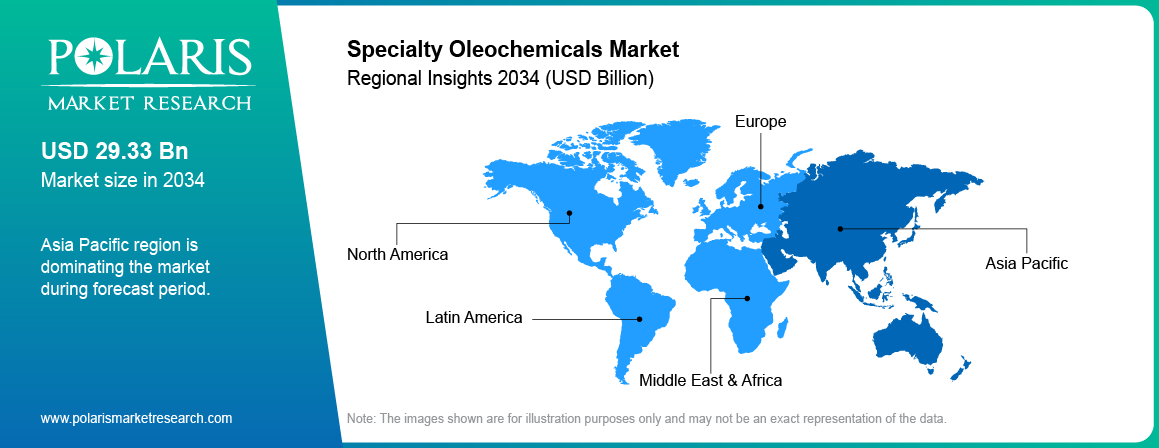
By region, the report provides specialty oleochemicals market insights into Asia Pacific, North America, Europe, Latin America, and the Middle East & Africa. In 2025, Asia Pacific held the largest specialty oleochemicals market share of 42.1%. The Philippines, Malaysia, Thailand, and Indonesia are producing more palm oil and palm kernel oil, which is driving the region's market dynamics. A significant amount of the raw materials used in the production of oleochemicals come from these nations. The growth of the Asia Pacific market is also attributed to the expansion in a number of end-use industries, such as cleaning supplies, food & beverages, pharmaceuticals, and personal care and cosmetics.
The specialty oleochemicals market in North America is expected to register the highest CAGR of 7.8% during the forecast period. The regional market growth is driven by the imposition of strict laws governing sustainability practices and the rising demand for plant-based goods. Furthermore, the US market is anticipated to be driven by the expanding chemical industry in the nation. Over the last decade, European nations such as Germany, Italy, France, and the UK have been implementing sustainability practices as a result of consumers' increased awareness of pollution, climate change, and other environmental issues. A key driver of the regional market is the growing focus on the effective use of bio-based resources, such as waste and products derived from agriculture and animals.
Source: Polaris Market Research Analysis
Competitive Insights
Leading market players in the specialty oleochemicals market are embracing eco-friendly procedures and integrating renewable raw materials into their manufacturing processes as part of a trend toward sustainability. The fierce rivalry between long-standing firms and the rise of new competitors defines the competitive landscape of the market. Market players constantly strive to develop new products for end-use markets and new applications through research and development. This maintains a high level of competition among the players. To expand their market share and obtain a competitive advantage, a number of significant players engage in a variety of strategic alliances to market their brands and sales.
Oleon NV, Kao Corporation, Evonik Industries, IOI Group, Wilmar International, Emery Oleochemicals, Godrej Industries, Ecogreen Oleochemicals, and Vantage Specialty Chemicals are among the key players influencing the specialty oleochemicals market dynamics.
List of Key Players
- Oleon
- Kao Corporation
- Evonik Industries
- IOI Group
- Wilmar International
- Emery Oleochemicals
- Godrej Industries
- Ecogreen Oleochemicals
- Vantage Specialty Chemicals
- BASF
- LG Chem
- Croda International
Specialty Oleochemicals Industry Developments
- April 2026: Evonik presented its latest innovations at in-cosmetics Global 2026. These include TEGO FILMSTAR BST1 and SPHINOHANCE Clear. TEGO FILMSTAR BST1 is an eco-friendly film-forming agent designed for boosting SPF properties. SPHINOHANCE Clear is a glycolipid-ceramide combination that allows for transparent formulations of hair and skin applications. (source: evonik.com)
- February 2026: Oleon announced its participation in the European MULTIPLY project, a Horizon Europe initiative launched in June 2025. The 17-member partnership seeks to expand applications of microalgae products as an alternative to fossil materials and agricultural feedstock. (source: oleon.com)
Specialty Oleochemicals Market Segmentation
By Application Type Outlook
- Pharmaceuticals
- Plastic and Rubber
- Paints and Coatings
- Oilfield and Mining
- Industrial and Institutional Cleaning
- Food and Beverages
- Cosmetics and Personal Care Products
By Product Type Outlook
- Bio-Based Solvents
- Ionic Surfactants
- Non-Ionic Surfactants
- Amides
- Esters
- Glycerin & Derivatives
- Fatty acids & Derivatives
- Others
By Market Source Type Outlook
- Microbial-Based
- Animal-Based
- Plant-Based
By Regional Outlook
- North America
- US
- Canada
- Europe
- Germany
- France
- UK
- Italy
- Spain
- Netherlands
- Russia
- Rest of Europe
- Asia Pacific
- China
- Japan
- India
- Malaysia
- South Korea
- Indonesia
- Australia
- Rest of Asia Pacific
- Middle East & Africa
- Saudi Arabia
- UAE
- Israel
- South Africa
- Rest of the Middle East & Africa
- Latin America
- Mexico
- Brazil
- Argentina
- Rest of Latin America
Specialty Oleochemicals Market Report Scope
| Report Attributes | Details |
| Market Size Value in 2025 | USD 35.98 Billion |
| Market Size Value in 2026 | USD 38.66 Billion |
| Revenue Forecast by 2034 | USD 69.60 Billion |
| CAGR | 7.6 % from 2026 to 2034 |
| Base Year | 2025 |
| Historical Data | 2021–2024 |
| Forecast Period | 2026–2034 |
| Quantitative Units | Revenue in USD and CAGR from 2026 to 2034 |
| Report Coverage | Revenue Forecast, Market Competitive Landscape, Growth Factors, and Trends |
| Segments Covered |
|
| Regional Scope |
|
| Competitive Landscape |
|
| Report Format |
|
| Customization | Report customization as per your requirements with respect to countries, regions, and segmentation. |
Source: Polaris Market Research Analysis
Specialty Oleochemicals Market FAQ's
The specialized oleochemicals market is valued at USD 35.98 billion in 2025 and is projected to grow to USD 69.60 billion by 2034.
The market is expected to register a CAGR of 7.6% during the forecast period.
Asia Pacific accounted for a 42.1% market share in 2025.
Oleon, Kao Corporation, Evonik Industries, IOI Group, Wilmar International, Emery Oleochemicals, Godrej Industries, Ecogreen Oleochemicals, and Vantage Specialty Chemicals are among the key players in the market.
The fatty acids & derivatives segment dominated with a 36.0% share in 2025.
The cosmetics and personal care segment led with a 34.8% share in 2025.
Download Sample Report of Specialty Oleochemicals Market
Please fill out the form to request a customized copy of the research report.


