
Stem Cell Therapy Market Share, Size, Trends, Industry Analysis Report, 2026 - 2034
REPORT DETAILS
Stem Cell Therapy Market Summary
The stem cell therapy market was valued at USD 17.94 Billion in 2025 and is expected to grow at a CAGR of 12.64% during the forecast period. The rise in cell therapy production facilities, the growing number of precision medicine, and the rising number of clinical trials are some prominent factors responsible for market growth.
Market Statistics
Key Takeaways
- In 2025, North America held the largest share of 36.0%. The leading position is attributed to a robust healthcare infrastructure and significant government and private funding for advanced biotechnology research.
- The Asia Pacific market is expected to register the highest CAGR of 14.20% during the forecast period. Expanding biotechnology industry would drive the regional market growth.
- The allogeneic stem cell therapy segment held the largest share of 56.0% in 2025. This dominance is supported by advantages in manufacturing scalability, off-the-shelf availability, and broader accessibility.
- The adipose tissue-derived MSCs segment accounted for a 22.0% share in 2025. Its growth is driven by simple isolation procedures, high stem cell yield, and minimally invasive harvesting methods.
- The musculoskeletal disorders segment dominated with a 21.0% share in 2025. Increasing prevalence of chronic joint conditions and rising demand for regenerative therapies continue to drive segment growth.
Note: Figures and projections outlined in this report are the result of Polaris Market Research’s proprietary analytical processes, grounded in the latest available datasets and market observation
Industry Dynamics
- The increasing global prevalence of chronic and degenerative diseases, such as cardiovascular issues, neurological disorders, and diabetes.
- Rapid advancements in cell technology, including the development of induced pluripotent stem cells (iPSCs) and the integration of sophisticated gene-editing tools.
- A notable rise in funding from both government bodies and private investors, coupled with an increasing number of active clinical trials.
Stem Cell Therapy in Simple Terms
Stem cell therapy is a type of treatment that uses particular cells. Such special cells have an ability to turn into other types of cells. The process of repairing damaged tissues is assisted by such methods. These treatments are used to restore normal body functions and support healing. They provide new treatments for diseases that are complex to treat with conventional medicines.
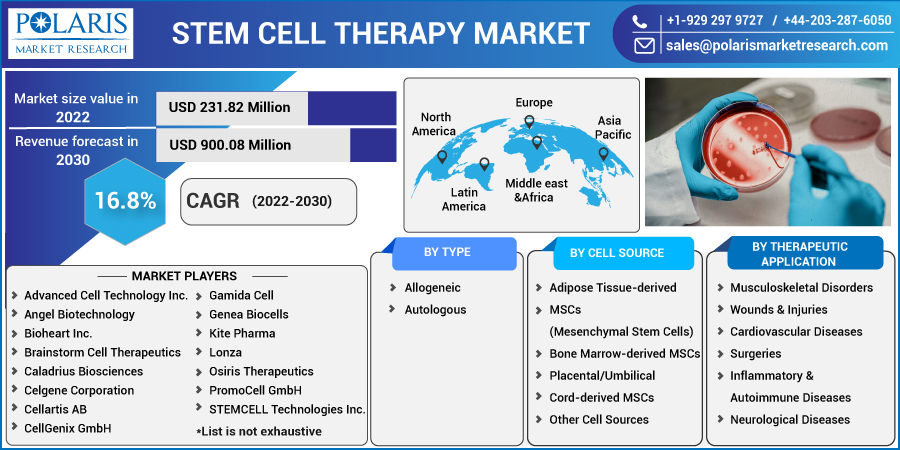
Source: Polaris Market Research Analysis
To Understand More About this Research: Download Sample Report
Impact of AI on Market
- AI algorithms, including machine learning and deep learning, are transforming the manufacturing of cell-based products by automating crucial quality control and culture processes.
- The use of AI-driven predictive modeling allows researchers to forecast stem cell differentiation pathways and identify optimal culture conditions more accurately.
- AI enables the advancement of personalized medicine by analyzing vast sets of patient data, such as genetic profiles and medical histories.
An increasing number of clinical trials and approval of stem cell-based therapies from regulatory bodies will create many opportunities for this market. Additionally, rising number of cancer patients worldwide also spurs market growth.
Financial assistance from governments, private vendors, and NGOs drives the market's growth. For instance, National Stem Cell Foundation, a nonprofit, provides funds for research and clinical trials for adult stem cell therapies, education initiatives, and patient advocacy.
How Stem Cell Therapy Works?
- First, clinicians diagnose the medical issue of the patient. They determine whether the stem cell treatment is suitable for the patient.
- Appropriate stem cells are taken from various sources. Cells are extracted from bone marrow, fatty tissues, cord blood, and even from donors.
- In laboratory setup, cell extraction, isolation, and processing are performed.
- Quality control and processing is done to ensure that the suitability of cells for the therapy.
- The administration of stem cells takes place through injections, infusion, and transplantation surgery.
- Transplanted cells aid in regeneration of tissues, repair of tissues, or rebuilding of the immune system.
Covid-19 has positively influenced the stem cell therapy market, as lung dysfunction was the primary cause of death during the pandemic. For instance, in January 2020, University of Miami researchers administered two infusions of stem cells to COVID-19 patients with lung injury. The results showed no noticeable side effects, and the therapy was effective. Also, according to the article published by BMC, stem cells are safe and effective in treating severe COVID-19 disease, indicating significant potential.
However, limited awareness regarding appropriate treatment and ethical concerns for embryonic stem cells are some factors hampering the market growth. For instance, according to the National Center for Biotechnology Information data, the main elements concerning the population are fear of unknown therapies and lack of awareness about treatment options. Also, decreased adoption due to high costs for the therapies can hinder the market's growth.

Source: Polaris Market Research Analysis
Stem Cell Therapy vs. Traditional Treatment
| Factor | Traditional Treatment | Stem Cell Therapy |
| Approach | Primarily manages symptoms and slows disease progression | Focuses on regenerating and repairing damaged tissues |
| Target | Disease symptoms or affected organs | Damaged cells and underlying tissues |
| Treatment Method | Medications, surgery, and conventional procedures | Cell-based regenerative therapies |
| Innovation Level | Well-established standard of care | Advanced and rapidly evolving regenerative medicine |
Source: Polaris Market Research Analysis
Key Market Drivers & Restraints.
Growth Drivers
Increasing technological advancement in stem cell therapeutics, rising demand for stem cell banking, and a growing focus on developing personalized medicines are the primary factors driving the market’s growth.
Increased product launches by key market players are expected to drive the market over the forecast period. For instance, LifeCell, a healthcare service provider, introduced an advanced umbilical cord-stem cell collection kit on August 2017 that protects neonatal stem cells from environmental damage and temperature fluctuations.
Rising chronic disorders are also supposed to accelerate the market's growth. Chronic diseases are common health problems all over the world. One in every three adults worldwide suffers from a chronic condition. Chronic diseases, such as cancer, musculoskeletal and neurologic disorders, chronic injuries, and cardiovascular and gastrointestinal, can result in hospital treatment, long-term disability, decreased quality of life, and death.
Challenges in the Stem Cell Therapy Market
- High manufacturing and processing costs result in increased therapy costs. Expensive therapies limit their use.
- Collection, testing, and storage of cells need special facilities. Also, there is a requirement to adhere to quality control standard. Difficult manufacturing processes reduce the market reach.
- Time-consuming development and approval processes cause delays in product development and release to the market. Thus, regulatory barriers restrain the market expansion.
Real-World Applications of Stem Cell Therapy
| Clinical Application | Practical Use | Patient Benefit |
| Bone Marrow Transplantation | Used to treat leukemia, lymphoma, and other blood disorders by replacing damaged blood-forming cells. | Restores healthy blood cell production and improves survival outcomes. |
| Tissue Regeneration | Stem cells help repair damaged muscles, skin, and soft tissues following injury or surgery. | Supports faster healing and improved tissue function. |
| Cartilage Repair | Applied in selected orthopedic procedures to regenerate damaged cartilage in joints. | Helps reduce pain and improve mobility in joint disorders. |
| Neurological Disease Research | Investigated for conditions such as Parkinson's disease, spinal cord injury, and multiple sclerosis. | May promote nerve repair and improve long-term treatment possibilities. |
Source: Polaris Market Research Analysis
Report Segmentation
The market is primarily segmented based on, type, cell source, therapeutic application, and region.
| By Type | By Cell Source | By Therapeutic Application | By Region |
|
|
|
|
Source: Polaris Market Research Analysis
Allogenic type accounted the largest market share in 2025
The allogenic type stem cell therapy acquired the largest market revenue in 2024 as it creates a new immune system for the patients when the donor cells engraft in the recipient. Many malignant and non-cancerous disorders, such as acute leukemia, chronic leukemia, Hodgkin's lymphoma, adrenoleukodystrophy, Bone marrow failure syndromes, and others, can be treated by allogeneic stem cell transplants.
The increasing number of cancer patients has driven the demand for Omidubicel (advanced cell therapy for patients with blood cancer), which is anticipated for the segment's expansion. For instance, in 2022, The MD of Duke Cancer Institute recognized the patients who underwent allogeneic stem cell transplant with the novel cell therapy omidubicel had shown efficacy over standard myeloablative umbilical cord blood in a phase 3 trial (NCT02730299).
Cost-effectiveness and the expansion of stem cell banking have all contributed to the growth of this segment. Furthermore, many cell therapy companies are refocusing on developing allogeneic cell therapy products, which is anticipated to fuel the segment growth.

Source: Polaris Market Research Analysis
Adipose tissue-derived MSCs segment acquires the largest market share
Adipose tissue-derived MSCs account most significant market share. The segment’s demand is fueled by associated benefits such as simple isolation procedures, minimally invasive harvesting methods, and a comparatively higher capacity for proliferation.
Adipose-derived stem cells provide various opportunities in the field of tissue engineering and regenerative medicine due to their wide availability and ability to differentiate other tissue types of the mesoderm-including bone, cartilage, muscle, and adipose-ASCs. This application is also anticipated to drive the segment’s growth over the forecast period.
Musculoskeletal disorder segment is expected to hold the significant revenue share
The musculoskeletal disorders segment is anticipated to witness considerable growth over the forecast period. Many musculoskeletal disorders, such as carpal tunnel syndrome, cartilage repair, living cartilage transplant program, ligament repair, orthopedic implant failure, and others, are treated using stem cell therapy.
Stem cells have played an important role in orthopedic regenerative medicine, particularly in healing the body without invasive surgery. Although orthopedic treatment applications in stem cell therapies are still evolving, recent research has shown promising outcomes expected to drive future market growth.
Additionally, the growing demand for mesenchymal stem cells (MSCs) in stem cell therapy has influenced the market’s growth. According to the Journal of Orthopedic Surgery and Research, MSCs are the therapeutic target of biophysical stimulation for treating musculoskeletal disorders.
Stem Cell Therapy in Cancer Treatment
- Hematopoietic Stem Cell Transplantation (HSCT): Widely used to restore healthy blood-forming stem cells after intensive chemotherapy or radiation therapy for blood cancers.
- Treatment of Blood Cancers: Stem cell treatment is highly significant in the management of leukemia, lymphoma, multiple myeloma, and other cancers. The therapy restores the body's blood and immune system.
- Bone Marrow Regeneration: The transplanted stem cells play a key role in bone marrow regeneration. The cells assist in healthy blood cells production after cancer therapy.
North America is projected for the largest market share
North America is expected to witness the highest growth over the forecast period owing to the strong biotechnology industry, the dominance of major key players, extensive R&D activities, and the promotion of personalized medicines.
Furthermore, growth in this sector can be attributed to a growing government initiative to promote stem cell therapies. For instance, the Canadian government invested approximately USD 7 million in regenerative medicine and stem cell research in March 2020. It will finance nine transnational projects and four clinical trials in the country to help the country's growth in the regenerative medicine sector.

Source: Polaris Market Research Analysis
Regional Market Trends (2026)
| Region | Key Growth Factor | 2026 Outlook |
| North America | Strong commercialization of regenerative therapies, advanced healthcare infrastructure, and sustained R&D investments | Largest market share in 2026 |
| Europe | Expanding clinical research, supportive regulatory policies, and increasing adoption of advanced cell therapies | Stable growth with a significant market share |
| Asia Pacific | Rapid biotechnology expansion, favorable government initiatives, and growing demand for regenerative medicine | Fastest-growing regional market |
| Latin America & Middle East & Africa | Improving healthcare access, rising clinical research activities, and increasing investment in life sciences | Developing markets with strong future potential |
Source: Polaris Market Research Analysis
Competitive Insight
Some of the major players operating in the global market include Advanced Cell Technology Inc., Angel Biotechnology, Bioheart Inc., Brainstorm Cell Therapeutics, Caladrius Biosciences, Celgene Corporation, Cellartis AB, CellGenix GmbH, Cellular Engineering Technologies Inc., Gamida Cell, Genea Biocells, Kite Pharma, Lonza, Osiris Therapeutics, PromoCell GmbH, STEMCELL Technologies Inc., Tigenix, and Waisman Biomanufacturing.
Regulatory & Ethical Considerations
- Complex Regulatory Approvals: The regulation of stem cell treatments involves extensive preclinical testing. It also includes clinical trials. Such processes are conducted to evaluate the effectiveness and safety of a product. Product standardization is also required prior to approval.
- Ongoing Patient Monitoring: Continuous monitoring of the patients is required by regulatory agencies after therapy. This will make it easier to evaluate risk factors such as immune reaction, potential development of cancer, and effects of treatment.
- Ethical Issues Involved in Embryonic Stem Cells: Several countries are focusing on the ethical and legal issues involved in applications of embryonic stem cells. Hence, there is increasing use of adult stem cells and induced pluripotent stem cells.
- Standardization in Manufacturing: Standardization of cell harvest, processing, preservation, and inspection is very important. This will ensure product quality and successful treatment.
Recent Developments
- June 2026: UCI Health launched in-human embryonic stem cell clinical trial for Huntington's disease. The phase 1b/2a trial is expected to evaluate the safety of hNSC-01 neural stem cells, which are derived from embryonic stem cells. (Source: news-medical.net)
- February 2025: researchers at Saveetha Institute of Medical and Technical Sciences in India developed a stem cell–based therapy aimed at eliminating the dengue virus and protecting liver cells from further damage. The approach involved extracting stem cells from bone marrow and injecting them into dengue-infected mice, with plans to advance the therapy into human clinical trials.
Future Outlook of the Stem Cell Market
There is great scope for the market to grow significantly in the future. The field of regenerative medicine has become an essential part of modern medicine. There is continuous development in the area of stem cell engineering, gene editing, and cellular production processes. These advances will ensure that the therapy becomes more precise and effective in its application. Studies on cancer, neurological, orthopedic, and autoimmune diseases will expand the area of treatment with the help of stem cells. Increased funding and new regulations and approvals from the commercial sector are expected to boost the process over the coming years.
Stem Cell Therapy Market Report Scope
| Report Attributes | Details |
| Market size value in 2025 | USD 17.94 Billion |
| Market size value in 2026 | USD 20.19 Billion |
| Revenue forecast in 2034 | USD 52.36 Billion |
| CAGR | 12.64% from 2026 - 2034 |
| Base year | 2025 |
| Historical data | 2021 - 2024 |
| Forecast period | 2026 - 2034 |
| Quantitative units | Revenue in USD million and CAGR from 2026 to 2034 |
| Segments Covered | By Type, By Cell Source, By Therapeutic Application, By Region |
| Regional scope | North America, Europe, Asia Pacific, Latin America; Middle East & Africa |
| Key Companies | Advanced Cell Technology Inc., Angel Biotechnology, Bioheart Inc., Brainstorm Cell Therapeutics, Caladrius Biosciences, Celgene Corporation, Cellartis AB, CellGenix GmbH, Cellular Engineering Technologies Inc., Gamida Cell, Genea Biocells, Kite Pharma, Lonza, Osiris Therapeutics, PromoCell GmbH, STEMCELL Technologies Inc., Tigenix, and Waisman Biomanufacturing. |
Source: Polaris Market Research Analysis
Stem Cell Therapy Market FAQ's
The global market size was valued at USD 17.94 Billion in 2025 and is projected to grow to USD 52.36 Billion by 2034.
The global market is projected to register a CAGR of 12.64% during the forecast period.
North America dominated the market share in 2025.
The allogeneic stem cell therapy segment accounted for the largest share of the market in 2025.
Stem cell therapy is a form of regenerative medicine which employs specific stem cells to treat damaged tissue by repairing or replacing them to help restore normal body functions.
Currently approved stem cell treatments can only treat blood cancer and blood diseases. Research is being conducted on various treatments like orthopedic injury, neurodegenerative disorders, autoimmunity, and heart problems.
Different kinds of stem cells are adult stem cells, hematopoietic stem cells, and mesenchymal stem cells. Also, other types are pluripotent stem cells and umbilical cord blood stem cells based on the kind of treatment needed.
Yes. Hematopoietic stem cell transplant and various other stem cell treatments are regulated. However, many therapies are undergoing clinical trials.
Download Sample Report of Stem Cell Therapy Market
Please fill out the form to request a customized copy of the research report.


