
Underwater Warfare Market Size, Share, Trends and Forecast, 2026–2034
REPORT DETAILS
Underwater Warfare Market Summary
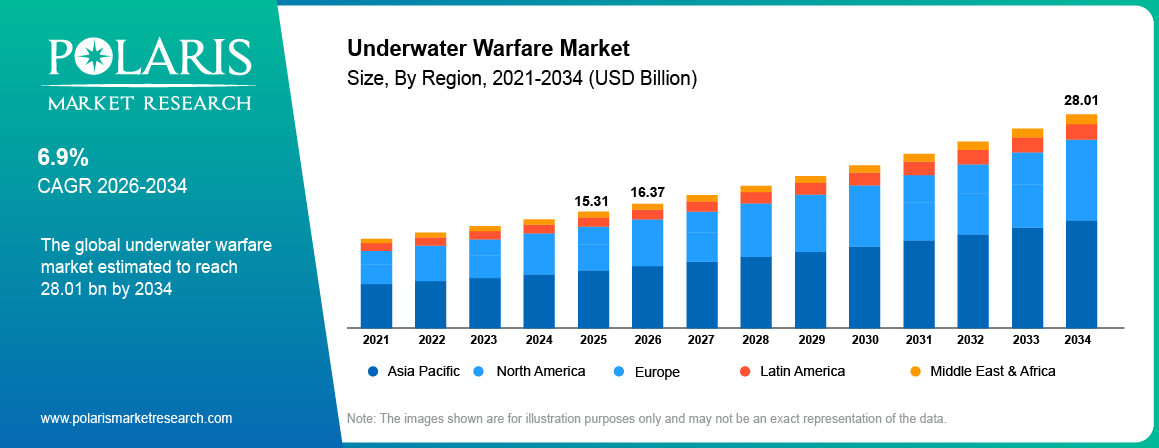
Global underwater warfare market size was valued at USD 15.31 billion in 2025. The market is anticipated to grow from USD 16.37 billion in 2026 to USD 28.01 billion by 2034, exhibiting the CAGR of 6.9% during the forecast period.
Market Statistics
Key Takeaways
- North America accounted for 41.10% of the underwater warfare market revenue in 2025. Strong defense spending and advanced naval capabilities are supporting the region's market dominance.
- Europe is projected to register the highest CAGR of 7.4% during 2026–2034. Investments in naval modernization and advanced underwater warfare technologies are supporting growth.
- Unmanned systems are projected to grow at a CAGR of 8.2% during 2026–2034. Rising demand for underwater surveillance, mine countermeasures, and intelligence gathering is supporting the segment.
- Sonar systems accounted for 32.6% of the underwater warfare market revenue in 2025. Growing demand for underwater threat detection, submarine tracking, and advanced underwater sensing technologies is supporting the segment.
- Surface ships is expected to witness growth of CAGR 7.5% during the forecast period. Their role in submarine detection, anti-submarine warfare, and mine countermeasures is supporting segment growth.
- The Protect segment accounted for 38.4% of the underwater warfare market revenue in 2025. Rising demand for submarine protection, anti-torpedo defense, and advanced countermeasure systems is supporting the segment.
Note: Figures and projections outlined in this report are the result of Polaris Market Research’s proprietary analytical processes, grounded in the latest available datasets and market observations.
Underwater Warfare Market Overview
The underwater warfare market includes military systems and technologies used to detect, track, and counter underwater threats. It covers unmanned systems, sonar systems, electronic warfare systems, weapons systems, and communications systems. These systems are used on surface ships, naval helicopters, and submarines. Surface radar also supports naval operations by detecting and tracking threats above the water. Together, these technologies support underwater surveillance, anti-submarine warfare, mine detection, and other naval defense operations. The market is gaining importance as countries focus on maritime security and stronger underwater defense capabilities.
The growing need for advanced underwater warfare systems is driving investments in naval modernization. Governments worldwide are investing in new technologies to upgrade their existing naval platforms and counter evolving underwater threats. These investments aim to improve the performance and reliability of underwater defense systems. Countries are also focusing on autonomous underwater vehicles, advanced sonar, and underwater surveillance technologies. These developments are helping navies improve their ability to detect and respond to underwater threats.
International cooperation is also supporting the development of underwater warfare technologies. Australia and Japan continued to strengthen their defense cooperation. Their focus on advanced defense technologies reflects the growing interest in robotic and autonomous systems. These technologies can support underwater surveillance, mine detection, and other naval operations. Such cooperation can help countries improve their maritime security capabilities.
For instance, in July 2025, Australia, the United Kingdom, and the United States tested underwater acoustic communications with autonomous underwater systems during Exercise Talisman Sabre 2025, with Japan participating for the first time. The exercise focused on improving communication and coordination between uncrewed underwater vehicles and naval forces (Source: defence.gov.au).
However, environmental regulations and legal requirements can create challenges for underwater warfare operations. The U.S. Navy follows environmental laws and regulations to reduce the impact of its activities on the marine environment. These requirements can affect the use of certain sonar systems and may lead to changes in naval training schedules. As a result, environmental concerns and legal challenges can affect how naval forces plan and conduct underwater warfare activities.
International laws also influence the use of underwater warfare systems. The United Nations Convention on the Law of the Sea (UNCLOS), adopted in 1982, requires countries to protect and preserve the marine environment. The Law of Armed Conflict (LOAC) governs the conduct of military operations. Submarines and other naval vessels must follow applicable international laws and regulations.
Market Dynamics
Market Driver- Advanced Sonar Technology Development
The growing need for underwater threat detection is driving demand for advanced sonar systems. These systems help naval forces detect and track underwater objects. Artificial intelligence (AI) and machine learning can improve sonar data analysis and support faster decisions. For example, in April 2025, Thales announced the integration of its BlueSentry sonar system with Saildrone’s Surveyor uncrewed surface vehicle. Such developments support advances in underwater surveillance and maritime security. They also create opportunities to improve sensor integration and strengthen naval situational awareness (Source: thalesgroup.com).
Market Driver- Naval Modernization and Autonomous Systems
Naval modernization is increasing demand for advanced underwater warfare systems. Countries are investing in autonomous underwater vehicles (AUVs) and unmanned underwater vehicles (UUVs) for surveillance, reconnaissance, and mine countermeasures. These systems can perform missions with reduced risk to personnel. Australia and Japan have also strengthened cooperation in advanced defense technologies. Such initiatives reflect the growing focus on robotic systems and modern naval capabilities to address evolving underwater threats. Continued investment in these technologies can also support the development of more efficient underwater defense operations.
Market Opportunity- Growing Investment in Autonomous Underwater Systems
The growing use of autonomous systems creates opportunities for the underwater warfare market. In April 2026, the Royal Navy reported successful demonstrations of autonomous and uncrewed technologies for anti-submarine warfare. Its Atlantic Bastion programme focuses on underwater sensors, autonomous platforms, and digital systems. These developments create opportunities for defense companies to develop advanced underwater surveillance, mine countermeasure, and naval defense solutions. They may also encourage further investment in military robotics and integrated underwater monitoring capabilities (Source: royalnavy.mod.uk).
Market Opportunity- Integration of Advanced Sonar and Sensor Systems
The integration of advanced sonar with unmanned platforms creates new opportunities for underwater warfare technology providers. In March 2025, the U.S. Navy awarded Northrop Grumman a contract worth approximately USD 24.9 million for research on autonomous undersea systems. The work includes sonar design, sensor systems, real-time processing, and autonomous sensing. Such investments can support the development of integrated underwater detection and surveillance solutions. They can also encourage innovation in sensor technologies and improve information sharing across naval defense systems (Source: eandt.theiet.org).
Market Restraint- High Cost of Underwater Warfare Systems
The high cost of developing and maintaining underwater warfare systems can limit market growth. Submarines, sonar equipment, underwater sensors, and autonomous vehicles require specialized materials and advanced engineering. Maintenance, personnel training, cybersecurity, and technology upgrades add to overall costs. Long procurement cycles can also delay adoption. These financial requirements may limit investment, particularly among countries with smaller defense budgets. In addition, complex testing and integration requirements can increase development timelines and make it difficult for some navies to adopt new technologies quickly.
Submarine Warfare vs. Anti-Submarine Warfare
Submarine warfare and anti-submarine warfare are important parts of naval defense. Submarine warfare involves using submarines for surveillance, deterrence, and military operations. Anti-submarine warfare (ASW) focuses on detecting, tracking, and responding to potential submarine threats. Both rely on advanced technologies, including sonar systems, underwater sensors, and communication systems. However, they differ in their objectives, platforms, and operational roles. These concepts help explain the technologies used in the underwater warfare market and are not separate market segments in the report.
| Factor | Submarine Warfare | Anti-Submarine Warfare (ASW) |
| Primary Purpose | Uses submarines for deterrence, surveillance, and military operations. | Detects, tracks, and responds to submarine threats. |
| Typical Platforms | Submarines and their onboard systems. | Surface ships, maritime patrol aircraft, helicopters, sonar networks, and unmanned systems. |
| Key Technologies | Stealth technology, navigation systems, underwater communications, and onboard sensors. | Active and passive sonar, sonobuoys, sensor systems, tracking technologies, and countermeasures. |
| Market Relevance | Supports demand for submarine construction, modernization, and onboard equipment. | Drives demand for submarine detection systems, sonar technologies, and fleet protection solutions. |
Source: Polaris Market Research Analysis
Key Technologies in Underwater Warfare
Sonar and Underwater Sensors
Sonar systems play an important role in underwater warfare by helping naval forces detect and track underwater objects. Active sonar uses sound waves to identify objects, while passive sonar detects sounds produced by other sources. Underwater sensors support surveillance, threat identification, and submarine detection. Growing investments in advanced sonar technology are improving underwater monitoring and supporting maritime security. These systems are important for anti-submarine warfare and modern naval defense operations.
Unmanned and Autonomous Underwater Systems
Unmanned underwater vehicles (UUVs) support underwater surveillance, reconnaissance, and mine countermeasures. They include autonomous underwater vehicles (AUVs), which operate independently, and remotely operated vehicles (ROVs), which are controlled by operators. These systems collect underwater data and inspect submerged structures. Their growing use helps reduce risks to personnel and supports the development of advanced underwater warfare systems. Rising demand for military robotics is also encouraging the adoption of unmanned technologies in naval operations.
Electronic Warfare, Countermeasures and Communications
Electronic warfare systems and countermeasures support naval defense against potential threats. These systems include jammers, decoys, and other technologies used to disrupt or respond to hostile systems. Underwater communications systems help transfer information between platforms and command centers. However, communication underwater can be challenging because radio signals do not travel effectively through seawater. Improvements in secure communications, defense electronics, and integrated naval systems are supporting coordination and situational awareness during underwater warfare operations.
AI and Data Processing
Artificial intelligence (AI) and data processing technologies help analyze information collected by sonar systems and underwater sensors. AI can support threat identification and process large amounts of underwater data. These technologies can also assist with autonomous navigation and decision-making. As naval forces adopt advanced sensing systems, AI-based tools may improve underwater situational awareness and support faster responses to potential threats. Their use is also creating opportunities for more integrated and efficient underwater defense systems.
| Technology | Primary Role | Market Relevance |
| Sonar System | Detect and track underwater objects using sound waves. | Support submarine detection, underwater surveillance, and anti-submarine warfare. |
| Unmanned Underwater Vehicles (UUVs) and Autonomous Underwater Vehicles (AUVs) | Conduct underwater surveillance, reconnaissance, inspections, and mine detection. | Support the growing adoption of unmanned systems and autonomous naval technologies. |
| Electronic Warfare and Countermeasures | Use jammers, decoys, and other systems to respond to potential threats. | Support naval protection and the development of advanced underwater defense systems. |
| Weapons Systems | Include underwater weapons such as torpedoes and mines. | Support naval defense capabilities and underwater combat operations. |
| Communication Systems | Enable information exchange between underwater platforms and naval command systems. | Support coordination, surveillance, and information sharing during naval operations. |
Source: Polaris Market Research Analysis
Segmental Analysis
By Systems Analysis
The global underwater warfare market is segmented by system into unmanned systems, sonar systems, electronic warfare systems, weapons systems, and communications systems. Unmanned systems include remotely operated underwater vehicles (RUVs) and autonomous underwater vehicles (AUVs), which support underwater surveillance, reconnaissance, and mine countermeasures. Sonar systems include active and passive sonars used to detect and track underwater objects. Electronic warfare systems include countermeasures, jammers, and decoys, while weapons systems include mines and torpedoes. Communications systems support information exchange between naval platforms and command centers.
The unmanned systems segment is projected to grow at a CAGR of 8.2% during 2026–2034. Rising demand for underwater surveillance, mine countermeasures, and intelligence gathering is supporting the segment. Meanwhile, sonar systems accounted for 32.6% of the underwater warfare market revenue in 2025. Growing demand for submarine detection, underwater threat tracking, and advanced sensing technologies is supporting the adoption of sonar systems in naval defense operations.
By Capability Analysis
The global underwater warfare market segmentation, based on capability, includes support, protect, attack, and others. The Protect segment accounted for 38.4% of market revenue in 2025. Its growth is supported by rising demand for submarine protection, anti-torpedo defense, and countermeasure systems. These systems help naval forces detect and respond to underwater threats. They also help protect submarines and other naval assets. Growing investments in advanced defense technologies are further supporting the segment.
The Support segment is expected to grow at a CAGR of 6.6% during 2026–2034. This segment includes systems used for underwater surveillance, communication, reconnaissance, and navigation. Growing investments in sonar systems, underwater sensors, and unmanned underwater vehicles are supporting its growth. These technologies help naval forces collect underwater data and monitor potential threats. They also improve communication and coordination during naval operations. Increasing investments in naval modernization are expected to support demand for these systems.
By Platform Analysis
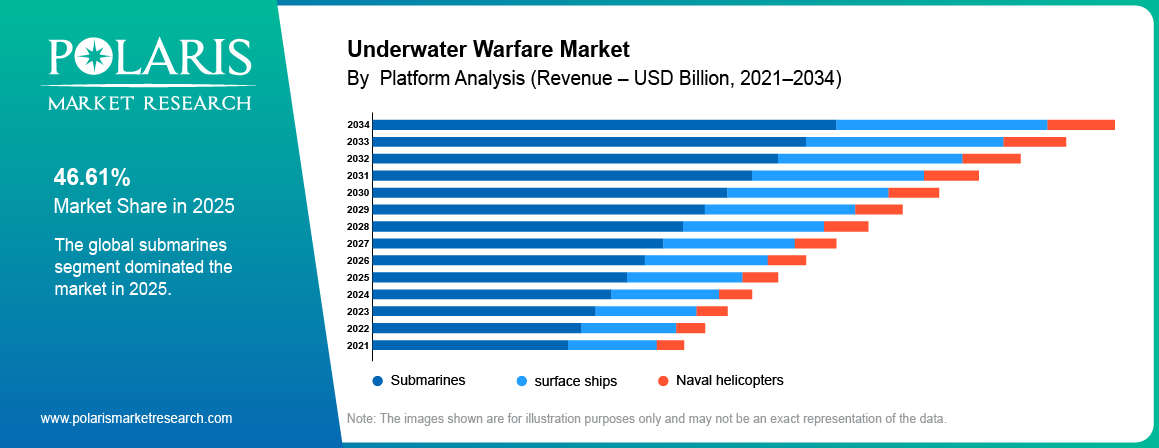
The global underwater warfare market segmentation, based on platform, includes surface ships, naval helicopters, and submarines. The surface ships segment is expected to grow at a CAGR of 7.5% during the forecast period. Its growth is supported by rising demand for submarine detection and underwater surveillance. Surface ships use sonar systems and underwater sensors to detect potential threats. They also support anti-submarine warfare and mine countermeasures. Growing investments in naval modernization are further supporting the segment.
The submarines segment accounted for 46.61% share in 2025. Submarines support underwater surveillance, reconnaissance, and naval defense operations. Rising investments in submarine modernization are driving demand for advanced onboard systems. Improvements in sonar, stealth technology, and underwater communication are also supporting market growth.
The naval helicopters segment plays an important role in anti-submarine warfare. These helicopters use sonar systems and sonobuoys to detect and track submarines. They also support maritime surveillance and naval operations. Growing demand for effective underwater threat detection is supporting the use of naval helicopters in the underwater warfare market.
Underwater Warfare Use Cases
Underwater warfare systems support several naval defense activities. They help naval forces detect underwater threats, monitor maritime areas, and protect naval assets. The underwater warfare market includes sonar systems, unmanned underwater vehicles, sensors, and communication technologies. These systems support anti-submarine warfare, mine countermeasures, and underwater surveillance.
Growing investments in naval modernization are increasing demand for advanced underwater warfare technologies. Autonomous systems and advanced sensors also help improve threat detection. These technologies support safer naval operations and help protect important maritime infrastructure.
| Use Case | Key Technologies | Purpose |
| Anti-Submarine Warfare Missions | Sonar systems, underwater sensors, naval helicopters | Detect and track submarines and protect naval fleets. |
| Mine Countermeasures | Sonar, underwater sensors, unmanned underwater vehicles | Detect and clear underwater mines while reducing risks to personnel. |
| Underwater Surveillance and Intelligence | Autonomous underwater vehicles, sonar, surveillance systems | Monitor underwater activities and support reconnaissance. |
| Naval Asset and Infrastructure Protection | Underwater sensors, monitoring systems, sonar | Protect ports, sea routes, submarine cables, and other critical maritime assets. |
Source: Polaris Market Research Analysis
Regional Market Trends
North America
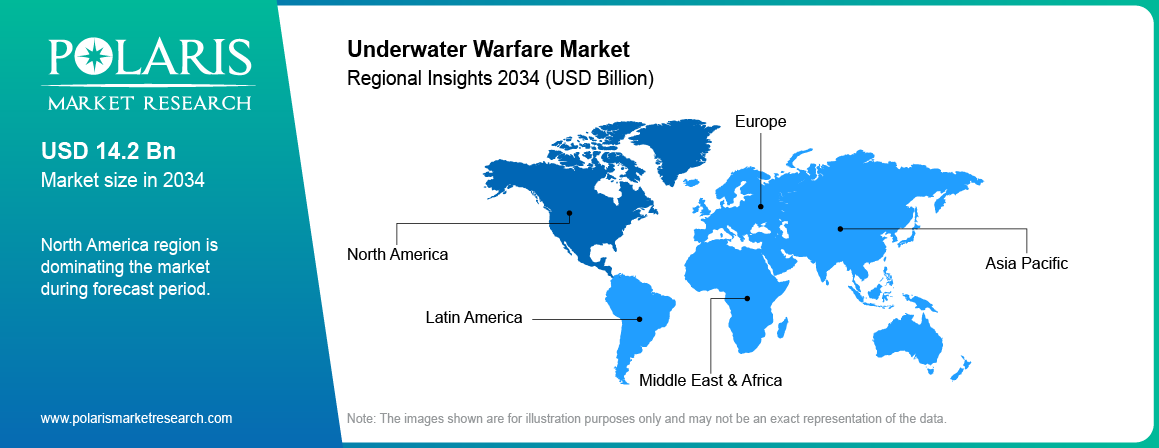
North America is a major region in the global underwater warfare market, accounting for 41.10% of market revenue in 2025. Strong defense spending supports investment in advanced underwater warfare technologies. The region is home to major defense contractors that develop sonar systems, unmanned underwater vehicles, and naval defense equipment. Its advanced naval capabilities and access to the Atlantic and Pacific Oceans further support demand for underwater surveillance and maritime security.
Asia Pacific
The Asia Pacific underwater warfare market is supported by rising defense spending and naval modernization. Countries are investing in submarines, sonar systems, and unmanned underwater vehicles. Growing maritime security concerns are increasing demand for underwater surveillance and anti-submarine warfare systems. These investments are supporting the development of advanced naval defense capabilities across the region.
Europe
Europe is expected to witness strong growth in the underwater warfare market, with a projected CAGR of 7.4% during 2026–2034. Countries such as the UK, France, and Germany are investing in naval modernization and advanced defense technologies. The Royal Navy is focusing on autonomous systems, artificial intelligence, and cybersecurity. These investments are supporting demand for advanced sonar, underwater sensors, and anti-submarine warfare systems.
Latin America
The Latin America underwater warfare market is supported by efforts to modernize naval fleets and improve maritime security. Countries are investing in naval equipment to monitor coastal waters and protect important sea routes. Demand for underwater surveillance, sonar systems, and mine countermeasures is creating opportunities for market growth. The need to protect maritime resources is also encouraging investment in naval defense technologies.
Middle East and Africa
The Middle East and Africa underwater warfare market is gaining attention as countries strengthen their naval defense capabilities. Maritime security concerns are encouraging investment in surveillance systems and advanced naval equipment. The protection of ports, coastal areas, and important sea routes is supporting demand for underwater warfare technologies. Investments in naval modernization are expected to create opportunities for sonar systems, underwater sensors, and unmanned underwater vehicles.
Competitive Landscape
The global underwater warfare market is competitive, with several companies developing advanced naval defense technologies. Key players focus on product development, partnerships, and technology upgrades to strengthen their market position. They invest in sonar systems, underwater sensors, unmanned underwater vehicles, torpedoes, and communication systems. These technologies support submarine detection, underwater surveillance, and anti-submarine warfare.
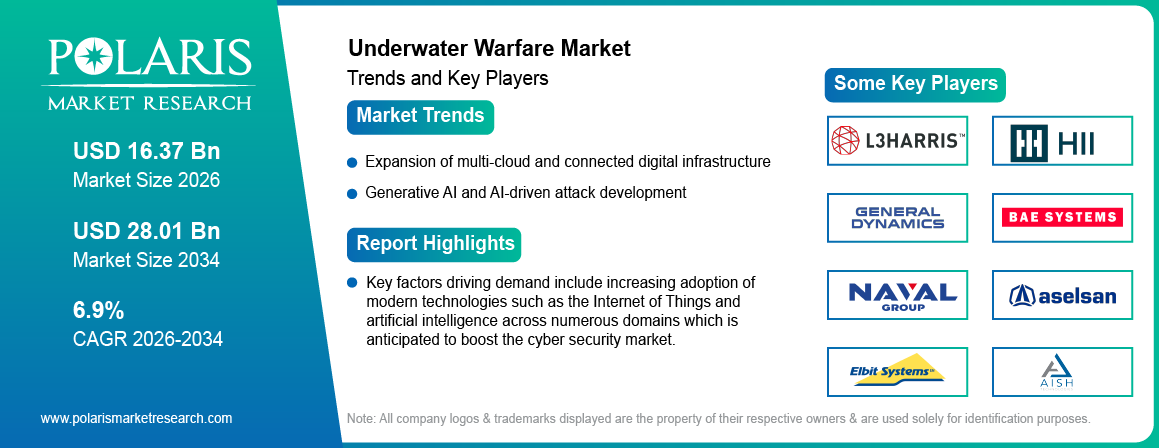
Major companies in the underwater warfare market include Aish Technologies, ASELSAN, BAE Systems plc, Elbit Systems Ltd., General Dynamics Corporation, Huntington Ingalls Industries, L3Harris Technologies, Naval Group, Northrop Grumman Corporation, RTX Corporation, Saab AB, Thales, and TKMS. These companies support naval operations through submarine construction, sonar technology, underwater weapons, and countermeasure systems. TKMS includes ATLAS ELEKTRONIK, which develops sonar systems, sensors, and naval electronics. Companies continue to improve their technologies to meet changing naval requirements and strengthen underwater defense capabilities.
Some of the major players operating in the global market include:
- Aish Technologies
- ASELSAN
- BAE Systems plc
- Elbit Systems Ltd.
- General Dynamics Corporation
- Huntington Ingalls Industries (HII)
- L3Harris Technologies
- Naval Group
- Northrop Grumman Corporation
- RTX Corporation
- Saab AB
- Thales
- TKMS
Vendor Positioning
| Company Name | Headquarters | Key Products | Capabilities |
| Aish Technologies | Portsmouth, UK | Naval electronics and control systems | Naval system integration and underwater defense |
| ASELSAN | Ankara, Türkiye | Sonar systems and naval electronics | Underwater detection and maritime surveillance |
| BAE Systems plc | London, UK | Naval systems and submarine technologies | Submarine defense and naval warfare systems |
| Elbit Systems Ltd. | Haifa, Israel | Sonar and underwater surveillance systems | Underwater monitoring and acoustic technologies |
| General Dynamics Corporation | Reston, Virginia, USA | Submarines and naval systems | Submarine design, construction, and modernization |
| Huntington Ingalls Industries (HII) | Newport News, Virginia, USA | Unmanned underwater vehicles and naval platforms | Underwater robotics and naval defense |
| L3Harris Technologies | Melbourne, Florida, USA | Underwater vehicles and sonar systems | Undersea surveillance and autonomous systems |
| Naval Group | Paris, France | Submarines and naval combat systems | Submarine construction and naval defense |
| Northrop Grumman Corporation | Falls Church, Virginia, USA | Undersea systems and autonomous platforms | Underwater sensing and defense technologies |
| RTX Corporation | Arlington, Virginia, USA | Defense electronics and naval sensors | Underwater threat detection and sensor technologies |
| Saab AB | Stockholm, Sweden | Torpedoes and underwater sensor systems | Mine countermeasures and underwater surveillance |
| Thales | Meudon, France | Naval sonar and underwater sensors | Submarine detection and mine countermeasures |
| TKMS | Kiel, Germany | Submarines and underwater systems | Submarine construction and naval defense technologies |
Source: Polaris Market Research Analysis
Recent Developments
- September 2026: The Royal Navy successfully tested a torpedo launch from its uncrewed submarine, XV Excalibur, near Scotland. The trial demonstrated progress in autonomous underwater warfare and uncrewed naval platforms. (Source: royalnavy.mod.uk)
- July 2026: Lockheed Martin announced an agreement to acquire Ultra Maritime for USD 3.45 billion. The proposed acquisition is expected to expand its sonar, underwater sensing, and anti-submarine warfare capabilities. (Source: news.lockheedmartin.com)
- June 2026: HII delivered the first REMUS 130 unmanned underwater vehicle to a U.S. ally. The system supports mine countermeasures, seabed mapping, and underwater data collection. (Source: hii.com)
- March 2026: L3Harris Technologies advanced submarine-based autonomous operations through its Torpedo Tube Launch and Recovery system for deploying and recovering Iver4 900 autonomous underwater vehicles. (Source: l3harris.com)
- February 2026: The Royal Navy awarded Ultra Maritime a £40 million contract to supply sonobuoys for its Merlin helicopter fleet, supporting submarine detection and anti-submarine warfare missions.(Source: royalnavy.mod.uk)
- November 2025: India’s Defence Research and Development Organisation (DRDO) developed a new generation of man-portable autonomous underwater vehicles for mine countermeasures. The systems use sonar, underwater cameras, and target-recognition technologies to support underwater mine detection. (Source: pib.gov.in)
- April 2025: Thales Australia’s BlueSentry thin-line towed sonar array was successfully integrated into Saildrone’s Surveyor-class uncrewed surface vehicle, demonstrating strong operational performance during an extended mission conducted off the U.S. coast. (Source: thalesgroup.com)
- March 2025: Thales, a long-standing partner of Naval Group and the Royal Netherlands Navy, announced the delivery of a comprehensive suite of high-performance sonar systems for the next generation of submarines set to replace the Walrus-class fleet. The agreement will provide advanced insight into underwater acoustic environments, supporting the Netherlands in maintaining operational superiority. (Source: thalesgroup.com)
Future Outlook
The underwater warfare market is expected to benefit from ongoing naval modernization and rising demand for advanced defense systems. Growing use of autonomous underwater vehicles is supporting surveillance and mine countermeasures. Advances in sonar and underwater sensors are improving threat detection. Integration of artificial intelligence and communication systems is also helping naval forces improve coordination. These developments are expected to support the adoption of advanced underwater warfare technologies.
Research Methodology
The underwater warfare market research is based on a combination of primary and secondary research. Primary research may include interviews and discussions with industry experts, defense technology providers, naval equipment manufacturers, and other market participants. These interactions help assess market trends, technology developments, and industry challenges.
Secondary research includes information from company websites, annual reports, product announcements, government publications, defense industry reports, and other reliable sources. The research examines key market segments, including systems, capabilities, and platforms. It also considers regional trends, competitive developments, and technological advances in sonar systems, autonomous underwater vehicles, and underwater surveillance.
Market estimates and forecasts are developed by analyzing available industry data, historical trends, market drivers, and challenges. Company profiles and recent developments help assess the competitive landscape. The findings are reviewed for consistency to provide an overview of the underwater warfare market.
Report Segmentation
Underwater Warfare, System Outlook (Revenue - USD Billion, 2021 - 2034)
- Unmanned Systems
- Remotely Operated Underwater Vehicles (RUVs)
- Autonomous Underwater Vehicles (AUVs)
- Sonar Systems
- Active Sonars
- Passive Sonars
- Electronic Warfare Systems
- Countermeasures
- Jammers
- Decoys
- Weapons Systems
- Mines
- Torpedoes
- Communications Systems
Underwater Warfare, Capability Outlook (Revenue - USD Billion, 2021 - 2034)
- Support
- Protect
- Attack
- Others
Underwater Warfare, Platform Outlook (Revenue - USD Billion, 2021 - 2034)
- Surface Ships
- Naval Helicopters
- Submarines
Underwater Warfare, Regional Outlook (Revenue - USD Billion, 2021 - 2034)
- North America
- U.S.
- Canada
- Europe
- Germany
- UK
- France
- Italy
- Spain
- Russia
- Netherlands
- Rest of Europe
- Asia Pacific
- China
- India
- Japan
- South Korea
- Indonesia
- Malaysia
- Australia
- Rest of Asia Pacific
- Latin America
- Argentina
- Brazil
- Mexico
- Rest of Latin America
- Middle East & Africa
- UAE
- Saudi Arabia
- Israel
- South Africa
- Rest of Middle East & Africa
Underwater Warfare Market Report Scope
| Report Attributes | Details |
| Market size value in 2026 | USD 16.37 billion |
| Revenue forecast in 2034 | USD 28.01 billion |
| CAGR | 6.9% from 2026 – 2034 |
| Base year | 2025 |
| Historical data | 2021 – 2024 |
| Forecast period | 2026 – 2034 |
| Quantitative units | Revenue in USD billion and CAGR from 2026 to 2034 |
| Segments covered | By System, By Capability, By Platform, By Region |
| Regional scope | North America, Europe, Asia Pacific, Latin America; Middle East & Africa |
| Customization | Report customization as per your requirements with respect to countries, region and segmentation. |
Source: Polaris Market Research Analysis
Underwater Warfare Market FAQ's
The global underwater warfare market was valued at USD 15.31 billion in 2025. Demand for advanced naval defense systems, sonar technologies, and underwater surveillance is supporting market growth.
The market is projected to grow at a CAGR of 6.9% during 2026–2034. Naval modernization and rising investments in autonomous underwater systems are expected to support this growth.
The main growth drivers include rising defense spending, naval fleet modernization, and growing demand for advanced underwater threat detection. Investments in sonar systems and unmanned underwater vehicles are also supporting market expansion.
North America accounted for 41.10% of the market revenue in 2025. Strong defense spending, advanced naval capabilities, and investments in underwater warfare technologies support the region's market position.
Europe is projected to register a CAGR of 7.4% during 2026–2034. Investments in submarine modernization, sonar technologies, and autonomous naval systems are supporting regional growth.
The unmanned systems segment is projected to grow at a CAGR of 8.2% during 2026–2034. Rising demand for underwater surveillance, reconnaissance, and mine countermeasures is supporting the segment.
Key players include BAE Systems, General Dynamics Corporation, L3Harris Technologies, Naval Group, Northrop Grumman Corporation, RTX Corporation, Saab AB, Thales, and TKMS. These companies develop submarines, sonar systems, underwater sensors, and other naval defense technologies.

Download Sample Report of Underwater Warfare Market
Please fill out the form to request a customized copy of the research report.


