
Usage-Based Insurance for Automotive Market Share, Forecast 2026-2034
REPORT DETAILS
Usage-Based Insurance for Automotive Market Summary
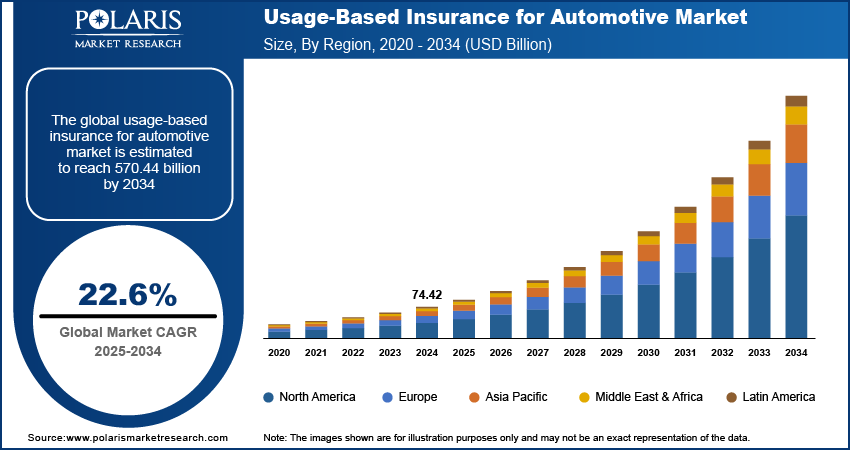
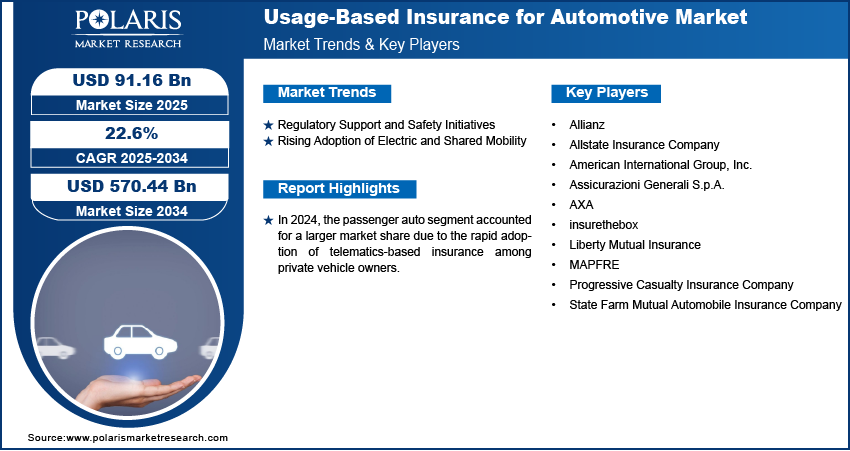
The usage-based insurance for automotive market size was valued at USD 91.16 billion in 2025. The market is projected to exhibit a CAGR of 22.6% during 2026–2034. The implementation of regulatory frameworks promoting telematics adoption is one of the key factors driving market growth.
Market Statistics
Key Takeaways
- North America led the market with a 35.21% revenue share in 2025. The ability to provide personalized premium structures based on real-time driving behavior is a major factor driving this segment's growth.
- Europe is projected to witness significant growth at a 17.65% CAGR. This is driven by the region's stringent emission regulations and the increasing adoption of electric vehicles.
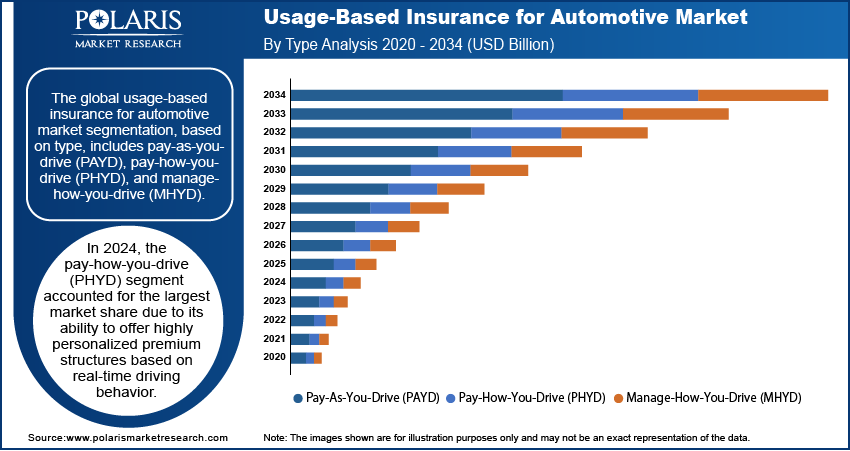
- The pay-how-you-drive (PHYD) segment accounted for the largest market share of 38.64% in 2025. This is because PHYD can offer highly personalized premium structures based on real-time driving behavior.
- The passenger auto segment held the largest share of 68.51% in 2025. This is owing to the rapid adoption of telematics-based insurance among private vehicle owners.
- The OBD II devices segment led with a 35.32% revenue share in 2025. This segment is valued for its aftermarket flexibility and ability to provide comprehensive vehicle data.
Note: Figures and projections outlined in this report are the result of Polaris Market Research’s proprietary analytical processes, grounded in the latest available datasets and market observations.
Industry Dynamics
- The implementation of favorable regulations by governments worldwide to promote telematics adoption is driving market growth.
- The rising usage of electric vehicles (EVs) and shared mobility services is fueling market demand.
- The growing popularity of smartphone-based telematics is expected to present several opportunities.
- High telematics installation costs may present market challenges.
AI Impact on Usage-Based Insurance for Automotive Market
- AI assists in computing insurance premiums according to actual driver behavior, such as speed, braking, and distances. This ensures better fairness and personalization in pricing.
- AI helps assess risks by analyzing driving patterns. This helps determine the safer and riskier drivers.
- AI enables real-time tracking, meaning that insurers can make adjustments in rewards or penalties depending on how the driver drives at the moment.
- AI is useful in minimizing claims and accidents by providing driver feedback on their driving.
The usage-based insurance (UBI) for automotive market focuses on insurance policies where premiums are determined based on real-time driving behavior, vehicle usage patterns, and telematics data. Unlike traditional fixed-rate insurance, UBI leverages GPS, onboard diagnostics (OBD-II), and connected vehicle technologies to assess factors such as mileage, driving speed, acceleration, braking patterns, and time of use.
The increasing integration of telematics,AI-driven analytics, and IoT in connected vehicles is enhancing insurers' ability to assess real-time driving behavior, which is significantly contributing to the usage-based insurance for automotive market growth. Moreover, consumers and businesses are increasingly seeking cost-effective insurance solutions based on actual vehicle usage, rather than traditional fixed-premium models which is further driving market demand.
Source: Polaris Market Research Analysis
Usage-based insurance allows insurers to better assess risks, reduce fraudulent claims, and improve underwriting efficiency, driving market value and profitability. Furthermore, the adoption of app-based UBI solutions, eliminating the need for additional hardware installations, is further accelerating usage-based insurance for automotive market development.
Usage-Based vs Traditional Auto Insurance
| Aspect | Usage-based Insurance | Traditional Insurance |
| Price | Behavior-based | Fixed premium |
| Personalization | High | Low |
| Risk assessment | Real-time data | Historical/statistical |
| Cost efficiency | Savings for safe drivers | Cost fixed irrespective of behavior |
Source: Polaris Market Research Analysis
Market Dynamics
Regulatory Support and Safety Initiatives Driving Usage-Based Insurance (UBI) For Automotive Market
Governments worldwide are implementing regulatory frameworks that promote telematics adoption and data-driven insurance models. Stringent road safety initiatives and policies aimed at reducing accident-related costs are driving UBI for automotive market demand, as insurers leverage real-time driving data to assess risk more accurately. Regulatory mandates in regions such as North America and Europe are encouraging fairer premium structures and incentivizing safer driving behaviors. Additionally, government-backed programs supporting vehicle connectivity and data privacy regulations are shaping market dynamics, ensuring transparency and consumer trust. Insurers and policymakers are aligning to create a more efficient and cost-effective auto insurance ecosystem. Thus, the regulatory support and safety initiatives play a crucial role in usage-based insurance (UBI) for automotive market growth.
Rising Adoption of Electric and Shared Mobility
The increasing adoption of electric vehicles (EVs) and shared mobility services is reshaping the automotive insurance landscape, driving usage-based insurance (UBI) for automotive market expansion. According to IEA, in 2023, nearly 14 million new electric vehicles (EVs) were registered globally, bringing the total on the road to 40 million, in line with 2023. This marks a 35% year-on-year increase, with 3.5 million more EVs sold compared to 2022. Moreover, traditional insurance models struggle to accommodate the unique risk profiles of EV drivers and shared vehicle users, UBI demand is surging due to its flexible, data-driven approach. Insurers are leveraging telematics to offer customized coverage based on real-time driving behavior, optimizing UBI requirements by both providers and consumers. The shift toward mobility-as-a-service (MaaS) and pay-per-use vehicle access is further creating significant UBI for automotive market opportunities as insurers develop innovative policies tailored to evolving transportation trends.
Source: Polaris Market Research Analysis
Usage-Based Insurance for Automotive Market Segment Insights
Usage-Based Insurance for Automotive Market Assessment by Type Outlook
The global usage-based insurance for automotive market segmentation, based on type, includes pay-as-you-drive (PAYD), pay-how-you-drive (PHYD), and manage-how-you-drive (MHYD). In 2025, the pay-how-you-drive (PHYD) segment accounted for the largest market share of 38.64% due to its ability to offer highly personalized premium structures based on real-time driving behavior. Insurers are leveraging advanced telematics and AI-driven analytics to assess factors such as acceleration, braking patterns, and adherence to speed limits, allowing for risk-adjusted pricing models that appeal to safety-conscious drivers. The increasing consumer preference for fair and transparent insurance premiums, combined with regulatory support for telematics-based risk assessment, is contributing to PHYD segment expansion. Additionally, the integration of PHYD models with connected vehicle ecosystems enhances market demand, further strengthening insurer competitiveness in this evolving sector.
| Type | Description | Key Feature |
| PAYD | Premium determined by miles driven | Useful for drivers who drive fewer miles |
| PHYD | Premium determined by how safely one drives | Motivates safer driving |
| MHYD | Takes into account behavior improvement | Helps one drive safely |
Source: Polaris Market Research Analysis
Usage-Based Insurance for Automotive Market Evaluation by Vehicle Outlook
The global usage-based insurance for automotive market segmentation, based on vehicle, includes passenger auto and commercial auto. In 2025, the passenger auto segment accounted for the largest market share of 68.51% due to the rapid adoption of telematics-based insurance among private vehicle owners. Increasing consumer demand for cost-effective and behavior-based insurance solutions, especially among urban and younger demographics, has accelerated market growth for the passenger auto segment. Automakers are also partnering with insurers to integrate telematics solutions directly into new vehicles, facilitating seamless data collection for risk assessment. Additionally, rising vehicle connectivity, advancements in AI-powered risk modeling, and the growing acceptance of pay-as-you-drive (PAYD) and pay-how-you-drive (PHYD) models are driving the passenger auto segment expansion.
Source: Polaris Market Research Analysis
How Driving Behavior Impacts Premiums?
In usage-based insurance (UBI), the premium is calculated according to actual driver performance. The elements used include speed, braking patterns, miles driven, and driving hours. This data helps in measuring risk more precisely compared to conventional fixed rates. Good drivers who maintain constant speeds while driving, exhibit consistent braking patterns, and drive fewer miles will have to pay less premium costs. However, risky or reckless drivers will pay more premium costs.
Usage-Based Insurance for Automotive Market Regional Analysis
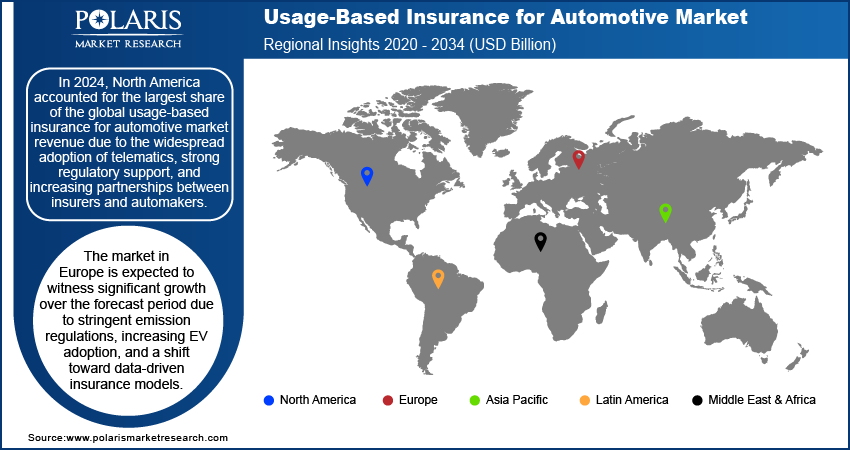
By region, the study provides usage-based insurance for automotive market insights into North America, Europe, Asia Pacific, Latin America, and the Middle East & Africa. In 2025, North America accounted for the largest market share of 35.21% due to the widespread adoption of telematics, strong regulatory support, and increasing partnerships between insurers and automakers. In November 2022, Mobilize Financial Services partnered with Accenture to launch a new usage-based insurance (UBI) offering. The region’s advanced connected vehicle infrastructure and high consumer awareness regarding cost-saving insurance models are driving UBI for automotive market expansion. Additionally, the growing integration of telematics in new vehicles, facilitated by regulatory mandates and insurer incentives, has further strengthened market demand. The presence of leading telematics providers and insurance firms investing in AI-driven risk assessment models has also contributed to market growth across the region.
The Europe usage-based insurance for automotive market is expected to witness significant growth of CAGR 17.65% over the forecast period due to stringent emission regulations, increasing EV adoption, and a shift toward data-driven insurance models. The region’s focus on road safety and regulatory frameworks promoting telematics-based insurance is driving market development. Additionally, the expansion of shared mobility services and the rising penetration of connected vehicles are creating usage-based insurance for automotive market opportunities for insurers. Technological advancements in telematics and AI-driven risk analysis, coupled with consumer demand for flexible and fair insurance premiums, are further accelerating market growth in Europe.
Source: Polaris Market Research Analysis
Usage-Based Insurance for Automotive Market – Key Players & Competitive Analysis Report
The competitive landscape of the usage-based insurance for automotive market is characterized by intense competition among insurance providers, telematics companies, and automotive OEMs striving to gain a larger market share through strategic partnerships, technological advancements, and product innovations. Key players are investing in AI-driven analytics, real-time data monitoring, and predictive modeling to refine risk assessment and offer more personalized insurance plans, contributing to UBI for automotive market expansion. Insurers are forming alliances with automakers and mobility service providers to integrate telematics into vehicles, enhancing market demand. The rise of pay-as-you-drive (PAYD) and pay-how-you-drive (PHYD) models has led companies to enhance their telematics platforms to improve data accuracy and user experience. Moreover, regulatory compliance and data privacy remain crucial competitive factors, influencing market dynamics. Companies are also focusing on customer engagement strategies, such as usage-based rewards and dynamic pricing, to attract a wider consumer base. With the increasing adoption of electric vehicles and connected cars, the market is witnessing new entrants and technology-driven startups, further intensifying competition and fueling the UBI for automotive market growth.
Allianz Life Insurance Company of North America, established in 1896 and headquartered in Minnesota, US, specializes in providing financial and retirement solutions. The company's offerings include annuities and life insurance products designed to help individuals manage risks in retirement. Its annuity products, such as fixed index annuities, offer tax-deferred growth potential and protection from market downturns. For instance, the Allianz Benefit Control Annuity provides options for accumulation and income flexibility. In the realm of life insurance, Allianz offers indexed universal life insurance policies such as the Allianz Life Accumulator, which combines a death benefit with the potential for cash value accumulation based on market index performance. These products are utilized by individuals seeking financial protection and strategies to secure their financial future.
Allstate Insurance Company is a personal lines insurer in the US. The company was founded in 1931 as part of Sears, Roebuck & Co., and Allstate became an independent company in 1995. Allstate Insurance offers a wide range of insurance products, such as auto, home, life, and health insurance, distributed through various channels, such as exclusive agencies, independent agencies, and online platforms. Allstate has been in usage-based insurance (UBI) through its Drivewise program in the automotive sector. Drivewise is a telematics-based system that tracks driving habits, such as speed, braking, and acceleration, to provide personalized insurance rates. This program allows safe drivers to lower their premiums by demonstrating responsible driving behaviors. Additionally, Allstate's Esurance brand offers similar UBI options with DriveSense, which also uses data from vehicle telematics to adjust insurance costs based on driving performance. Allstate's focus on UBI reflects its commitment to leveraging technology to improve customer experience and offer tailored insurance solutions. Allstate aims to provide more accurate risk assessments and reward safe driving practices by integrating advanced data analytics and telematics, aligning with its mission to protect families and belongings while enabling a culture of safety on the roads.
List of Key Companies in Usage-based Insurance for Automotive Market
- Allianz
- Allstate Insurance Company
- American International Group, Inc.
- Assicurazioni Generali S.p.A.
- AXA
- insurethebox
- Liberty Mutual Insurance
- MAPFRE
- Progressive Casualty Insurance Company
- State Farm Mutual Automobile Insurance Company
Industry Developments
April 2026: Roamly launched a usage-based insurance product for autonomous fleets, integrating with Tesla systems to price coverage per mile. The solution adjusted premiums during autopilot use, addressed coverage gaps, and enabled fleet operators to manage risk using live vehicle telemetry data. (source: fnews.com)
March 2026: Allianz X made a strategic investment of $350 million in CMT in partnership with TPG. The deal includes commercial contracts with Allianz Partners and Allianz Versicherungs-AG. It will enable them to utilize AI-powered telematics to assess driving risks in real time in Europe. (source: tpg.com)
September 2024, Novo launched innovative cloud usage-based car insurance for connected vehicles. (Source: novo.u)
August 2024, Zuno General Insurance launched a mobile telematics add-on, Pay How You Drive, for private car policies. The feature assessed driving behaviour, provided a Zuno Driving Quotient, tracked scores after each trip, and applied usage-based discounts during policy renewals. (Source: autocarpro.in).
Market Segmentation
By Type Outlook (Revenue – USD Billion, 2021–2034)
- Pay-As-You-Drive (PAYD)
- Pay-How-You-Drive (PHYD)
- Manage-How-You-Drive (MHYD)
By Technology Outlook (Revenue – USD Billion, 2021–2034)
- OBD II
- Black Box
- Smartphones
- Others
By Vehicle Outlook (Revenue – USD Billion, 2021–2034)
- Passenger Auto
- Commercial Auto
By Regional Outlook (Revenue – USD Billion, 2021–2034)
- North America
- US
- Canada
- Europe
- Germany
- France
- UK
- Italy
- Spain
- Netherlands
- Russia
- Rest of Europe
- Asia Pacific
- China
- Japan
- India
- Malaysia
- South Korea
- Indonesia
- Australia
- Vietnam
- Rest of Asia Pacific
- Middle East & Africa
- Saudi Arabia
- UAE
- Israel
- South Africa
- Rest of Middle East & Africa
- Latin America
- Mexico
- Brazil
- Argentina
- Rest of Latin America
Report Scope
| Report Attributes | Details |
| Market Size Value in 2025 | USD 91.16 Billion |
| Market Size Value in 2026 | USD 111.15 Billion |
| Revenue Forecast by 2034 | USD 570.44 Billion |
| CAGR | 22.6% from 2026 to 2034 |
| Base Year | 2025 |
| Historical Data | 2021–2024 |
| Forecast Period | 2026–2034 |
| Quantitative Units | Revenue in USD Billion, and CAGR from 2026 to 2034 |
| Report Coverage | Revenue Forecast, Market Competitive Landscape, Growth Factors, and Trends |
| Segments Covered |
|
| Regional Scope |
|
| Competitive Landscape |
|
| Report Format |
|
| Customization | Report customization as per your requirements with respect to countries, regions, and segmentation. |
Source: Polaris Market Research Analysis
Usage-Based Insurance for Automotive Market FAQ's
The market size was valued at USD 91.16 billion in 2025 and is projected to grow to USD 570.44 billion by 2034.
The global market is projected to register a CAGR of 22.6% during the forecast period.
In 2025, North America accounted for the largest market share of 35.21% due to the widespread adoption of telematics, strong regulatory support, and increasing partnerships between insurers and automakers.
A few of the key players in the market are Allianz; Allstate Insurance Company; American International Group, Inc.; Assicurazioni Generali S.p.A.; AXA; insurethebox; Liberty Mutual Insurance; MAPFRE; Progressive Casualty Insurance Company; and State Farm Mutual Automobile Insurance Company.
In 2025, the pay-how-you-drive (PHYD) segment accounted for the largest market share of 38.64% due to its ability to offer highly personalized premium structures based on real-time driving behavior.
In 2025, the passenger auto segment accounted for a larger market share of 68.51% due to the rapid adoption of telematics-based insurance among private vehicle owners.
Download Sample Report of Usage-Based Insurance for Automotive Market
Please fill out the form to request a customized copy of the research report.


