
Laminated Busbar Market Size, Share, Trends & Forecast, 2026–2034
REPORT DETAILS
Laminated Busbar Market Summary
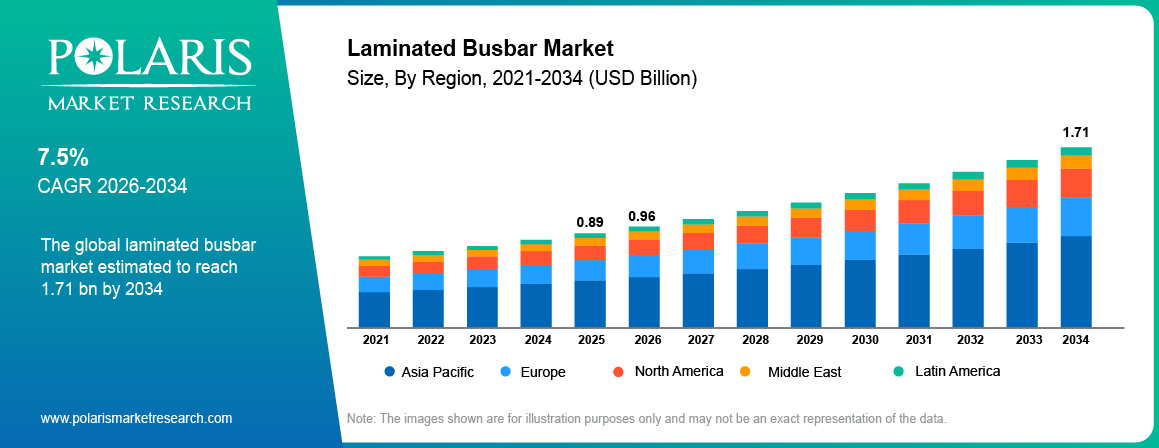
The global laminated busbar market size was valued at USD 0.89 billion in 2025. The market is projected to account for a CAGR of 7.5% from 2026 to 2034. The market is driven by increasing demand for compact and efficient power distribution systems in electronics and automotive sectors.
Market Statistics
Key Takeaways
- Asia Pacific led the laminated busbar market with a 40.85% revenue share in 2025. Ongoing infrastructure development in emerging economies across the region has increased demand for advanced and compact electrical distribution solutions.
- North America is expected to witness the fastest growth, at a 7.75% CAGR. This is supported by growing adoption of laminated busbars in the region’s automotive industry.
- The aluminum segment is projected to witness a CAGR of 7.85% during forecast period. Its low weight and ease of application make it suitable for electrical distribution. Copper held the largest conductor share.
- Epoxy powder coating held the largest market share of 37.35% in 2025, due to their rising applications in switchgear, industrial equipment, and power distribution systems.
- The industrial segment is projected to witness a significant CAGR of 8.75%. Rising industrial electrification and automation contribute to the segment’s growth.
Note: Figures and projections outlined in this report are the result of Polaris Market Research’s proprietary analytical processes, grounded in the latest available datasets and market observations.
What is a Laminated Busbar?
A laminated busbar is defined as a flat and layered component used for conducting electrical power. It is widely used in switchgears, electrical power distribution systems, and other applications in which efficient power distribution is critical. The laminated busbar structure is composed of various conducting layers, which are held together after being separated by insulating materials.
The main purpose of a laminated bus bar is to create a compact and efficient way of conducting electrical currents from various components of a system. The layers of the conductive materials are typically made of copper or aluminum, as these are efficient and widely used for electrical applications. The insulating layers are placed between the conductive layers to prevent electrical short circuits. These laminated busbar insulation layers also ensure proper insulation between the phases.
How do Laminated Busbars Work?
The pathway of the current flow through the assembly depends on layout of the conductors. Based on the current, voltage, temperature, and mounting requirements of the system, the engineers choose the conductor material, layer dimensions, and insulation. The proximity of conductors can also reduce parasitic inductance, which is useful in power electronics with fast switching frequencies. The design must also handle heat and keep the voltage drop within acceptable bounds. Electrical and thermal testing assists in validating that a finished busbar will perform reliably under its application environment.
How do Laminated Busbars Manage Heat and Voltage Drop?
Effective laminated busbar heat dissipation is essential to maintaining the integrity of the laminated busbar. The laminated busbar should ensure efficient heat dissipation to prevent overheating. The laminated busbar should be designed in such a way that the voltage drop is minimized to maintain the efficiency of the power distribution system. The dimensions of the busbar are optimized in order to keep the voltage drop reduction within acceptable limits.
Difference Between Laminated Busbar vs Cable Assemblies
| Parameter | Laminated Busbars | Traditional Cable Assemblies |
| Space Efficiency | Compact multilayer structure enables efficient use of limited space in high-density systems | Requires larger routing space and cable management |
| Inductance Reduction | Low inductance busbar design minimizes electromagnetic interference (EMI) and switching losses | Higher inductance can increase EMI and reduce system efficiency |
| Heat Dissipation | Superior thermal management due to flat conductor design and even heat distribution | Less efficient heat dissipation, especially in tightly packed assemblies |
| Reliability | Fewer connection points reduce risks of loose connections and electrical failures | Multiple wires and connectors increase maintenance and failure risks |
| Assembly Complexity | Simplified installation with integrated design and fewer components | Complex wiring layouts increase assembly time and labor requirements |
| Electrical Performance | Provides stable current flow, lower resistance losses, and improved high-frequency performance | Higher resistance and inconsistent current distribution may impact performance |
| Weight Optimization | Lightweight and optimized designs available for EV and aerospace applications | Generally heavier due to extensive cabling and connector systems |
| Maintenance | Easier troubleshooting and reduced maintenance needs | More difficult inspection and higher maintenance complexity |
Source: Polaris Market Research Analysis
Benefits and Applications of Laminated Busbars
Laminated busbars have several advantages, such as space savings, improved thermal performance, and reliability. Laminated busbars are used in different applications where the power density is of critical importance. These include industrial plants, data center power distribution, and renewable energy systems. Laminated busbars are utilized in battery packs for electric vehicles, traction inverters, industrial drives, uninterruptible power supplies, data centers, and battery energy storage systems. They are also used to link parts in solar and wind power conversion systems. The laminated busbars' design may vary depending on the application’s demands, including the electrical characteristics of the system to be achieved. Their multi-layer architecture can substitute for several cables or traditional bus bars, decreasing wiring complexity and assembly times. Each usage comes with a set of unique requirements: an inverter may require low inductance, or a battery system may have specific needs regarding the shape of the conductor and the type of assembly.
In addition to saving space, laminated busbars can be used to minimize energy losses, improve electromagnetic compatibility, and make wiring easier and faster. This is important in the construction of EV battery packs, traction inverters, industrial drives, UPS systems, and energy storage systems. Therefore, with the growing adoption of electrification and modular power systems, there is a need for laminated busbars tailored to meet the current, thermal, and insulation requirements of various applications.
How are Energy Storage and EV Charging Affecting Demand?
Demand is also increasing as adoption of battery energy storage systems, EV charging infrastructure, smart factory technologies, and high-efficiency converters in solar and wind power plants grows. In these applications, laminated busbars support the design, electrical performance, and heat management of compactly assembled systems.
Other factors that are contributing to this industry include favorable government regulations, technological innovations, and rising power electronics demand. The growing demand for laminated busbars from developing countries, smart cities, and awareness among consumers is likely to create several laminated busbar market opportunities.
Market Dynamics
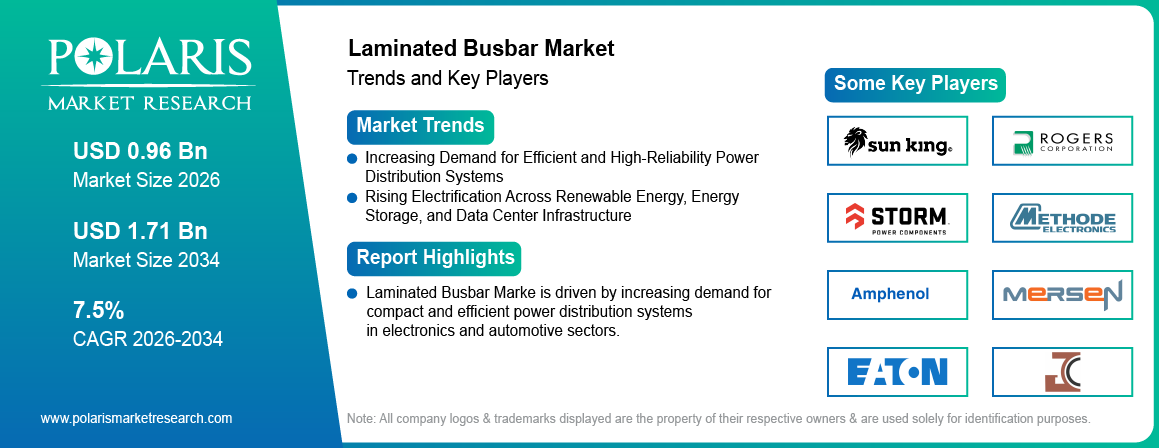
Driver: Increasing Demand for Efficient and High-Reliability Power Distribution Systems
The electricity demand is growing worldwide. This has therefore led to an increased need for efficient power distribution systems. Laminated busbars are used in various applications such as switchgear and distribution boards. They are used to ensure compact and reliable power distribution. The growing focus on renewable energy sources, such as solar and wind power, has driven increased demand for laminated busbars in inverter and power-conversion equipment.
Laminated busbars play an extremely significant role in these applications in terms of their efficiency and compact design. The electrification of the automotive and transportation sector is one of the major factors that is boosting the use of laminated busbars in EVs and hybrid electric vehicles. The laminated busbars are used in the power distribution system of electric and hybrid electric vehicles. The rise in demand for industrial automation and smart manufacturing technologies requires effective, space-saving solutions for power distribution. Laminated busbars are used in control panels and automation, which contributes to the laminated busbar market growth. Efforts to increase energy efficiency across sectors are also driving the market expansion.
In EVs and HEVs, laminated busbars are increasingly used in battery packs, battery management systems, onboard chargers, traction inverters, and DC link assemblies. The laminated busbar provides compactness and better current distribution and thermal performance over the conventional cable-based solution. In industrial laminated busbar applications, their use in drives, converters, motors, and power panels facilitates the simplification of assembly and operations.
Driver: Rising Electrification Across Renewable Energy, Energy Storage, and Data Center Infrastructure
The development of renewable energy sources and energy storage solutions is also driving demand for renewable energy laminated busbars. Solar inverters, wind energy converters, battery banks, and grid-connected storage solutions require space-saving solutions. Laminated busbar for solar inverter offers high current-carrying capacity with low losses. Laminated busbars are being used in these solutions, which saves space and enables clean and organized power distribution.
Another significant driver behind demand for the bus is the expansion of mega-data centers. Growing rack power density, advances in UPS and DC power systems, and the need for dependable IAC power delivery are driving demand for more-compressed electrical interconnects. In such applications, a low-inductance busbar is used to minimize voltage transients and to efficiently distribute power. This is expected to drive long-term demand for laminated busbars in digital infrastructure.
Restraint: Fluctuation in Raw Material Prices
Variations in raw material prices hinder the growth of the laminated busbar industry. The cost of raw material such as copper, aluminum and insulating materials can lead to some uncertainties in the cost of production of laminated busbar. A rise in the cost of materials can have an impact on the profit margin of the laminated busbar producers. For example, the U.S. Geological Survey predicted the COMEX copper price would average USD 4.80 per pound in 2025, up 14% from the 2024 average of USD 4.22 per pound. (Source: pubs.usgs.gov) This is representative of pressure on the prices manufacturers that employ copper conductors.
Restraint: Design Customization and Engineering Complexity
Another significant restraint factor is the engineering complexities involved in custom laminated busbar design. In most of the end-use applications, there are specific requirements for tolerance, insulation, thermal validation, dielectric testing, and mechanical integration. This may result in a time-consuming and costly design process, as well as a barrier for small buyers of standard interconnect products.
Challenge: Competition from Cables and Unorganized Local Suppliers
Traditional cables and conventional busbar configurations continue to compete in cost-driven applications where the performance benefits of laminated busbars are not fully required. Therefore, the lifecycle value must be demonstrated through reduced assembly times, improved reliability, reduced space usage, and improved electrical performance.
Opportunity: Growing Demand for High-Power Data Centers and Power Electronics
The growth of data center and high-power electronic systems presents a huge opportunity for laminated busbar market. Modern data centers need good power distribution designs for servers, storage, cooling, backup power and, increasingly, energy-intensive AI. Laminated busbars for data center help achieve low inductance high current, high power density with enhanced thermal management in power distribution units, uninterruptible power supplies, converters and switchgears. Higher rack power densities are driving both operators and equipment vendors o minimize electrical losses and increase the efficiency of power delivery. Comparable needs are arising in semiconductor equipment, industrial automation, robotics, and high-frequency power conversion. An opportunity exists for manufacturers who design compact, thermally efficient, high-voltage laminated busbars to address increasing power efficiency challenges in both the next generation digital infrastructure and advanced power electronics solutions.
Opportunity in Application-Specific Customization
One of the key opportunities that exists is in the area of application-specific customization. Power systems are becoming more specialized. This has meant that users require laminated busbars that meet specific size, conductor, mounting, insulation, and thermal requirements. It is creating busbar market opportunities for suppliers who can offer customized laminated busbar solutions, rather than competing only on price.
Technology and Innovation Trends
Technological and innovation developments in the laminated busbar market are increasingly being directed towards enhancing power density, thermal performance, compactness, and electrical performance in high-voltage applications. Manufacturers are creating multilayer laminated designs with tailored conductor geometry to reduce inductance, shield electromagnetic interference, and enable higher switching speeds in power electronics. A rise in the usage of silicon carbide and gallium nitride semiconductors is also driving busbar designs towards which can accommodate higher switching frequencies and temperatures. Novel insulation materials, automated lamination techniques and precision bonding methods enhance reliability and realize thinner, lighter package. Innovation is also focused on tailored busbar solutions for electric vehicles, battery energy storage systems, renewable energy equipment, industrial drives and data centres. Sensing, thermal monitoring, and modular design integrated are also improving system intelligence, service ability, and the efficiency of power distribution.
Market Segmentation
The laminated busbar market segmentation is primarily based on conductor, insulation material, application, and region.
By Conductor Insights
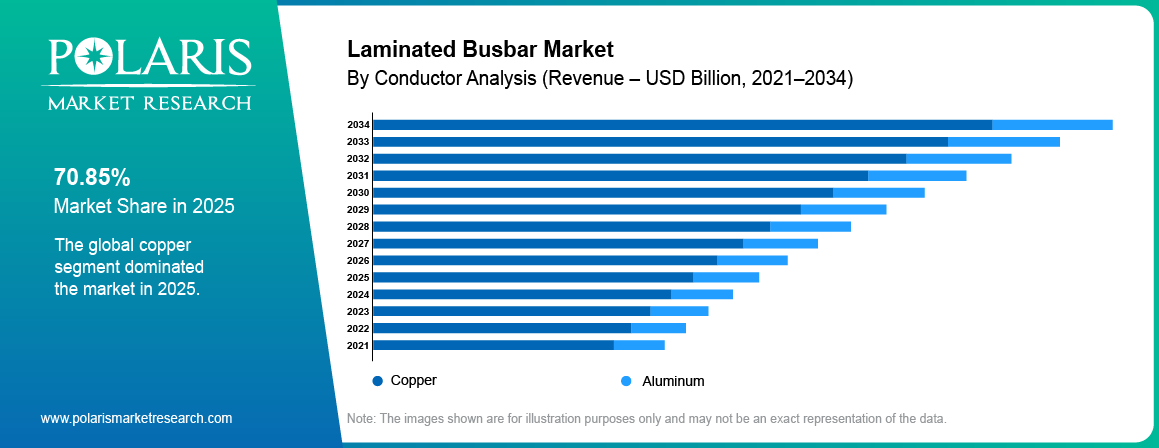
Based on conductor, the laminated busbar market is segmented into copper and aluminium. The copper segment led the market with a 70.85% revenue share in 2025. The high electrical conductivity of copper allows for effective current transfer in laminated busbars for the power distribution and power electronics. Copper also excels in applications requiring heat dissipation and minimization of electrical losses, such as industrial drives, inverters, and energy storage systems. It is widely used in electrical components, which means manufacturers have well-known ways of processing and joining it. These properties have made copper the most common material for such applications, although the weight and cost of copper may cause some designers to consider aluminium where appropriate.
The aluminum segment is projected to witness the significant CAGR of 7.85% during forecast period. Aluminum is gaining popularity in applications where reduced weight, cost savings, and adequate conductivity are significant. However, copper remains essential in high-performance applications where strong conductivity is required, along with adequate capacity for high-load conditions. Therefore, buyers are increasingly comparing copper vs. aluminum laminated busbars on the basis of cost, current requirements, heat performance, design constraints, and reliability.
Copper vs Aluminum vs Copper–Aluminum Hybrid Laminated Busbars
| Parameter | Copper | Aluminum | Cu–Al Hybrid |
| Electrical conductivity | Highest (≈100% IACS) | ≈61% of copper | Aluminum body; copper at contact points |
| Density / weight | 8.96 g/cm³ — heaviest | 2.70 g/cm³ — ≈70% lighter by volume | Intermediate |
| Cross-section for same current | Smallest | ≈1.6× larger | Optimized per zone |
| Thermal conductivity | ≈400 W/m·K | ≈237 W/m·K | Intermediate |
| Material cost | Higher, volatile | Lower | Lower than all-copper |
| Joining / termination | Straightforward | Needs plating or oxide management | Bimetal joint quality is critical |
| Best-fit applications | Traction inverters, SiC modules, compact high-current designs | Large power distribution, renewables, weight-sensitive transport | Hybrid laminated busbar for EV battery pack, BESS, lightweight high-voltage equipment |
Source: Polaris Market Research Analysis
By Insulation Material Insights
Based on insulation material, the market is segmented into polyester film, heat-resistant fiber, epoxy powder coating, polyamide film, epoxy glass, and others. Epoxy powder coating led the laminated busbar market share with 37.35% in 2025. High electrical insulation and mechanical protection facilitate the reliable performance of laminated busbars in harsh conditions. The coating can be used on complex shapes of conductors and forms a tough barrier against moisture and abrasion. It is also compatible with existing manufacturing processes, which allows for repeatable production at scale. This quality makes epoxy powder coated busbar attractive for applications in industrial equipment, switchgear, and power distribution systems, where insulation performance and long-term reliability are critical.
Laminated Busbar Insulation Materials Compared
| Material | Thermal capability | Key strengths | Trade-offs | Typical applications |
| Polyester (PET) film Insulation | Moderate | Low cost, flexible, good dielectric strength | Lower temperature ceiling | Cost-sensitive converters, industrial panels |
| Polyimide film Insulation | Very high | Thin layers, high dielectric strength | Premium price | EV power modules, aerospace, high-temperature inverters |
| Epoxy powder coating | High | Uniform edge coverage, moisture and dust protection | Thicker build, coating process control | Switchgear, industrial drives, power converters |
| Heat-resistant aramid fiber (e.g., Nomex) | Very high | Long-term thermal endurance, mechanical toughness | Higher cost, bulk | Rail traction, heavy-duty and generator systems |
| Epoxy glass laminate | High | Rigid structural support, edge insulation | Weight, machining | Spacers and edge seals in high-voltage stacks |
| PVF film | Moderate–high | Chemical and UV resistance | Niche availability | Outdoor and harsh-environment power systems |
Source: Polaris Market Research Analysis
By Application Insights
Laminated busbar market application is segmented into datacenter, telecom, alternative energy, power electronics and SiC, transportation, aerospace & defense, industrial, and others. The industrial segment is projected to witness the fastest growth, at a 8.75% CAGR. The rising trend of urbanization and infrastructure development across the world is creating opportunities in the electrical sector. Laminated busbars are used in various infrastructure electrical systems, such as buildings and industrial plants. Continuous R&D activities are enhancing the properties of laminated busbars. In addition, innovation in laminated busbar products is also contributing to the segment’s growth by meeting the evolving needs of industries.
The industrial segment is also likely to grow with laminated busbars being used in automation cabinets, motor drives, converters, robotics, process equipment, and factory power systems. Such products demand compactness, good connections, low maintenance, and stable performance with continuous operation. Currently, there is also growing demand for laminated busbars in power electronics, silicon carbide power electronics, telecom power modules, data centers, renewable energy solutions, and EV charging solutions. All of this supports the overall segmental growth.
Application Segment Comparison
| Application (Polaris segment) | Where the busbar sits | Key requirement | Growth signal |
| Industrial | Motor drives, automation cabinets, robotics, process power | Continuous-duty reliability, compact layout | Fastest-growing, 8.75% CAGR |
| Transportation (EV, rail) | Battery packs, traction inverters, onboard chargers, rail propulsion | Low weight, vibration resistance, high current | 8.00% |
| Alternative energy | Solar/wind inverters, BESS power conversion | Low loss, outdoor durability | 7.95% |
| Power electronics and SiC | DC links between capacitors and IGBT/SiC modules | Minimal stray inductance, partial-discharge control | 8.05% |
| Datacenter | UPS, rack power shelves, PDUs | High current density, heat management | 8.02% |
| Telecom | Base-station and network power supplies | Compact, stable DC distribution | 6.15% |
| Aerospace & defense | Aircraft power systems, defense electronics | Lightweight, high-temperature insulation | 6.75% |
Source: Polaris Market Research Analysis
Regional Insights
Asia Pacific
The Asia Pacific laminated busbar market had the largest market share of 40.85% in 2025, with India and China leading in revenue. Ongoing infrastructure development projects in Asia Pacific countries, including China and India, often require advanced, compact electrical distribution solutions. Laminated busbars, due to their space-saving nature, could be in demand for infrastructure development projects. Asia Pacific countries have been actively investing in renewable energy projects as the global market for renewable energy has grown. Laminated busbars are used in various renewable energy applications, such as solar and wind power systems. Applications in electric vehicles and hybrid vehicles for power distribution, along with the growth of the automotive industry in Asia Pacific, may boost demand for laminated busbars.
A robust manufacturing base in electronics, EV parts, industrial equipment, and renewable energy equipment also supports the Asia Pacific. High production capacity, cost benefits, improved infrastructure, and increased levels of electrification make the Asia Pacific an important region for global laminated busbar demand. The rise in requirement for batteries, EV charging, and smart industrial systems is likely to further reinforce the Asia Pacific’s position as a leader in the global laminated busbar demand.
India
The India laminated busbar market size is expected to grow at a CAGR of 8.82% during the forecast period (2026-2034). Demand is supported by the production of electric vehicles, renewable energy projects, and the growth of industrial power systems. Laminated busbars offer tight electrical connections with a small form factor and low inductance, which is the reason they are found in inverters, battery packs and high power devices. Data center growth also enables new opportunities for power distribution and backup power reliability. Manufacturers that can cater to India are expected to experience a demand for models with different current ratings, insulation specifications and space for installation. Sustained electrification investments should enable penetration across transportation, energy and industrial uses.
North America
The North America laminated busbar market is projected to witness the fastest growth, with a 7.75% CAGR. This is because of the growing adoption of laminated busbars in the automotive industry due to their outstanding corrosion resistance and temperature acceptance. North America has diverse manufacturing industries, and laminated busbars find applications in various manufacturing processes. Growth in manufacturing activities could drive demand for laminated busbars. There has been a growing emphasis on energy efficiency and sustainability in North America. Laminated busbars can reduce energy losses and enable energy-efficient power distribution.
With growing industrialization, North America is expected to dominate the market during the forecast period. Rising investments in data centers, grid infrastructure, EV manufacturing, renewable energy projects, and improved industrial electric systems also drive regional growth. As OEMs and utilities focus on improving power efficiency, miniaturization, and reliable electrical systems, laminated busbars are expected to gain traction in transport and stationary applications.
Europe
The demand for laminated busbars in Europe is expected to be high and expected to grow at 5.95% CAGR during forecast period. The Europe laminated busbars market is driven by the region’s industrial electrification needs, rail modernization activities, renewable power systems, and the need for efficiency. The emphasis on high-performance systems, customization, and production for compliance in the region is expected to fuel the laminated busbars market in the region.
Latin America and Middle East & Africa
The Latin America laminated busbar market is projected to grow at a 6.35% CAGR, while the Middle East & Africa market is projected to grow at a 6.55% CAGR during 2026–2034, offering emerging opportunities in both regions. Industrial growth, electrical upgrades, electrification of commercial establishments, and renewable energy help sustain these regional markets. Although these regions account for a relatively small share of global demand, increased infrastructure investments and electrical system upgrades are expected to create growth opportunities for laminated busbar suppliers.
Laminated Busbar Use Cases and Real-World Examples
| Company | Use case | Benefit |
| Rogers Corporation | ROLINX laminated busbars in DC-link and power-distribution circuits of high-power EV charging stations | Lower inductance and losses, higher power density |
| Rogers Corporation | ROLINX Performance busbars for rail/ship propulsion and industrial converters — up to 12 kV DC and several MW; ROLINX Thermal rated to 130°C | High-voltage capability with partial-discharge control |
| Mersen | Laminated busbars interconnecting IGBT/SiC/GaN modules and capacitors in photovoltaic inverters | Low-inductance integration of multiple power components |
| Mersen / Automotive Cells Company (ACC) | Smart laminated busbars for next-generation EV batteries of ACC (Stellantis, TotalEnergies/Saft, Mercedes-Benz JV) | Integrated sensing in battery interconnects |
| Storm Power Components | High-current laminated busbars for data centers carrying hundreds of amps per rack | Efficient, reliable high-density power distribution |
| Molex | Liquid-cooled busbar for high-power AI data center racks | Thermal headroom at rising rack power |
Source: Polaris Market Research Analysis

Competitive Landscape
The laminated busbar market competition is intense. The established laminated busbar companies are using advanced technology, quality products, and brand reputation to generate business growth. Laminated busbar manufacturers are implementing various business strategies, such as R&D activities, acquisitions, and busbar product innovations, to enhance their product offerings and sustain the competition in the laminated busbar industry.
Competition in the laminated busbar market is being fueled by elements such as custom busbar manufacturing, insulation expertise, precise manufacturing, reliable supplies, and application-centric engineering support. Companies that have the capabilities to serve EV platforms, renewable energy solutions, industrial automation, and high-density power electronics with efficient and thermally optimized busbar solutions have greater opportunities to achieve a competitive advantage. Further, strategic acquisitions within the wider electrical infrastructure space could help improve capabilities within segments such as data centers, charging, and modular power distribution.
Mersen is a global provider of electrical power solutions. The company offers custom laminated busbars for applications in the fields of energy, transportation, and power electronics. The company specializes in high-performance, low-inductance solutions. Mersen has significant engineering and manufacturing expertise.
Ryoden Kasei Co., Ltd. is a Japan-based manufacturer specializing in insulating materials and laminated busbars. The company provides reliable and application-specific solutions. It is supported by its expertise in materials and precision manufacturing.
How OEM Buyers Evaluate Laminated Busbar Suppliers
OEM buyers choose laminated busbar suppliers using a mix of technical ability, manufacturing quality, customization expertise, delivery reliability, and cost competitiveness. Major evaluation points are the supplier’s technical ability to design low-inductance, compact, and thermally efficient busbars for specific voltage, current, insulation, and packaging requirements. Buyers also evaluate material quality, dielectric performance, dimensional tolerances, bonding consistency, and compliance with applicable automotive, industrial, and electrical standards. Proven experience in applications (e.g., electric vehicles, battery systems, inverters, renewable energy equipment, data centers) is often a key selection criterion. OEMs generally favor suppliers with strong engineering support, quick prototyping capabilities, simulation expertise, and the flexibility to get involved early in product development. Manufacturing scalability, automation, traceability, quality certifications, and supply-chain resilience are also factors in sourcing decisions. Furthermore, buyers consider lead times, tooling costs, lifecycle support, and the supplier’s ability to ensure consistent performance in high-volume production programs.
How is Laminated Busbar Design Changing by Manufacturer?
Manufacturers are increasingly focusing their efforts on the conductor's structure, insulation, and layering. This is to achieve a proper balance between conductivity, insulation, heat dissipation, and miniaturization. It is especially important as there is a general trend in power electronics toward higher switching speeds, higher current density, and the miniaturization of devices in the transport, industrial, and energy sectors.
List of Key Companies
- Amphenol Corporation
- Jans Copper (P) Ltd
- Mersen
- Methode Electronics, Inc.
- Rogers Corporation
- Ryoden Kasei Co., Ltd.
- Storm Power Components
- Eaton Corporation plc
- Sun.King Technology Group Limited
- Molex, LLC
- Raychem RPG Private Limited
- EAE Elektrik A.Ş.
- Shanghai Eagtop Electronic Technology Co., Ltd.
- Segue Electronics, Inc.
- Zhejiang RHI Electric Co., Ltd.
- Zhuzhou CRRC Times Electric
Vendor Positioning
| Company | HQ | Core application focus | Market positioning / competitive angle |
| Mersen | France | EV batteries, PV inverters, rail, power electronics | Closest to a dedicated laminated busbar specialist in the set. Full design-to-assembly offer, including smart-monitoring laminated busbars for EV and stationary battery packs, powder-coated busbars and value-add assemblies. Broad global engineering and manufacturing footprint. |
| Rogers Corporation | US | EV/HEV, charging, wind/solar, propulsion, UPS, telecom | Materials-science-led player (ROLINX laminated busbars). Strength in low-inductance, high-power designs for xEV drivetrains, charging and renewable inverters, with deep OEM design-in relationships. |
| Amphenol Corporation | US | Power conversion, renewables, storage, data centers | Scale and interconnect breadth allow busbars to be bundled with connectors and power-distribution systems. Well placed in data-center, storage and renewable power-conversion programs. |
| Methode Electronics, Inc. | US | Aerospace, industrial power conversion, telecom, transportation | Long-standing laminated busbar heritage within its power-solutions portfolio. Diversified across aerospace, industrial, telecom and transportation rather than tied to a single end market. |
| Eaton Corporation plc | Dublin, Ireland | Power distribution, data centers, industrial, e-mobility | Electrical power-management major; busbar and interconnect offer sits alongside a much larger portfolio. Leverages existing industrial, data-center and e-mobility customer relationships. Laminated busbars are one product line, not the core. |
| Molex, LLC | Lisle, US | Automotive/EV, data centers, industrial | Global interconnect major positioning power interconnects and busbars alongside connectors and cable assemblies. Laminated busbar is adjacent rather than core; strength is platform-level bundling. |
| Sun.King Technology Group Limited | China | HVDC, rail, industrial, data centers | High-power segment champion in China. Strong in rail traction and HVDC/grid applications requiring high-voltage, high-current laminated designs; benefits from domestic rail and grid build-out. |
| Shanghai Eagtop Electronic Technology Co., Ltd. | Shanghai, China | Industrial drives, new energy, rail, power quality | Passive power-electronics specialist (founded 1998) supplying film capacitors, laminated busbars, liquid-cooling plates and reactors. Can offer bundled capacitor-busbar assemblies to drive and converter makers. |
| Zhejiang RHI Electric Co., Ltd. | Zhejiang, China | New energy, rail, industrial power electronics | China-based laminated busbar manufacturer named in third-party market coverage of the segment. Likely cost-competitive domestic supplier; limited public detail on scale and customers. |
| Ryoden Kasei Co., Ltd. | Japan | Industrial, power electronics | Japan-based supplier with a laminated busbar line listed on its website. Strength lies in the Japanese industrial and power-electronics supply chain rather than global reach. |
| Storm Power Components | US | Data centers, power electronics | Engineering-led, smaller-scale US supplier focused on data-center and power-electronics customers. Competes on customization and responsiveness rather than volume. |
| Raychem RPG Private Limited | India | Power and industrial interconnects; EV, rail, renewables (indicative) | India-based (RPG Group) player positioned to serve domestic EV, rail and renewable build-out with local manufacturing. Also named in third-party coverage of the segment. |
| EAE Elektrik A.Ş. | Istanbul, Turkey | Busbar trunking; buildings, factories, data centers, EV charging | Founded 1973; core strength is busbar trunking energy-distribution systems rather than laminated busbars. Best viewed as an adjacent player with potential crossover into laminated designs. |
| Jans Copper (P) Ltd | Daman, India | Copper busbars, flexible busbars, busbar assemblies; industrial | Copper-conversion specialist offering laminated copper busbars to customer specification alongside flexible busbars and assemblies. Small-scale, price-competitive regional supplier. |
| Segue Electronics, Inc. | Not confirmed | Not confirmed | Limited verifiable public information. Treat as niche/emerging until validated through primary research or company disclosures. |
| Zhuzhou CRRC Times Electric | China | Rail and transportation | Rail-electronics leader with largely captive demand (traction converters and power modules). Busbars mainly serve its own systems. |
Source: Polaris Market Research Analysis
Recent Developments
- July 2025: Eaton announced the acquisition of Resilient Power Systems Inc. The company stated that the acquisition will help expand the market for Resilient’s medium voltage solid-state transformers to data centers and other customers. (Source: eaton.com)
- March 2025: Eaton signed a USD 1.4 billion agreement to acquire Fibrebond Corporation. The move is expected to strengthen its position in modular power enclosures for multi-tenant data centers. (Source: eaton.com)
Future Outlook
The future laminated busbar market CAGR is expected to be driven by rapid electrification across automotive, industrial, and energy sectors. Also, the rising global EV production and charging infrastructure development would boost the growth. Expanding renewable energy installations and energy storage systems would accelerate demand for compact and high-efficiency power distribution solutions. Advancements in lightweight conductive materials and improved thermal management technologies will also propel the adoption of laminated busbar. Enhanced insulation systems would improve product performance and reliability. In addition, there is an increasing integration of smart power electronics and high-voltage architectures. This will strengthen the role of laminated busbars in electric mobility, next-generation industrial automation, and renewable energy applications worldwide.
Research Methodology
The laminated busbar market solution offers you detailed insight and thorough analysis of the market size, market trends and market competitive dynamics, market growth, new market and future opportunities by utilizing market best selling solutions. Secondary research accounted for information from annual reports of companies, investor presentations, product manuals, government websites, industry association reports, technical journals, regulatory publications and other trusted industry sources. This will outline the development of the industry in terms of the leading manufacturers, product classifications, applications, insulating materials, conductor technologies, producing abilities, and key applications such as electric vehicle and renewable energy system, industrial power electronics, data center and energy storage system.
Primary interviews were conducted with laminated busbar manufacturers, raw material suppliers, distributors, system integrators, automotive OEMs, electrical equipment firms, and industry experts. These exchanges confirm secondary research findings and gain insight into pricing, purchasing tendencies, product specifications, technology adoption rates, supply condition, and regional demand trends. Using both top-down and bottom-up approaches, the market size is estimated.
Bottom‐up This strategy focuses on evaluating the entire revenues of the best manufacturers and analyzing the demand within the key applications while the top‐down analysis assesses the overall power electronics market and electrification market and splits them down into relevant scales for the laminated busbar market. Data triangulation is employed for estimating values from various sources to get more accurate estimations.
The forecasts take account of historical market growth, production of electric vehicles, installation of renewable energy, automation in industry, expansion of data centre, changes in regulations, emergence of new technologies, condition of supply chains, investment trends. Final market estimates are reviewed for internal consistency and validated using expert opinion to ensure that the estimates are consistent across conductor, insulation material, application, and region.
Market Segmentation
By Conductor Insights (Revenue, USD Billion, 2021–2034)
- Copper
- Aluminum
By Insulation Material Insights (Revenue, USD Billion, 2021–2034)
- Polyester Film
- Heat-resistant Fiber
- Epoxy Powder Coating
- Polyamide Film
- Epoxy Glass
- Others
By Application Insights (Revenue, USD Billion, 2021–2034)
- Datacenter
- Telecom
- Alternative Energy
- Power Electronics and SiC
- Transportation
- Aerospace & Defense
- Industrial
- Others
By Regional Outlook (Revenue, USD Billion, 2021–2034)
- North America
- U.S.
- Canada
- Europe
- Germany
- France
- UK
- Italy
- Spain
- Netherlands
- Russia
- Rest of Europe
- Asia Pacific
- China
- Japan
- India
- Malaysia
- South Korea
- Indonesia
- Australia
- Vietnam
- Rest of Asia Pacific
- Middle East & Africa
- Saudi Arabia
- UAE
- Israel
- South Africa
- Rest of Middle East & Africa
- Latin America
- Mexico
- Brazil
- Argentina
- Rest of Latin America
Laminated Busbar Market Report Scope
| Report Attributes | Details |
| Market Size in 2025 | USD 0.89 billion |
| Market Size in 2026 | USD 0.96 billion |
| Revenue Forecast by 2034 | USD 1.71 billion |
| CAGR | 7.5% |
| Base Year | 2025 |
| Historical Data | 2021–2024 |
| Forecast Period | 2026–2034 |
| Quantitative Units | Revenue in USD Billion, and CAGR from 2026 to 2034 |
| Report Coverage | Revenue Forecast, Market Competitive Landscape, Growth Factors, and Trends |
| Segments Covered |
|
| Regional Scope |
|
| Competitive Landscape | Laminated Busbar Industry Trend Analysis (2025) Company profiles/industry participants profiling include company overview, financial information, product/service benchmarking, and recent developments |
| Report Format | PDF + Excel |
| Customization | Report customization as per your requirements with respect to countries, regions, and segmentation. |
Source: Polaris Market Research Analysis
Report Coverage
The laminated busbar market report focuses on key regions worldwide to provide users with a better understanding of the product. Also, the report provides market insights into recent developments and trends, and analyzes the technologies gaining traction worldwide. Furthermore, the report provides in-depth qualitative analysis of the various paradigm shifts associated with the transformation of these solutions.
The report provides a detailed analysis of the market, focusing on key aspects such as competitive analysis, conductors, insulation materials, applications, and future growth opportunities.
Laminated Busbar Market FAQ's
The laminated busbar market size stood at USD 0.96 billion in 2026. The market is projected to reach USD 1.71 billion by 2034.
The market is projected to grow at a CAGR of 7.5% between 2026 and 2034.
A laminated busbar is an electrical conductor in which multiple sheets of copper or aluminum are laminated with insulating materials. Laminated busbars are used for efficient power transmission in compact devices such as EV battery packs, inverters, switchgear, industrial drive systems, and renewable power systems.
The market is driven by the growing demand for compact and high-current power distribution systems in EVs and renewable energy systems.
Laminated busbars can minimize space requirements, thermal performance, assembly and inductance. They also offer more predictable electric behavior than traditional cable assemblies in high-power systems.
The two most commonly used materials for conductors are copper and aluminum. Copper is preferred for its high conductivity and space-saving features. Aluminum is used for its weight-saving and cost-effective features.
The major end-use industries that make use of laminated busbars are the automotive industry, industrial automation, power electronics, and renewable energy. The laminated busbars are also used in the telecom industry, aerospace and defense industry, data center industry, and the transportation industry.
Laminated busbars are used in EV components such as battery packs and battery management systems. Their use helps improve current flow and packaging efficiency.
Common insulation materials used in laminated busbars include epoxy powder coated busbar, polyester film, heat-resistant fiber, epoxy glass, and polyamide or polyimide films.
Raw material pricing volatility, especially copper and aluminum, is a key restraint. In addition, customization may increase the cost of development and manufacturing.
Laminated busbars stack the positive and negative conductors in parallel, separated only by a thin dielectric layer. Opposite current flows create magnetic fields that largely cancel, cutting stray inductance and voltage overshoot when IGBT or SiC switches turn off, which improves efficiency and protects semiconductors.
Download Sample Report of Laminated Busbar Market
Please fill out the form to request a customized copy of the research report.


