
3D Ultrasound Market Size, Share, Trends and Forecast, 2026-2034
REPORT DETAILS
3D Ultrasound Market Overview and Key Insights
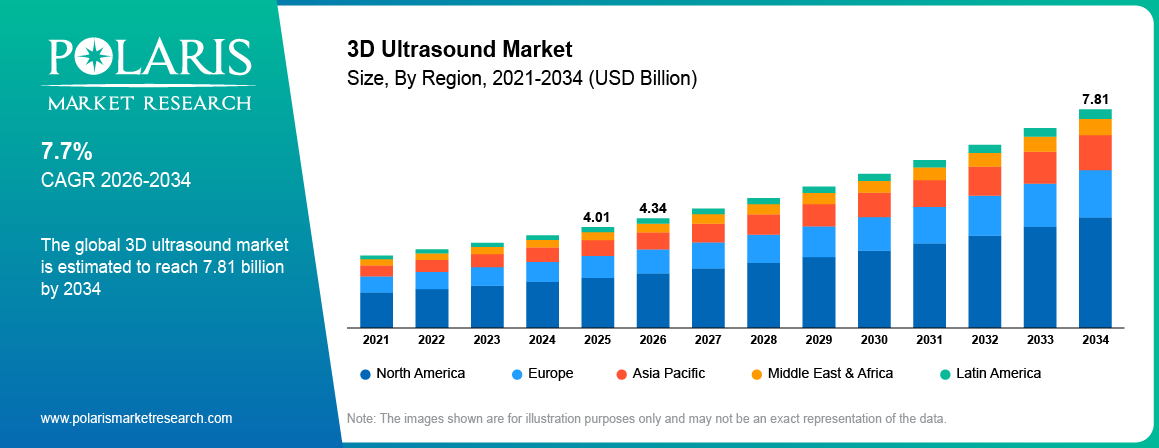
The global 3D ultrasound market size was valued at USD 4.01 billion in 2025. The market is projected to grow at a CAGR of 7.70% from 2026 to 2034. The rising prevalence of chronic conditions and the shift towards non-invasive diagnostics are a few of the key factors driving market demand.
Market Statistics
3D Ultrasound Market Key Takeaways
- North America led the global market with a 41.1% market share in 2025. The presence of an advanced healthcare infrastructure and high healthcare spending contribute to the regional market dominance.
- Asia Pacific is projected to witness the fastest growth at a 8.9% CAGR. Improved healthcare infrastructure and high accessibility to advanced medical technologies drive the regional market growth.
- The cart/trolley segment dominated with a 46.9% market share in 2025. The superior versatility and functionality of these systems contribute to their market dominance.
- The general imaging segment is projected to register the highest CAGR of 7.9%. This is owing to the increasing market demand for non-invasive diagnostic solutions.
- The hospitals segment accounted for the largest market share of 55.1%. High patient footfall and continuous availability of advanced imaging systems have led to the segment's dominance.
Note: Figures and projections outlined in this report are the result of Polaris Market Research’s proprietary analytical processes, grounded in the latest available datasets and market observations.
3D Ultrasound Market Dynamics
- Technological advancements such as AI-powered features and improved cameras are driving market demand.
- Expanding healthcare infrastructure in emerging markets is another factor fueling market expansion.
- The rising use of 3D technology in specialty medicine applications is expected to present several market opportunities.
- Strict technical skill requirements may present market challenges.
Impact of Artificial Intelligence on the 3D Ultrasound Market
- AI is useful in enhancing the quality of 3D ultrasound images, thus improving their clarity.
- AI speeds up diagnosis by enabling healthcare professionals to identify abnormalities in a shorter time.
- With the help of AI, automatic measurement and analysis of the images are enabled, thus minimizing labor.
- AI enhances patient care through accurate and personalized medical assessment.
3D ultrasound is a medical imaging technique that generates three-dimensional images by combining several two-dimensional ultrasound scans taken from different angles. This method improves the visualization of anatomical structures, making it particularly valuable in fields such as obstetrics and cardiology. In these areas, detailed images of the fetus or heart can assist in diagnosis and treatment planning.
The 3D ultrasound market growth is driven by advancements in imaging technology that provide more detailed views and accurate diagnostics. Factors such as the expansion of healthcare facilities and the increasing importance of diagnostic procedures in patient care are significantly driving the demand for high-quality imaging tools. Innovations in 3D ultrasound, such as AI-enhanced features, are further helping operators to reduce dependency and improve workflow efficiency. Additionally, regulatory approvals and new product launches are boosting the global adoption of 3D ultrasound systems. For instance, in September 2024, PIUR IMAGING received approval for the implementation of 3D ultrasound technology, PIUR tUS Infinity, across the healthcare sector. According to PIUR IMAGING, the approval will allow the company to introduce its advanced ultrasound technology to the US healthcare market for thyroid imaging.
2D vs. 3D vs. 4D Ultrasound: Differences and Clinical Uses
| Criteria | 2D Ultrasound | 3D Ultrasound | 4D Ultrasound |
| Type of Image | Flat image | 3-Dimensional image | 3-Dimensional moving images in real time |
| Visualizing | Structural information | Volumetric information | Live motion visualization |
| Amount of Diagnostic Information | Moderate | High | Very High |
| Motion in Real Time | Limited | Limited | Yes |
| Usage | Standard scanning | Complex scanning of fetus and organs | Fetus movement monitoring |
Source: Polaris Market Research Analysis
Source: Polaris Market Research Analysis
To Understand More About this Research: Download Sample Report
3D Ultrasound Market Drivers, Opportunities and Challenges
Advancements in 3D Ultrasound Imaging Technology
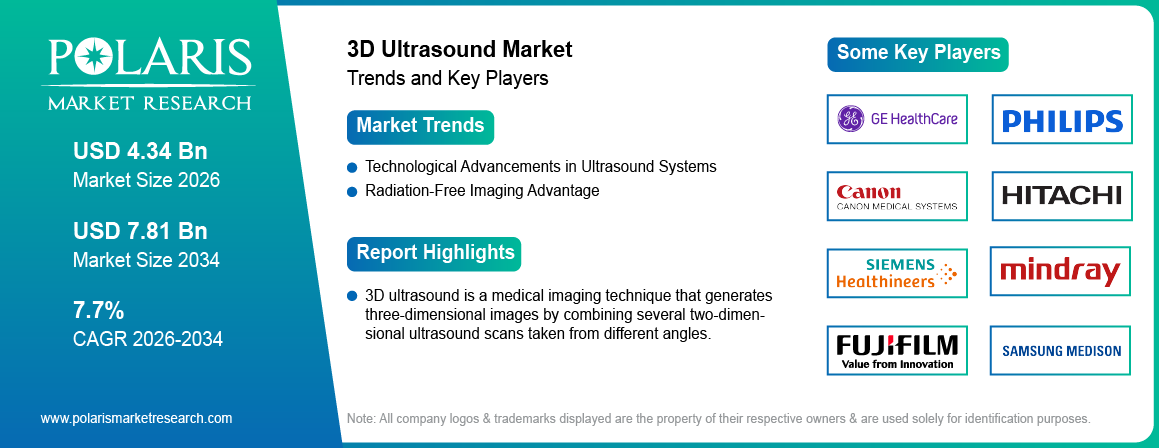
Technological advancements such as improved cameras and AI-powered features are driving the 3D ultrasound market expansion by enabling superior imaging quality, real-time capabilities, and enhanced diagnostic accuracy. Innovations such as AI integration, enhanced resolution, and better 3D image rendering are allowing healthcare providers to make more precise and faster diagnoses, particularly in obstetrics and cardiology. Additionally, these advancements improve workflow efficiency, reduce repetitive tasks for clinicians, and make ultrasound procedures more accessible and reliable. For instance, in February 2024, GE HealthCare launched the LOGIQ ultrasound portfolio, featuring the new LOGIQ Totus system. This portfolio integrates advanced AI tools to enhance imaging workflows, support diagnostic accuracy, and streamline healthcare operations with digital reporting and management tools. Moreover, as ultrasound systems become more compact and user-friendly, their adoption in diverse clinical settings is expanding, further propelling the growth of the market.
Healthcare Infrastructure Expansion and Diagnostic Imaging Investment
Emerging markets, especially in Asia and Latin America, are investing heavily in healthcare facilities and advanced imaging technology to improve patient care and meet rising healthcare demand. As healthcare systems in these regions expand, the market demand for high-resolution, real-time diagnostic tools, such as 3D ultrasound systems, continues to grow. For instance, in October 2024, Smith+Nephew and JointVue partnered for its patented OrthoSonic 3D Surgery Planning Technology, the only ultrasound device currently on the market to deliver 3D preoperative planning in robotics-assisted surgery. Additionally, increased healthcare budgets globally allow facilities to acquire advanced imaging devices to support accurate diagnoses and improved patient outcomes across clinical applications. Thus, the expansion of healthcare infrastructure and increased investments in diagnostic imaging services are driving the 3D ultrasound market development.
Radiation-free and Non-invasive 3D Ultrasound Imaging
Non-ionization is one of the key strengths of 3D ultrasound imaging. This technique differentiates itself from other imaging techniques like computed tomography scans and X-ray scans because ultrasound imaging does not emit radiation during the process. The use of ultrasound is based on sound waves to produce internal images. It is a much safer modality compared to other imaging procedures because of the absence of radiation, which reduces any risks of harm in pregnant mothers and those requiring multiple diagnostic tests. In addition, ultrasound technology has excellent resolution for soft tissues, which makes it applicable in various fields such as cardiology, gynecology, abdominal scanning, and musculoskeletal examinations.
Source: Polaris Market Research Analysis
3D Ultrasound Market Segment Analysis
3D Ultrasound Market, by Product
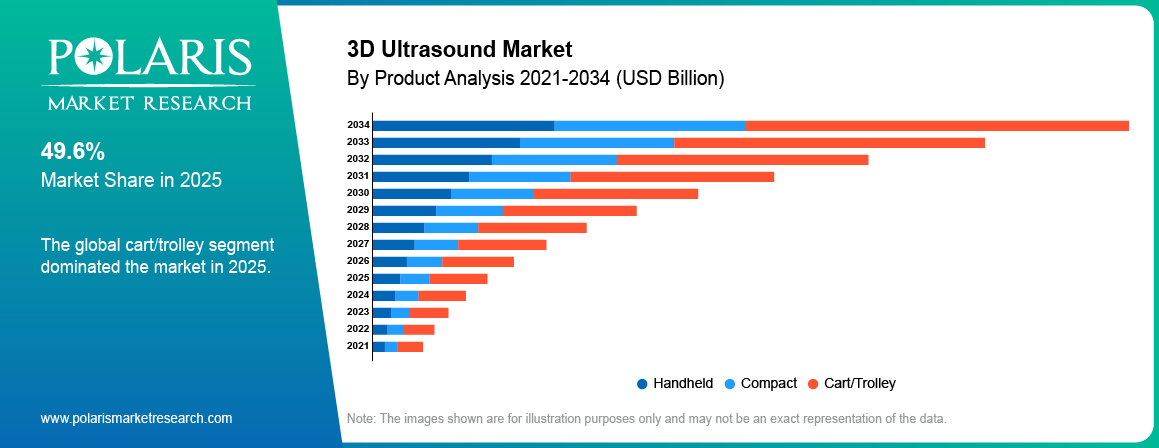
The global 3D ultrasound market, based on product, is segmented into handheld, compact, and cart/trolley. In 2025, the cart/trolley ultrasound systems dominated the market with 49.6% share due to their superior versatility, functionality, and widespread adoption in hospitals and healthcare centers. These systems offer improved performance, high-end imaging quality, and robust features, making them ideal for detailed diagnostic procedures. The demand is driven by their ability to support complex imaging techniques required in various clinical applications, such as obstetrics and gynecology. Additionally, their mobility and ability to accommodate larger, more advanced imaging equipment make them the preferred choices for healthcare facilities aiming for efficiency and high-quality diagnostics.
3D Ultrasound Market, by Application
The global 3D ultrasound market, based on application, is segmented into general imaging, cardiology, obstetrics and gynecology, urology, and others. The general imaging segment is expected to register the highest CAGR of 7.9% from 2026 to 2034 due to the increasing market demand for non-invasive, accurate diagnostic solutions across a range of medical specialties. Advancements in 3D ultrasound technology enable better visualization of internal structures, making it ideal for routine diagnostic imaging in areas such as abdominal, musculoskeletal, and soft tissue imaging. The growing focus on early disease detection and rising healthcare access, especially in emerging markets, also contribute to the segment’s rapid growth. Additionally, the integration of AI tools and automated features in general imaging ultrasound systems is enhancing diagnostic efficiency, driving the segment’s expansion in the market.
Source: Polaris Market Research Analysis
3D Ultrasound Market Regional Analysis
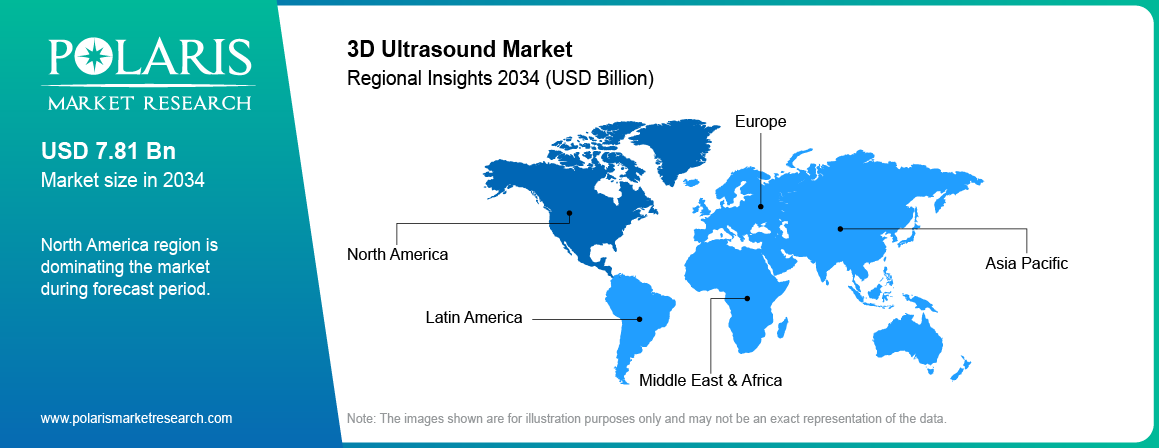
By region, the study provides 3D ultrasound market insights into North America, Europe, Asia Pacific, Latin America, and the Middle East & Africa. North America dominated the global market in 2025 with 41.1% share due to the region's advanced healthcare infrastructure, high healthcare spending, and early adoption of innovative medical technologies. The US and Canada are at the forefront of integrating 3D ultrasound systems in hospitals, diagnostic centers, and research institutions, benefiting from a strong regulatory framework and investment in healthcare technologies. Additionally, the increasing prevalence of chronic diseases and the demand for non-invasive diagnostic procedures drive the adoption of 3D ultrasound systems. For instance, in 2024, the US Department of Health and Human Services reported that approximately 129 million individuals in the United States are affected by at least one significant chronic condition, such as heart disease, cancer, diabetes, obesity, and hypertension. These factors, combined with a well-established market for diagnostic imaging, support the dominant position of North America in the 3D ultrasound market.
The Asia Pacific 3D ultrasound market is expected to register the highest CAGR of 8.9% during the forecast period, driven by improved healthcare infrastructure and greater accessibility to advanced medical technologies. Technological innovations, such as portable ultrasound devices, are making diagnostic tools more accessible, especially in rural and underserved areas. For instance, in February 2023, Mindray, a Chinese manufacturer of medical devices, introduced the TE Air, a wireless handheld ultrasound system designed to address the increasing demand from healthcare professionals for advanced portable ultrasound technology. The device is engineered to provide high-definition point-of-care ultrasound (POCUS) imaging, ensuring precision and ease of use for practitioners in diverse clinical environments. Additionally, the aging population in Asia Pacific is driving the demand for effective diagnostic solutions to manage age-related health conditions. These factors, combined with improved healthcare awareness and increased investments in medical technologies, are propelling the regional market demand.
Source: Polaris Market Research Analysis
3D Ultrasound Market Competitive Landscape
The 3D ultrasound market is highly competitive, with key players including GE Healthcare, Philips Healthcare, Siemens Healthineers, and Toshiba Medical Systems, among others. These companies dominate through continuous innovation, offering advanced imaging systems with enhanced resolution, real-time capabilities, and ease of use. Strategic partnerships and collaborations, such as Smith+Nephew’s partnership with JointVue for OrthoSonic 3D Surgery Planning Technology, further drive market growth. Additionally, regional players in emerging markets, particularly in Asia and Latin America, are making significant strides by investing in affordable, high-quality 3D ultrasound solutions to meet the rising demand for improved diagnostics. The market is characterized by a focus on expanding product portfolios, enhancing technological features, and addressing diverse clinical needs, creating a dynamic and evolving competitive environment.
A few key major players are GE HealthCare; Koninklijke Philips N.V.; Canon Medical Systems Corporation; Hitachi, Ltd.; Siemens Healthineers AG; Shenzhen Mindray Bio-Medical Electronics Co., Ltd.; FUJIFILM Corporation; Samsung Medison Co., Ltd.; Analogic Corporation; Barco.
Koninklijke Philips N.V., commonly recognized as Philips, is a company that operates in various industries, including healthcare technology, consumer electronics, and lighting. Philips provides medical equipment, software, and services in healthcare, including imaging systems, patient monitoring systems, and clinical informatics solutions. Philips offers a range of mammography solutions, including digital mammography systems, breast tomosynthesis systems, and computer-aided detection (CAD) systems. These technologies are designed to provide high-quality images of breast tissue and help clinicians detect breast cancer at an early stage. In addition to mammography solutions, Philips provides a range of other medical imaging and diagnostic solutions, including ultrasound systems, MRI scanners, CT scanners, and nuclear medicine systems. Philips operates in more than 100 countries worldwide.
GE Healthcare is a healthcare technology company offering various medical devices and technologies, such as magnetic resonance imaging (MRI) machines, computed tomography (CT) scanners, ultrasound machines, X-ray systems, and patient monitoring systems. The company also offers a variety of software solutions and services to help healthcare providers manage and analyze patient data. GE Healthcare’s life care solutions provide a range of products and solutions for patient monitoring, including telemetry systems, fetal monitoring systems, and patient monitors. These systems include advanced features such as wireless connectivity, real-time data visualization, and remote monitoring capabilities. Also, the company provides a range of interventional imaging solutions, including angiography systems, fluoroscopy systems, and interventional ultrasound systems. GE Healthcare’s major focus is on precision health, digital healthcare, and global healthcare access. The company operates in over 160 countries worldwide.
Leading 3D Ultrasound Companies and Product Portfolios
- GE HealthCare. GE
- Koninklijke Philips N.V.,
- Canon Medical Systems Corporation
- Hitachi, Ltd.
- Siemens Healthineers AG
- Shenzhen Mindray Bio-Medical Electronics Co., Ltd.
- FUJIFILM Corporation
- Samsung Medison Co., Ltd.
- Analogic Corporation
- Barco
3D Ultrasound Market Recent Developments
February 2026: GE HealthCare unveiled its latest series of LOGIQ ultrasound machines. According to the company, the latest series of ultrasound machines is equipped with improved AI-enabled automation and imaging technology. They are projected to provide better day-to-day performance and insightful clinical intelligence. (source: gehealthcare.com)
February 2026: GE HealthCare announced a new $35 million expansion of its prior deal with the Biomedical Advanced Research and Development Authority (BARDA). GE HealthCare stated that the expansion will enable the advancement of AI-enabled ultrasound for emergency and trauma preparation. (source: gehealthcare.com)
3D Ultrasound Market Segmentation and Forecast
By Product Outlook (Revenue – USD Billion, 2021–2034)
- Handheld
- Compact
- Cart/Trolley
By Application Outlook (Revenue – USD Billion, 2021–2034)
- General Imaging
- Cardiology
- Obstetrics and Gynecology
- Urology
- Others
By End Use Outlook (Revenue – USD Billion, 2021–2034)
- Hospitals
- Diagnostic Imaging Centers
- Others
By Regional Outlook (Revenue – USD Billion, 2021–2034)
- North America
- US
- Canada
- Europe
- Germany
- France
- UK
- Italy
- Spain
- Netherlands
- Russia
- Rest of Europe
- Asia Pacific
- China
- Japan
- India
- Malaysia
- South Korea
- Indonesia
- Australia
- Vietnam
- Rest of Asia Pacific
- Middle East & Africa
- Saudi Arabia
- UAE
- Israel
- South Africa
- Rest of Middle East & Africa
- Latin America
- Mexico
- Brazil
- Argentina
- Rest of Latin America
3D Ultrasound Market Report Scope and Methodology
| Report Attributes | Details |
| Market Size Value in 2025 | USD 4.01 billion |
| Market Size Value in 2026 | USD 4.34 billion |
| Revenue Forecast by 2034 | USD 7.81 billion |
| CAGR | 7.7% from 2026 to 2034 |
| Base Year | 2025 |
| Historical Data | 2021–2024 |
| Forecast Period | 2026–2034 |
| Quantitative Units | Revenue in USD billion and CAGR from 2026 to 2034 |
| Report Coverage | Revenue Forecast, Market Competitive Landscape, Growth Factors, and Trends |
| Segments Covered |
|
| Regional Scope |
|
| Competitive Landscape |
|
| Report Format |
|
| Customization | Report customization as per your requirements with respect to countries, regions, and segmentation. |
Source: Polaris Market Research Analysis
3D Ultrasound Market Frequently Asked Questions
The global market was valued at USD 4.01 billion in 2025 and is projected to grow to USD 8.78 billion by 2034
The global market is projected to register a CAGR of 7.7% from 2026 to 2034
North America dominated the market for 3D ultrasound in 2025 with 41.1% share.
A few of the key players in the market are GE HealthCare; Koninklijke Philips N.V.; Canon Medical Systems Corporation; Hitachi, Ltd.; Siemens Healthineers AG; Shenzhen Mindray Bio-Medical Electronics Co., Ltd.; FUJIFILM Corporation; Samsung Medison Co., Ltd.; Analogic Corporation; and Barco.
The cart/trolley segment dominated the 3D ultrasound market in 2025 with 46.9% share.
The general imaging segment is anticipated to register the highest CAGR of 7.9% during the forecast period.
Download Sample Report of 3d ultrasound market
Please fill out the form to request a customized copy of the research report.


