
AI-optimization for Quantum Computing Market Growth Opportunity, 2025-2034
REPORT DETAILS
AI-optimization for Quantum Computing Market Summary
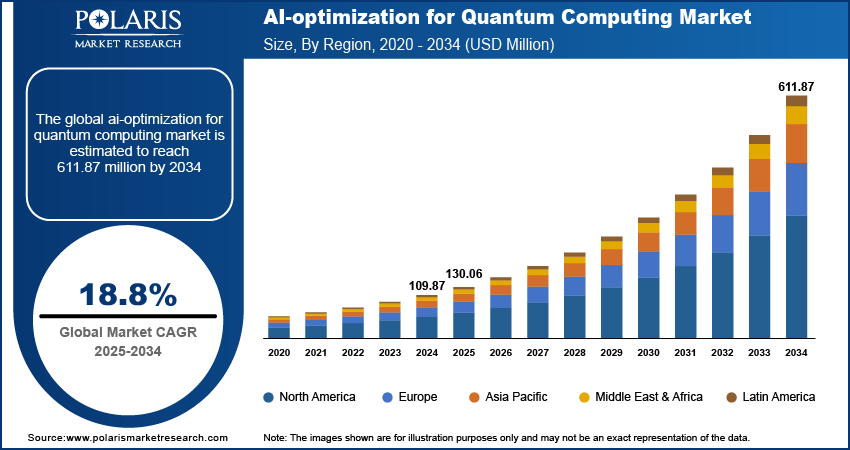
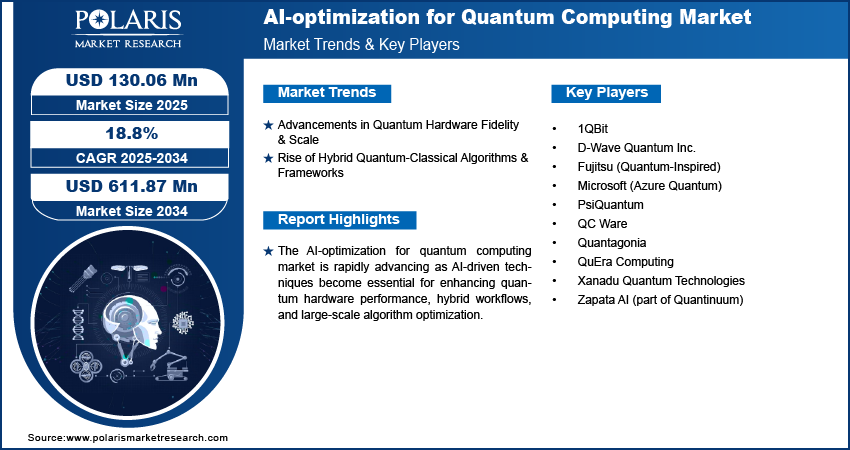
The global AI-optimization for quantum computing market size was valued at USD 109.80 million in 2024, growing at a CAGR of 18.8% from 2025–2034. Key factors driving demand for this market include commercial availability of quantum cloud services & quantum-inspired solutions, strategic investment and government funding, advancements in the fidelity and scale of quantum hardware, and increasing adoption of hybrid quantum classical co-simulation?algorithms and frameworks.
Market Statistics
Key Takeaways
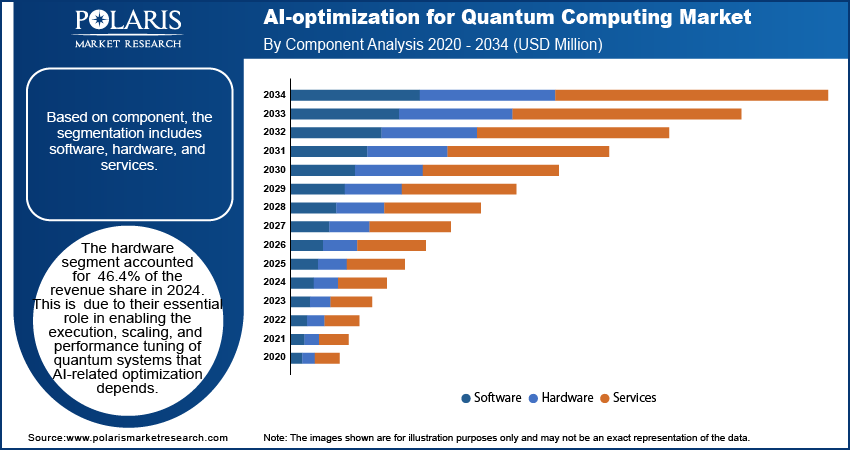
- The hardware segment contributed nearly 46.4% in 2024 in the revenue share. This is because they are vital components in which the execution, scaling, and performance tuning of quantum systems (on which AI-related optimization depends) is based.
- The photonic quantum computing segment is expected to grow at the fastest rate during the forecast period as it offers some natural scalability, operational stability, and room-temperature processing enhancements.
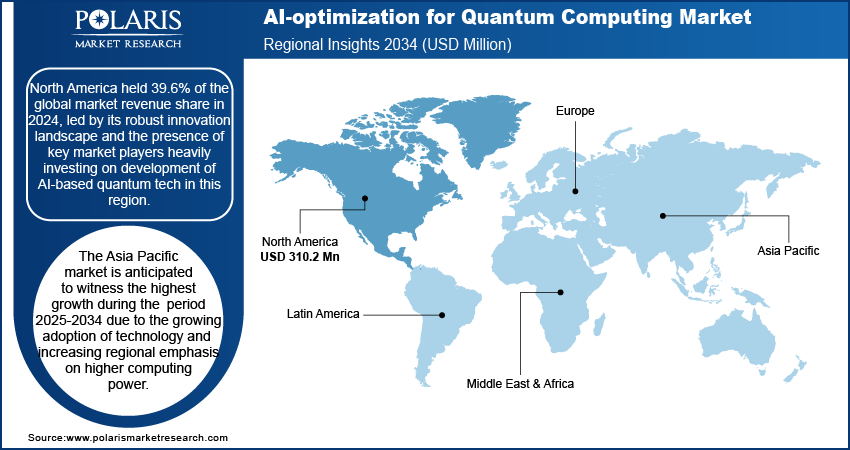
- North America accounted for 39.6% of the global market share in 2024 owing to its strong innovation ecosystem and presence of major players who are massively investing on the development of AI-based quantum tech in this region.
- The Asia Pacific region is expected to grow at the fastest rate over the period 2025-2034 due to increasing adoption of technology and focus of the region on more computing power.
Industry Dynamics
- Improvements in scale and fidelity of quantum hardware is propelling the growth of the market
- The growing acceptance of hybrid quantum-classical algorithms & frameworks is driving the market growth.
- Decoherence and quantum noise keep qubits stable and error-free at scale.
- Quantum advantage in optimization tackles challenging logistics, financial modeling or drug discovery problems exponentially faster than classical systems.
AI-optimization for quantum computing is the application of AI to quantum computing to improve the efficiency, reliability, and/or scalability of quantum algorithms or hardware. The market is driven by the growing demand from business and research centers aiming for solutions to bridge the gap between classical systems of today and those of quantum processors. The availability of commercial quantum cloud services and quantum-inspired solutions, which has considerably relaxed end user’s entry barriers is one of the major factor boosting the demand. These cloud-based services provide AI developers with the ability to train their AI models, execute hybrid workflows and simulate quantum circuits without the need of physical quantum hardware. In addition, quantum-inspired optimization software is also making it possible for companies to realize gains on classical systems with an eye on future quantum-ready architecture. These breakthroughs are converging to accelerate adoption by delivering accessible spaces in which AI-based optimization may be prototyped, analyzed and scaled, further solidifying the market growth.
Source: Polaris Market Research Analysis
A strong foundation of research and commercialization is further bolstered by strategic private investment and government funding. Nations and corporations around the world are working on developing quantum processors, error-correction methods, and AI-driven control systems that make quantum systems more stable. Such ongoing sponsorship is now driving university, start-up, and traditional technology provider partnerships to push forward the hardware and software stacks. For example, in November 2025, IBM and Cisco partnered to Build a Network of Large-Scale, Fault-Tolerant Quantum Computers. National technology road maps are beginning to place more and more emphasis on AI-enabled quantum solutions as areas to receive funding particularly related to computational efficiency, security, and advanced optimization solutions. Consequently, significant presence of government initiatives and corporate funding makes the market for technical solutions more conducive for long term growth.
Drivers & Opportunities
Advancements in Quantum Hardware Fidelity & Scale: Advancements in the fidelity and scale of quantum hardware confound directly contribute to an increase quantum systems performance and reliability, as well as in the speed and quality of quantum algorithms, enabling AI models to extract more from the quantum process. Conversely as qubit coherence times improve and hardware designs scale to larger numbers of qubits, AI-based strategies are taking on greater importance for error mitigation, circuit tuning, and resource management. Systems that are more precise and generate cleaner, more easily utilizable data, for AI led enhancements of quantum ops, with more predictable outputs. For instance, in Oct 2025, IonQ, a quantum computing company, received 99.99% two-qubit gate performance in quantum computing. This is achieved by IonQ’s proprietary Electronic Qubit Control (EQC) technology. They also enable more complex quantum workloads to be executed, further boosting for AI-based orchestration and optimization tools. Thus, co-designing quantum hardware, multiple extent of scalability and performance quantum processors adoption drives the market expansion.
Rise of Hybrid Quantum-Classical Algorithms & Frameworks: Growth of the market is boosted by increasing adoption of hybrid quantum classical co-simulation algorithms and frameworks, as these architectures are strongly dependent on AI, which co-ordinates, accelerates and optimizes computing in both paradigms. For example, in November 2025, Quandela and OVHcloud teamed up to bring together AI and quantum computing. The partnership will allow researchers and businesses to develop and simulate hybrid models on NVIDIA GPUs using the Quandela photonic quantum computers, which are available from OVHcloud’s cloud platform, before running them on photonics. Hybrid workflows that combine classical machine learning with quantum processing also need intelligent scheduling, parameter tuning, and feedback loops where AI provides substantial benefits. AI models contribute towards determining the best circuit layouts, mitigating the noise effects and handling iterative procedures that form the foundation of hybrid algorithms. Furthermore, with hybrid frameworks spreading throughout different domains including optimization, simulation, and machine learning, AI-driven orchestration facilitates the smooth communication between classical and quantum devices. This synergy enhances the computational efficiency, and also facilitates the wider applicability, as it allows for making hybrid quantum systems more “user-friendly” and more robust in their operability.
Premium Insight- Emerging Technological Advancements
| Emerging advancement (2022–2025) | Brief technical description (AI + QC optimization) | Example government / company initiatives (2022–2025) |
| AI‑driven quantum error correction and decoding | Use of machine‑learning and advanced decoders to identify and correct error syndromes more efficiently, reducing overhead for logical qubits and enabling scalable fault‑tolerant systems. | IBM reports improved efficiency in quantum error correction codes and real‑time decoding as part of its error‑corrected quantum roadmap, describing more efficient LDPC‑style codes and decoders to cut resource overhead. DOE’s Quantum Information Science Applications Roadmap and QIS centers emphasize advancing quantum error correction as a key pillar of useful quantum computation. |
| AI‑powered quantum circuit compilation and optimization | Application of reinforcement learning and other AI methods to compile high‑level algorithms into hardware‑efficient circuits with reduced depth, gate count, and noise sensitivity, thereby improving “quantum utility.” | IBM describes bringing “the power of AI to quantum computing” via a circuit compilation service that uses reinforcement learning to optimize circuits for its hardware, tying this to its 2033 quantum roadmap. Microsoft Research highlights work across the Azure Quantum stack where software optimizes circuits and error‑correction layers for its topological‑qubit architecture. |
| Quantum‑aware AI control and error suppression software | AI‑driven control and calibration layers that automatically tune pulses, suppress noise, and stabilize qubits, effectively extending coherence and usable circuit depth without changing hardware. | Q‑CTRL provides quantum‑control and error‑suppression software that integrates with IBM Quantum services, reporting order‑of‑magnitude gains in circuit depth, shot efficiency, and algorithm success by automatically optimizing control. DOE‑supported collaborations (e.g., with Sandia National Laboratories) use AI automation for quantum hardware operation and control, illustrating government backing for AI‑driven control stacks. |
| AI‑optimized quantum error‑correction code design (e.g., Floquet and topological codes) | Use of numerical optimization and AI‑guided simulations to design and tune new code families that reduce qubit/time overhead for fault tolerance, improving the practicality of large‑scale quantum systems. | Microsoft’s Azure Quantum team introduced Floquet codes tailored to its topological qubits, reporting simulations that show roughly tenfold reductions in overhead for error correction versus earlier approaches and favorable thresholds near 1%. Government strategies like the EU “Quantum Europe Strategy” and U.S. DOE QIS roadmap explicitly prioritize research into more efficient error‑correcting codes as part of hybrid AI–quantum infrastructures. |
| Hybrid AI–HPC–quantum workflows for scientific and industrial optimization | Integration of classical AI, high‑performance computing, and quantum processors where AI orchestrates which subproblems are offloaded to quantum hardware to accelerate simulation, chemistry, and optimization tasks. | Microsoft Azure Quantum positions its platform as combining HPC, AI, and quantum to tackle complex workloads such as materials and chemistry, with quantum resources used as specialized accelerators within AI‑driven workflows. The U.S. Department of Energy describes initiatives to couple next‑generation quantum systems with AI and supercomputers in an integrated discovery platform, aiming to transform science and national‑scale optimization problems. |
Source: Polaris Market Research Analysis
Source: Polaris Market Research Analysis
Segmental Insights
Component Analysis
Based on component, the segmentation includes software, hardware, and services. The hardware segment accounted for 46.4% of the revenue share in 2024. This is due to their essential role in enabling the execution, scaling, and performance tuning of quantum systems that AI-related optimization depends. Hardware advancements including longer qubit coherence times, lower error rates, and sophisticated control electronics rendered quantum processors more robust and capable of handling more complex AI-enhanced flowcharts. Increased focus on hybrid quantum–classical architectures has significantly raised the need for strong quantum hardware, which can be closely connected to classical AI systems. Moreover, continuous innovation in cryogenic systems, photonic interconnects, quantum chips have further strengthened the foundational role of hardware in the entire systems. Therefore, as enterprises are building out next-generation quantum platforms, the hardware segment continues to be essential in the development of AI models that help improve circuit design, resource management, and algorithm efficacy.
Technology Analysis
In terms of technology, the segmentation includes superconducting qubits, trapped ions, quantum annealing, photonic quantum computing, and others. The photonic quantum computing segment is anticipated to grow at the highest rate during the forecast period as it has some natural enhancement in scalability, operational stability, and room-temperature processing. Photonic architectures use qubits based on light, which are less affected by environmental noise and allow AI models to produce more consistent and higher-fidelity results. The photonics compatibility with established semiconductor processes also enable fast development cycles and integration with AI-based design flows. In addition, photonic systems enable higher speed data transmission and parallelism, which fits well in AI-based optimization methods that demand high-throughput computation. Thus, as their applications grow in communication, simulation and optimization, photonic quantum platforms are becoming a natural choice for companies looking for sustainable integration of AI-quantum solutions.
Source: Polaris Market Research Analysis
Regional Analysis
North America AI-optimization for Quantum Computing Market Insights
North America held 39.6% of the global market revenue share in 2024, led by its robust innovation landscape and the presence of key market players heavily investing on development of AI-based quantum tech in this region. The area enjoys the advantage of a well-developed infrastructure enabling the joint development of quantum hardware, AI algorithms, and hybrid computing solutions. The availability of large pool of technology and early adopters further supports the growth of AI powered quantum systems in enterprise and research environments. In addition, the concentration of industry players and collaborative networks continuously enhance algorithm optimization, error mitigation, and system-level integration. All these factors collectively make North America one of the most lucrative regions for AI-powered quantum computing solution.
Asia Pacific AI-optimization for Quantum Computing Market Assessment
The Asia Pacific market is anticipated to witness the highest growth during the period 2025-2034 due to the growing adoption of technology and increasing regional emphasis on higher computing power. The development of the region’s digital infrastructure lays solid groundwork for the integration of AI models with new quantum platforms. Increasing funding for research institutes and innovation clusters are enhancing capabilities in the areas of quantum hardware, algorithm, and hybrid computational paradigms. Moreover, entities throughout the region are increasingly focusing on optimizing performance and computational efficiency, at which point AI-enhanced quantum systems are particularly impactful. This readiness in technology and strategic direction are considered to facilitate the market growth of AI-optimization solutions in Asia Pacific in the next years.
Source: Polaris Market Research Analysis
Key Players & Competitive Analysis Report
AI-Adaptation for quantum computing space, competitor analysis and strategy provides a detail of technological advancements, and strategic positioning. D-Wave (Quantum Annealing) and Fujitsu (Quantum-Inspired) who are focused on near term revenue by working on complex logistics and scheduling challenges now. Contrast with the full-stack, but also software specialists like QcWare, who are making strategic plays around hybrid algorithms and platforms (PennyLane, from Xanadu), building out the industry ecosystems for the fault-tolerant future, betting on a longer-term price outlook for quantum advantage. Among key disruptions and trends is the increase in neutral-atom platforms (QuEra) for native optimization, and the demand for sustainable value chains in materials simulation (PsiQuantum). Success will require partner & customer ecosystem development (demonstrated by Microsoft’s Azure Quantum multi-solver aggregation) and it will require weathering major economic and geopolitical changes in supply chains for critical hardware. The future roadmap of all players is about turning pilot projects in finance and pharma today into scalable business transformation, establishing regional reach and competitive positioning in this emerging domain.
Major companies operating in the AI-optimization for quantum computing industry include 1QBit, D-Wave Quantum Inc., Fujitsu (Quantum-Inspired), Microsoft (Azure Quantum), PsiQuantum, QC Ware, Quantagonia, QuEra Computing, Xanadu Quantum Technologies, and Zapata AI (part of Quantinuum).
Key Players
- 1QBit
- D-Wave Quantum Inc.
- Fujitsu (Quantum-Inspired)
- Microsoft (Azure Quantum)
- PsiQuantum
- QC Ware
- Quantagonia
- QuEra Computing
- Xanadu Quantum Technologies
- Zapata AI (part of Quantinuum)
Industry Developments
- In March 2025: D-Wave Quantum Inc. and the pharmaceutical unit of Japan Tobacco Inc. completed a joint proof of concept project combining quantum computing with artificial intelligence to improve drug discovery. Using a quantum trapped ions workflow to train large language models, the team created new and more drug-like molecular structures beyond the original datasets.
- January 2025: Multiverse Computing and Kinesis Network Inc. collaborated to enhance AI efficiency in terms of resource utilization. They want to reap the benefits of AI while avoiding high environmental and financial costs. This partnership merges their large language model and compute optimization capabilities.
- September 2024: D-Wave Quantum Inc., quantum computing systems, software and services company, and Staque, a consulting and development practice specializing in AI, blockchain and quantum computing, have partnered to promote the commercial use of quantum computing in the Middle East.
AI-optimization for Quantum Computing Market Segmentation
By Component Outlook (Revenue, USD Million, 2020–2034)
- Software
- Hardware
- Services
By Technology Outlook (Revenue, USD Million, 2020–2034)
- Superconducting Qubits
- Trapped Ions
- Quantum Annealing
- Photonic Quantum Computing
- Others
By Application Outlook (Revenue, USD Million, 2020–2034)
- Machine Learning Model Optimization
- Quantum Circuit Optimization
- Scheduling & Resource Allocation
- Material Simulation & Drug Discovery
- Financial Modeling & Portfolio Optimization
- Supply Chain & Logistics Optimization
- Others
By End Use Outlook (Revenue, USD Million, 2020–2034)
- BFSI
- Healthcare & Life Sciences
- Energy & Utilities
- Manufacturing
- IT & Telecommunications
- Aerospace & Defense
- Transportation & Logistics
- Others
By Regional Outlook (Revenue, USD Million, 2020–2034)
- North America
- US
- Canada
- Europe
- Germany
- France
- UK
- Italy
- Spain
- Netherlands
- Russia
- Rest of Europe
- Asia Pacific
- China
- Japan
- India
- Malaysia
- South Korea
- Indonesia
- Australia
- Vietnam
- Rest of Asia Pacific
- Middle East & Africa
- Saudi Arabia
- UAE
- Israel
- South Africa
- Rest of Middle East & Africa
- Latin America
- Mexico
- Brazil
- Argentina
- Rest of Latin America
AI-optimization for Quantum Computing Market Report Scope
| Report Attributes | Details |
| Market Size in 2024 | USD 109.87 Million |
| Market Size in 2025 | USD 130.06 Million |
| Revenue Forecast by 2034 | USD 611.87 Million |
| CAGR | 18.8% from 2025 to 2034 |
| Base Year | 2024 |
| Historical Data | 2020–2023 |
| Forecast Period | 2025–2034 |
| Quantitative Units | Revenue in USD Million and CAGR from 2025 to 2034 |
| Report Coverage | Revenue Forecast, Competitive Landscape, Growth Factors, and Industry Trends |
| Segments Covered |
|
| Regional Scope |
|
| Competitive Landscape |
|
| Report Format |
|
| Customization | Report customization as per your requirements with respect to countries, regions, and segmentation. |
Source: Polaris Market Research Analysis
AI-optimization for Quantum Computing Market FAQ's
The global market size was valued at USD 109.87 million in 2024 and is projected to grow to USD 611.87 million by 2034.
The global market is projected to register a CAGR of 18.8% during the forecast period.
North America dominated the market in 2024, holding 39.6% share.
A few of the key players in the market are 1QBit, D-Wave Quantum Inc., Fujitsu (Quantum-Inspired), Microsoft (Azure Quantum), PsiQuantum, QC Ware, Quantagonia, QuEra Computing, Xanadu Quantum Technologies, and Zapata AI (part of Quantinuum).
The hardware segment accounted for?46.4% of the revenue share in 2024.
The photonic quantum computing segment is anticipated to?grow at the highest rate during the forecast period.
Download Sample Report of AI-optimization for Quantum Computing Market
Please fill out the form to request a customized copy of the research report.


