
Global Alternative Data Market Size, Share, Trends & Forecast, 2026–2034
REPORT DETAILS
Alternative Data Market Summary
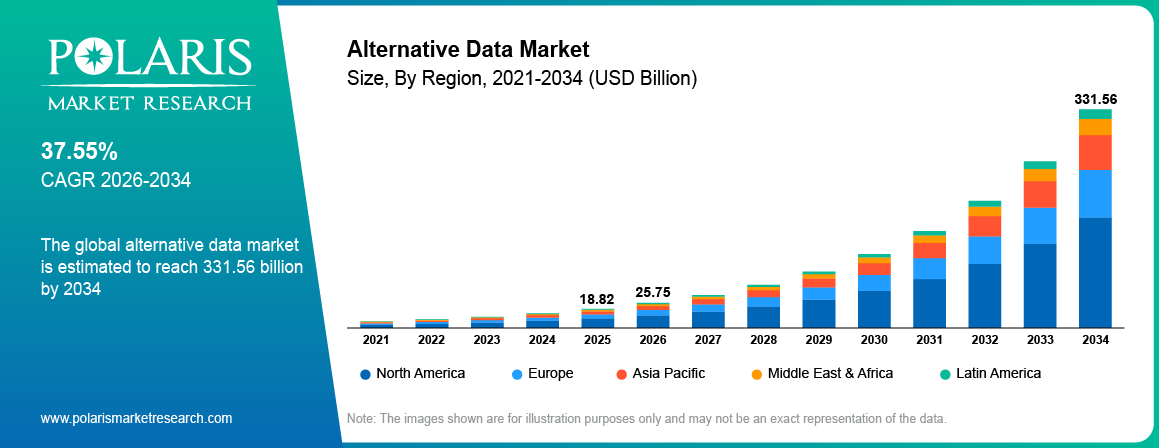
The global alternative data market size was valued at USD 18.82 billion in 2025. The market is anticipated to grow at a CAGR of 37.55% from 2026 to 2034. The alternative data market is driven by the rising adoption of AI and machine learning and an increasing demand for real-time competitive intelligence. The market is also benefiting from the surge in digital data generation from mobile and IoT devices.
Market Statistics
Alternative Data Market Key Takeaways
- North America accounted for 41.0% of the market share in 2025. North America's strong technological base drives its market leadership position.
- Asia Pacific is projected to account for a 41.90% CAGR. Growth in the region is propelled by rising adoption of data analytics and digital transformation.
- The credit & debit card transactions segment was leading with a market share of 15.0% in 2025. The extensive use of credit and debit cards in economic activities drives this high share.
- The social & sentiment data segment is expected to grow at a CAGR of 39.70%. The reason behind growth in the social & sentiment data segment is rising adoption of social media platforms for communication.
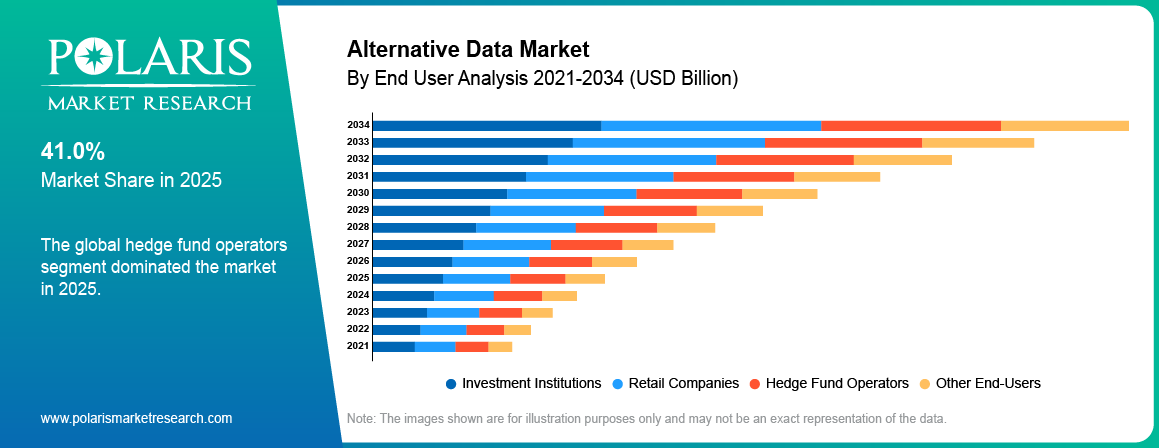
- The hedge fund operators segment accounted for 41.0% of the alternative data market share in 2025. The segment's dominance is driven by increasing demand for hedge fund alternative data.
Note: Figures and projections outlined in this report are the result of Polaris Market Research’s proprietary analytical processes, grounded in the latest available datasets and market observations.
What is Alternative Data?
Alternative data refers to non-traditional sources of information that analysts and investors use to gain insights into various aspects of businesses, industries, or markets. This data often includes unconventional sources such as sensor data, satellite imagery, credit card transactions, web scraping, and social media posts, among others. Unlike traditional financial data such as earnings reports or balance sheets, alternative data offers a more dynamic and granular view, providing unique insights into consumer behavior, supply chain dynamics, economic trends, and more.
The alternative data market has witnessed significant growth in recent years, driven by the increasing demand for unique insights and competitive advantages in various industries. One prominent trend is the proliferation of non-traditional data sources, ranging from social media sentiment analysis to satellite imagery and IoT sensor data. This diversification reflects the growing recognition among businesses and investors of the limitations of traditional financial data and the need for more comprehensive and dynamic datasets to make informed decisions. As a result, alternative data providers are continuously expanding their offerings to cater to this demand, fueling alternative data market size growth.
How Does Alternative Data Work?
Data Gathering: Data is gathered from non-traditional data sources such as transactions, mobile apps, satellite imagery, websites, and social networking sites.
Data Preparation: The gathered data is prepared and structured to improve its quality.
Data Integration: The prepared data is integrated with the alternative data analytics software and business data for comprehending the market dynamics.
Pattern Recognition: Complex data analytics help in recognizing patterns or changes in the data that are otherwise overlooked in traditional datasets.
Insights Creation: The data analytics process helps in creating useful insights, which can be leveraged for forecasting and investment analysis.
Decision-making: Investors and organizations take decisions based on the information derived from the data analysis process.
Alternative Data vs. Traditional Data
Alternative data and traditional data are different in terms of the kind of information provided. Traditional financial data can be sourced from well-established sources such as financial statements, earnings announcements, and regulatory filings. On the other hand, alternative data is sourced from sources external to these.
| Factor | Alternative Data | Traditional Financial Data |
| Source of Data | Can be gathered through digital transactions, mobile app usage data, websites, and satellite images. | Collected through financial documents, company reports, and regulatory documents. |
| Frequency of Updates | Updated regularly and may sometimes be available in real time. | Commonly released on a quarterly or annual basis. |
| Information | Gives information about consumer behavior, market activities, and company performance. | Mainly gives information on the company’s financial performance and company reports. |
| Predictive Value | Helps in identifying upcoming trends before they become apparent in the financial documents. | Indicative of the financial performance in the past. |
| Nature of Data | Data needs to be processed and analyzed before it becomes useful. | Structured data and easier to analyze. |
| Regulations | Management of privacy issues and consent is key in its collection. | Collected in accordance with financial reporting regulations. |
| Common Applications | Used in investment research, demand forecasts, customer profiling, and competitive intelligence. | Used in financial reporting and company valuation. |
Source: Polaris Market Research Analysis
Source: Polaris Market Research Analysis
Market Dynamics
The alternative data market is driven by AI and advanced analytics, rising demand for ESG insights, and the growing volume of big data. Privacy requirements and technical complexity also influence market growth.
Drivers: Increasing Adoption of AI and Advanced Analytics
The increasing adoption of AI and analytics technology is boosting demand for alternative data as companies look for smarter ways to extract insights from growing volumes of data. The growing use of data-driven decision-making in various industries, including finance, retail, and health care, is driving the demand for alternative data sets. The rising importance of market intelligence and competitive insights is another driver behind this shift.
Drivers: Rising Demand for ESG Insights
Another driving force shaping the alternative data market is the growing emphasis on ESG (Environmental, Social, and Governance) factors in investment decision-making. Investors are increasingly integrating ESG criteria into their portfolio strategies to mitigate risks, align with their values, and capitalize on emerging opportunities in sustainable industries. Alternative data providers are responding to this trend by offering datasets that enable investors to evaluate companies' ESG performance and assess their long-term sustainability prospects. As ESG considerations continue to gain prominence in the investment landscape, the demand for alternative data solutions tailored to these needs is expected to drive further alternative data market growth.
Drivers: Growth of Big Data Driving the Alternative Data Market Share
The exponential growth of big data from diverse sources such as IoT devices, sensors, and social media sites is a primary driver of the alternative data market's expansion. These sources collectively generate massive volumes of data at an unprecedented rate, offering massive amounts of data for analysis. The availability of such diverse and abundant data sources fuels the demand for alternative data as businesses and investors seek to extract actionable insights and gain competitive advantages. Traditional datasets often struggle to capture the complexities and nuances of rapidly evolving markets and consumer behaviors. Alternative data, leveraging big data analytics and machine learning techniques, enables deeper analysis and predictive modeling, empowering organizations to make informed conclusions in real time. As the volume and variety of big data continue to expand, the alternative data market is poised for further growth, with innovative solutions emerging to meet the evolving needs of businesses and investors in an increasingly data-driven world.
Restraints: Technical Complexity in Alternative Data Processing
The processing and analysis of alternative data pose significant challenges due to their inherent complexity, particularly when dealing with unstructured or semi-structured data obtained from sources such as social media sites and satellite imagery. Extracting meaningful insights from these diverse datasets demands specialized expertise and infrastructure in data science, machine learning, and big data analytics. Many organizations need help effectively harnessing alternative data for decision-making because data integration, cleaning, and modeling are complex. Without sufficient resources and capabilities in data engineering and advanced analytics, organizations may be unable to derive actionable insights from alternative data sources, limiting their ability to leverage this valuable resource for informed decision-making across various domains.
Restraints: Licensing Costs and Data Access Complexity
The expensive and complex process of licensing the alternative data sources could also limit their adoption by businesses. Businesses may have to come up with individual licensing agreements with each source, and each would be subject to its own rules and cost structures. This would especially prove to be difficult for small-scale businesses with small budget allocations for data. The complex data licensing requirements may also impact the scalability of the data across various applications.
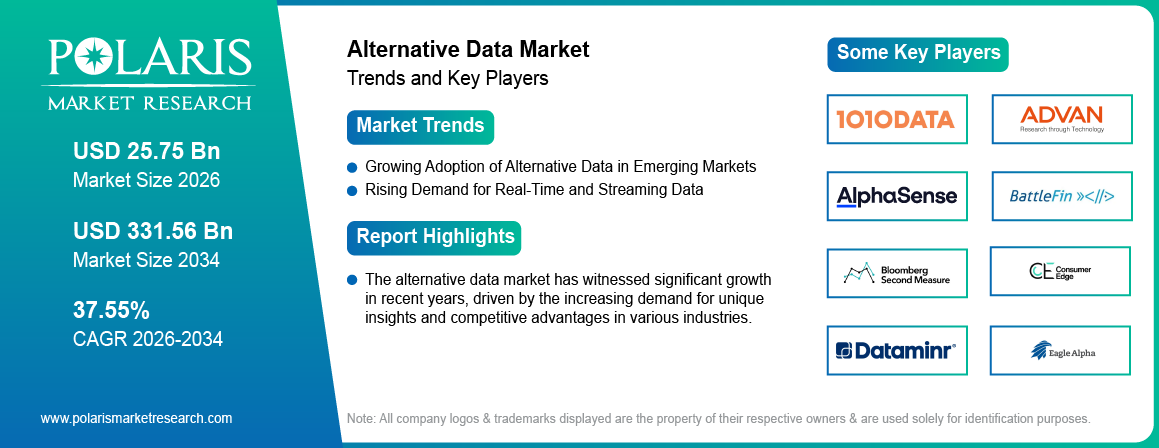
Opportunities: Growing Adoption of Alternative Data in Emerging Markets
There are numerous opportunities for alternative data vendors in emerging markets due to the rising adoption of technology by firms. The increasing use of smartphones, payment platforms, e-commerce, and smart devices contributes to the emergence of more alternative data sources. Alternative data can be used to help organizations get a better understanding of local markets, consumer behaviors, and investment opportunities. Financial institutions also leverage alternative data to evaluate their clients who lack a track record with conventional credit scoring. More localized alternative data will be created as digital networks expand in developing countries.
Opportunities: Rising Demand for Real-Time and Streaming Data
The need for quicker decisions on businesses and investments is creating increased demand for real-time and streaming alternative data. Information provided through transactions, mobile apps, web browsing, Internet of Things (IoT), and location-based sensors could give insight into market conditions in near real time. Retailers can see what customers are doing, and investors can follow market signals and trends as they happen. Alternative data providers that can deliver consistent datasets can take advantage of this shift. There have been developments in the areas of cloud computing and data processing that could facilitate such tasks.
Alternative Data Market Trends
Expansion of Alternative Data Marketplaces
The rise of alternative data marketplaces has become a trend as companies seek simpler ways to gain access to specialized data. These systems help unite many data suppliers and provide an opportunity to find, assess, compare, and acquire datasets via one platform. Marketplaces can save time and effort needed to find proper data sources. Furthermore, companies will be able to use a greater number of different datasets without having the capacity to collect the data. The growth of such marketplaces may help companies use alternative data better.
Growing Data Monetization Opportunities
Data monetization offers several opportunities for companies that gather significant amounts of business and customer data. Companies can generate revenue by selling the proprietary data sets to investors, banks, retail companies, and other parties. With the rising need for targeted and timely data, there are emerging opportunities for companies to recognize commercially useful data sets among their own data.
Source: Polaris Market Research Analysis
Market Segment Analysis
By Data Type
The credit & debit card transactions segment accounted for an 15.0% alternative data market share in 2025. This dominance can be attributed to the extensive usage of credit and debit cards in various economic activities, providing a rich source of transactional data that offers valuable insights into consumer behavior, spending patterns, and economic trends. The widespread adoption of digital payment methods, coupled with the convenience and accessibility of credit and debit cards, has resulted in a vast volume of transaction data being generated daily. Analyzing this data enables businesses and investors to make informed decisions regarding alternative data market trends, customer preferences, and investment opportunities. Additionally, advancements in data analytics and machine learning techniques have enhanced the ability to derive actionable insights from credit and debit card transaction data, further solidifying its position as a leading segment in the alternative data landscape.
The social & sentiment data segment is projected to grow at a 39.70% CAGR. This is primarily driven by the increasing reliance on social media sites as channels for communication, expression, and information sharing. Social media sites generate vast amounts of user-generated content, including posts, comments, likes, and shares, which collectively provide valuable insights into consumer sentiments, preferences, and trends. Businesses and investors recognize the importance of tapping into this rich source of data to gauge public opinion, track brand sentiment, and identify emerging alternative data market trends. Additionally, advancements in natural language processing (NLP) and sentiment analysis techniques empower organizations to extract actionable insights from social media data with greater accuracy and efficiency. As a result, the social & sentiment data segment is expected to experience significant growth as more businesses and investors leverage this alternative data source to gain competitive advantages and drive informed decision-making strategies.
The web-scraped data segment is projected to grow at an 34.50% CAGR. The web-scraped data segment is likely to see significant growth in the coming years as companies seek timely information on their products, prices, inventories, competition, and demand for their products. The rise in popularity of e-commerce and other digital platforms has led to increased information on the internet. These datasets can be analyzed by companies and investors to keep track of developments and look out for new opportunities in the markets.
The geo-location (foot traffic) records segment held an 14.0% market share in 2025. This geo-location (foot traffic) records segment is becoming increasingly important because of the growing need for real-time knowledge regarding consumer physical activity by retailers, real estate companies, and investors. The increasing use of location-based technologies is resulting in valuable insights about the number of visits to various retail facilities. Such insights can be used for assessing retail store performance, comparing locations, and detecting changes in consumer behavior. High demand for location-based market research is expected to drive growth in the segment.
By Industry
The BFSI (Banking, Financial Services, and Insurance) segment accounted for a 31.0% share in 2025. The BFSI industry is one of the leading industries that make use of alternative data since banks, investment firms, and insurance companies need more information for purposes of investment analysis, risk assessment, and evaluating customers. Information from transactions, credit, social sentiment, and internet data could help in identifying signals in the market. Moreover, alternative data enables the profiling of customers, detecting fraud, and evaluating credit by providing information that is not normally found in traditional finance data. Increased adoption of online payments and financial services has created opportunities for higher use of alternative data in the BFSI industry.
The retail segment is projected to account for a 38.40% CAGR. Use of alternative data is growing in the retail industry since it assists in understanding consumer behavior and making decisions. Such data can be collected through foot traffic, online engagement, transactions, and sentiment to determine the need for and performance of the stores. E-commerce and omnichannel retailing are growing in popularity, and new alternative sources of data are being introduced. Alternative data could be utilized in retailing for analyzing locations for setting up stores, understanding competitors’ moves, managing inventories, and customer preferences. Growth in demand for consumer insights is anticipated to push this development further.
The energy segment is projected to grow at a 40.50% CAGR. Alternative sources of information are also being used by the energy sector to improve market intelligence. Images from satellites, weather reports, geolocation information, and supply chain data could assist companies in asset monitoring, evaluation of the environment, and changes in energy operations. Alternative data sources are likely to gain prominence in the energy sector due to increasing concerns about energy security and market efficiency. Companies could leverage these data sets for the purpose of infrastructure monitoring, evaluation of production operations, weather risk management, and market development in energy.
By End User
The hedge fund operators segment led with a 41.0% share in 2025. This is because there is high demand for alternative data from hedge funds and investment companies. Some of the key customers in this segment include QR Capital Management, BlackRock Advisors, and Bridgewater Associates. The segment is forecasted to experience consistent growth in the coming years as hedge funds seek varied sources of data for their analysis.
The retail companies segment is projected to account for a 39.80% CAGR. This surge is credited to innovative applications of alternative data, including social media, sentiment analysis, geolocation, and satellite imagery, employed by retail companies to inform strategic decision-making. For instance, retail companies like Gap, Walmart, and Target extensively utilize geolocation data. Amidst the burgeoning dominance of online shopping, this data aids major retailers and shopping malls in correlating foot traffic with actual sales figures. Moreover, it assists stores in determining optimal locations for new outlets.
The investment institutions segment accounted for an 25.0% market share in 2025. A number of investment companies and asset management firms have incorporated alternative data as one of the ways through which they conduct their research, portfolio analysis, and risk management. Investment institutions can integrate alternative data with conventional financial data to obtain a complete analysis of a firm or market. Competition in the investment industry is also pushing the use of alternative data in investments.
Alternative Data by Source: Deep Dive
Alternative data is collected from different sources that help gain further insight beyond the financial information. These sources give different kinds of information that can be utilized by organizations and investors in order to understand the market, customers, and business.
Alternative Data Type Comparison
| Data type | Best for | Typical buyer | Latency |
| Credit & debit card transactions | Revenue/demand forecasting, credit risk scoring | Hedge funds, lenders, BFSI | Near real-time to daily |
| Geolocation / foot traffic | Store performance, site selection, mobility trends | Retail, real estate | Daily |
| Web scraped data | Pricing intelligence, inventory/availability tracking | Retail, e-commerce, corporates | Continuous |
| Satellite & weather data | Agricultural output, industrial activity, logistics monitoring | Energy, agriculture, commodities investors | Daily to weekly |
| Social & sentiment data | Brand perception, sentiment-driven trading signals | Hedge funds, retail brands | Real-time |
| Mobile app usage | App adoption, digital engagement benchmarking | Tech/media investors, corporates | Daily to weekly |
Source: Polaris Market Research Analysis
Credit & Debit Card Transaction Data
Data from transactions using credit cards and debit cards gives valuable insight into consumer behavior and buying habits. Such data would be helpful for companies to study changes in customer demand patterns, sales trend analysis, and spending behavior in different markets. It can be used by investors to gauge the performance of companies before the release of financial data. With the growing number of transactions conducted through digital channels, more transaction data is becoming available.
Geolocation & Foot Traffic Analytics
Geolocation and foot traffic statistics give insights into physical activity and visits to business sites. Retailers are able to use these data sets in order to measure traffic of stores, compare sites, and analyze changes in customer behavior. Foot traffic trends may be used by investors in order to evaluate the performance of their retail investments. With the increase in popularity of smartphones and geolocation services, more geolocation data is being created.
Web Scraped Data & Digital Intelligence
Web scraped data refers to data obtained from publicly accessible web pages like product descriptions, prices, inventory levels, product reviews, employment opportunities, and even the websites themselves. Firms can use such data to keep track of their competitors and monitor any changes in the market environment and demand among consumers. Investors can use online actions to spot new business trends. With the growth of e-commerce and other online platforms, an abundance of online data is now easily analyzable.
Satellite & Alternative Observation Data
Information on physical assets, locations, environmental factors, and economic activity is provided by satellite and other types of observational data. Satellite imaging can help investors and companies keep track of the processes related to construction, agriculture, energy production, transportation, and logistics. Advancements in satellite coverage, image clarity, and data processing make the utilization of satellites more commercially viable. Besides, remote monitoring of physical activity allows these data sets to be used for tracking unreported developments.
Social Media & Sentiment Analytics
Sentiment analysis using social media data can help understand consumer sentiment, brand perception, and future market trends. Organizations are able to gain insight into how customer preferences are evolving through analyzing posts, feedback, reviews, and other forms of online communication. Investors can leverage the sentiment indicators to gain insight into public sentiment and any change in demand. The rising popularity of social media is increasing the availability of data. Improvements in the field of natural language processing technology have helped to process larger amounts of unstructured information.
Real-World Use Cases
| Use Case | Description |
| Retail Sales Estimation | Credit and debit card transaction data can assist both companies and investors in forecasting retail sales prior to releasing official reports. |
| Foot Traffic Analysis | Geospatial datasets allow for measuring the number of visits by customers to stores, shopping centers, and other commercial places. |
| Supply Chain Analytics | Satellite imagery allows for monitoring of manufacturing activities, shipping, and inventory movements. |
| Customer Sentiment Analysis | Social media datasets allow companies to analyze customers' sentiments and changing market trends. |
| Alternative Investment Research | App usage, website activity and other forms of digital activity allow for evaluating companies' performance. |
| Risk Assessment | Financial alternative data assists banks and other financial organizations in assessing risks. |
| Competitive Intelligence | Web-based datasets allow for monitoring of competitors' prices, product launches, and other activities. |
| Demand Forecasting | Alternative data can help businesses forecast demand by analyzing consumer spending and online activity. |
Source: Polaris Market Research Analysis
Alternative Data for Hedge Funds
By analyzing alternative data, hedge funds acquire insights that cannot be obtained through conventional financial data. Transaction data, web activity data, satellite images, geolocation data, and sentiment data from social media can assist the investment teams in detecting market signals and investment opportunities. Alternative data can assist in hedge fund alpha generation because they provide the investment teams with more information about trends, estimates of company performance, and investment strategies.
Alternative data allows real-time monitoring, enabling hedge fund investment teams to monitor changes in consumer behavior, operations of businesses, and market conditions on a regular basis. The portfolio managers can incorporate alternative data into the decision-making process regarding allocation of the portfolios and investments. With the rising competition in the area of investment returns, alternative data is becoming increasingly essential for hedge funds.
Artificial Intelligence and Machine Learning in Alternative Data Analytics
Artificial intelligence (AI) technologies and machine learning are revolutionizing the ways in which firms can obtain, analyze, and process alternative data. In particular, they can be used to automatically clean data through error detection and correction, elimination of duplications, standardization, and preparation of data sets. Such techniques reduce the need for human labor in processing data obtained from social networks, browsing, transactions, and satellite imagery.
AI and machine learning are additionally used for detecting patterns within large and complicated datasets. It is possible to detect certain relationships, changes, and anomalies that cannot easily be detected manually. This way, organizations and investors can recognize emerging market signals and shifts in consumer behavior.
Predictive modeling is also an important application of AI and machine learning. Using alternative data, machine learning platforms are capable of forecasting future tendencies, demand, risks, and the performance of a particular organization. With the constant growth in alternative data, the use of AI and machine learning is expected to rise.
Alternative Data for Business, FinTech, and Private Markets
Alternative data is no longer restricted to investment-related applications only. It is being utilized by corporations, fintechs, private equity funds, and venture capitalists for making business decisions, financial analysis, and investment decisions.
Decision-making for Business (Corporates)
Alternative data can help companies improve their demand forecasts and benchmarking. Businesses can employ the use of web traffic, transactions, sentiment, and location data to identify what happens in terms of the changes in demand and the market. They can also analyze the prices, products, and engagement of competitors and create a benchmark of performance. This is useful for decision-making on inventory management, market expansion, product strategy, and resource allocation.
FinTech & Alternative Data Integration
FinTech companies are using alternative data to assist them in lending, fraud detection, and customer personalization. Transaction history, digital activity, payment patterns, and other such factors can help them evaluate the borrower when regular data regarding the borrower’s creditworthiness is not available. These datasets may also help detect unusual transaction patterns, which will be useful in fraud detection. The alternative data related to spending and digital engagement may be used by FinTech companies to offer personalized products and services to customers.
Private Equity & Venture Capital Applications
Venture capitalists and private equity firms utilize alternative data to improve due diligence as well as recognize opportunities in the market. Data like web traffic, customer reviews, recruitment efforts, transactional data, and sentiments expressed on the internet can be useful in gaining more information regarding the growth of a targeted firm. Alternative data can help investors gain knowledge regarding customer demand, the competitive conditions, and trends in the industry. In addition, alternative data can be helpful to investors in tracking the performance of companies or markets in their portfolios.
Data Privacy, Ethics & Regulatory Compliance
Data privacy and compliance are two aspects to consider when working with alternative data. The alternative data may include personal information; therefore, there is a risk associated with collecting, storing, processing, and distributing this type of information. There are many regulations, including GDPR in Europe and CCPA in the United States, which impose restrictions on working with personal information.
Alternative data users should examine whether the data was legally acquired and consent had been appropriately sought where necessary. Additionally, they must evaluate the process used to source, process, and distribute the data. Clear data governance ensures the protection of privacy rights as well as meeting legal requirements.
Another factor to consider is the ethical use of alternative data. Corporations need to ensure that they do not engage in unfair treatment and profiling through alternative data usage. This will enable organizations to harness the benefits of alternative data while complying with changing laws and earning public trust.
Cloud Infrastructure Supporting Market Growth
The cloud computing system is facilitating the development of the market for alternative data as it offers the storage and computational capabilities required to handle massive and complex data sets. The cloud system enables enterprises to capture, store, compute, and analyze the data generated through such things as transactions, browsing behaviors, social networks, and even satellite images. The scalability of cloud computing resources also helps minimize the requirement for maintaining on-site infrastructure. This makes alternative data analytics easier and faster as the volume of data keeps increasing.
Emerging Technologies Shaping the Market
The following are some of the recent technological innovations used to improve the process of collecting, processing, and analyzing alternative data:
Generative Artificial Intelligence (GenAI): Enables the interpretation of large volumes of unstructured data; therefore, assists in the process of analyzing and using alternative data sets in decision-making.
Natural Language Processing (NLP): Enables organizations to analyze textual data from sources such as social media, articles, customer reviews, etc., to derive sentiment, themes, and emerging trends.
Geospatial Intelligence: Combines geographical data and satellite imagery for the purpose of tracking physical activity, infrastructure, transport, and geographical changes.
Real-Time Consumer Intelligence: Analyzes live transaction data, geographical data, and behavioral data to derive insight into market conditions.
Multi-Agent Systems: Allows several AI agents to collaborate on functions like data gathering, analysis, and validation, helping companies process different types of alternative datasets.
Source: Polaris Market Research Analysis
Regional Insights
The alternative data market is growing in various regions as companies and investors use non-conventional data sets to make decisions. Regional growth is driven by process digitalization, financial technology, and the availability of large volumes of consumer and company data.
North America
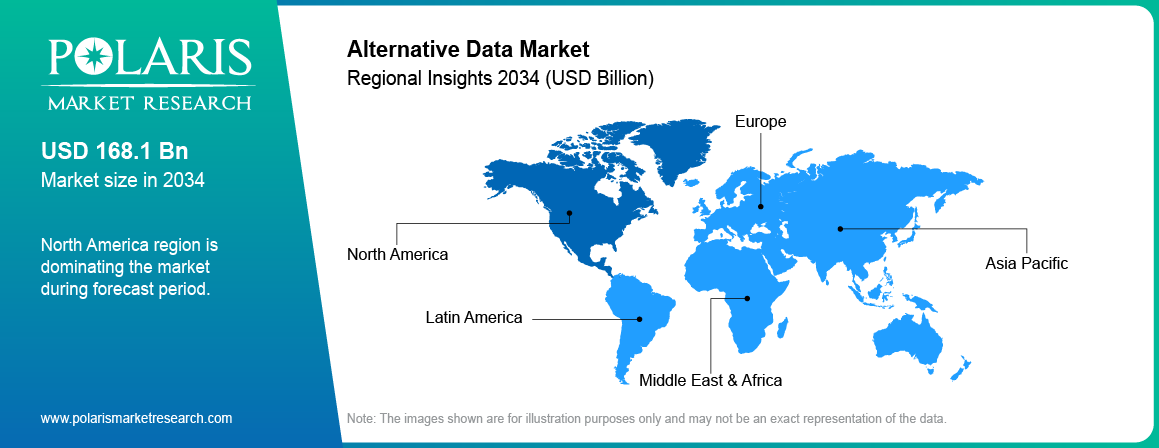
North America led with an 41.0% market share in 2025. This can be attributed to several factors, including the region's robust technological infrastructure, extensive adoption of data analytics and artificial intelligence (AI) technologies, and a high concentration of leading alternative data providers and users. North America hosts several major financial centers, including New York City and Silicon Valley, which serve as hubs for innovation and investment in alternative data solutions. Moreover, the region's regulatory environment, while stringent, also fosters innovation and compliance in data privacy and security, enhancing investor confidence and market stability. Additionally, North America's diverse and dynamic economy, coupled with its large consumer base and mature financial markets, creates ample opportunities for leveraging alternative data across various industries, further solidifying its dominance in the global alternative data market.
Europe
Europe accounted for an 26.0% market share in 2025. This is owing to the region's increasing adoption of data analytics and digital transformation initiatives across various industries. Europe boasts a diverse financial services sector, with major financial hubs such as Zurich, London, and Frankfurt, which are driving demand for alternative data solutions among investment firms, asset managers, and hedge funds. Moreover, the European Union's stringent alternative data privacy regulations, such as the General Data Protection Regulation (GDPR), have fostered a culture of compliance and data protection, instilling trust and confidence in alternative data sources. Furthermore, the region's vibrant startup ecosystem and growing investment in technology and innovation are fueling the development of novel alternative data sources and analytics platforms.
Asia Pacific
Asia Pacific is projected to witness the fastest growth at a 41.90% CAGR. Asia Pacific is rapidly emerging as one of the most rapidly developing regions in terms of alternative data, owing to digitization, numerous fintech firms, eCommerce, and mobile communications. Countries in the Asia Pacific region, such as China, Japan, India, South Korea, and Singapore, create massive amounts of data from both consumers and businesses using digital payments, mobile applications, and online platforms. Furthermore, alternative data is increasingly used in finance and investing in India. There are various ways through which alternative data firms can find scope in the region due to digital financial services.
Latin America and the Middle East & Africa
Latin America and the Middle East & Africa are emerging markets due to an increase in digital payments, fintech services, e-commerce, and mobile penetration. For Latin America, an increased adoption of digital payments has led to the creation of additional datasets that can be used in finance and retail applications. The increase in digitalization and fintech in the Middle East & Africa is generating more sources of alternative data. These regions are still less developed than North America and Europe; thus, there is potential for further use of alternative data.
Source: Polaris Market Research Analysis
Key Players & Competitive Landscape
The alternative data market is characterized by a diverse array of players ranging from established data providers to emerging startups, each vying for market share and differentiation. Major financial data vendors have expanded their offerings to include alternative datasets, leveraging their extensive networks and infrastructure to cater to institutional investors' growing demand for non-traditional data sources. Additionally, technology giants are actively entering the alternative data space, leveraging their cloud computing and AI capabilities to offer innovative solutions for data collection, analysis, and visualization. With the market witnessing continuous innovation and consolidation, competition intensifies as players strive to differentiate themselves through data quality, breadth of coverage, technological prowess, and value-added services, driving continuous evolution and growth in the alternative data landscape.
Competitive Positioning
| Tier | Representative players | Positioning | Watch-for |
| Global Data & Financial Intelligence Leaders | Bloomberg Second Measure, S&P Global, UBS Evidence Lab, Preqin, AlphaSense | Broad data coverage, strong institutional relationships, and integration with financial research and investment workflows. | Expansion of alternative datasets, AI-powered analytics, and deeper integration with investment platforms. |
| Established Alternative Data Specialists | 1010data, Consumer Edge, Dataminr, M Science, RavenPack, YipitData, Advan Research | Specialized datasets focused on consumer behavior, market signals, transactions, sentiment, and investment research. | New proprietary datasets, sector expansion, partnerships, and improvements in data quality and analytics. |
| Alternative Data Platforms & Emerging Providers | BattleFin, Eagle Alpha, Neudata, Quiver Quantitative, Thinknum, Foursquare | Platforms and specialized providers helping users discover, access, and analyze niche or proprietary datasets. | Dataset expansion, platform adoption, AI integration, and differentiation through unique data sources. |
| Acquired / Integrated Providers | Earnest Analytics, Bloomberg Second Measure, M Science, Preqin | Providers operating within larger financial or data organizations, gaining access to broader distribution networks and resources. | Product integration, cross-selling opportunities, expanded datasets, and changes following acquisitions. |
Source: Polaris Market Research Analysis
List of Top Companies
- 1010data, Inc. (Subsidiary of SymphonyAI)
- Advan Research Corporation
- AlphaSense, Inc.
- BattleFin
- Bloomberg Second Measure (Subsidiary of Bloomberg LP)
- Consumer Edge LLC
- Dataminr, Inc.
- Eagle Alpha Ltd.
- Earnest Analytics (Acquired by Consumer Edge)
- Foursquare Labs, Inc.
- M Science LLC (Subsidiary of Jefferies Financial Group)
- Neudata
- Preqin Ltd. (Acquired by BlackRock)
- Quiver Quantitative
- RavenPack International S.L.
- S&P Global Inc.
- Thinknum, Inc.
- UBS Evidence Lab (Division of UBS)
- YipitData
Recent Developments
- July 2026: INRIX showcased its AI Infrastructure Intelligence and Site Activity Monitoring solutions at Neudata's New York Summer Data Summit. The company stated that the solutions help alternative data buyers and investment professionals track data center construction and AI supply chain activity. (source: inrix.com)
- January 2026: Bloomberg announced the introduction of Data Entitlements in {ALTD
}, part of the investment research solutions offering on the Bloomberg Terminal. The company stated that it provides clients with near-real-time actionable insights powered by alternative data. (source: bloomberg.com)
Alternative Data Market Report Segmentation Outlook
The alternative data market is segmented based on industry, data type, end user, and region. These segments provide a detailed view of market demand and growth across different applications and geographic areas.
By Industry | By Data Type | By End User | By Region |
|
|
|
|
Source: Polaris Market Research Analysis
Alternative Data Market Report Scope
| Report Attributes | Details |
| Market Size Value in 2025 | USD 18.82 billion |
| Market Size Value in 2026 | USD 25.75 billion |
| Revenue Forecast by 2034 | USD 331.56 billion |
| CAGR | 37.55% from 2026 to 2034 |
| Base Year | 2025 |
| Historical Data | 2021–2024 |
| Forecast Period | 2026–2034 |
| Quantitative Units | Revenue in USD billion and CAGR from 2026 to 2034 |
| Report Coverage | Revenue Forecast, Market Competitive Landscape, Growth Factors, and Industry Trends |
| Segments Covered |
|
| Regional Scope |
|
| Competitive Landscape |
|
| Report Format |
|
| Customization | Report customization as per your requirements with respect to countries, regions, and segmentation. |
Source: Polaris Market Research Analysis
Future Outlook
The alternative data market is anticipated to grow as businesses need fast and detailed data to inform decision-making. The increasing digitization of businesses will keep producing alternative data sources. Artificial intelligence and machine learning technologies will be increasingly applied in the field to make data analysis more accurate and faster. Cloud platforms will provide a way to perform large-scale data processing more effectively. Beyond finance, new industries like retail, health care, and manufacturing are anticipated to use this data and will drive the growth of the alternative data market. The emergence of data marketplaces is expected to be another major driver during the alternative data market forecast period.
Alternative Data Market FAQ's
The alternative data market size was valued at USD 18.82 billion in 2025. The market is projected to reach USD 331.56 billion by 2034.
The market is projected to account for a 37.55% CAGR from 2026 to 2034.
The key segments covered in the report are industry, data type, end user, and region.
A few of the key market players include 1010data, Inc. (Subsidiary of SymphonyAI); Advan Research Corporation; AlphaSense, Inc.; Bloomberg Second Measure (Subsidiary of Bloomberg LP); Consumer Edge LLC; Dataminr, Inc.; Eagle Alpha Ltd.; Foursquare Labs, Inc.; Neudata; Preqin Ltd. (Acquired by BlackRock); Quiver Quantitative; RavenPack International S.L.; S&P Global Inc.; Thinknum, Inc.; and YipitData.
Some examples of alternative data include credit card transactions, location data, satellite imagery, social media interactions, web traffic data, emails, and app usage. Alternative data allows firms to derive insights that cannot be derived from regular financial statements.
Hedge funds rely on alternative data for identifying potential investments and gaining an understanding of market trends. Accessing timely information allows them to assess the performance of companies and the activities of consumers.
Alternative data finds wide application in the retail industry, the healthcare sector, the telecommunications sector, the automotive industry, the energy industry, and consumer goods industries.
Alternative data offers timely insights that cannot be obtained through conventional financial data. Alternative data can help organizations learn about their customers and the market. Investors can use alternative data to analyze market trends.
Artificial intelligence allows organizations to analyze massive quantities of alternative data. Artificial intelligence also allows for automating data cleaning processes and identifying data patterns. Predictive analysis can also be done using artificial intelligence.
Data privacy is one of the limitations of alternative data. Organizations need to adhere to constantly changing regulations. Licensing costs of some datasets are high.
Download Sample Report of Alternative Data Market
Please fill out the form to request a customized copy of the research report.


