
Aquaculture Market Size, & Growth Analysis Report, 2026-2034
REPORT DETAILS
Aquaculture Market Summary
The global aquaculture market is estimated around USD 325.37 Billion in 2025,with consistent growth anticipated during 2026–2034. This growth is driven by rising seafood demand, declining wild fish stocks, and growing investments in sustainable aquaculture technologies. The market is projected to grow at a CAGR of 5.1% during the forecast period.
Market Statistics
Key Takeaways
- Asia Pacific dominated the market with 51.3% in 2025, due to large-scale fish farming activities.
- North America is projected to witness steady growth at a CAGR 4.0%, during the forecast period.
- Fish segment dominated the market with 81.3% in 2025, due to strong commercial production volumes.
- Freshwater segment dominated the market with 48.6% in 2025, owing to lower operating costs.
- Recirculating aquaculture systems segment is projected to grow at the fastest CAGR of 9.4%, during the forecast period due to water efficiency benefits.
- Major companies operating in the market include BioMar Group, Cargill Incorporated, Cermaq Group AS, Cooke Aquaculture Inc., Grieg Seafood ASA, and others.
Industry Dynamics
- Rising seafood consumption increases commercial aquaculture production globally.
- Adoption of smart farming technologies improves farm productivity and operational efficiency.
- Disease outbreaks and environmental concerns continue to create production challenges.
- Land-based aquaculture systems create long-term growth opportunities.
What is Aquaculture?
Aquaculture refers to the breeding, rearing, and harvesting of fish, crustaceans, mollusks, and aquatic plants under controlled freshwater, marine, and land-based farming environments. The industry helps address the growing gap between seafood demand and declining wild fish availability. Aquaculture products for commercial purposes are commonly provided to retail stores, restaurants, food processors, and export firms. Aquaculture has emerged to be a significant player in the provision of global food security.
The value chain comprises hatcheries, feed producers, aquaculture equipment manufacturers, farm managers, seafood processors, cold storage facilities, distributors, and retailers. The feed producers provide nutritional products for improving fish productivity. The equipment manufacturers provide aeration, water monitoring, and automatic feeding equipment. The seafood processors distribute products both domestically and internationally.
Market growth is driven by growing consumption of proteins, urbanization, population growth, and increasing export of seafood. The governments of Asia Pacific, Latin American, and European countries are making investments in sustainable fish farms. Improved technology usage is expected to enhance production efficiencies and minimize mortality losses. These developments continue to contribute towards market growth.
Source: Polaris Market Research Analysis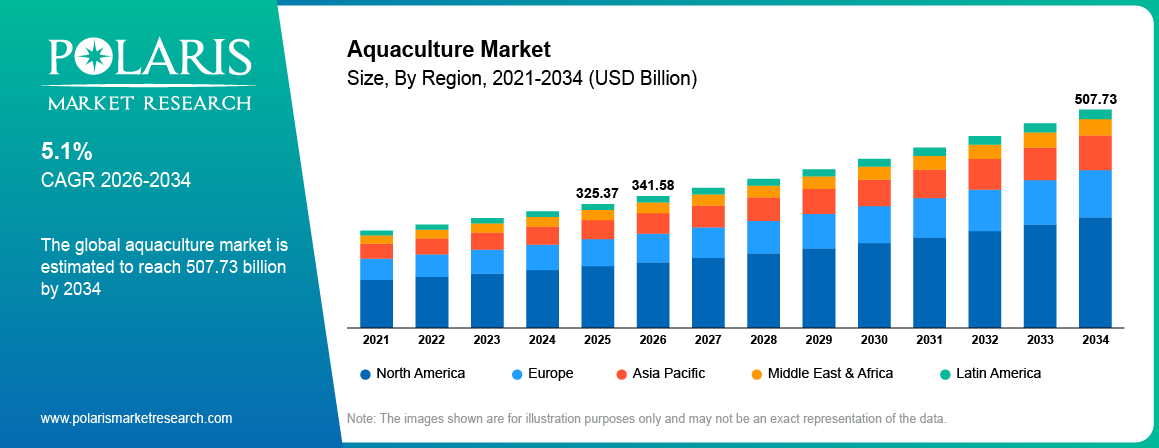
Drivers & Opportunities
Rising Global Seafood Consumption: Global consumption of seafood is rising owing to increasing preference among consumers for high-protein foods and healthy diets. According to OECD, the forecasted global average consumption of aquatic animals is expected to increase from 21.1 kg in 2022–2024 to 21.8 kg in 2034.The demand for seafood products like salmon fish, shrimp, tilapia, and shellfish keep on increasing in the hospitality, retail, and food processing industry. There has been a marked increase in seafood consumption in emerging nations owing to rising disposable incomes.
Technological Advancements in Aquaculture: Technology adoption is ensuring improved efficiency within commercial aquafarms. Technology adoption involves the use of AI-based monitoring solutions, automatic feeders, IoT sensors, and prediction analytics solutions to enhance feed conversion ratios and minimize mortality. In August 2025, DNV, a Norway-based company, introduced an AI-based compliance solution that helps automate reporting processes and ensure compliance among other benefits. These solutions help improve water quality monitoring and minimize dependency on manpower.
Restraints & Challenges
Disease Outbreaks and Environmental Risks: Outbreaks of diseases continue to be a major problem facing the aquaculture industry. Diseases caused by viruses, bacteria, and poor water quality results in great economic loss to the fish or shrimp farmers. In addition, environmental problems such as waste disposal and use of antibiotics are increasing the cost of compliance among exporting producers.
Opportunity
Expansion of Land-Based Aquaculture: Aquaculture farms based on land are receiving a lot of investment from various countries. According to Spheric Research, land-based aquaculture farms are generating a lot of interest among investors, who are anticipated to invest around USD 2 billion in 2025.Such farms offer better biosecurity, reduced disease risks, and allow for year-round seafood production. Recirculating aquaculture systems help reduce water consumption compared to traditional farming methods
Source: Polaris Market Research Analysis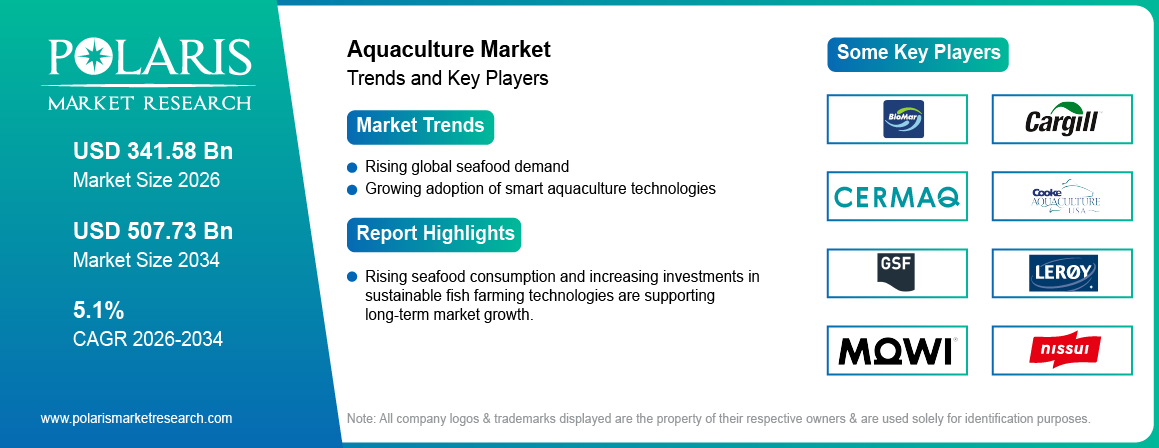
Segmental Insights
The report provides a comprehensive analysis of the aquaculture market by species, environment, and technology to pinpoint the key revenue generating and growth segments.
By Species
-
Fish
Fish segment dominated the market in 2025 with 81.3% share, due to strong global demand for salmon, carp, tilapia, catfish, and trout. Fish farming accounts for a major share of global aquaculture production due to large-scale farming operations across China, India, Norway, and Vietnam. Strong export demand and higher production volumes continue to support segment growth. Large commercial farms are also investing in production expansion.
-
Crustaceans
Crustaceans segment is projected to grow at the fastest CAGR of 5.4% during the forecast period due to rising global shrimp consumption. Countries such as India, Ecuador, Vietnam, and Thailand continue to expand shrimp farming operations to meet export demand. Shrimp Vannamei farming continues to generate huge profits due to shorter cycles. Shrimps' export is growing rapidly owing to the rising number of processing companies globally.
By Environment
-
Freshwater
The freshwater sector dominated the industry with 48.6% in 2025, due to low operational cost and easy scalability. Freshwater farming requires lower infrastructure investment compared to marine farming systems. Carp and catfish production remain highly concentrated across Asian countries. Strong domestic consumption continues to support production growth.
-
Marine
Marine segment is projected to grow at the fastest CAGR of 6.1% during the forecast period due to rising demand for premium seafood products. The salmon, oyster, mussel, and tuna have continued to be important products in marine aquaculture. Offshore farming systems are used by producers to increase their production capacities. The export demand is continuing to drive the growth of this segment.
By Technology
-
Traditional Aquaculture Systems
The traditional aquaculture systems segment is dominating the market with 95.0% in 2025, due to the relatively low capital investment needed. Pond culture and cage culture continue to be popular throughout the developing nations. Small-scale producers continue to rely on conventional farming infrastructure. These systems account for a large share of global seafood production.
-
Recirculating Aquaculture Systems (RAS)
Recirculating aquaculture systems segment is projected to grow at the fastest CAGR of 9.4% during the forecast period due to rising sustainability concerns. These techniques help in improving water utilization and minimizing environmental effects. The producers are incorporating the RAS system for biosecurity purposes. Thus, investment activity continues to rise globally.
Source: Polaris Market Research Analysis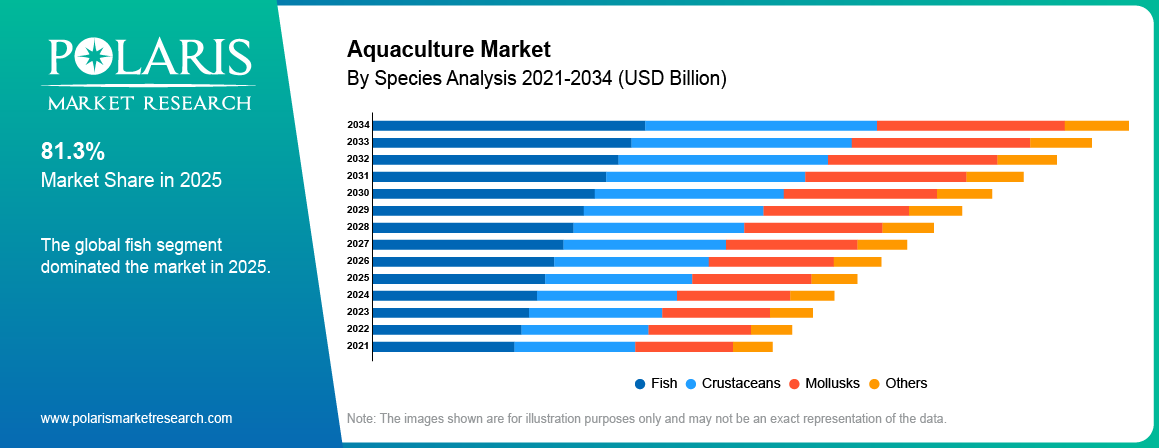
Regional Analysis
Asia Pacific Aquaculture Market Overview
Asia Pacific dominated the aquaculture market in 2025 capturing 51.3% due to large-scale seafood production across China, India, Vietnam, Indonesia, and Bangladesh. China maintains its position as the leading producer of aquaculture products due to high domestic consumption and efforts towards modernization by the government. Shrimp exports from India continue to grow into North America and Europe. India's Ministry of Commerce & Industry revealed that seafood exports reached a record USD 8.28 billion in FY 2025–26, driven by higher shipments of frozen shrimp, which generated USD 5.51 billion and remained the country’s largest export segment.
North America Aquaculture Market Insights
North America is projected to witness steady growth at a CAGR of 4.0% during the forecast period due to increasing investments in land-based salmon farming projects. In February 2026, Great Northern Salmon secured USD 2 million in Maine R&D funding to support construction of its land-based salmon farm and expand domestic aquaculture production capacity in the US. Also, the US and Canada are increasing investments in seafood traceability and domestic production to meet rising demand for sustainable seafood.
Europe Market Insights
Europe held second-largest market share of 12.3% in 2025, due to its dominance in salmon farming and seafood export. According to Eurostat, the production of aquaculture products in the EU amounted to 1.0 million tonnes worth about USD 5.4 billion in 2024. The major producers included Spain, France, Greece, and Italy, which contributed 64.6% of total production.Stringent environmental policies are promoting sustainable aquaculture. Companies are adopting innovative technologies in monitoring and management.
Latin America Market Trends
Latin America is experiencing a significant growth at a CAGR of 3.48% due to the increase in exports of shrimp from Ecuador and salmon from Chile. There have been investments in aquaculture facilities that export their products. Governments in Latin America are encouraging growth in the production of seafood. Global demand is driving opportunities in the region.
Source: Polaris Market Research Analysis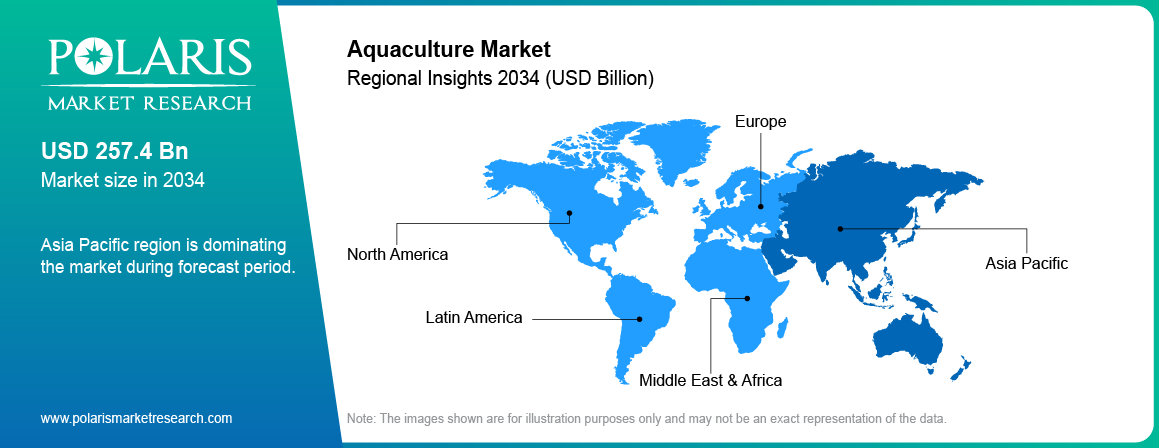
Competitive Landscape & Key Players
Aquaculture industry has moderate level of market fragmentation with the existence of global fishery firms, local aquaculture players, feed companies, and technology companies. Competitive dynamics in this industry revolve around factors such as production capacity, price competition, fish quality, sustainability practices, and export capabilities. Investments in automation, alliances, and expansion are made by firms in this industry.
The leading players involved in the industry include BioMar Group, Cargill Incorporated, Cermaq Group AS, Cooke Aquaculture Inc., Grieg Seafood ASA, Lerøy Seafood Group ASA, Mowi ASA, Nissui Corporation, Nutreco N.V., SalMar ASA, Thai Union Group PCL, Tassal Group Limited, and others.
Premium Insights
Blue Economy Investment Trends
Governments and private investors are making investments in aquaculture infrastructures with the objective of enhancing seafood production and easing pressure on the wild fishery industry. Offshore farms, processing plants, and expansion of the cold chain remain areas of interest to investors.
ESG-Linked Financing
Financial institutions are now investing in aquaculture firms that focus on sustainable feeds, waste management, and traceability systems. The ESG compliance has facilitated easier access to financing.
Smart Aquaculture Future
The use of AI-powered monitoring systems, automated feeding systems, and IoT-facilitated farm management systems has enhanced productivity among aquaculture farms. Land-based farming and alternative aquafeed are anticipated to facilitate growth.
Key Players
- BioMar Group
- Cargill Incorporated
- Cermaq Group AS
- Cooke Aquaculture Inc.
- Grieg Seafood ASA
- Lerøy Seafood Group ASA
- Mowi ASA
- Nissui Corporation
- Nutreco N.V.
- SalMar ASA
- Tassal Group Limited
- Thai Union Group PCL
Industry Developments
- April 2026: Biomar is increasing its R&D activities for barramundi and yellowtail kingfish aquaculture to create customized feeding solutions and enhance production efficiency with the growing demand for sustainable seafood. [source: biomar.com]
- May 2026: Innovasea introduced a new brand identity and restructured its leadership team to better align its aquaculture and fish tracking solutions with its sustainability-focused mission and support future growth. [source: innovasea.com]
Aquaculture Market Segmentation
By Species Outlook (Revenue, USD Billion, 2021-2034)
- Fish
- Crustaceans
- Mollusks
- Others
By Environment Outlook (Revenue, USD Billion, 2021-2034)
- Freshwater
- Marine
- Brackish Water
By Technology Outlook (Revenue, USD Billion, 2021-2034)
- Traditional Systems
- Recirculating Aquaculture Systems
- Offshore Aquaculture
By Regional Outlook (Revenue, USD Billion, 2021-2034)
- North America
- US
- Canada
- Europe
- Germany
- France
- UK
- Italy
- Spain
- Netherlands
- Russia
- Rest of Europe
- Asia Pacific
- China
- Japan
- India
- Malaysia
- South Korea
- Indonesia
- Australia
- Vietnam
- Rest of Asia Pacific
- Middle East & Africa
- Saudi Arabia
- UAE
- Israel
- South Africa
- Rest of Middle East & Africa
- Latin America
- Mexico
- Brazil
- Argentina
- Rest of Latin America
Aquaculture Market Report Scope
| Report Attributes | Details |
| Market Size in 2025 | USD 325.37 Billion |
| Market Size in 2026 | USD 341.58 Billion |
| Revenue Forecast by 2034 | USD 507.73 Billion |
| CAGR | 5.1% from 2026 to 2034 |
| Base Year | 2025 |
| Historical Data | 2021–2024 |
| Forecast Period | 2026–2034 |
| Quantitative Units | Revenue in USD Billion and CAGR from 2026 to 2034 |
| Report Coverage | Revenue Forecast, Competitive Landscape, Growth Factors, and Industry Trends |
| Segments Covered |
|
| Regional Scope |
|
| Competitive Landscape |
|
| Report Format |
|
| Customization | Report customization as per your requirements with respect to countries, regions, and segmentation. |
Source: Polaris Market Research Analysis
Aquaculture Market FAQ's
The global market size was valued at USD 325.37 Billion in 2025 and is projected to grow to USD 507.73 Billion by 2034.
Asia Pacific held dominating position in the market with 51.3% in 2025 owing to high production of seafood and domestic growth.
Major applications include food consumption, seafood processing, exports, and ornamental fish production.
A few of the key players in the market are BioMar Group, Cargill Incorporated, Cermaq Group AS, Cooke Aquaculture Inc., Grieg Seafood ASA, Lerøy Seafood Group ASA, Mowi ASA, Nissui Corporation, Nutreco N.V., SalMar ASA, Thai Union Group PCL, Tassal Group Limited, and others.
Growth is driven by rising seafood demand and increasing sustainable farming investments.
Fish dominated the market with 81.3% in 2025 due to high global production volumes.
Smart farming and land-based aquaculture are expected to support future growth.
Download Sample Report of Aquaculture Market
Please fill out the form to request a customized copy of the research report.


