
Baby Tech Market Overview Size, Share & Trends Analysis, 2026-2034
REPORT DETAILS
Baby Tech Market Summary
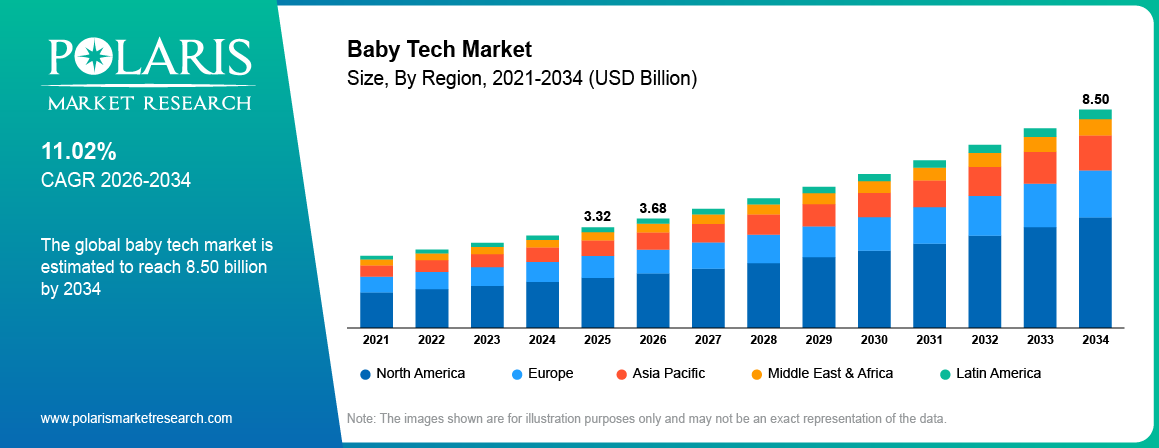
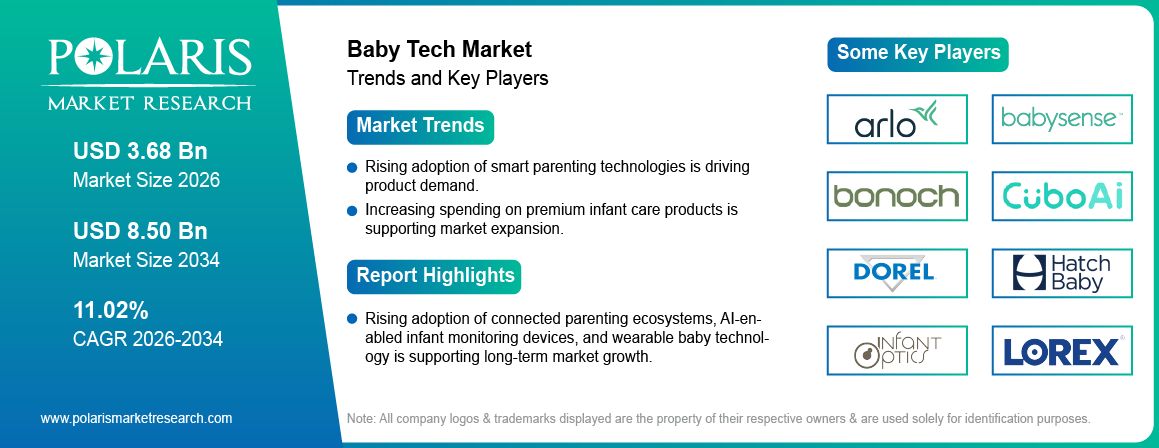
The global baby tech market is estimated around USD 3.32 Billion in 2025,with consistent growth anticipated during 2026–2034. This growth is driven by rising adoption of smart parenting solutions, increasing demand for AI-enabled infant monitoring devices, and growing spending on connected nursery products. The market is projected to grow at a CAGR of 11.02% during the forecast period.
Market Statistics
Key Takeaways
- North America dominated the market in 2025 capturing 37.0% share, due to high smart home adoption and increasing spending on premium parenting products.
- Smart baby monitors segment dominated the market in 2025 with 39.0% share, due to rising demand for real-time infant monitoring solutions.
- Wi-Fi enabled devices dominated the market in 2025 capturing 54.0% share, driven by increasing adoption of app-connected parenting ecosystems.
- Wearable baby devices are projected to grow at the fastest CAGR of 12.5% during the forecast period, owing to rising demand for biometric infant tracking solutions.
- Major companies operating in the market include Arlo Technologies, Inc., Babysense, Bonoch, CuboAi, Dorel Industries Inc., and others.
Industry Dynamics
- Rising adoption of smart parenting technologies is driving market growth.
- Increasing spending on premium infant care products is supporting product demand.
- Cybersecurity and infant data privacy concerns are limiting market expansion.
- Expansion of AI-enabled infant analytics platforms is creating new growth opportunities.
What is the Baby Tech Market?
Baby technology includes connected products and digital solutions designed for infant monitoring, healthcare, feeding, sleep tracking, and parental convenience. The market includes smart baby monitors, wearable infant devices, connected feeding systems, smart bassinets, and mobile parenting applications. These devices allow parents to track activities, health status, movements, and sleeping patterns of their infants.
The baby tech industry consists of component suppliers, sensor manufacturers, artificial intelligence software providers, device manufacturers, e-commerce retailers, distributors, and end users. The firms create artificial intelligence-assisted parenting products and connected nursery products. The companies make use of smartphone connectivity and smart home technology.
Source: Polaris Market Research Analysis
This growth in the market is attributed to the increasing trend of urbanization, rising usage of smartphones, and growing awareness about infant safety. There is an increasing trend among millennials and Gen Z parents to adopt connected parenting products. The increasing use of AI, IoT, and cloud technology is contributing towards market growth.
Drivers & Opportunities
Rising Adoption of Smart Parenting Technologies is Driving Market Growth: The growing popularity of smart home ecosystems is contributing to the rise in the demand for connected parenting solutions and baby monitors. According to CEDIA, the US smart home market was valued at approximately USD 29 billion in 2024, and there are promising growth prospects in the coming year. Furthermore, the rising inclination towards remote monitoring and smartphone-enabled parenting apps is fueling product adoption.
Growing Premiumization of Infant Care Products is Supporting Market Expansion: The urban population is opting for luxury baby care products and advanced baby monitors. Smart baby products, including smart baby bassinets, wearable trackers for babies, and AI-based baby feeders are used to make life easy for parents. The companies are manufacturing luxury baby technologies that offers subscription-based analytics systems as well as app-based parenting ecosystems. In April 2024, Elora launched an AI-based baby wellness monitor that is based on smartwatch technology.
Restraints & Challenges
Cybersecurity and Data Privacy Concerns are Limiting Market Growth: The connected baby devices capture audio, video, and biometric information that have raised concerns over cybersecurity and data privacy. The weak encryption methods and insecure IoT connections pose threats to hacking and other forms of security breaches. Compliance issues surrounding the collection of infant data and cloud storage processes are posing challenges to device manufacturers.
Opportunity
AI-Based Infant Analytics Platforms are Creating New Growth Opportunities: AI technologies are utilized to enable the development of predictive infant monitoring and behavioral analysis systems. AI systems have the capability to monitor the movement, sleep patterns, oxygen levels, and breathing rate of infants in real-time. In June 2024, Ellie introduced the world’s first non-Wi-Fi baby monitor named Ellie Baby Plus, which includes features like AI-based safety and sleep monitoring. The healthcare industry and parenting technology firms are further considering the implementation of neonatal monitoring systems with telehealth services.
Source: Polaris Market Research Analysis
Segmental Insights
The report presents an extensive analysis of the baby tech market based on factors such as type of product, connectivity, distribution channel, and end user in order to understand the most profitable and lucrative segments.
By Product
-
Smart Baby Monitors
The smart baby monitors led the market in 2025 with 39.0% share due to the growing need for real-time monitoring of babies and parental connection devices. Smart baby monitors have features like HD video feed, motion sensing, baby crying detection, sleep monitoring, and connection to smartphones. Parents have begun using AI-powered baby monitors more frequently.
-
Wearable Baby Devices
Wearable baby devices are estimated to have the highest CAGR of 12.5% over the forecast period on account of increasing need for biometric monitoring systems for infants. Socks, breathing monitors, and wearable tracking devices assist in monitoring the level of oxygen, heartbeat, sleep patterns, and movement of infants. Increasing awareness about the prevention of sudden infant death syndrome is driving the growth of the segment.
By Connectivity
-
Wi-Fi Enabled Devices
Wi-Fi enabled devices led the market with 54.0% share in 2025 on account of the increasing preference for app-enabled infant monitoring ecosystems. These devices enable remote access, centralized monitoring, and cloud synchronization of data on multiple devices. There is an increasing consumer preference for connected nursery products.
-
Bluetooth Devices
The Bluetooth devices segment is expected to maintain a constant growth rate of 11.0% in the forecast period on account of low costs and easy connectivity. The popularity of such products remains high among price-sensitive consumers who need wireless baby monitors. Energy-efficient Bluetooth baby care products are developed by manufacturers.
By Distribution Channel
-
Online Retail
Online retail have accounted for the major market share valued at 60.0% in 2025 due to the growing popularity of online stores and increasing preference for premium parenting brands. Consumers increasingly purchase connected nursery products through digital platforms owing to convenience and wider product availability. Social commerce and influencer-driven marketing are also supporting online product sales.
-
Offline Retail
Offline retail is projected to grow at the fastest CAGR of 9.5% during the forecast period owing to increasing consumer preference for physical product demonstrations and in-store purchasing experience. Retail stores help consumers compare product quality, connectivity features, and monitoring capabilities before purchase. Premium parenting brands are further extending their reach through retail collaborations across the globe.
By End User
-
Residential Users
Residential users dominated the market share of 74.0% in 2025 owing to the growing demand for connected parenting products among urban families. There is a growing inclination among parents to utilize artificial intelligence-based monitoring devices, wearable products for infants, and smart nursery ecosystems. Rising smartphone penetration and smart home adoption are supporting segment growth.
-
Healthcare Providers
Healthcare providers are projected to grow at the fastest CAGR of 11.5% during the forecast period owing to increasing use of neonatal monitoring systems and remote infant healthcare platforms. Hospitals and pediatric care centers are adopting connected monitoring devices to improve infant care and patient monitoring efficiency. Growing telehealth integration is also supporting segment expansion.
Source: Polaris Market Research Analysis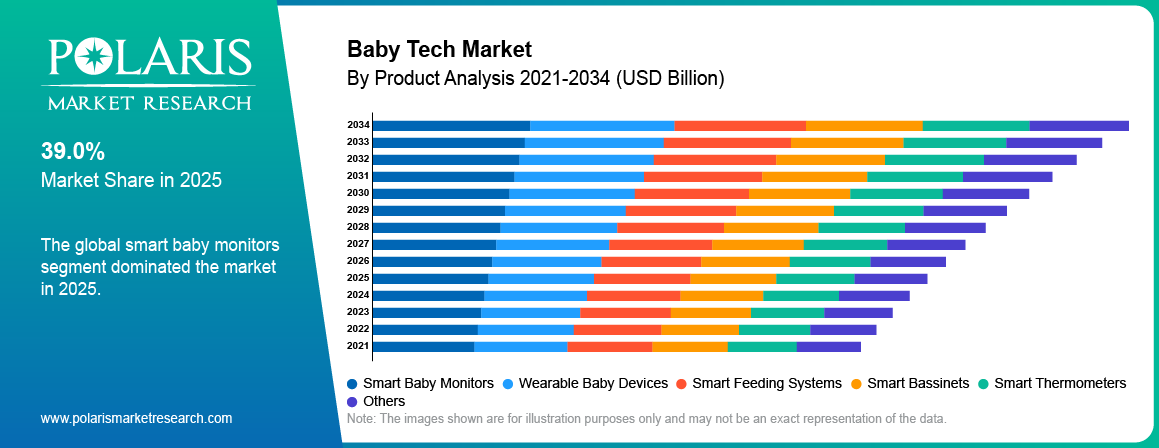
Regional Analysis
North America Baby Tech Market Assessment
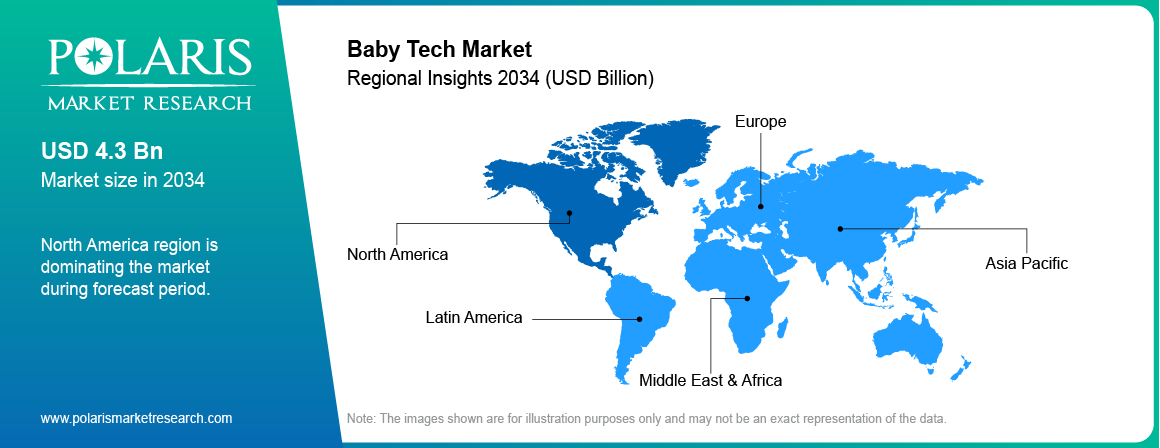
North America baby tech market dominated the global market capturing 37.0% share in 2025 driven by high smart home penetration, strong consumer spending, and increasing adoption of connected parenting technologies. The US remains the leading country in the region owing to rising demand for AI-based infant monitoring devices and wearable baby products. Growing awareness regarding infant safety and increasing spending on premium childcare products are supporting regional market expansion. In May 2026, Momcozy launched its maternal care products at ABC Kids Expo 2026, such as wearable breast pumps, baby monitors, and wellness solutions to make life convenient for mothers.
Asia Pacific Baby Tech Market Insights
Asia Pacific baby tech market is projected to grow at the fastest CAGR of 13.5% during the forecast period due to rising urbanization, growing middle-class population, and increasing smartphone adoption. People Research on India's Consumer Economy stated that India’s middle-class population is projected to rise from 31% in 2020-21 to 61% by 2047, supported by economic reforms and steady GDP growth.Countries such as China, India, Japan, and South Korea are witnessing increasing demand for wearable infant devices and smart nursery products. The growth of online retail and disposable income is helping the market expand in the region.
Europe Baby Tech Market Overview
Europe baby tech market had a substantial market share of 29.0% in 2025 owing to an increase in the demand for high-quality baby care products and a rising emphasis on safety norms of infants. Countries like Germany, UK, and France have seen a rise in the installation of connected nursery devices and artificial intelligence baby monitors. Development in smart homes and digital parenting trends are contributing towards market growth. In August 2024, Ontex introduced Dreamshield 360° baby pants technology in Europe, providing better leak protection and comfort to babies.
Latin America Baby Tech Market Overview
Latin America baby tech market is witnessing steady growth at a CAGR of 11.0% owing to increasing adoption of connected parenting products and rising awareness regarding infant healthcare monitoring. Brazil, Mexico, and Argentina are witnessing growing demand for smart baby monitors and connected feeding systems. Expanding e-commerce infrastructure and rising urban parenting trends are supporting regional market development.
Middle East & Africa Baby Tech Market Overview
Middle East & Africa baby tech market is experiencing gradual growth at a CAGR of 10.5% driven by increasing smart home adoption and rising spending on premium infant care products. UAE, Saudi Arabia, and South Africa are witnessing increasing deployment of connected nursery products and wearable infant devices. In October 2025, Grownsy partnered with Trucare to launch smart baby care innovations across GCC markets, expanding access to connected parenting solutions in the region.
Source: Polaris Market Research Analysis
Competitive Landscape
The baby tech market has a moderate level of fragmentation owing to the existence of consumer electronics firms operating internationally and regional firms in the parenting technology segment. The competition in the market is determined by innovations, AI adoption, connectivity, pricing, and distribution channels. The firms are concentrating on collaboration, product launch, mobile applications integration, and connected parenting ecosystem expansion.
The prominent players operating in the baby tech market include Arlo Technologies, Inc., Babysense, Bonoch, CuboAi, Dorel Industries Inc., Hatch Baby, Inc., iBaby Labs, Inc., Infant Optics, Lorex Technology Inc., Motorola Solutions, Nanit, Owlet Baby Care Inc., Panasonic Holdings Corporation, Philips N.V., Samsung Electronics Co., Ltd., and others.
Premium Insights
Integrated Parenting Ecosystems are Supporting Market Expansion
There is a trend towards the development of connected parenting ecosystems that integrate infant monitoring, sleep analysis, feeding analysis, and healthcare into one system. AI analytics, wearables for infants, and telemedicine are some of the factors expected to drive the market in the future.
Baby technology has been gaining more importance among investors owing to the increasing demand for connectivity in nursery products, home automation, and infant healthcare solutions. The growing use of artificial intelligence in parenting platforms has further fueled the potential of future markets.
Key Players
- Arlo Technologies, Inc.
- Babysense
- Bonoch
- CuboAi
- Dorel Industries Inc.
- Hatch Baby, Inc.
- iBaby Labs, Inc.
- Infant Optics
- Lorex Technology Inc.
- Motorola Solutions
- Nanit
- Owlet Baby Care Inc.
- Panasonic Holdings Corporation
- Philips N.V.
- Samsung Electronics Co., Ltd.
Industry Developments
- May 2026: Hubble Connected partnered with Kodak to launch a connected family technology ecosystem across baby, kids, and pet categories through the Kodak HubbleClub app. [source prnewswire.com]
- June 2025: Yoomi BabyTech launched a patented self-heating baby feeding technology designed to improve bottle-feeding convenience and support breastfeeding recovery. [source: prnewswire.com]
Baby Tech Market Segmentation
By Product Outlook (Revenue, USD Billion, 2021–2034)
- Smart Baby Monitors
- Wearable Baby Devices
- Smart Feeding Systems
- Smart Bassinets
- Smart Thermometers
- Others
By Connectivity Outlook (Revenue, USD Billion, 2021–2034)
- Wi-Fi Enabled Devices
- Bluetooth Devices
- Hybrid Connectivity
By Distribution Channel Outlook (Revenue, USD Billion, 2021–2034)
- Online Retail
- Offline Retail
By End User Outlook (Revenue, USD Billion, 2021–2034)
- Residential Users
- Healthcare Providers
- Daycare Centers
- Others
By Regional Outlook (Revenue, USD Billion, 2021-2034)
- North America
- US
- Canada
- Europe
- Germany
- France
- UK
- Italy
- Spain
- Netherlands
- Russia
- Rest of Europe
- Asia Pacific
- China
- Japan
- India
- Malaysia
- South Korea
- Indonesia
- Australia
- Vietnam
- Rest of Asia Pacific
- Middle East & Africa
- Saudi Arabia
- UAE
- Israel
- South Africa
- Rest of Middle East & Africa
- Latin America
- Mexico
- Brazil
- Argentina
- Rest of Latin America
Baby Tech Market Report Scope
| Report Attributes | Details |
| Market Size in 2025 | USD 3.32 Billion |
| Market Size in 2026 | USD 3.68 Billion |
| Revenue Forecast by 2034 | USD 8.50 Billion |
| CAGR | 11.02% from 2026 to 2034 |
| Base Year | 2025 |
| Historical Data | 2021–2024 |
| Forecast Period | 2026–2034 |
| Quantitative Units | Revenue in USD Billion and CAGR from 2026 to 2034 |
| Report Coverage | Revenue Forecast, Competitive Landscape, Growth Factors, and Industry Trends |
| Segments Covered |
|
| Regional Scope |
|
| Competitive Landscape |
|
| Report Format |
|
| Customization | Report customization as per your requirements with respect to countries, regions, and segmentation. |
Source: Polaris Market Research Analysis
Baby Tech Market FAQ's
The global market size was valued at USD 3.32 Billion in 2025 and is projected to reach USD 8.50 Billion by 2034 at a CAGR of 11.02%.
North America held the highest share of 37.0% in 2025 owing to high smart home penetration rates and increasing investment in smart parenting products.
Major companies operating in the market include Arlo Technologies, Inc., Babysense, Bonoch, CuboAi, Dorel Industries Inc., Hatch Baby, Inc., iBaby Labs, Inc., Infant Optics, Lorex Technology Inc., Motorola Solutions, Nanit, Owlet Baby Care Inc., Panasonic Holdings Corporation, Philips N.V., Samsung Electronics Co., Ltd., and others.
Smart baby monitors dominated the market in 2025 with 39.0% share driven by increasing demand for real-time infant monitoring solutions.
The growing use of smart parenting technologies and artificial intelligence in infant monitoring systems is fueling the market growth.
Asia Pacific is projected to grow at the fastest CAGR of 13.5% during the forecast period owing to rising urbanization and smartphone adoption.
The market outlook remains positive due to rising AI integration, wearable infant monitoring adoption, and expansion of connected parenting ecosystems.
Download Sample Report of Baby Tech Market
Please fill out the form to request a customized copy of the research report.


