
Cell Culture Matrices Market Trends, Growth and Overview – 2026-2034
REPORT DETAILS
Cell Culture Matrices Market Summary
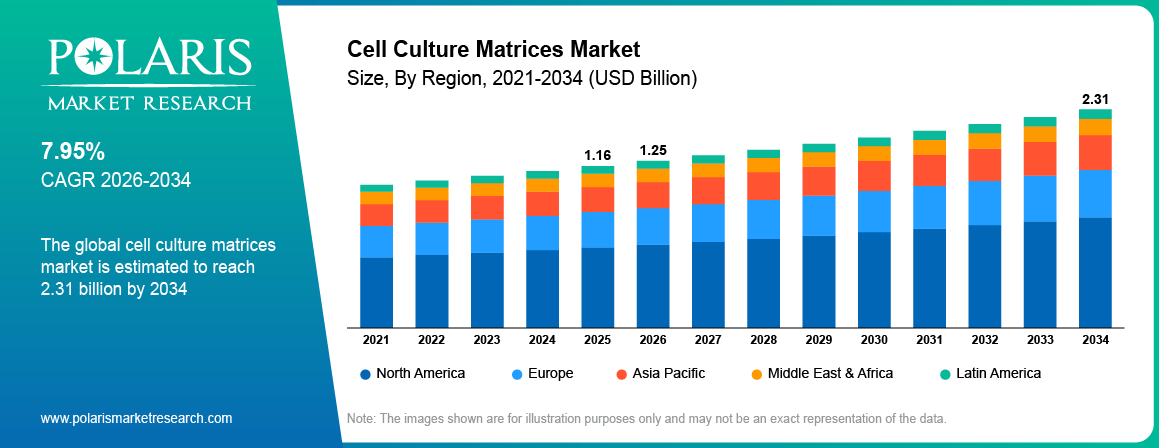
The global cell culture matrices market is estimated around USD 1.16 Billion in 2025,with consistent growth anticipated during 2026–2034. Rising adoption of 3D cell culture systems, growing stem cell research activities, and increasing investments in regenerative medicine are supporting market expansion. The market is projected to grow at a CAGR of 7.95% during the forecast period.
Market Statistics
Key Takeaways
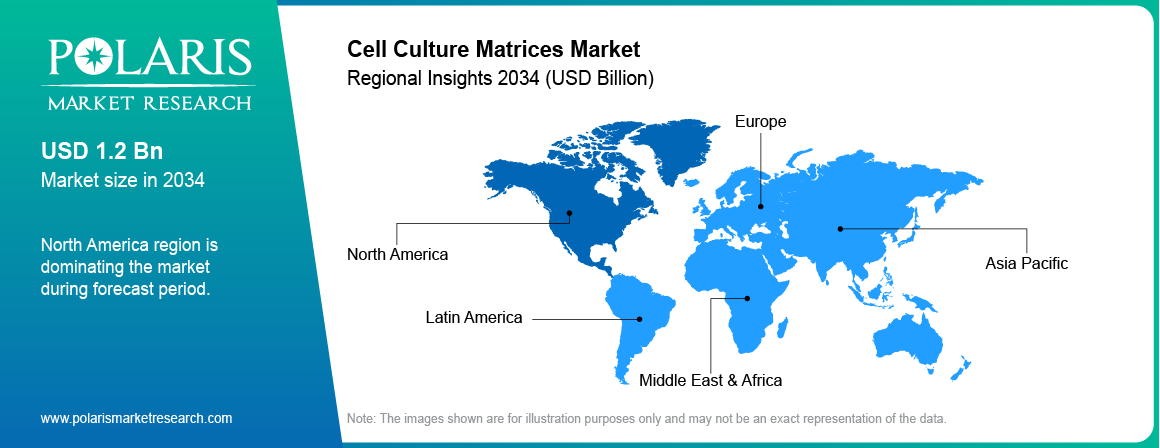
- North America dominated the market in 2025 capturing 39.0% due to advanced biotechnology infrastructure and strong regenerative medicine investments.
- Natural matrices segment dominated the market with 64.0% in 2025 due to strong adoption across stem cell and oncology research activities.
- Pharmaceutical & biotechnology companies dominated the market with 46.0% in 2025 driven by increasing investments in biologics and precision medicine research.
- Synthetic matrices segment is projected to grow at the fastest CAGR of 9.2% during the forecast period owing to rising demand for reproducible and scalable culture systems.
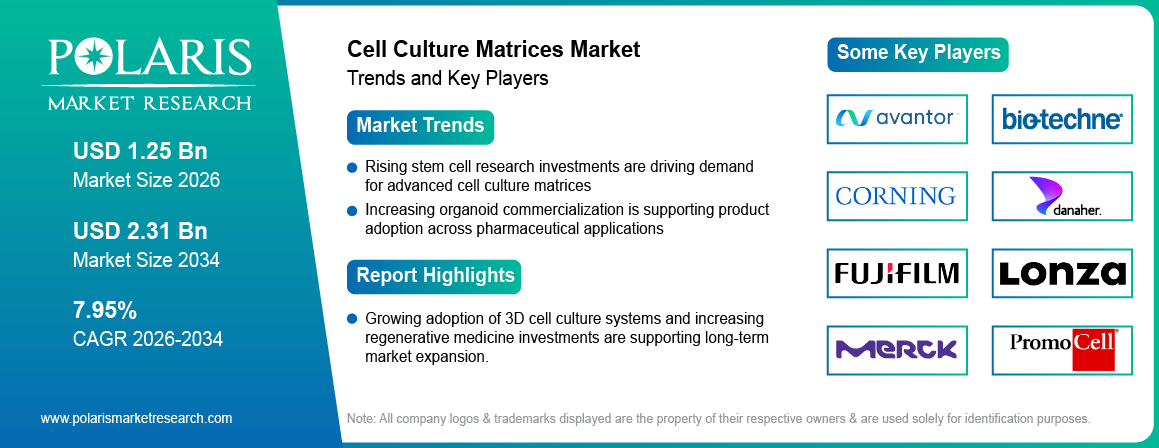
- Major companies operating in the market include Avantor, Inc., Bio-Techne Corporation, Corning Incorporated, Danaher Corporation, FUJIFILM Holdings Corporation, and others.
Industry Dynamics
- Rising stem cell research investments are driving market growth.
- Increasing adoption of 3D cell culture systems is supporting product demand.
- Reproducibility challenges in natural matrices are limiting market expansion.
- AI-driven biomaterial engineering is creating new growth opportunities.
What is the Cell Culture Matrices Market?
Cell culture matrices are biomaterials used to support cell growth, differentiation, and tissue development in laboratory environments. These matrices help mimic natural extracellular environments and are widely used across regenerative medicine, oncology research, tissue engineering, and drug discovery applications. The common products in this industry include collagen matrices, hydrogels, peptide scaffolds, and polymer-based products.
The players in the industry include raw material providers, biomaterial producers, biotechnology companies, pharmaceutical companies, distributors, and research institutions. The matrix producers manufacture natural and synthetic biomaterials for use in cell cultures. These products are used by pharmaceutical companies, academic labs, CROs, and regenerative medicine clinics.
Source: Polaris Market Research Analysis
The market is witnessing growth owing to the rise in investment in stem cell therapy research, rise in demand for organoids, and increasing usage of precision medicine platforms. The adoption of three-dimensional culture platforms by the pharmaceutical companies has increased to enhance the drug screening process and decrease the reliance on animal models for testing purposes.
Drivers & Opportunities
Expansion of Stem Cell Research is Driving Market Growth: Rising investment in stem cell therapy and regenerative medicines is increasing consistently within the healthcare and biotechnology sectors. Advanced cell culture matrices have been adopted by research organizations and pharmaceutical companies to enhance the process of stem cell differentiation and tissue regeneration. For example, in May 2026, FUJIFILM Biosciences and NextCell Pharma introduced a commercial platform based on the usage of stromal cells and cell culture medium.
Rising Adoption of 3D Cell Culture Models is Accelerating Product Demand: There is a growing tendency in pharmaceutical companies towards 3D culture systems owing to the drawbacks related to conventional 2D cell cultures. In October 2025, REPROCELL introduced its innovative platform for generating 3D engineered tissues, which helps to advance cell culture studies. Advanced matrices improve biological accuracy and support better disease modeling and oncology drug testing. Rising use of organoid-based drug discovery platforms is increasing demand for high-performance biomimetic matrices globally.
Restraints & Challenges
High Cost of Advanced Biomaterials is Limiting Market Expansion: Expensive manufacturing and development processes characterize the production of artificial matrices and biomimetic scaffolds. Research laboratories and universities tend to have financial constraints when using expensive culture systems on a large scale. Variability between batches of natural matrices is another challenge that hinders pharmaceutical and biotechnology companies.
Opportunity
AI-Based Biomaterial Engineering is Creating New Growth Opportunities: AI technologies have been used in the design of biomaterials and optimization of scaffolds in regenerative medicine applications. AI-powered systems assist the manufacturers in improving the structure, mechanical properties, and consistency of the matrix. Rising integration of bioprinting technologies and AI-assisted biomaterials is expected to create new commercial opportunities during the forecast period. For instance, in August 2025, the NSF renewed a USD 19.8 million program led by UCSB and UCLA to advance AI-driven biomaterials research for next-generation cell culture and bioengineering applications.
Source: Polaris Market Research Analysis
Segmental Insights
The report provides a comprehensive analysis of the cell culture matrices market by type, application, end user to identify key revenue generating and high-growth segments.
By Type
-
Natural Matrices
Natural matrices dominated the market in 2025 with 64.0% due to strong biological compatibility and extensive use across stem cell and oncology research. Products including collagen, laminin, and fibrin matrices remain widely adopted for organoid development and tissue engineering applications. Pharmaceutical and academic institutions continue increasing adoption of natural extracellular matrix systems.
-
Synthetic Matrices
Synthetic matrices segment is projected to grow at the fastest CAGR of 9.2% during the forecast period owing to increasing demand for scalable and reproducible biomaterials. Synthetic hydrogels and polymer-based matrices provide controlled mechanical properties and lower contamination risks. Growing use of GMP-grade synthetic matrices in cell therapy manufacturing is supporting segment growth.
By Application
-
Oncology Research
Oncology research dominated the market in 2025 with 22.0% share driven by rising adoption of tumor organoids and precision oncology models. Advanced matrices help researchers replicate tumor microenvironments and improve cancer drug screening processes. Pharmaceutical companies are increasing investments in organoid-based cancer research platforms globally.
-
Stem Cell Research
Stem cell research segment is projected to grow at the fastest CAGR of 9.0% during the forecast period owing to rising regenerative medicine investments and increasing tissue engineering activities. Matrices supporting pluripotent stem cell growth and differentiation are witnessing strong demand across biotechnology companies and academic institutions.
By End User
-
Pharmaceutical & Biotechnology Companies
Pharmaceutical & biotechnology companies dominated the market in 2025 with 46.0% due to growing investments in biologics development and precision medicine research. These firms have started using innovative cell culture matrices for improving drug discovery and facilitating organoids commercialization initiatives.
-
Academic & Research Institutes
Academic & research institutes segment is projected to grow at the fastest CAGR of 7.2% during the forecast period owing to rising government funding for stem cell research and regenerative medicine projects. Universities and public research laboratories are expanding research activities involving tissue engineering and advanced biomaterials.
Source: Polaris Market Research Analysis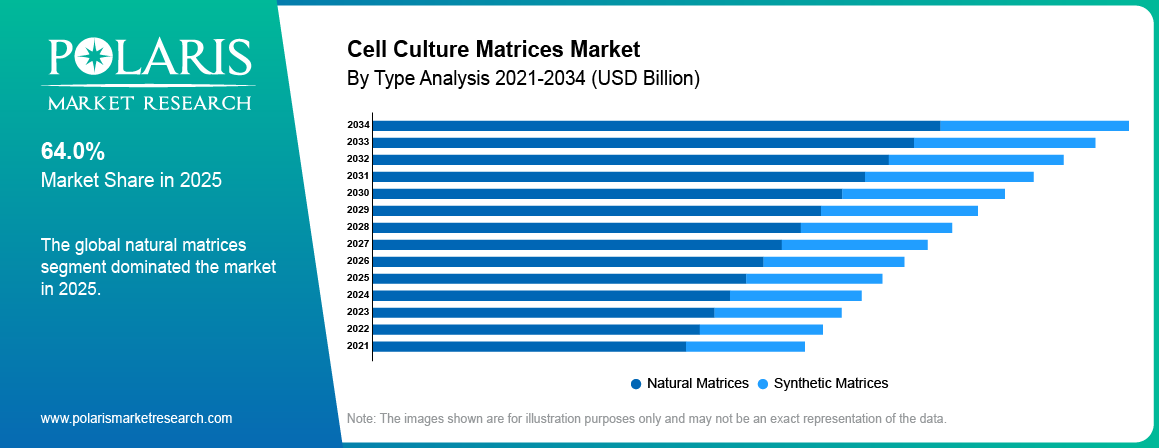
Regional Analysis
North America Cell Culture Matrices Market Assessment
North America dominated the global market in 2025 capturing 39.0% share driven by strong biotechnology infrastructure, rising NIH funding, and increasing regenerative medicine research activities. The US remains the leading country in the region due to growing organoid research and advanced pharmaceutical development capabilities. Rising adoption of 3D culture systems across pharmaceutical companies is supporting regional market growth. In February 2026, TheWell Bioscience has introduced VitroPrime – a 3D culture and imaging plate for optimizing 3D cell culture workflows including organoids.
Europe Cell Culture Matrices Market Overview
Europe had a considerable market share of 29.0% in 2025 due to rising government initiatives towards biotech innovations and regenerative medicine studies. Nations such as Germany, the UK, and France have been investing more in tissue engineering and bio-materials research. Increasing academic partnerships and precision medicine studies are fueling regional demand. In April 2026, BioLamina secured approximately USD 22.7 million in EIB financing to expand laminin-based cell culture technologies for next-generation cell therapy development.
Asia Pacific Cell Culture Matrices Market Insights
Asia Pacific is projected to grow at the fastest CAGR of 10.5% during the forecast period due to expanding biotechnology manufacturing and rising pharmaceutical outsourcing activities. According to the Department of Biotechnology (DBT), India’s bio-economy grew from USD 10 billion in 2015 to USD 130 billion in 2024 and is projected to reach USD 300 billion by 2030.China, Japan, South Korea, and India are increasing investments in stem cell research and regenerative medicine infrastructure. Growing demand for advanced drug discovery platforms is supporting regional market expansion.
Source: Polaris Market Research Analysis
Competitive Landscape
Key Players & Competitive Strategies
The cell culture matrices market is moderately fragmented due to the presence of global biomaterial manufacturers and regional suppliers. Competition is based on product quality, reproducibility, pricing, and innovation capabilities. Companies are focusing on synthetic matrix development, strategic collaborations, manufacturing expansion, and AI-driven biomaterial engineering to strengthen their market presence.
The prominent players operating in the field of cell culture matrices market include Avantor, Inc., Bio-Techne Corporation, Corning Incorporated, Danaher Corporation, FUJIFILM Holdings Corporation, Lonza Group AG, Merck KGaA, PromoCell GmbH, Sartorius AG, STEMCELL Technologies Inc., Thermo Fisher Scientific Inc., and Trevigen, Inc., and others.
Premium Insights – Future Trends
AI-Driven Biomaterial Engineering: AI-assisted biomaterial design is improving matrix reproducibility and scaffold optimization across regenerative medicine applications.
Organoid Commercialization: Growing adoption of organoid-based drug discovery is increasing demand for advanced and scalable cell culture matrices.
Bioprinting Integration: The expansion of 3D bioprinting technology has led to an increase in demand for bioink compatible hydrogels and scaffold systems.
Synthetic Matrices GMP-grade: Biotechnology firms have increased their efforts towards GMP-grade synthetic matrices because of their scalability and consistency.
Biomimetic ECM Platforms: Precision oncology and personalized medicine programs are driving the uptake of biomimetic ECM platforms.
Key Players
- Avantor, Inc.
- Bio-Techne Corporation
- Corning Incorporated
- Danaher Corporation
- FUJIFILM Holdings Corporation
- Lonza Group AG
- Merck KGaA
- PromoCell GmbH
- Sartorius AG
- STEMCELL Technologies Inc.
- Thermo Fisher Scientific Inc.
- Trevigen, Inc.
Industry Developments
- February 2026: Bio-Techne expanded its cell culture matrices portfolio with a fully defined synthetic hydrogel for scalable 3D stem cell and organoid culture. [source: bio-techne.com]
- May 2026: Medix Biochemica invested USD 5 million to expand recombinant antigen and cell culture capabilities for scalable and consistent IVD raw material production. [source: medixbiochemica.com]
Cell Culture Matrices Market Segmentation
By Type Outlook (Revenue, USD Billion, 2021–2034)
- Natural Matrices
- Synthetic Matrices
By Application Outlook (Revenue, USD Billion, 2021–2034)
- Oncology Research
- Stem Cell Research
- Drug Discovery & Toxicology
- Tissue Engineering
- Regenerative Medicine
- Others
By End User Outlook (Revenue, USD Billion, 2021–2034)
- Pharmaceutical & Biotechnology Companies
- Academic & Research Institutes
- Contract Research Organizations
- Hospitals & Diagnostic Laboratories
- Others
By Regional Outlook (Revenue, USD Billion, 2021-2034)
- North America
- US
- Canada
- Europe
- Germany
- France
- UK
- Italy
- Spain
- Netherlands
- Russia
- Rest of Europe
- Asia Pacific
- China
- Japan
- India
- Malaysia
- South Korea
- Indonesia
- Australia
- Vietnam
- Rest of Asia Pacific
- Middle East & Africa
- Saudi Arabia
- UAE
- Israel
- South Africa
- Rest of Middle East & Africa
- Latin America
- Mexico
- Brazil
- Argentina
- Rest of Latin America
Cell Culture Matrices Market Report Scope
| Report Attributes | Details |
| Market Size in 2025 | USD 1.16 Billion |
| Market Size in 2026 | USD 1.25 Billion |
| Revenue Forecast by 2034 | USD 2.31 Billion |
| CAGR | 7.95% from 2026 to 2034 |
| Base Year | 2025 |
| Historical Data | 2021–2024 |
| Forecast Period | 2026–2034 |
| Quantitative Units | Revenue in USD Billion and CAGR from 2026 to 2034 |
| Report Coverage | Revenue Forecast, Competitive Landscape, Growth Factors, and Industry Trends |
| Segments Covered |
|
| Regional Scope |
|
| Competitive Landscape |
|
| Report Format |
|
| Customization | Report customization as per your requirements with respect to countries, regions, and segmentation. |
Source: Polaris Market Research Analysis
Cell Culture Matrices Market FAQ's
The global market size was valued at USD 1.16 Billion in 2025 and is projected to reach USD 2.31 Billion by 2034 at a CAGR of 7.95%.
North America dominated the market in 2025 with 39.0% share owing to strong regenerative medicine investments and advanced biotechnology infrastructure.
Major companies operating in the market include Avantor, Inc., Bio-Techne Corporation, Corning Incorporated, Danaher Corporation, FUJIFILM Holdings Corporation, Lonza Group AG, Merck KGaA, PromoCell GmbH, Sartorius AG, STEMCELL Technologies Inc., Thermo Fisher Scientific Inc., and Trevigen, Inc., and others.
Natural matrices dominated the market in 2025 with 64.0% share due to strong biological compatibility and rising organoid research adoption.
Rising stem cell research investments, increasing organoid development, and growing demand for 3D cell culture systems are driving market growth.
Stem cell research is projected to grow at the fastest CAGR of 9.0% during the forecast period.
The market outlook remains positive due to increasing precision medicine adoption, regenerative therapy development, and AI-driven biomaterial innovation.
Download Sample Report of Cell Culture Matrices Market
Please fill out the form to request a customized copy of the research report.


