
Corrosion Resistant Resin Market Share, Growth & Industry Report, 2026-2034
REPORT DETAILS
Corrosion Resistant Resin Market Summary
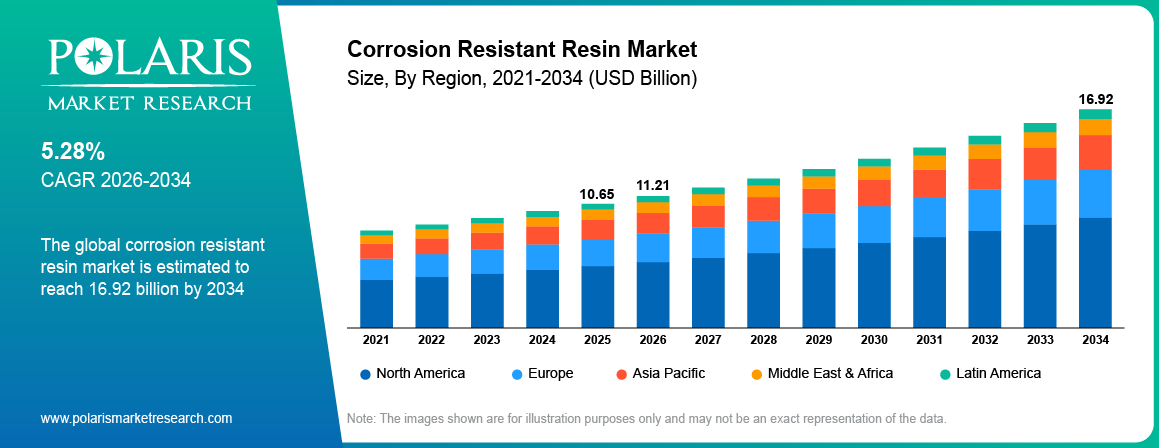
The global corrosion resistant resin market size was valued at USD 10.65 billion in 2025, exhibiting a CAGR of 5.28% from 2026 to 2034. The market is driven by rising demand for durable, low-maintenance materials across expanding infrastructure, automotive, marine, and chemical industries.
Market Statistics
Corrosion Resistant Resin Market Key Takeaways
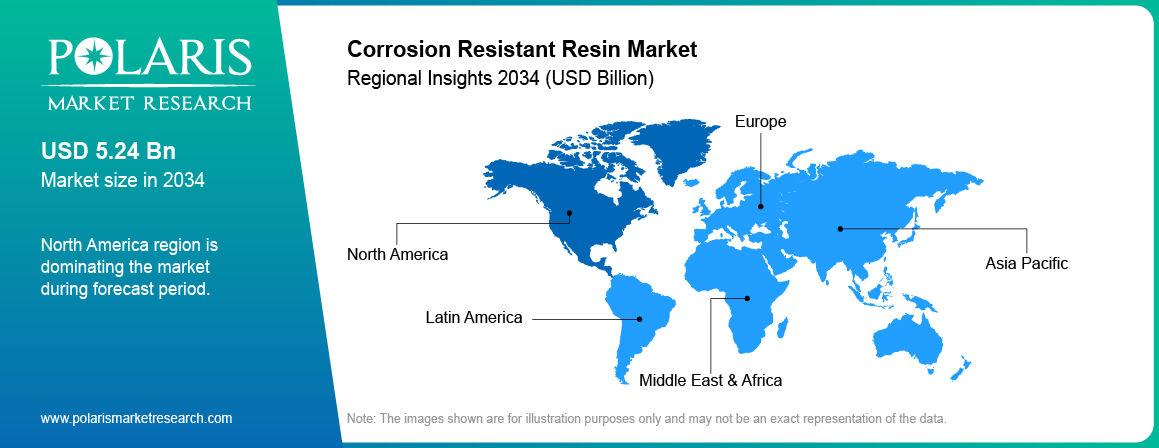
- North America leads the market with 31.0% share in 2025, driven by its expanding automotive sector and demand for corrosion-resistant materials.
- Asia Pacific is registering high growth at a CAGR of 7.43% during the forecast period, due to rapid industrialization and increased investment in the chemical and oil & gas sectors.
- The epoxy segment held 34.0% share in 2025 due to its excellent durability, adhesion, and resistance to chemicals, making it suitable for harsh environments.
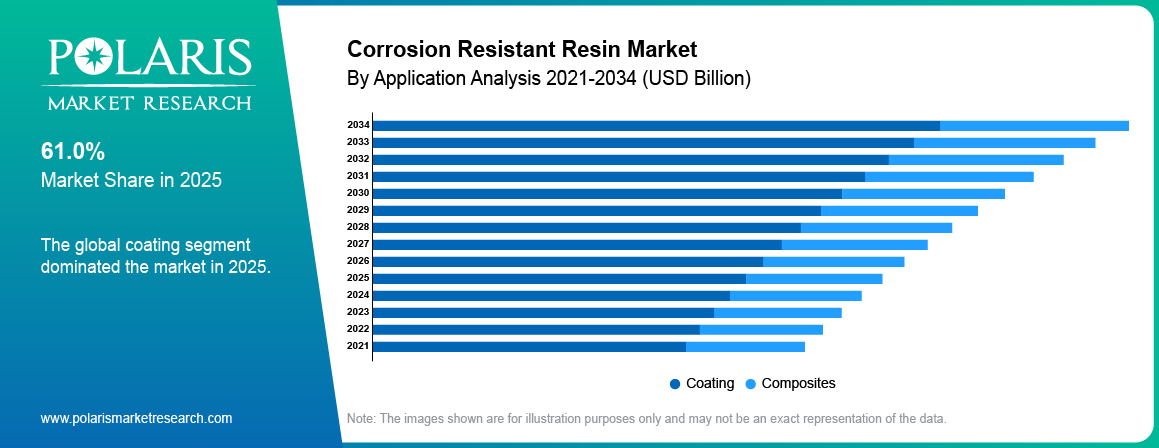
- Coating applications dominate the market with 61.0% share in 2025, as industries rely on corrosion-resistant coatings to extend the life of structures and equipment.
- The epoxy segment held 34.0% market share in 2025 due to its strong chemical resistance and durability across industrial applications.
Note: Figures and projections outlined in this report are the result of Polaris Market Research’s proprietary analytical processes, grounded in the latest available datasets and market observations.
What is Corrosion Resistant Resin?
Corrosion-resistant resin is a synthetic polymer engineered to withstand chemical degradation and environmental damage, making it ideal for coatings, adhesives, and composites. Commonly used in industries such as marine and chemical processing, it protects surfaces from corrosive substances, enhancing product durability and lifespan.
The corrosion resistant resin market is growing due to its increasing use in industries such as automotive, aerospace, and construction. As industries prioritize durability and reduced maintenance, there is a rising demand for effective protective materials. Corrosion resistant resins play a crucial role in extending the lifespan of components and structures, making them essential in sectors that require reliable performance under harsh conditions. Additionally, increasing investment and expansion of multiple end use industries such as automotive, chemical, and marine is significantly driving the growth of corrosion resistant resins market in the forecast period. The expansion of these end-use industries, coupled with the need for minimal maintenance costs, has raised the demand for corrosion resistant resins. Corrosion resistant resins are durable and are leveraged with advanced technology for efficient operation.
Source: Polaris Market Research Analysis
To Understand More About this Research: Download Sample Report
How Corrosion Resistant Resins Work
Corrosion resistant resins protect surfaces and structures from damage caused by moisture, chemicals, oxygen, and harsh environmental conditions. When applied as coatings or incorporated into composite materials, these resins create a durable protective layer that isolates the underlying material from corrosive agents. This barrier helps prevent rust formation, chemical attack, and structural degradation in industrial equipment, pipelines, storage tanks, and infrastructure. By reducing maintenance requirements and extending service life, corrosion resistant resins play an important role in improving asset durability and operational reliability across multiple industries.
Epoxy vs Vinyl Ester vs Polyester Resins
| Parameter | Epoxy Resins | Vinyl Ester Resins | Polyester Resins |
| Adhesion | Excellent adhesion to metals, concrete, and composites | Very good adhesion | Moderate adhesion |
| Flexibility | Moderate flexibility | High flexibility and crack resistance | Lower flexibility |
| Chemical Resistance | Excellent resistance to chemicals, solvents, and moisture | Very high resistance to acids, alkalis, and corrosive chemicals | Good resistance but lower than epoxy and vinyl ester |
| Durability | High mechanical strength and long service life | High durability in aggressive environments | Moderate durability |
| Temperature Tolerance | High temperature resistance | High temperature resistance, suitable for harsh conditions | Moderate temperature resistance |
| Corrosion Protection | Excellent | Excellent, especially in chemical processing environments | Good |
| Cost | High | Medium to high | Low |
| Common Industrial Applications | Protective coatings, marine structures, aerospace, automotive, infrastructure | Chemical storage tanks, pipelines, marine equipment, flue gas desulfurization systems | Construction panels, pipes, storage tanks, general-purpose composites |
| Key Advantage | Superior adhesion and overall performance | Best balance of chemical resistance and toughness | Cost-effective solution for standard applications |
Market Dynamics
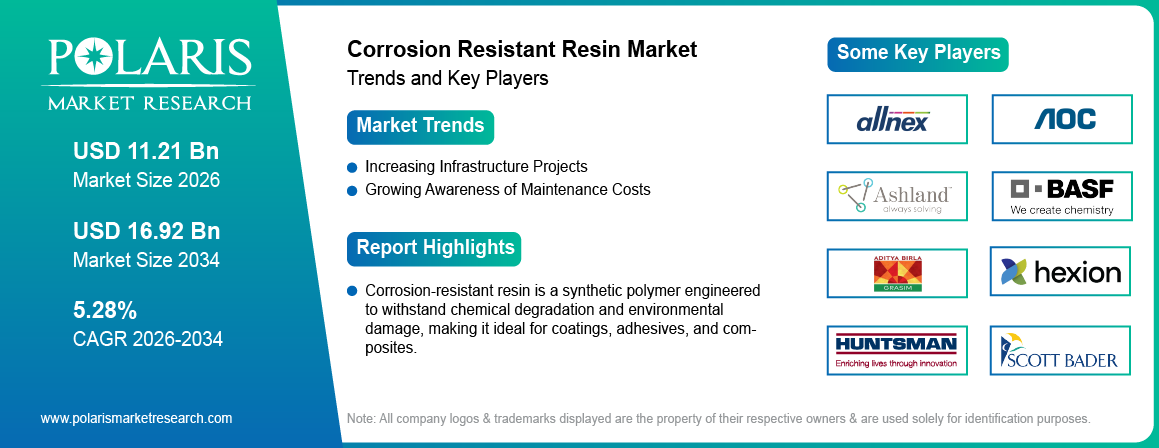
Driver: Increasing Infrastructure Projects
The increase in investment in construction projects globally is driving the number of new projects. For instance, according to Trading Economics, in India, the housing index rose to 116 points in the second quarter of 2024, a significant increase from 107 points in the same quarter in 2022. This increase in housing and infrastructure projects necessitates durable materials that can withstand harsh environmental conditions and corrosion, leading to increased demand for corrosion-resistant resins. Consequently, this infrastructure expansion has made corrosion-resistant resins an essential component for improving the longevity and performance of buildings and structures, thereby driving the corrosion-resistant resin market growth.
Driver: Growing Awareness of Maintenance Costs
The costs associated with corrosion are a major concern among builders and governments. For instance, according to the International Zinc Association, in India, it is estimated that the country loses around 5–7% of its gross domestic product (GDP) annually due to corrosion-related damage. This significant economic impact is encouraging industries to adopt corrosion-resistant materials to minimize maintenance expenses and prolong the lifespan of assets, thereby driving the corrosion-resistant resin market growth.
Advanced Resin & Coating Technologies
Advancements in resin and coating technologies are improving corrosion protection across industrial applications. Nanocoatings are being developed to create denser protective barriers that enhance resistance to moisture, chemicals, and surface degradation. Smart protective coatings can respond to environmental changes and help detect or reduce corrosion-related damage. Hybrid polymer systems combine the properties of different resin types to improve adhesion, flexibility, and chemical resistance. High-performance thermoset resins offer enhanced mechanical strength, thermal stability, and long-term durability in harsh operating environments. These innovations are supporting the development of longer-lasting and more efficient corrosion protection solutions for industrial infrastructure and equipment.
Source: Polaris Market Research Analysis
Segment Insights
Market Evaluation by Type Insights
The corrosion resistant resin market segmentation, based on type, includes epoxy, polyurethanes, polyester, vinyl ester, and others. The epoxy segment held 34.0% share in 2025. Epoxy resins are preferred for their exceptional adhesion, chemical resistance, and durability, making them ideal for a variety of applications in industries such as automotive, aerospace, and construction. Their ability to withstand harsh environments and prevent corrosion effectively enhances the lifespan of products, driving increased adoption. As infrastructure development accelerates, the demand for epoxy-based solutions is anticipated to rise, positively impacting the segment growth in the global market.
Market Assessment by Application Insights
The corrosion resistant resin market segmentation, based on application, includes coating and composites. The coating segment dominate the corrosion resistant resin market with 61.0% share in 2025 due to its wide-ranging applications across various industries. Coatings are essential for protecting surfaces from corrosion, enhancing durability, and improving aesthetic appeal. Key sectors such as automotive, marine, and construction heavily rely on high-performance coatings to safeguard structures and equipment from environmental degradation. With the growth of these industries, the demand for coatings from corrosion-resistant resin is expected to rise, thereby driving the growth of the segment in the global market.
Source: Polaris Market Research Analysis
Market Regional Insights
By region, the study provides the corrosion resistant resin market insights into North America, Europe, Asia Pacific, Latin America, and the Middle East & Africa. In 2025, North America had the largest revenue share of 31.0% in the corrosion resistant resin market due to the expansion of the automotive manufacturing sector. For instance, according to the US Bureau of Labor Statistics, the automotive sector employed approximately 1,062 thousand people in September 2024, up from 1,052 thousand in September 2023. This increase reflects the rapid expansion of the automotive sector, which is driving the demand for advanced materials that can withstand harsh environments and prevent corrosion in automotive applications.
Source: Polaris Market Research Analysis
The Asia Pacific corrosion resistant resin market is projected to register a substantial CAGR of 7.43% during the forecast period due to increased investment in the chemical and oil & gas industries. There is a heightened demand for materials that can withstand corrosive environments and ensure operational efficiency as these sectors expand. The region's focus on infrastructure development and industrialization further fuels this demand as companies seek durable solutions to enhance the longevity of their assets.
The India corrosion resistant resin market is experiencing significant growth at a CAGR of 8.80% due to the surge in construction projects. For instance, according to the India Brand Equity Foundation, the Interim Budget 2024-25 announced an 11.1% increase in capital investment outlay for infrastructure, signaling a strong commitment to development. The expansion of new construction projects has led to an increase in the demand for durable materials, such as corrosion resistant resins, that can withstand environmental challenges and prevent corrosion.
Competitive Insights
The corrosion resistant resin market is constantly evolving, with numerous companies striving to innovate and distinguish themselves. Leading global corporations dominate the market by leveraging extensive research and development, advanced manufacturing technologies, and significant capital to maintain a competitive edge. These companies pursue strategic initiatives such as mergers and acquisitions, partnerships, and collaborations to enhance their product offerings and expand into new markets.
New companies are impacting the market by introducing innovative resins and meeting the needs of specific market sectors. This competitive environment is amplified by continuous progress in product offerings, greater emphasis on sustainability, and the rising requirement for tailor-made products in diverse industries. Major players in the corrosion resistant resin market include Ashland; Huntsman International LLC.; Hexion Inc.; AOC; Olin Corporation; Sino Polymer Co., Ltd.; Swancor; Grasim Industries Limited; TotalEnergies; Allnex GMBH; BASF SE Reichhold LLC; and Scott Bader Company Ltd.
BASF SE, headquartered in Ludwigshafen, Germany, is a chemical producer founded in 1865. Originally a dye manufacturer, BASF has greatly diversified its operations and now encompasses six business segments: Chemicals, Plastics, Performance Products, Functional Solutions, Agricultural Solutions, and Oil and Gas. The company serves a wide array of industries, such as automotive, construction, electronics, and agriculture, providing products such as solvents, adhesives, and performance materials. In the corrosion-resistant resin market, BASF offers advanced solutions that cater to various applications requiring durability and protection against environmental factors. Their innovative products are designed to meet the stringent demands of industries where corrosion resistance is critical. This commitment to quality and sustainability aligns with BASF's corporate philosophy of creating chemistry for a sustainable future. BASF continues to invest in research and development to drive innovation and enhance its product offerings in the resin sector with approximately 110,000 employees globally.
Grasim Industries Limited, an entity of the Aditya Birla Group, was established in 1947 and has transformed from a textile manufacturer into a diversified conglomerate. Headquartered in Mumbai, Grasim operates across various sectors, including cellulosic fibers, diversified chemicals, and cement. The company is a producer of viscose staple fibre (VSF) and has a portfolio that includes fashion yarn and fabrics. In recent years, Grasim has expanded to the paints sector with its brand ‘Birla Opus, launching six manufacturing plants across India, three of which began operations in April 2024. Additionally, the company has developed ‘Birla Pivot,’ a B2B online marketplace for building materials. Grasim epoxy products include liquid resins, formulated resins, reactive diluents, and hardeners.
List of Key Companies
- Allnex GMBH
- AOC
- Ashland
- BASF SE
- Grasim Industries Limited
- Hexion Inc.
- Huntsman International LLC.
- Olin Corporation
- Reichhold LLC
- Scott Bader Company Ltd.
- Sino Polymer Co., Ltd.
- SWANCOR
- TotalEnergies
Corrosion Resistant Resin Industry Developments
- April 2026: Evonik launched Ancamine 2873, an ultra-low-emission epoxy curing agent. It is designed for protective and marine coatings. The product offers fast curing and improved corrosion resistance. (Source: evonik.com)
- April 2026: Denso Inc. launched Archco 456, a high-solids epoxy coating for pipeline applications. It provides strong adhesion, durability, and corrosion protection. (Source: worldpipelines.com)
- March 2026: AkzoNobel launched Relest Wind EP Process Coat. It is a solvent-free epoxy coating developed for wind turbine blade manufacturing. (Source: windtechinternational.com)
Future Outlook
The corrosion resistant resin market is expected to grow steadily in the coming years. Increasing infrastructure upgrades and industrial expansion will support demand. Industries such as oil & gas, marine, automotive, and chemicals will continue to use corrosion-resistant materials to improve equipment life. New technologies, including nanocoatings, low-VOC resin systems, and lightweight composites, are improving product performance. Smart coatings and advanced resin formulations are also expected to drive wider adoption across industries.
Corrosion Resistant Resin Market Segmentation
By Type Outlook (USD Billion, 2021–2034)
- Epoxy
- Polyurethanes
- Polyester
- Vinyl Ester
- Others
By Application Outlook (USD Billion, 2021–2034)
- Coating
- Composites
By End Use Outlook (USD Billion, 2021–2034)
- Chemical
- Marine
- Oil & Gas
- Automobiles
- Others
By Regional Outlook (USD Billion, 2021–2034)
- North America
- US
- Canada
- Europe
- Germany
- France
- UK
- Italy
- Spain
- Netherlands
- Russia
- Rest of Europe
- Asia Pacific
- China
- Japan
- India
- Malaysia
- South Korea
- Indonesia
- Australia
- Rest of Asia Pacific
- Middle East & Africa
- Saudi Arabia
- UAE
- Israel
- South Africa
- Rest of Middle East & Africa
- Latin America
- Mexico
- Brazil
- Argentina
- Rest of Latin America
Corrosion Resistant Resin Market Report Scope
| Report Attributes | Details |
| Market Size Value in 2025 | USD 10.65 billion |
| Market Size Value in 2026 | USD 11.21 billion |
| Revenue Forecast by 2034 | USD 16.92 billion |
| CAGR | 5.28% from 2026–2034 |
| Base Year | 2025 |
| Historical Data | 2021–2024 |
| Forecast Period | 2026-2034 |
| Quantitative Units | Revenue in USD billion and CAGR from 2026 to 2034 |
| Report Coverage | Revenue Forecast, Market Competitive Landscape, Growth Factors, and Trends |
| Segments Covered |
|
| Regional Scope |
|
| Competitive Landscape |
|
| Report Format |
|
| Customization | Report customization as per your requirements with respect to countries, regions, and segmentation. |
Source: Polaris Market Research Analysis
Corrosion Resistant Resin Market FAQ's
• The corrosion resistant resin market size was valued at USD 10.65 billion in 2025 and is projected to grow to USD 16.92 billion by 2034.
• The global market is projected to register a CAGR of 5.28% from 2026 to 2034.
• North America led the market with 31.0% share in 2025.
• A few of the key players in the market are Ashland; Huntsman International LLC.; Hexion Inc.; AOC; Olin Corporation; Sino Polymer Co., Ltd.; Swancor; Grasim Industries Limited; TotalEnergies; Allnex GMBH; BASF SE Reichhold LLC; and Scott Bader Company Ltd.
• The epoxy segment held 34.0% market share in 2025.
• Coating applications dominate the market 61.0% share in 2025.
Download Sample Report of Corrosion Resistant Resin Market
Please fill out the form to request a customized copy of the research report.


