
Custom Software Development Market Development Factors, Revenue Strategies, and Future Trends, 2026-2034
REPORT DETAILS
Custom Software Development Market Summary
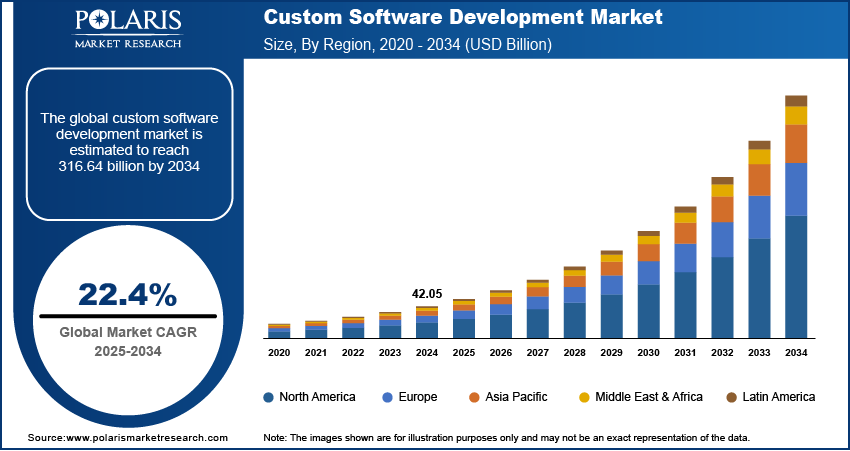
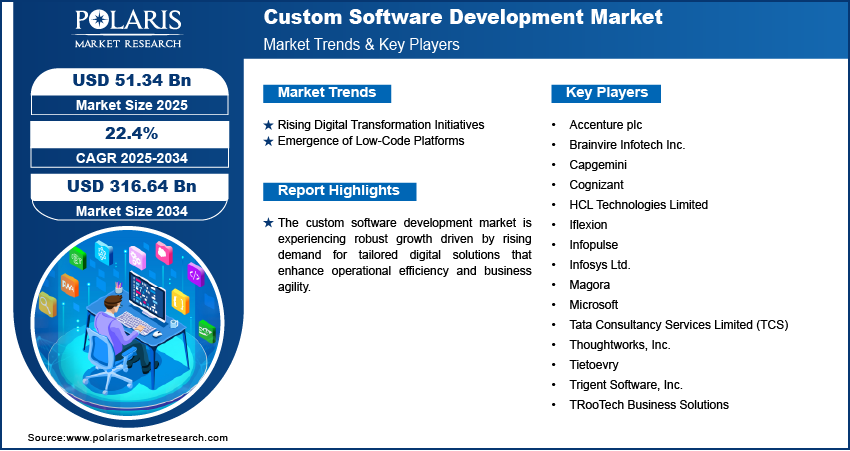
The global custom software development market size was valued at USD 51.34 billion in 2025, growing at a CAGR of 22.4% during 2026–2034. The increased demand for customized software that can integrate seamlessly with cloud-based systems and the growing adoption of robotic process automation across sectors are fueling market growth.
Market Statistics
Key Takeaways
- North America led the market with 40.0% share in 2025. The regional market dominance is attributed to its advanced technological landscape and robust presence of major software vendors.
- Asia Pacific is projected to witness significant growth at a CAGR of 24.6% during the forecast period. Rapid digitalization and growing investments in IT infrastructure are driving regional market growth.
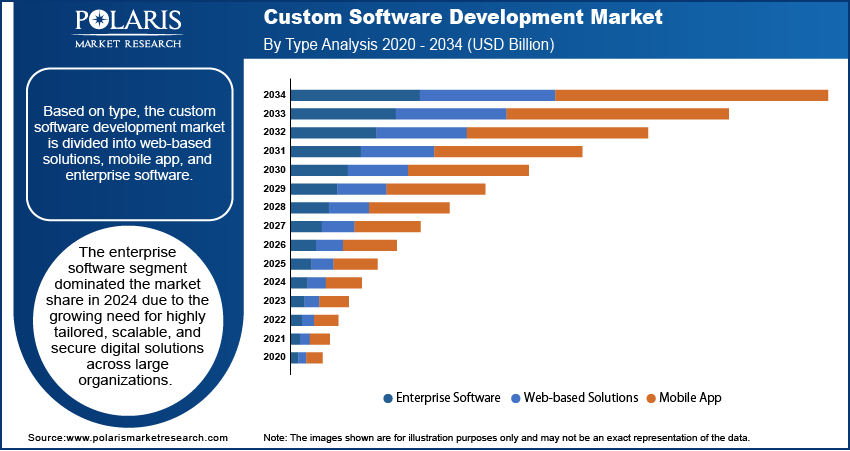
- The enterprise software segment accounted for the largest market share of 41.0% in 2025, owing to the increased demand for scalable and secure digital solutions across large organizations.
- The SMEs segment is projected to witness significant growth at a CAGR of 24.2%, primarily driven by the growing recognition of custom software development among small and medium-sized businesses.
Note: Figures and projections outlined in this report are the result of Polaris Market Research’s proprietary analytical processes, grounded in the latest available datasets and market observation.
Industry Dynamics
- Increased focus on the modernization of legal systems among businesses is fueling the demand for custom software development.
- The introduction of low-code platforms is fueling market development by democratizing software development and accelerating development cycles.
- The growing integration of advanced technologies is creating several market opportunities.
- Shortage of skilled web-based solutions developers and engineers is hindering market growth.
AI Impact on Custom Software Development Market
- AI accelerates coding, testing, and debugging with automated code generation and error detection.
- AI enables adaptive applications tailored to specific business needs and user behaviors.
- Intelligent project management tools optimize resource allocation, timelines, and cost control.
- AI-powered analytics improve software performance post-deployment through predictive maintenance and updates.
Source: Polaris Market Research Analysis
To Understand More About this Research: Download Sample Report
What is Custom Software Development?
Custom software development refers to the process of designing, creating, deploying, and maintaining software tailored specifically to the needs of individual users or organizations. This market has witnessed steady growth due to the increasing demand for personalized digital solutions that align precisely with specific business processes. One of the key drivers propelling this growth is the increasing adoption of cloud computing. For instance, a January 2024 IBEF report estimated that 40% of Indian organizations will adopt cloud services by 2024. Additionally, India’s data center capacity is projected to nearly double from 770 MW in 2022 to 1,500 MW by 2025, reflecting rapid digital infrastructure growth. There is a rising need for customized software that can seamlessly integrate with cloud environments as enterprises shift from traditional infrastructure to cloud-based systems. Cloud computing offers scalability, flexibility, and cost-efficiency, which encourages organizations to invest in custom-built solutions to optimize their development to operations market, enhance accessibility, and streamline workflows.
The expansion is attributed to the increasing adoption of robotics process automation across industries. For instance, an August 2024 Statistics Canada report stated that large enterprises led robotics adoption with 9.1%, sourcing externally at 76.6% over in-house development, which was 3.3%. Medium-sized firms were most likely to develop robotics internally at 12.1%, while small enterprises had the lowest adoption rate at 1.6%. This rising demand for customized automation systems is boosting the growth. The demand for software that can support and control robotic systems has grown substantially as businesses strive for greater efficiency and productivity. Robotic automation requires software solutions that are highly specific to the task, environment, and industry application, making custom software a strategic necessity. Custom-built software enables businesses to tailor robotic processes to their unique operational requirements, improving precision and reducing manual intervention. This trend highlights the evolving role of custom software as an enabler of intelligent automation and next-generation operational transformation.
How Custom Software Development Works?
- Business Requirements Identified: Business goals, user needs, and project requirements are defined.
- Software Architecture Designed: System architecture, databases, and technology frameworks are planned.
- Coding and Development Performed: Developers build the software according to the defined requirements.
- Testing and Quality Assurance Completed: The software is tested for bugs, performance, security, and functionality.
- Deployment and Integration Executed: The application is deployed and integrated with existing business systems.
- Ongoing Maintenance and Upgrades Provided: Regular updates, bug fixes, security patches, and feature improvements are delivered.
Custom Software vs Off-the-Shelf Software
| Factor | Custom Software | Off-the-Shelf Software |
| Scalability | Scaled based on business needs | Depends on available software features |
| Flexibility | Built according to business requirements | Fixed features and functionality |
| Cost | Higher development cost | Lower initial cost |
| Customization | Fully customized | Limited customization |
| Integration Capability | Integrated with existing systems as needed | Integration can be difficult in some cases |
| Ownership | Owned by the organization | Owned by the software vendor |
| Long-Term Business Value | Supports specific business goals and processes | May not fully match long-term business requirements |
Market Dynamics
Rising Digital Transformation Initiatives
The rising digital transformation initiatives across industries are driving the custom software development market growth as organizations increasingly seek to modernize legacy systems and improve operational agility. Digital transformation requires businesses to adopt technologies that are tailored to their unique processes, goals, and customer interactions, necessitating customized software solutions. Unlike off-the-shelf products, custom software allows companies to align digital capabilities with strategic objectives, enabling seamless integration with existing systems and improved user experiences. In September 2024, Shopify, Oracle, and Deloitte Digital collaborated to launch a Next Gen Retail Commerce model, combining Shopify’s commerce platform with Oracle’s enterprise solutions. The collaboration aims to enhance omni-channel retail solutions, operational efficiency, and data-driven personalization for enterprise retailers. Custom software becomes central to supporting end-to-end digital workflows and competitive differentiation in an evolving digital landscape as enterprises prioritize data-driven decision-making, automation, and innovation.
Emergence of Low-Code Platforms
The emergence of low-code platforms is fueling the demand for custom software development by democratizing software creation and accelerating development cycles. In March 2025, Mendix 10.21 launched AI-driven productivity enhancements for developers. The major updates included Maia AI improvements, simplified page building with local variables, faster REST API integration via OpenAPI, and view entities for streamlined data modeling. These platforms empower both professional developers and business users to build tailored applications with minimal coding effort, reducing dependency on extensive programming resources. While low-code tools simplify development, they also expand the possibilities for custom software by enabling rapid prototyping, iterative design, and faster deployment of personalized solutions. This evolution improves the agility of custom software development, making it more accessible and adaptable to changing business needs, thereby strengthening its role as a cornerstone of enterprise innovation.
Challenges in Custom Software Development Market
- Project Complexity: Custom software projects involve multiple functions, teams, and technologies. This can increase development time and management efforts.
- Evolving Cybersecurity Threats: Security risks continue to grow. Developers must regularly update and strengthen software protection.
- Changing Business Requirements: Business needs can change during development. This may result in revisions, delays, and additional work.
- Integration with Legacy Systems: Many organizations still use older systems. Integrating new software with existing infrastructure can be challenging.
- Rising Software Development Costs: Development costs are increasing due to higher labor expenses, advanced technologies, and ongoing maintenance requirements.
Source: Polaris Market Research Analysis
Segment Insights
Market Assessment by Type Outlook
The segmentation based on type, includes web-based solutions, mobile app, and enterprise software. The enterprise software segment dominated the market with 41.0% share in 2025 due to the growing need for highly tailored, scalable, and secure digital solutions across large organizations. Enterprise software enables businesses to address complex operational requirements such as enterprise resource planning (ERP), customer relationship management (CRM), and supply chain management through customized platforms. Custom-developed enterprise applications offer the flexibility and control needed to meet these dynamic demands as enterprises continue to digitize core processes and demand seamless integration across departments and systems. This strong alignment with strategic business goals has positioned enterprise software as a leading contributor to the market’s growth.
Market Evaluation by Enterprise Size Outlook
The segmentation based on enterprise size, includes large enterprises and SMEs. The SMEs segment is expected to witness a fastest growth at a CAGR of 24.2% during the forecast period due to the increasing recognition among small and medium-sized businesses of the value of customized digital solutions. SMEs are embracing custom software to streamline operations, enhance customer engagement, and gain competitive advantage in niche markets. The rising affordability and accessibility of development tools, such as low-code platforms and cloud-based infrastructure, have lowered entry barriers for smaller firms. As a result, more SMEs are investing in tailored solutions that align with their unique operational needs, enabling agility and innovation without the constraints of standardized software.
Source: Polaris Market Research Analysis
Regional Analysis
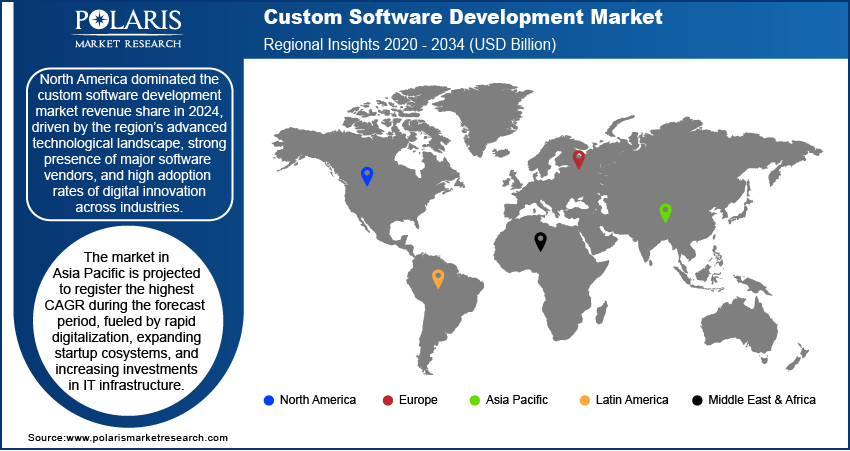
By region, the report provides the custom software development insights into North America, Europe, Asia Pacific, Latin America, and the Middle East & Africa. North America dominated the revenue with 40.0% share in 2025, driven by the region’s advanced technological landscape, strong presence of major software vendors, and high adoption rates of digital innovation across industries. Businesses in North America have consistently prioritized IT modernization and digital transformation, creating a robust demand for customized solutions that support evolving business models. Significant public-sector investments in digital infrastructure further reinforce the custom software development expansion. For instance, an October 2022 GSA report noted that in June 2022, the TMF Board allocated USD 100 million to modernize public-facing digital services and technology systems, aiming to enhance customer experience for US citizens through streamlined and improved government platforms. Furthermore, the mature cloud infrastructure and skilled developer ecosystem in the region enable the rapid deployment of custom applications. This supportive environment has solidified North America’s leadership in driving enterprise-specific software innovation and adoption.
The Asia Pacific region is projected to register the highest CAGR of 26.5% during the forecast period, fueled by rapid digitalization, expanding startup ecosystems, and increasing investment in IT infrastructure. For instance, an April 2025 IBEF report indicated that India's IT sector contributed 7.5% of GDP in FY23, with projections to reach 10% by FY25. This growth reflects the industry's expanding role in the nation's economy and development. There is a growing need for software tailored to local market dynamics and operational requirements as businesses across emerging economies in the region embrace digital transformation. The demand is further amplified by the increasing penetration of mobile and web-based technologies and government-led initiatives supporting technology-driven growth. This rising emphasis on localized, scalable, and efficient digital solutions is propelling the adoption of custom software across diverse industries in Asia Pacific.
Source: Polaris Market Research Analysis
Key Players & Competitive Analysis Report
The market is characterized by intense competition between global leaders and regional players, all competing for market share through innovation, strategic partnerships, and geographic expansion. Global firms leverage robust R&D capabilities and cutting-edge technologies such as AI, cloud, IoT, and vast distribution networks to deliver tailored solutions that meet demand for digital transformation and scalable business models. Custom software development market trends highlight rising needs for disruptive technologies, such as generative AI and low-code platforms driven by economic shifts, geopolitical factors, and enterprise modernization. Large players prioritize M&A, joint ventures, and post-merger integration to enhance capabilities and enter new markets to maintain dominance. Regional players, meanwhile, compete by addressing niche demands with cost-optimized solutions and localized expertise. A few key major players are Accenture plc; Brainvire Infotech Inc.; Capgemini; Cognizant; HCL Technologies Limited; Iflexion; Infopulse; Infosys Ltd.; Magora; Microsoft; Tata Consultancy Services Limited (TCS); Thoughtworks, Inc.; Tietoevry; Trigent Software, Inc.; and TRooTech Business Solutions.
Accenture plc is into consulting, technology services, and custom software development, recognized for its ability to execute and vision in creating tailored solutions. The company leverages cutting-edge technologies, such as AI, machine learning, and cloud computing, to design scalable, secure, and high-performance applications that address specific business challenges across industries such as healthcare, financial services, and retail. It customizes enterprise applications using programming languages such as Java, Python, and C++ to enhance operational efficiency, improve customer engagement, and support data-driven decision-making. Accenture also specializes in modernizing legacy systems to adopt newer technologies and streamline workflows. Its industrialized methods enable rapid deployment of solutions such as SAP Fiori apps while customizing user interfaces to meet unique business requirements. Accenture continues to help organizations reinvent their operations and create innovative products through bespoke software solutions, recognized as a leader in Gartner’s Magic Quadrant for custom software development services.
HCL Technologies Limited is a global IT services and consulting company renowned for its expertise in custom software development and innovative technology solutions. HCL delivers tailored software solutions to meet the unique needs of businesses in diverse sectors such as healthcare, finance, and manufacturing with over 40 years of experience and a strong presence across 44 countries. Its custom software development services include embedded systems engineering, cloud-based applications, enterprise software, and digital transformation initiatives. HCL employs agile methodologies and cutting-edge technologies such as AI, IoT, and DevSecOps to design scalable and secure applications that enhance operational efficiency and customer experience. The company also focuses on modernizing legacy systems, integrating advanced features, and ensuring compliance standards. HCL’s approach emphasizes end-to-end capabilities, from feasibility studies to testing and maintenance, enabling clients to achieve their business goals effectively. Additionally, its robust portfolio includes solutions for data management, automation, and marketing platforms. HCL Technologies continues to drive digital transformation globally by delivering high-quality custom software that aligns with evolving market demands and technological advancements recognized for its domain-specific expertise and innovative practices.
List of Key Companies
- Accenture plc
- Brainvire Infotech Inc.
- Capgemini
- Cognizant
- HCL Technologies Limited
- Iflexion
- Infopulse
- Infosys Ltd.
- Magora
- Microsoft
- Tata Consultancy Services Limited (TCS)
- Thoughtworks, Inc.
- Tietoevry
- Trigent Software, Inc.
- TRooTech Business Solutions
Custom Software Development Industry Developments
- May 2026: UiPath launched UiPath for Coding Agents, enabling enterprises to build, test, deploy, and manage software using AI coding agents. (Source: uipath.com)
- April 2026: C3 AI launched C3 Code, an enterprise AI development platform that converts natural-language requirements into production-ready applications. (Source: c3.ai)
- March 2026: Tata Elxsi launched DevStudio.ai, a generative AI platform that helps accelerate software engineering workflows. (Source: prnewswire.com)
- February 2026: Fujitsu launched an AI-Driven Software Development Platform to automate software development, testing, and deployment processes. (Source: prnewswire.com)
- September 2025: Brainvire announced the successful development of an enterprise-grade e-commerce solution for home furniture retailer Ashley. Brainvire stated that the project involved the development of a full-featured Shopify website. It also included integration with Microsoft Dynamics 365 to ensure seamless business operations. (Source: brainvire.com)
- September 2025: Tietoevry revealed the completion of the divestment of its Tech Services business. Following the completion, the digital engineering business and vertical software businesses are now a part of the company’s business portfolio. (Source: tietoevry.com)
Future Outlook
The custom software development market is expected to grow steadily as businesses continue to invest in digital transformation and modern IT systems. Increasing use of AI-powered applications and cloud-based software will support market demand. Generative AI coding tools and low-code development platforms are helping reduce development time and costs. Improvements in cybersecurity, DevOps automation, and software customization are further driving adoption. Demand is expected to rise across healthcare, finance, retail, manufacturing, and enterprise IT sectors worldwide.
Custom Software Development Market Segmentation
By Type Outlook (Revenue, USD Billion, 2021–2034)
- Web-Based Solutions
- Mobile App
- Enterprise Software
By Deployment Mode Outlook (Revenue, USD Billion, 2021–2034)
- Cloud
- On-premise
By Enterprise Size Outlook (Revenue, USD Billion, 2021–2034)
- Large Enterprise
- SMEs
By Industry Vertical Outlook (Revenue, USD Billion, 2021–2034)
- BFSI
- Government
- Healthcare
- IT & Telecom
- Manufacturing
- Retail
- Others
By Regional Outlook (Revenue, USD Billion, 2021–2034)
- North America
- US
- Canada
- Mexico
- Europe
- Germany
- France
- UK
- Italy
- Spain
- Netherlands
- Russia
- Rest of Europe
- Asia Pacific
- China
- Japan
- India
- Malaysia
- South Korea
- Indonesia
- Australia
- Rest of Asia Pacific
- Middle East & Africa
- Saudi Arabia
- UAE
- Israel
- South Africa
- Rest of Middle East & Africa
- Latin America
- Brazil
- Argentina
- Rest of Latin America
Custom Software Development Market Report Scope
| Report Attributes | Details |
| Market Size Value in 2025 | USD 51.34 billion |
| Market Size Value in 2026 | USD 62.72 billion |
| Revenue Forecast by 2034 | USD 316.77 billion |
| CAGR | 22.4% from 2026 to 2034 |
| Base Year | 2025 |
| Historical Data | 2021–2024 |
| Forecast Period | 2026–2034 |
| Quantitative Units | Revenue in USD Billion and CAGR from 2026 to 2034 |
| Report Coverage | Revenue Forecast, Market Competitive Landscape, Growth Factors, and Industry Trends |
| Segments Covered |
|
| Regional Scope |
|
| Competitive Landscape |
|
| Report Format |
|
| Customization | Report customization as per your requirements with respect to countries, regions, and segmentation. |
Source: Polaris Market Research Analysis
Custom Software Development Market FAQ's
The global market size was valued at USD 51.34 billion in 2025 and is projected to grow to USD 316.77 billion by 2034.
The global market is projected to register a CAGR of 22.4% during the forecast period.
North America led the market with 40.0% share in 2025.
A few of the key players in the market are Accenture plc; Brainvire Infotech Inc.; Capgemini; Cognizant; HCL Technologies Limited; Iflexion; Infopulse; Infosys Ltd.; Magora; Microsoft; Tata Consultancy Services Limited (TCS); Thoughtworks, Inc.; Tietoevry; Trigent Software, Inc.; and TRooTech Business Solutions.
The enterprise software segment accounted for the largest market share of 41.0% in 2025.
The SMEs segment is projected to witness significant growth at a CAGR of 24.2%.
Download Sample Report of Custom Software Development Market
Please fill out the form to request a customized copy of the research report.


