
Data Center Generator Market Size, Share, and Forecast 2026 to 2034
REPORT DETAILS
Data Center Generator Market Summary
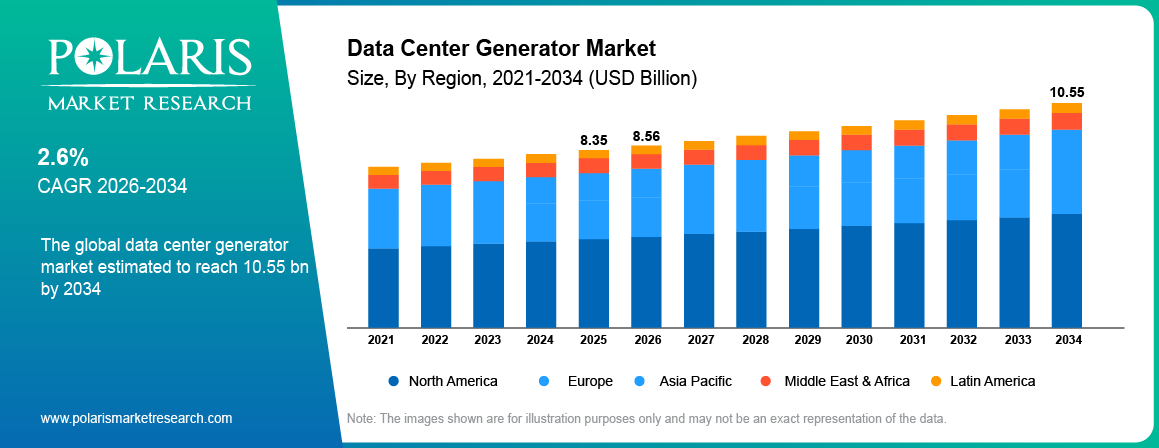
The global Data Center Generator Market was valued at USD 8.35 Billion in 2025. The market is expected to grow at a CAGR of 2.6% from 2026 to 2034. Growth is driven by increasing investments in hyperscale and AI data center infrastructure, rising demand for reliable backup power, and delays in grid connections across major data center development locations. This data center generator market report assesses data center backup generators by standby power rating, fuel type and application across five regions.
Market Statistics
Key Takeaways
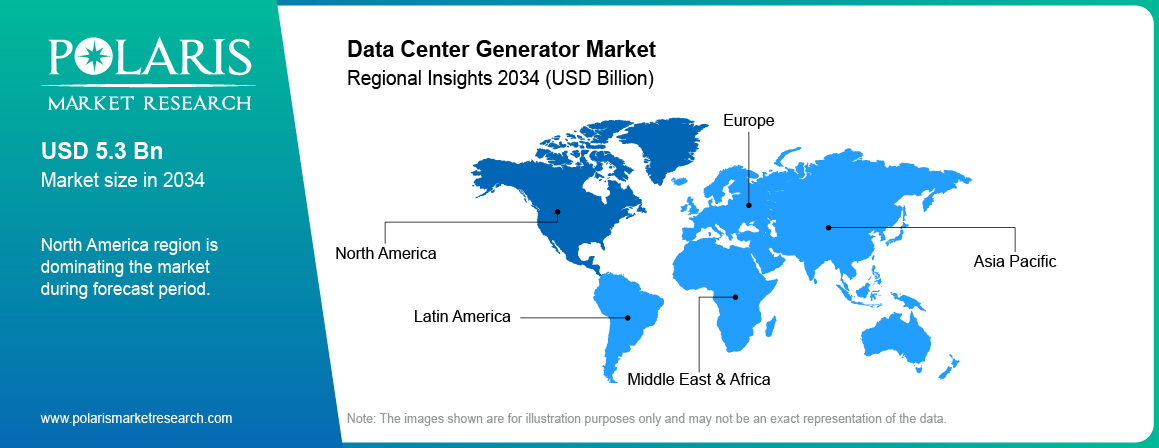
- North America region is projected to hold 40.34% share of the Data Center Generator Market in 2025 owing to construction of hyperscale data centers, investment in AI infrastructure and large capacity backup power systems.
- Asia Pacific region is expected to grow at a CAGR of 4.20% over the forecast period, driven by increasing cloud infrastructure, digitalization, colocation development and investment in data center capacity.
- The diesel segment held 81.24% share of the fuel type segment in 2025, attributed to the established presence of diesel in emergency standby power applications and availability of proven generator technologies.
- Dual fuel and HVO compatible generator systems are projected to witness a CAGR of 5.22% owing to the interest in fuel flexibility and alternative-fuel compatibility.
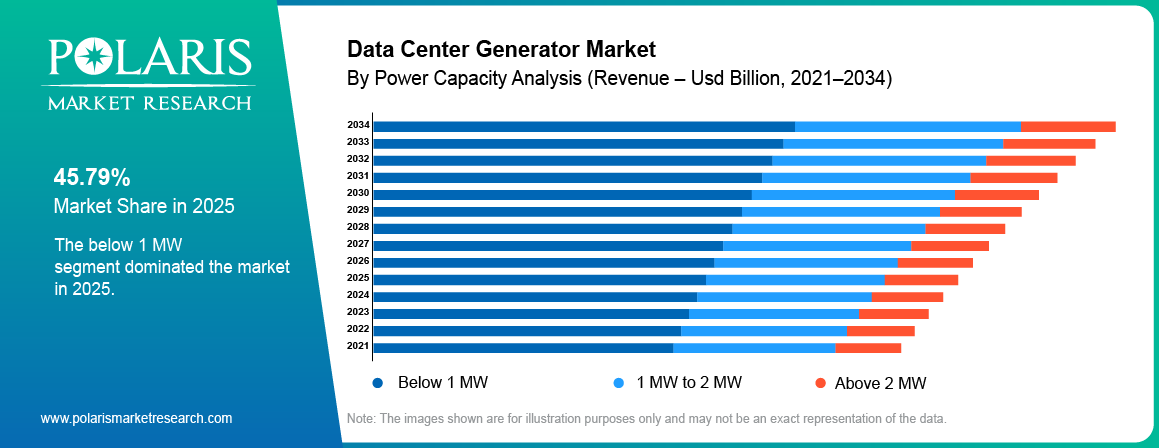
- The below 1 MW segment accounted for 45.79% of the power capacity segment in 2025, due to demand for smaller enterprise, edge and distributed data center facilities.
- The above 2 MW generator systems market is expected to grow at a CAGR of 4.10% driven by expansion of large hyperscale campuses and high density AI infrastructure, which increases demand for hyperscale generator systems.
- Emergency standby applications held 71.85% share of the application segment in 2025, due to the need to maintain critical loads during utility power interruptions.
- Peak and grid support applications are expected to grow at a CAGR of 4.18% driven by increasing interest in on-site generation, prime power microgrid designs, grid flexibility and integrated power management.
- Hyperscale facilities held a 38.45% share of the facility type segment in 2025, supported by large-scale cloud infrastructure and AI computing needs.
- The edge data center market is expected to grow at a CAGR of 3.65% attributed to distributed computing, low latency applications, and geographically distributed digital infrastructure.
- N+1 redundancy made up 49.65% of the redundancy design segment in 2025, due to its use in generator configurations that preserve capacity when a single unit is lost or under maintenance.
- The cloud and AI segment held 37.60% share of the end use industry segment in 2025, owing to the rising investment in hyperscale computing and AI infrastructure.
Note: Figures and projections outlined in this report are the result of Polaris Market Research’s proprietary analytical processes, grounded in the latest available datasets and market observations.
What Is the Data Center Generator Market?
The Data Center Generator Market covers stationary generator sets and associated power generation packages supplied specifically for data center applications. These systems provide emergency standby power during utility interruptions, support prime power generation, and serve as temporary bridge power where permanent grid connections are delayed. The market includes diesel generator sets, natural gas generator sets, dual-fuel configurations, and qualified alternative-fuel generator packages.
A data center generator system generally consists of an engine, alternator, generator controls, factory-supplied enclosure, and associated components required to deliver electrical power. Packaged parallel systems are included when supplied as part of the generation installation. Standalone UPS equipment, battery energy storage systems, switchgear, electrical distribution infrastructure, and unrelated building or cooling expenditure are excluded from generator revenue.
A generator performs a different function from an uninterruptible power supply. A UPS provides immediate electrical ride-through when utility power is interrupted, while a generator starts, establishes voltage and frequency, and accepts the required electrical load. The two technologies operate as complementary elements of a data center power architecture. Generator demand is therefore influenced by the facility’s electrical topology, backup duration, load profile, and required redundancy.
The market includes both emergency standby and prime power applications. Emergency standby generators operate when utility supply becomes unavailable and must demonstrate reliable starting and load acceptance. Prime power generator sets are used for extended periods as a main or normal source of electricity. Their procurement needs vary in operating hours, fuel consumption, maintenance intervals, emissions compliance and service support.
The installation of generators is altered by the evolution of AI infrastructure. Rapid changes in electrical demand and transient load acceptance can characterize AI data center load profiles, making generator paralleling and coordinated control systems important considerations. Operators also consider standby power rating, fuel autonomy, automatic transfer switch integration and factory acceptance testing prior to commissioning.
The market comprises generator equipment that is deployed into hyperscale, colocation, enterprise and edge data center facilities. These customer groups have different requirements in terms of capacity, redundancy architectures, installation conditions and service expectations. The growth of hyperscale generator systems and mission critical generator sets is making equipment scalability, manufacturing capacity and long-term maintenance support more important. The data center backup power forecast in this report is built on generator equipment revenue only.
Data Center Generator Market Dynamics
Driver: Hyperscale AI Campus Construction Reshapes Backup Power Orders
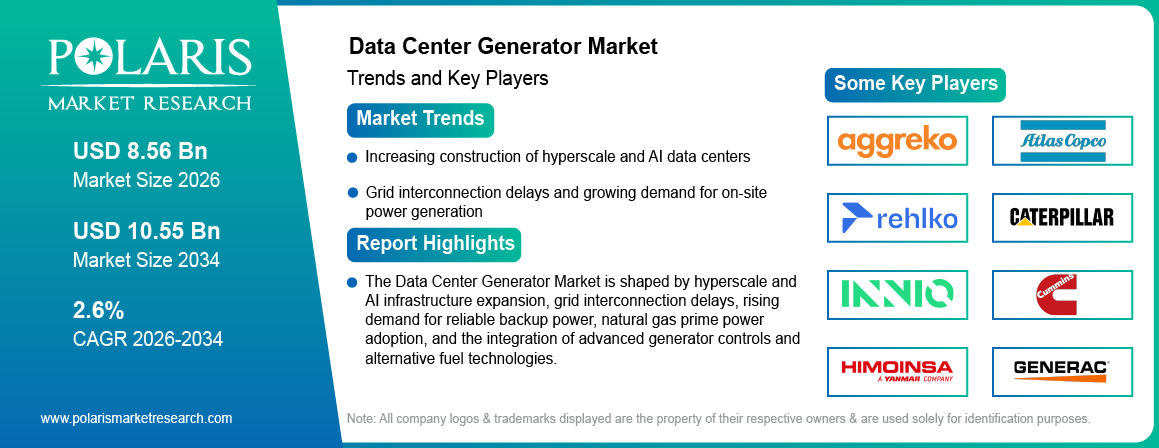
The growth of hyperscale data centers and AI computing infrastructure is driving the need for large-capacity generator installations. Reliable electricity is essential for powering servers, cooling equipment, networking infrastructure, and supporting electrical systems in high performance computing facilities. AI workloads are driving higher rack density and overall power needs for the campus, so operators need generator systems that can support larger electrical loads and still keep operations stable when there are utility interruptions. This makes generator availability, equipment capacity and dependable backup power an important consideration in data center infrastructure planning. Lawrence Berkeley National Laboratory’s 2025 update estimates that data centers could account for 11.8% of total U.S. electricity use by 2030 (Source: Lawrence Berkeley National Laboratory).
Large campuses often require multiple generator units operating through coordinated control and paralleling arrangements. Their designs must account for connected load, staged load pickup, transient response, redundancy, and the sequence through which UPS systems, chillers, pumps, and auxiliary equipment return after a grid disturbance. Caterpillar’s CloudHQ installation in Ashburn, Virginia, is a case in point with 101 Cat C175 generator sets providing 313 MW of standby power. Such projects bring out the importance of generator capacity, coordinated equipment supply, commissioning and lifecycle service support.
Driver: Grid Connection Delays Encourage Prime Power and Bridge Generation
The lack of speed in permanently connecting to the grid is pushing data center developers to consider on-site power generation as part of their plans to build infrastructure. Utilities and interconnection schedules may affect construction milestones and the timing of facility energization, particularly for large campuses needing significant electricity capacity. Prime power and temporary bridge generation provide additional options for developers seeking to establish electricity supply while grid capacity is developed. This is particularly relevant for AI facilities where delayed access to utility power can affect the planned deployment of computing capacity.
Prime power applications create different equipment requirements from emergency standby installations. Generators that are a primary power source have more running hours and maintenance planning based on fuel consumption, lubricant management, engine availability, overhaul schedules, and spare parts. In June 2026, Cummins announced a deal with Circe Energy to supply natural gas generator sets for a high-performance computing campus in West Texas. The project is a behind-the-meter prime power microgrid, scheduled for delivery from 2026 to 2030, demonstrating the role of on-site generation in meeting large-scale power needs.
Restraint: Air Permits, Noise, and Fuel Logistics Limit Installation Flexibility
Installation of a generator requires coordination with environmental regulations, local permitting authorities, site conditions, and fuel supply arrangements. Large data centers may have multiple generator sets and aggregate emissions, and testing schedules and hours of operation may impact air quality permitting requirements. Operators should review any stationary engine regulations and local conditions of authorization that may apply before finalizing equipment specifications. Such requirements can affect the choice of generator technology, the design of the installation, the commissioning schedule and the operating conditions permitted for emergency standby or prime power applications.
Additional installation constraints are created by fuel availability and site conditions. Diesel generator installations shall provide sufficient fuel storage capacity, spill containment, fuel handling procedures and planning for replenishment in the event of extended power interruptions. The availability of pipeline and the reliability of local gas infrastructure are critical for natural gas generator systems. Noise limitations, exhaust configurations, acoustic enclosures, and equipment access can also affect generator placement and project costs (Source: U.S. EPA).
Opportunity: Renewable Diesel Compatibility and Environmental Disclosure
The use of alternative fuels and increased environmental reporting present opportunities for generator manufacturers to differentiate their equipment. Data center operators are looking at fuel compatibility, lifecycle emissions information and availability of lower-carbon fuel alternatives, while still meeting reliability requirements for emergency power systems. Manufacturers that provide approved fuel flexibility and the necessary supporting technical documentation can satisfy the procurement requirements of operators seeking to incorporate environmental considerations into critical power infrastructure without compromising standby performance.
Hydrotreated vegetable oil (HVO) is gaining attention as an alternative fuel for compatible diesel generator sets. In 2023, Caterpillar reported that LCL Data Centers in Belgium commissioned six Cat 3516B diesel generator sets operating on 100% HVO fuel at its Brussels-West facility. Manufacturers are also increasing environmental disclosure for critical power equipment. In December 2025, Rolls-Royce delivered mtu emergency power generators with verified environmental product declarations to a European data center operator. The declarations include lifecycle information on material extraction, production, operation, maintenance and end-of-life treatment. These developments provide opportunities for suppliers to meet fuel flexibility and environmental reporting requirements.
Opportunity: Intelligent Paralleling and Hybrid Energy Integration
The ever-growing size of data center power systems opens doors for advanced generator controls, intelligent paralleling and hybrid energy integration. Large facilities may have multiple generator sets, UPS systems, battery storage, power conversion equipment and utility connections. Coordinated control is required for load sharing, synchronization, power quality and response during electrical disturbances. These requirements are raising the bar for control platforms that can coordinate multiple generator units and support diverse operating configurations for mission-critical facilities.
Manufacturers are responding to these needs with control and integration solutions. Rehlko introduced its APM804 Global Systems Controller in May 2026, aimed at modern data center and mission critical power installations, addressing applications from single generator sets to complex grid parallel systems. This development creates opportunities for generator suppliers through controls integration, system engineering, and coordinated commissioning.
Driver and Opportunities Impact Analysis
| Driver or Opportunity | Impact on CAGR | Regions Impacted | Impact Timeline |
| Driver: Hyperscale AI campus construction | +0.85% | North America, Asia Pacific, Europe | Short to medium term |
| Driver: Grid connection delays | +0.55% | North America, Europe | Short term |
| Opportunity: Renewable diesel compatibility | +0.40% | Europe, North America | Medium term |
| Opportunity: Intelligent paralleling and hybrid integration | +0.35% | North America, Europe, Asia Pacific | Medium to long term |
Source: Polaris Market Research Analysis
Data Center Generator Market Segmentation Analysis
The market is segmented by fuel type, power capacity, application, facility type, redundancy design, end use industry, and region. These categories reflect differences in fuel selection, generator output, operating duty, data center infrastructure, electrical redundancy, and customer requirements for data center generator solutions.
Fuel Type Insights
The diesel segment accounted for 81.24% of the fuel type segment in 2025, and was the leading segment due to its use in emergency standby applications for critical infrastructure. Diesel generator sets come in a variety of capacity ranges and are a widely deployed solution for data center backup power needs. Operators assess these systems for: start performance, standby power rating, fuel storage capacity, maintenance support, emissions compliance and equipment availability. Their established service networks also support procurement across large and smaller facilities.
The natural gas segment is expected to register a CAGR of 3.85% during the forecast period, as developers adopt onsite gas generation to supply prime and bridge power where grid connections are delayed. Wärtsilä’s April 2026 order for 412 MW of engine power for a hyperscale data center project in Ohio, which includes 40 Wärtsilä 34SG engines, shows how gas engines are being specified for campuses that operate off grid. Pipeline availability, emissions permits and start time remain the main selection criteria.
The dual-fuel and HVO-compatible segment is projected to grow at a CAGR of 5.22% during the forecast period owing to the rising interest for fuel flexibility and alternative fuel options. These generator systems enable the operator to test different fuel supply configurations while still fulfilling the reliability requirements of critical backup power. For data centers seeking to incorporate renewable diesel into approved standby configurations, HVO-capable generator sets are becoming increasingly relevant. Manufacturer compatibility, quality of fuel, storage conditions and warranty requirements are still important buying considerations.
Power Capacity Insights
The below 1 MW segment captured 45.79% share of the power capacity segment in 2025, fueled by the demand from enterprise data centers, edge facilities, and distributed computing installations. These generator systems are typically used for facilities with lower power needs and can be configured to meet site specific loads and backup durations. Buyers will consider capacity, redundancy architecture, installation space, fuel autonomy, and maintenance access when choosing systems. The demand for smaller-capacity generator installations is supported by their applicability across different facility sizes.
The 1 MW to 2 MW segment is expected to record a CAGR of 2.55% during the forecast period, because colocation facilities and enterprise campuses of medium size typically combine several units of this rating in paralleled arrangements to meet facility load with N+1 redundancy. Buyers in this range compare rated output, installation footprint, delivery lead times and the availability of local service support.
The above 2 MW segment is expected to record a CAGR of 4.10% over the forecast period due to the proliferation of hyperscale campuses and high-density AI computing facilities. Large generator platforms meet large standby power requirements and can be part of coordinated generator plants. Generac, for example, offers a 3,250 kW diesel generator for data centers with integrated controls and modular paralleling capabilities. The systems respond to the need for higher capacity generation and coordinated power infrastructure.
Application Insights
The emergency standby segment accounted for 71.85% share of the application segment in 2025, emphasizing the necessity of backup power supply for mission-critical data center facilities. Emergency standby generators can supply power during utility outages and maintain continuity for servers, cooling systems, networking equipment and supporting infrastructure. These systems are selected by operators because of their standby capacity, starting performance, ability to accept transient loads, redundancy design, fuel autonomy and maintenance arrangements. They can be deployed widely across hyperscale, colocation and enterprise facilities because of their ability to safeguard critical workloads.
The prime and bridge power segment is expected to grow at a CAGR of 3.42% during the forecast period due to the grid connection delays and increasing electricity requirements from AI infrastructure. Prime power systems provide continuous on-site electricity, while bridge generation provides temporary power until permanent grid capacity is available. These applications require suitable engine operating ratings, fuel supply arrangements, maintenance planning, and coordinated electrical controls. Increasing deployment of behind-the-meter generation is expanding procurement opportunities for generator suppliers serving large data center campuses.
The peak and grid support segment is expected to grow at a CAGR of 4.18% during the forecast period, as operators evaluate onsite generation for grid flexibility and demand response. Adoption depends on air permit conditions, because federal rules allow stationary emergency engines to operate without an hourly limit during emergencies but limit certain nonemergency operation to 50 hours a year.
Facility Type Insights
The hyperscale segment accounted for a 38.45% share of the facility type segment in 2025, owing to large-scale cloud infrastructure, AI computing deployments and increasing campus power requirements. These types of facilities require large numbers of generators, standardized equipment layouts, and coordinated commissioning practices to manage the high electrical loads. For multi-campus equipment purchases, operators focus on manufacturing capacity, delivery certainty, generator paralleling, redundancy architecture, and long term service support. The size of hyperscale developments also creates demand for large-capacity generator platforms and integrated control systems.
The edge segment is expected to grow at a CAGR of 3.65% over the forecast period owing to the growth of distributed computing infrastructure and rising demand for low latency digital services. Edge data centers are close to users, connected devices, and network access points, creating localized demands for dependable backup power. Limited space to install, the distance service access, environmental conditions and availability of local power all impact their generator purchase. Operators need compact footprints and reliable maintenance support for geographically dispersed facilities.
Redundancy Design Insights
The N+1 segment made up 49.65% of the redundancy design segment in 2025, as it is used in data centers that require more generator capacity than is required to support the stated load. This design allows for one additional generator unit, so that the system can keep up its required capacity when one unit is out for maintenance or has failed. Operators consider generator sizing, load distribution, control coordination, and maintenance procedures when applying N+1 redundancy to critical power infrastructure.
The 2N and distributed redundant segment is estimated to witness a CAGR of 3.45% during the forecast period, as operators are considering higher levels of power resilience for critical computing infrastructure. These configurations rely on duplicated or distributed power paths to ensure continuity during equipment failures and planned maintenance. Their application depends on the criticality of the facility, electrical topology, maintainability requirements and the level of redundancy specified by the operator. Such arrangements may be made by large hyperscale and colocation facilities where the operational continuity requirements warrant larger power infrastructure.
End Use Industry Insights
The cloud and AI segment accounted for 37.60% share of the end use industry segment in 2025, owing to the growth of cloud computing infrastructure and high-density AI workloads. These facilities require scalable power systems to support servers, advanced cooling equipment, networking infrastructure and increasing electrical loads. AI deployments are also driving up requirements for large-capacity generator systems, fast response generation and integrated controls. In order to sustain computing operations during utility disruptions, operators place a high priority on coordinated power infrastructure and dependable backup capacity.
Telecommunications and Edge segment is expected to register a CAGR of 3.65% in the forecast period, owing to the network expansion, distributed computing adoption, and increasing demand for localized digital services. These facilities support telecommunications infrastructure, connectivity networks and computing workloads deployed near the end user. Remote operating conditions, limited installation space, localized electricity availability and service accessibility determine the requirements for generators. The expansion of geographically distributed facilities is creating demand for dependable backup generator solutions suited to smaller and remotely managed installations.
Regional Analysis
The market is analyzed across North America, Europe, Asia Pacific, Latin America, and the Middle East & Africa. Regional demand is influenced by data center construction, grid interconnection timelines, fuel infrastructure, emissions requirements, and the availability of manufacturers and service providers for data center backup generators.
North America Data Center Generator Market Trends
North America accounted for 40.34% share of the Data Center Generator Market in 2025. The region is witnessing strong investment in hyperscale data centers, growth in cloud infrastructure and rising AI computing needs. The U.S. is a major market for large-capacity generator installations, driven by demand from hyperscale operators, colocation providers and enterprise data center owners. These trends are driving demand for hyperscale data center generators and high capacity backup power infrastructure.
Interest in on-site generation and prime power microgrids is driven by grid capacity constraints and interconnection delays. Caterpillar, Joule Capital Partners and Wheeler Machinery Co. announced an agreement in August 2025 to power a data center campus in Utah with 4 GW of total energy capacity, using a fleet of Cat G3520K generator sets, which is evidence of the demand for natural gas generation systems that support large computing campuses. Such projects demonstrate the increasing role of natural gas generator systems in data centers to satisfy the need for uninterrupted power and to overcome the challenges of grid connection.
Generator suppliers are also expanding manufacturing capacity and securing large-scale customer agreements. Generac’s global hyperscale supply agreement and Rehlko’s reported 1.7 GW of newly awarded hyperscale backup power capacity in North America demonstrate the scale of procurement activity in the region. Such trends are increasing the demand for data center backup power solutions and opening up opportunities for suppliers in large-scale infrastructure projects.
Europe Data Center Generator Market Trends
Europe is expected to grow at a CAGR of 2.05% during the forecast period. The regional market is supported by cloud infrastructure investment, colocation expansion, and demand for reliable power systems across major data center locations. Operators are looking at generator technologies that can meet the demand for backup power, along with emissions regulations and environmental reporting. This is supporting interest in low-emission data center generator technologies and alternative-fuel-compatible equipment.
In December 2025, Rolls-Royce and AVK strengthened their partnership through a five-year agreement covering mtu Series 4000 emergency power generators. The agreement secures production capacity for data center applications and supports the supply of generator solutions compatible with hydrotreated vegetable oil (HVO). These arrangements increase the availability of HVO-compatible emergency power generators for European operators seeking reliable standby power systems with alternative fuel flexibility.
Rehlko also strengthened its European position through the acquisition of The Wilmott Group, a U.K. based critical power provider, which was completed in August 2025. The transaction adds enclosure manufacturing and service capability for data center backup power customers across the EMEA region, which supports regional delivery and lifecycle support for generator projects.
Asia Pacific Data Center Generator Market Trends
Asia Pacific is projected to witness the highest growth rate with a CAGR of 4.20% during the forecast period. The region is witnessing greater investment in cloud computing, digital infrastructure, colocation facilities, and AI-related computing capacity. Demand for data center generator installations and scalable backup power infrastructure is being driven by growth in data center construction in China, India, Japan, Australia and Southeast Asian markets.
The procurement of generators depends on reliability of the local grid, availability of fuel, facility capacity and regulatory requirements. Hyperscale and colocation operators need scalable generator configurations that integrate with UPS systems, electrical distribution and site-level power management controls. Digital infrastructure expansion is opening opportunities for global engine manufacturers and regional equipment suppliers. Local service networks, equipment delivery schedules, and spare parts availability remain important considerations for operators selecting scalable data center power generation systems.
Latin America Data Center Generator Market Trends
Latin America is expected to record a CAGR of 2.95% during the forecast period. Demand is fueled by rising adoption of digital services and development and investment in cloud infrastructure and colocation facilities. Brazil and Mexico are the most significant data center infrastructure markets, but other regional economies are adding digital capacity. These investments are pushing demand for data center backup generator systems in new and existing digital infrastructure markets.
Generator requirements vary according to grid reliability, local fuel supply, site conditions, and the scale of data center operations. Operators assess diesel generator sets, natural gas configurations, and modular backup power solutions according to facility capacity and maintenance requirements. The expansion of enterprise computing and telecommunications infrastructure is also creating demand for modular generator solutions for data centers at smaller and distributed facilities.
Middle East & Africa Data Center Generator Market Trends
The Middle East & Africa market is projected to grow at a CAGR of 3.35% during the forecast period. Data center investment in Gulf markets is supporting demand for reliable power generation systems, while telecommunications expansion and digital infrastructure development are creating opportunities across African markets. These developments are driving demand for data center power generation equipment across hyperscale, enterprise and distributed facilities.
Generators are chosen and installed depending on high ambient temperatures, dust exposure, fuel availability and the need to cool equipment. Operators consider generator derating, enclosure design, maintenance access and fuel autonomy to ensure reliable operation in regional environmental conditions. Growth in cloud services, enterprise digital infrastructure, and edge computing will drive demand for data center generators and equipment built to operate in tough environments and high ambient temperatures.
Data Center Generator Market Competitive Landscape
The market features established engine manufacturers and power generation specialists competing through equipment performance, manufacturing capacity, system integration, delivery schedules, and lifecycle service support. Suppliers are positioning their portfolios around hyperscale backup power, natural gas prime power, modular generator systems, and advanced control platforms. These are factors driving the competition among data center generator makers for big infrastructure projects.
The competitive environment is increasingly influenced by the ability to secure production capacity for large customer programs. Rehlko’s framework agreement with INNIO for approximately 1.25 GW of gas engine capacity and Rolls-Royce’s USD 24 million expansion of its Mankato manufacturing site demonstrate supplier efforts to support expanding data center demand. Such activity underscores the importance of hyperscale generator supply agreements in the competitive landscape.
Vendor Landscape Snapshot
| Vendor | Market Position | Core Offering | Fuel Focus | Key Strength |
| Caterpillar Inc. | Leader | Cat C175 and G3520K gensets | Diesel and gas | Global dealer network |
| Cummins Inc. | Leader | HSK78 and QSK60 gensets | Diesel and gas | Prime power microgrids |
| Rolls-Royce plc (mtu) | Leader | mtu Series 4000 gensets | Diesel and gas | U.S. capacity expansion |
| Rehlko | Leader | KD Series gensets and controls | Diesel and gas | Hyperscale backup awards |
| Generac Holdings Inc. | Challenger | Large megawatt diesel gensets | Diesel | Growing hyperscale backlog |
| Wärtsilä Oyj Abp | Challenger | 50SG and 34SG gas engines | Natural gas | Onsite power plants |
| INNIO N.V. | Challenger | Jenbacher gas engines | Natural gas | Engine supply to OEMs |
| Mitsubishi Heavy Industries, Ltd. | Challenger | MGS series diesel gensets | Diesel | Data center rated sets |
| Atlas Copco AB | Niche Player | Standby and rental gensets | Diesel | Rental fleet and field service |
| HIMOINSA, S.L. | Niche Player | HGY series gensets | Diesel, HVO ready | High kVA nodes |
| Kirloskar Oil Engines Limited | Niche Player | Diesel gensets to 3,000 kVA | Diesel | India presence |
| Niche Player | Rental and bridge power | Diesel | Temporary power supply | |
| Phinergy Ltd. | Emerging Player | Aluminium air generator | Aluminium air | Zero emission backup |
Source: Polaris Market Research Analysis. Market position reflects analyst assessment.
Competition is shaped by equipment qualification and the ability to deliver repeatable generator configurations across multiple sites. Buyers assess engine and alternator performance, controls interoperability, acoustic performance, thermal management, transient load acceptance, and the availability of replacement parts. Factory acceptance testing and documented commissioning procedures are important elements of supplier qualification for mission-critical generator systems.
Fuel strategies also differentiate market participants. Cummins is expanding natural gas prime power applications, Rolls-Royce is developing fast-start gas generator platforms, and diesel systems continue to serve established emergency standby requirements. Operating duty, fuel infrastructure, emissions conditions, and each facility's reliability requirements all influence the choice of equipment. These factors are driving competition between diesel and natural gas data center generators.
Lifecycle service is another competitive factor. Data center operators want coverage from authorized technicians, availability of spare parts, remote diagnostics, preventive maintenance and manufacturer accountability. Suppliers with existing service networks and experience supporting large fleets of generators can use broad data center generator maintenance services to strengthen their hyperscale and colocation procurement position.
Data Center Generator Market Technology and Innovation Landscape
Technology and Innovation Landscape Snapshot
| Technology | Example | Key Benefit | Maturity |
| Fast start gas gensets | Rolls-Royce mtu 20V4000, 2.8 MW in 45 seconds | Rapid gas power | Early commercial |
| Intelligent controls and paralleling | Caterpillar Cat ECS controllers | Multi unit coordination | Commercial |
| HVO compatible gensets | Cat 3516B sets on 100% HVO | Lower lifecycle emissions | Commercial |
| Hybrid energy integration | Generac and EPC Power collaboration | Load smoothing and ride through | Early stage |
| Natural gas prime power | Cummins HSK78 and QSK60 for Circe Energy | Behind the meter supply | Early commercial |
| Aluminium air generators | Phinergy with Rosendin | Zero emission backup | Pilot stage |
Source: Polaris Market Research Analysis
Fast-Start Gas Generator Sets
Fast-start gas generator technology is expanding the range of applications available to natural gas systems. Rolls-Royce introduced a 20-cylinder mtu 4000 L64 gas engine designed to deliver 2.8 MW in approximately 45 seconds for the 60 Hz market. The platform is intended to support data center applications requiring rapid power availability and can also be used for continuous operation. This development highlights advancements in fast-start natural gas generators for data centers.
Intelligent Generator Controls and Paralleling
Advanced control platforms support synchronization, load sharing, monitoring, and coordination across multiple generator units. Caterpillar’s Cat ECS suite of integrated controllers allows customers to manage energy needs ranging from a single generator set to full site microgrid solutions linking multiple assets. This platform supports the growing importance of intelligent generator controls and paralleling systems in large data center facilities.
Alternative Fuel Compatibility
HVO-compatible generator sets are creating additional fuel options for data center operators. Caterpillar states that Cat C175 generator sets meeting U.S. EPA Tier 4 Final standards can use up to 100% HVO that meets the EN15940 standard. Such approvals highlight the role of HVO-compatible data center generators in alternative-fuel adoption.
Hybrid Energy Integration
Hybrid energy systems combine generators with batteries, inverters, and control platforms. These configurations can support load smoothing, ride-through, and coordination between on-site generation and utility supply. Generac and EPC Power’s collaboration on integrated energy solutions, which combine battery systems, controllers and inverters for data center applications, illustrates the development of coordinated power systems for AI data centers and the growing relevance of hybrid power systems for data centers.
Use Case Analysis
Cloud and AI Campus
Cloud and AI campuses require large-scale generation capacity to support high-density computing infrastructure. Caterpillar’s agreement to supply 2 GW of fast response natural gas generator sets for the Monarch Compute Campus in West Virginia illustrates a prime power application in which gas generator sets provide onsite capacity for AI computing. This demonstrates the application of prime power generators for AI data centers.
Colocation Facility
Colocation operators provide data center infrastructure to multiple customers and require power systems capable of supporting contractual service requirements. Generator installations are meant to provide availability of electricity during utility disruptions and planned maintenance. Tenant infrastructure continuity is supported by multiple generator sets, UPS systems, transfer equipment and coordinated electrical controls. Uptime Institute’s Tier Certification system is a reference model for evaluating data center infrastructure topology and colocation data center backup power systems.
Enterprise Computing
Enterprise data centers support internal business applications, corporate platforms and mission critical IT infrastructure. Generator installations provide emergency power to servers, cooling equipment and other critical loads during utility outages. Facility operators consider the capacity of the generator, fuel endurance, integration of an automatic transfer switch, maintenance needs, emissions permitting and the testing procedures that are required to ensure the readiness of enterprise data center emergency generators.
Telecommunications and Edge
Telecommunications and edge data centers are spread over geographies and provide network infrastructure, connectivity and low latency computing. The generator requirements depend on the size of the facility, the reliability of the local grid, environmental conditions and the availability of maintenance support. Caterpillar’s customer story on the 1623 Farnam data center describes three Cat 3512C diesel generator sets installed on a roof to provide backup power in a space-constrained urban facility, pointing to the need for edge data center generator systems.
Regulatory Snapshot
| Regulation | Jurisdiction | Scope | Relevance |
| 40 CFR Part 60 Subpart IIII | United States | Compression ignition engines | Diesel standby and prime sets |
| 40 CFR Part 60 Subpart JJJJ | United States | Spark ignition engines | Natural gas generator sets |
| 40 CFR Part 63 Subpart ZZZZ | United States | Hazardous air pollutants from engines | Operating hour limits |
Source: U.S. EPA; Polaris Market Research Analysis
Large generator fleets also create supply chain requirements for engines, alternators, controls, enclosures, and other critical components. Large campus installations require manufacturers to have enough production capacity and a reliable service network to support them. Data center generator supply chain reliability is an important consideration, as buyers also look at factory acceptance testing, commissioning support and long-term parts availability when selecting a supplier.
Procurement considerations include fuel logistics. Diesel systems require storage and replenishment planning. Natural gas installations depend on pipeline infrastructure and reliability of supply. HVO-compatible systems must adhere to approved fuel specifications and require suitable storage and maintenance. These requirements have an impact on the management of fuel for data center generators and long-term operating plans.
Premium Insights and Forward Outlook
Power Procurement Moves From Individual Engines to Replicable Campus Programs
Hyperscale data center construction is driving demand for repeatable generator configurations and coordinated equipment supply. Rehlko’s plan to add a U.S. assembly facility in Kenosha, Wisconsin, to serve hyperscale data center customers is an example of manufacturing capacity being aligned with generator procurement programs in support of AI and cloud infrastructure. This capacity addition highlights the growing importance of hyperscale data center generator procurement.
For operators developing multiple campuses, manufacturing slots, common equipment specifications, and predictable commissioning documentation can support project execution. Suppliers with established manufacturing capacity, standardized product platforms, and regional service coverage are positioned to address these procurement requirements through standardized data center generator systems.
Prime Power Expands the Commercial Boundary of Generator Demand
The growing use of on-site generation is expanding generator demand beyond conventional emergency standby applications. Behind-the-meter microgrids that supply electricity to high performance computing campuses demonstrate a prime power model in which natural gas generator sets serve as the primary source. This illustrates the expanding role of natural gas prime power for data centers.
Prime power systems require different maintenance, fuel, and operating assumptions from emergency standby equipment. Future market demand will therefore depend on the balance between standby generator installations, prime power deployments, and temporary bridge generation, creating opportunities across data center prime power and standby generation.
Generator Controls and Hybrid Integration Gain Importance
Large data center power systems increasingly require coordination between generators, batteries, inverters, UPS equipment, and utility connections. New control platforms and integrated energy solutions reflect the development of coordinated power systems for critical power applications, supporting demand for integrated data center power management systems.
These developments are increasing the importance of system-level testing, generator paralleling, load management, and coordinated response during power disturbances. Generator manufacturers are likely to compete through integrated controls, application engineering, and service capabilities alongside engine performance, strengthening the relevance of data center generator synchronization and load management.
Alternative Fuels and Environmental Reporting Influence Equipment Selection
Environmental reporting and fuel compatibility are playing an increasingly important role in data center power procurement. Manufacturer approvals for HVO use and published environmental product declarations for emergency power generators show supplier activity in this area and the growing focus on sustainable fuels for data center generators.
Future equipment selection will continue to consider approved fuel types, lifecycle information, emissions requirements, local fuel supply, and fuel autonomy. Alternative fuel compatibility will remain an important product differentiation factor for manufacturers serving data center operators, increasing attention to low-carbon data center generator solutions.
Key Players in the Data Center Generator Market
- Aggreko Limited
- Atlas Copco AB
- Caterpillar Inc.
- Cummins Inc.
- Discovery Energy, LLC (Rehlko)
- Generac Holdings Inc.
- HIMOINSA, S.L.
- INNIO N.V.
- Kirloskar Oil Engines Limited
- Mitsubishi Heavy Industries, Ltd.
- Phinergy Ltd.
- Rolls-Royce plc
- Wärtsilä Oyj Abp
Industry Developments
- November 2026: Phinergy and Rosendin pointed to aluminium-air generator technology as a potential alternative to conventional diesel back-up systems for data centers.
- October 2026: Wärtsilä secured an order to supply a 282 MW onsite power solution, based on 15 Wärtsilä 50SG gas engines, for a data center project in the United States, which brings its cumulative U.S. data center capacity sold to more than 3 GW.
- September 2026: Rehlko announced that it doubled annual backup power capacity at its Changzhou manufacturing facility in China.
- September 2026: Generac signed a long term supply agreement with Amazon for backup power generators for Amazon data centers, with initial deliveries expected to total USD 2.4 billion in 2027 and 2028. (Source: SEC Form 8-K)
- July 2026: Rolls-Royce opened a USD 24 million Logistics Operations Center in Mankato, Minnesota, to more than double production capacity for mtu Series 4000 generator sets used in data centers.
- April 2026: Rehlko and INNIO Group signed a multi year framework agreement that secures approximately 1.25 GW of gas engine capacity over three years to support data center and flexible generation demand.
Data Center Generator Market Report Segmentation
By Fuel Type Outlook (Revenue, USD Billion, 2021–2034)
- Diesel
- Natural Gas
- Dual Fuel and HVO Compatible
By Power Capacity Outlook (Revenue, USD Billion, 2021–2034)
- Below 1 MW
- 1 MW to 2 MW
- Above 2 MW
By Application Outlook (Revenue, USD Billion, 2021–2034)
- Emergency Standby
- Prime and Bridge Power
- Peak and Grid Support
By Facility Type Outlook (Revenue, USD Billion, 2021–2034)
- Hyperscale
- Colocation
- Enterprise
- Edge
By Redundancy Design Outlook (Revenue, USD Billion, 2021–2034)
- N+1
- 2N and Distributed Redundant
- N
By End Use Industry Outlook (Revenue, USD Billion, 2021–2034)
- Cloud and AI
- Colocation Services
- Enterprise IT
- Telecommunications and Edge
By Region Outlook (Revenue, USD Billion, 2021–2034)
- North America
- US
- Canada
- Europe
- Germany
- France
- UK
- Italy
- Spain
- Netherlands
- Rest of Europe
- Asia Pacific
- China
- Japan
- India
- South Korea
- Taiwan
- Australia
- Rest of Asia Pacific
- Latin America
- Brazil
- Mexico
- Argentina
- Rest of Latin America
- Middle East & Africa
- Saudi Arabia
- UAE
- South Africa
- Rest of Middle East & Africa
Data Center Generator Market Report Scope
| Report Attributes | Details |
| Market Size in 2025 | USD 8.35 Billion |
| Market Size in 2026 | USD 8.56 Billion |
| Revenue Forecast by 2034 | USD 10.55 Billion |
| CAGR | 2.6% from 2026–2034 |
| Base Year | 2025 |
| Historical Data | 2021–2024 |
| Forecast Period | 2026–2034 |
| Quantitative Units | Revenue in USD Billion and CAGR |
| Report Coverage | Revenue Forecast, Growth Factors, Competitive Landscape, Industry Trends, and Strategic Analysis |
| Segments Covered | By Fuel Type, Power Capacity, Application, Facility Type, Redundancy Design, End Use Industry, and Region |
| Regional Scope | North America, Europe, Asia Pacific, Latin America, Middle East & Africa |
| Competitive Landscape | Company Profiling, Product Benchmarking, Market Developments, and Strategic Initiatives |
| Report Format | PDF + Excel |
| Customization | Available by Country, Region, and Segment |
Source: Polaris Market Research Analysis
Why Choose Polaris Market Research
Polaris Market Research & Consulting, Inc. provides a structured assessment of the Data Center Generator Market across fuel types, power capacity ranges, applications, facility categories, redundancy designs, end use industries, and regional markets. The research distinguishes generator equipment supplied for emergency standby, prime power, and bridge generation from adjacent UPS, battery storage, switchgear, and electrical distribution markets. This allows buyers to assess generator demand without having to combine different critical power equipment categories.
This data center generator industry analysis reviews commercial and technical considerations that affect generator procurement including hyperscale infrastructure development, grid interconnection delays, fuel availability, emissions permitting, generator paralleling, and commissioning of equipment. It also examines the role of natural gas generator sets, diesel generator sets and HVO-capable configurations for data center power generation applications.
Clients can request tailored segmentation by regional market, fuel system, facility type, electrical redundancy design and generator power capacity. This allows the research to be aligned to specific procurement requirements, supplier assessments, investment screening and market entry strategy. Further analysis can be performed on hyperscale generator systems, prime power microgrids, mission critical generator sets and integration of generator equipment with UPS and control systems.
The competitive assessment includes Caterpillar Inc., Cummins Inc., Rolls-Royce plc (mtu), Generac Holdings Inc., Rehlko, Wärtsilä Oyj Abp, and INNIO N.V. The research looks at company developments, product capabilities, manufacturing investments, customer agreements and technology initiatives. It also assesses supplier qualifications, production capacity, service networks and availability of generator systems for large data center projects.
Research Methodology
The Data Center Generator Market analysis research process begins by defining the market at the generator equipment level. The scope includes stationary diesel, natural gas, dual-fuel, and qualified alternative-fuel generator packages supplied specifically for data center standby, prime power, bridge power, and eligible grid support applications. Standalone UPS systems, batteries, switchgear, electrical distribution equipment, unrelated rental fleets, and general construction expenditure are excluded.
The research distinguishes emergency standby systems from prime power installations because the two applications have different operating hours, fuel requirements, maintenance schedules, emissions conditions, and service requirements. It also separates generator equipment revenue from the wider value of hybrid power installations to avoid double counting batteries, inverters, and other electrical infrastructure.
The research combines primary interviews with secondary research. Primary research includes interviews with industry participants such as generator manufacturers, system integrators, data center operators and service providers, which validate market definitions, segment assumptions and regional estimates.
Secondary research draws on manufacturer announcements, product specifications, public regulatory resources, data center infrastructure standards, and industry disclosures. Evidence includes company developments from Caterpillar, Cummins, Generac, Rehlko, and Rolls-Royce; facility infrastructure guidance from Uptime Institute; and stationary engine regulatory resources from the U.S. Environmental Protection Agency. Data center electricity demand context is assessed using Lawrence Berkeley National Laboratory’s 2025 U.S. Data Center Energy Usage Report.
Market estimates take into account project-level demand, generator capacity, facility type, application, supplier activity, equipment replacement requirements, and regional deployment patterns. The model separates announced customer contracts, installed generator capacity, company backlog and generator equipment revenue because these are different commercial measures.
Construction of the data center backup power forecast includes consideration of AI and cloud infrastructure investment, grid connection delays, prime power deployment, fuel flexibility, manufacturing capacity, and environmental permitting requirements. Regional and segment estimates are reconciled using the approved Polaris Market Research model.
Five-Phase Research Methodology
| Phase | Activity | Output |
| 1. Scope Definition | Define generator system inclusions and exclusions across standby, prime, and bridge applications | Market boundary and segmentation |
| 2. Secondary Research | Review manufacturer data sheets, equipment specifications, regulatory resources and data center infrastructure standards | Source register |
| 3. Market Estimation | Measure generator demand by fuel type, capacity, application, facility, redundancy, end use, and region. | Market model |
| 4. Validation | Cross-check assumptions through primary interviews and evidence on projects, supplier activity, equipment specifications and market indicators | Validated market assumptions |
| 5. Quality Review | Review source origin, company name, consistency of segmentation, regional allocation and calculations | Final report and forecast |
Source: Polaris Market Research Analysis
We have a technical and editorial review process that ensures the accuracy of source data, market definitions and terminology, company information and the consistency of segment sums and regional totals. Approved Polaris model incorporates proprietary market estimates and forecasts.
Talk with a Polaris analyst about facility-specific standby configurations, prime power applications and custom market segmentation.
Data Center Generator Market FAQ's
The Data Center Generator Market covers stationary generator sets and associated power generation packages supplied specifically to data centers, including data center backup generators.
The global Data Center Generator Market size was valued at USD 8.35 Billion in 2025.
The market is projected to grow at a CAGR of 2.6% between 2026 and 2034, according to the Polaris Market Research forecast.
The market is led by North America supported by hyperscale data center construction, AI infrastructure investment and demand for large capacity backup power systems.
Asia Pacific region is anticipated to exhibit the fastest growth during the forecast period due to cloud infrastructure build-out, colocation development and increasing investment in data center capacity.
Diesel generator sets led the fuel type segment in 2025 with a share of 81.24%, owing to their established use in emergency standby applications.
AI data center load profiles can be characterized by high power density and rapid changes in electrical demand.
Diesel generators are used for emergency standby applications and need to be planned for on-site fuel storage and replenishment. Natural gas generators draw on pipeline supply, which reduces on-site storage needs but depends on the reliability of local gas infrastructure.
Emergency standby generators can run for as long as an outage lasts, provided fuel is replenished, because federal rules place no hourly limit on emergency operation. Run time at a site is therefore set by onsite fuel storage and refueling arrangements.
N+1 redundancy for a data center generator means one extra generator unit beyond the capacity required to power the specified load.
Data Center Generator emissions regulations vary by type of equipment, the fuel type, the operating classification, the jurisdiction, and the allowed running hours. In the United States, stationary engines are subject to EPA standards under 40 CFR Parts 60 and 63, and state authorities issue most air permits.
The report profiles key suppliers including Caterpillar Inc., Cummins Inc., Rolls-Royce plc (mtu), Generac Holdings Inc., Rehlko, Wärtsilä Oyj Abp and INNIO N.V.
Data center generator price per megawatt varies based on fuel type, generator rating, engine configuration, emissions package, enclosure, controls, installation scope and commissioning requirements.
HVO-compatible generator sets for data centers are the generator systems that are approved by their manufacturers to operate on hydrotreated vegetable oil.
Natural gas prime power for AI campuses uses generator systems operating as the primary power source through on-site generation or a microgrid configuration.

Download Sample Report of Data Center Generator Market
Please fill out the form to request a customized copy of the research report.


