
Distributed Energy Resource Management System Market Size, Share Forecast 2026-2034
REPORT DETAILS
Distributed Energy Resource Management System Market Summary
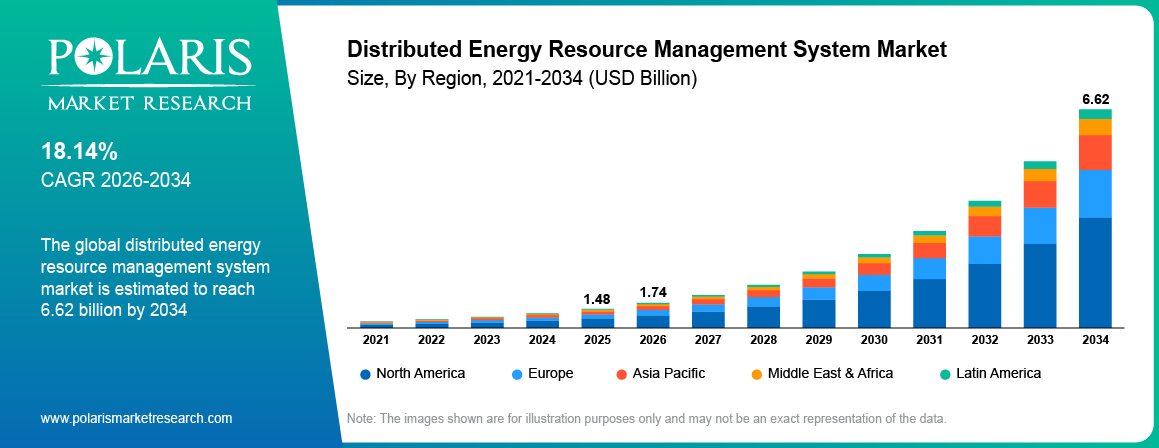
The global Distributed Energy Resource Management System (DERMS) market was valued at approximately USD 1.48 billion in 2025 and is expected to reach USD 6.62 billion by 2034, registering a CAGR of 18.14% during the forecast period. Market growth can be attributed to the increase in the use of distributed energy resources, modernization of the electric grids, expansion of the renewable energy capacity, and investments in digital grid management systems.
Market Statistics
Key Takeaways
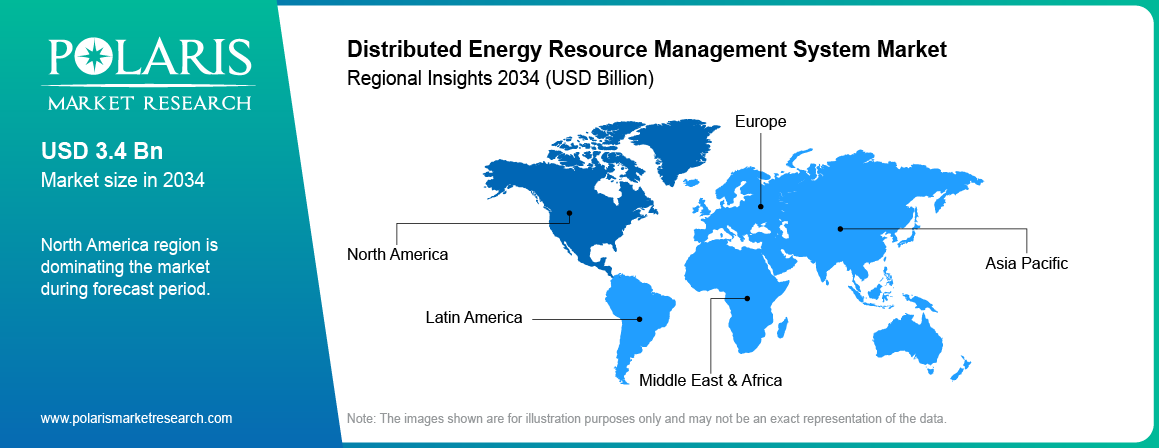
- North America accounted for the largest market share of 39.40% in 2025, due to extensive smart grid investments and supportive regulatory programs.
- Asia Pacific is projected to witness the fastest market growth at a CAGR of 18.80% during the forecast period, driven by increasing renewable energy deployment and grid modernization initiatives.
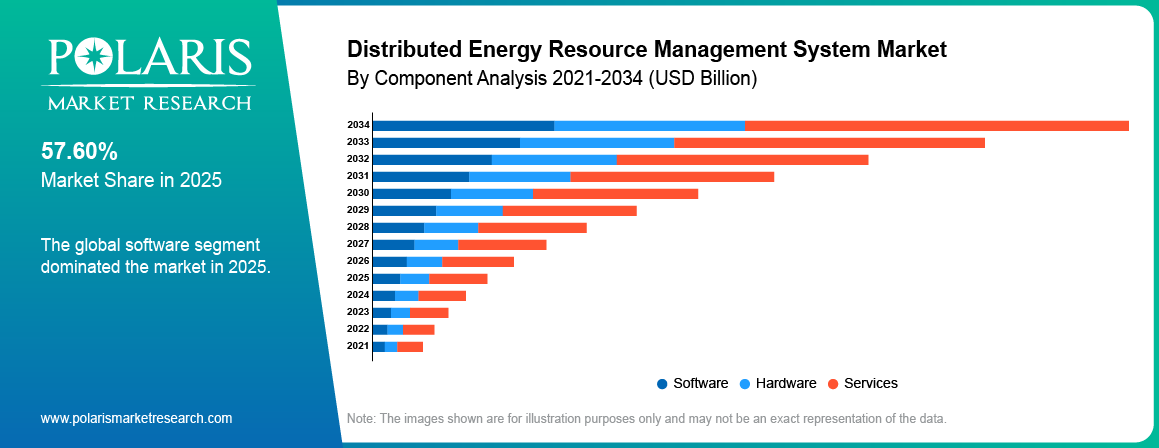
- Software represented the leading component segment with a 57.60% market share in 2025, owing to increasing demand for real-time energy optimization and enhanced grid visibility.
- Cloud-based deployment is expected to record the fastest growth at a CAGR of 20.10% during the forecast period, supported by increasing adoption of scalable and cloud-native energy management platforms.
- Utilities remained the largest end-user segment with a 52.90% market share in 2025, due to expanding distributed energy resource integration and rising investments in grid digitalization.
Note: Figures and projections outlined in this report are the result of Polaris Market Research’s proprietary analytical processes, grounded in the latest available datasets and market observations.
What is Distributed Energy Resource Management System?
Distributed energy resource management system (DERMS) are software applications used to control and monitor distributed energy resources such as solar PV power generation systems, energy storage systems, electric vehicles, microgrids, and other demand response resources. These applications allow utilities and grid operators to control these resources efficiently without causing instability in the grid.
The value chain includes software providers, hardware suppliers, communication technology suppliers, system integrators, utilities, independent power producers, grid operators, and commercial energy consumers. DERMS systems gather information about distributed assets, monitor the state of the system, and automate the control of energy assets to enhance the operation of the network.
The increasing use of renewable energy sources, higher distributed energy production, the development of smart grids, and government policies supporting such projects stimulate utilities to implement advanced energy management systems. The rising need for grid flexibility and real-time monitoring is expected to support long-term market expansion.
Distributed Energy Resource Management System Market Driver Impact Analysis
The DERMS market is growing due to modernization of electricity grids by utilities to integrate higher amounts of renewable energy sources and other distributed power sources. The utilities are upgrading themselves with digital solutions that helps them to control large numbers of distributed sources without compromising on system reliability and operational efficiency. Funding initiatives from governments to develop smart grid infrastructures are also driving the market growth.
The rising demand for battery storage systems, EV charging stations, and distributed solar power systems fuels the market's need for smart energy management solutions. Utility companies emphasizes automation, forecasting, and real-time monitoring to enhance energy flow optimization and decrease congestion.
| Market Driver | Est. CAGR Impact | Geographic Relevance | Impact Timeline |
| Smart grid modernization | High | North America, Europe | Medium to Long Term |
| Renewable energy integration | High | Global | Long Term |
| Battery energy storage deployment | Medium | US, China, Europe | Medium Term |
| Artificial intelligence adoption | Medium | Global | Short to Medium Term |
| Utility digital transformation | Medium | Global | Medium Term |
Source: Polaris Market Research Analysis
Industry Dynamics
- Increasing renewable energy integration is driving investments in DERMS platforms.
- Modernization initiatives for smart grids have increased the need for innovative grid management software.
- High implementation costs remain a key challenge for utilities with aging infrastructure.
- Expansion of virtual power plants is creating new opportunities for DERMS vendors.
Distributed Energy Resource Management System Market Drivers, Restraints and Opportunities
How is Renewable Energy Integration Driving Market Growth?
Growing deployment of solar, wind, and battery energy storage systems is increasing the complexity of electricity networks. According to the United Nations, global renewable electricity capacity increased by approximately 2,600 GW between 2015 and 2024, marking a 140% rise(Source: www.un.org).The utilities need an advanced management system to effectively manage the distributed energy resources without compromising on grid stability. The DERMS technology improves visibility of the dispersed assets, manages energy dispatching, and ensures grid stability. The increasing installations of renewable energy capacity are predicted to continue fueling demand for DERMS systems through the forecast period.
How is Grid Digitalization Supporting Market Expansion?
Electricity providers are adopting digital technologies in order to optimize their operations and update outdated electrical infrastructure. In March 2025, Itron has introduced the IntelliFLEX DERMS system, which allows for better coordination of DERs and helps electric companies to increase the reliability of the grid as well as its capacity by up to 20%(Source: investors.itron.com).DERMS systems utilize artificial intelligence, cloud computing, and analytics to monitor and control the electricity network in real time, thus allowing utilities to optimize forecasts and minimize costs, as well as to enhance the flexibility of the network due to increasing numbers of DERs.
What Challenges Limit Market Growth?
The implementation of DERMS solutions involves high costs associated with software integration, communication, cybersecurity, and workforce training. Utilities have been using older grid management technologies that need major improvements before implementing DERMS solutions. The complexity of integration and interoperability is expected to slow down the process of implementation, especially for small and medium-sized utilities.
What Opportunities are Emerging in the Market?
Investment into the virtual power plant, community-based energy sources, and microgrids is providing new opportunities for DERMS solution providers. In February 2026, OATI and NCEMC launched a real-time DERMS system in North Carolina for optimization of distributed energy resources and increasing grid reliability(Source: www.oati.com).Utilities are increasingly seeking intelligent platforms capable of coordinating distributed assets while participating in electricity markets and demand response programs. Expansion of electric vehicle charging networks and battery storage installations is expected to generate additional long-term demand for advanced DERMS solutions.
Segment and Regional Leaders at a Glance
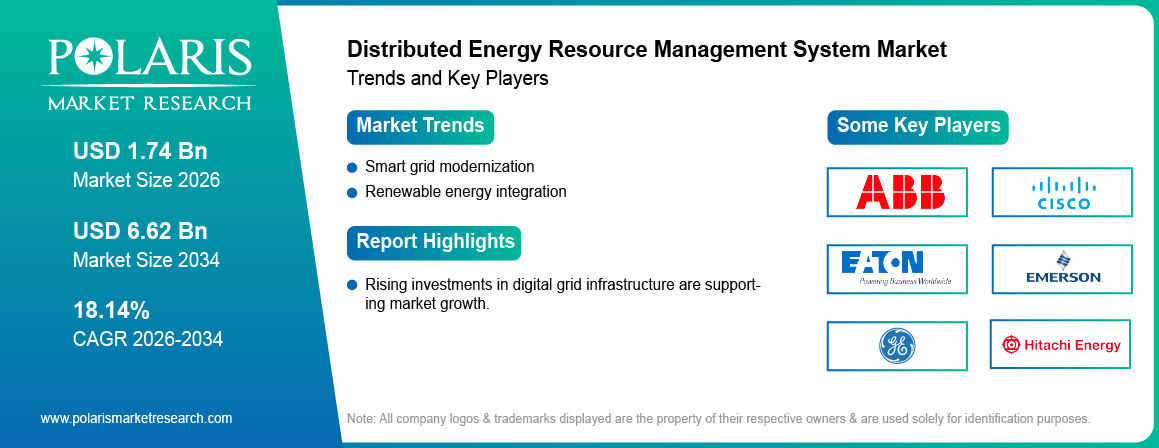
According to Polaris Market Research, North America leads the market while Asia Pacific the fastest-growing region.
- Largest Regional Market: North America
- Fastest Growing Region: Asia Pacific
- Largest Component Segment: Software
- Largest End User: Utilities
Distributed Energy Resource Management System Market Segmentation Analysis
The study covers detailed information on the distributed energy resource management system market based on component, deployment mode, application, and end user segments to generate revenues and growth.
Distributed Energy Resource Management System Market by Component
Which Component Dominated the Distributed Energy Resource Management System Market in 2025?
The software segment dominated the market in 2025 due to growing demand for centralized monitoring, forecasting, and optimization of distributed energy resources. There is growing use of advanced software systems to enhance grid visibility and automation of operations in addition to managing integration of renewables. Constant advancements in cloud computing, AI, and data analysis are contributing even further to the adoption of software within utility networks.
Which Component is Projected to Grow at the Fastest CAGR?
The services segment is expected to grow at a rapid CAGR throughout the forecast period. Growing projects relating to DERMS installation fuels the demand for consulting, system integration, deployment, maintenance, and technical support services. There is also a constant need for software upgradation and cybersecurity services in addition to operational optimization.
Distributed Energy Resource Management System Market by Deployment Mode
Which Deployment Mode Dominated the Market in 2025?
The on-premises segment held the highest market share in 2025. The preference for on-premise installations by large utilities stems from the ability to have better control over operations, cybersecurity, and compliance. In addition, existing investments in control center solutions and grid management legacy systems encourage on-premise deployment of the DERMS system.
Which Deployment Mode is Projected to Grow at the Fastest CAGR?
The cloud-based segment is anticipated to witness the highest growth rate over the forecast period. The cloud deployment model provides benefits such as cost-effective infrastructure, easy implementation, accessibility from anywhere, and scalability. Increasing adoption of cloud solutions by utilities for enabling digital transformation is a key trend observed.
Distributed Energy Resource Management System Market by Application
Which Application Dominated the Market in 2025?
Grid optimization and control dominated the market in 2025. Utilities are using DERMS solutions to enhance their capability to regulate voltage, balance energy supply and demand, prevent congestion, and sustain stable network performance. The increasing usage of renewable sources of energy is leading to further importance of advanced optimization of the grid.
Which Application is Projected to Grow at the Fastest CAGR?
The virtual power plant (VPP) management segment is expected to register the highest CAGR during the forecast period. Energy aggregators and utilities have been adopting VPP programs to effectively manage decentralized energy resources and take part in the electricity market. In May 2026, the Maryland Public Service Commission advanced virtual power plant deployment through a new distributed energy resource integration framework(Source: psc.maryland.gov).Growing adoption of battery storage systems and flexible energy resources is expected to support rapid expansion of this segment.
Distributed Energy Resource Management System Market by End User
Which End User Dominated the Market in 2025?
The utilities segment held the largest market share in 2025 due to increasing investments in smart grid modernization and distributed energy integration. Electric utilities are deploying DERMS systems for enhanced efficiency, grid reliability, and management of the increasing number of decentralized energy resources that are linked to electricity grids.
Which End User is Projected to Grow at the Fastest CAGR?
The commercial and industrial segment is witnessing the highest CAGR during the forecast period. Commercial buildings, industrial units, and other energy-intensive enterprises have been increasingly using distributed energy resources to increase energy efficiency, lower the cost of electricity, and meet sustainable practices. DERMS technologies help enterprises manage energy production, storage, and utilization efficiently.
Segment Summary Table
| Segment | Category | 2025 Status | Forecast CAGR | Key Driver |
| Software | Component | Largest Share | Moderate | Grid monitoring and real-time optimization |
| Services | Component | Fastest Growing | High | Increasing DERMS implementation and integration services |
| Grid Optimization & Control | Application | Largest Share | Moderate | Growing renewable energy integration |
| Virtual Power Plant Management | Application | Fastest Growing | High | Expansion of distributed energy aggregation |
| Utilities | End User | Largest Share | Moderate | Smart grid modernization investments |
| Commercial & Industrial | End User | Fastest Growing | High | Rising adoption of distributed energy resources |
Source: Polaris Market Research Analysis
Distributed Energy Resource Management System Market Regional Analysis
North America Distributed Energy Resource Management System Market
North America dominated the market in 2025 due to increasing investments in smart grid infrastructure and distributed energy resources. The US is dominating the market in the region due to significant investments in grid modernization and battery storage. In January 2026, Yield Energy introduced its agriculture-based DERMS system which helps farms optimize distributed energy resources and be part of grid services. Canada is also increasing its investment in renewable energy generation and utility digitalization, favoring DERMS adoption.
Europe Distributed Energy Resource Management System Market
The Europe region had a significant market share in 2025 due to its high decarbonization goals and the installation of renewable energy resources. The European Commission announced that in 2023 the EU introduced climate and energy policies whereby greenhouse gases is expected to be reduced by 55% by 2030 relative to 1990 levels(Source: climate.ec.europa.eu).Germany, the UK, France, Italy, and the Netherlands are investing in digital grid technologies and energy flexibility solutions. These investments continue to increase demand for DERMS platforms across the region.
Asia Pacific Distributed Energy Resource Management System Market
Asia Pacific is projected to grow at the fastest CAGR during the forecast period. China, Japan, India, South Korea, and Australia are expanding renewable energy capacity and upgrading electricity networks. For instance, in 2025, Smarter Grid Solutions, a Mitsubishi Electric Power Products' subsidiary, and Clean Power Research have partnered to connect Strata Grid DERMS technology with the PowerClerk platform(Source: www.meppi.com).Thereby simplifying DER registration and making distributed energy resource management in real time possible. Government support for smart grid and digital power systems is boosting regional growth.
Latin America Distributed Energy Resource Management System Market
Latin America is showing consistent growth due to growing investments in renewable energy and power infrastructure. Brazil, Mexico, Chile, and Argentina are expanding distributed solar generation and battery storage projects. Utilities are gradually adopting DERMS solutions to improve grid flexibility and operational efficiency.
Middle East & Africa Distributed Energy Resource Management System Market
The Middle East & Africa market is expected to grow steadily during the forecast period. Saudi Arabia, the UAE, South Africa, and Israel are investing in renewable energy projects and smart grid development. IEA stated that energy investment in the Middle East reached USD 175 billion in 2024, with clean energy accounting for 15% of total investment, while clean energy investment is expected to more than triple by 2030(Source: www.iea.org).Rising clean energy deployment is expected to create new opportunities for DERMS providers.
Regulatory Heatmap
| Region/Country | Policy Environment | Key Regulations | Market Implication | Trend |
| US | Favorable | Grid modernization funding, FERC initiatives, clean energy programs | Supports DERMS deployment | Expanding |
| Canada | Favorable | Clean Electricity Regulations, provincial smart grid programs | Encourages distributed energy integration | Growing |
| European Union | Favorable | Green Deal, Fit for 55, Renewable Energy Directive | Accelerates digital grid investment | Expanding |
| UK | Favorable | Net Zero Strategy, Smart Systems Plan | Supports flexible energy markets | Stable |
| China | Favorable | Smart Grid Development Plan, Renewable Energy Law | Expands utility digitalization | Expanding |
| Japan | Developing | Energy Transition Strategy | Increases grid automation | Growing |
| India | Developing | National Smart Grid Mission, Revamped Distribution Sector Scheme | Supports smart utility infrastructure | Expanding |
| Australia | Favorable | Integrated System Plan, Distributed Energy Roadmap | Encourages DERMS implementation | Growing |
Source: Polaris Market Research Analysis
Distributed Energy Resource Management System Market Competitive Landscape and Key Players
Distributed energy resource management systems is moderately fragmented owing to the presence of global players providing technology solutions for the market, grid software vendors, and energy management solution vendors. Software capability, grid integration, security, and service support are some of the competition parameters for these companies in the market. Strategic alliances, innovation in products, acquisitions, and cloud-based platforms are key growth strategies being adopted by market players.
Leading companies such as ABB Ltd., Uplight, Inc., Cisco Systems Inc., Eaton Corporation plc, Emerson Electric Co., GE Vernova, Hitachi Energy Ltd., Itron Inc., Oracle Corporation, Schneider Electric SE, Siemens AG, Smarter Grid Solutions are augmenting their AI technologies, making their products more compatible with utility software, and enhancing their cloud-based energy management systems. Vendors are also investing in virtual power plant technologies, advanced analytics, and distributed grid optimization to improve their competitive position.
Competitive Positioning Table
| Company | Est. Market Position | Primary Strength | Geographic Focus | In Report |
| ABB Ltd. | Top Tier | Grid automation | Global | Yes |
| Uplight, Inc. | Strong Challenger | DERMS software | North America | Yes |
| GE Vernova | Top Tier | Utility solutions | Global | Yes |
| Hitachi Energy | Top Tier | Grid management | Global | Yes |
| Oracle Corporation | Established Player | Enterprise software | Global | Yes |
| Schneider Electric | Top Tier | Energy management | Global | Yes |
| Siemens AG | Top Tier | Smart grid portfolio | Global | Yes |
Source: Polaris Market Research Analysis
Distributed Energy Resource Management System Market Technology and Innovation Landscape
Technology development is improving the performance of DERMS platforms across modern electricity networks. Utility companies are using the capabilities of cloud computing, artificial intelligence, and data analytics to monitor the electricity grid better and enable energy management through automation. This allows utility companies to manage the balance between electricity demand and supply and improve grid flexibility.
In addition, software companies are working on developing open platforms that combine renewable energy systems, battery storage, EVs, and demand response resources. Improved interoperability is helping utilities manage growing numbers of distributed energy assets through a single control platform.
| Technology | Adoption Stage | Key Development | Market Impact |
| Artificial Intelligence | Growing | Demand forecasting | Improves grid efficiency |
| Advanced Analytics | Growing | Operational insights | Better decision making |
| Cloud Computing | Rapid | Scalable deployment | Faster implementation |
| Digital Twin | Early Commercial | Asset simulation | Better planning |
| IoT Integration | Mainstream | Real-time monitoring | Higher grid visibility |
| Machine Learning | Growing | Load prediction | Improved energy optimization |
Source: Polaris Market Research Analysis
Who Buys Distributed Energy Resource Management System Market Research and Why?
Utilities continue to be the main customers for the DERMS software due to growing expenditures on the development of smart grids and renewable energy integration. Other organizations making investments include independent power producers, microgrid developers, businesses, and government institutions.
The increasing use of battery storage, electric vehicle charging, and renewables for decentralized power generation is expected to add new customers. There is an increasing demand for software solutions that help cut down the cost of operations while boosting energy efficiency.
| Buyer / Investor Type | Primary Use Case | Key Insight Sought | Decision Horizon |
| Electric Utilities | Grid optimization | Reliability and scalability | 2–5 Years |
| Independent Power Producers | Renewable integration | System flexibility | 1–3 Years |
| Commercial Facilities | Energy optimization | Return on investment | 1–3 Years |
| Government Agencies | Grid modernization | Regulatory compliance | 3–5 Years |
| Microgrid Developers | Distributed control | System interoperability | 1–2 Years |
Source: Polaris Market Research Analysis
What are the Barriers to Entering the Distributed Energy Resource Management System Market?
- High implementation and integration costs.
- Long utility procurement and approval cycles.
- Complex regulatory and cybersecurity requirements.
- Compatibility issues with legacy utility systems.
- Requirement for advanced software and grid expertise.
- High customer expectations for reliability and system performance.
Distributed Energy Resource Management System Market Premium Insights and Forward Outlook
The investments in renewable energy, battery storage, and smart grid helps to sustain market growth. The utilities have increased their expenditure in digital grid solutions to boost the efficiency of operations.
AI, cloud computing, and virtual power plants are significant areas of investment in the forecast period. Companies with strong software capabilities and utility partnerships are likely to strengthen their market position.
Cost Benchmarking Table
| Product | Est. Price Range | Key Cost Driver | Complexity Tier |
| DERMS Software License | 100,000–800,000 | Software functionality | High |
| Cloud-Based DERMS | Subscription Based | Number of connected assets | Medium |
| System Integration | 250,000–2 Million | Project scope | High |
| Support & Maintenance | Annual Contract | Service level | Medium |
Source: Polaris Market Research Analysis
Key Players
- ABB Ltd.
- Uplight, Inc.
- Cisco Systems Inc.
- Eaton Corporation plc
- Emerson Electric Co.
- General Electric Company (GE Vernova)
- Hitachi Energy Ltd.
- Itron Inc.
- Oracle Corporation
- Schneider Electric SE
- Siemens AG
- Smarter Grid Solutions
Distributed Energy Resource Management System Market Industry Developments
- February 2026: GE Vernova has introduced GridOS for Distribution, which is an AI-enabled software solution designed to assist utilities in optimizing their distribution network operations and incorporating DERs (source: www.gevernova.com).
- March 2026: Austin Energy has joined hands with EnergyHub to introduce the Power Partner Battery Program in order to add residential battery storage to its multi-DER Virtual Power Plant(source: www.energyhub.com).
Market Segmentation
By Component Outlook (Revenue, USD Billion, 2021–2034)
- Software
- Hardware
- Services
By Deployment Mode Outlook (Revenue, USD Billion, 2021–2034)
- Cloud-Based
- On-Premise
By Application Outlook (Revenue, USD Billion, 2021–2034)
- Grid Optimization & Control
- Virtual Power Plant Management
- Demand Response Management
- Microgrid Management
- Renewable Energy Integration
- Energy Storage Management
- Others
By End User Outlook (Revenue, USD Billion, 2021–2034)
- Utilities
- Commercial & Industrial
- Independent Power Producers
- Government & Public Utilities
- Others
By Regional Outlook (Revenue, USD Billion, 2021-2034)
- North America
- US
- Canada
- Europe
- Germany
- France
- UK
- Italy
- Spain
- Netherlands
- Russia
- Rest of Europe
- Asia Pacific
- China
- Japan
- India
- Malaysia
- South Korea
- Indonesia
- Australia
- Vietnam
- Rest of Asia Pacific
- Middle East & Africa
- Saudi Arabia
- UAE
- Israel
- South Africa
- Rest of Middle East & Africa
- Latin America
- Mexico
- Brazil
- Argentina
- Rest of Latin America
Report Scope
| Report Attributes | Details |
| Market Size in 2025 | USD 1.48 Billion |
| Market Size in 2026 | USD 1.74 Billion |
| Revenue Forecast by 2034 | USD 6.62 Billion |
| CAGR | 18.14% from 2026 to 2034 |
| Base Year | 2025 |
| Historical Data | 2021–2024 |
| Forecast Period | 2026–2034 |
| Quantitative Units | Revenue in USD Billion and CAGR from 2026 to 2034 |
| Report Coverage | Revenue Forecast, Competitive Landscape, Growth Factors, and Industry Trends |
| Segments Covered |
|
| Regional Scope |
|
| Competitive Landscape |
|
| Report Format |
|
| Customization | Report customization as per your requirements with respect to countries, regions, and segmentation. |
Distributed Energy Resource Management System Market FAQ's
• The global distributed energy resource management system market was valued at USD 1.48 billion in 2025 and is projected to witness steady growth during the forecast period.
• The market is projected to reach USD 6.62 billion by 2034, registering a CAGR of 18.14% from 2026 to 2034.
• North America accounted for the largest market share of 39.40% in 2025 due to advanced grid infrastructure, supportive regulations, and high smart grid investments.
• Software represented the leading component segment with a 57.60% market share in 2025 owing to increasing demand for centralized monitoring, forecasting, and grid optimization.
• Leading companies include ABB Ltd., GE Vernova, Hitachi Energy, Oracle Corporation, Schneider Electric, Siemens AG, Uplight, Inc., Eaton Corporation, and Itron Inc.
• Growing deployment of renewable energy, smart grid modernization, battery energy storage, and digital utility investments are driving market growth.
Download Sample Report of Distributed Energy Resource Management System Market
Please fill out the form to request a customized copy of the research report.


