
Energy Recovery Ventilator Market Size, Share Global Analysis Report, 2026-2034
REPORT DETAILS
Energy Recovery Ventilator Market Summary
The global energy recovery ventilator market is estimated around USD 4.27 Billion in 2025, with consistent growth anticipated during 2026–2034. Growth is driven by rising demand for energy efficient HVAC systems and increasing focus on indoor air quality across residential and commercial buildings. The market is projected to grow at a CAGR of 9.08% during the forecast period.
Market Statistics
Key Takeaways
- North America Energy Recovery Ventilator Market accounted for over 38% market share in 2025, driven by strict energy efficiency regulations, advanced building codes, and high adoption of HVAC systems across residential and commercial infrastructure.
- By Technology Type, Plate Heat Exchanger accounted for over 52% market share in 2025, driven by increasing adoption of advanced heat exchange technologies, supporting energy-efficient ventilation across commercial and residential buildings.
- By Product Type, Cabinet / Centralized accounted for approximately 58% market share in 2025, driven by strong demand in commercial infrastructure, providing centralized ventilation solutions across multiple building zones.
- By Installation Type, New Construction accounted for nearly 61% market share in 2025, driven by integration of energy recovery ventilation systems in modern building designs focused on energy efficiency and sustainability.
- By Application, Commercial Buildings accounted for around 65% market share in 2025, driven by strong demand for controlled ventilation across offices, hospitals, and institutions requiring continuous fresh air circulation.
Industry Dynamics
- Increasing demand for energy-efficient HVAC systems is fueling the adoption of energy recovery ventilation systems.
- Rising focus on indoor air quality in buildings is fueling the adoption of advanced ventilation systems.
- High installation costs and system integration requirements limit adoption across some existing buildings.
- Growth in smart buildings and sustainable construction is creating long term opportunities in the energy recovery ventilator market.
What is an Energy Recovery Ventilator (ERV)?
The energy recovery ventilator comprises the use of ventilation systems to replace stale air with fresh outdoor air while at the same time recovering energy using the exhaust air. The energy recovery ventilator works through the transfer of heat and moisture using the heat exchange core. This ensures that there is no energy loss as the air is ventilated, thus maintaining a constant temperature and humidity level. The energy recovery ventilation systems are commonly used as part of the ventilation systems to ensure improved ventilation of indoor air quality and to support the use of energy-efficient ventilation systems.
Energy recovery ventilators form an important component of modern HVAC energy recovery systems used across residential, commercial, and institutional buildings. ERV units supply continuous fresh air ventilation solutions while recovering thermal energy from exhaust air. This mechanism improves energy efficiency HVAC performance and reduces the load on heating and cooling equipment. Commercial ventilation equipment integrates ERV technology to ensure efficient ventilation and air circulation in buildings.
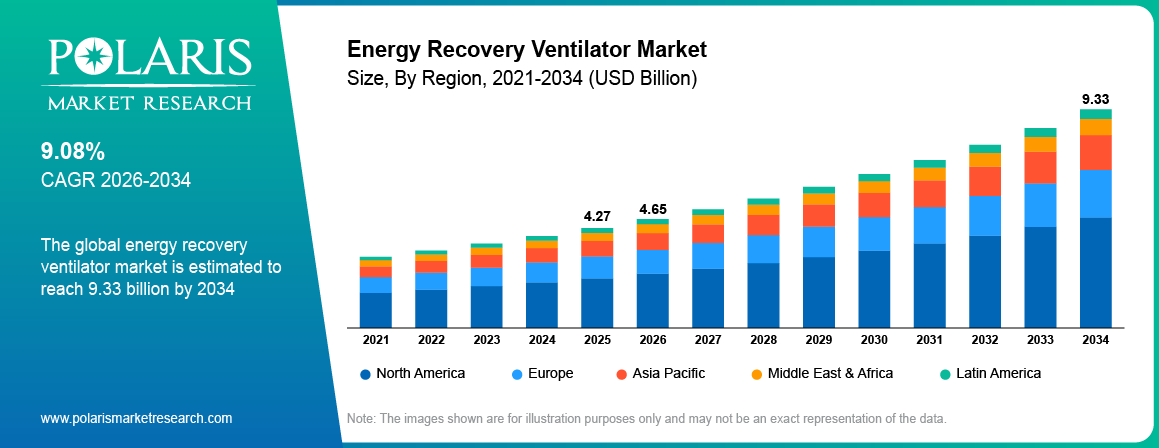
Source: Polaris Market Research Analysis
To Understand More About this Research:Download Sample Report
The market for energy recovery ventilators is witnessing growth due to increased awareness about indoor air quality and rising emphasis on energy efficiency in building ventilation systems. Energy efficiency norms and green building developments are creating demand for energy recovery ventilation systems in modern infrastructures. Manufacturers of HVAC equipment are improving ERV technologies to support sustainable building operations and ventilation systems. These factors are positively impacting the energy recovery ventilator market in the global market scenario.
How Energy Recovery Ventilators Work
Energy recovery ventilation systems use a process in which a controlled exchange of air occurs using HVAC systems with a heat recovery process.
- Exhausted air is expelled from the building via the ERV system.
- Fresh outdoor air is introduced into the ERV system using a separate air channel.
- The enthalpy exchanger is used to transfer heat and moisture from one air stream to another.
The air-to-air energy recovery process serves to condition the air before it enters the building. The energy recovery ventilation systems serve to reduce heating and cooling requirements, promoting efficient ventilation of HVAC systems. The above passage explains the working of energy recovery ventilators within the fresh air ventilation systems.
Key Difference – ERV vs HRV
| Feature | Energy Recovery Ventilator | Heat Recovery Ventilator |
| Energy transfer | Recovers heat and moisture | Recovers heat only |
| Moisture control | Maintains balanced indoor humidity | No moisture transfer |
| Climate suitability | Suitable for humid or mixed climates | Suitable for cold and dry climates |
| Building use | Residential and commercial buildings requiring humidity control | Buildings focused on heat recovery |
Source: Polaris Market Research Analysis
Drivers & Opportunities
Increasing demand for energy-efficient HVAC systems: Growing electricity costs are increasing the focus on energy efficient building operations across residential and commercial infrastructure. Building owners and facility managers are adopting energy recovery ventilator (ERV) systems to improve ventilation while reducing heating and cooling energy losses. In October 2024, DUCO has introduced “The Natural Family” range of ventilation products that provide demand-controlled ventilation while improving air quality and reducing energy consumption. Moreover, energy recovery ventilation systems transfer heat and moisture between incoming and outgoing air streams, which supports building energy optimization and improves the performance of modern HVAC ventilation systems.
Rising focus on indoor air quality (IAQ): Growing awareness of the importance of indoor air quality is fueling demand for advanced ventilation systems. Post-pandemic building management guidelines have increased the focus on continuous fresh air circulation in schools, hospitals, and office buildings. Energy recovery ventilators support controlled indoor air quality ventilation while maintaining building energy efficiency. This trend is driving the adoption of ERV systems in commercial ventilation products and institutional infrastructure.
Restraints & Challenges
High installation cost: The high cost of installations continues to be one of the major factors hindering the growth of the energy recovery ventilator market. The cost of installations of ERV systems includes designing ductwork and matching the existing HVAC ventilation systems. The cost of installations also includes integrating the ERV systems with HVAC systems, which are used for heating and cooling.
Opportunity
Growth in green buildings: The increasing trend of green construction practices is opening new growth prospects for the energy recovery ventilator market. According to the International Finance Corporation, green investment in cities of emerging markets has the potential to reach USD 24 trillion by 2030. Green building standards such as LEED certification are increasing the demand for energy efficient ventilation solutions in residential and commercial infrastructure. Energy recovery ventilators help in the design of building ventilation systems that minimize energy consumption and provide satisfactory indoor air purification. This helps in the promotion of sustainable building design and the use of ERV technology in modern green building construction.
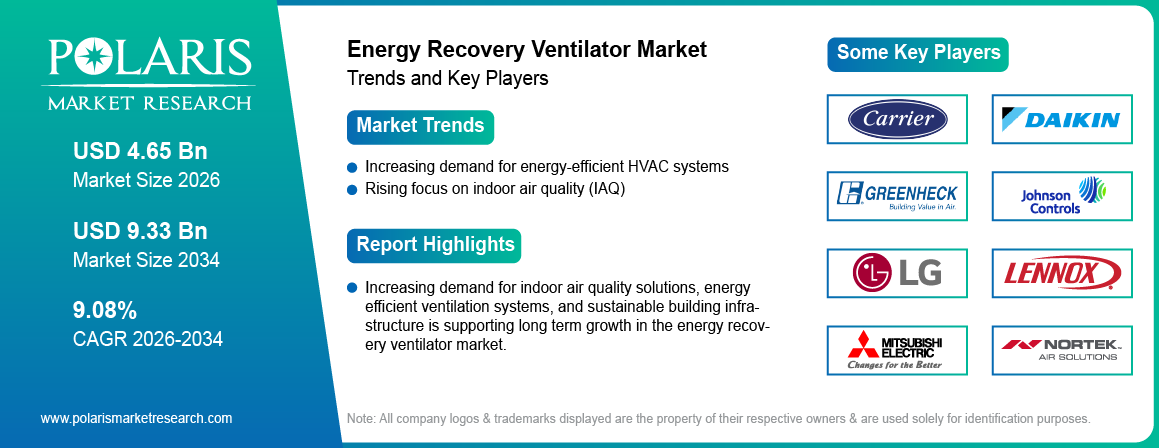
Source: Polaris Market Research Analysis
Segmental Insights
This report offers detailed coverage of the energy recovery ventilator market by technology type, product type, installation type, and application to help readers identify the fastest expanding and most attractive demand segments.
By Technology Type
-
Plate Heat Exchanger
The plate heat exchanger segment led the market in 2025, owing to the efficient energy recovery capacity and compact design of the technology. The technology involves the transfer of heat and moisture between two air streams through plates. The technology helps in efficient energy recovery in modern air-to-air energy recovery in building ventilation systems. There is a rise in demand for energy-efficient ventilation in buildings.
-
Rotary Heat Exchanger
The rotary heat exchanger segment is expected to register the fastest CAGR during the forecast period, owing to the efficiency of heat and moisture transfer. In rotary heat exchangers, heat energy is recovered by using a rotating thermal wheel that picks up heat from the exhaust air and transfers it to the fresh air. This technology is expected to enhance the efficiency of HVAC systems in energy recovery.
By Product Type
-
Cabinet / Centralized
The cabinet or centralized ERV market segment held the largest market share in 2025, owing to higher adoption rates in large commercial spaces and institutions. Centralized ERV systems provide integrated ventilation for multiple rooms or building zones. Growing construction of commercial infrastructure is increasing demand for centralized commercial ventilation equipment.
-
Ceiling Mount
The ceiling mount segment is projected to grow at the fastest CAGR during the forecast period, due to increasing installation across modern residential and office buildings. Ceiling mounted ERV units support compact ventilation design and efficient fresh air distribution. Rising demand for space efficient HVAC ventilation systems is supporting segment growth.
By Installation Type
-
New Construction
The new construction segment accounted for the largest market size in 2025, owing to the increasing number of energy-efficient buildings and infrastructure developed. Modern building ventilation systems are integrating ERV technology during the design stage to support energy optimization. Rising construction of commercial complexes and residential projects is supporting segment expansion.
-
Retrofit Installations
The retrofit installations segment is projected to grow at the fastest CAGR during the forecast period, due to rising upgrades of existing HVAC systems. The building owners are increasingly using energy recovery ventilation systems to enhance the quality of air. There is an increase in focus towards energy efficiency retrofits in older buildings.
By Application
-
Commercial Buildings
The commercial buildings segment accounted for the largest market share in 2025, owing to increasing demand for controlled ventilation in offices, hospitals, schools, and shopping complexes. These buildings require continuous fresh air ventilation to maintain the quality of the air. Energy recovery ventilators help in efficient air circulation and minimize losses in heating and cooling.
-
Residential Sector
the residential sector segment is expected to grow at the fastest CAGR during the forecast period. This is due to increasing awareness about indoor air quality and energy-efficient homes. Homeowners are adopting ERV systems to maintain fresh air ventilation while reducing HVAC energy consumption. Growing adoption of energy efficient building technologies is supporting market growth across residential infrastructure.
Source: Polaris Market Research Analysis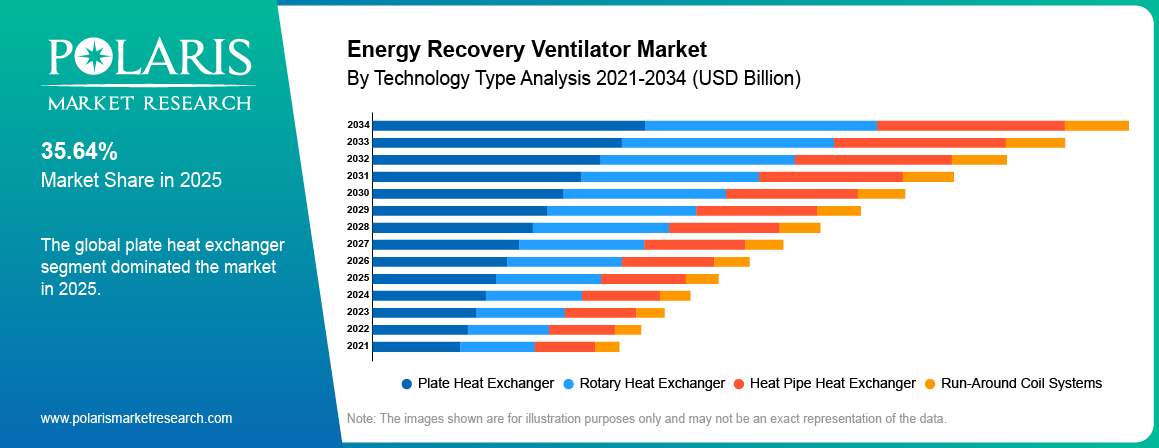
Regional Analysis
North America Market Assessment
The North America ventilation market dominated the energy recovery ventilator market by region in 2025. Strict energy efficiency regulations and advanced building codes are increasing the adoption of energy recovery ventilation systems across residential and commercial buildings. High adoption of HVAC systems in the US and Canada is fueling market growth. The ERV market in the US has the highest share in this region due to strong HVAC infrastructure and increasing demand for energy-efficient systems. In June 2025, Greenheck introduced the Model IVE energy recovery ventilator, an indoor-mounted HVAC solution that delivers up to 85% energy recovery efficiency and 100% outdoor air ventilation for commercial buildings with space-constrained installations.
Asia Pacific Energy Recovery Ventilator Market Insights
The energy recovery ventilation market Asia Pacific is projected to grow at the fastest CAGR during the forecast period. Rapid urbanization and expanding construction activity across China, India, and Japan are increasing demand for modern building ventilation systems. UN-ESCAP reported that the Asia-Pacific region hosts over 2.2 billion urban residents, and its urban population is projected to grow 50% by 2050, increasing demand for strategic urban development. Moreover, growing residential complexes and commercial infrastructure is strengthening the Asia Pacific HVAC market.
Europe Energy Recovery Ventilator Market Overview
The Europe ventilation systems market accounted for the second largest share in the global energy recovery ventilator industry. Strong energy efficiency directives and rising adoption of sustainable building practices are driving market growth. Countries such as Germany, France, and the UK are increasing the use of energy efficient ventilation technologies. Climate control requirements across modern buildings are also supporting ERV adoption.
Latin America Market Outlook
The energy recovery ventilator market in Latin America is expanding due to infrastructure modernization across urban regions. Governments and private organizations are investing in new residential and commercial buildings. These buildings require good ventilation systems to maintain good indoor air quality. This is supporting ERV market growth in this region.
Middle East & Africa Market Insights
The Middle East & Africa ventilation systems market is growing due to increasing commercial infrastructure development. Egis Group reported that infrastructure construction in the Middle East is projected to increase from USD 204.0 billion in 2025 to USD 266.7 billion by 2030, reflecting a 5.51% CAGR. In addition, large hospitality, retail, and mixed-use construction projects require advanced HVAC ventilation systems. Rising construction of hotels, shopping centers, and commercial facilities is increasing demand for energy recovery ventilation systems across the region.
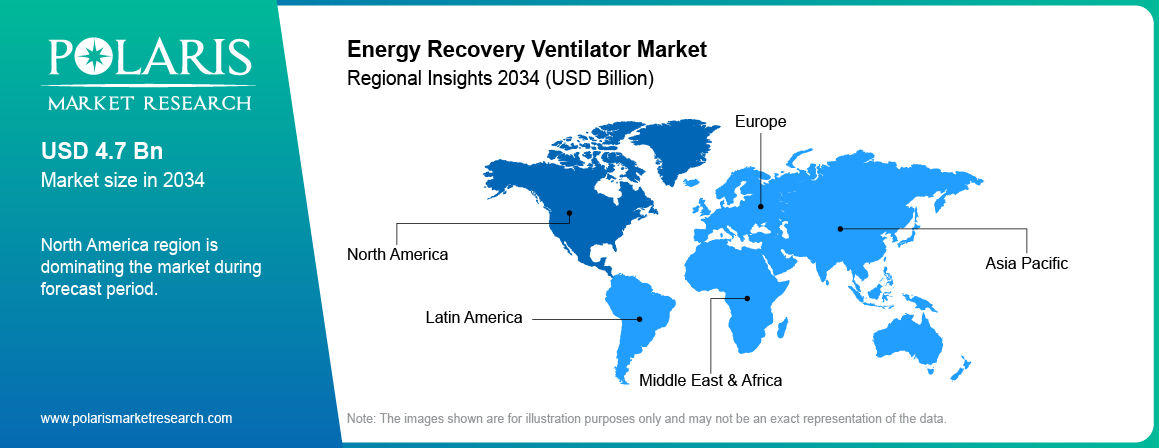
Source: Polaris Market Research Analysis
Key Players & Competitive Analysis Report
The competitive environment in the energy recovery ventilator market is shaped by continuous innovation in HVAC ventilation technologies and energy recovery systems. Companies are developing advanced ERV units that have increased efficiency in heat exchange and airflow control. Strategic partnerships with manufacturers, construction companies, and building automation providers are boosting the adoption of energy recovery ventilation systems.
The major players in the energy recovery ventilator market include Daikin Industries, Mitsubishi Electric, Panasonic Corporation, Carrier Global, Lennox International, Johnson Controls, Greenheck Fan Corporation, Zehnder Group AG, LG Electronics Inc, Systemair AB, Swegon Group, Nortek Air Solutions, and many more.
Premium Insights and Future Market Trends
he energy recovery ventilator market is transforming through the incorporation of intelligent ventilation systems and other advanced HVAC automation systems. The HVAC industry is incorporating sensors, automation of ventilation air flows, and digital monitoring systems to enhance the effectiveness of ventilation systems. This trend continues to enhance the position of ERV systems as integral components of future HVAC technology for intelligent buildings.
The increasing trend of AI-based HVAC systems projected to influence the management of buildings. The AI-based building management systems utilize AI technology to analyze the indoor air conditions and optimize the ventilation systems' performance. This ensures effective operation of HVAC systems and energy management of buildings.
Decarbonization initiatives and the development of net zero buildings are increasing demand for sustainable ventilation solutions. Governments and developers of constructions are focusing on reducing the consumption of energy and the amount of carbon emitted into the environment. Energy recovery ventilators play a critical role in attaining this objective by increasing efficiency while reducing heat and cooling losses.
Key Players
- Carrier Global
- Daikin Industries
- Greenheck Fan Corporation
- Johnson Controls
- LG Electronics Inc
- Lennox International
- Mitsubishi Electric
- Nortek Air Solutions
- Panasonic Corporation
- Swegon Group
- Systemair AB
- Zehnder Group AG
Industry Developments
- January 2026: Panasonic announced its new line of Intelli-Balance Elite and Elite+ Energy Recovery Ventilators (ERVs) at AHR Expo 2026, providing up to 90% sensible recovery efficiency and reliable heat exchange in temperatures as low as -22°F to support high-efficiency ventilation systems in residential spaces. (Source: panasonic.com)
- May 2025: Airxchange announced the Blue Wave Energy Recovery Wheel, a new generation of HVAC products that improves the efficiency of energy recovery while reducing air pressure drop by 15 to 20 percent and facilitate compliance with new commercial building energy standards. (Source: airxachange.com)
Energy Recovery Ventilator Market Segmentation
By Technology Type Outlook (Revenue, USD Billion, 2021-2034)
- Plate Heat Exchanger
- Rotary Heat Exchanger
- Heat Pipe Heat Exchanger
- Run-Around Coil Systems
By Product Type Outlook (Revenue, USD Billion, 2021-2034)
- Wall Mount
- Ceiling Mount
- Cabinet / Centralized
By Installation Type Outlook (Revenue, USD Billion, 2021-2034)
- New Construction
- Retrofit Installations
By Application Outlook (Revenue, USD Billion, 2021-2034)
- Residential Sector
- Commercial Buildings
- Industrial Facilities
By Regional Outlook (Revenue, USD Billion, 2021-2034)
- North America
- US
- Canada
- Europe
- Germany
- France
- UK
- Italy
- Spain
- Netherlands
- Russia
- Rest of Europe
- Asia Pacific
- China
- Japan
- India
- Malaysia
- South Korea
- Indonesia
- Australia
- Vietnam
- Rest of Asia Pacific
- Middle East & Africa
- Saudi Arabia
- UAE
- Israel
- South Africa
- Rest of Middle East & Africa
- Latin America
- Mexico
- Brazil
- Argentina
- Rest of Latin America
Energy Recovery Ventilator Market Report Scope
| Report Attributes | Details |
| Market Size in 2025 | USD 4.27 Billion |
| Market Size in 2026 | USD 4.65 Billion |
| Revenue Forecast by 2034 | USD 9.33 Billion |
| CAGR | 9.08% from 2026 to 2034 |
| Base Year | 2025 |
| Historical Data | 2021–2024 |
| Forecast Period | 2026–2034 |
| Quantitative Units | Revenue in USD Billion and CAGR from 2026 to 2034 |
| Report Coverage | Revenue Forecast, Competitive Landscape, Growth Factors, and Industry Trends |
| Segments Covered |
|
| Regional Scope |
|
| Competitive Landscape |
|
| Report Format |
|
| Customization | Report customization as per your requirements with respect to countries, regions, and segmentation. |
Source: Polaris Market Research Analysis
Energy Recovery Ventilator Market FAQ's
The global market size was valued at USD 4.27 Billion in 2025 and is projected to grow to USD 9.33 Billion by 2034.
North America dominates the market due to strict energy efficiency regulations and high HVAC system adoption.
Major applications include residential ventilation, commercial building ventilation, and industrial air circulation systems.
A few of the key players in the market are Daikin Industries, Mitsubishi Electric, Panasonic Corporation, Carrier Global, Lennox International, Johnson Controls, Greenheck Fan Corporation, Zehnder Group AG, LG Electronics Inc, Systemair AB, Swegon Group, Nortek Air Solutions, and others.
Key market drivers include rising demand for energy efficient HVAC systems, increasing focus on indoor air quality, and growth in green building construction.
Major sectors include residential housing, commercial buildings such as offices and hospitals, and industrial facilities.
The market outlook remains strong due to growing focus on energy efficient green buildings and rising adoption of smart ventilation systems.
Download Sample Report of Energy Recovery Ventilator Market
Please fill out the form to request a customized copy of the research report.


