
Engineering Services Outsourcing Market Demand, Opportunity, 2026 - 2034
REPORT DETAILS
Engineering Services Outsourcing Market Summary
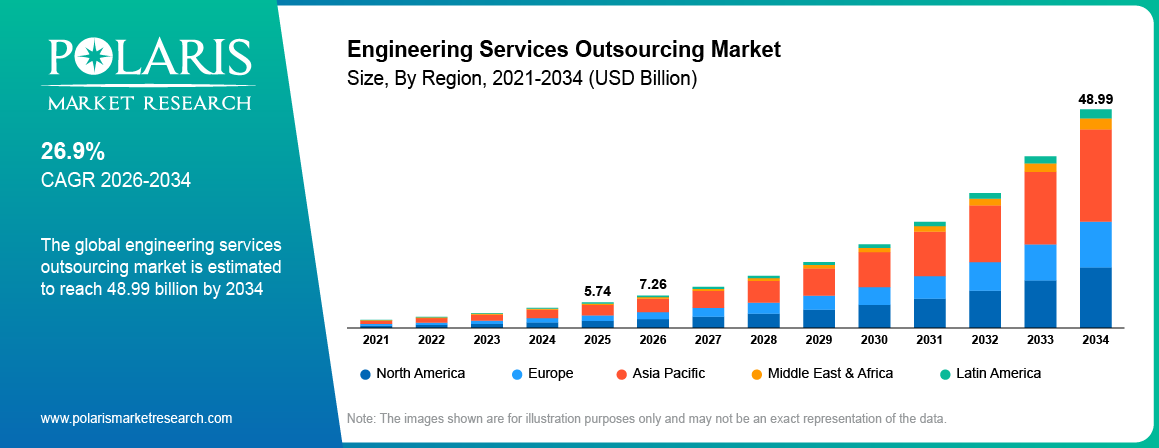
The engineering services outsourcing market size was valued at USD 3.22 billion in 2025 and is expected to register a CAGR of 20.47% from 2026 to 2034. The rising demand for cost savings and access to global talent drives the industry growth. Companies in multiple industries, including automotive, aerospace, energy, telecommunications, and healthcare, are increasingly turning to engineering service outsourcing providers. This factors fuels the growth of the market.
Market Statistics
Key Takeaways
- In 2025, Asia Pacific accounted for the largest revenue share of 34.0%. The increasing demand from the manufacturing sector and rising emphasis on Industry 4.0 drive the regional industry expansion.
- The industry in North America is experiencing significant growth of 18.80%. This is due to a growing demand for industrial automation consultancy, especially in the automotive and electronics sectors.
- In 2025, the industrial automation segment held the largest share of 17.0%. This is due to the rising adoption of automation in various end-use industries.
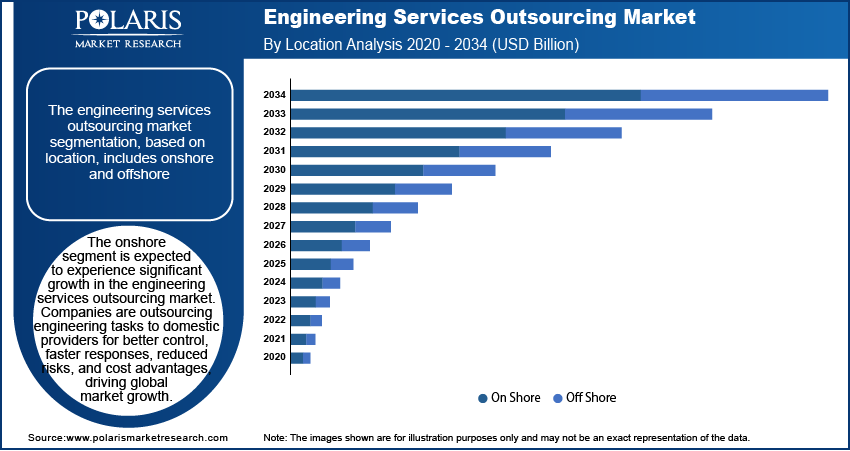
- The onshore segment is expected to experience significant growth rate of 17.80% during the forecast period. Companies increasingly seek to outsource engineering tasks to providers within their country to ensure better communication and higher control over projects.
Note: Figures and projections outlined in this report are the result of Polaris Market Research’s proprietary analytical processes, grounded in the latest available datasets and market observations.
Industry Dynamics
- Rising complexity of engineering projects creates the requirement for specialized expertise. This factor fuels the engineering services outsourcing industry growth.
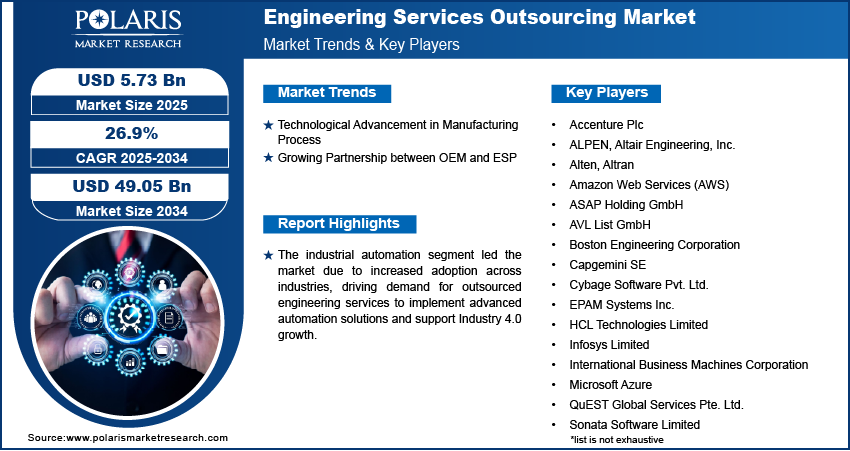
- Increasing technological advancements in manufacturing processes propel the demand for engineering service outsourcing.
- Growing partnerships between OEM and ESP would create lucrative opportunities in the coming years.
- High initial investments hinder the engineering services outsourcing (ESO) market growth.
AI Impact on Engineering Services Outsourcing Market
- Artificial Intelligence (AI) technology is transforming the ESO market landscape. AI and machine learning (ML) technology are used to automate complex engineering tasks
- These technologies provide advanced analytics capabilities.
- AI tools analyze vast data, identify patterns, and offer insights that help make effective decisions.
- The ESO industry uses AI and ML for quality control and predictive maintenance.
- Using these technologies, engineering service providers can deliver more efficient and innovative solutions.
Source: Polaris Market Research Analysis
To Understand More About this Research:Download Sample Report
What Is Engineering Services Outsourcing?
Engineering service outsourcing means hiring outside companies to handle specific engineering tasks or projects. Outsourcing partners provide services related to design, development, or testing. This allows businesses to reduce costs, access specialized expertise, and focus on core operations.
Engineering services outsourcing has evolved from a cost-saving model into a strategic business function that helps enterprises gain access to niche engineering talent, advanced design tools, automation expertise, embedded systems capabilities, and digital engineering solutions. As product architectures become more software-driven and manufacturing systems become more intelligent, companies are seeking engineering partners that can improve speed, innovation, scalability, and compliance while allowing internal teams to focus on core strategic priorities
Engineering service outsourcing has gained significant traction in recent years due to the increasing complexity of engineering projects, the increase in cost, and the need for specialized expertise. Engineering service outsourcing providers support overall cost reduction in engineering projects as they boast the required resources for engineering projects, due to which companies in multiple industries, such as automotive, aerospace, energy, telecommunications, and healthcare, are increasingly turning to engineering service outsourcing providers, thereby driving the growth of the engineering service outsourcing market growth.
The engineering services outsourcing market typically includes design engineering, mechanical engineering, electronic and embedded engineering, validation and testing, industrial engineering, manufacturing support, and digital engineering functions. The ESO market growth is driven by the demand for cost savings and access to global talent. Outsourcing engineering tasks to countries such as India, China, and Eastern Europe supports companies with cost reduction. This allows businesses to focus internal resources on strategic goals while benefiting from specialized expertise at a reduced cost. Engineering services outsourcing also provides access to a wider range of skills and the latest technological advancements. Providers offer fresh perspectives, innovative solutions, and specialized knowledge. They help companies solve complex engineering problems and accelerate product development. They also assist in improving quality and maintaining competitiveness in an evolving market.
Why Businesses Choose Engineering Services Outsourcing
Engineering services outsourcing has become popular among business across verticals. It supports three important business goals. These goals include lowering engineering costs, improving access to specialized expertise, and speeding up product or process innovation. Many companies do not have enough internal resources to maintain a full in-house team in every engineering area. Outsourcing allows them to hire outside specialists when expertise is limited or when project demand shifts.
Buyers also use engineering outsourcing to improve responsiveness. External partners can help execute prototyping, simulation, testing, embedded design, automation consulting, process optimization, and sustaining engineering tasks more quickly than an internal team that is already committed to core operations. This makes outsourcing especially useful for companies under pressure to launch products, modernize plants, meet compliance deadlines, or find specialized engineering talent.
Market Dynamics
Drivers
Technological Advancement in Manufacturing Process
Automation, AI, robotics, and other advanced technologies are changing how products are designed, produced, and tested. These innovations need specialized skills that in-house resources may lack. Thus, companies turn to external engineering firms to bring in these technologies. It improves efficiency and lowers costs. Outsourcing also helps businesses stay ahead of competitors by quickly adopting new manufacturing techniques.
Outsourcing becomes especially attractive when businesses need quick access to advanced engineering toolchains such as CAD, CAM, CAE, PLM, digital twin, virtual validation, and process automation systems. Instead of building every internal capability from scratch, companies partner with engineering service providers that already possess domain talent, digital infrastructure, and cross-industry implementation experience. This reduces deployment risk and accelerates time-to-value. Therefore, technological advancement is driving the engineering services outsourcing market growth.
Growing Partnership between OEM and ESP
The demand for engineering services outsourcing is mainly driven by growing partnerships between original equipment manufacturers (OEM) and engineering services providers (ESP). These collaborations allow OEMs to tap into specialized skills and lower operational costs. They also concentrate on their main strengths while outsourcing complex engineering tasks. ESPs benefit by broadening their customer base and offering innovative solutions. For example, Faurecia, an OEM, worked with an ESP for consulting on automotive digital cockpit design. Such collaborations support OEMs to accelerate product development and improve efficiency. This mutual benefit strengthens the outsourcing trend, thereby driving the market.
Strategic partnerships are becoming more sophisticated, moving beyond project-level outsourcing into co-innovation, digital transformation support, lifecycle engineering, and platform-level collaboration. This is particularly relevant for enterprises working on electrification, automation, connected products, industrial analytics, and energy transition technologies.
Rising Complexity of Engineering Projects
The increasing complexity of engineering projects is creating a need for specialized external expertise. Today's products are made using various hardware, software, electronics, connectivity, automation, analytics, and compliance needs. Many organizations lack the internal engineering skills required to manage complex design and development processes on their own. Outsourcing enables them to access specialized knowledge while managing project cost and time more efficiently.
This shift is especially visible in sectors such as automotive, aerospace, industrial automation, and medical technology, where engineering teams must integrate embedded systems, software-defined controls, advanced materials, real-time analytics, and safety requirements into a single development program. External engineering providers help bridge this capability gap by offering targeted expertise across design, simulation, testing, certification support, and process optimization. This supports the growth of the engineering services outsourcing market.
Restraints
High Initial Investments and Transition Costs
High initial investments remain a challenge for the market. Although outsourcing often reduces long-term operating cost, companies may still face upfront expenses related to vendor onboarding, knowledge transfer, integration of engineering workflows, cybersecurity controls, quality governance, and project transition management. These factors can slow decision-making, especially in industries with strict compliance or highly customized engineering processes.
Concerns around intellectual property protection, confidentiality, quality assurance, and communication across distributed teams influence sourcing decisions. These risks do not stop outsourcing adoption, but they do increase the importance of vendor selection, delivery governance, and contractual safeguards.
Source: Polaris Market Research Analysis
Segment Analysis
Market Assessment by Application Outlook
The engineering services outsourcing market segmentation, based on application, includes automotive, energy, network & communications, industrial automation, medical technology, industrial electronics & automated embedded service, consumer electronics, semiconductors, construction, and aerospace. The industrial automation segment accounted for the largest share of 17.0% in 2025. This is due to the increasing use of automation in different industries. Companies are increasingly integrating automation technologies to improve efficiency, cut costs, and boost production quality. Businesses look for specialized skills to set up complex automation systems, such as building automation systems. Industries like manufacturing, automotive, and electronics focus on automating processes to stay competitive. The growth of smart factories and Industry 4.0 increases the demand for modern automation solutions. This trend has increased the demand for outsourcing engineering services.
Market Evaluation by Location Outlook
The engineering services outsourcing market segmentation, based on location, includes onshore and offshore. The onshore segment is expected to experience significant growth witnessing 17.80% CAGR in the market during 2026-2034. Companies are increasingly looking to outsource engineering tasks to providers in their own country. This helps ensure better communication, greater control over projects, and faster turnaround times. This trend is fueled by the increasing need for quicker response times, lower risks associated with offshore outsourcing, and stronger compliance with regulations. Moreover, the continuing demand for quality and innovation has led businesses to select onshore providers. These providers can deliver local expertise while keeping costs competitive. These factors promote market growth for the segment.
Comparison Matrix: Onshore Vs. Offshore Engineering Services Outsourcing
| Parameter | Onshore ESO | Offshore ESO |
| Location | Same country as client | Different (foreign) country |
| Cost | High | Low (cost advantage) |
| Talent Pool | Limited | Large and diverse |
| Communication | Easy, real-time | Time zone & language challenges |
| Quality Control | High control | Requires strong governance |
| Turnaround Time | Faster coordination | 24/7 cycle but possible delays |
| Compliance | Easier (local laws) | Complex (cross-border regulations) |
| Data Security | High | Moderate risk |
| Scalability | Limited | Highly scalable |
| Best Use Case | High-complexity, sensitive projects | Cost-driven, large-scale projects |
Source: Polaris Market Research Analysis
Source: Polaris Market Research Analysis
Regional Insights
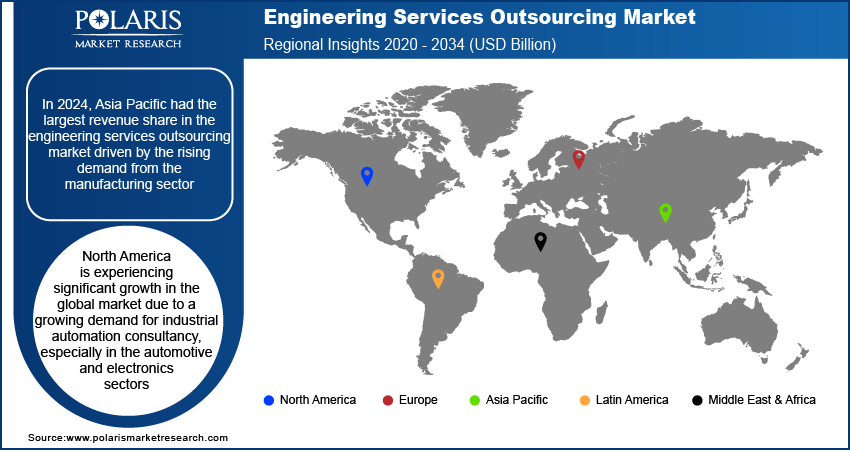
By region, the study provides the engineering services outsourcing market insights into North America, Europe, Asia Pacific, Latin America, and the Middle East & Africa. In 2025, Asia Pacific had the largest engineering services outsourcing market revenue share of 34.0% driven by the rising demand from the manufacturing sector. Countries like China, India, and Japan are experiencing a boost in manufacturing activities. This growth has raised the demand for specialized engineering services to increase productivity and lower costs. For example, Japan's manufacturing output makes up maximum global production, showing growth in its manufacturing sector. By outsourcing tasks like product design, development, and prototyping, manufacturers can stay competitive by gaining access to expert knowledge and technology. This trend is driving regional growth in the market.
North America is experiencing significant growth witnessing 18.80% CAGR during 2026-2034 in the global market due to a growing demand for industrial automation consultancy, especially in the automotive and electronics sectors. Companies in these industries are focusing on enhancing production efficiency and lowering costs by adopting advanced automation technologies. Outsourcing provides access to specialized expertise in areas such as robotics, control systems, and process optimization. The increasing need for customized automation solutions in these sectors is driving the growth of the North America engineering services outsourcing market.
Europe is a key market witnessing 18.40% CAGR during the forecast period, due to its strong industrial base, developed automotive sector, engineering skills, and emphasis on sustainability, electrification, and smart manufacturing. Latin America, along with the Middle East and Africa, offers new opportunities, particularly in industrial modernization, telecom infrastructure, energy engineering, and targeted manufacturing growth.
Source: Polaris Market Research Analysis
Key Players & Competitive Analysis Report
The engineering services outsourcing market is constantly evolving, with numerous companies striving to innovate and distinguish themselves. Major global corporations dominate the market by using extensive research and development and improved techniques. These companies pursue strategic initiatives like mergers, acquisitions, partnerships, and collaborations. These strategies assist them in broadening their product offerings and entering new markets. These strategies help them strengthen their position in product engineering, industrial automation, embedded systems, cloud engineering, and digital manufacturing.
New companies are impacting the industry by introducing innovative products to meet the demand of specific market sectors. This competitive environment is amplified by continuous progress in product offerings. Major players in the engineering services outsourcing industry include Accenture Plc; Siemens AG; Akkodis; Alten; Bertrandt AG; EDAG Engineering Group AG; L&T Technology Services Limited (LTTS); AVL List GmbH; Boston Engineering Corporation; Capgemini SE; Cybage Software Pvt. Ltd.; EPAM Systems Inc.; HCL Technologies Limited; Infosys Limited; International Business Machines Corporation; Tata Elxsi Limited; QuEST Global Services Pte. Ltd.; Sonata Software Limited; Tata Consultancy Services Limited; Tech Mahindra Limited (Mahindra Group); Wipro Limited.
Buyer Challenges and Risk Mitigation
Engineering services outsourcing has major advantages. However, buyers deal with risks related to intellectual property, design confidentiality, quality control, and communication. There are growing concerns about the integration of external engineering teams with internal product or plant workflows. These challenges are especially important in regulated sectors and in projects that involve embedded systems, industrial controls, proprietary designs, or safety-critical engineering.
Effective risk mitigation includes robust contractual controls, clear SLAs, milestone-based reviews, secure engineering environments, access control frameworks, structured knowledge transfer, design verification processes, and strong communication cadences between internal and external teams. Vendors that demonstrate maturity in these areas are more likely to win long-term engineering partnerships.
List of Key Companies
- Accenture Plc
- Siemens AG
- Akkodis
- Alten
- Bertrandt AG
- EDAG Engineering Group AG
- L&T Technology Services Limited (LTTS)
- AVL List GmbH
- Boston Engineering Corporation
- Capgemini SE
- Cybage Software Pvt. Ltd.
- EPAM Systems Inc.
- HCL Technologies Limited
- Infosys Limited
- International Business Machines Corporation
- Tata Elxsi Limited
- QuEST Global Services Pte. Ltd.
- Sonata Software Limited
- Tata Consultancy Services Limited
- Tech Mahindra Limited (Mahindra Group)
- Wipro Limited
Engineering Services Outsourcing Industry Developments
- September 2026: Tech Mahindra launched an AWS Agentic Process Transformation CoE, to help enterprises scale AI adoption across industries, focusing on operational efficiency, cost reduction, and faster pilot-to-production cycles through industry-specific solutions. (Source: techmahindra.com)
- March 2025: Alliance Machine Systems International disclosed its intent to acquire Systec Corporation and Automatan LLC, expanding automation solutions across corrugated-packaging lines. (Source: barrywehmiller.com)
- February 2025: Lear Corporation bought StoneShield Engineering for an undisclosed sum, enhancing advanced automation capabilities for next-generation wire-harness assembly in its E-Systems division. (Source: ir.lear.com)
Why Engineering Services Outsourcing Market Matters for Buyers?
The ESO market matters because it sits at the intersection of product innovation, industrial transformation, software integration, cost efficiency, and global talent access. As enterprises face pressure to launch more advanced products, modernize factory operations, digitize engineering workflows, and maintain resilience in a competitive global environment, outsourcing has become a practical lever for scaling engineering performance.
For strategy teams, the market offers insight into where engineering demand is shifting. For procurement leaders, it reveals how delivery models and vendor capabilities are evolving. For OEMs and manufacturers, it highlights how external engineering support can improve time-to-market, reduce development bottlenecks, and support digital adoption.
Market Segmentation
By Service Type Outlook (Revenue USD Billion, 2021–2034)
- Product Engineering and Designing
- Embedded Engineering and Electronics
- Digital Engineering and Software
- Verification, Validation, and Compliance
- Prototyping and NPI
- Sustenance/Value Engineering
- System Integration
By Application Outlook (Revenue USD Billion, 2021–2034)
- Automotive
- Energy
- Network & Communications
- Industrial Automation
- Medical Technology
- Industrial Electronics & Automated Embedded Service
- Consumer Electronics
- Semiconductors
- Construction
- Aerospace
By Location Outlook (Revenue USD Billion, 2021–2034)
- Onshore
- Offshore
By Regional Outlook (Revenue USD Billion, 2021–2034)
- North America
- U.S.
- Canada
- Europe
- Germany
- France
- UK
- Italy
- Spain
- Netherlands
- Russia
- Rest of Europe
- Asia Pacific
- China
- Japan
- India
- Malaysia
- South Korea
- Indonesia
- Australia
- Rest of Asia Pacific
- Middle East & Africa
- Saudi Arabia
- UAE
- Israel
- South Africa
- Rest of Middle East & Africa
- Latin America
- Mexico
- Brazil
- Argentina
- Rest of Latin America
Engineering Services Outsourcing Market Report Scope:
| Report Attributes | Details |
| Market Size in 2025 | USD 3.22 billion |
| Market Size in 2026 | USD 3.88 billion |
| Revenue Forecast in 2034 | USD 17.22 billion |
| CAGR | 20.47% from 2026 to 2034 |
| Base Year | 2025 |
| Historical Data | 2022–2024 |
| Forecast Period | 2026–2034 |
| Quantitative Units | Revenue in USD billion, 2021–2034 and CAGR from 2026 to 2034 |
| Report Coverage | Revenue Forecast, Market Competitive Landscape, Growth Factors, and Trends |
| Segments Covered |
|
| Regional Scope |
|
| Competitive Landscape |
|
| Report Format |
|
| Customization | Report customization as per your requirements with respect to countries, regions, and segmentation. |
Source: Polaris Market Research Analysis
Engineering Services Outsourcing Market FAQ's
The global market was valued at approximately USD 3.22 billion in 2025. It is expected to reach USD 17.22 billion by 2034 at a CAGR of 20.47% during 2026–2034.
Rising OEM cost pressures, software-defined product roadmaps, and AI-augmented CAE adoption drive the market growth. The growth is also driven by geopolitical nearshoring trends and critical talent shortages in advanced engineering domains.
The industrial automation segment held the largest share of 17.0% in 2025. It is due to the growing need for robotics and process automation. Increasing emphasis on controls engineering and smart factory implementation across industrial sectors also boost the dominance.
Asia-Pacific dominated the market with 34.0% share in 2025. It is fueled by India's vast engineering talent pool and China's large-scale manufacturing capabilities.
Companies outsource engineering services to access specialized expertise and reduce internal overhead. It also helps them improve speed-to-market and adopt advanced technologies faster. Using these services, internal teams of companies can focus on core strategic priorities.
AI is helping engineering providers automate workflows and improve simulation and design decisions. It also supports predictive maintenance and enhances quality inspection. The technology delivers more data-driven engineering outcomes.
Engineering services outsourcing may include design engineering, prototyping, simulation, embedded software development, and testing and validation. It also consists of automation engineering, PLM support, digital twin development, and lifecycle engineering.
Accenture Plc; Siemens AG; Akkodis; Alten; Bertrandt AG; EDAG Engineering Group AG; L&T Technology Services Limited (LTTS); AVL List GmbH; Boston Engineering Corporation; Capgemini SE; Cybage Software Pvt. Ltd.; EPAM Systems Inc.; HCL Technologies Limited; Infosys Limited; International Business Machines Corporation; Tata Elxsi Limited; QuEST Global Services Pte. Ltd.; Sonata Software Limited; Tata Consultancy Services Limited; Tech Mahindra Limited (Mahindra Group); Wipro Limited.
Download Sample Report of Engineering Services Outsourcing Market
Please fill out the form to request a customized copy of the research report.


