
Fatty Acid Esters Market Research Report, Size, Share & Forecast by 2026 - 2034
REPORT DETAILS
Fatty Acid Esters Market Summary
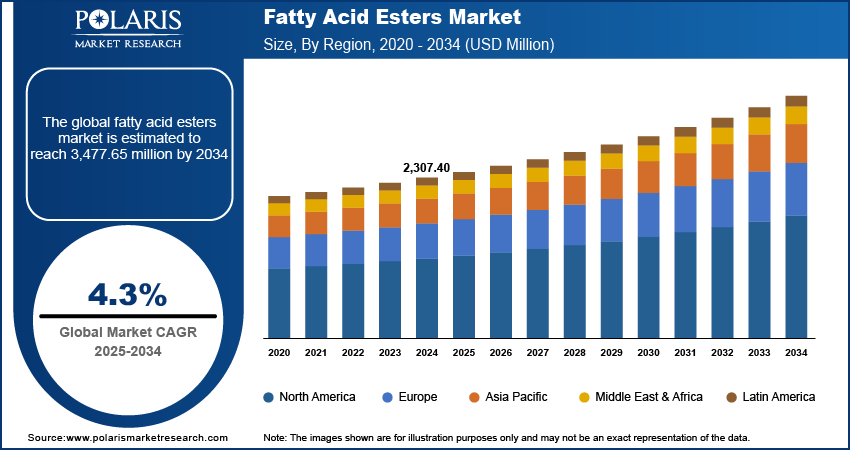
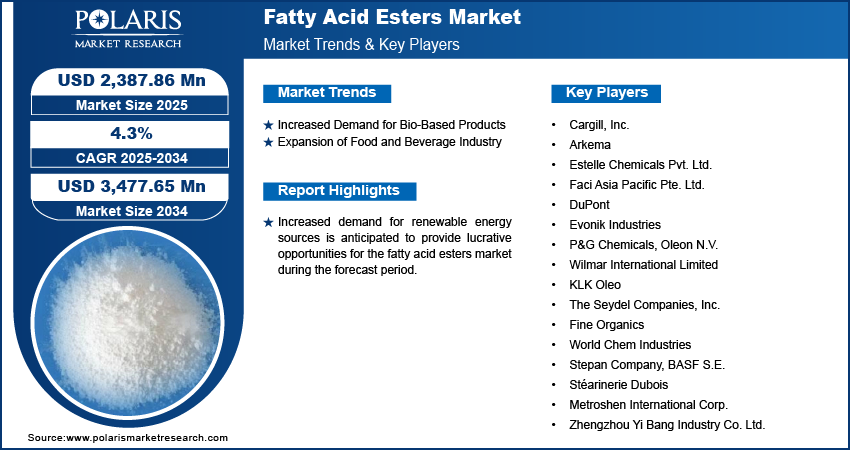
The global fatty acid esters market size was valued at USD 2.4 billion in 2025, growing at a CAGR of 4.32% from 2026 to 2034. The growing demand for bio-based products and increased applications of fatty acid esters are the key factors driving market development.
Market Statistics
Key Takeaways
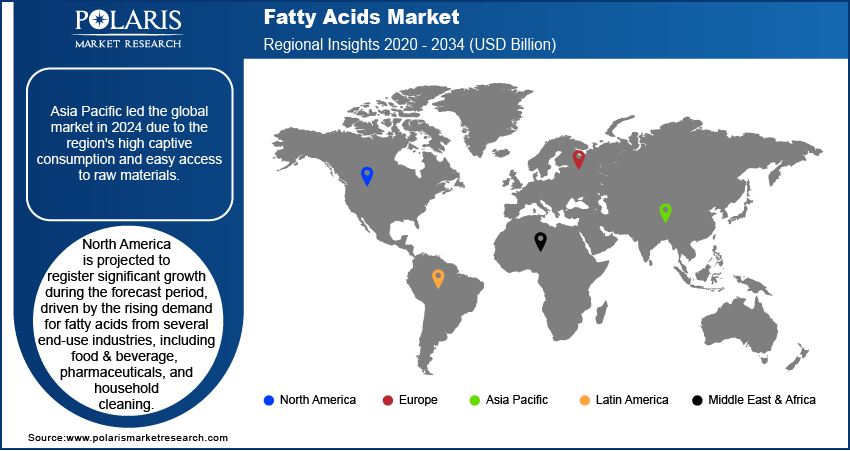
- North America accounted for the largest market share of 38.50% in 2025. The regional market dominance is attributed to shifting consumer preferences and increased focus on beauty and appearance.
- Asia Pacific is anticipated to register the fastest growth at a 5.62% CAGR. The increasing presence of regional market participants and rising focus on preventive healthcare are driving the regional market growth.
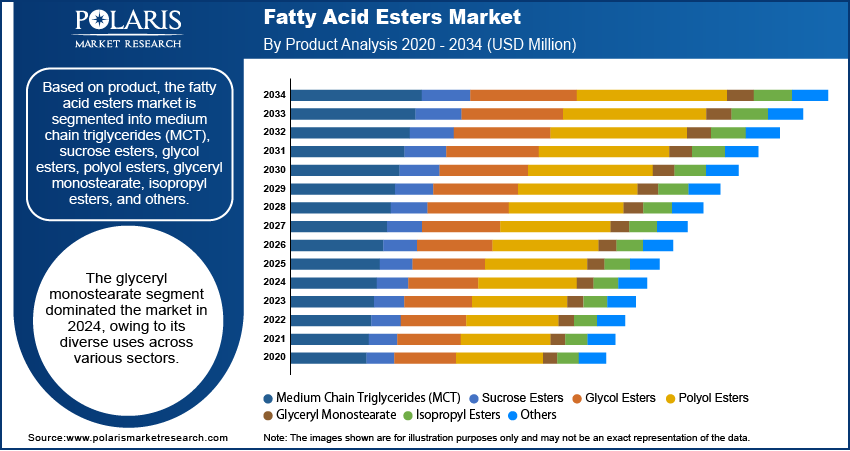
- The glyceryl monostearate segment led the market with a 40.50% market share in 2025. The segment’s dominance is driven by its widespread use in baked goods to increase shelf life and prevent staling.
- The personal care & cosmetics segment dominated with a 39.50% share in 2025. Fatty acid esters are the primary components in several cosmetic formulations.
- The lubricants segment accounted for a 4.80% share in 2025. This is owing to the rising adoption of bio-lubricants due to environmental mandates.
Note: Figures and projections outlined in this report are the result of Polaris Market Research’s proprietary analytical processes, grounded in the latest available datasets and market observations.
Industry Dynamics
- The growing awareness about the environmental impact of traditional petroleum-based products has led to an increased need for bio-based alternatives, such as fatty acid esters.
- The expanding food and beverage industry contributes to the market demand. Fatty acid esters are widely used in the food and beverage industry as thickeners, emulsifiers, and stabilizers.
- Emerging applications, such as use in nano-formulations for drug delivery, are expected to provide significant market opportunities.
- Rising adoption of synthetic lubricants may present challenges to market growth.
AI Impact on Fatty Acid Esters Market
- AI is used to help increase fatty acid ester production through optimized formulas and methods of production.
- AI assists with quality assurance through controlling the quality, purity, and efficacy of the products.
- AI helps manufacturers minimize waste and optimize efficiency in the manufacturing process through real-time monitoring of processes.
Source: Polaris Market Research Analysis
To Understand More About this Research: Download Sample Report
Fatty acid esters are an ester type synthesized by dehydrating fatty acids with alcohol. As industrial bioactive ingredients, these esters find a wide range of applications across several sectors, including cosmetics, food, and pharmaceuticals.
The increasing demand for bio-based products, growing awareness about the health benefits associated with fatty acid esters, and rising applications in pharmaceuticals are among the key factors driving the fatty acid esters market growth. Advancements in manufacturing processes, which have enabled the development of high-quality fatty acid esters, further contribute to their increased adoption.
Fatty acid esters, especially methyl esters, which have properties closer to those of conventional diesel fuels than pure plant-based oils, are increasingly being used as substitutes for several chemicals in the food and cosmetics industries. This shift from chemicals to fatty acid esters is anticipated to drive the fatty acid esters market development in the coming years. Increased demand for renewable energy sources is projected to provide lucrative fatty acid esters market opportunities during the forecast period.
Fatty Acid Esters vs Petroleum-Based Chemicals
| Parameter | Fatty Acid Ester Compounds | Petroleum-based Compounds |
| Biodegradability | Fully biodegradable and degrade rapidly in the environment | Take more time to degrade and remain present in the environment for prolonged periods |
| Effect on Environment | Have a low effect on the environment and emit minimal pollutants | Possess high environmental impacts owing to fossil fuel utilization and pollutant emissions |
| Renewability | Made through renewable materials like vegetable and animal fats | Produced using non-renewable fossil fuels including crude oil |
| Lubrication Properties | Excellent lubricating properties and reduce friction | Good lubricating properties and need other additives for performance |
| Toxicity | Low toxicity levels that make them safe to use and less hazardous to the environment | Likely to contain more toxic elements that cause environmental hazards |
| Sustainability | Highly sustainable in production | Less sustainable because of dependency on fossil fuels |
Market Dynamics
Increased Demand for Bio-Based Products
The rising awareness about the environmental impact of conventional petroleum-based products is fueling the need for bio-based alternatives. Fatty acid esters are obtained from natural, renewable feedstock such as vegetable oil and animal fats, which makes them a sustainable alternative for various applications. The growing emphasis on the utilization of bio-based products across sectors such as pharmaceuticals and personal care products continues to boost the fatty acid esters market expansion.
Expansion of Food and Beverage Industry
Fatty acid esters are widely used in the food & beverage industry. The esters are used to provide a smooth texture to ice creams and whipped cream. Also, they find applications as stabilizers, emulsifiers, thickeners, and conditioners. The increased demand for processed foods and beverages is anticipated to drive the demand for fatty acid esters. In addition, the rising popularity of plant-based meat alternatives, which typically use fatty acid esters as texture modifiers and binders, is projected to further contribute to the fatty acid esters market development.
Advancements in Oleochemical Processing Technologies
The developments in technology are contributing to increased efficiency and effectiveness of fatty acid ester production. The production process has incorporated advanced technological approaches like the application of enzyme catalysts, continuous production, and green chemistry in order to increase efficiency through the reduction of energy consumption and waste production. The application of innovative technologies in processes such as esterification and transesterification enables increased yield, quality, and cost savings during production. Such technological developments are also contributing to the production of bio-products with better performance. As there is an ever-growing trend of being sustainable and using renewable sources, innovations within this domain will lead to a wider application of fatty acid esters in various industries.
Source: Polaris Market Research Analysis
Segment Insights
Market Outlook by Product Insights
The fatty acid esters market, based on product, is segmented into medium chain triglycerides (MCT), sucrose esters, glycol esters, polyol esters, glyceryl monostearate, isopropyl esters, and others. The glyceryl monostearate segment dominated the market with 40.50% revenue share in 2025. Glyceryl monostearate is primarily used in baked goods to improve texture, increase shelf life, and prevent staling. It is also used in the pharmaceuticals sector to stabilize water-in-oil emulsions and control the release of substances in pharmaceuticals. Further, glyceryl monostearate has various other industrial applications in the form of lubricant, preservative, and thickening agent. The diverse uses of glyceryl monostearate contribute to its dominance in the market.
Market Assessment by Application Insights
The fatty acid esters market, based on application, is segmented into personal care & cosmetics, lubricants, pharmaceuticals, food processing, surfactants & detergents, and others. The personal care & cosmetics segment led the market with 39.50% market share in 2025. Growing social media influence has resulted in increased demand for personal care and cosmetic products. This, in turn, has fueled the need for fatty acid esters as they are the primary components in various cosmetic formulations.
Source: Polaris Market Research Analysis
Regional Analysis
By region, the market report offers fatty acid esters market insights into North America, Europe, Asia Pacific, Latin America, and the Middle East & Africa. North America dominated the market with over 38.50% share of the global revenue in 2025. High standards of living, changing consumer preferences, and a growing focus on beauty and appearance owing to social media influence are a few key factors propelling the fatty acid esters market expansion in the region.
The Asia Pacific fatty acid esters market is projected to witness the fastest growth with 5.62% CAGR from 2026 to 2034. The rising focus on preventive healthcare and increasing penetration of regional market participants into the organic food product segment are among the key factors driving the market growth in Asia Pacific. In addition, the growing purchasing power of individuals and increasing emphasis on the introduction of new products among market players contribute to the regional market expansion.
Source: Polaris Market Research Analysis
Key Players and Competitive Insights
The key players in the fatty acid esters market are focusing on research and development to enhance their products and services offerings and drive market demand. Furthermore, they are adopting various strategic initiatives, including collaborations, mergers and acquisitions, new product launches, and increased investments, to improve their global footprint. To expand and survive in a more competitive environment, market participants must offer innovative solutions.
In recent years, the fatty acid esters market has witnessed several innovations, with key players seeking to provide advanced solutions that help meet sustainability goals. The fatty acid esters market research report offers a market assessment of all the key players, including Cargill, Inc.; Arkema; Estelle Chemicals Pvt. Ltd.; Faci Asia Pacific Pte. Ltd.; DuPont; Evonik Industries; P&G Chemicals; Oleon N.V.; Wilmar International Limited; KLK Oleo; The Seydel Companies, Inc.; Fine Organics; World Chem Industries; Stepan Company; BASF S.E.; Stéarinerie Dubois; Metroshen International Corp.; and Zhengzhou Yi Bang Industry Co. Ltd.
List of Key Companies
- Cargill, Inc.
- Arkema
- Estelle Chemicals Pvt. Ltd.
- Faci Asia Pacific Pte. Ltd.
- DuPont
- Evonik Industries
- P&G Chemicals
- Oleon N.V.
- Wilmar International Limited
- KLK Oleo
- The Seydel Companies, Inc.
- Fine Organics
- World Chem Industries
- Stepan Company
- BASF S.E.
- Stéarinerie Dubois
- Metroshen International Corp.
- Zhengzhou Yi Bang Industry Co. Ltd.
Fatty Acid Esters Industry Developments
May 2024: Stepan Company announced the sale of its specialty esters product line to The HallStar Company. The company stated that its specialty esters production plant will continue the manufacturing of esters for Stepan's specialty flavor and food ingredient products and industrial markets.
June 2023: Cargill introduced its new line of sustainable fatty acid esters for the food & beverage industry. According to the company, these fatty esters can be used to create low-VOC solutions for several coating applications, including oil-modified urethanes, alkyd resins, and exterior wood finishes.
Fatty Acid Esters Market Segmentation
By Product Outlook
- Medium Chain Triglycerides (MCT)
- Sucrose Esters
- Glycol Esters
- Polyol Esters
- Glyceryl Monostearate
- Isopropyl Esters
- Others
By Application Outlook
- Personal Care & Cosmetics
- Lubricants
- Pharmaceuticals
- Food Processing
- Surfactants & Detergents
- Others
By Regional Outlook
- North America
- US
- Canada
- Europe
- Germany
- France
- UK
- Italy
- Spain
- Netherlands
- Russia
- Rest of Europe
- Asia Pacific
- China
- Japan
- India
- Malaysia
- South Korea
- Indonesia
- Australia
- Rest of Asia Pacific
- Middle East & Africa
- Saudi Arabia
- UAE
- Israel
- South Africa
- Rest of the Middle East & Africa
- Latin America
- Mexico
- Brazil
- Argentina
- Rest of Latin America
Fatty Acid Esters Market Report Scope
| Report Attributes | Details |
| Market Size Value in 2024 | USD 2,307.40 million |
| Market Size Value in 2025 | USD 2,387.86 million |
| Revenue Forecast by 2034 | USD 3,477.65 million |
| CAGR | 4.3% from 2025 to 2034 |
| Base Year | 2024 |
| Historical Data | 2020–2023 |
| Forecast Period | 2025–2034 |
| Quantitative Units | Revenue in USD million and CAGR from 2025 to 2034 |
| Report Coverage | Revenue Forecast, Market Competitive Landscape, Growth Factors, and Trends |
| Segments Covered |
|
| Regional Scope |
|
| Competitive Landscape |
|
| Report Format |
|
| Customization | Report customization as per your requirements with respect to countries, regions, and segmentation. |
Source: Polaris Market Research Analysis
Fatty Acid Esters Market FAQ's
The market was valued at USD 2.4 billion in 2025 and is projected to grow to USD 3.5 billion by 2034.
The market is projected to register a CAGR of 4.32% from 2026 to 2034.
North America accounted for the largest region-wise market size of 38.50% in 2025.
A few of the key players in the market are Cargill, Inc.; Arkema; Estelle Chemicals Pvt. Ltd.; Faci Asia Pacific Pte. Ltd.; DuPont; Evonik Industries; P&G Chemicals; Oleon N.V.; Wilmar International Limited; KLK Oleo; The Seydel Companies, Inc.; Fine Organics; World Chem Industries; Stepan Company; BASF S.E.; Stéarinerie Dubois; Metroshen International Corp.; and Zhengzhou Yi Bang Industry Co. Ltd.
The glyceryl monostearate segment dominated the market in 2025 with 40.50% share.
The personal care & cosmetics segment led the market with 39.50% in 2025.
Download Sample Report of Fatty Acid Esters Market
Please fill out the form to request a customized copy of the research report.


