
Ferrite Magnet Market Size, Share, Growth | Trends, 2026-2034
REPORT DETAILS
Ferrite Magnet Market
The global ferrite magnet market is estimated around USD 10.61 billion in 2025,?with consistent growth anticipated during 2026–2034. This is due to rising EV production and ongoing energy transition activities increase ferrite demand across vehicle components and renewable energy systems. The market is projected to grow at a CAGR of 5.4% during the forecast period.
Market Statistics
Industry Dynamics
- Rising EV production increases ferrite magnet demand across auxiliary motors and power electronics.
- Expansion of renewable energy systems strengthens ferrite usage in inverters, turbines, and grid equipment.
- Cost pressure and quality consistency create challenges in high volume ferrite magnet manufacturing.
- Global electrification and appliance growth create strong opportunities for large scale ferrite adoption.
Ferrite Magnets Definition and Their Uses in Modern Industries?
Ferrite magnets or ceramic magnets refer to a category of permanent magnets generated by a combination of iron oxide with strontium or barium. They boast stable magnetic performance, high resistance to demagnetization, and relatively inexpensive production. They find wide applications in EV components, household appliances, electronics, and industrial systems due to the right balance between performance and affordability.
Ferrite magnets exhibit lower magnetic strength, high corrosion resistance, and higher cost efficiency compared to that of rare earth magnets. This makes it a practical choice for high volume applications across the industrial magnets market. In September 2025, Ziehl Abegg developed a lift motor that uses ferrite magnets to deliver high performance while eliminating the need to use rare earth materials.
Source: Polaris Market Research Analysis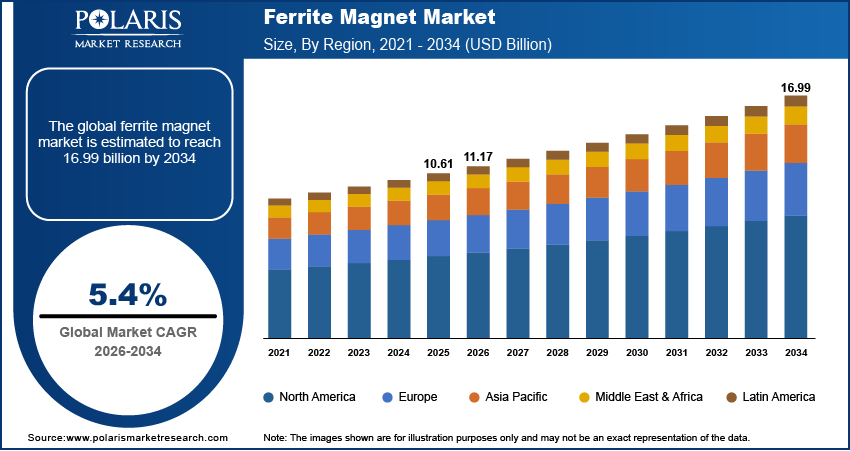
The demand for ferrite rises with growing EV adoption across motors and power systems. Growing production in appliances and electronics sustains demand for ceramic magnets in compressors, fans, speakers, and sensors. Energy transition programs open up extra demand in wind turbines and power electronics. The Global Energy Alliance has pledged USD 1 billion in grants to facilitate India's clean energy transition through renewable and energy storage projects. All these factors boost the long-term outlook for ferrite magnets in industries worldwide.
Ferrite vs NdFeB vs SmCo Magnet Comparison
| Magnet Type | Magnetic Strength | Temperature Stability | Cost Level | Common Use Cases |
| Ferrite (Ceramic) | Medium | Good | Low | EV components, appliances, speakers |
| NdFeB | Very High | Moderate | Medium to High | High torque motors, precision electronics |
| SmCo | High | Very High | High | Aerospace, high temperature devices |
Source: Polaris Market Research Analysis
Drivers & Opportunities
Rising EV Production: Increasing EV manufacturing upsurges the usage of ferrite magnets in traction motors, auxiliary pumps, power steering units, and on-board electronics. According to the International Energy Agency, the world produced 17.3 million electric cars in 2024, around 25 percent more than in 2023. As demand for compact and efficient motor systems grows, so does demand for ceramic magnets. This is due to its capability of providing stable performance at a lower cost. Thus, automaker giants ramp up EV manufacturing capacity, leading to greater procurements of ferrite for motors and sensors.
Ferrite magnets support consistent motor efficiency under high-temperature conditions, therefore making them a preferred option in several EV subsystems. Growing infrastructure for charging and the rise of hybrid vehicles pose further demands originating from power converters and control units alike. This creates a virtuous cycle of growth for ferrite suppliers through automotive value chains.
Growing Emphasis on Energy Transition Projects: Energy transition projects drive increasing ferrite needs within wind turbines, smart grids, power controllers, and renewable energy equipment. Growth in wind power installations supports the use of ceramic magnets in generators where stable magnetic properties and heat tolerance are vital. This is due to expanding solar systems require more ferrite materials for inverters, transformers, and power conditioning units.
Many countries invest in grid modernization, which increases ferrite usage in meters, sensors, and switching devices. Renewable energy OEMs focus on reliable and cost-efficient magnet options for high volume deployments, which strengthens the role of ferrite magnets in large utility projects. These trends support long term demand across power, utility, and distributed energy networks.
Driver Callout Table
| Driver | Description | OEM Examples |
| EV Production Growth | Rising EV manufacturing increases ferrite use in motors, pumps, and electronics. | Tesla, BYD, Volkswagen |
| Energy Transition Projects | Renewable energy systems increase ferrite demand in turbines, inverters, and power units. | Siemens Gamesa, GE Renewable Energy, Vestas Wind Systems |
| Electronics Expansion | Higher production of appliances and consumer electronics boosts ferrite use in speakers, sensors, and power supplies. | Samsung, LG, Panasonic |
Source: Polaris Market Research Analysis
Restraints & Challenges
Limited Raw Material Availability: Limited availability of high-quality raw materials creates supply constraints for ferrite magnet producers. Consistent access to iron oxide and strontium carbonate is important for maintaining stable output, yet fluctuations in mining activity and regional supply variations affect procurement planning. This reduces production flexibility and exposes manufacturers serving automotive, electronics, and industrial customers to greater risks of supply gaps.
High Production Cost: High production and processing costs reduce the profitability of the companies operating in the ferrite magnet market. Energy-intensive steps of sintering, material preparation, and quality control increase operation expenses for large- and mid-scale producers. Any rise in energy prices or processing input costs affects margins and limits the ability of manufacturers to offer competitive pricing across key end use sectors.
Source: Polaris Market Research Analysis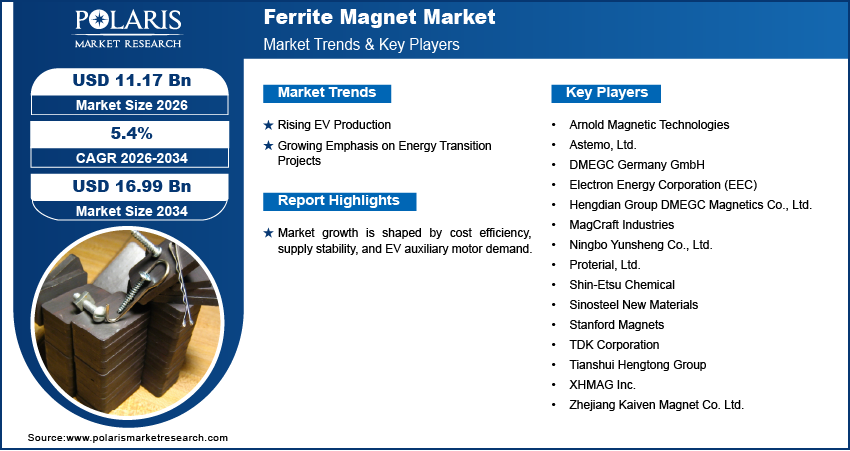
Segmental Insights
This report offers detailed coverage of the ferrite magnet market by type and application to help readers identify the fastest expanding and most attractive demand segments.
By Type
-
Hard Ferrite
Hard ferrite magnets accounted for the maximum share in 2025, due to strong demand in motors, pumps, speakers, and rotating systems in automotive, appliances, and industrial equipment. These magnets assure stable coercivity, high temperature tolerance, and cost benefits, which favor high volume production for EV auxiliaries, consumer motors, and compressors. Strong adoption in automotive fans, ABS units, and fuel pumps keeps the segment dominant through 2034.
Ferrite Magnet Performance Comparison
| Magnet Type | Coercivity (Hc) | Remanence (Br) | Curie Temperature (Tc) |
| Hard Ferrite | Medium High | Medium | High |
| Soft Ferrite | Low | Low | Medium |
Source: Polaris Market Research Analysis
-
Soft Ferrite
Soft ferrite magnets grow steadily due to rising use in transformers, inductors, power supplies, and EMI suppression components. EV chargers, renewable inverters, and consumer electronics drive the demand for soft ferrites due to their low magnetic losses and stable switching performance. The power electronic manufacturers prefer soft ferrites as they are cost-efficient and offer reliable operations for energy conversion systems.
Key Comparison of Strontium Ferrite and Barium Ferrite
| Parameter | Strontium Ferrite | Barium Ferrite |
| Magnetic Strength | Higher | Moderate |
| Temperature Stability | Better | Lower |
| Corrosion Resistance | Good | Very Good |
| Cost Level | Low | Very Low |
| Main Applications | EV auxiliaries, pumps, industrial motors | Speakers, small motors, magnetic cards |
Source: Polaris Market Research Analysis
Ferrite Magnet Manufacturing and Failure Modes
Ferrite magnets are produced through powder mixing, pressing, sintering, and machining. This process delivers stable and uniform magnetic properties in sintered ferrite magnets. A cross section of the ferrite magnet reveals uniform grain distribution that supports consistent coercivity levels.
The main modes of failure are microcracks created during sintering, porosity, or strength reduction due to improper grain alignment. This risk is minimized by controlled cycles of firing and precision pressing systems. Proper processing improves magnetic performance and reduces scrap.
By Application
-
Automotive
Automotive applications account for a major share in 2025 owing to high ferrite usage in EV auxiliaries, cooling fans, fuel pumps, HVAC blowers, and ABS motors. Rising EV production strengthens ferrite demand as OEMs use ceramic magnets to reduce cost and avoid rare earth supply risk. Growth in hybrid and mid-range EV platforms keeps automotive ferrite consumption stable through the forecast period.
-
Consumer Electronics
Consumer electronics point to the fastest-growing segment, driven by huge penetration across speaker magnets, sensors, small motors, and magnetic holders. Ferrites continue their leadership in speaker applications on account of cost-effectiveness and stable magnetic properties. The growth of televisions, smart audio devices, and home appliances is driving electronics manufacturers into large-scale procurement.
-
Industrial & Energy
Industrial and energy applications continue to expand with rising demands from compressors, blowers, wind turbines, inverters, and grid equipment. Ferrite magnets support reliable performance in high-temperature environments and long service life. Energy transition programs increase ferrite usage in renewable power systems, which strengthens long term growth prospects for this segment.
Heatmap of Application vs Magnet Type
| Application | Hard Ferrite | Soft Ferrite |
| Automotive | High | Medium |
| Consumer Electronics | High | Low |
| Industrial & Energy | Medium | High |
| Medical Devices | Medium | Medium |
| Aerospace & Defense | Medium | Low |
| Others | High | Medium |
Source: Polaris Market Research Analysis
-
Medical Devices
Medical devices use ferrite magnets in pumps, imaging accessories, sensors, and small precision motors. Demand rises due to the expansion of diagnostic devices and portable medical equipment where stable magnetic strength and low cost are important. Growing adoption of compact health monitoring systems adds further volume to this segment.
-
Aerospace & Defense
The applications related to aerospace and defense involve actuators, sensors, power systems, and control units with requirements for strong and durable magnets. Ferrite magnets are preferred in non-critical systems that call for corrosion resistance and long-term stability. Increasing production levels of UAVs, communications systems, and onboard electronics favor steady demand from this segment.
-
Others
The others segment includes appliances, robotics, office equipment, and general industrial tools using ferrites in motors, fans, locks, and magnetic mechanisms. Growth of home appliances and small machinery manufacturing supports continuous demand across several end use categories. The cost-sensitive applications keep ferrites widely adopted across global markets.
Demand Quantification by Top Applications
| Application | Demand Level | Key Usage Areas |
| Automotive | Very high demand | EV auxiliaries, pumps, cooling fans, ABS motors |
| Consumer Electronics | High demand | Speakers, sensors, small motors, magnetic holders |
| Industrial & Energy | High and growing demand | Compressors, blowers, renewable energy systems, inverters |
| Medical Devices | Moderate demand | Pumps, diagnostic devices, compact medical motors |
| Aerospace & Defense | Moderate but specialized demand | Actuators, sensors, onboard electronics |
| Others | Steady demand | Appliances, tools, general industrial mechanisms |
Source: Polaris Market Research Analysis
Market Use-Cases
Ferrite Adoption in Auxiliary EV Motors
In October 2025, Astemo introduced a new rare earth free motor for BEVs that uses ferrite magnets and a synchronous reluctance rotor design to reduce dependence on scarce materials. The motor delivers 180 kW for the main drive and reaches about 315 kW when auxiliary drives are included, which brings its performance close to conventional rare earth motors with only a 30% size increase. By removing rare earth content, Astemo improves supply chain stability and offers automakers a cost effective and sustainable option without major performance loss.
Source: Polaris Market Research Analysis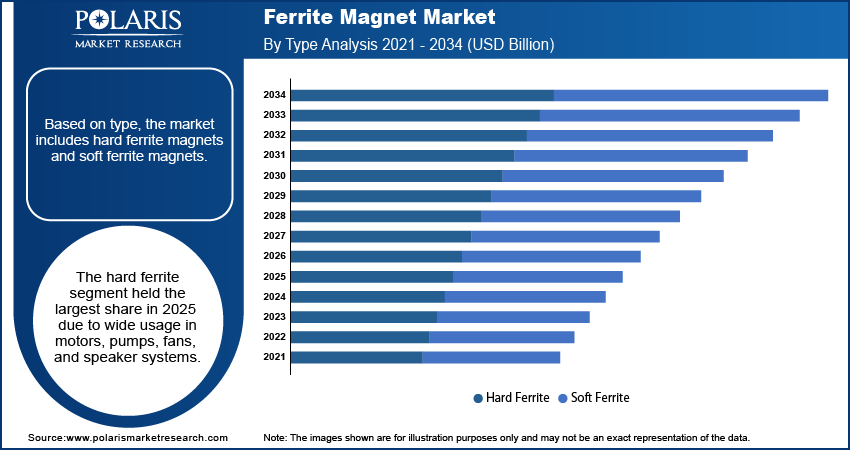
Regional Analysis
Asia Pacific Market Assessment
The Asia Pacific dominated the market in 2025, due to large scale automotive and electronics production across China, Japan and South Korea. Chinese Ministry of Industry and Information Technology reported that China produced 1.02 billion smartphones from January to October 2025, up 0.7% year on year, while integrated circuit output increased 10.2% to 386.6 billion units. Moreover, China ferrite magnet manufacturing strengthens regional supply capability for motors and power systems. In addition, stable raw material availability supports high output.
North America Ferrite Magnet Market Insights
North America is anticipated to witness the highest growth. This is owing to rising EV manufacturing activity in the US and Canada increases ferrite demand for auxiliary motors and power electronics. According to the Environmental Defense Fund, U.S. EV manufacturing capacity is expected to reach about 4.7 million vehicles per year by 2028, equal to nearly one third of total new vehicle sales in 2023. Moreover, expansion of renewable energy projects lifts magnet usage in wind and solar equipment.
Europe Ferrite Magnet Market Overview
The Europe growth in the ferrite magnet market is attributed to its strong automotive production in Germany and Central Europe supports steady ferrite consumption in pumps, ABS units and HVAC systems. Moreover, Europe’s renewable energy programs increase magnet use in inverters and grid electronics. In addition, regional industrial equipment manufacturing sustains stable long term ferrite demand.
Production vs Consumption Map Placeholder
| Region | Production Insight | Consumption Insight |
| Asia Pacific | Largest ferrite magnet manufacturing base with strong output from China and Japan | Highest consumption driven by automotive, electronics and industrial systems |
| Europe | Limited production focused on specialty grades | Strong demand from automotive and renewable energy sectors |
| North America | Growing interest in local manufacturing | Rising consumption due to EV, charging and industrial equipment programs |
| MEA | Small scale production | Moderate consumption across appliances and industrial tools |
Source: Polaris Market Research Analysis
Trade Policies and Raw Material Insights
| Theme | Key Insight |
| Trade Policies | Import duties on magnets and metal oxides influence sourcing strategies for OEMs in Europe and North America. |
| Raw Material Access | Availability of iron oxide and strontium carbonate shapes production planning for major Asian suppliers. |
| Supply Chain Dynamics | Regional policy changes impact long term contracting for ferrite magnet manufacturing and raw material procurement. |
Source: Polaris Market Research Analysis
Sourcing Challenges
| Challenge Area | Insight |
| Lead Time Variability | Longer transport and customs cycles cause planning issues for automotive and electronics buyers dependent on Asian suppliers. |
| Tolerances and Precision | Tight dimensional tolerances increase risk in motor and sensor applications. |
| Quality Control Requirements | Consistent coercivity and uniform sintering performance remain critical for high volume EV and industrial buyers. |
Source: Polaris Market Research Analysis
Source: Polaris Market Research Analysis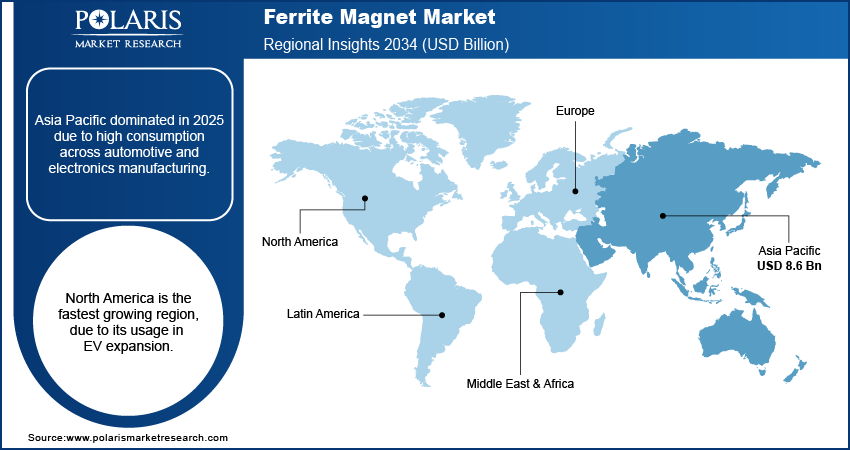
Key Players & Competitive Analysis Report
The ferrite magnet global market is moderately consolidated, considering a few major Asian producers that lead material manufacturing and large volume supply. Competition is really shaped by advances in sintering processes and magnetic property optimization. Companies focus on improving grain alignment and dimensional stability for consistent performance. Producers also strengthen raw material control to support reliable use in automotive, electronics, and industrial applications.
Major companies operating in the ferrite magnet include TDK Corporation, Astemo, Ltd., Proterial, Ltd., DMEGC Germany GmbH, Zhejiang Kaiven Magnet Co. Ltd., Hengdian Group DMEGC Magnetics Co., Ltd., XHMAG Inc., Arnold Magnetic Technologies, Ningbo Yunsheng Co., Ltd., Electron Energy Corporation (EEC),Sinosteel New Materials, MagCraft Industries, Tianshui Hengtong Group, Shin-Etsu Chemical, Stanford Magnets, and others.
Key Players
- Arnold Magnetic Technologies
- Astemo, Ltd.
- DMEGC Germany GmbH
- Electron Energy Corporation (EEC)
- Hengdian Group DMEGC Magnetics Co., Ltd.
- MagCraft Industries
- Ningbo Yunsheng Co., Ltd.
- Proterial, Ltd.
- Shin-Etsu Chemical
- Sinosteel New Materials
- Stanford Magnets
- TDK Corporation
- Tianshui Hengtong Group
- XHMAG Inc.
- Zhejiang Kaiven Magnet Co. Ltd.
Competitive Positioning Matrix: Cost vs Temperature Stability
| Company Positioning | Cost Level | Temperature Stability | Focus |
| High Volume Asian Producers | Low | Medium | Automotive motors, consumer electronics |
| Tier 1 Global Magnet Suppliers | Medium | High | EV systems, industrial equipment |
| Specialty Magnet Manufacturers | High | Very High | Aerospace, defense, medical devices |
Source: Polaris Market Research Analysis
ESG and Recycling Efforts
Leading manufacturers of ferrite magnets are aggressively reducing energy consumption during sintering to reduce their respective emissions and enhance process efficiencies. Several manufacturers significantly increase reutilization of recycled iron oxide and invest in waste heat recovery systems to enhance environmental performance. Recycling programs contribute to long-term security of raw materials and are in line with the increasing requirements of customers for sustainability within the automotive and electronics industries. In March 2025, Heraeus Remloy started operation on a large recycling plant in Europe that transformed discarded rare-earth magnets into magnetic powders, including ferrite that feeds magnet makers without new mining inputs.
Industry Developments
- October 2025: Celestion introduced a new ferrite magnet HF compression driver that is said to provide high power handling and consistent, reliable performance in professional audio systems.
- July 2025: TDK introduced large ferrite cores for industrial applications, which support higher power handling and efficiency in motor drives, EV charging, and renewable energy systems.
- March 2025: TDK Corporation announced the expansion of its ferrite magnet production line at its Japan facility to address rising demand from the automotive and consumer electronics markets. The upgrade includes advanced sintering equipment and automated inspection systems, improving magnetic consistency, shortening production cycles, and strengthening TDK’s capacity to deliver high-volume, high-reliability products.
- February 2025: Proterial Ltd completed the modernization of its ferrite magnet manufacturing process at its Japanese facility to improve energy efficiency and lower environmental impact. The upgrade includes optimized kiln controls, advanced material handling, and automated inspection to ensure consistent magnetic performance, supporting growing global demand especially for automotive motors and electronic components while meeting evolving sustainability requirements.
- January 2025: Arnold Magnetic Technologies launched a new precision ferrite assembly line at its U.S. headquarters to boost production for industrial automation and medical device applications. The line features real-time monitoring and robotic handling to ensure dimensional accuracy, lower defect rates, enhance operational flexibility, and speed delivery of large-scale and custom magnet orders.
Strategic Recommendations for OEMs and Investors
- Focus on ferrite magnets for cost sensitive and high volume motor applications across EVs and appliances.
- Diversify sourcing across multiple Asian and regional suppliers to reduce supply chain risk.
- Invest in suppliers with strong quality control and stable sintering capabilities.
- Prioritize partnerships with manufacturers that support recycling and energy efficient production.
- Track demand growth in EV auxiliaries, renewable energy systems, and power electronics for long term returns.
Ferrite Magnet Market Segmentation
By Type Outlook (Revenue, USD Billion, 2021-2034)
- Hard Ferrite
- Strontium ferrite magnets
- Barium ferrite magnets
- Isotropic ferrite magnets
- Anisotropic ferrite magnets
- Soft Ferrite
- Manganese zinc (MnZn) ferrites
- Nickel zinc (NiZn) ferrites
- High-frequency ferrites
- Low-frequency ferrites
By Application Outlook (Revenue, USD Billion, 2021-2034)
- Automotive
- EV Auxiliaries
- Fuel Pumps
- Cooling Fans
- ABS Motors
- Consumer Electronics
- Speakers
- Sensors
- Magnetic Holders
- Industrial & Energy
- Medical Devices
- Aerospace & Defense
- Others
By Regional Outlook (Revenue, USD Billion, 2021-2034)
- North America
- US
- Canada
- Europe
- Germany
- France
- UK
- Italy
- Spain
- Netherlands
- Russia
- Rest of Europe
- Asia Pacific
- China
- Japan
- India
- Malaysia
- South Korea
- Indonesia
- Australia
- Vietnam
- Rest of Asia Pacific
- Middle East & Africa
- Saudi Arabia
- UAE
- Israel
- South Africa
- Rest of Middle East & Africa
- Latin America
- Mexico
- Brazil
- Argentina
- Rest of Latin America
Ferrite Magnet Market Report Scope
| Report Attributes | Details |
| Market Size in 2025 | USD 10.61 Billion |
| Market Size in 2026 | USD 11.17 Billion |
| Revenue Forecast by 2034 | USD 16.99 Billion |
| CAGR | 5.4% from 2026 to 2034 |
| Base Year | 2025 |
| Historical Data | 2022–2024 |
| Forecast Period | 2026–2034 |
| Quantitative Units | Revenue in USD Billion and CAGR from 2026 to 2034 |
| Report Coverage | Revenue Forecast, Competitive Landscape, Growth Factors, and Industry Trends |
| Segments Covered |
|
| Regional Scope |
|
| Competitive Landscape |
|
| Report Format |
|
| Customization | Report customization as per your requirements with respect to countries, regions, and segmentation. |
Source: Polaris Market Research Analysis
Ferrite Magnet Market FAQ's
The global market size was valued at USD 10.61 billion in 2025 and is projected to grow to USD 16.99 billion by 2034.
Asia Pacific dominates due to large scale ferrite magnet manufacturing and high automotive and electronics demand.
Ferrite magnets are used in motors, speakers, industrial equipment, renewable energy systems, and appliances.
A few of the key players in the market are TDK Corporation, Astemo, Ltd., Proterial, Ltd., DMEGC Germany GmbH, Zhejiang Kaiven Magnet Co. Ltd., Hengdian Group DMEGC Magnetics Co., Ltd., XHMAG Inc., Arnold Magnetic Technologies, Ningbo Yunsheng Co., Ltd., Electron Energy Corporation (EEC), Sinosteel New Materials, MagCraft Industries, Tianshui Hengtong Group, Shin-Etsu Chemical, and Stanford Magnets.
Growth is driven by EV expansion, renewable energy projects, and cost sensitive industrial demand.
Ferrite magnets, also called ceramic magnets, are permanent magnets made from iron oxide combined with strontium or barium, offering stable magnetic performance, high corrosion resistance, and cost efficiency.
Key trends include rising EV production driving auxiliary motor demand, growing renewable energy adoption, expanding consumer electronics usage, rare earth substitution focus, and increasing recycling and sustainability initiatives.
Download Sample Report of Ferrite Magnet Market
Please fill out the form to request a customized copy of the research report.


