
Hydrochloric Acid Market Size & Share Global Analysis Report, 2026-2034
REPORT DETAILS
Hydrochloric Acid Market Summary
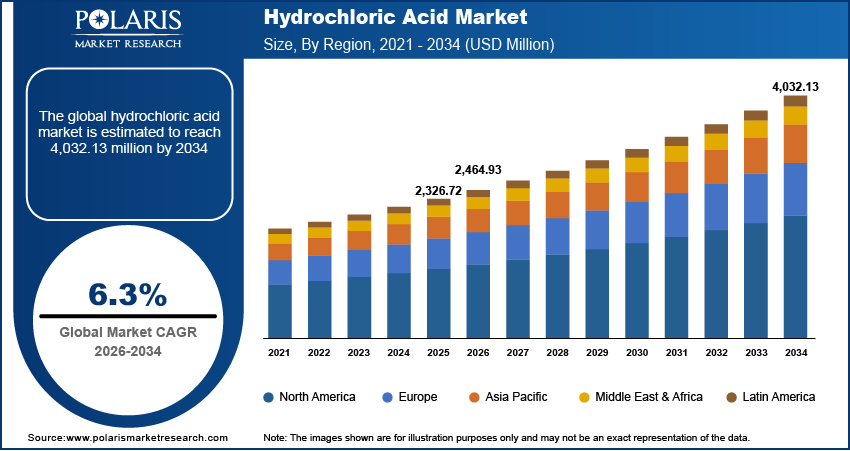
The global hydrochloric acid market size was valued at USD 2,326.72 million in 2025. The hydrochloric acid market CAGR is projected to be 6.3% from 2026 to 2034. The high use of steel pickling hydrochloric acid and increased demand for hydrochloric acid-based disinfectants and cleaning agents are a few of the key factors driving market growth.
Market Statistics
Key Takeaways
- The by-product grade segment led the market in 2025. The segment’s dominance is largely due to the cost-effectiveness and widespread availability of by-product hydrochloric acid.
- The steel segment is poised to register significant growth during the projection period. The growing demand for hydrochloric acid in steel pickling processes contributes to the segment’s growth.
- The Middle East & Africa accounted for the largest hydrochloric acid market share in 2025. The region’s robust presence in the oil & gas industry primarily drives demand for hydrochloric acid.
- Asia Pacific is projected to register significant growth during the projection period. The rapid expansion of industrial sectors drives the Asia Pacific hydrochloric acid market growth.
- A major demand center for hydrochloric acid products includes oil well acidizing and pH control. Hydrochloric acid is used as an additive to improve oil and gas well formation permeability. In the treatment of water, hydrochloric acid is also used in wastewater treatment systems to control the pH level. There is interest in the hydrochloric acid recycling and recovery technologies, particularly in applications such as steel pickling to enhance sustainability.
This hydrochloric acid market study takes into account revenue trends and hydrochloric acid market volume represented in kiloton across major grades, applications, end-use industries, and regions to present an overall hydrochloric acid market outlook for the period of 2026-2034. It also reviews supply-side factors such as by-product generation, hydrochloric acid production capacity, and distribution patterns that shape hydrochloric acid demand across industrial value chains.
Industry Dynamics
- Hydrochloric acid is being increasingly used in the oil & gas industry for well acidizing and enhanced oil recovery. This has created demand for the product.
- Hydrochloric acid is an essential material in the chemical manufacturing industry; it is required to produce dyes and fertilizers. Growth in the chemical manufacturing industry drives the market.
- A rise in recycling and sustainability practices is creating market opportunities.
- The corrosive and unsafe nature of hydrochloric acid may pose potential challenges.
Source: Polaris Market Research Analysis
To Understand More About this Research:Download Sample Report
The market for hydrochloric acid comprises the global trade and production of hydrochloric acid, also known as HCl. HCI is a highly diversified chemical used extensively across a number of industries such as chemical processing, steel plants, food and beverage, pharmaceuticals, water treatment, and oil refineries.
From the point of view of the industrial buyer, the role played by storage and transportation issues is significant. For users such as steel, oil & gas, and water treatment industries, the total cost of ownership usually depends upon factors like packaging, corrosion-resistant storage, and transportation. As such, hydrochloric acid price trends and supply chain reliability are key factors for buyers.
Different hydrochloric acid concentrations exist because different applications require different acid strengths. The market demand for acid differs between commercially sold acid and acid generated as a by-product in chemical manufacturing. The different supply patterns to markets, together with the pricing mechanism, create economic effects that affect regions with strong petrochemical and chlor-alkali production facilities.
The market for hydrochloric acid is driven by its use in steel pickling, where it removes impurities and scales from the steel surface. Hydrochloric acid is widely used for API manufacturing in pharmaceutical formulation. In addition, it is used as an acidifier in food processing. All these factors contribute to the market development.
The rising demand for hydrochloric acid-based disinfectants, sanitizers, and cleaning agents, especially in the post-pandemic era, is a major factor driving the growth of the hydrochloric acid market. In addition, environmental regulations and growing concerns about water pollution are driving increased hydrochloric acid consumption, particularly for pH adjustment, wastewater treatment, and desalination.
Market Dynamics
Growing Use in Oil & Gas Industry
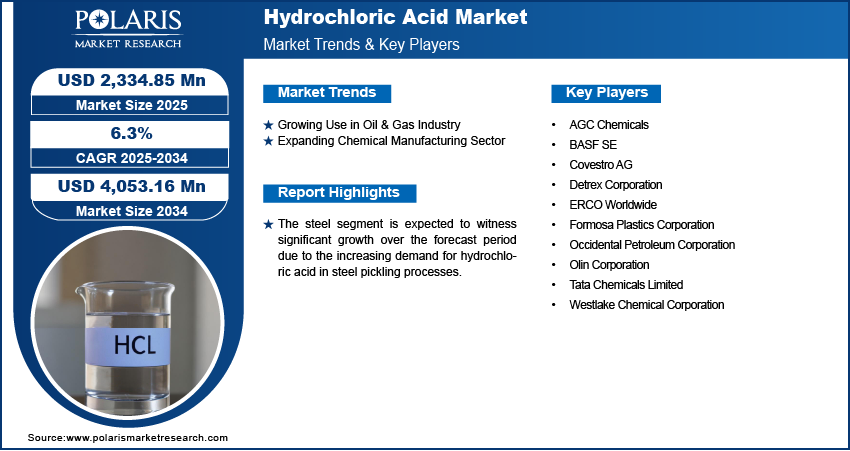
Hydrochloric acid is commonly used in the oil & gas industry for enhanced oil recovery (EOR) and well acidizing. Hydrochloric acid is injected into underground formations, dissolving limestone, dolomite, and other carbonate-containing rocks. This improves permeability to improve oil and gas extraction. It enhances the efficiency of oil and gas exploration, thereby increasing the industrial importance of hydrochloric acid, especially during unconventional oil and gas exploration. Hydrochloric acid is also significant in oil & gas descaling activities, cleaning oil and gas pipelines, refining oil, and maintaining petrochemical processing units. The market opportunity for hydrochloric acid lies in the energy industry, driven by increasing global energy requirements. In addition, the market has registered deepwater exploration activities. For instance, in December 2024, Shell Nigeria Exploration and Production Company Limited, a subsidiary of Shell Plc, made a final investment decision for a deepwater venture known as Bonga North. This project is based offshore, in Nigeria. Accordingly, the market forces of hydrochloric acid have been largely affected by its significance to the oil and gas industry.
In the case of upstream oil & gas activities, the consumption of hydrochloric acid relies on drilling and maintenance operations in wells, as well as the presence of carbonate reservoirs. As such, an area with higher investment in upstream activities would require more hydrochloric acid to be used in the region. This explains the dominance of the Middle East & Africa in the hydrochloric acid market in value terms.
Expanding Chemical Manufacturing Sector
Hydrochloric acid is used in large quantities in the chemical manufacturing industry. The principal application areas of hydrochloric acid are in the manufacture of chlorides, fertilizers, dyes, and other inorganic compounds. The acid is crucial in chemical synthesis, pH adjustment, and catalyst regeneration. There is an increased need for chlorine derivatives, such as PVC, calcium chloride, and pharmaceutical-grade salts. In agriculture, hydrochloric acid is used to produce fertilizers, such as ammonium chloride. Also, the push toward sustainable chemical manufacturing and green manufacturing programs is encouraging R&D of hydrochloric acid recycling and recovery technologies. For example, in October 2023, the U.S. Economic Development Administration announced USD 51 million in funding for Ohio's Sustainable Polymers Tech Hub under its Tech Hubs Program. Such funding is intended to boost conditionally advanced manufacturing. Thus, the growing chemical manufacturing industry is driving the hydrochloric acid market.
Hydrochloric acid is an essential chemical for the manufacturing of chloride and salt. This also supports the production of industrial intermediates for plastics, water treatment agents, and pharmaceutical salts. Ongoing investments in advanced manufacturing technologies and process optimization are enhancing the hydrochloric acid demand, especially for some of the major industrial centers located in the Asia Pacific.
Source: Polaris Market Research Analysis
Segment Insights
Assessment by Grade Outlook
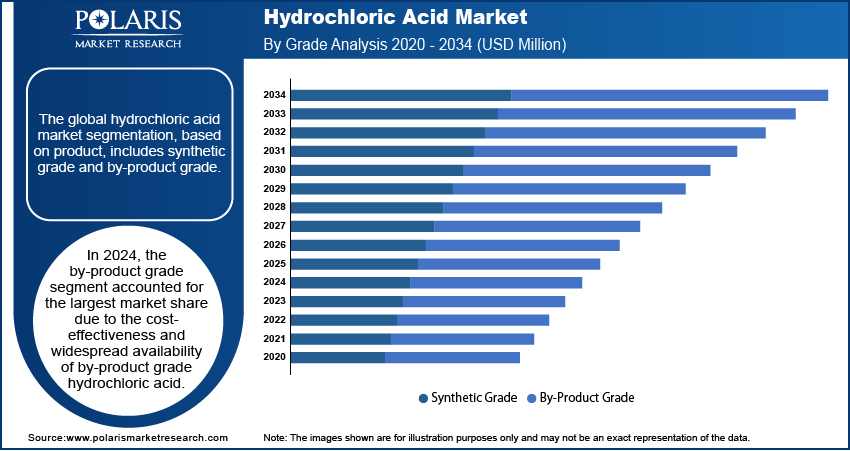
The global hydrochloric acid market by grade is segmented into synthetic grade and by-product grade. The by-product grade segment dominated the market in terms of revenue share in 2025. This is due to its cost-effectiveness and easy accessibility. By-product hydrochloric acid is generated as a secondary product of various chemical processes. These include the manufacture of chlorinated solvents, the production of polyurethane, or the production of vinyl chloride monomer. The chemical industry uses by-product-grade hydrochloric acid due to its diverse applications, including steel pickling, water treatment, and chemical synthesis. The current trend of resource optimization and waste minimization has increased the adoption of by-product-grade hydrochloric acid, thereby expanding market opportunities and promoting the use of sustainable practices.
Although by-product grade hydrochloric acid holds a market-leading position due to its cost-effectiveness, synthetic grade is often used for applications where impurity levels must be tightly controlled, for example, in pharmaceutical and some industrial applications. This is a quality-oriented market segment that may command a higher product price in these end-use areas.
Evaluation by End-Use Industry Outlook
The global hydrochloric acid market segmentation by end-use industry includes food and beverages, pharmaceuticals, textile, steel, oil & gas, and chemical industry. The steel segment is expected to grow rapidly during the forecasted period. This is due to the growing demand for hydrochloric acid in steel pickling processes. Here, it is used to remove oxide layers and scale from carbon steel, stainless steel, and alloy steel surfaces. The expansion of the construction, automotive, and infrastructure sectors has resulted in an increase in steel production. Also, improved technologies in metal processing and the wider penetration of high-performance steel products in various industries have given hydrochloric acid a stronger lead in steel manufacturing and treatment.
Source: Polaris Market Research Analysis
Regional Analysis
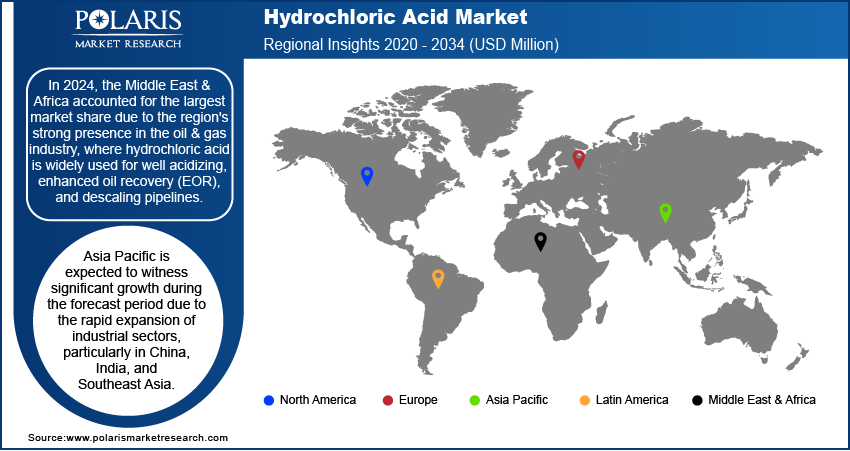
By region, the study provides the hydrochloric acid market insights into North America, Europe, Asia Pacific, Latin America, and the Middle East & Africa. In 2025, the Middle East & Africa accounted for the largest share of the global market. This is due to the region’s strong presence in the oil & gas industry. Hydrochloric acid is widely used in the region’s oil & gas industry for well acidizing, EOR, and descaling pipelines. For instance, according to the International Energy Agency, the Middle East & Africa host five of the world’s top ten oil-producing countries. These are the United Arab Emirates, Iraq, Saudi Arabia, Iran, and Kuwait. Also, three of the world’s top twenty gas-producing countries are based in this region. Moreover, the Middle East & Africa accounted for more than 40% of the world’s oil exports as of 2022, underscoring its importance. Additionally, the expansion of the chemical production industry and investments in water processing and industrial processing are responsible for the growth of the market.
The hydrochloric acid market in the Asia Pacific is likely to see considerable growth during the forecast period, driven by the rapid expansion of the industrial sector in the region, particularly in China, India, and Southeast Asia. The region's steel industry will drive market expansion, as demand is growing from large-scale construction, infrastructure development, and automotive manufacturing. For example, according to the World Steel Association, in 2023, India was the second-largest crude steel producer, producing 140.8 million metric tons (MT). China topped the list with 1,019.1 MT. Japan ranked third at 87.0 MT. Additionally, increasing demand for hydrochloric acid across the chemical, pharmaceutical, and food & beverage industries is contributing to the Asia Pacific hydrochloric acid market growth. Growing population, urbanization, and economic growth have likewise forced an increase in water treatment initiatives, further driving regional market demand.
Polaris’s regional positioning aligns with the more concentrated market value of oil- and gas-driven economies, which employ the chemical for well acidizing, EOR, and pipeline descaling. In contrast, the Asia Pacific region’s projected growth would be a result of growing steel production, increasing chemical production, and strengthening wastewater treatment investment in the region to ensure a steady volume growth in China, India, and Southeast Asia.
Source: Polaris Market Research Analysis
Key Players and Competitive Insights
The hydrochloric acid market is highly competitive. Major players in this market are focusing on capacity expansions, strategic partnerships, improving product portfolios, and enhancing sustainability initiatives to gain a larger market share. A few of the hydrochloric acid key players are Olin Corporation, BASF SE, Dow Inc., Westlake Chemical Corporation, Covestro AG, Tata Chemicals Ltd., AGC Inc., and Detrex Corporation.
Companies are looking to increase production capacity to meet the constant market demand for hydrochloric acid from industries such as steel, oil & gas, chemicals, and pharmaceuticals. Players also invest in technology for the recovery and recycling of hydrochloric acid, aligning with environmental regulations and sustainability trends. Strategic merger and acquisition deals remain important in shaping the course for market growth as players try to consolidate supply chain efficiencies while positioning themselves well for high growth in regions like the Asia Pacific and the Middle East. The volatility in the prices of raw materials, energy costs, and stringent environmental regulations poses challenges to market players, making them increasingly shift towards green chemistry and sustainable practices in manufacturing.
For competitive benchmarking purposes, the market can be segmented by producer type, including integrated chlor-alkali manufacturers versus merchant suppliers, and route-to-market segments such as direct industrial supply or distributor-led networks. For a buyer, supplier differentiation typically relies on guaranteed supply, regional storage facility capability, consistent product concentration, proper documentation, and adequate logistics safety. These factors go on to affect hydrochloric acid procurement decisions, especially for high-volume industrial users.
BASF SE is primarily involved in the production and marketing of chemicals, plastics, and performance products with a focus on a wide range of industrial applications. It was established in the year 1865 and has its headquarters in Ludwigshafen, Germany. The company offers a range of products, namely solvents, adhesives, surfactants, and agricultural products. Among its prominent products, hydrochloric acid, a chemical compound, is also part of the BASF family. It has established a prominent position in the hydrochloric acid market with its production and a wide range of industrial applications. It has a global presence with networks across multiple countries, including Europe, Asia Pacific, and North America.
Olin Corporation is a company that manufactures chemical products and ammunition. The company deals exclusively in chlor-alkali products and epoxy resins. Olin Corporation was established in 1892 and is headquartered in Missouri, U.S. The company's product offerings include hydrochloric acid, which is used for water treatment, oilfield services, and chemical synthesis. The company has a strong presence in the North American market, with multiple production units.
List of Key Companies
- AGC Chemicals
- BASF SE
- Covestro AG
- Detrex Corporation
- ERCO Worldwide
- Formosa Plastics Corporation
- Occidental Petroleum Corporation
- Olin Corporation
- Tata Chemicals Limited
- Westlake Chemical Corporation
Hydrochloric Acid Industry Developments
- May 2025: Iraq partnered with China for the establishment of a major petrochemical plant within the new Basra industrial city. The facility makes use of eco-friendly technology. It has a daily output of 185 tons of hydrochloric acid.
- January 2025: Jones-Hamilton Co. announced the acquisition of Nexchlor LLC. The company stated that the strategic move will improve its hydrochloric acid portfolio. It will also strengthen its position as a leading North American supplier in the sector.
- May 2024: Wynnchurch Capital, L.P. announced the acquisition of Reagent Chemical & Research, LLC. Reagent is a major specialty distributor of hydrochloric acid in North America.
Hydrochloric Acid Market Segmentation
By Grade Outlook (Volume, Kilotons; Revenue, USD Million; 2021–2034)
- Synthetic Grade
- By-Product Grade
By Purity Level Outlook (Volume, Kilotons; Revenue, USD Million; 2021–2034)
- Technical Grade
- Industrial Grade
- Reagent Grade
By Distribution Channel Outlook (Volume, Kilotons; Revenue, USD Million; 2021–2034)
- Direct Sales
- Distributors
- Online Sales
By Application Outlook (Volume, Kilotons; Revenue, USD Million; 2021–2034)
- Steel Pickling
- Oil Well Acidizing
- Ore Processing
- Food Processing
- Pool Sanitisation
- Calcium Chloride
- Biodiesel
By End-Use Industry Outlook (Volume, Kilotons; Revenue, USD Million; 2021–2034)
- Food and Beverages
- Pharmaceuticals
- Textile
- Steel
- Oil & Gas
- Chemical Industry
By Regional Outlook (Volume, Kilotons; Revenue, USD Million; 2021–2034)
- North America
- US
- Canada
- Europe
- Germany
- France
- UK
- Italy
- Spain
- Netherlands
- Russia
- Rest of Europe
- Asia Pacific
- China
- Japan
- India
- Malaysia
- South Korea
- Indonesia
- Australia
- Vietnam
- Rest of Asia Pacific
- Middle East & Africa
- Saudi Arabia
- UAE
- Israel
- South Africa
- Rest of Middle East & Africa
- Latin America
- Mexico
- Brazil
- Argentina
- Rest of Latin America
Hydrochloric Acid Market Report Scope
| Report Attributes | Details |
| Market Size in 2025 | USD 2,326.72 million |
| Market Size in 2026 | USD 2,464.93 million |
| Revenue Forecast by 2034 | USD 4,032.13 million |
| CAGR | 6.3% |
| Base Year | 2025 |
| Historical Data | 2021–2024 |
| Forecast Period | 2026–2034 |
| Quantitative Units | Volume in kilotons, revenue in USD million, and CAGR from 2026 to 2034 |
| Report Coverage | Revenue Forecast, Market Competitive Landscape, Growth Factors, and Trends |
| Segments Covered |
|
| Regional Scope |
|
| Competitive Landscape | Hydrochloric Acid Industry Trend Analysis (2025) Company profiles/industry participants profiling include company overview, financial information, product/service benchmarking, and recent developments |
| Report Format | PDF + Excel |
| Customization | Report customization as per your requirements with respect to countries, regions, and segmentation. |
Source: Polaris Market Research Analysis
Hydrochloric Acid Market FAQ's
The hydrochloric acid market stood at USD 2,326.72 million in 2025. The market is projected to reach USD 4,032.13 million by 2034.
The market is projected to account for a CAGR of 6.3% between 2026 and 2034.
The Middle East & Africa accounted for the largest market share in 2025 due to its strong presence in the oil & gas industry.
A few of the key players in the market include BASF SE, Covestro AG, Olin Corporation, Westlake Chemical Corporation, Occidental Petroleum Corporation, Formosa Plastics Corporation, Tata Chemicals Limited, AGC Chemicals, ERCO Worldwide, and Detrex Corporation.
The by-product grade segment dominated the market in terms of revenue share in 2025. This is due to its cost-effectiveness and easy accessibility
Hydrochloric acid prices are primarily based on demand from industries such as steel and oil & gas. In addition, prices depend on raw materials and their accessibility as well as energy prices.
The steel segment is expected to grow rapidly during the forecasted period. This is because of the growing demand for hydrochloric acid in steel pickling processes.
By-product grade is produced as a secondary output from other chemical processes. It is usually more economical. Synthetic grade is manufactured specifically for higher-purity requirements. Synthetic grade is preferred for applications requiring closer quality control.
Buyers seek suppliers with high-quality products, consistent supply, pricing certainty, and storage and transportation infrastructure.
Download Sample Report of Hydrochloric Acid Market
Please fill out the form to request a customized copy of the research report.


