
Intelligent Power Module Market Size, Share, Trends & Forecast, 2026–2034
REPORT DETAILS
Intelligent Power Module Market Summary
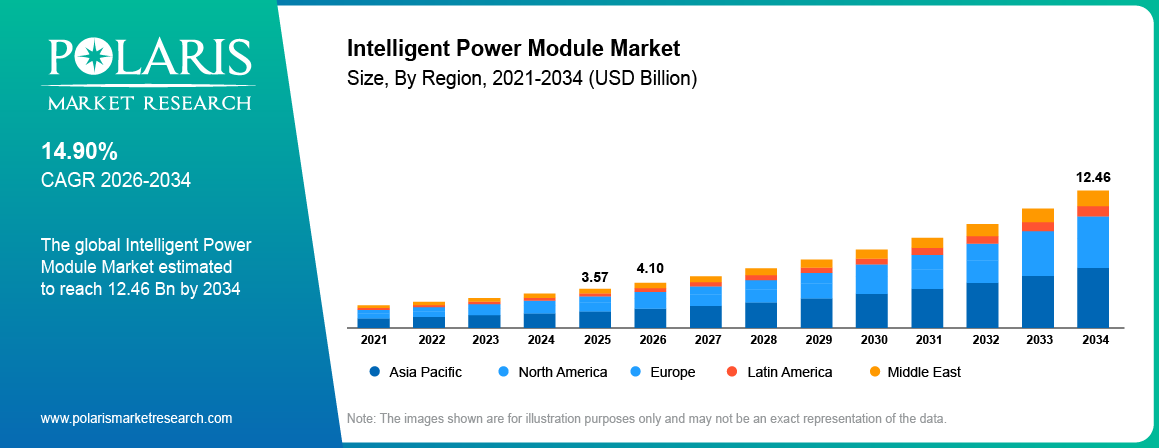
Intelligent Power Module Market size was valued at USD 3.57 billion in 2025. The market outlook is anticipated to grow from USD 4.10 billion in 2026 to USD 12.46 billion by 2034, exhibiting the CAGR of 14.90% during the forecast period.
Market Statistics
Key Takeaways
- Asia Pacific accounted for 35.4% of market revenue in 2025 and dominated the regional market. Strong automotive production, industrial automation, and demand for energy-efficient power electronics support its leading position.
- During 2026-2034 North America is forecast to be the fastest-growing regional market with a CAGR of 16.2%. Growing adoption of EVs, advanced industrial systems and demand for energy-efficient power electronics are propelling growth.
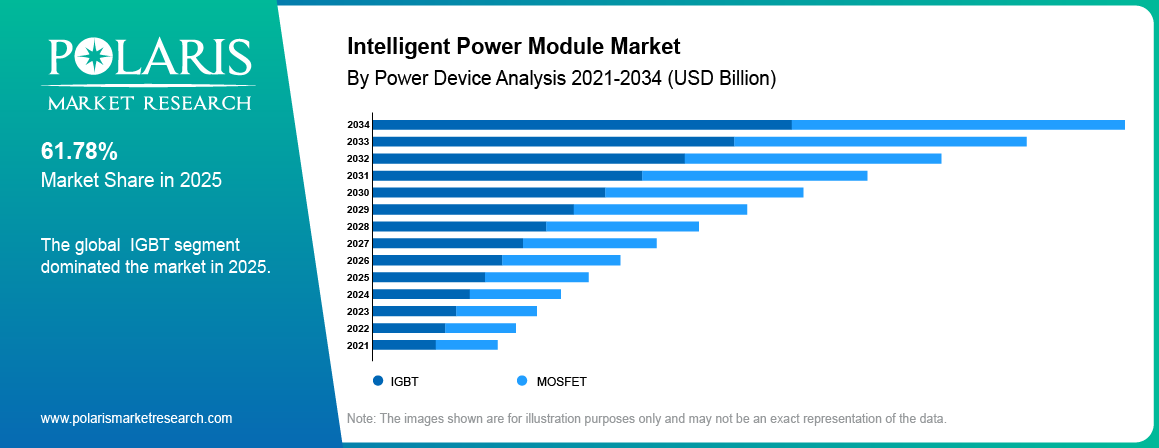
- IGBT was the largest power device segment with 61.78% of market revenue in 2025. Demand is supported by overload handling capability and wide application in automotive and consumer applications.
- The MOSFET is expected to grow at a CAGR of 15.7% from 2026 to 2034. Growing adoption of MOSFET for low-voltage, low-current, and high-frequency applications is a major factor that is driving the market growth.
- In 2025, the 600 V to 1,199 V segment represented 57.95% of market revenue and held a significant share. Its wide use in home appliances and industrial drives supports segment growth.
- During 2026–2034 the 1,200 V and above segment is expected to grow at a CAGR of 15.4%. The demand for EVs, industrial automation, and HVAC applications is rising, leading to the adoption of high-voltage modules.
Note: Figures and projections outlined in this report are the result of Polaris Market Research’s proprietary analytical processes, grounded in the latest available datasets and market observations
What Is an Intelligent Power Module?
An Intelligent Power Module (IPM) is a power semiconductor device that combines power switching components, gate drivers, and protection circuits in a single package. It helps control and convert electrical power efficiently while providing protection against conditions such as overcurrent, overtemperature, and undervoltage.
IPMs are widely used in motor drives, electric vehicles, industrial equipment, appliances, and power conversion systems. Their integrated design can reduce component count, simplify system design, and improve reliability.
Market is fueled by the increasing sales of electric vehicles, the growing adoption of renewable energy sources, and the rising demand for highly reliable and compact power devices. The intelligent power modules, with their advanced features and simplified design processes, play a vital role in improving system efficiency and meeting the evolving needs of modern power applications. There is need for highly reliable, compact, and user-friendly power devices.
Intelligent power modules serve as advanced power-switching devices, incorporating components like Insulated-Gate Bipolar Transistors (IGBT) and Metal-Oxide-Semiconductor Field-Effect Transistors (MOSFET). These modules also integrate additional protection and control circuitry. The inclusion of such circuitry enhances the reliability and performance of these modules.
The electronics industry faced substantial challenges due to labor shortages and disruptions in the supply chain. According to the World Semiconductor Trade Statistics (WSTS), global semiconductor sales reached USD 795.6 billion in 2025, an increase of 26.2% year over year. However, discrete semiconductors remained slightly negative on a full-year basis, highlighting continued pressure in this product category. Since discrete semiconductors are used in intelligent power modules, these market conditions can affect component availability and production planning for IPM manufacturers (Source: www.wsts.org).
From the demand perspective, various industries encountered difficulties due to travel restrictions and adherence to social distancing measures. The International Energy Agency (IEA) reported that supply chain interruptions and lockdown measures resulted in delays in the construction of renewable energy projects. Additionally, the consumption of renewable energy witnessed a decline due to restrictions on business activities and travel.
How Intelligent Power Modules Work
An Intelligent Power Module receives electrical power and uses built-in IGBTs or MOSFETs to control current flow based on signals from the system controller. The gate driver manages the switching process and helps convert input power into the required voltage and current for the connected application. This makes IPMs useful in motor drives, EV systems, appliances, and industrial equipment.
During operation, built-in circuits continuously monitor current, voltage, and temperature. If an unsafe condition such as overcurrent, overtemperature, or undervoltage occurs, the protection circuit responds to reduce the risk of damage. The controlled electrical output is then supplied to the connected load for efficient and reliable operation.
Market Dynamics
Market Driver- Rising Adoption of Electric Vehicles
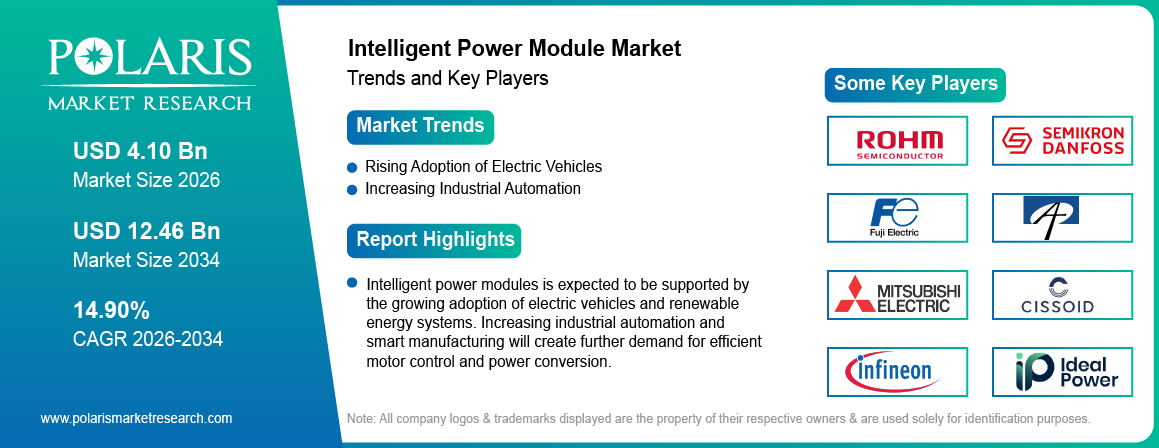
Global electric car sales reached 21 million units in 2025, up more than 20% year over year, according to the International Energy Agency (IEA). This expanding EV base is increasing the need for efficient power control in traction systems, charging equipment, compressors, and other vehicle systems. Intelligent power modules combine switching and protection functions, making them suitable for compact automotive power systems (Source: www.iea.org).
Market Driver- Increasing Industrial Automation
The International Federation of Robotics reported that 542,000 industrial robots were installed globally in 2024, more than double the number recorded 10 years earlier. This continued use of automated machinery is increasing demand for reliable motor-control and power-conversion components. Intelligent power modules can support these systems by integrating power switches, gate drivers, and protection functions in a compact package (Source: ifr.org/ifr-press-releases).
Market Opportunity- Expansion of Renewable Energy Systems
Global renewable energy capacity additions reached a record 800 GW in 2025, with solar PV accounting for more than three-quarters of new additions, according to the IEA. The expansion of solar installations creates opportunities for intelligent power modules in inverters and power-conversion equipment. Their switching and protection features can support efficient operation in systems that convert and manage electricity from renewable sources (Source: www.iea.org).
Market Opportunity- Growing Demand for Integrated Power Solutions
Product development is creating opportunities for IPMs across appliances and motor-control systems. For example, Infineon offers a 650 V IGBT-based IPM with built-in overcurrent shutdown, temperature monitoring, and undervoltage protection for applications such as refrigerators, washing machines, air conditioners, and motor control. Such integration can reduce design complexity while supporting compact system designs (Source: www.infineon.com).
Market Restraint- Thermal Management and Supply Chain Challenges
Intelligent power modules must manage heat effectively while operating under demanding load conditions. At the same time, manufacturers face supply chain pressures across semiconductor materials, components, and production capacity. These factors can increase product costs and create challenges in maintaining consistent supply, particularly for high-performance modules used in automotive and industrial applications.
IPM vs. Discrete Power Components
| Feature | Intelligent Power Module | Discrete Power Components |
| Integration | Power switch, gate driver, and protection functions are integrated into one module | Functions are distributed across multiple components |
| Installation Complexity | Lower | Higher |
| Protection | Built-in protection is commonly available | Often requires external protection circuitry |
| System Footprint | Compact | Typically larger for equivalent integrated functions |
| Design Effort | Simplified module-level integration | Requires more component selection and circuit design |
| Reliability Considerations | Integrated architecture can reduce interconnect complexity | More external components and interconnects can increase design complexity |
| Best-fit Use | Motor drives, inverters, HVAC, appliances, and compact power conversion | Custom designs where component-level flexibility is required |
Source: Polaris Market Research Analysis
IGBT-Based Intelligent Power Modules
IGBT-based intelligent power modules combine IGBTs with gate drivers and protection circuits in a single package. They are suitable for applications that require high power handling and reliable switching, including motor control, industrial equipment, renewable energy systems, and electric vehicles. Their ability to handle higher voltage and current levels makes them useful in applications where efficient power control is important.
MOSFET-Based Intelligent Power Modules
MOSFET-based intelligent power modules are designed for applications that require fast switching and efficient operation at lower voltage levels. They are commonly used in compact electronic systems, motor control, and other applications where high switching frequency is important. Their switching performance makes them suitable for systems that require quick and precise control of electrical power.
Advancements in Power Semiconductor Technologies
Advancements in power semiconductor technologies are improving the performance of intelligent power modules. Silicon carbide (SiC) and gallium nitride (GaN) devices support faster switching, lower power losses, and improved efficiency compared with conventional technologies in suitable applications. These technologies also help reduce system size by enabling more compact power components. Improved thermal management is important as switching speeds and power density increase. Ongoing development in semiconductor materials and device design is supporting the use of IPMs in EVs, renewable energy systems, and industrial equipment.
Contribution to Energy Efficiency
Intelligent power modules can improve energy efficiency by reducing power losses during switching and power conversion. Their integrated design combines power switches, drivers, and protection functions, helping reduce component count and simplify system design. Better conversion efficiency can lower energy consumption and operating costs in applications such as motor drives, HVAC systems, appliances, and industrial equipment. Improved thermal performance can also support reliable operation and help extend the working life of power electronic systems.
Role in Industry 4.0 & Smart Factories
Intelligent power modules support Industry 4.0 and smart factory systems by providing efficient power control for connected industrial equipment. They are used in motor drives, automation systems, robotics, and other electronically controlled machinery. Built-in monitoring and protection functions can help detect operating conditions and support system diagnostics. As manufacturers adopt smart manufacturing technologies, IPMs can contribute to reliable motor control, efficient power conversion, and compact designs for automated industrial systems.
Report Segmentation
By Power Device Analysis
The Intelligent Power Module Market is segmented by power device into IGBT and MOSFET. IGBT segment accounted for the largest share, representing 61.78% of the market in 2025. It is due to its ability of IGBTs to withstand overloads & its applicability in burgeoning end-users, particularly the automotive sector, which is experiencing a notable increase in Electric Vehicle (EV) adoption. Additionally, IGBTs are employed in consumer applications, including induction cookers & air conditioners. Various market players manufacture IGBT-based modules, making them readily available in the market. The advantages of IGBTs, including lower electromagnetic interference and thermal impedance when compared to MOSFETs, contribute to their popularity and widespread adoption.
MOSFET segment is expected to grow rapidly, with a CAGR of 15.7% from 2026 to 2034. MOSFETs, or metal-oxide-semiconductor field-effect transistors, are particularly well-suited for applications characterized by low current, low voltage, and high switching frequency. The notable growth in this segment can be attributed to the MOSFETs' capacity to deliver superior performance, especially in applications requiring high switching frequencies. MOSFETs exhibit advantages in scenarios where precise control over low currents and voltages is essential, making them suitable for various electronic devices and circuits. Their ability to efficiently handle high switching frequencies is a key factor driving their growth. In applications demanding rapid switching, MOSFETs offer superior performance, contributing to their increasing adoption and market demand.
Introducing innovative MOSFET technologies or enhanced versions of existing products can attract attention in the market, driving demand and contributing to the overall growth of the MOSFET segment. The continuous development and introduction of new MOSFET products align with the evolving needs of industries relying on low current, low voltage, and high-frequency applications, further fueling the projected growth.
By Voltage Rating Analysis
The Intelligent Power Module Market is segmented by voltage rating into 0 V to 599 V, 600 V to 1,199 V, and 1,200 V and above. 600 V to 1,199 V segment held the significant market share, representing 57.95% of the market in 2025. Growth is attributed to the broad spectrum of applications falling within this voltage rating range, including significant use cases in major home appliances and industrial drives. Additionally, the widespread availability of modules within this voltage range contributes to the segment's expansion. For instance, Infineon Technologies presents the IFCM20T65GD, a 650 V TRENCHSTOP IGBT-based intelligent module designed for the industrial drives & home appliances. This specific module exemplifies the prevalent trend in the intelligent power module market, where a significant number of intelligent power modules cater to applications within voltage range.
1,200 V and above segment is expected to gain substantial growth rate of CAGR 15.4% during the forecast period. Growth is fueled by the increasing demand for high-voltage intelligent power modules in diverse applications, including automotive, industrial automation, and Heating, Ventilation, and Air Conditioning (HVAC). Notably, Semiconductor Components (onsemi)'s NFVA23512NP2T intelligent power module, with a voltage rating of 1,200 V, is specifically designed for hybrid and electric vehicles, exemplifying the trend in high-voltage applications.
The surge in adoption of automation in various industries and the increasing uptake of renewable energy contribute significantly to the growth of this segment. High-voltage intelligent power modules play a vital role in addressing the specific requirements of applications in automotive, industrial automation, and HVAC, driving the demand for modules with a voltage rating of 1,200 V and above. This trend is likely to persist and contribute to the segment's accelerated growth over the forecast period.
By Application Analysis
The Intelligent Power Module Market is segmented by application into Automotive, Industrial, Consumer Electronics, Energy & Utility, IT & Telecommunication, and Others. Automotive segment held the significant market share, representing 49.01% of the market in 2025. According to the International Energy Agency (IEA), electric car sales exceeded 20 million globally in 2025, growing by 20% from 2024, while electric cars accounted for 25% of all new car sales. This surge in electric car adoption, encompassing both hybrid electric and fully electric vehicles, is a key driver behind the notable growth of this segment (Source: www.iea.org).
The adoption of intelligent power modules is pivotal in various automotive applications, including but not limited to the oil pumps, compressors, & charging systems for electric vehicles. With the automotive industry increasingly embracing electric and hybrid technologies, the demand for these modules continues to grow, contributing significantly to the segment's dominance and expected rapid expansion in the coming years.
The industrial segment is witnessing steady growth due to the increasing use of intelligent power modules in motor drives, industrial automation, robotics, and manufacturing equipment. IPMs help improve power control, energy efficiency, and system reliability in industrial applications. Rising automation and demand for efficient power conversion are expected to support segment growth, with a CAGR of 15.3% during the forecast period.
Real-World IPM Use Cases
| Application | IPM Use Case |
| Electric Vehicles | EV traction and charging systems |
| Motor Drives | Industrial motors and variable-speed drives |
| Solar & Wind | Inverters and power conversion |
| HVAC | Air conditioners and compressors |
| Appliances | Washing machines and refrigerators |
| Factory Automation | Automated manufacturing equipment |
| Robotics | Motor control and robotic systems |
Source: Polaris Market Research Analysis
Regional Insights
Asia Pacific Dominated the Global Market in 2025
APAC dominated the global market, representing 35.4% of the market in 2025. According to the International Energy Agency (IEA), China remained the largest electric car market in 2025, with more than 13 million electric cars sold. China also added nearly 500 GW of renewable energy capacity in 2025, including solar and wind power. The growth of electric vehicles and renewable energy is increasing the demand for intelligent power modules in the region (Source: www.iea.org).
Intelligent power modules find significant applications in both the automotive and renewable energy sectors. The robust growth of the market is propelled by the region's high levels of automobile manufacturing activity and considerable installed capacity of renewable energy.
North America Will Grow at a Substantial Pace
North America will grow at a substantial pace, with a CAGR of 16.2% during the forecast period. The region’s advanced technology infrastructure, growing electric vehicle adoption, and strong semiconductor manufacturing activity are supporting market growth. In 2025, the U.S. Department of Commerce reported that planned semiconductor manufacturing investments in the country were nearly USD 450 billion. These investments are expected to support demand for power semiconductor technologies and intelligent power modules (Source: www.semiconductors.org).
Europe Held a Significant Market Share
Europe's intelligent power module market is growing at a CAGR of 14.2% during the forecast period supported by the growing adoption of electric vehicles, renewable energy systems, and industrial automation. Increasing focus on energy efficiency and the development of advanced power electronics is also creating demand for intelligent power modules across automotive and industrial applications.
Middle East & Africa Market Is Supported by Renewable Energy Growth
The Middle East & Africa market is growing at a CAGR of 12.8% during the forecast period supported by investments in renewable energy and power infrastructure. Growing solar power projects and industrial development are creating opportunities for intelligent power modules in power conversion, inverters, and other energy applications.
Latin America Market Is Driven by Renewable Energy and Industrial Growth
The Latin America market is growing at a CAGR of 13.6% during the forecast period witnessing growing demand for intelligent power modules due to the expansion of renewable energy, electric mobility, and industrial applications. Increasing investments in solar power and modern power infrastructure are expected to support market growth across the region.

Intelligent Power Module Market Segmentation
| Segment | Categories |
| Power Device | IGBT; MOSFET |
| Voltage Rating | 0 V to 599 V; 600 V to 1,199 V; 1,200 V and above |
| Application | Automotive; Industrial; Consumer Electronics; Energy & Utility; IT & Telecommunication; Others |
| Region | North America; Europe; Asia Pacific; Latin America; Middle East & Africa |
Source: Polaris Market Research Analysis
Key Market Players & Competitive Insights
The market is characterized by the presence of key players operating on a global scale, contributing significantly to the substantial growth of the market. These players are employing strategies such as the introduction of new products to establish a competitive advantage.
Infineon Technologies AG is a major power semiconductor company offering intelligent power modules for automotive, industrial, and consumer applications. Its IPM portfolio includes IGBT- and MOSFET-based solutions with integrated gate drivers and protection functions. The company focuses on improving power efficiency, compact system design, and reliable operation. Its products are used in applications such as motor drives, appliances, and electric vehicle systems.
Mitsubishi Electric Corporation develops intelligent power modules for motor control, industrial equipment, consumer appliances, and automotive applications. Its IPM products integrate power semiconductor devices with control and protection functions to support efficient power conversion. The company offers modules designed for different voltage and power requirements. Its IPM technologies are widely used in applications requiring reliable switching, compact designs, and efficient electrical power management.
Some of the major players operating in the global market include
- Alpha and Omega Semiconductor
- Cissoid
- Danfoss (Semikron Danfoss)
- Fuji Electric Co., Ltd.
- Ideal Power, Inc.
- Infineon Technologies AG
- Mitsubishi Electric Corporation
- ROHM Co., Ltd.
- Semiconductor Components Industries, LLC (onsemi)
- Sensitron Semiconductor
- STMicroelectronics
Key Companies in the Intelligent Power Module Market
| Company | Market Positioning | Technology and Application Focus |
| Alpha and Omega Semiconductor | Focus on compact power solutions for appliances and motor applications | IPM, MOSFET, and BLDC motor applications |
| Fuji Electric Co., Ltd. | Strong presence in power semiconductors and industrial power electronics | IGBT modules, industrial drives, and renewable energy systems |
| Infineon Technologies AG | Broad power semiconductor portfolio and strong presence in intelligent power modules | IGBT, SiC, GaN, automotive, and industrial applications |
| Mitsubishi Electric Corporation | Long-standing IPM and motor-control portfolio | IGBT-based IPMs, HVAC, industrial drives, and power electronics |
| ROHM Co., Ltd. | Focus on wide-bandgap and power semiconductor technologies | SiC, MOSFET, automotive, and industrial applications |
| Semiconductor Components Industries, LLC (onsemi) | Power-management and intelligent power solutions | IGBT/IPM, EVs, HVAC, and industrial applications |
| STMicroelectronics N.V. | Power semiconductor portfolio serving automotive and industrial markets | MOSFET, IGBT, SiC, automotive, and industrial applications |
Source: Polaris Market Research Analysis
Benefits of Intelligent Power Modules
Intelligent power modules offer several benefits for modern power electronic systems. Their compact design combines power switches, gate drivers, and protection functions in a single package, helping reduce the number of external components. Built-in protection can help safeguard systems against overcurrent, overtemperature, and undervoltage conditions. IPMs can also improve energy efficiency by reducing power losses during switching and conversion. Their integrated design simplifies system development and can support better thermal performance, reliable operation, and space-efficient equipment.
Recent Developments
- September 2026: Alpha and Omega Semiconductor released two 600 V αMOS E2™ Super Junction MOSFETs for solar inverters, motor drives, servers, and industrial power systems, focusing on efficiency, power density, and reliability (Source: investor.aosmd.com)
- March 2026: Infineon launched the TDM24745T OptiMOS™ quad-phase power module with integrated TLVR inductors, delivering up to 320 A peak current for next-generation AI processors and data-center power systems. (Source: www.infineon.com)
- September 2025: Infineon Technologies AG and ROHM entered into a partnership to collaborate on silicon carbide (SiC) power device packaging, enabling mutual second-source supply of select SiC power packages to enhance design flexibility and supply security for customers. This partnership promotes wider adoption of SiC technologies, essential for high-efficiency IPMs in automotive and industrial sectors. (Source: www.infineon.com)
- May 2025: Infineon launched EasyPACK CoolGaN 650 V modules that support up to 70 kW per phase for data-center power systems and charging applications. (Source: www.infineon.com)
- April 2025: Alpha and Omega Semiconductor introduced Mega IPM-7 modules for brushless DC appliance motors, delivering 600 V performance within compact module designs. (Source: investor.aosmd.com)
Future Outlook
The future of intelligent power modules is expected to be supported by the growing adoption of electric vehicles and renewable energy systems. Increasing industrial automation and smart manufacturing will create further demand for efficient motor control and power conversion. Advances in semiconductor technologies, including SiC and GaN, are expected to improve switching performance and energy efficiency. These developments can support wider use of IPMs across automotive, industrial, and energy applications.
Research Methodology
The Intelligent Power Module Market is defined as revenue generated from intelligent power modules that integrate power switches with gate drivers, protection, and control functions. The analysis covers the validated market segments by power device, voltage rating, application, and region.
The study uses secondary research from company disclosures, industry publications, regulatory sources, trade associations, and technical literature. Primary research and expert validation are included where applicable. Market estimates are assessed using bottom-up and top-down approaches, with data triangulation across companies, applications, and regions.
The methodology states the base year, historical period, forecast period, currency, units, and geographic coverage. Market size, CAGR, segment shares, and regional estimates are reviewed and validated against available data. The published figures represent proprietary analyst estimates and may be updated when the underlying market model is refreshed.
Intelligent Power Module Market Report Scope
The Intelligent Power Module Market report covers intelligent power modules that integrate power switching devices, gate drivers, protection circuits, and related control functions. The scope includes analysis by power device, voltage rating, application, and region. The report presents the latest analyst-validated market size, growth rate, segment shares, historical data, and forecast figures. All market figures and forecasts are based on the latest validated market model and defined reporting period.
Intelligent Power Modules Market Report Scope
| Report Attributes | Details |
| Market size value in 2025 | USD 3.57 billion |
| Market size value in 2026 | USD 4.10 billion |
| Revenue forecast in 2034 | USD 12.46 billion |
| CAGR | 14.90% from 2026 – 2034 |
| Base year | 2025 |
| Historical data | 2021 – 2024 |
| Forecast period | 2026 – 2034 |
| Quantitative units | Revenue in USD billion and CAGR from 2026 to 2034 |
| Segments covered | By Power Device, By Voltage Rating, By Application, By Region |
| Regional scope | North America, Europe, Asia Pacific, Latin America, Middle East & Africa |
| Customization | Report customization as per your requirements with respect to countries, region, and segmentation. |
Source: Polaris Market Research Analysis
Intelligent Power Module Market FAQ's
The market is segmented by power device, voltage rating, application, and region.
The global Intelligent Power Module Market was valued at USD 3.57 billion in 2025.
The market is projected to reach USD 12.46 billion by 2034.
The market is expected to grow at a CAGR of 14.9% from 2026 to 2034.
Asia Pacific leads the global market with 35.4% share, supported by strong demand from automotive, industrial, and power electronics applications.
IGBT holds a dominant market share of 61.78% due to its use in motor drives, automotive systems, industrial equipment, and power conversion applications.
Major applications include automotive, industrial, consumer electronics, energy & utility, and IT & telecommunication.
Growing electric vehicle adoption, industrial automation, renewable energy systems, and demand for energy-efficient power electronics are key factors supporting market growth.
Download Sample Report of Intelligent Power Module Market
Please fill out the form to request a customized copy of the research report.


