
Medical Holography Market Opportunity, Trends, Growth Analysis Report, 2026-2034
REPORT DETAILS
Medical Holography Market Summary
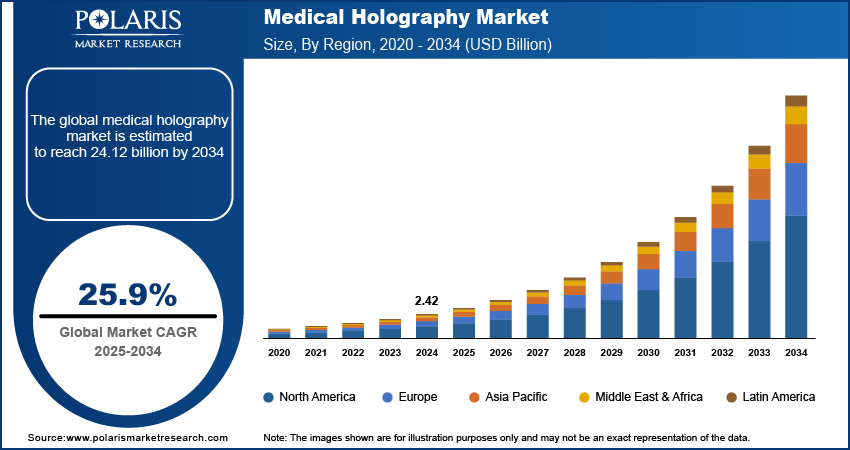
The global medical holography market size was valued at USD 2.83 billion in 2025. The market is projected to grow from USD 3.58 billion in 2026 to USD 23.81 billion by 2034, exhibiting a CAGR of 26.7% during 2026–2034.
Market Statistics
Key Takeaways
- North America led with a 39.0% market share in 2025. Advanced healthcare infrastructure and high adoption of innovative imaging solutions contribute to the regional market dominance.
- Asia Pacific is projected to witness rapid growth at a 30.35% CAGR. Rising healthcare investments in emerging economies drive the regional market growth.
- The holographic displays segment led with a 36.0% share in 2025. This is owing to their extensive application in medical imaging, education, and research.
- The holography microscopes segment is projected to register the highest growth rate of 28.34%. This is owing to their rising use in cellular imaging and pathology studies.
- Imaging in medical indications led with the largest market share of 62.0% in 2025. Its significant role in diagnostics and surgical planning drives the segment’s leading position.
Note: Figures and projections outlined in this report are the result of Polaris Market Research’s proprietary analytical processes, grounded in the latest available datasets and market observations.
Industry Dynamics
- The rising integration of augmented reality (AR) and virtual reality (VR) technologies is shaping the market landscape.
- Advancements in cost-effective and portable holographic devices is another factor driving market adoption.
- The use of 3D/4D holographic simulations in medical schools and universities is expected to create several market opportunities.
- High upfront costs may present market challenges.
AI Impact on Medical Holography Market
- The application of AI technology makes it easier to improve medical holography by providing assistance in the creation and analysis of intricate 3D medical imaging.
- Using this technology makes it easier to make accurate diagnoses and formulate treatment plans.
- AI facilitates image processing, saving time for both the creation and analysis of the images.
- It is also helpful for proper surgical training and planning.
The global medical holography market encompasses technologies and solutions that utilize holographic imaging for medical applications, such as diagnosis, education, research, and surgery. The market growth is driven by advancements in imaging technology, increasing demand for minimally invasive procedures, and the growing adoption of holography in medical training and education. The rising prevalence of chronic diseases and the need for accurate visualization of complex anatomical structures further contribute to the market demand. Notable holography market trends include the integration of with holographic systems and the development of portable and cost-effective holographic devices augmented reality (AR) and virtual reality (VR) in healthcare.
Source: Polaris Market Research Analysis
To Understand More About this Research: Download Sample Report
Medical Holography Market Dynamics
Integration of Holography with AR and VR Technologies
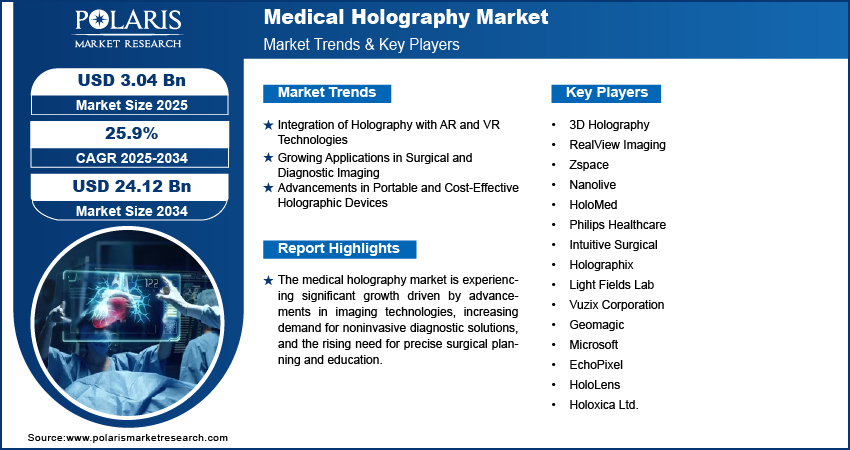
The combination of holography with augmented reality (AR) and virtual reality (VR) is reshaping the medical sector, enabling enhanced visualization and interactivity. These technologies are increasingly being utilized in medical education and surgical planning, allowing practitioners to view 3D holographic models of organs or tissues overlaid in real-world settings. According to a 2023 survey by the National Institute of Health Technology, over 45% of healthcare institutions in developed countries have begun experimenting with AR- and VR-enabled holographic tools to improve patient outcomes. The trend highlights the potential for advanced, immersive technologies to transform traditional medical practices. Thus, the integration of AR and VR technologies with holography is expected to drive the medical holography market development in the coming years.
Growing Application in Surgical and Diagnostic Imaging
Holography is being widely adopted in surgical planning and diagnostic imaging to provide detailed, multi-dimensional views of patient anatomy. These tools are particularly valuable in neurology, cardiology, and orthopedics, where precision is crucial. A 2022 report published in The Journal of Medical Imaging revealed that the use of holography in pre-surgical planning reduces the margin for error by up to 30%, enhancing surgical success rates. This trend reflects the increasing reliance on holographic systems for accurate and noninvasive diagnostics. Hence, the rising application in surgical and diagnostic imaging fuels the medical holography market demand.
Advancements in Portable and Cost-Effective Holographic Devices
The development of portable and affordable holographic devices is democratizing access to advanced imaging technologies in healthcare. These devices are especially beneficial for resource-constrained settings and telemedicine applications, where access to traditional imaging tools may be limited. Research by the Global Health Innovation Alliance in 2023 showed a 25% year-over-year increase in the deployment of compact holographic imaging systems in low- and middle-income countries. This trend is making innovative diagnostic tools more accessible globally while supporting the expansion of telemedicine services. Therefore, advancements in portable and cost-effective holographic devices are expected to drive the medical holography market growth during the forecast period.
Medical Holography vs Traditional Medical Imaging
| Aspect | Medical Holography | Traditional Medical Imaging |
| Depth of Visualization | Offers interactive three-dimensional visualization of internal body parts and structures | Offers two-dimensional or limited cross-sectional views |
| Interactivity | Permits the user to manipulate, rotate, and examine holograms | Allows limited interaction with images and viewing angles |
| Surgery | Offers great assistance for surgical procedure planning and visualization | Proves very useful in providing images but is limited in offering preoperative assistance |
| Accuracy | Helps to understand complicated anatomical connections through realistic three-dimensional visualization | Depends on flat images interpretation and slicing |
| Effectiveness | Provides immersive experience through real-life 3D anatomical models and simulations | Depends on regular images, scanning methods, and visuals |
Source: Polaris Market Research Analysis
Medical Holography Market Segment Insights
Medical Holography Market Outlook – Product Type-Based Insights
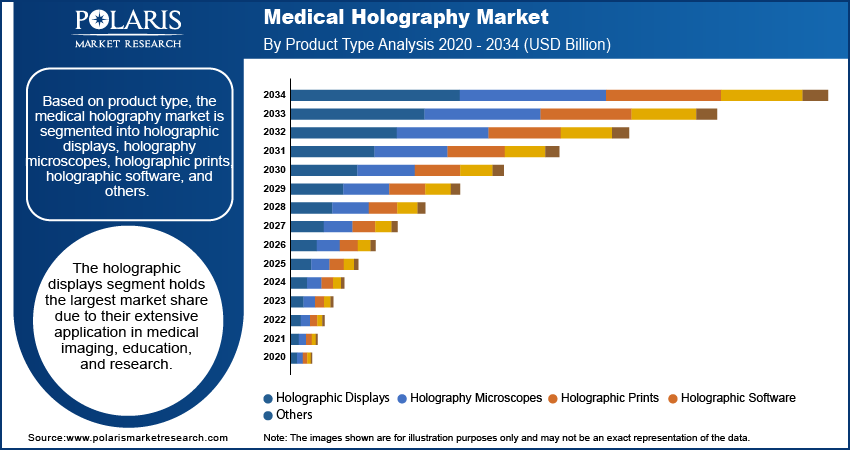
By product type, the medical holography market is segmented into holographic displays, holography microscopes, holographic prints, holographic software, and others. The holographic displays segment holds the largest market share of 36.0% in 2025 due to their extensive application in medical imaging, education, and research. These displays provide high-resolution, three-dimensional visualization of anatomical structures, which is increasingly valued in surgical planning and diagnostics. The adoption of holographic displays is further driven by technological advancements that enhance image quality and integration with other healthcare technologies, such as AR and VR systems.
The holography microscopes segment is registering CAGR of 28.34% within the market owing to their rising use in cellular imaging and pathology studies. These microscopes enable researchers and clinicians to examine live cells and tissues in 3D without invasive procedures or staining. This capability is crucial for understanding complex biological processes and accelerating drug development. Additionally, holographic software is gaining traction as it complements hardware solutions by enabling better data analysis and visualization, creating a seamless ecosystem for medical holography applications.
Medical Holography Market Assessment – Application-Based Insights
The medical holography market segmentation, by application, includes imaging in medical indications, medical education, and others. Imaging in medical indications accounts for the largest market share of 62.0% in 2025, due to its significant role in diagnostics, surgical planning, and monitoring of chronic conditions. This segment benefits from the increasing demand for precise, noninvasive imaging techniques that provide enhanced visualization of internal organs and structures. The adoption of holographic imaging systems is particularly prominent in neurology and cardiology, where detailed 3D representations are critical for improving diagnostic accuracy and surgical outcomes.
The medical education segment is growing at the fastest rate of 29.51%, driven by the need for advanced learning tools that enhance the understanding of complex anatomical and physiological concepts. Holography is transforming traditional medical training by enabling interactive, immersive experiences for students and professionals. Educational institutions and training centers are increasingly investing in holographic solutions to simulate real-world scenarios, allowing for improved skill development and knowledge retention. This trend is further supported by collaborations between medical institutions and technology providers to develop tailored educational platforms.
Medical Holography Market Evaluation – End User Insights
By end user, the medical holography market is segmented into hospitals and clinics, biopharmaceutical companies, and others. The hospitals and clinics segment holds the largest market share of 58.0% in 2025, due to the extensive application of holographic technologies in diagnostics, surgical planning, and patient education. These institutions increasingly rely on advanced imaging solutions to enhance clinical outcomes and streamline complex procedures. The integration of holography into surgical suites and diagnostic departments highlights its growing importance in modern healthcare infrastructures, particularly in specialized fields such as cardiology and oncology.
The biopharmaceutical companies segment is witnessing the highest growth at a CAGR of 29.59% within the market, driven by their increasing adoption of holography for research and development purposes. Holographic imaging is revolutionizing drug discovery services by enabling detailed, real-time visualization of molecular interactions and cellular mechanisms. This application accelerates the development of novel therapies while improving the understanding of drug efficacy and safety. Rising investments in advanced technologies to enhance R&D productivity and innovation further boost the biopharmaceutical companies segment growth.
Source: Polaris Market Research Analysis
Medical Holography Market Regional Insights
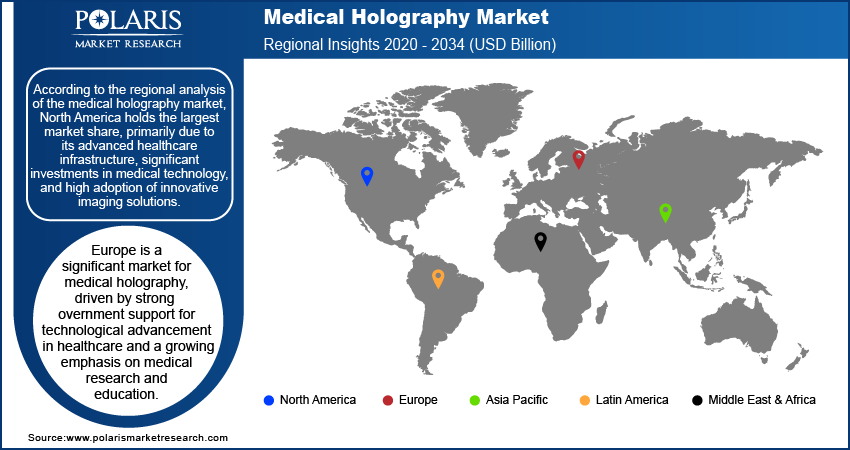
By region, the study provides medical holography market insights into North America, Europe, Asia Pacific, Latin America, and the Middle East & Africa. North America holds the largest market share of 39.0% in 2025, primarily due to its advanced healthcare infrastructure, significant investments in advanced medical technologies, and high adoption of innovative imaging solutions. The region benefits from the presence of leading market players and robust research activities conducted in collaboration with academic institutions and biopharmaceutical companies. Additionally, government initiatives to promote the integration of advanced technologies in healthcare and the growing demand for noninvasive diagnostic techniques contribute to North America's dominance. The US, in particular, leads in the deployment of holographic solutions for medical education and surgical planning, further solidifying the region's position in the global market.
Europe is a significant market capturing 28.0% share in 2025 for medical holography, driven by strong government support for technological advancements in healthcare and a growing emphasis on medical research and education. The region has seen increased adoption of holographic technologies in countries such as Germany, the UK, and France, where advanced healthcare infrastructure and research funding are prominent. The focus on precision medicine and the integration of holography into surgical planning and diagnostics further drive market growth in Europe.
Asia Pacific is witnessing rapid growth with 30.35% CAGR during 2026-2034 in the medical holography market, fueled by rising healthcare investments and the growing adoption of advanced imaging technologies in countries such as China, Japan, and India. The region benefits from a large patient population, increasing demand for minimally invasive diagnostic tools, and expanding medical education infrastructure. Initiatives to enhance healthcare quality and the growing presence of key market players offering affordable solutions contribute to the regional market growth.
Source: Polaris Market Research Analysis
Medical Holography Market – Key Players and Competitive Insights
apoQlar GmbH; Brainlab AG; EchoPixel; GigXR, Inc.; Holoeyes Inc.; Lyncée Tec SA; MedApp S.A.; Medicalholodeck AG; Nanolive; Park Systems Corp.; Phase Holographic Imaging AB; Realize Medical, Inc.; RealView Imaging; Surgical Theater, Inc.; Zspace are a few key players in the medical holography market. These companies are actively developing and offering holographic imaging solutions that cater to medical imaging, surgical planning, and medical education. They are focused on enhancing the quality of medical services with 3D visualizations and interactive holograms, allowing for more precise diagnostics and treatments. These players are continually innovating to address growing healthcare demands, with some focusing on integrating augmented reality (AR) and virtual reality (VR) with their holographic platforms.
In terms of competitive analysis, companies in the medical holography market are exploring partnerships with hospitals, research institutions, and universities to enhance their offerings and gain traction in the medical community. For example, partnerships between technology firms and healthcare providers have been pivotal in ensuring seamless integration of holographic technologies into existing medical workflows. Many companies are also expanding their product portfolios, offering more advanced and user-friendly holographic systems to cater to the needs of a diverse range of healthcare professionals, from surgeons to educators. This competition is leading to innovation in the affordability, portability, and functionality of medical holography products.
Despite the technological advancements, challenges remain regarding the widespread adoption of medical holography, particularly concerning the cost and the need for specialized training. Companies are actively working on reducing the cost of devices and making them more accessible to a larger group of healthcare providers, including those in developing regions. Furthermore, as more companies enter the market, the competition will likely increase, pushing firms to improve the effectiveness and practicality of their solutions while maintaining cost-efficiency. Market players that can provide high-quality holographic imaging systems with easy integration and strong customer support will see continued success in the evolving market.
List of Key Companies in Medical Holography Market
- apoQlar GmbH
- Brainlab AG
- EchoPixel
- GigXR, Inc.
- Holoeyes Inc.
- Lyncée Tec SA
- MedApp S.A.
- Medicalholodeck AG
- Nanolive
- Park Systems Corp.
- Phase Holographic Imaging AB
- Realize Medical, Inc.
- RealView Imaging
- Surgical Theater, Inc.
- Zspace
Medical Holography Industry Developments
- April 2026: Illuminant Surgical announced raising USD 8.4 million in seed funding. The company stated that the funding will help accelerate the development of its flagship Skylight platform. The technology provides surgeons with real-time "X-ray vision" by projecting 3D medical imaging directly onto a patient's skin. (source: prnewswire.com)
- April 2026: Avatar Medical received FDA 510(k) clearance for its software platform, Avatar Medical Vision. According to Avatar Medical, the approval marked the first software cleared for use with glasses-free 3D medical displays. (source: avatarmedical.ai)
Future Outlook
The market for medical holography is projected to witness robust growth in the future due to the rising demand for 3D visualizations in medical applications and the increasing adoption of digital health care solutions. Innovations in fields like artificial intelligence, holographic display, AR integration, and medical imaging have been instrumental in improving the efficiency and precision of diagnosis and surgeries, as well as training medical professionals. The use of minimally invasive techniques and personalized medicine will further create growth opportunities for holography applications in the clinical setting. As more healthcare organizations start to adopt digital technology, holography is set to be extensively used in all diagnostic, surgical, medical education, and biomedical research applications.
Medical Holography Market Segmentation
By Product Type Outlook
- Holographic Displays
- Holography Microscopes
- Holographic Prints
- Holographic Software
- Others
By Application Outlook
- Imaging in Medical Indications
- Medical Education
- Others
By End User Outlook
- Hospitals & Clinics
- Biopharmaceutical Companies
- Others
By Regional Outlook
- North America
- US
- Canada
- Europe
- Germany
- France
- UK
- Italy
- Spain
- Netherlands
- Russia
- Rest of Europe
- Asia Pacific
- China
- Japan
- India
- Malaysia
- South Korea
- Indonesia
- Australia
- Vietnam
- Rest of Asia Pacific
- Middle East & Africa
- Saudi Arabia
- UAE
- Israel
- South Africa
- Rest of Middle East & Africa
- Latin America
- Mexico
- Brazil
- Argentina
- Rest of Latin America
Medical Holography Market Report Scope
| Report Attributes | Details |
| Market Size Value in 2025 | USD 2.83 billion |
| Market Size Value in 2026 | USD 3.58 billion |
| Revenue Forecast by 2034 | USD 23.81 billion |
| CAGR | 26.7% from 2026 to 2034 |
| Base Year | 2025 |
| Historical Data | 2021–2024 |
| Forecast Period | 2026–2034 |
| Quantitative Units | Revenue in USD billion and CAGR from 2026 to 2034 |
| Report Coverage | Revenue Forecast, Market Competitive Landscape, Growth Factors, and Trends |
| Segments Covered |
|
| Regional Scope |
|
| Competitive Landscape |
|
| Report Format |
|
| Customization | Report customization as per your requirements with respect to countries, regions, and segmentation. |
Source: Polaris Market Research Analysis
How is the report valuable for an organization?
Workflow/Innovation Strategy
The medical holography market has been broadly segmented on the basis of product type, application, and end user. Moreover, the study provides the reader with a detailed understanding of the different segments at the global and regional levels.
Growth/Marketing Strategy
The medical holography market growth and marketing strategy focuses on expanding product offerings through innovation and partnerships. Companies are investing in research and development to improve the functionality and affordability of holographic imaging systems, making them more accessible to a wider range of healthcare providers. Strategic alliances with hospitals, universities, and research institutions are key to gaining market visibility and credibility. Additionally, players are emphasizing the integration of holography with emerging technologies such as AR and VR to enhance user experience and attract diverse clientele. Targeted marketing efforts are also focusing on educating medical professionals on the benefits of holographic solutions for precise diagnostics and surgical planning.
Medical Holography Market FAQ's
The market size was valued at USD 2.83 billion in 2025 and is projected to grow to USD 23.81 billion by 2034.
The global market is projected to register a CAGR of 26.7% during the forecast period.
North America led with a 39.0% market share in 2025.
A few key players in the medical holography market are apoQlar GmbH; Brainlab AG; EchoPixel; GigXR, Inc.; Holoeyes Inc.; Lyncée Tec SA; MedApp S.A.; Medicalholodeck AG; Nanolive; Park Systems Corp.; Phase Holographic Imaging AB; Realize Medical, Inc.; RealView Imaging; Surgical Theater, Inc.; Zspace
The holographic displays segment led with a 36.0% share in 2025.
Imaging in medical indications led with the largest market share of 62.0% in 2025.
Medical holography refers to the use of holographic imaging techniques in the healthcare field to create three-dimensional visualizations of medical data, such as CT scans, MRI scans, or other diagnostic images. This technology enables healthcare professionals to view and interact with detailed, accurate representations of anatomical structures in 3D, providing better insight into complex medical conditions. It is used in various applications, including surgical planning, medical education, diagnostics, and research, offering a noninvasive method for enhanced visualization and decision-making. Medical holography improves the precision and effectiveness of treatments, reduces the risks of surgical procedures, and helps in a better understanding of the human body.
A few key medical holography market trends are described below: Integration with AR and VR: Combining holography with AR and VR technologies for enhanced surgical planning, medical training, and patient education. Increased Adoption in Medical Education: Growing use of holographic imaging for interactive, 3D-based learning experiences in medical schools and training programs. Focus on Noninvasive Diagnostics: Rising demand for noninvasive diagnostic tools that provide accurate 3D visualizations of internal anatomy for improved decision-making. Development of Portable Devices: Advances in portable and cost-effective holographic solutions to increase accessibility in remote and resource-limited healthcare settings.
A new company entering the medical holography market must focus on developing cost-effective and portable holographic solutions, making advanced imaging accessible to healthcare providers in underserved and remote areas. Emphasizing the integration of holography with AR and VR technologies for enhanced user interactivity and precision in surgical planning and education would also be a key differentiator. Additionally, focusing on seamless software development for easy integration with existing medical systems and offering flexible, customizable products could help attract a diverse range of healthcare providers. Collaborations with hospitals, research institutions, and universities for product validation and adoption would further position the company as a trusted player in the market.
Companies manufacturing, distributing, or purchasing medical holography and related products and other consulting firms must buy the report.
Download Sample Report of Medical Holography Market Opportunity, Trends, Growth Analysis Report, 2026-2034
Please fill out the form to request a customized copy of the research report.


