
Microencapsulated Pesticides Market Growth & Industry Trend 2026-2034
REPORT DETAILS
Microencapsulated Pesticide Market Summary
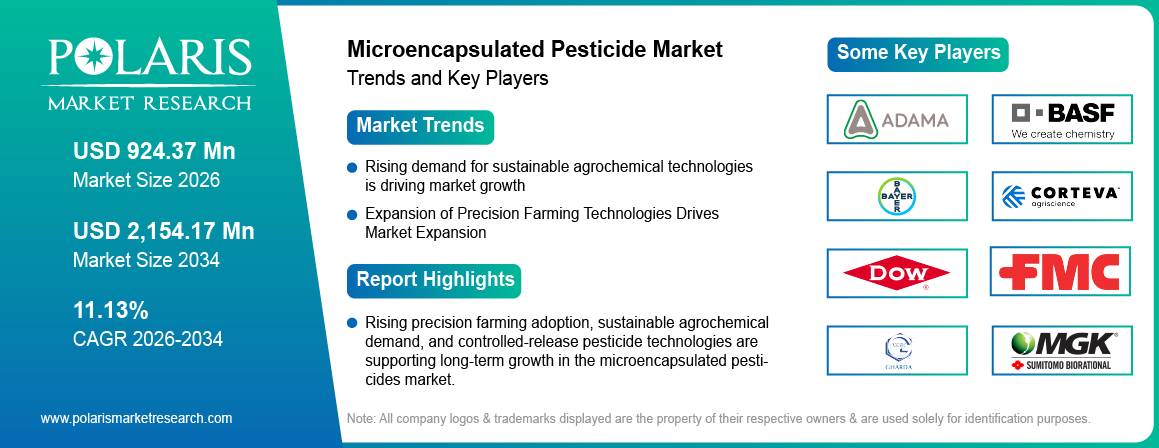
The global microencapsulated pesticide market is estimated around USD 833.41 Million in 2025,with consistent growth anticipated during 2026–2034. Rising demand for sustainable crop protection technologies, precision agriculture practices, and controlled-release pesticide formulations is supporting market expansion globally. The market is projected to grow at a CAGR of 11.13% during the forecast period.
Market Statistics
Key Takeaways
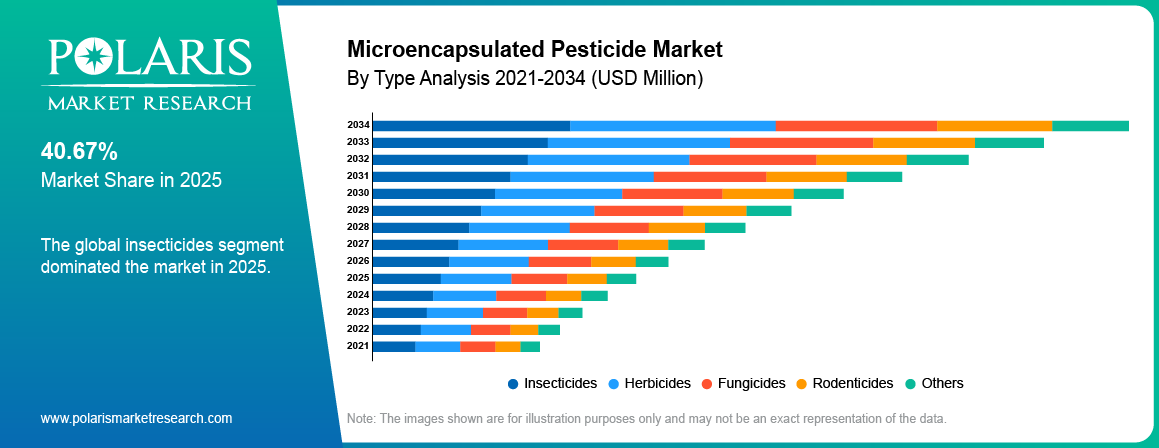
- Insecticides segment dominated the market in 2025 due to increasing deployment across cereals, grains, and horticulture crops.
- Polymer-based encapsulation segment dominated the market in 2025 driven by superior controlled-release efficiency and formulation stability.
- Seed treatment segment is projected to grow at the fastest pace driven by increasing focus on early-stage crop protection and precision agriculture practices.
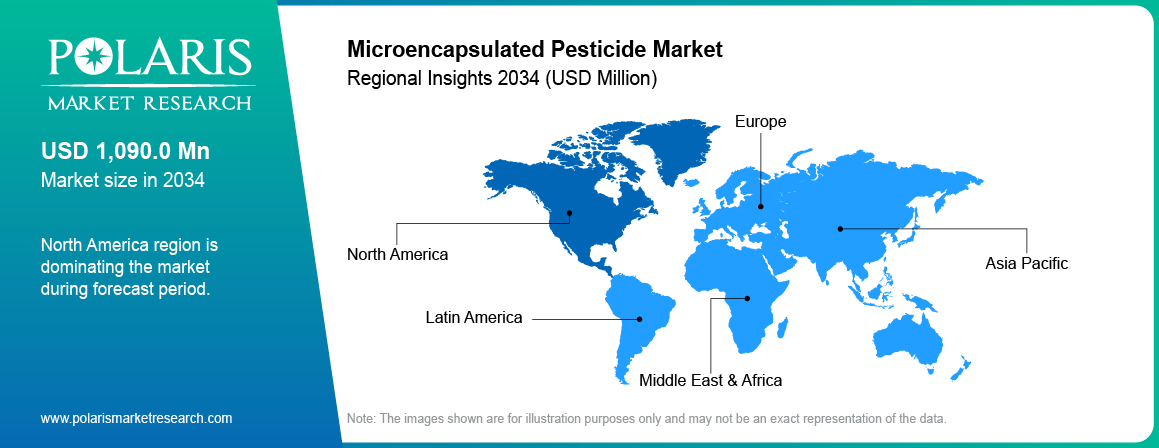
- North America dominated the market in 2025 supported by advanced farming infrastructure and strong regulatory compliance standards.
- Major companies operating in the market include BASF SE, Bayer AG, Corteva Agriscience, Inc., FMC Corporation, and Syngenta Group.
Industry Dynamics
- Rising demand for sustainable agrochemical formulations is driving market growth.
- Expansion of precision farming technologies is supporting microencapsulated pesticide adoption.
- High production and formulation costs are restraining market expansion.
- Rising demand for biodegradable formulations is creating opportunities for bio-compatible encapsulation technologies.
What is the Microencapsulated Pesticide Market?
Microencapsulated pesticides are advanced crop protection formulations in which active ingredients are enclosed within microscopic polymeric or lipid-based shells. These formulations provide controlled-release properties that improve pesticide stability, reduce volatilization losses, and increase field efficiency across agricultural applications. Microencapsulated pesticides is widely used in different types of pesticides, including insecticides, herbicides, fungicides, and seed treatments.
The microencapsulated pesticides market value chain consists of raw material providers, polymer providers, agrochemical makers, pesticide producers, encapsulating techniques providers, distributors, agricultural cooperatives, and farmers. The formulation of active substances with encapsulants and release control techniques leads to effective delivery of pesticides.
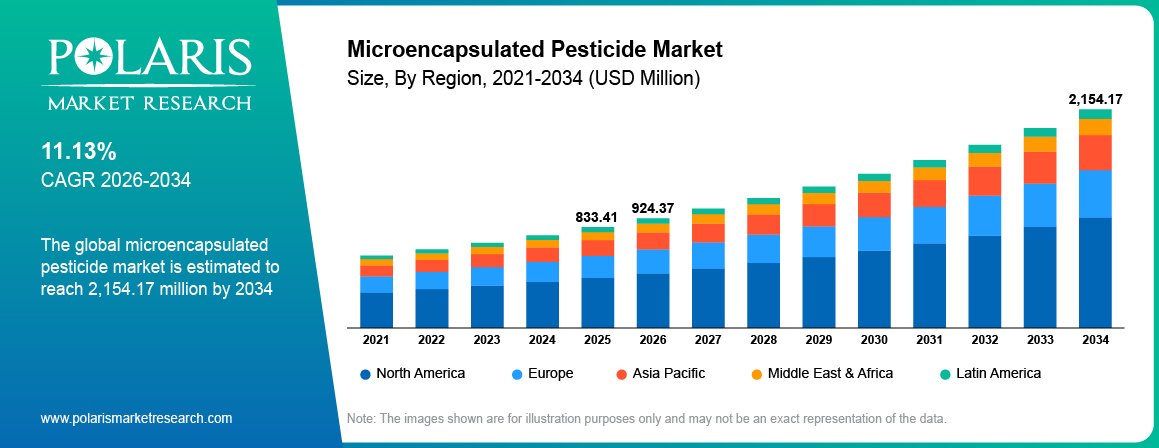
Growing demand for higher agricultural productivity in an environmentally friendly manner has resulted in the growth of the market. Adoption of precision farming, drones for pesticide application, use of AI in agriculture, and sustainable farming practices are leading to the implementation of controlled release technology for crop protection.
Drivers & Opportunities
Rising Demand for Sustainable farming Technologies Fuels Market Growth: Sustainable crop protection is becoming popular among governmental agencies and agricultural institutions owing to the need for reduction in contamination of the environment with harmful pesticides. In November 2025, Rovensa Next launched two biosolutions including Orocide Plus and Tulga Spinex in Europe, adding to their growing list of crop protection solutions for integrated management of pests and diseases.Formulations of controlled release pesticides are becoming increasingly popular with farmers due to the benefits they provide on the farm.
Expansion of Precision Farming Technologies Drives Market Expansion: There is an increasing trend in the adoption of precision agricultural technologies when designing innovative pesticide application technologies. For example, the Precision Agriculture PTx solution suite by AGCO Corporation was released in April 2024. The solution entails the adoption of technology from Precision Planting and PTx Trimble with the aim of automating and digitalizing farming operations.The increase in the adoption of GPS technology, drone technology, and IoT sensors for efficient pesticide distribution.
Restraints & Challenges
High Production Costs and Complex Formulation Processes Restrain Market Growth: The microencapsulation technologies have a more complicated production process and higher costs for development and materials compared to traditional pesticides production systems. The complexity and increasing costs of raw materials are constantly raising the costs for commercialization in the industry. These aspects hinder adoption among smaller agricultural producers in cost-sensitive regions.
Opportunity
Biological Encapsulation Technologies Create Market Opportunity: Growing demand for biological agricultural chemical products is generating huge potential for biodegradable delivery systems. Agricultural chemical companies are increasingly concentrating on natural starch carriers, bio-polymers, and environmentally friendly shells to enhance environmental performance. An increased interest in eco-friendly chemistry and agricultural chemicals is expected to be key factors driving future growth.
Segmental Insights
This market research study presents a detailed assessment of the global microencapsulated pesticides market segmented on the basis of type, technology, crop type, and application to find out the most profitable and fastest growing markets.
By Type
-
Insecticides
Insecticides segment had the largest market share in 2025 owing to the rising application in cereals, grains, fruits, and vegetables. The microencapsulation of insecticides leads to better adherence to pesticides, minimal volatilization, and better long-term pest control performance.
-
Fungicides
Fungicides segment is projected to grow at the fastest CAGR during the forecast period owing to rising disease management requirements across horticulture and high-value crop cultivation. Encapsulation technologies improve formulation stability and moisture resistance across humid farming conditions.
By Technology
-
Polymer-Based Encapsulation
Polymer-based encapsulation dominated the market in 2025 supported by superior release-control characteristics and strong protection against environmental degradation. Synthetic and semi-synthetic polymers remain widely used across controlled-release agrochemical systems due to customizable release performance and formulation flexibility.
-
Lipid-Based Encapsulation
Lipid-based encapsulation is projected to grow at the fastest CAGR during the forecast period owing to increasing adoption of biodegradable and bio-compatible crop protection technologies. These systems provide strong compatibility with biological pesticides and sustainable agricultural applications.
By Crop Type
-
Cereals & Grains
Cereals & grains segment dominated the market in 2025 due to large-scale global cultivation volumes and increasing food security concerns. Farmers are increasingly deploying controlled-release pesticide systems across wheat, rice, maize, and barley production to improve crop protection efficiency.
-
Fruits & Vegetables
Fruits & vegetables segment is projected to grow at the fastest CAGR during the forecast period owing to rising demand for residue-compliant and export-oriented crop protection solutions. High-value horticulture farming is increasingly adopting advanced pesticide formulations to improve disease and pest management.
By Application
-
Foliar Spray
Foliar spray segment dominated the market in 2025 due to extensive deployment across large-scale agricultural operations and row crop farming. Controlled-release foliar formulations improve pesticide retention, spraying efficiency, and crop surface adherence across field applications.
-
Seed Treatment
Seed treatment segment is projected to grow at the fastest CAGR during the forecast period owing to increasing focus on early-stage crop protection and precision farming practices. Microencapsulated seed treatment technologies improve germination protection and reduce pesticide application frequency.
Regional Analysis
North America Microencapsulated Pesticides Market Overview
North America microencapsulated pesticides market dominated the global market in 2025 due to advanced agricultural infrastructure, precision farming adoption, and strong environmental compliance standards across the US and Canada. In January 2024, John Deere announced its 2026 Startup Collaborator Program focused on AI-driven robotics, telematics, advanced sensing, and digital crop intelligence technologies.Agrochemical companies are focusing on developing sustainable methods of crop protection and controlled release of pesticides to improve agricultural production.
Europe Microencapsulated Pesticides Market Assessment
Europe microencapsulated pesticides market is witnessing steady growth owing to stringent environmental regulations and increasing restrictions on conventional pesticide formulations across Germany, France, Italy, and the Netherlands. According to the European Commission, Europe continues strengthening low-input farming initiatives focused on reducing chemical dependency and supporting sustainable pesticide technologies.Sustainability initiatives and low-residue agriculture programs are accelerating demand for environmentally responsible agrochemical formulations across the region.
Asia Pacific Microencapsulated Pesticides Market Insights
Asia Pacific microencapsulated pesticides market is projected to grow at the fastest CAGR during the forecast period driven by rapid agricultural modernization, increasing food demand, and rising precision farming adoption across China, India, Japan, and Southeast Asia. In February 2026, World Food Programme and Japan launched a USD 4.5 million initiative to strengthen climate-resilient agricultural value chains and smart farming technologies in the Kyrgyz Republic.Government support for climate-smart agriculture, drip irrigation systems, and sustainable crop protection technologies is supporting strong regional market growth.
Competitive Landscape
Key Players & Competitive Strategies
Microencapsulated pesticides industry has a moderate concentration with regard to the involvement of multinational agrochemical companies and crop protection players from various geographical regions. The competition among players is based on efficacy in formulations, controlled release, sustainable practices, innovation ability, and effective distribution networks. Microencapsulation technology companies have started emphasizing more on biodegradability, use in precision farming, formation of strategic alliances, and development of sustainable agrochemicals.
Some of the key companies in microencapsulated pesticides are ADAMA Agricultural Solutions Ltd., BASF SE, Bayer AG, Corteva Agriscience, Inc., Dow AgroSciences LLC, FMC Corporation, Gharda Chemicals Limited, Insecticides (India) Limited, McLaughlin Gormley King Company, Nihon Nohyaku Co., Ltd., PI Industries Ltd., Rallis India Limited, Sumitomo Chemical Co., Ltd., Syngenta Group, and UPL Limited.
Premium Insights
The market for microencapsulated pesticides is witnessing growth owing to rising requirements for controlled-release formulations that offer enhanced crop protection while minimizing ecological footprints. Growing interest among companies to adopt advanced encapsulation processes in order to boost stability and minimize the loss of chemicals is noticeable.
-
Patent Innovation Race
The number of patents filed for biodegradable polymer coatings, nanotechnology-based encapsulation techniques, and controlled release pesticide technology is growing steadily. Manufacturers are concentrating on developing sustainable formulas that are used with the current generation of precise agriculture techniques.
-
Future Technology Outlook
AI-assisted spraying systems and climate change-driven pesticides are anticipated to emerge as promising innovations in future agricultural pest management practices. Precision agriculture tools have significantly enhanced spray performance.
-
Investment Opportunities
Some of the emerging investment destinations include Asia Pacific and Latin America due to increasing agricultural mechanization, food security problems, and increasing use of advanced crop protection technologies.
Key Players
- ADAMA Agricultural Solutions Ltd.
- BASF SE
- Bayer AG
- Corteva Agriscience, Inc.
- Dow AgroSciences LLC
- FMC Corporation
- Gharda Chemicals Limited
- Insecticides (India) Limited
- McLaughlin Gormley King Company
- Nihon Nohyaku Co., Ltd.
- PI Industries Ltd.
- Rallis India Limited
- Sumitomo Chemical Co., Ltd.
- Syngenta Group
- UPL Limited
Industry Developments
- January 2024: PilarBio launched its Pilarcore microencapsulated pesticide formulation brand to strengthen innovation in controlled-release crop protection technologies. [source: www.pilarquim.com]
- December 2023: FMC Corporation launched Mustang 20 EW, a microencapsulated pyrethroid insecticide formulation developed for soybean, cotton, sunflower, and corn crop protection applications. [source: ag.fmc.com]
Microencapsulated Pesticide Market Segmentation
By Type Outlook (Revenue, USD Million, 2021–2034)
- Insecticides
- Herbicides
- Fungicides
- Rodenticides
- Others
By Technology Outlook (Revenue, USD Million, 2021–2034)
- Polymer-Based Encapsulation
- Lipid-Based Encapsulation
- Nanoencapsulation
- Biological Encapsulation
- Others
By Crop Type Outlook (Revenue, USD Million, 2021–2034)
- Cereals & Grains
- Fruits & Vegetables
- Oilseeds & Pulses
- Plantation Crops
- Others
By Application Outlook (Revenue, USD Million, 2021–2034)
- Foliar Spray
- Seed Treatment
- Soil Treatment
- Post-Harvest Treatment
By Regional Outlook (Revenue, USD Million, 2021-2034)
- North America
- US
- Canada
- Europe
- Germany
- France
- UK
- Italy
- Spain
- Netherlands
- Russia
- Rest of Europe
- Asia Pacific
- China
- Japan
- India
- Malaysia
- South Korea
- Indonesia
- Australia
- Vietnam
- Rest of Asia Pacific
- Middle East & Africa
- Saudi Arabia
- UAE
- Israel
- South Africa
- Rest of Middle East & Africa
- Latin America
- Mexico
- Brazil
- Argentina
- Rest of Latin America
Microencapsulated Pesticide Market Report Scope
| Report Attributes | Details |
| Market Size in 2025 | USD 833.41 Million |
| Market Size in 2026 | USD 924.37 Million |
| Revenue Forecast by 2034 | USD 2,154.17 Million |
| CAGR | 11.13% from 2026 to 2034 |
| Base Year | 2025 |
| Historical Data | 2021–2024 |
| Forecast Period | 2026–2034 |
| Quantitative Units | Revenue in USD Million and CAGR from 2026 to 2034 |
| Report Coverage | Revenue Forecast, Competitive Landscape, Growth Factors, and Industry Trends |
| Segments Covered |
|
| Regional Scope |
|
| Competitive Landscape |
|
| Report Format |
|
| Customization | Report customization as per your requirements with respect to countries, regions, and segmentation. |
Source: Polaris Market Research Analysis
Microencapsulated Pesticides Market FAQ's
The global market size was valued at USD 833.41 million in 2025 and is projected to reach USD 2,154.17 million by 2034 at a CAGR of 11.13%.
North America dominated the market in 2025 supported by advanced farming infrastructure and increasing adoption of precision agriculture technologies.
Major companies operating in the market include BASF SE, Bayer AG, Corteva Agriscience, Inc., FMC Corporation, and Syngenta Group.
Rising demand for sustainable agriculture technologies, precision farming expansion, and increasing regulatory pressure on conventional pesticides are major growth drivers.
Insecticides segment dominated the market in 2025 due to increasing deployment across cereals, grains, and horticulture farming applications.
The market outlook remains positive supported by AI-integrated farming systems, biodegradable encapsulation technologies, and sustainable crop protection innovations.
Microencapsulated pesticides are crop protection formulations in which active ingredients are enclosed within microscopic shells for controlled release and improved agricultural efficiency.
Download Sample Report of Microencapsulated Pesticides Market
Please fill out the form to request a customized copy of the research report.


