
Network Operations Center As A Service Market Demand & Industry Analysis Report, 2026-2034
REPORT DETAILS
Network Operations Center As A Service Market Summary
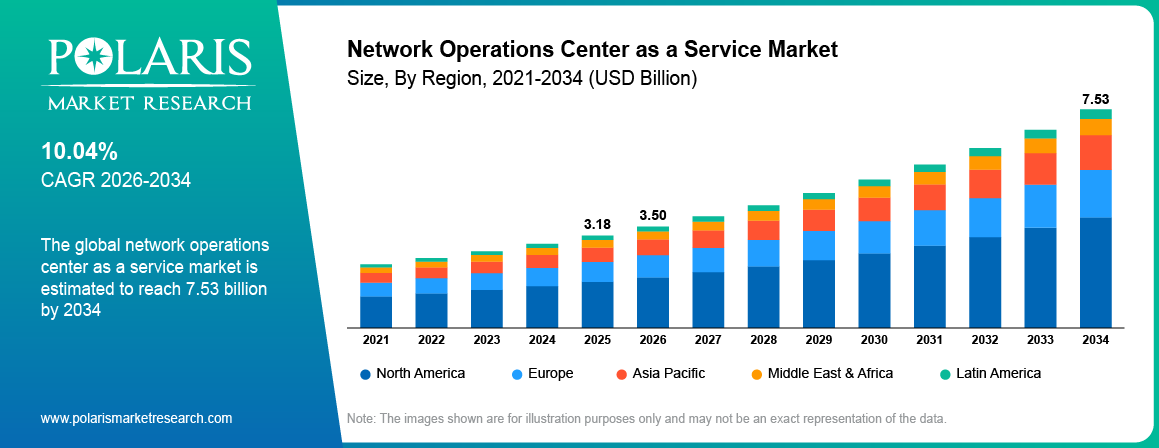
The global network operations center as a service market is estimated around USD 3.18 Billion in 2025, with consistent growth anticipated during 2026–2034. Expansion is driven by increasing complexity of enterprise IT infrastructure, rising adoption of cloud and hybrid environments, and growing demand for real-time network monitoring. The market is projected to grow at a CAGR of 10.04% during the forecast period.
Market Statistics
Key Takeaways
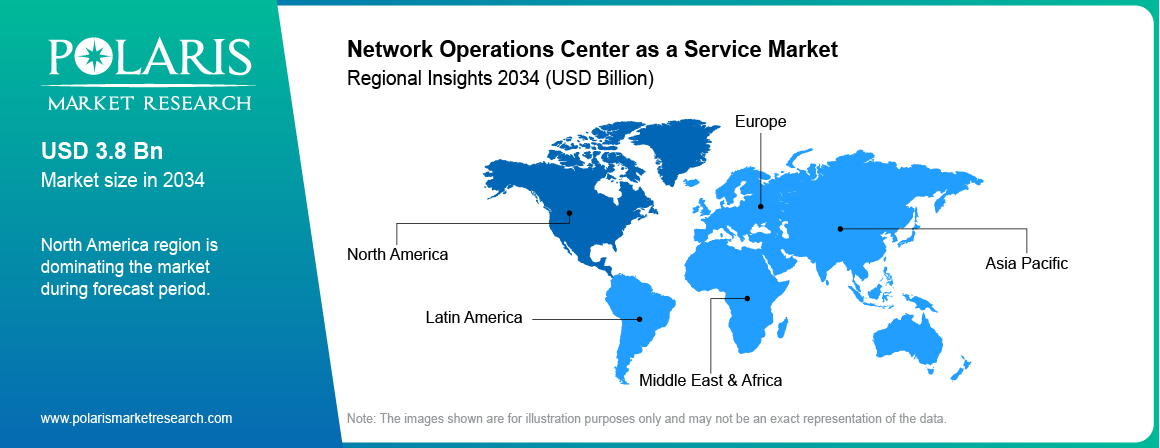
- North America dominated the market share, accounting for approximately 40.25% due to high cloud adoption and strong presence of managed service providers.
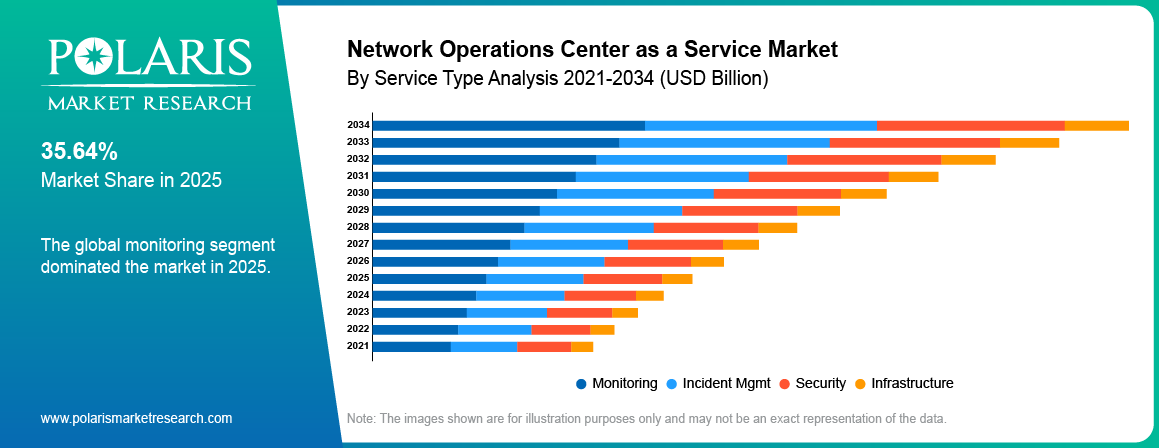
- Monitoring services gained strong traction, holding approximately 34.60% market share due to their core role in real-time network visibility and performance tracking.
- NOCaaS remains widely used, contributing approximately 37.15% market share due to its ability to provide continuous monitoring and centralized network management.
- Enterprises dominate demand, accounting for approximately 42.80% market share supported by complex, large-scale IT infrastructure and high uptime requirements.
- Cloud-based deployment remains the largest segment, holding approximately 45.35% market share due to scalability and cost efficiency.
- Hybrid deployment is witnessing rapid growth and is projected to register a CAGR of approximately 13.95% driven by the need to manage both cloud and on-premise systems.
Industry Dynamics
- Increasing complexity of enterprise IT environments is strengthening demand for centralized network monitoring solutions.
- Shift towards cloud-native infrastructure and hybrid IT infrastructure is driving an increase in scalable NOCaaS platforms.
- The complex process of integration and issues related to data sovereignty are hindering adoption.
- Adoption of AI, machine learning, and AIOps is opening new opportunities in predictive monitoring and automation.
What is the Network Operations Center as a Service Market?
The market for NOC as a service is experiencing growth owing to increasing need for real-time network monitoring services and outsourcing IT operations. NOCaaS is an acronym for Network Operations Center as a Service which denotes a solution that involves managing network performance, availability, notifications, and incident responses in real time via cloud services.
NOCaaS is different from SOCaaS and the general managed services in terms of scope and responsibilities. Unlike SOCaaS which is mainly concerned with threats and vulnerabilities, NOCaaS deals with ensuring optimal network health and performance. Furthermore, compared to general managed services, NOCaaS provides niche and continuous monitoring services with shorter response cycles. There exist various NOC outsourcing services, including fault monitoring and performance tuning.
Source: Polaris Market Research Analysis
To Understand More About this Research:Download Sample Report
The market estimates related to the NOC as a service market are different, owing to disparities in the definition of services offered, managed IT operations, and geographical regions covered. While some research studies consider broader segments under the network management services market, there are also some that look only at the outsourcing of NOC services.
Drivers & Opportunities
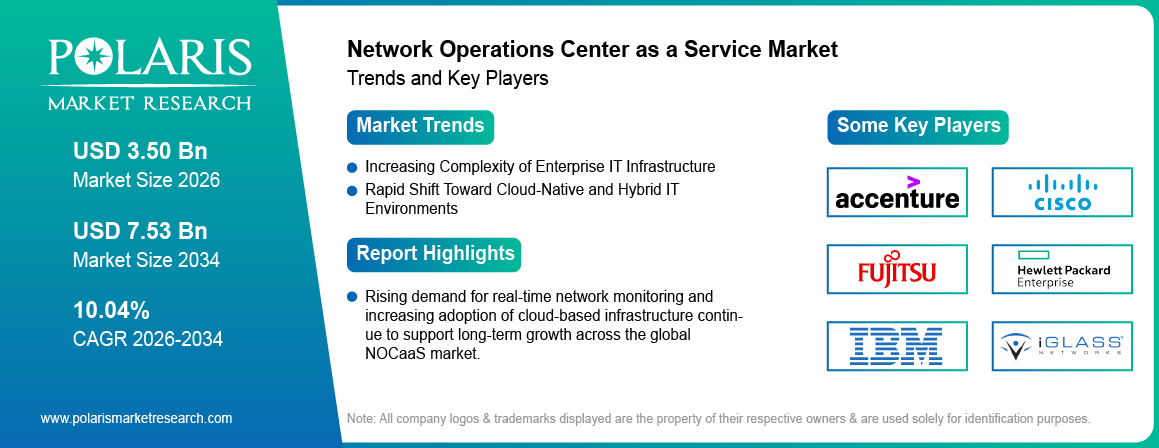
Increasing Complexity of Enterprise IT Infrastructure: Enterprises are operating in a multilayered manner within multi-cloud and hybrid IT settings, thus adding to the network complexities. Managing performance, security, and availability across multiple platforms is increasing reliance on NOC as a Service (NOCaaS) for centralized, real-time visibility. The costs associated with downtime have also risen significantly. As per Siemens’ 2024 True Cost of Downtime Report, unplanned downtime contributes to 11% of the revenues earned by large enterprises annually, totalling to USD 1.4 trillion. The growing financial burden has forced companies to look at NOCaaS options to achieve continuous network monitoring and better network availability.
Rapid Transition Toward Cloud-Native and Hybrid IT Environments: Transitioning to cloud-native applications has contributed to the rising need for network monitoring solutions. Traditional in-house NOCs struggle to manage dynamic workloads, microservices, and distributed cloud resources. The NOCaaS model offers better monitoring, automation, and visibility across environments. This trend is driving companies to adopt network operations outsourcing in order to sustain their performance on the cloud and on premises.
Restraints & Challenges
Integration Complexity, Vendor Lock-in, and Data Sovereignty Concerns: The integration of NOCaaS presents challenges that pertain to compatibility with other IT infrastructures and vendor lock-in issues that make changing from one service provider to another quite challenging. Data sovereignty and compliance-related issues are yet another complexity that complicates NOCaaS adoption.
Opportunity
Adoption of AI, Machine Learning platform, and AIOps: The increasing network size and data volumes, are compelling organizations to adopt NOCaaS powered by AI and machine learning. Using AI, organizations detect potential problems, identify their causes, and solve them quickly. It also reduces the amount of downtime experienced by enterprises. Furthermore, integration of AIOps with edge computing and IoT monitoring is increasing its adoption in various settings.
Source: Polaris Market Research Analysis
Segmental Insights
The report provides an in-depth analysis of the network operations center as a service market by service type, deployment, organization size, and industry vertical to help readers identify the fastest expanding and most attractive demand segments.
By Service Type
-
Monitoring
Monitoring segment held leading market share in NOCaaS service segments as it represents the fundamental process within network operations outsourcing services for telecom and enterprise organizations. Constant network monitoring allows for real-time performance tracking, availability, and anomaly detection on dispersed IT infrastructure.
-
Security Management
Security management is projected to grow at fast pace, due to the increasing cyber security and merger of NOC and SOC processes. In addition to the standard services, companies started incorporating security monitoring and threat prevention capabilities into NOCaaS solutions. According to the Global Cybersecurity Outlook 2026 survey, 87% of participants stated that AI-driven threats were one of the fasted-growing cyber threats in 2025.
By Deployment
-
Cloud-based
Cloud NOC services held the largest market share owing to scalability, centralized management, and economies of scale. Cloud-based NOC services make it easy for businesses to manage their network operations from different locations via a single dashboard, thus saving on costs and providing easy deployment.
-
Hybrid
Hybrid deployment is expected to witness the highest growth rate as businesses reconcile existing infrastructures with cloud infrastructure. This makes it possible for organizations to monitor their resources within the business premises as well as cloud resources.
By Organization Size
-
Enterprises
Enterprise was leading the market in 2025, due to their complex nature and large network structures that required constant monitoring. The demand for Enterprise NOC is attributed to the need to monitor multi-cloud environments, international operations, and large amounts of data that translate into revenue and customer experience.
-
SME
Small and Medium Enterprises projected to be the fastest-growing category owing to the ease of access to NOC-as-a-service offered at affordable rates and with easy installation and payment terms. The adoption of SME NOC has been fueled by the ease of use and cost-effective pricing.
By Industry Vertical
-
Telecom
Telecom led the market share as the network operations outsourcing telecom plays a significant role in the management of high-capacity infrastructure. Telecom providers use NOCaaS to ensure real-time monitoring, fault management, and performance tuning in 4G/5G networks.
-
Healthcare
Healthcare is projected to grow at a rapid pace during the forecast period, propelled by the greater use of healthcare information systems and connected healthcare devices. Trends in NOCaaS indicate growing demand from hospitals for infrastructure monitoring purposes.
Source: Polaris Market Research Analysis
Regional Analysis
North America Network Operations Center as a Service Market Assessment
North America witnessed leading share in NOCaaS market owing to high cloud adoption rates in addition to the existence of many managed service providers in the US. Companies are moving towards the outsourcing of their network operations in order to cope with complex hybrid and multi-cloud networks. US network operations center market is supported by the availability of robust IT infrastructure and increasing interest in artificial intelligence-based solutions for monitoring purposes. In April 2026, NWN rolled out its AI-powered cybersecurity offering that provides services for detection & response and ransomware mitigation. This reflects a shift toward integrated NOC and security operations, strengthening regional demand.
Europe Network Operations Center as a Service Market Overview
Europe was the second largest market in NOCaaS due to factors including GDPR compliance and digital transformation efforts. Businesses are increasingly implementing network monitoring solutions as a way of ensuring that data remains secure, compliant, and uninterrupted. European network monitoring services are growing as a result of businesses that need to manage data from multiple countries and cloud computing. Nations like Germany and France are building secure digital infrastructure, thus increasing interest in outsourcing NOC services.
Asia Pacific Network Operations Center as a Service Market Insight
Asia Pacific is projected to grow rapidly during the forecast period, owing to digitalization and cloud adoption in countries like India, China, and Japan. Corporations are increasingly looking out for outsourced network operations in order to increase scalability and decrease operational complexity. Existing IT services industry contributes to the development of the NOC outsourcing market in India. According to the International Trade Administration, in 2024, Infosys generated revenues of around USD 19 billion, Tata Consultancy Services earned about USD 29 billion, and Wipro made close to USD 11 billion.This expanding digital ecosystem continues to drive strong demand for NOCaaS solutions.
Middle East & Latin America Network Operations Center as a Service Market Assessment
MEA NOC market and network monitoring market in Latin America are some of the rapidly growing markets fueled by factors like smart cities, 5G technology, and increased investment in enterprise IT by countries including the UAE and Brazil. With increasing network complexities and real-time monitoring needs, there is an inclination towards the use of NOCaaS solutions.
Source: Polaris Market Research Analysis
Competitive Landscape & Pricing Analysis
Key Players & Strategic Developments
The competitive landscape in the NOCaaS industry features considerable participation from foreign IT service firms, telecoms, and specialized managed service firms providing remote management and monitoring services. The competition in the NOCaaS industry is characterized by intelligent analysis of networks and automation tools along with the capacity to monitor them around-the-clock with a focus on improving their performance and availability. Global NOCaaS companies such as Accenture PLC, IBM Corporation, and Cisco Systems, Inc. are focused on advanced and enterprise NOC solutions while NOCaaS for telecom includes firms like Nokia Corporation and Tata Communications Limited.
Some of the key players included in the NOCaaS market are Accenture PLC, Cisco Systems, Inc., Fujitsu Limited, Hewlett Packard Enterprise Company, IBM Corporation, iGLASS Networks, INOC, Inc., Infosys Limited, Infrassist Technologies, Kaseya Company Inc., Nokia Corporation, Park Place Technologies LLC, Sify Technologies Limited, Tata Communications Limited, and Wipro Limited.
Operational Model, Pricing, Use Cases & ROI
How NOCaaS Works (Workflow: Monitor → Detect → Resolve)
The NOCaaS service operates according to a cycle of monitoring, detecting, and resolving issues. Using state-of-the-art software, the system monitors the networks on its own. It is able to collect real-time data from the network infrastructure, application, and endpoints.
The abnormal behavior is recognized by the alerts and analysis, and subsequently handled using runbooks to resolve any issues. With integration into IT service management tools, the process is escalated and tickets created for root cause analysis.
-
Pricing Models (Subscription, Per Device, Tiered)
NOCaaS is priced according to a subscription basis, whereby costs are predictable and scalable, either monthly or per device, depending on the extent of the infrastructure.
In most cases, the cost of outsourcing the NOC are always lower than investing in the required infrastructural elements as it does not involve any expenditure on software, manpower, and hardware.
-
ROI & KPIs (MTTR, Uptime, Efficiency Gains)
The ROI of using NOCaaS is measured by analyzing the impact of improvement in KPIs in terms of MTTR, uptime, and efficiency of managing the incident.
NOC service outsourcing firm facilitates round-the-clock monitoring and incident resolution while reducing operational overhead. The benefits of using NOCaaS over the internal NOC include improved scalability, decreased expenses, and access to specialist expertise which enhances efficiency.
-
Use Cases (Multi-cloud, SD-WAN, IoT, Edge Networks)
NOCaaS has become a popular choice for applications in multi-cloud environments, software-defined wide-area networking (SD-WAN), Internet of Things (IoT), and edge networking technologies. Modern-day network infrastructures require centralized visibility and monitoring capabilities.
The network service provider offers a unified approach for monitoring, optimizing, and managing events in a complex network environment.
Premium Insights & Analyst Takeaways
Top 5 Strategic Insights
- The outsourcing trend is becoming more popular, with businesses emphasizing efficiency and scalability over developing a NOC.
- Automation and AI help reduce human intervention and shorten incident resolution times.
- Multi-cloud and edge computing have spurred the demand for real-time network visibility.
- Service-level agreement (SLA)-driven models are gaining importance while considering vendors and signing contracts.
- Cybersecurity operations integration is ensuring that NOCaaS is a component of managed services.
Future Outlook (Next 5–10 Years)
Future trends of NOCaaS show that its growth is expected to be consistent owing to increasing network complexity, cloud deployment, and need for ongoing monitoring. Trends within the NOCaaS industry suggests more automation, predictive analytics, and AIOps in NOCaaS.
By the next decade, NOCaaS are projected to transform into a network management platform capable of autonomous management of networks.
Key Players
- Accenture PLC
- Cisco Systems, Inc.
- Fujitsu Limited
- Hewlett Packard Enterprise Company
- IBM Corporation
- iGLASS Networks
- INOC, Inc.
- Infosys Limited
- Infrassist Technologies
- Kaseya Company Inc.
- Nokia Corporation
- Park Place Technologies LLC
- Sify Technologies Limited
- Tata Communications Limited
- Wipro Limited
Industry Developments
- March 2026: project44 introduced its Network Operations Agent into its Decision Intelligence Platform, enabling automated monitoring, verification, and validation of data in the supply chain network. The intelligent agent performs continuous analysis of shipment data, identifies anomalies, and enhances the accuracy of data. [Source: www.project44.com]
Network Operations Center as a Service Market Segmentation
By Service Type Outlook (Revenue, USD Billion, 2021-2034)
- Monitoring
- Incident Mgmt
- Security
- Infrastructure
By Deployment Outlook (Revenue, USD Billion, 2021-2034)
- Cloud
- On-Premise
- Hybrid
By Organization Size Outlook (Revenue, USD Billion, 2021-2034)
- SMEs
- Enterprises
By Industry Vertical Outlook (Revenue, USD Billion, 2021-2034)
- Telecom
- BFSI
- Healthcare
- IT
- Government
By Regional Outlook (Revenue, USD Billion, 2021-2034)
- North America
- US
- Canada
- Europe
- Germany
- France
- UK
- Italy
- Spain
- Netherlands
- Russia
- Rest of Europe
- Asia Pacific
- China
- Japan
- India
- Malaysia
- South Korea
- Indonesia
- Australia
- Vietnam
- Rest of Asia Pacific
- Middle East & Africa
- Saudi Arabia
- UAE
- Israel
- South Africa
- Rest of Middle East & Africa
- Latin America
- Mexico
- Brazil
- Argentina
- Rest of Latin America
Network Operations Center as a Service Market Report Scope
| Report Attributes | Details |
| Market Size in 2025 | USD 3.18 Billion |
| Market Size in 2026 | USD 3.50 Billion |
| Revenue Forecast by 2034 | USD 7.53 Billion |
| CAGR | 10.04% from 2026 to 2034 |
| Base Year | 2025 |
| Historical Data | 2021–2024 |
| Forecast Period | 2026–2034 |
| Quantitative Units | Revenue in USD Billion and CAGR from 2026 to 2034 |
| Report Coverage | Revenue Forecast, Competitive Landscape, Growth Factors, and Industry Trends |
| Segments Covered |
|
| Regional Scope |
|
| Competitive Landscape |
|
| Report Format |
|
| Customization | Report customization as per your requirements with respect to countries, regions, and segmentation. |
Source: Polaris Market Research Analysis
Network Operations Center As A Service Market FAQ's
The global market size was valued at USD 3.18 Billion in 2025 and is projected to grow to USD 7.53 Billion by 2034.
North America was the market leader due to high cloud adoption rates, superior IT infrastructure, and the presence of prominent MSPs.
Enterprises and telecommunications industry held the largest market share due to their complex networks.
A few of the key players in the market are Accenture PLC, Cisco Systems, Inc., Fujitsu Limited, Hewlett Packard Enterprise Company, IBM Corporation, iGLASS Networks, INOC, Inc., Infosys Limited, Infrassist Technologies, Kaseya Company Inc., Nokia Corporation, Park Place Technologies LLC, Sify Technologies Limited, Tata Communications Limited, and Wipro Limited.
Growth is fueled by cloud adoption, increasing network complexity, and need for real-time monitoring and optimization of uptime.
AI-based monitoring, AIOps implementation, collaboration with edge computing, and automation in network operations.
NOCaaS offers monitoring and visibility for multi-cloud and hybrid ecosystems.
Automation delivers real-time alerts, predictive problem detection, and rapid issue resolution.
Vendors differentiate themselves based on AI capabilities, automation functionality, scalability, and compatibility with cloud ecosystems.
Download Sample Report of Network Operations Center As A Service Market
Please fill out the form to request a customized copy of the research report.


