
Global Neuromarketing Market Size, Trends & Outlook, 2026-2034
REPORT DETAILS
Neuromarketing Market Summary
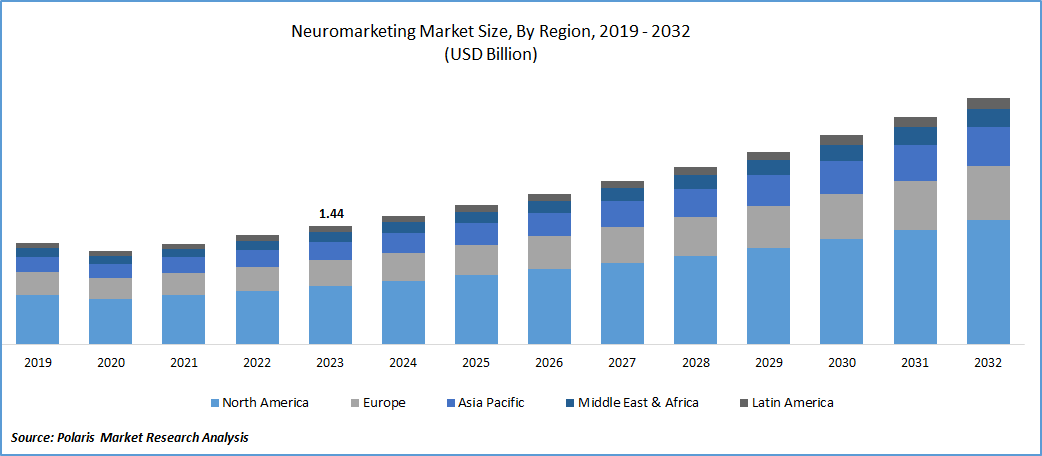
The global neuromarketing market size was valued at USD 1.79 billion in 2025. According to our neuromarketing market forecast, the market is projected to account for a CAGR of 6.8% between 2026 and 2034. The market is primarily driven by the growing demand for personalized marketing and increased focus on customer experience optimization.
Market Statistics
Key Takeaways
- North America dominated the global market with over 40% revenue share in 2025. This is due to the presence of a high density of neuromarketing solution providers and technology vendors.
- The Asia Pacific neuromarketing market is expected to register the highest growth rate of 7.83%. The rapid adoption of neuromarketing solutions in emerging economies across the Asia Pacific due to the development of digital advertising systems contributes to the region’s leading market share.
- The implicit association test (IAT) segment dominated with a 39% revenue share in 2025. This is due to technological advancements in complementary neuromarketing tools like EEG and fMRI.
- Functional near-infrared spectroscopy (fNIRS) is projected to grow at a CAGR of 7.84%. fNIRS measures cortical oxygenation using optical sensors attached to the scalp.
- The retail/consumer brands segment dominated with over 36% revenue share in 2025. Increased interest in neuromarketing among companies in the retail and consumer goods industry contributes to the segment’s leading market position.
Note: Figures and projections outlined in this report are the result of Polaris Market Research’s proprietary analytical processes, grounded in the latest available datasets and market observations
Industry Dynamics
- Growing adoption of novel marketing activities and increased investment in neuromarketing drive the neuromarketing market growth.
- The market is benefiting from the rising demand for personalized marketing and customer experience optimization.
- Development of lightweight EEG headsets and facial coding apps is expected to create several market opportunities.
- Data privacy and regulatory compliance requirements may hinder market expansion.
Source: Polaris Market Research Analysis
To Understand More About this Research:Download Sample Report
AI Impact on Neuromarketing Market
- Artificial intelligence (AI) enables businesses to know the genuine feelings of consumers toward ads through analysis of reactions such as facial emotions or level of attention.
- It increases the efficiency of campaign testing, enabling brands to make changes based on what appeals most.
- It allows for making more tailored advertisements based on consumer tastes.
- AI minimizes any guesswork involved in marketing decisions, hence allowing better use of budgets in marketing campaigns.
The growing need for innovative marketing strategies to improve customer loyalty, retention, and satisfaction is driving neuromarketing market growth. Neuromarketing provides insight into the emotional and subconscious side of decision-making, something that conventional marketing tends to ignore. With neuromarketing technologies such as facial recognition, eye-tracking, biometric measures, and implicit association tests, marketers can devise campaigns that suit their brands and target audiences.
The scientific basis behind neuromarketing is very convincing. Research by Harvard Business School indicates that nearly 95% of consumer purchasing decisions occur subconsciously [Harvard Business School, 'Neuromarketing — Predicting Consumer Behavior to Drive Purchasing Decisions,' professional.dce.harvard.edu]. This subconscious consumer decision making indicates that regular surveys account for just a small percentage of purchase determinants. Studies also show that advertisements created using neural insights are 27% more effective at recalling brands by consumers. Ad campaigns that make use of emotional information result in 2.5 times greater ROI than conventional ad campaigns. These neuromarketing ROI statistics are fueling increased usage of this technique. As of 2025, nearly 54% of the Fortune 500 companies were using some form of neuro or biometric marketing performance tests in marketing [Deloitte Digital, '2026 Digital Marketing Trends,' deloitte.com].
The application of neuromarketing enables marketers to assess how effective their marketing stimuli, like ads, products, and content, have been by analyzing the neurological and physiological reactions of the consumer. The application of neuromarketing also allows marketers to leverage knowledge from neuroscience and cognitive science to develop more effective marketing campaigns. There is high demand for neuromarketing services, as global firms seek unique experiences that increase consumer engagement.
Among other important areas where neuromarketing is proving very useful is the mobile industry, since smartphones are now an indispensable part of our daily lives. With the increasing popularity of e-commerce and digital marketing, there has been a need for more advanced marketing techniques, and neuromarketing has emerged as one of the most effective. According to the U.S. Census Bureau, the total e-commerce sales for 2025 in the country were estimated at 1,233.7 billion. This marked an increase of 5.4% from 2024 [U.S. Census Bereua, 'Quarterly Retail E-Commerce Sales,' census.gov]. This increase in digital commerce is also leading to the development of e-commerce neuromarketing technology that will improve user experience on websites, product page design, and checkout design from a neurological perspective.
Neuromarketing vs. Traditional Research: A Comparative Analysis
| Dimension | Traditional Research | Neuromarketing |
| Data Type | Self-reported (conscious) | Neural & biometric (subconscious) |
| Response Bias | High (social desirability) | Minimal |
| Speed | Days to weeks | Hours (AI platforms) |
| Sample Size Required | Large (100–1000+) | Smaller (20–60, predictive validity) |
| Emotional Depth | Surface level | Deep emotional mapping |
| Ad Effectiveness Prediction | 60–70% accuracy | 80–90% accuracy (EEG-ML systems) |
| New Product Failure Reduction | Baseline | 19% reduction (NSBA research) |
| Cost (Full Study) | USD 5,000–50,000 | USD 10,000–250,000+ (varies by method) |
| Best For | Post-launch evaluation | Pre-launch optimization |
Source: Polaris Market Research Analysis
Growth Drivers
Rising Adoption of Novel Marketing Activities and Increased Investment in Neuromarketing
Various major brands, including PepsiCo, eBay, and Frito-Lay, have implemented neuromarketing research methods for market research, focus groups, and designing marketing strategies. Companies have been using different technological innovations, such as functional magnetic resonance imaging (fMRI), electroencephalography (EEG), eye tracking, facial coding, and augmented reality, in order to understand consumer behavior based on brain activity, eye movement, facial expressions, and emotions. Technological innovations have enabled companies to identify critical factors that influence consumer behavior in terms of attention, memory, emotion, motivation, and trust, and design marketing stimuli to influence them.
For example, to improve car design, Hyundai Motors conducts an EEG test before production and analyzes consumer reactions to various elements of car design, both external and internal, to understand what customers want before entering mass production. Likewise, Yahoo tested a 60-second TV commercial featuring dancing individuals on an EEG test before airing it on prime and cable TV, thereby maximizing neural connections with its search engine. Thus, the growing adoption of new marketing methods and rising investments in neuromarketing are contributing to the neuromarketing market growth.
Integration of Artificial Intelligence and Advanced Analytics with Neuromarketing
The emergence of artificial intelligence and neuroscience has brought changes in the neuromarketing market. Today's AI neuromarketing analytics technologies can analyze EEG and biometric data in real time, offering companies immediate insights into their campaigns in just a few hours rather than weeks. Neuromarketing software that combines brainwaves and machine learning is able to predict customers' purchasing intentions accurately. This is making neuromarketing more reliable and easier to use at a larger scale for businesses.
Cloud-based neuromarketing platforms are bringing down costs for such services. In the past, techniques like the fMRI method involved high laboratory costs, ranging into thousands of dollars. Today, the AI-powered platform gives businesses the ability to study the consumer’s emotional response with basic equipment like a webcam and a facial recognition tool. AI-powered neuromarketing solutions are expected to represent approximately 49% of all neuromarketing tools by 2026. Cloud computing-based platforms are anticipated to be used by 43% of all service providers within the industry.
There are also emerging opportunities regarding research enabled by wearable neuromarketing devices. In January 2025, for instance, IDUN Technologies and Analog Devices launched a brain-sensing earbud prototype during CES 2025 [DUN Technologies, ' IDUN Technologies Unveils Groundbreaking Brain-Sensing Earbuds Leveraging ADI Technology and Expertise at CES 2025, iduntechnologies.com]. The use of such a device enables researchers to analyze brain activity beyond laboratory settings. This represents a move towards consumer-oriented technologies that can measure behavior in natural environments.
Growing Demand for Personalized Marketing and Customer Experience Optimization
According to the Salesforce research findings, about 73% of customers expect organizations to comprehend their needs and preferences [Salesforce, ' What Are Customer Expectations, and How Have They Changed', salesforce.com]. Demographic segmentation and surveys have proven to be ineffective measures for meeting the expectations. Neuromarketing contributes to consumer experience optimization through the analysis of more consistent emotions and thoughts of consumers. Moreover, several studies have reported strong results. For example, eye-tracking can help raise advertising conversion rate by 28%, while content created according to EEG data can ensure an engagement rate 23% higher than conventional A/B testing techniques.
Market Restraints
Data Security, Privacy Concerns, and Regulatory Compliance
The use of biometric and neurodata in neuromarketing poses privacy and data protection risks. The companies capture private data such as brain signals and physical reactions. This information can be closely linked to the individual. Thus, there has been growing awareness regarding the process of collecting and using this data. This is increasing the need for proper data protection measures.
Pressure from regulation is mounting worldwide. For example, GDPR remains in place in Europe to guide the collection and processing of biometric and neural data, with stringent rules for consent and disclosure. The California Senate Bill 1223 (SB 1223) is one of the laws that were enacted in 2024 in the United States. It amended the CCPA by including the processing of neural data as a category of personal data that should be protected. It became the first regulation in the U.S. to regulate neurotech data. In India, the Digital Personal Data Protection Act (DPDP), which became effective in 2024, has introduced new consent regimes. These India DPDP Act marketing data regimes will determine how neuromarketers collect and process consumer brain and biometric data.
Biometric data privacy marketing issues are having an impact on neuromarketing market adoption. Around 38% of companies believe that compliance with data privacy is a significant hindrance to the adoption of neuromarketing. Over 44% firms struggle to incorporate the neuro data into their marketing tech systems.
High Implementation Costs and Skill Shortages
Technical problems and budget constraints constitute a major impediment to the application of neuromarketing by small- and medium-sized enterprises (SMEs). The cost of conducting an fMRI test within laboratory conditions may vary between USD 10,000 to USD 50,000 per study. The full neuroanalysis of marketing campaigns may require spending between USD 50,000 to USD 250,000 per year.
Furthermore, there is a lack of qualified personnel. Approximately half of all marketing companies have admitted that it was challenging for them to find people competent in utilizing neuroscientific data. However, the emergence of Software-as-a-Service-enabled platforms and AI-powered analysis is reducing costs and the skills required. AI neuromarketing SaaS solutions are currently offered on subscription plans costing less than USD 1,000 per month. The trend is expected to expand the market's scope in the coming years.
Market Opportunity
Collaboration with Neuroscience Institutions and AI Platform Development
The markets of India and Southeast Asia are underpenetrated in neuromarketing, although there is fast growth observed in digital marketing. In 2024, the digital advertising market in India exceeded USD 5.5 billion and is expected to witness an annual growth of over 20% through 2027. Given that there are more than 800 million internet users, as well as growing sectors such as FMCG, fintech, and D2C, demand for consumer insights is increasing. This is expected to contribute significantly to Asia Pacific neuromarketing growth.
Direct-to-Consumer (D2C) and E-Commerce Optimization
The growth of D2C brands worldwide has sparked great interest in neuromarketing for enhancing the user experience. Since D2C brands operate directly with consumers online, the role played by websites becomes significant. The use of digital marketing neuroscience technologies involves enhancing web design, call-to-action buttons, images, and the purchasing process to make even minor adjustments that could increase conversion rates. Conversion rates have been found to increase by 10-28 percent through controlled experiments involving EEG and eye tracking.
Source: Polaris Market Research Analysis
Report Segmentation
By Test Technique Type Insights
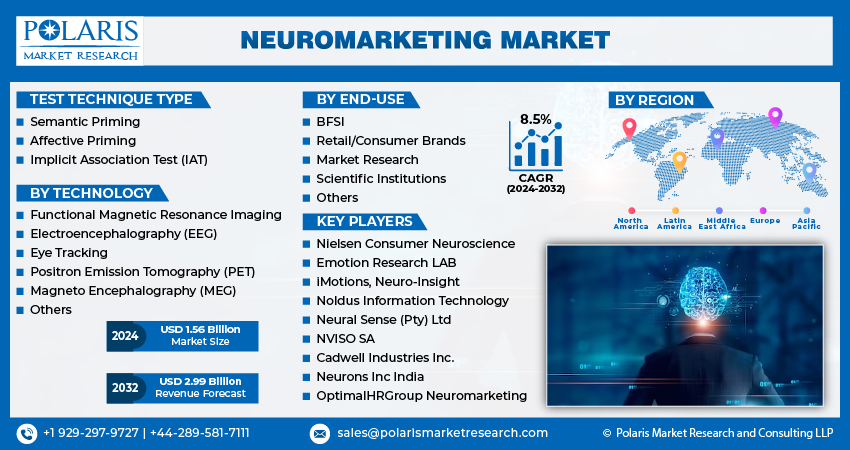
Based on test technique type, the market is segmented into semantic priming, affective priming, and implicit association test (IAT). The implicit association test (IAT) segment led the global market with a 39% revenue share in 2025. Technological advancements in complementary neuromarketing tools like EEG devices and fMRI have enabled more accurate and cheaper testing processes for IAT. The process of implementing IAT has therefore become faster, as companies realize that by using IAT, they can directly tap into their customers' subconscious feelings regarding their brands and products. This is why implicit association test marketing has gained popularity within many industries, especially as competition becomes fiercer and companies seek to know exactly what drives consumers' preferences.
Neuromarketing Test Techniques Comparison
| Test Technique | Applicatiom | Key Benefit | Key Limitation | % of Market Share in 2025 |
| IAT (Implicit Association Test) | Brand association and emotional bias | Captures subconscious brand perception | Limited brain detail | 39% |
| Semantic Priming | Message recall and cognitive links | Fast and cost-effective | Limited scope | 33% |
| Affective Priming | Emotional response to stimuli | Shows automatic emotional reactions | Needs controlled setup | 28% |
Source: Polaris Market Research Analysis
By Technology Insights
The functional magnetic resonance imaging segment led the neuromarketing market with over 33% revenue share in 2025. The demand for the technology in the market is fueled by its capability to generate images of the brain’s activities. This helps determine precisely which parts of the brain react to marketing stimuli. The non-invasive nature, together with the robust scientific basis, makes it a favorable choice for making critical decisions in terms of launching products, changing brands, and testing campaigns. Awareness creation among marketing executives, coupled with increased spending on digital advertisements, further boosts growth in this market segment.
Functional near-infrared spectroscopy (fNIRS) is among the rapidly developing technologies being used in neuromarketing, growing at a CAGR of 7.84% up to 2034. While fMRI requires a stationary, lab-based scanner to measure brain activity, fNIRS measures cortical oxygenation using optical sensors attached to the scalp. The portability of fMRI neuromarketing technology means this technology can be used to conduct consumer tests in stores, vehicles, and even at home. This makes it highly attractive for retail brand research, in-store shopper behavior studies, and automotive experience testing.
Neuromarketing Technology Comparison
| Technology | Market Share (2025) | CAGR (2026–2034) | Best For |
| fMRI | ~33% | High | Deep emotional mapping, brand studies |
| EEG | ~28% | Moderate-High | Real-time ad testing, attention tracking |
| Eye Tracking | ~34% | Moderate | Visual attention, packaging, UX |
| Facial Coding | Growing | High | Emotion detection in video content |
| fNIRS | Emerging | Fastest (7.84%) | Mobile & naturalistic research settings |
| PET / MEG | Niche | Low | Academic and clinical research |
| GSR / Biometrics | Complementary | Moderate | Arousal and stress measurement |
Source: Polaris Market Research Analysis
By End-Use Insights
The retail/consumer brands segment dominated the neuromarketing market with over 36% revenue share in 2025. Increased interest in neuromarketing among companies in the retail and consumer goods industry has been one of the driving forces behind the adoption of neuromarketing technologies. Companies such as PepsiCo, The Weather Channel, eBay, Daimler, Campbell's, Frito-Lay, Gerber, and IKEA have employed neuromarketing technologies to gain insights into consumer behavior, perform market research, and develop effective marketing campaigns. Neuromarketing retail industry technologies provide valuable information about consumer behavior and contribute to more effective decision-making when developing marketing campaigns and improving product placement.
BFSI (Banking, Financial Services & Insurance): Financial institutions are incorporating neuromarketing in their customer engagement strategies. Whether assessing products, apps, or communication, BFSI neuromarketing solutions are used to determine which visual stimuli and messages lead to trust and decisions.
Healthcare & Pharma: Rapid growth is anticipated in this industry, with a projected CAGR of about 7.24% till 2034. Neuromarketing applications include physician communication, patient journey optimization, and DTC campaigns. Pharmaceutical marketing neuroscience helps determine subconscious information processing. It leads to improved message understanding and retention.
Media & Entertainment: Organizations in this sector use neuromarketing to measure consumer reactions to media content. These include TV pilots, movie trailers, game design, and streaming videos. The segment represents almost 16% of the global market share.
Source: Polaris Market Research Analysis
Regional Analysis
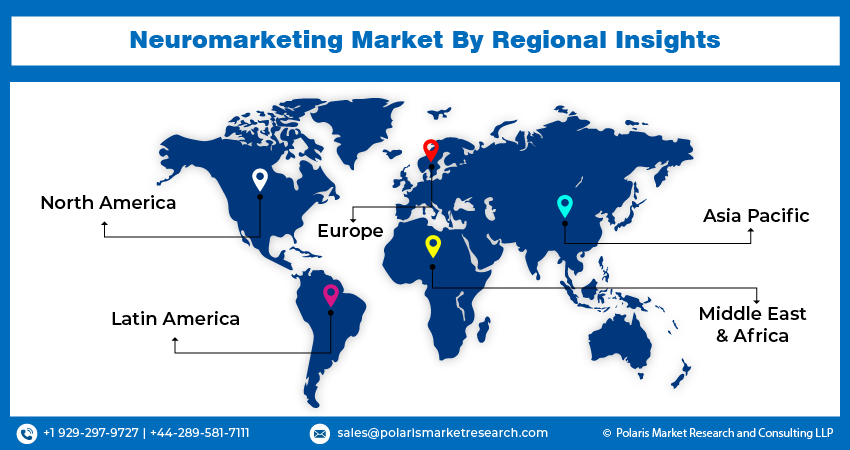
North America led the global neuromarketing market with over 40% revenue share in 2025. This region is characterized by a high density of neuromarketing solution providers and technology vendors, as well as a high level of sophistication among marketing enterprises. There are also a number of research centers, including universities and corporate research facilities, that have established the United States as a hub of neuroscience and marketing solutions. Neuromarketing technologies have been incorporated into the service portfolios of companies such as Nielsen, Westat, Forrester Research Services, and Momentive. All these factors contribute to the region’s leading market position.
Europe accounted for over 28% revenue share of the global neuromarketing market in 2025. Europe’s neuromarketing sector thrives because of the close relationship between academia and the business sector, as well as the high representation of FMCG and automotive firms conducting extensive research in consumer neuroscience. For example, IKEA applied neuromarketing methods to determine how consumers navigate through space, make spatial decisions, and arrive at purchase decisions. The European region’s strong focus on data regulation under GDPR has enabled companies to develop highly privacy-oriented neuromarketing solutions. This approach to neuromarketing will not only ensure the ethical treatment of data but also allow the companies operating in this region to take advantage of their position as more stringent standards are set globally.
While Europe commands a significant global market share, the Asia Pacific neuromarketing market is expected to register the highest growth rate, with a CAGR of 7.83%. China, Japan, South Korea, and India are all experiencing rapid adoption driven by the rapid development of digital advertising systems, increased investments from multinational FMCG companies conducting consumer research among Asian populations, and the advent of neuromarketing technology start-ups.
India represents a high-growth market. India represents a high-growth market. India is experiencing an exponential increase in demand for digital marketing services. Polaris has identified players in the Indian neuromarketing industry, such as Neurons Inc India, that have established a footprint due to this rapid growth in demand. The regions where technology in neuromarketing is progressing include South Korea and China. This is largely due to collaboration between academia and industry to advance wearables and real-time emotion recognition.
Neuromarketing is still in its early stages in Latin America and the Middle East & Africa, but it is growing steadily. This growth can be attributed to increased spending on digital marketing campaigns, particularly in nations like Brazil, the UAE, and South Africa, as companies begin incorporating advanced consumer research methods.
Source: Polaris Market Research Analysis
Key Market Players and Competitive Insights
The global neuromarketing market is marked by fierce competition and a highly diverse landscape, with major firms operating across the industry. As more companies seek information through neuromarketing, they have invested more in research and development. There has been growing investment in neuroimaging technology, among other areas, to improve the process of neuromarketing research.
| Company | Headquarters | Core Offering | Differentiator |
| U.S. | Biometric + neural ad testing | Scale; integration with Nielsen ratings data | |
| Emotion Research LAB | Spain | Real-time facial coding AI | High-volume automated emotion recognition |
| iMotions | Denmark | Multi-signal biometric platform | Combines eye tracking, EEG, GSR, facial coding |
| Neuro-Insight | Australia/UK | Memory encoding measurement | Proprietary Steady State Topography (SST) |
| Noldus Information Technology | Netherlands | Behavioral research software | Academic and clinical neuromarketing |
| Neural Sense (Pty) Ltd | South Africa | Full-service neuromarketing | Emerging market specialist |
| NVISO SA | Switzerland | AI-based emotion and behavior AI | Computer vision, no wearables required |
| U.S. | Medical-grade EEG hardware | Clinical accuracy in commercial settings | |
| Neurons Inc India | India | AI neuromarketing platform | Asia Pacific and emerging market expansion |
| OptimalHRGroup Neuromarketing | Global | Neuromarketing-based HR & branding | Cross-functional behavioral research |
Source: Polaris Market Research Analysis
Recent Developments
- May 2025: Prophesee partnered with Tobii to design high-speed event-based eye-tracking modules for XR headsets. These components seek to offer visual attention mapping in a fully immersive neuromarketing setting.
- January 2025: IDUN Technologies and Analog Devices unveiled a prototype for their 4-channel brain-sensing earbuds during CES 2025. This marks an important milestone in the development of consumer-friendly neural wearables for real-world research.
Market Segmentation
By Test Technique Type Outlook (Revenue, USD Billion, 2021–2034)
- Semantic Priming
- Affective Priming
- Implicit Association Test (IAT)
By Technology Outlook (Revenue, USD Billion, 2021–2034)
- Functional Magnetic Resonance Imaging (FMRI)
- Electroencephalography (EEG)
- Eye Tracking
- Positron Emission Tomography (PET)
- Magneto Encephalography (MEG)
- Others
By End-Use Outlook (Revenue, USD Billion, 2021–2034)
- BFSI
- Retail/Consumer Brands
- Market Research
- Scientific Institutions
- Others
By Regional Outlook (Revenue, USD Billion, 2021–2034)
- North America
- US
- Canada
- Europe
- Germany
- France
- UK
- Italy
- Spain
- Netherlands
- Russia
- Rest of Europe
- Asia Pacific
- China
- Japan
- India
- Malaysia
- South Korea
- Indonesia
- Australia
- Vietnam
- Rest of Asia Pacific
- Middle East & Africa
- Saudi Arabia
- UAE
- Israel
- South Africa
- Rest of Middle East & Africa
- Latin America
- Mexico
- Brazil
- Argentina
- Rest of Latin America
Neuromarketing Market Report Scope
| Report Attributes | Details |
| Market Size in 2025 | USD 1.79 billion |
| Market Size in 2026 | USD 1.91 billion |
| Revenue Forecast by 2034 | USD 3.24 billion |
| CAGR | 6.8% |
| Base Year | 2025 |
| Historical Data | 2021–2024 |
| Forecast Period | 2026–2034 |
| Quantitative Units | Revenue in USD billion, and CAGR from 2026 to 2034 |
| Report Coverage | Revenue Forecast, Market Competitive Landscape, Growth Factors, and Trends |
| Segments Covered |
|
| Regional Scope |
|
| Competitive Landscape | Neuromarketing Industry Trend Analysis (2025) Company profiles/industry participants profiling include company overview, financial information, product/service benchmarking, and recent developments |
| Report Format | PDF + Excel |
| Customization | Report customization as per your requirements with respect to countries, regions, and segmentation. |
Source: Polaris Market Research Analysis
Neuromarketing Market FAQ's
The market for neuromarketing was valued at USD 1.79 billion in 2025. It is projected to reach USD 3.24 billion by 2034.
The market is projected to account for a CAGR of 6.8% during the forecast period.
North America leads the market for neuromarketing. This is owing to the region’s high density of neuromarketing solution providers and technology vendors.
The retail/consumer brands segment represents the largest end-use segment. Increased interest in neuromarketing among companies in the retail and consumer goods industry contributes to its leading market share.
The primary technologies used in the neuromarketing market include functional magnetic resonance imaging (fMRI), electroencephalography (EEG), Eye tracking, facial coding, functional near-infrared spectroscopy (fNIRS), and positron emission tomography (PET).
Key players in the global neuromarketing market include Nielsen Consumer Neuroscience, Emotion Research LAB, iMotions, Neuro-Insight, Noldus Information Technology, Neural Sense, NVISO SA, Cadwell Industries Inc., Neurons Inc India, and Buyology Inc., among others.
The market is driven by the rising adoption of AI-powered consumer analytics. It also benefits from increasing digital advertising investment and the growth of e-commerce and D2C brands requiring UX optimization.
Neuromarketing is the application of neuroscience methods and cognitive science principles to marketing research. It allows brands to measure and interpret subconscious consumer responses to advertising, products, and packaging.
Download Sample Report of Neuromarketing Market
Please fill out the form to request a customized copy of the research report.


