
Oil Storage Market Size, Share Global Analysis Report, 2026-2034
REPORT DETAILS
Oil Storage Market Summary
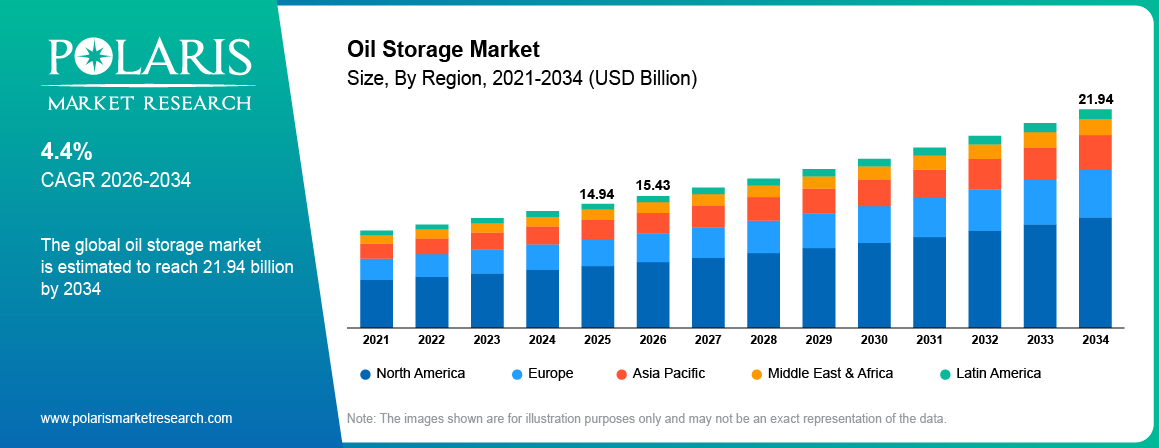
The oil storage market size was valued at USD 14.94 billion in 2025 and is expected to grow at a CAGR of 4.4% during the forecast period. The market growth is primarily fueled by rising energy consumption, the introduction of strategic storage initiatives by governments, and growing exploration and production (E&P) activities.
Market Statistics
Oil Storage Market Key Takeaways
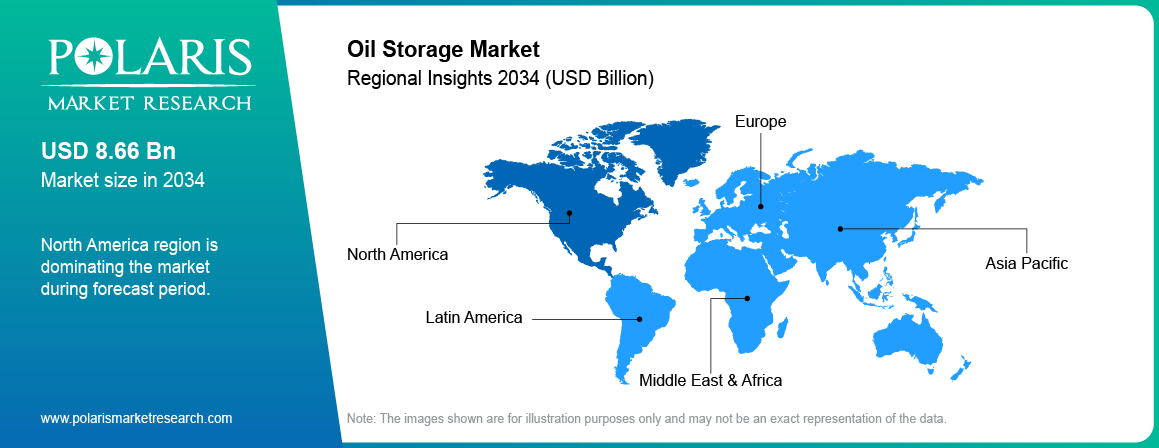
- North America accounted for the largest market share of 39.5% in 2025. The regional market dominance is primarily due to increased crude oil production in the U.S.
- Asia Pacific is anticipated to register the highest CAGR of 5.1% during the projection period. Growing energy demand and significant investments in oil storage infrastructure drive regional market growth
- The floating roof tanks segment accounted for the largest market share of 46.8% in 2025. The superior design of these tanks minimizes evaporative losses and ensures safer storage of volatile hydrocarbons.
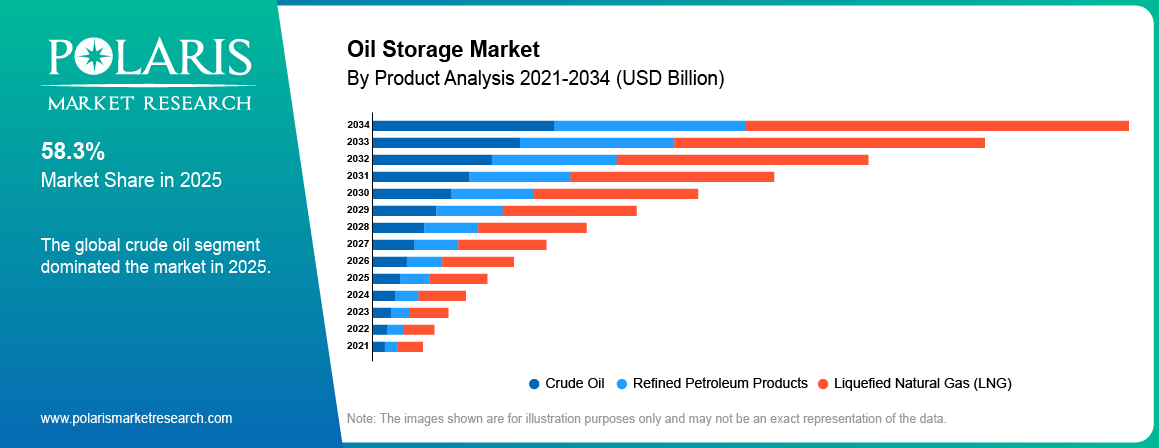
- The crude oil segment led the market in 2025 with 58.3% share, owing to growing global energy demand and the strategic importance of crude oil as a primary energy source.
Note: Figures and projections outlined in this report are the result of Polaris Market Research’s proprietary analytical processes, grounded in the latest available datasets and market observations.
AI Impact on Oil Storage Market
- AI ensures operational safety by analyzing sensor and IoT data to monitor tank levels, temperature, and pressure in real time.
- Machine learning models predict demand fluctuations and optimize storage utilization to reduce costs.
- AI-powered predictive maintenance identifies early signs of corrosion, leakage, or equipment failure. This early detection helps minimize downtime.
- Advanced analytics support strategic inventory planning and enable operators to align storage decisions with market price trends and trading opportunities.
Source: Polaris Market Research Analysis
To Understand More About this Research: Download Sample Report
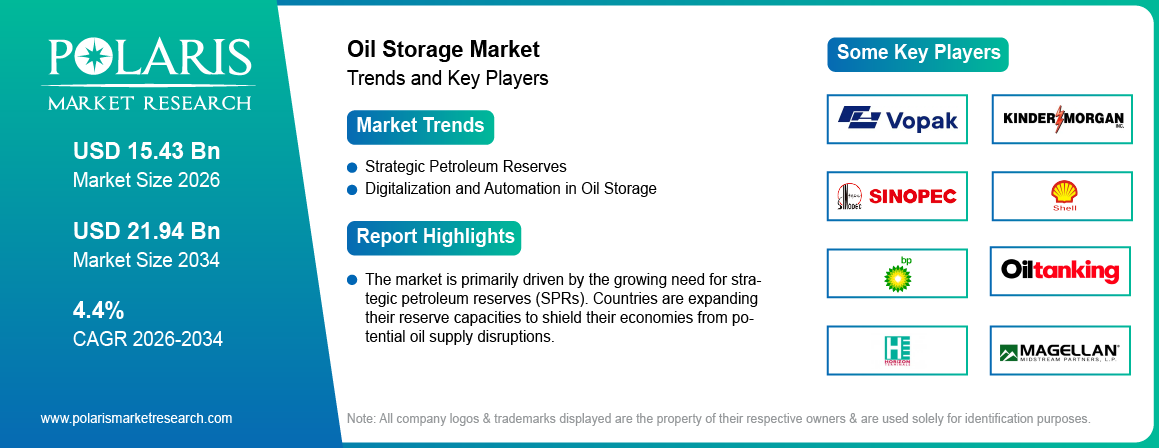
The market is primarily driven by the growing need for strategic petroleum reserves (SPRs). Countries are expanding their reserve capacities to shield their economies from potential oil supply disruptions.
The oil storage market focuses on the storage of crude oil, refined petroleum products, and other liquid fuels, enabling efficient supply chain management and stabilization. This industry is critical for ensuring energy security and balancing demand-supply dynamics globally. Increasing energy consumption and strategic storing initiatives by governments, the demand for advanced oil storage infrastructure has risen significantly.
The increasing exploration and production (E&P) activities, particularly in offshore regions, are driving the demand for oil storage facilities. Moreover, technological advancements in storage systems, such as floating roof tanks and underground caverns, are further supporting market growth. The surge in oil trading activities, driven by fluctuating crude oil prices, also contributes to the oil storage market expansion, highlighting its pivotal role in the global energy ecosystem.
Difference Between Fixed Roof vs Floating Roof Storage Tanks
Fixed roof tanks remain a cost-effective solution for storing stable liquids and for smaller storage facilities. Floating roof tanks are widely preferred in the oil storage market. This is due to their ability to minimize evaporation losses and reduce emissions. It improves storage efficiency for volatile crude oil and petroleum products.
| Parameter | Fixed Roof Storage Tanks | Floating Roof Storage Tanks |
| Design Structure | Permanent roof attached to the tank shell. | Roof floats directly on the liquid surface and moves with liquid level changes. |
| Cost | Lower initial investment and construction cost. | Higher capital cost due to more complex design and sealing systems. |
| Suitable Products | Best suited for stable, low-volatility liquids such as water, lubricants, and certain refined products. | Ideal for volatile liquids including crude oil, gasoline, and other petroleum products. |
| Evaporation Losses | Higher vapor formation and product evaporation losses. | Significantly reduces evaporation losses by minimizing vapor space above the liquid. |
| Emissions Control | Generates higher VOC emissions compared to floating roof designs. | Helps reduce VOC emissions and improves environmental compliance. |
| Maintenance Requirements | Easier to inspect, maintain, and operate, particularly in smaller storage facilities. | Requires regular inspection of seals, floating mechanisms, and roof integrity. |
| Operational Efficiency | Suitable for facilities with moderate storage requirements and lower environmental concerns. | Preferred for large-scale petroleum storage where product conservation is critical. |
| Typical Applications | Chemical storage, water storage, industrial liquids, and smaller fuel terminals. | Crude oil terminals, refineries, petrochemical facilities, and large fuel depots. |
Source: Polaris Market Research Analysis
Market Dynamics
Driver: Strategic Petroleum Reserves
The market is driven by the growing need for strategic petroleum reserves (SPRs) as governments prioritize energy security, and supply stability. SPRs serve as a safeguard against geopolitical tensions, natural disasters, and unexpected demand surges, ensuring a steady oil supply. Countries such as the United States, China, and India are expanding their reserve capacities, increasing demand for oil storage facilities.
For example, according to the US Energy Information Administration (EIA), the US Strategic Petroleum Reserve (SPR) held approximately 354.7 million barrels of crude oil at the end of December 2023, rising to around 387.2 million barrels by October 2024. This expansion reflects a broader global trend of increasing storage capacities to enhance energy security. As nations strengthen their oil reserves, the demand for storage infrastructure, including underground caverns, tank farms, and floating storage units, continues to grow.
Driver: Digitalization and Automation in Oil Storage
The integration of digitalization and automation is a transformative trend shaping the market growth. Advanced technologies, such as IoT sensor, artificial intelligence, and blockchain, are employed to optimize storage operations and enhance safety measures. IoT-enabled sensors provide real-time monitoring of tank conditions, detecting potential issues such as leaks or pressure anomalies. AI-driven analytics further aid in inventory management by predicting demand patterns and optimizing supply chains. Blockchain technology ensures transparency and security in oil trading and inventory tracking, reducing fraud risks. Companies are also implementing automated systems to enhance operational efficiency, such as robotic inspections for storage tanks.
Challenges in Oil Storage Market
- High Infrastructure and Maintenance Costs: Oil storage facilities need substantial capital investment. Capital is required for tank construction, land acquisition, safety systems, monitoring equipment, and ongoing maintenance. Large-scale terminals and strategic storage facilities can include significant operational and compliance expenses in their lifecycle.
- Stringent Environmental Regulations: Governments and regulatory bodies impose stringent standards on emissions, spill prevention, and waste management. To comply with environmental regulations, companies need to invest in vapor recovery systems and leak detection technologies. They emphasize on advanced monitoring solutions. These strategies increase operating costs.
- Transition Toward Renewable Energy: There is a global shift toward renewable energy sources, electrification, and decarbonization initiatives. This may gradually reduce long-term demand for fossil fuel storage infrastructure. Due to this transition, operators diversify storage assets and explore alternative fuels, biofuels, and energy storage applications.
Source: Polaris Market Research Analysis
Segment Insights
Market Assessment by Type
The global oil storage market segmentation, based on type, includes floating roof tanks, fixed roof tanks, underground storage, and bullet tanks. In 2025, the floating roof tanks segment held the largest share of 46.8% due to their superior design, which minimizes evaporative losses and ensures safer storage of volatile hydrocarbons. These tanks are widely adopted in oil and gas industries for storing crude oil and refined products, as they effectively reduce the risk of fire and contamination by preventing direct exposure to air. Rising environmental regulations and the need for cost-efficient storage solutions further propelled the demand for floating roof tanks. Additionally, advancements in material technologies and construction techniques enhanced their durability and operational efficiency, solidifying their dominance in the segmental growth.
Market Evaluation by Product
The oil storage market is segmented by product into crude oil, refined petroleum products, and liquefied natural gas (LNG). In 2025, the crude oil segment accounted for the largest market share of 58.3% due to the increasing global demand for energy and the strategic importance of crude oil as a primary energy source. Rising production levels, particularly in key oil-producing regions, necessitated expanded storage capacities to manage supply fluctuations and ensure energy security. Additionally, the growing adoption of crude oil as feedstock for petrochemical industries and refining processes further drove demand for storage solutions. Enhanced storage infrastructure investments, including advanced tank technologies for safety and efficiency, also contributed to the segment's growth.
Source: Polaris Market Research Analysis
Regional Analysis
By region, the study provides insights into North America, Europe, Asia Pacific, Latin America, and the Middle East & Africa. In 2025, North America oil storage market is accounted for the largest revenue share of 39.5%. This is driven by increased crude oil production in the US, particularly from shale reserves and the region's advanced storage infrastructure. For instance, according to the December 2024 US Energy Information Administration Latest Short-Term Energy Outlook (STEO), crude oil production in the US Lower 48 (L48) states, excluding Alaska and offshore production, reached a record high of 11.3 million barrels per day (b/d) in November 2024. The US Strategic Petroleum Reserve (SPR) played a significant role in ensuring energy security, while investments in expanding storage capacities further supported market growth. Additionally, rising energy exports, including crude oil and refined products, amplified the need for efficient storage solutions. Favorable government policies and advancements in tank technologies, prioritizing safety and environmental compliance, also contributed to region’s growth.
Asia Pacific is expected to witness the fastest CAGR of 5.1% over the forecast period due to rapid industrialization, increasing energy demand, and significant investments in oil storage infrastructure. Growing economies such as China and India are driving crude oil imports to meet their expanding industrial and transportation needs, which is further boosting the demand for advanced storage facilities. For instance, according to the Petroleum Planning & Analysis Cell, India's crude oil imports reached 18.8 million metric tons in in February 2024, reflecting a marginal increase of 0.4% during February FY 2023-24 compared to the same period in FY 2022-23. This growth is attributed to the rising energy demands of the industrial and transportation sectors, particularly in growing economies such as India. The continued reliance on imported crude oil highlights the need for expanding advanced storage facilities to support the country's energy requirements. Additionally, government initiatives to build strategic petroleum reserves and the rising adoption of renewable energy sources alongside conventional fuels further contribute to the region's growth. Expanding refining capacities and technological advancements in storage solutions also boost the market development in Asia Pacific.
Source: Polaris Market Research Analysis
Key Market Players & Competitive Analysis Report
The competitive landscape reflects the dynamic and interconnected nature of the global energy industry. Key players in the oil storage market adopt strategies such as partnerships, mergers, and collaborations to enhance their storage capacities and optimize operations. Companies continuously invest in infrastructure development to meet the increasing demand for crude oil, refined products, and liquefied natural gas storage. Strategic alliances between stakeholders across the supply chain, including producers, storage providers, and trading firms, play a pivotal role in driving efficiency and profitability.
Technological advancements have further intensified competition, with players integrating digital tools to streamline inventory management and ensure operational safety. Innovations such as IoT-based monitoring, AI-driven analytics, and automated maintenance systems offer a competitive edge by reducing costs and minimizing risks. Additionally, increasing focus on sustainability, with companies exploring renewable energy integration and environmentally friendly storage solutions. Market participants are expanding their footprints in emerging economies as global energy demand rises. The competitive intensity is further heightened by fluctuating oil prices and geopolitical developments, pushing companies to adopt flexible and adaptive strategies.
Royal Dutch Shell, commonly referred to as Shell, is a global energy and petrochemical industry specializing in oil and gas, chemicals, and energy solutions. The company operates as one of the mobility networks; Shell serves approximately 33 million customers daily across more than 47,000 retail stations worldwide. The company has over 54,000 public electric vehicle (EV) charging infrastructure at Shell stations, on-street locations, and key destinations. The company's main operations include oil and natural gas exploration, liquefied natural gas (LNG), gas-to-liquids (GTL) technology, methane emissions management, deep-water exploration, and the development of shale oil and gas. Additionally, Shell is involved in renewable energy, carbon capture and storage (CCS), and nature-based solutions.
Kinder Morgan excels through its integrated infrastructure and advanced storage facilities across North America. The company focuses on enhancing operational efficiency and safety through digital solutions. Recent expansions in the Gulf Coast region, coupled with investments in renewable fuel storage, highlight its expansion. These strategies reinforce Kinder Morgan’s leadership in the evolving oil storage industry.
Key Companies
- Royal Vopak
- Kinder Morgan
- China Petroleum & Chemical Corporation (Sinopec)
- Shell
- BP
- Oiltanking GmbH
- Horizon Terminals
- Magellan Midstream Partners
- Vitol Group
- Saudi Aramco
- Emirates National Oil Company (ENOC)
- CLH Group
- Adani Group
- Buckeye Partners
- LBC Tank Terminals
Oil Storage Industry Developments.
- January 2025, MRPL collaborated with ISPRL to utilize its crude oil storage caverns. The agreement reduces MRPL’s infrastructure costs, ensures supply security, and offers operational flexibility by storing diverse crude grades while optimizing capital expenditure for other operational needs. (Source: thehindu.com)
- May 2024: General Petroleum, a lubricant manufacturer based in the UAE, upgraded its facilities by expanding its base oil storage capacity. This enhancement is designed to optimize operations and support increased production levels in response to market demand. (Source: argusmedia.com)
Oil Storage Market Segmentation
By Type Outlook (Revenue, USD Billion, 2021 - 2034)
- Floating Roof Tanks
- Fixed Roof Tanks
- Underground Storage
- Bullet Tanks
By Application Outlook (Revenue, USD Billion, 2021 - 2034)
- Commercial Usage
- Strategic Reserves
- Industrial Applications
By Product Outlook (Revenue, USD Billion, 2021 - 2034)
- Crude Oil
- Refined Petroleum Products
- Liquefied Natural Gas (LNG)
By Regional Outlook (Revenue, USD Billion, 2021 - 2034)
- North America
- US
- Canada
- Europe
- Germany
- France
- UK
- Italy
- Spain
- Netherlands
- Russia
- Rest of Europe
- Asia Pacific
- China
- Japan
- India
- Malaysia
- South Korea
- Indonesia
- Australia
- Rest of Asia Pacific
- Middle East & Africa
- Saudi Arabia
- UAE
- Israel
- South Africa
- Rest of Middle East & Africa
- Latin America
- Mexico
- Brazil
- Argentina
- Rest of Latin America
Report Scope:
| Report Attributes | Details |
| Market Size Value in 2025 | USD 14.94 billion |
| Market Size Value in 2026 | USD 15.43 billion |
| Revenue Forecast in 2034 | USD 21.94 billion |
| CAGR | 4.4% from 2026 to 2034 |
| Base Year | 2025 |
| Historical Data | 2021– 2024 |
| Forecast Period | 2026 – 2034 |
| Quantitative Units | Revenue in USD Billion and CAGR from 2026 to 2034 |
| Report Coverage | Revenue Forecast, Market Competitive Landscape, Growth Factors, and Industry Trends |
| Segments Covered |
|
| Regional Scope |
|
| Competitive Landscape |
|
| Report Format |
|
| Customization | Report customization as per your requirements with respect to countries, regions, and segmentation. |
Source: Polaris Market Research Analysis
Oil Storage Market FAQ's
The global oil storage market size was valued at USD 14.94 billion in 2025 and is projected to grow to USD 21.94 billion by 2034.
The global market is projected to register a CAGR of 4.4% during the forecast period.
In 2025, North America accounted for the largest share of 39.5%, driven by increased crude oil production in the US, particularly from shale reserves, and the region's advanced storage infrastructure.
Some of the key players in the market are Royal Vopak, Kinder Morgan, China Petroleum & Chemical Corporation (Sinopec), Shell, BP, Oiltanking GmbH, Horizon Terminals, Magellan Midstream Partners, Vitol Group, Saudi Aramco, Emirates National Oil Company (ENOC), CLH Group, Adani Group, Buckeye Partners, LBC Tank Terminals.
In 2025, the floating roof tanks segment held the largest market share of 46.8% due to their superior design, which minimizes evaporative losses and ensures safer storage of volatile hydrocarbons.
In 2025, the crude oil segment accounted for the largest market share of 58.3% in the oil storage market due to the increasing global demand for energy and the strategic importance of crude oil as a primary energy source.
Key trends include rising strategic petroleum reserve expansions, growing digitalization and AI-powered automation in storage operations, increasing offshore E&P activities, and expanding refining and petrochemical industry infrastructure globally.
Download Sample Report of Oil Storage Market
Please fill out the form to request a customized copy of the research report.


