
Penetration Testing as a Service Market Size, Share, Trends & Forecast, 2026–2034
REPORT DETAILS
Penetration Testing as a Service Market Summary
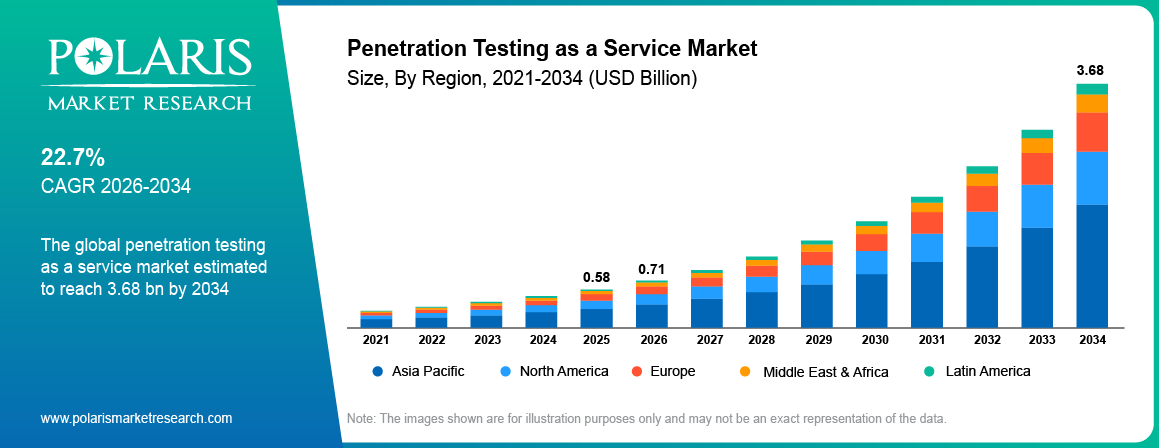
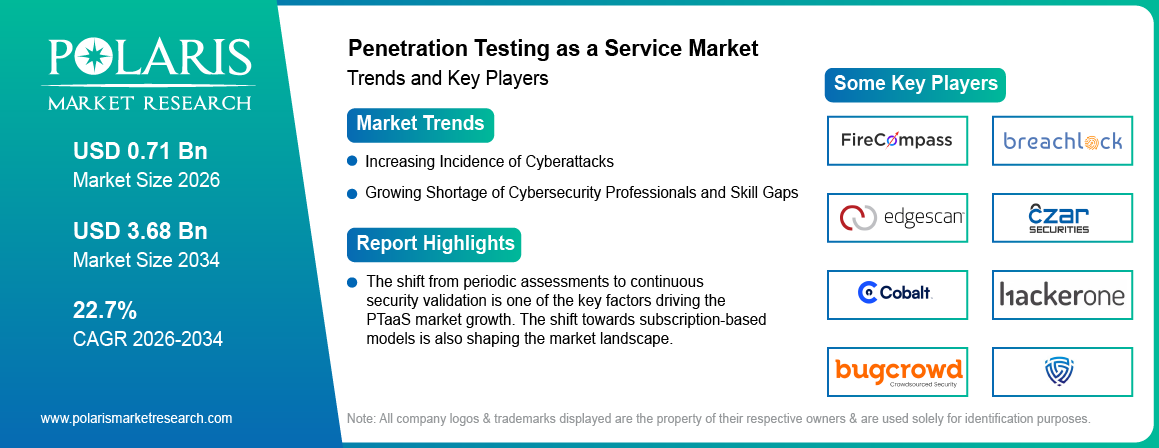
The global penetration testing as a service (PTaaS) market size was valued at USD 0.58 billion in 2025. The market is projected to grow at a 22.7% CAGR from 2026 to 2034. The shift from periodic assessments to continuous security validation is one of the key factors driving the PTaaS market growth. The shift towards subscription-based models is also shaping the market landscape.
Market Statistics
Penetration Testing as a Service Market Key Takeaways
- North America led the global penetration testing as a service market with an 39.84% share in 2025. Strong cybersecurity regulations contribute to its leading market position.
- Asia Pacific is projected to witness the fastest growth at an 25.74% CAGR. Expanding cybersecurity regulations in emerging economies drive market growth in the region.
- By offering, the managed services segment accounted for an 61.37% market share in 2025. This is because of the shift to continuous validation.
- By deployment, the cloud-based segment held an 48.72% share in 2025. This is owing to the strong preference for scalable delivery models across enterprises.
- By vertical, the BFSI segment accounted for an 28.42% PTaaS market share in 2025. The massive volume of sensitive data handled in the BFSI industry creates a need for PTaaS offerings.
- By organization size, the small and medium enterprises (SMEs) segment is projected to grow at an 26.48% penetration testing as a service market CAGR. SMEs typically lack full-time cybersecurity teams. This drives the demand for PTaaS platforms among SMEs.
Note: Figures and projections outlined in this report are the result of Polaris Market Research’s proprietary analytical processes, grounded in the latest available datasets and market observations.
What Is Penetration Testing as a Service?
Definition
Penetration testing as a service is a cybersecurity delivery model that lets organizations use penetration testing through a digital platform and access to security professionals. This model helps companies detect vulnerabilities within their system in order to fix them in a timely manner. Pentest as a service is an alternative name for this model.
PTaaS in Simple Terms
With PTaaS, businesses get the opportunity to conduct assessments of their systems for vulnerabilities in a more flexible way than just using periodic assessments. Continuous penetration testing enables businesses to detect changes within their environment and find new vulnerabilities. On-demand penetration testing can be done with PTaaS if the business needs a more precise assessment after making significant changes within its system or before launching something new. In most cases, PTaaS uses both automated security checks and testing performed by ethical hackers and security specialists. The results are typically provided through a central portal where the company can analyze them, monitor remediation activities, and request further tests.
How Does PTaaS Work?
Scope definition: The organization and PTaaS provider agree on which websites, applications, networks, or cloud systems should undergo the tests.
Asset discovery: The PTaaS provider identifies the systems in scope and verifies the connections between them.
Weakness identification: Security assessments are performed using security tools and manual checking to find vulnerabilities, exposed services, access problems, and misconfigurations.
Vulnerability testing: Ethical hackers try to exploit discovered weaknesses by executing controlled attacks.
Validation of findings: The PTaaS provider analyzes the findings and filters out any false positives.
Reporting and mitigation: Results of the test are communicated through the PTaaS platform together with information that makes it easier for security professionals to prioritize and mitigate each problem.
Re-testing: When the identified vulnerabilities are fixed, the PTaaS provider conducts re-testing of the systems under scope. Organizations have an option to conduct on-demand penetration tests in case of specific events.
This process can continue as systems change. This allows companies to maintain regular visibility into security weaknesses without waiting for the next assessment cycle.
PTaaS vs Traditional Penetration Testing
PTaaS permits security teams to perform tests more regularly and be in communication with the tester while problems are identified and resolved. The traditional process of penetration testing is often organized as a project and is completed within a certain time frame.
| Dimensions | PTaaS | Traditional Penetration Testing |
| Delivery | Cloud-based solution with experienced testers | Service-based engagement, typically project-based |
| Frequency | On demand and ongoing, possibly driven by releases or assets | Regular (typically once annually or audit-based) |
| Start and scoping | Scope and initiation via the platform | Negotiation of statement of work and schedule |
| Results | Live dashboard | Final report on completion of engagement |
| Re-testing | Initiation through the platform after remediation | Often a separate engagement |
| Collaboration | Conducted directly between testers and developers | Mostly conducted via project manager and final report |
| Scalability | High; testing capacity can be increased according to assets/releases | Limited by availability of consultant |
| Commercial structure | Based on subscription or credits | Fixed price or time-and-materials-based engagement |
| Ideal for | Dynamically changing applications, APIs and cloud infrastructures; DevSecOps teams | In-depth one-time assessments and audits |
Source: Polaris Market Research Analysis
PTaaS vs ASM, BAS and Bug Bounty: Where It Fits in Exposure Management
PTaaS assesses systems for vulnerabilities. It can also be combined with attack surface management, which helps identify exposed assets. BAS assesses the security controls, while bug bounties assist in discovering vulnerabilities by external researchers.
| Approach | Primary purpose | Human involvement | Cadence | Relationship to PTaaS |
| PTaaS | Validate exploitable weaknesses through simulated attacks | High (expert-led, tool-assisted) | On-demand to continuous | Subject of this report |
| Automated vulnerability scanning | Find known vulnerabilities at scale | Low | Scheduled or continuous | Feeds PTaaS triage; does not prove exploitability |
| Breach and attack simulation (BAS) | Test whether security controls detect scripted attacks | Low to medium | Continuous | Complements PTaaS; control validation rather than discovery |
| Bug bounty / crowdsourced security testing | Crowdsourced discovery of vulnerabilities | High (open researcher community) | Continuous, reward-based | Overlaps with crowdsourced PTaaS vendors |
| Red teaming | Adversary simulation against people, process and technology | High | Periodic | Broader and longer than a PTaaS test |
| Attack surface management (ASM/EASM) | Discover and monitor known and unknown exposed assets | Low to medium | Continuous | Finds the assets that can be assessed through PTaaS |
Source: Polaris Market Research Analysis
Market Dynamics
The penetration testing as a service market is shaped by cyber threats, evolving requirements for enterprise cybersecurity, entry barriers, and emerging business opportunities related to testing, compliance, and application security.
Driver : Increasing Incidence of Cyberattacks
The increasing number of attacks requires more frequent security assessments in organizations. Cyberattacks target a growing number of digital assets, leading to more pressure on security teams to find the vulnerabilities in them. Regularly performed pen tests scheduled at fixed periods of time might not be enough due to changing threat conditions. Thus, there is a growing need for PTaaS services to perform more regular security assessments. It is especially critical for those organizations that do not have enough testing capabilities or rapidly developing applications. According to an ISACA report published in September 2026, 38% of cybersecurity teams worldwide have experienced an increase in cyberattacks compared to 2025. The research revealed that 54% of cybersecurity experts thought their organization would undergo a cyberattack in the coming year (source: isaca.org). This data suggests that companies are still faced with the challenge of discovering vulnerabilities before they are exploited. As attack levels remain high, the need for repeatable penetration testing services is expected to drive the PTaaS market.
Driver : Growing Shortage of Cybersecurity Professionals and Skill Gaps
The shortage of cybersecurity skills poses challenges for organizations to keep adequate internal capability for testing. It requires unique skills which might be hard to find within small security teams. Also, organizations require professionals who can evaluate evolving applications and understand complex vulnerabilities. Finding additional specialists is challenging since experienced cybersecurity professionals are currently in great demand. That is why many organizations resort to using external services for special security evaluations and penetration testing. According to the December 2025 ISC2 Cybersecurity Workforce Study and its subsequent April 2026 deep-dive report, 95% of surveyed cybersecurity professionals reported having at least one cybersecurity skills need in their organizations. In addition, 59% of professionals considered their skill deficiencies critical or significant. 33% of respondents reported facing general understaffing issues, while 29% struggled with the budget to afford appropriate candidates (source: isc2.org). PTaaS can address the issue of the skill shortage by allowing organizations to have access to specialized testing capabilities without having a large team of internal penetration testers. Because of skill shortages, the availability of external testing services can play an important role in PTaaS adoption.
Restraints and Challenges : High Costs, Data Security, and Integration Challenges
PTaaS costs can continue to be a challenge for organizations with limited cybersecurity budgets. This is particularly the case when tests require regular assessments, specialized expertise, and a wider scope of assets. The cost structure may differ depending on the testing scope, test frequency, tester’s expertise, and level of integration. This could make it challenging for customers to gauge their overall costs. Security of information is yet another challenge due to the nature of information involved in penetration testing. Integration with existing vulnerability management, ticketing, governance, risk and compliance (GRC), and security processes can become additional obstacles for organizations that require transferring results between many different platforms. False positives may increase the workload of security teams as well because they result in unnecessary investigations and remediation efforts. Furthermore, poorly defined testing scopes can undermine the value of the service as well because some assets may not be assessed.
Opportunities : Expansion Through SME and MSSP-Based PTaaS Models
Small and medium enterprises (SMEs) present a strong opportunity for penetration testing as a service companies because most lack in-house penetration testing capabilities. The subscription approach enables organizations to benefit from continuous security assessments without incurring the costs of large-scale penetration testing. PTaaS can be integrated by managed security service providers into other cybersecurity services to enable their clients to use penetration testing along with monitoring and vulnerability management. More demand can emerge as insurance companies increase the security needs of their clients. Some insurers may require organizations to regularly carry out penetration testing to ensure their safety. This way, businesses can get interested in using penetration testing services on a subscription basis.
Opportunities : Growth in API and AI Application Security Testing
The development of APIs and AI applications gives rise to new needs for security tests. API security testing may assist companies in uncovering potential vulnerabilities in authentication, authorization, information exposure, and configuration of APIs. At the same time, LLM application penetration testing is becoming more relevant as businesses increasingly implement generative AI technologies. It is possible to analyze potential risks related to prompt injection, leakage of sensitive information, and unsafe model interaction. PTaaS providers have an opportunity to include these types of tests in their services portfolio and test new application architectures for their customers.
Trend
The implementation of PTaaS is being influenced by developments in testing technology and increased integration with software development. The market landscape is also being shaped by enhanced security demands in regulated sectors.
Trend : AI and Agentic Penetration Testing
Artificial intelligence (AI) is changing the way penetration testing teams carry out the process of reconnaissance, vulnerability assessment, and attack simulations. The manual assessment typically involves a lot of reading and sifting through huge chunks of data before making any decisions regarding where the testing should be concentrated. AI could make it possible to analyze this data more quickly and determine patterns that could require further investigation. This is why there is currently growing interest in using AI penetration testing.
The next phase is agentic pentesting, which allows the use of AI agents to execute several testing tasks independently and adjust their behavior according to the results achieved. The method may contribute to wider coverage and minimize the time for execution of monotonous tasks. Moreover, it may facilitate prioritizing the findings prior to human verification.
Agentic capabilities can help PTaaS vendors to better distribute their testing resources within large customer ecosystems. The AI application penetration testing market is also evolving because of the emergence of new techniques of testing systems that rely on AI technologies. Unlike application testing that uses traditional techniques, these assessments can analyze how the AI system will respond to unexpected input. With further development of these capabilities, AI-enhanced workflows may become an integral component of PTaaS solutions.
Trend : Continuous Testing and DevSecOps Integration
Software updates have been changing the way in which companies conduct their penetration tests. Penetration tests conducted once or twice a year may not be able to detect vulnerabilities added through later modifications. Continuous penetration testing enables firms to check for changes in security frequently. PTaaS vendors can be integrated into the development process since the testing process, updating, and re-testing of the vulnerability are done in one step. The continuous testing strategy is suitable for DevSecOps security testing. It involves conducting security tests early in development and not at the end of the process. For the developer, this implies that they receive the findings in the context in which they made the modification, hence making remediation easier. Re-testing can confirm whether the identified vulnerabilities have been fixed. As the release cycles shorten, this will allow penetration testing without creating separate testing processes.
Compliance-Driven Testing Mandates
Security testing is becoming a more common practice within cybersecurity initiatives due to regulatory and industry frameworks. Compliance penetration testing applies to multiple frameworks, including PCI DSS, DORA, and SOC 2. However, there are varying testing requirements for each framework.
| Framework | Region | Relevance to penetration testing |
| PCI DSS v4.0.1 | Global (payments) | Requires penetration testing for applicable cardholder-data environments and network segmentation controls. |
| DORA | EU financial sector | Requires digital operational resilience testing. Certain financial entities are also subject to threat-led penetration testing (TLPT). |
| NIS2 | EU essential and important entities | Includes security testing and assessment of cybersecurity measures as part of risk-management requirements. |
| CBEST | UK financial sector | Provides an intelligence-led testing framework for financial firms and financial market infrastructures. |
| CMMC 2.0 | US defense supply chain | Establishes cybersecurity assessment requirements for defense contractors. Penetration-testing requirements vary by applicable CMMC level and controls. |
| SOC 2 / ISO 27001 | Global | Penetration testing can be used as supporting evidence for security controls and audit requirements. Neither framework universally requires penetration testing. |
Source: Polaris Market Research Analysis
Segment Insights
The penetration testing as a service market can be assessed across key segments based on offering, testing type, organization size, deployment approach, and end-user requirements. These segments show how penetration testing needs differ across organizations and security environments.
By Offering
The managed services segment accounted for an 61.37% penetration testing as a service market share in 2025. The demand for managed penetration testing is supported by companies that require external security experts to conduct penetration testing. Such services may help avoid having to dedicate internal employees to testing. Managed providers also provide their clients with access to specialists when this is necessary. These providers can also plan assessments, log findings, and even conduct re-testing all under one service solution. This offering may be suitable for companies that require routine testing but do not have enough staff to carry out each test themselves. With increasing demands on testing, managed services will be especially convenient for regular penetration testing.
The solution segment is projected to grow at an 19.88% CAGR. Solutions in this segment allow for conducting penetration tests in accordance with the varying needs for different applications, networks, and digital assets. Moreover, these solutions can help security professionals identify potential weaknesses and determine if they can actually be exploited. The solutions are easy to integrate into the company's existing security infrastructure, which simplifies analysis of results and follow-up actions. The segment can benefit from increasing demand for structured and technology-based penetration testing on the part of businesses. Small security teams might also use such solutions to conduct their own testing without creating a dedicated function within the organization.
By Testing Type
The web applications segment held an 25.84% share in 2025. Web applications are one of the domains where penetration testing is important since many companies use websites for doing business operations. The penetration test enables security experts to identify any weakness or vulnerability concerning the functionality, authentication, authorization process, data handling, and other aspects of the application. The shift towards cloud-based hosting and integration of web applications into business operations makes it even more important to test the web applications regularly. PTaaS can assist in such an evaluation by offering regular penetration testing, quick report generation, and verification of identified vulnerabilities. Another demand driver for web application penetration testing could be companies that require web application evaluation after a major update or new feature addition.
The cloud segment is projected to grow at an 25.86% CAGR. Cloud computing is increasingly being adopted in enterprise IT infrastructures. Cloud use may expose organizations to security threats that conventional testing methods may not easily detect. Cloud penetration testing can support the testing process because it removes the need to build infrastructure for every test. In some cases, the cloud or cloud applications may need to be tested as part of the cloud security service provider's offering. This could work well for companies with scattered infrastructure or changing cloud environment configurations. Testing in such cloud environments following configuration and application changes may fuel the adoption of PTaaS solutions.
| Testing Type | What is Tested | Common Method or Standard | Typical Buyer | Market Share 2025 |
| Web applications | Customer-facing sites, portals, SaaS front ends | OWASP Web Security Testing Guide (WSTG), OWASP ASVS, OWASP Top 10 | AppSec and product security teams | 25.84% |
| Mobile application penetration testing | iOS and Android apps and their back ends | OWASP MASVS, OWASP MASTG | Mobile and fintech product teams | 13.48% |
| Network Penetration Testing | Internal and external networks, firewalls, wireless | NIST SP 800-115, PTES | IT and infrastructure security | 24.63% |
| Cloud | Cloud accounts, workloads, identity, storage, containers | CIS Benchmarks, cloud provider security guidance | Cloud and platform security teams | 18.72% |
| Social engineering | Phishing, vishing, physical access | Scenario-based testing with defined rules of engagement | CISO and security-awareness teams | 8.96% |
| Others (incl. API security testing, IoT/OT) | Interfaces and connected devices not covered above | OWASP API Security Top 10 for APIs; device- or industry-specific methods for IoT/OT | Product and operations teams | 8.37% |
Source: Polaris Market Research Analysis
By Deployment Mode
The cloud-based segment held an 48.72% penetration testing as a service market share in 2025. Cloud delivery allows customers to utilize testing services from online platforms without the need to install dedicated PTaaS architecture. It can help manage service delivery in a more simplified manner. The platform can also offer centralized access to results of tests, vulnerability reports, and remediation updates. It can benefit organizations that work with external security teams located in various locations. In addition, it allows providers to offer services to many customers via a shared service delivery infrastructure. These characteristics make cloud delivery beneficial for companies seeking simplified PTaaS service management.
The hybrid segment is projected to grow at an 27.18% CAGR. The hybrid deployment allows companies to use a combination of cloud-based and on-premises services in penetration testing solutions. This approach might be relevant to those companies that require more control over particular processes but want to use cloud services for other purposes. Additionally, this kind of deployment might be needed by those companies that have some confidential systems which should not be transferred to cloud-based services. The hybrid deployment approach increases the number of opportunities for testing services management in different environments. This approach is also valuable for those companies that are gradually transferring to a cloud-based IT environment.
By Organization Size
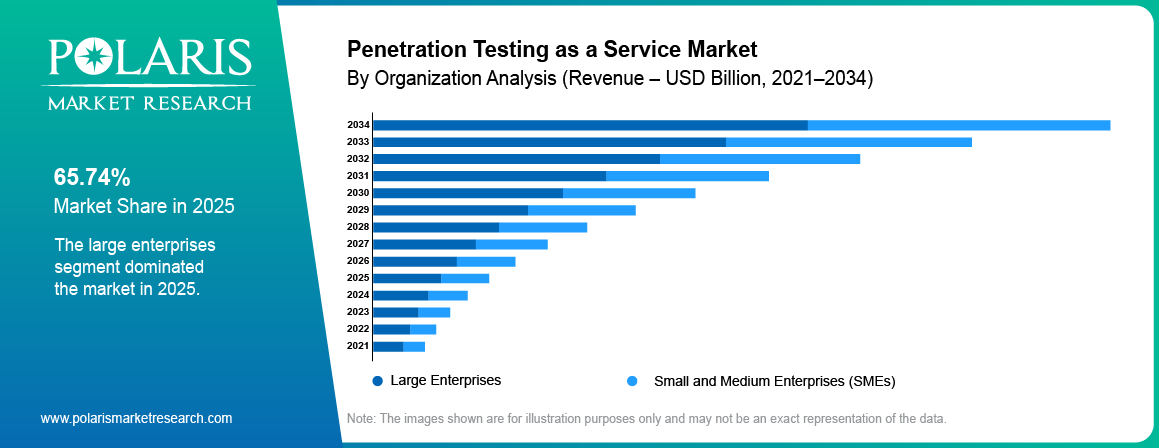
The large enterprises segment accounted for an 65.74% penetration testing as a service share in 2025. Large enterprises have IT environments involving many applications, network, and digital assets. These enterprises have a greater need for periodic security testing. In addition, larger cybersecurity budgets enable large enterprises to engage external security testing services alongside their internal cybersecurity teams. The PTaaS platform may help large enterprises manage testing procedures across different departments and technologies. In addition, PTaaS may assist large enterprises in periodic testing of their applications or infrastructures, which change often. Large enterprises may also benefit from using PTaaS to track testing and remediation efforts across different security teams.
The small and medium enterprises (SMEs) segment is projected to grow at an 26.48% CAGR. SMEs are increasingly paying attention to application and infrastructure security due to their growing adoption of digital platforms. Many firms in this category handle customer data, transactions, and other business information that must be protected. PTaaS can allow SMEs to get hold of specialized testing without having to establish a large security department for performing penetration tests. The service is also scalable depending on the systems that need to be tested. This option may help smaller firms manage cybersecurity spending. As more SMEs begin using digital technologies, demand for specialized security testing services can become a source of growth.
By Vertical
The BFSI segment accounted for an 28.42% share in 2025. Financial institutions such as banks and insurance companies handle confidential customer information and financial transactions through various online systems. Security tests have to be done on a consistent basis to detect any vulnerabilities in these systems. The PTaaS approach can help these financial institutions conduct such testing. There are also security and compliance requirements in this industry. This means they must document the security testing process. Financial institutions continue to develop their digital services. As such, the number of systems that require security assessment continues to rise.
The healthcare segment is projected to grow at an 27.36% CAGR. Healthcare companies are increasingly relying on interlinked solutions for keeping track of patient data, implementing clinical applications, telehealth solutions, and conducting various management operations. Since these solutions operate with sensitive patient data, security testing becomes one of the essential parts of IT activities within such companies. Moreover, hospitals and healthcare organizations usually perform vulnerability assessments regarding the use of applications by both employees and patients. PTaaS solution can offer healthcare organizations the opportunity to gain access to outside professionals who can conduct penetration testing. The tool can help with assessments whenever new software solutions are added, or existing applications are upgraded. With the expansion of digital solutions within healthcare companies, PTaaS market healthcare solutions can become increasingly popular among such customers.
Common PTaaS Use Cases
| Use case | What it covers | Example |
| Web and application testing | Security testing for websites, SaaS products, and web applications. | Aircall uses Cobalt for penetration testing of its communications platform. (source: cobalt.io) |
| API testing | Testing API endpoints, authentication, permissions, and access controls. | Rapyd used Bugcrowd for penetration testing of its API environment. (source: bugcrowd.com) |
| Network testing | Testing internal and external networks, systems, and network devices for security weaknesses. | Typical PTaaS engagements can include network infrastructure testing. |
| Cloud environment testing | Testing cloud workloads, identities, storage, configurations, and exposed services. | Cloud infrastructure can be included in PTaaS engagements based on the customer’s testing scope. |
| Testing after major changes | Testing following a product release, system update, or major configuration change. | Jack Henry used Synack to increase the frequency and scale of its penetration testing. (source: synack.com) |
| Remediation and re-testing | Checking reported vulnerabilities again after fixes have been made. | Pendo used Cobalt for re-testing after security findings were addressed. (source: cobalt.io) |
| Security testing during development | Bringing penetration testing into the development process instead of waiting until the final review. | PTaaS can support testing during development by allowing teams to request assessments as applications change. |
Source: Polaris Market Research Analysis
Regional Insights
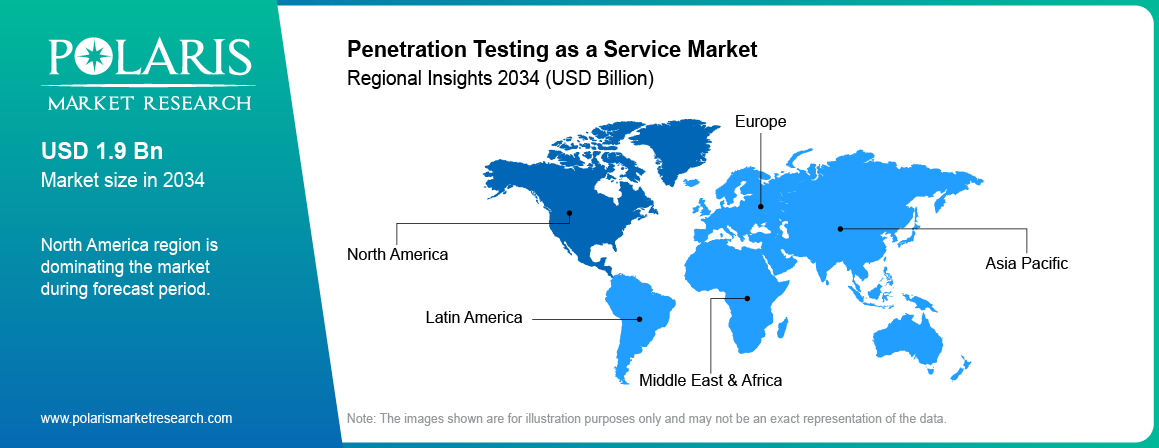
Regional PTaaS adoption varies with cybersecurity risks and digital infrastructure. Regulatory requirements and the security priorities of organizations across key markets also influence regional demand.
North America
North America held the largest penetration testing as a service market share of 39.84% in 2025. There is a mature market for cybersecurity in the region. External security testing is used by organizations to evaluate applications and cloud infrastructures. The U.S. plays a leading role in driving regional demand. This is because of the presence of a strong technology company base and digitally focused enterprises. Canada also drives regional growth as organizations strengthen application and infrastructure security. Demand is also driven by the need for regulatory compliance and rising awareness about the dangers of third-party security threats. PTaaS services also apply to companies where testing needs to be done at various phases of software development instead of being done in a single annual evaluation. All these factors contribute to continued use of PTaaS in the region.
Asia Pacific
The PTaaS market in Asia Pacific is projected to witness the fastest growth at an 25.74% CAGR. Countries such as China, Japan, India, South Korea, and Australia are witnessing increased digitalization, adoption of cloud, and software. This has led to an increase in the number of applications, systems, and online services that need security testing. Firms operating in the region are making more investments in their cybersecurity efforts due to the growth of their digital infrastructure. The emergence of e-commerce, fintech, online banking, and software services is contributing to this trend. Some firms have turned to using third-party cybersecurity firms for security testing expertise without creating a large internal team. In addition to this, the rising data protection regulations are forcing firms to reassess their testing procedures.
Europe
Europe accounted for an 23.76% share of the penetration testing as a service market in 2025. This region has an advanced cybersecurity ecosystem. It places greater emphasis on security assessments of digital systems and applications. Countries like Germany, the UK, France, Italy, and the Netherlands have developed technology and finance industries. This increases their need for penetration testing services. There are also regulatory policies in place that are shaping the cybersecurity posture of various organizations in the region. Regulations such as the NIS2 and DORA frameworks are making it more necessary for organizations to have better controls and tests in place. Businesses are increasingly turning to cloud services and expanding digital platforms. This increases the scope of systems that need to be assessed.
Latin America
The Latin America penetration testing as a service market is projected to grow at an 23.68% CAGR. Brazil, Mexico, and Argentina are major markets, due to increased adoption of digital services and online business portals. Financial services and fintech are among the critical segments for security testing because these sectors process sensitive information related to transactions and customers. Furthermore, e-commerce and cloud adoption trends are expanding the number of systems that require security testing. With the growth in digital operations, companies are increasingly resorting to third-party service providers that conduct security tests. This is supporting PTaaS demand in the region.
Middle East & Africa
The Middle East & Africa penetration testing as a service market is anticipated to grow at an 24.26% CAGR. UAE, Saudi Arabia, Israel, and South Africa are witnessing an increasing interest in the development of their digital infrastructure and cloud-based solutions. Security testing requirements are increasing in government platforms, financial services, and large businesses. Additionally, the region is showing increasing interest in securing critical infrastructure and sensitive corporate data. With the expansion of companies' digital reach, PTaaS can help provide external security expertise to perform assessments. These factors facilitate the use of penetration testing services across the region.
Competitive Landscape
The penetration testing as a service market includes several cybersecurity firms and testing specialists. The providers have differences in the services they offer and the industries where they operate. For example, some providers specialize in application security only, while others test applications, networks, clouds, and APIs. The delivery of services and testing frequency are also different for various providers. Many providers are upgrading their platforms to improve the testing process. Providers are developing new services related to API and artificial intelligence applications. Customer relationships continue to matter in this industry. Providers that offer a variety of testing services can cater to various needs. The market also includes providers that target a particular industry or organization size. Competition is likely to be tough as demand for flexible penetration testing services grows.
Key Players and Vendor Positioning
| PTaaS Providers | Positioning Tier | Delivery Model | PTaaS Offering |
| Astra IT Inc. / Czar Securities Private Limited (Astra Security) | Established Provider | Hybrid: automated + human-led | Continuous penetration testing for web applications, APIs, cloud, and infrastructure |
| BreachLock, Inc. | Established Provider | In-house experts + AI-assisted platform | Expert-led PTaaS across applications, APIs, networks, mobile, cloud, IoT, and DevOps |
| Leader | Crowdsourced researcher network + platform | PTaaS with security researchers for application, API, cloud, network, and other environments | |
| Cobalt.io, Inc. (Cobalt) | Leader | Vetted pentester network + platform | On-demand penetration testing with expert testers, reporting, remediation support, re-testing, and crowdsourced security testing |
| Emerging Provider | Human-led + platform-based | Penetration testing and security assessment services | |
| Edgescan Limited | Established Provider | Automated + expert-led | Hybrid penetration testing with automated discovery and human validation |
| FireCompass, Inc. | Emerging Provider | Automated + expert-led | Automated attack simulation and penetration testing |
| HackerOne Inc. | Leader | Crowdsourced researcher network + platform | Continuous offensive security and penetration testing through its security researcher community |
| ImmuniWeb SA | Established Provider | AI-assisted + human-led | Application, API, mobile, cloud, and infrastructure penetration testing |
| Intigriti NV | Established Provider | Crowdsourced researcher network + platform | Penetration testing and continuous security testing through vetted security researchers |
| NetSPI, Inc. | Leader | In-house experts + platform | PTaaS covering applications, APIs, cloud, networks, and specialized environments |
| Raxis, LLC | Established Provider | In-house expert-led | Application, network, cloud, social engineering, and physical penetration testing |
| Software Secured Inc. | Established Provider | In-house experts + platform | Application, API, mobile, cloud, and network penetration testing |
| Strobes Security, Inc. | Emerging Provider | Platform-based + expert-led | PTaaS combining automated testing, expert testing, reporting, and remediation tracking |
| Synack, Inc. | Leader | Vetted researcher network + platform | Point-in-time and continuous penetration testing supported by vetted researchers and AI |
Source: Polaris Market Research Analysis
Industry Developments
-
September 2026: NetSPI and Synack announced a merger that will combine NetSPI’s penetration testing platform with Synack’s security testing network. The transaction is expected to close in October 2026, subject to regulatory approval. (source: synack.com)
-
September 2026: Synack integrated its platform with Wiz. With the integration, the company aims to make penetration test findings available through Wiz’s Penetration Test Findings dashboard. This integration provides security professionals with one interface to analyze findings alongside cloud security information. (source: synack.com)
-
July 2026: Bugcrowd introduced Savant Pathseeker. The new offering continuously tests external web applications and APIs. This solution expands Bugcrowd’s service portfolio, including its security researchers’ network and automation features. (source: bugcrowd.com)
Future Outlook
The penetration testing as a service market is likely to see wider use as companies conduct regular security assessments and manage extensive digital environments. PTaaS vendors will continue extending their testing to applications, APIs, clouds, and other interconnected assets. Continuous threat exposure management (CTEM) pentesting can be implemented as one of the options for security programs, as it helps companies conduct regular testing of exposed assets and mitigate vulnerabilities. Moreover, PTaaS service providers may add more automation while ensuring active participation from security professionals in the testing process. It can help promote the usage of PTaaS services within security programs.
Research Methodology
The study defines the PTaaS market to include platform subscriptions, expert-led penetration testing delivered through a service platform, and crowdsourced penetration testing programs. One-time consulting work, standalone security scanning tools, and bug-bounty-only programs are outside the market scope.
The research uses company filings, annual reports, press releases, product information, regulatory documents, standards publications, and cybersecurity industry databases. Primary research includes discussions with PTaaS providers, enterprise security teams, managed security providers, and system integrators. These discussions help assess pricing and segment-level demand.
The market sizing approach involves both the bottom-up and top-down methods. The top-down approach begins with the budget allocated towards penetration testing and cybersecurity, and then narrows down to PTaaS. The bottom-up approach is based on revenue made by the vendors in different segments and regions. The two approaches are compared before the final estimate is established.
The base year is 2025. Forecasts are from 2026 through 2034. Forecast assumptions cover regulatory requirements and cloud and API adoption. They also take into account the use of AI-assisted testing. Market figures are re-verified at specified intervals, and the changes are logged accordingly. Values are expressed in USD billion, and rounding is consistently applied. Exchange rates are used to convert source data reported in other currencies.
Private-company revenue remains a limitation because detailed financial information is often unavailable. Market definitions also vary between publishers, so published estimates are compared only after reviewing differences in scope, currency, and methodology.
Penetration Testing as a Service Market Segmentation
| Segmentation Axis | Segments |
| By Deployment Mode | On-Premises · Cloud-Based · Hybrid |
| By Offering | Solution · Managed Services |
| By Testing Type | Cloud · Mobile Applications · Network Infrastructure · Social Engineering · Web Applications · Others |
| By Organization Size | Large Enterprises · Small and Medium Enterprises (SMEs) |
| By Vertical | BFSI · Healthcare · Retail & Ecommerce · Government · Energy & Utilities · IT & ITES · Telecom · Other Verticals |
| By Region | North America (US, Canada) · Europe (Germany, France, UK, Italy, Spain, Netherlands, Russia, Rest of Europe) · Asia Pacific (China, Japan, India, Malaysia, South Korea, Indonesia, Australia, Vietnam, Rest of Asia Pacific) · Middle East & Africa (Saudi Arabia, UAE, Israel, South Africa, Rest of Middle East & Africa) · Latin America (Mexico, Brazil, Argentina, Rest of Latin America) |
Source: Polaris Market Research Analysis
Penetration Testing as a Service Market Report Scope
What is counted: The market includes PTaaS platform subscriptions, expert-led penetration testing delivered through service platforms, and crowdsourced penetration testing programs.
| Report Attributes | Details |
| Market Size Value in 2025 | USD 0.58 billion |
| Market Size Value in 2026 | USD 0.71 billion |
| Penetration Testing as a Service Market Forecast 2034 | USD 3.68 billion |
| CAGR | 22.7% from 2026 to 2034 |
| Base Year | 2025 |
| Historical Data | 2021–2024 |
| Forecast Period | 2026–2034 |
| Quantitative Units | Revenue in USD billion and CAGR from 2026 to 2034 |
| Report Coverage | Revenue Forecast, Market Competitive Landscape, Growth Factors, and Industry Trends |
| Segments Covered |
|
| Regional Scope |
|
| Competitive Landscape |
|
| Report Format |
|
| Customization | Report customization as per your requirements with respect to countries, regions, and segmentation. |
Penetration Testing as a Service Market FAQ's
Penetration testing as a service is a security testing approach that brings together penetration testing and digital platforms. Organizations can perform their security testing, get the results, and even schedule re-testing under this single service offering.
The penetration testing as a service market size was valued at USD 0.58 billion in 2025. The market is projected to witness rapid growth. It is anticipated to grow to USD 3.68 billion by 2034.
The penetration testing as a service market CAGR is projected to be 22.7% from 2026 to 2034.
Acunetix, Checkmarx, Coalfire Labs, Core Security, Cyberhunter Solutions, Fireeye, Hackerone, IBM, Immuniweb, Indium Software, Isecurion, Micro Focus, and Netsparkar are among the key players in the market.
PTaaS is the process of testing certain applications, networks, or any other type of digital assets. The testers search for vulnerabilities and report them on the platform. The organization can then correct the identified problems and re-test again.
PTaaS provides a platform to manage tests, findings, remediation, and re-tests. Traditional penetration tests usually come with a one-time assessment that is followed by a report. PTaaS can help conduct regular tests and provide security teams with regular access to the results of the tests.
North America led with an 39.84% share in 2025. This is owing to strong cybersecurity regulations in the region. Asia Pacific is projected to grow at an 25.74% CAGR. Digital penetration and stronger cybersecurity regulations across the region are driving market expansion.
The BFSI segment held an 28.42% share in 2025. This is due to the high volume of sensitive data handled in the BFSI industry.
The cloud-based segment accounted for an 48.72% share in 2025. The strong preference for scalable delivery models across enterprises contributes to the segment’s major share.
Key market players include Astra IT Inc./Czar Securities Private Limited (Astra Security); BreachLock, Inc.; Bugcrowd Inc.; Cobalt.io, Inc. (Cobalt); DeepStrike, Inc.; Edgescan Limited; FireCompass, Inc.; HackerOne Inc.; ImmuniWeb SA; Intigriti NV; NetSPI, Inc.; Raxis, LLC; Software Secured Inc.; Synack, Inc.; and Strobes Security, Inc.
PTaaS can be highly effective for small or mid-sized firms that do not have substantial numbers of security personnel within their organization. This way, they can use penetration testing for SMEs services without necessarily building an internal team.
PTaaS could assist organizations in meeting their security testing needs within industry and regulatory frameworks. Testing reports, findings, remediation, and re-testing could serve as documentation to ensure compliance with the requirements. These vary from one framework and industry to another.
One of the key challenges hindering the PTaaS market is the expensive nature of the services provided. There is also the issue of data confidentiality since testing could reveal sensitive information. Compatibility of PTaaS services with security tools already used by organizations is another challenge. Poorly defined test scope and false positives could also increase workload.

Download Sample Report of Penetration Testing as a Service Market
Please fill out the form to request a customized copy of the research report.


