
Pressure Sensitive Tapes Market Share, Size, Trends, Industry Analysis Report, 2026 - 2034
REPORT DETAILS
Pressure Sensitive Tapes Market Summary
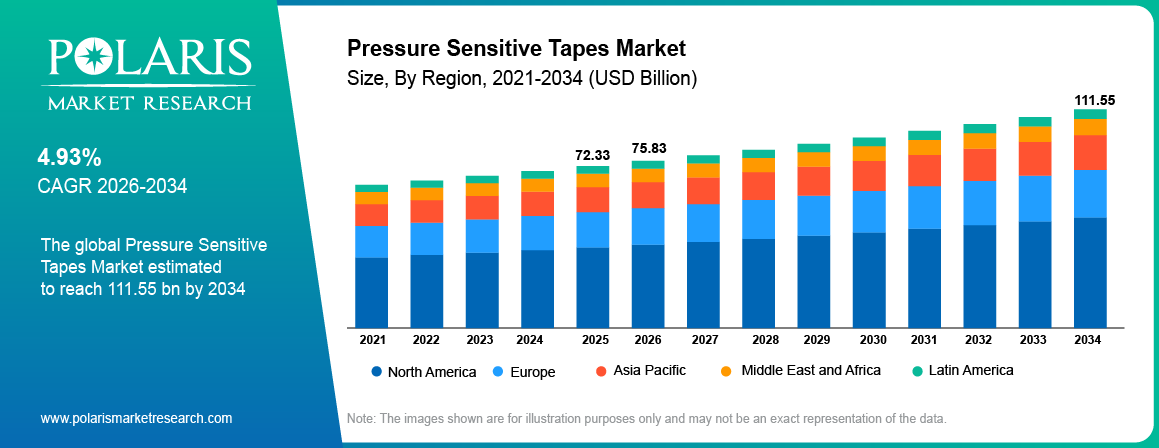
The global pressure sensitive tapes market was valued at USD 72.33 billion in 2025 and is expected to grow at a CAGR 4.93% during the forecast period. These are manufactured using thin, flexible material with single- or double-sided coating. These tapes can be applied to varied substrates with clean and dry surfaces with pressure.
Market Statistics
Pressure Sensitive Tapes Market Key Takeaways
- Asia Pacific accounted for a 41.0% market share in 2025. Rapid automotive and electronics manufacturing expansion contributes to the regional market share.
- North America is projected to witness steady growth at a 4.40% CAGR. Strong demand for the automotive and packaging industries drives the market growth in the region.
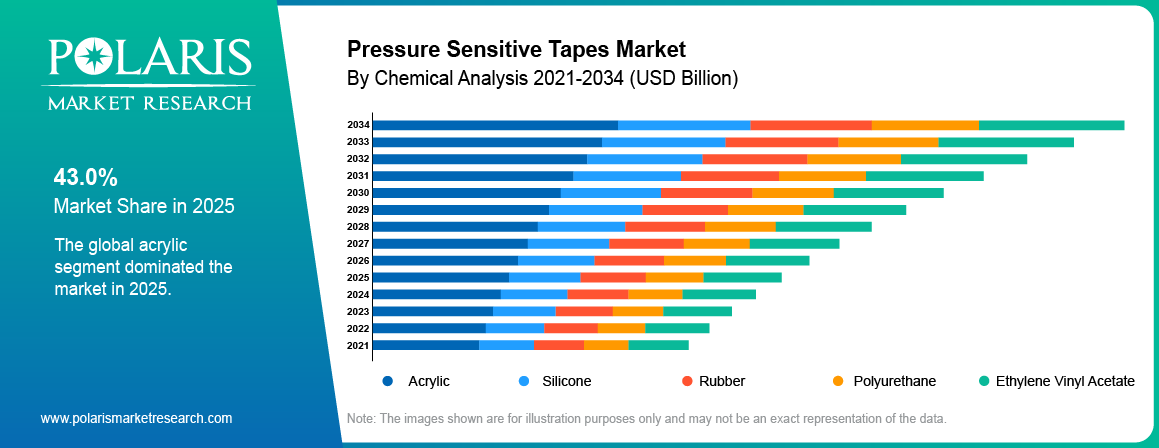
- The acrylic segment dominated the market with a 43.0% share in 2025. The segment’s dominance is driven by strong adhesion and UV resistance.
- The hot melt segment is projected to witness the highest CAGR of 5.36%. The segment’s growth is fueled by quick bonding and increasing use in packaging, hygiene, and industrial sectors.
- The aerospace segment is anticipated to account for a 5.20% CAGR. This is because pressure sensitive tapes offer strength and integrity.
Note: Figures and projections outlined in this report are the result of Polaris Market Research’s proprietary analytical processes, grounded in the latest available datasets and market observations.
What are Pressure Sensitive Tapes?
These tapes provide a bond between two surfaces, which is influenced by the amount of pressure applied. They are widely used to bond these low-energy substrate materials efficiently and effectively is another important factor that is anticipated to offer a new opportunity in the forecast period.
Moreover, the increase in regulations in the adhesive sector and the rise in demand for sustainability have forced manufacturers operating in the industry to develop bio-based tapes. Manufacturers are inclined toward the development of sensitive adhesives that are derived from vegetable oil, lignin, carbohydrates, and terpenes.
Improved weathering of waterborne acrylic adhesive tapes makes them an ideal choice of material for exterior decorative applications, outdoor tapes, and outdoor signs. The addition of additives such as neutralizing agents, surfactants, wetting agents, plasticizers, cross-linkers, thickeners, preservatives, and defoamers helps to enhance shear strength and peel strength and improves compatibility and mechanical stability.
These factors are predicted to offer a new opportunity in the global market. Moreover, the predominant trend towards the use of lightweight and low-cost engineered plastic materials in sectors such as automotive, electronics, aerospace, and construction has created a need that helps to bond efficiently to these materials.
Acrylic vs Rubber vs Silicone Adhesive Tapes
| Parameters | Acrylic Adhesive Tapes | Rubber Adhesive Tapes | Silicone Adhesive Tapes |
| Adhesive Strength | Consistent adhesion over various surfaces | High adhesive strength immediately after application | Adhesive tape for specialized surfaces |
| Heat Resistance | Resistant to heat exposure | Low to moderate heat resistant | High heat resistance |
| Longevity | Low to high long-term adhesive performance | Suitable for short and medium term performance | High longevity for demanding industrial uses |
| Flexibility | Flexible for varied industrial applications | Flexible tapes applicable in many cases | Maintains performance despite tough conditions |
| Resistance to Moisture | High resistance to environmental elements | Moderate resistance to moisture | Highest resistance to moisture and extreme environments |
| Industrial Applications | Used in packaging, automotive, construction, electronics, and general industries | Used in packaging, masking, carton sealing, and general purposes | Electronics industry and general industrial use |
AI Impact on Pressure Sensitive Tapes Market
- AI speeds product development by analyzing trends and optimizing solutions.
- AI improves supply chains by forecasting demand and managing inventory efficiently.
- AI enhances quality control through real-time monitoring and defect detection.
- AI uses customer feedback to customize tapes for specific industry needs.
Sustainable and Eco-Friendly Adhesive Tape Trends
Sustainability has become a key consideration within the adhesive tape industry as companies aim to lessen their environmental impact and comply with changing regulations. They are exploring methods such as the development of recyclable backings, solvent-free adhesives, bio-degradable tapes, and energy-efficient manufacturing processes in order to achieve their sustainability objectives. Green tape products are now increasingly sought after by industries such as packaging, consumer goods, automobiles, and electronics since they need tapes that align with their principles of the circular economy. Advancements have been made in areas such as bioadhesives and paper backing tapes as well.
Market Dynamics
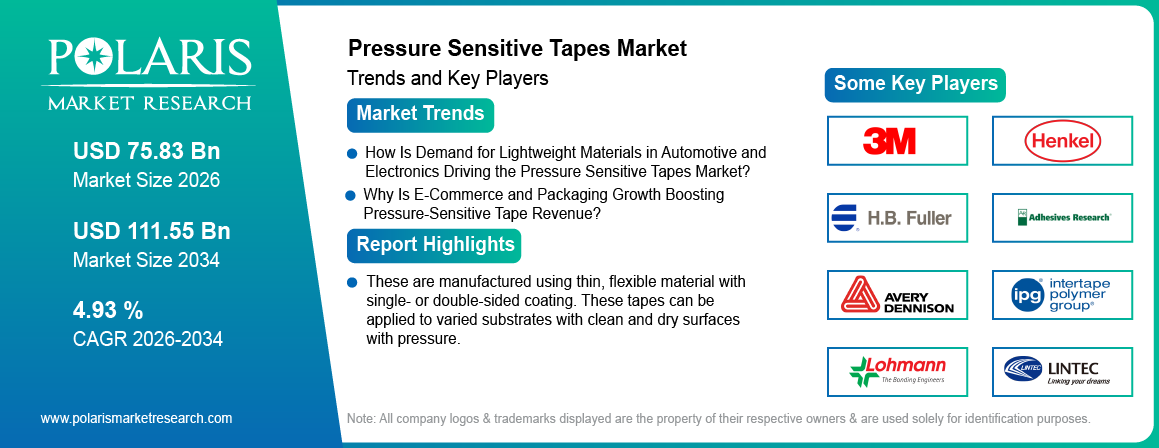
How Is Demand for Lightweight Materials in Automotive and Electronics Driving the Pressure Sensitive Tapes Market?
Automakers and electronics manufacturers are replacing mechanical fasteners, rivets, and liquid adhesives with pressure-sensitive tapes to reduce weight and simplify assembly. As OEMs move toward plastics, composites, and aluminum under the broader automotive lightweight material trend, they need bonding solutions that stick reliably to low-surface-energy substrates without welding or drilling. Pressure-sensitive tapes do this while also providing vibration damping, noise reduction, and sealing in a single step. Electric vehicles add further demand, using high-performance tapes for battery pack assembly, cell insulation, thermal interface bonding, and wire harness wrapping. In consumer electronics, thin double-sided acrylic and silicone tapes mount displays, bond touch panels, and secure flexible circuits in increasingly slim smartphones, tablets, and wearables, where liquid adhesives would add cure time and mess. This shift also supports growth in adjacent categories such as automotive adhesives and sealants. It helps explain why the acrylic segment held a 43.0% share in 2025, given its strong adhesion and UV resistance, and why Asia Pacific, the global hub for vehicle and electronics production, accounted for 41.0% of the market.
Why Is E-Commerce and Packaging Growth Boosting Pressure-Sensitive Tape Revenue?
Packaging is the largest volume application for pressure sensitive tapes. The rapid growth of online retail has multiplied the number of parcels that need to be sealed, labeled, and secured every day. Carton sealing tapes, tamper-evident tapes, and reinforced filament tapes keep shipments intact across multi-stage fulfillment and last-mile delivery networks. Fulfillment centers increasingly run automated case sealers, which favor hot melt and acrylic tapes that bond instantly at high line speeds. Beyond corrugated boxes, the expansion of the flexible packaging industry, spanning food, pharmaceuticals, and consumer goods, is raising demand for resealable closures, laminated structures, and label stock that rely on pressure sensitive adhesives. Brand owners also use printed tapes as a low-cost branding and anti-tampering tool. Durable, printable facestocks such as synthetic paper are gaining traction in shipping labels for the same reason. In North America, established logistics infrastructure and growing online commerce support a projected 4.40% CAGR. The hot melt technology segment, widely used in packaging, is expected to grow at the fastest rate, a 5.36% CAGR through 2034.
How Are Construction and Infrastructure Projects Fueling Demand for Weather-Resistant Adhesive Tapes?
Construction is becoming a high-value end use for pressure sensitive tapes as builders look for faster, cleaner alternatives to screws, nails, and wet sealants. Weather-resistant tapes are used for window and door installation, roofing underlayment, vapor and air barriers, insulation facing, HVAC duct sealing, and façade panel mounting. These applications need long-term resistance to UV exposure, moisture, and temperature swings, which favors waterborne acrylic and silicone formulations known for strong weathering performance. Energy-efficiency codes add momentum, because airtight building envelopes require reliable sealing at joints and penetrations, an area also covered by the building envelope adhesives and sealants market. Public infrastructure, residential housing programs, and commercial projects in China, India, and Southeast Asia keep regional demand strong, supported by rapid urbanization. Tapes also cut installation time and labor costs compared with mechanical fixing, which matters on job sites facing skilled-labor shortages. As a result, pressure sensitive tapes increasingly compete with and complement products in the wider construction adhesives market, particularly in prefabricated and modular construction where speed and consistency count.
What Innovations in Backing Materials, Adhesives, and Eco-Friendly Tapes Are Creating New Market Opportunities?
Material innovation is widening the range of applications where pressure sensitive tapes can replace other joining methods. On the adhesive side, manufacturers are refining acrylic, silicone, and rubber chemistries for higher temperature resistance, stronger cross-linking, and better adhesion to difficult substrates. Hot melt and radiation-cured technologies are gaining share because they eliminate solvents and speed up production, mirroring growth in the broader hot-melt adhesives market. Backing materials are also evolving, with thinner films, foam carriers, and specialty substrates engineered for electronics, medical, and aerospace uses.
Sustainability is now a central driver of innovation. Producers are developing:
- recyclable and paper-based backings
- solvent-free adhesives
- biodegradable tapes
- adhesives made from renewable feedstocks such as vegetable oils, lignin, carbohydrates, and terpenes
Recent industry moves reflect this shift. In February 2026, Henkel announced a collaboration with Sekab to speed up the transition to bio-based adhesive raw materials. In April 2026, WACKER presented a skin-friendly, gamma-sterilizable silicone PSA for medical use at Tape Week 2026. These advances make eco-friendly tapes a key growth avenue across the wider adhesives and sealants industry.
Segment Analysis
The pressure-sensitive tapes market is segmented by chemical composition, technology, end-use, and region. Four segments shape most of the market's value and growth: acrylic chemistry, hot melt technology, and the packaging and aerospace end uses.
Why Does the Acrylic Segment Lead the Pressure-Sensitive Tapes Market by Chemical Composition?
Acrylic is the leading chemistry in the pressure sensitive tapes market, holding a 43.0% share in 2025. Its lead comes from a balance of properties that few other chemistries match: strong adhesion to metals, glass, and plastics, excellent UV and oxidation resistance, and stable performance across a wide temperature range. These traits make acrylic the default choice for long-life outdoor, automotive, and construction applications where a bond must last for years. Waterborne and hot melt acrylic grades are also gaining ground as manufacturers cut solvent use, which keeps acrylic central to the industry's shift toward low-VOC, sustainable tape formulations.
Why Is Hot Melt the Fastest-Growing Pressure Sensitive Tape Technology?
Hot melt is the fastest-growing technology segment, projected to expand at a 5.36% CAGR through 2034. Hot melt adhesives are 100% solids, so they are applied molten and set almost instantly as they cool, with no drying ovens or solvent recovery. This fast setup suits high-speed carton sealing, hygiene products, and industrial assembly lines, and the technology is also used in aircraft interiors. Being solvent-free, hot melt helps converters meet tightening VOC regulations while lowering energy costs. Its main trade-off is lower heat resistance than solvent-based or radiation-cured systems, which still lead in demanding high-temperature uses. The table below compares the four technologies.
Water-Based vs Solvent-Based vs Hot Melt vs Radiation-Cured Pressure Sensitive Tapes
| Parameter | Water-Based | Solvent-Based | Hot Melt | Radiation-Cured |
| How it sets | Water evaporates in a drying oven | Solvent evaporates; solvent recovery needed | 100% solids; sets as it cools | 100% solids; cross-linked by UV or electron beam |
| VOC emissions | Low | High | Near zero (solvent-free) | Near zero (solvent-free) |
| Production speed | Moderate (drying step) | Moderate | Very fast | Fast |
| Heat and chemical resistance | Moderate | High | Lower; softens at high heat | High |
| Typical applications | Labels, packaging, construction tapes | Automotive, electronics, medical, high-performance tapes | Carton sealing, hygiene, aircraft interiors, industrial assembly | Electronics, specialty and premium industrial tapes |
| Growth outlook | Rising on low-VOC regulations | Steady in high-performance niches | Fastest-growing: 5.36% CAGR (2026–2034) | Emerging; premium positioning |
How Does the Packaging Segment Shape Pressure Sensitive Tape Demand?
Packaging is one of the largest end-use segments for pressure sensitive tapes, spanning carton sealing, bundling, labeling, tamper-evident security tapes, and flexible packaging laminates for food, beverages, and pharmaceuticals. Demand tracks the growth of e-commerce, organized retail, and global trade, as every shipped parcel needs a reliable seal. Packaging operations favor tapes that bond instantly on automated case sealers, which is why hot melt and acrylic tapes on BOPP backings dominate this space. The segment is price-sensitive and volume-driven, so competition centers on cost, consistent quality, and supply reliability. Pressure to make packaging recyclable is pushing demand toward paper-backed and solvent-free tapes.
Why Is Aerospace a High-Growth End-Use Segment for Pressure Sensitive Tapes?
Aerospace is a high-growth end-use segment, expected to register a 5.20% CAGR during the forecast period. Commercial and military aircraft use pressure sensitive tapes for logos, decorative cabin panels, carpet protection, window masking, and assembly work. Cabin interiors are largely built from plastics such as polyvinyl fluoride and polyamide films, and tapes secure these films to rigid substrates without the weight of mechanical fasteners. Aerospace tapes must meet strict flame, smoke, and toxicity requirements, so the segment is smaller in volume but high in value per square meter. Rising aircraft deliveries and cabin retrofit programs support steady demand. The table below shows how the key end uses differ.
Packaging vs Automotive & Electronics vs Aerospace: How End-Use Demand for Pressure-Sensitive Tapes Differs
| Parameter | Packaging | Automotive & Electronics | Aerospace |
| Typical tape types | Carton sealing, strapping, labeling, security tapes | Double-sided foam, wire harness, masking, display-bonding tapes | Cabin film-mounting, masking, splicing, flame-retardant tapes |
| Preferred chemistry | Acrylic and rubber | Acrylic and silicone | Acrylic and silicone |
| Critical performance need | Instant tack, high line speed, low cost | Long-term durability, heat and vibration resistance, thin bondlines | Flame/smoke compliance, weight saving, long service life |
| Volume vs value | Very high volume, low unit value | Medium volume, high value | Low volume, highest unit value |
| Main buying driver | Cost per roll and supply reliability | OEM qualification and design-in | Certification and regulatory approval |
| Growth signal | Tied to e-commerce and trade volumes | Supported by EV adoption and lightweighting | 5.20% CAGR (2026–2034) |
Which Pressure Sensitive Tape Should You Choose for Each Application?
Buyers rarely choose a tape by chemistry or technology alone; they start from the application. The guide below maps the most common high-value applications to the adhesive chemistry, technology, and backing that typically perform best.
Pressure Sensitive Tape Selection Guide: Recommended Chemistry, Technology, and Backing by Application
| Application | Recommended Chemistry | Recommended Technology | Typical Backing | Must-Have Performance |
| E-commerce carton sealing | Rubber or acrylic | Hot melt | BOPP film | Instant tack on recycled corrugate, high line speed |
| EV battery pack assembly and insulation | Acrylic or silicone | Solvent-based or radiation-cured | PET or polyimide film | Dielectric strength, heat resistance, flame retardance |
| Smartphone and display bonding | Acrylic | Solvent-based or radiation-cured | Thin PET or carrier-free transfer tape | Thin bondline, clarity, drop-shock resistance |
| Automotive exterior trim and emblems | Acrylic | Solvent-based or radiation-cured | Acrylic foam | Weathering, temperature cycling, permanent bond |
| Aircraft cabin interiors | Acrylic | Hot melt or solvent-based | Film or foam | Flame/smoke compliance, light weight |
| Windows, roofing, and building envelope sealing | Waterborne acrylic or butyl rubber | Water-based | PE film, foil, or nonwoven | UV and moisture resistance, long-term airtightness |
| Medical wound care and wearables | Silicone or acrylic | Water-based or solvent-based | Nonwoven or film | Skin-friendly, gentle removal, sterilization compatibility |
Report Segmentation Outlook
The market is primarily segmented based on chemical composition, technology, end-use, and region.
| By Chemical Composition | By Technology | By End-Use | By Region |
|
|
|
|
Source: Polaris Market Research Analysis
Regional Insights
Why Does Asia Pacific Lead the Pressure Sensitive Tapes Market?
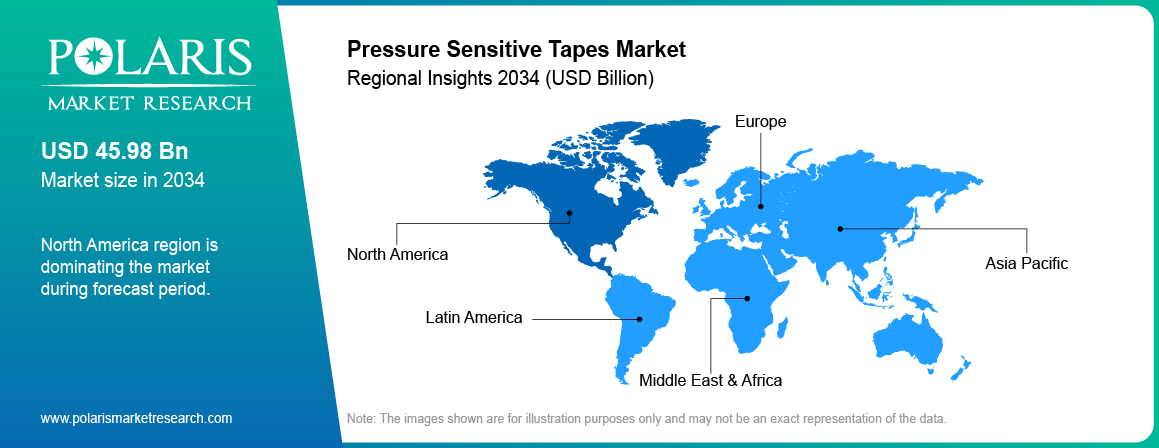
Asia Pacific accounted for a 41.0% share of the pressure sensitive tapes market in 2025, making it the largest regional market. The region's lead comes from its role as the world's manufacturing base for automobiles, electronics, and consumer goods, all major users of pressure sensitive tapes. China anchors demand, with rapid industrialization and urbanization driving growth in residential construction and public infrastructure. Japan and South Korea add high-value demand from electronics and display manufacturing, while India and Indonesia are expanding on rising passenger car penetration, organized retail, and e-commerce. Cost-competitive production and dense supply chains help keep the region ahead through 2034.
What Is Driving Pressure Sensitive Tapes Market Growth in North America?
North America is projected to grow at a steady 4.40% CAGR during the forecast period. Demand is spread across packaging, automotive, healthcare, electronics, and general manufacturing, supported by a well-established industrial base and robust logistics infrastructure. The U.S. is the largest contributor, where growing online commerce keeps carton-sealing and labeling tape volumes high. Rising investment in lightweight vehicles, EV programs, and medical devices is lifting demand for high-performance specialty tapes. Growing awareness of sustainable packaging and stricter regulatory compliance are also pushing manufacturers toward eco-friendly, low-VOC tapes, while Canada adds demand from construction and building envelope applications.
How Are Automotive Demand and Sustainability Rules Shaping the Europe Pressure Sensitive Tapes Market?
Europe is a mature, innovation-led market for pressure sensitive tapes, with Germany, France, the UK, Italy, and Spain as key contributors. The region's strong automotive industry, particularly in Germany, sustains demand for high-performance tapes used in vehicle assembly, interior trim, and EV battery systems. Europe is also home to leading tape and adhesive producers such as tesa SE, Henkel, and Lohmann, which keeps the region at the forefront of product development. Strict rules on VOC emissions and packaging waste are accelerating the shift toward solvent-free, recyclable, and bio-based tapes, a direction reflected in Henkel's February 2026 collaboration with Sekab on bio-based adhesive raw materials.
Why Is the Middle East & Africa an Emerging Market for Pressure Sensitive Tapes?
The Middle East & Africa is an emerging market for pressure sensitive tapes, with Saudi Arabia, the UAE, Israel, and South Africa as the main contributors. Demand is closely tied to construction and infrastructure, as large-scale real estate, tourism, and urban development projects in the Gulf need tapes for glazing, insulation, HVAC duct sealing, and building envelope applications. The region's extreme heat and UV exposure favor acrylic and silicone tapes with strong weathering resistance. Expanding logistics hubs and e-commerce in the UAE and Saudi Arabia are lifting packaging tape demand, while economic diversification programs support new manufacturing activity across the region.
Competitive Insight
The adhesive and tapes market features a mix of global conglomerates and specialized manufacturers competing on technology, end-use expertise, and geographic reach. 3M, Henkel, and Avery Dennison lead through broad portfolios spanning acrylic, silicone, rubber, polyurethane, and EVA chemistries, serving packaging, automotive, healthcare, electronics, and construction. H.B. Fuller and Saint-Gobain leverage strong industrial and construction ties, while tesa SE and Nitto Denko differentiate through advanced, application-specific tape solutions. LINTEC, Lohmann, and NICHIBAN focus on precision and electronics-grade products, competing on quality rather than scale. Intertape Polymer and Shurtape emphasize packaging and industrial tapes, competing on cost and distribution. ORAFOL and PPI target niche graphics and specialty segments. Overall, competition centers on innovation in water-based, hot melt, solvent-based, and radiation-cured technologies, alongside regional expansion and customer-specific solutions.
Some of the players include 3M Company; Adhesives Research, Inc.; Avery Dennison Corporation; H.B. Fuller; Henkel AG & Co. KGaA; Intertape Polymer Group Inc. (IPG); LINTEC Corporation; Lohmann GmbH & Co. KG; NICHIBAN Co., Ltd.; Nitto Denko Corporation; ORAFOL Europe GmbH; PPI Adhesive Products Ltd.; Saint-Gobain; Shurtape Technologies, LLC; tesa SE.
Key Companies
- 3M Company
- Adhesives Research, Inc.
- Avery Dennison Corporation
- H.B. Fuller Comapny
- Henkel AG & Co. KGaA
- Intertape Polymer Group Inc. (IPG)
- Mactac as a LINTEC company
- Lohmann GmbH & Co. KG
- NICHIBAN Co., Ltd.
- Nitto Denko Corporation
- ORAFOL Europe GmbH
- PPI Adhesive Products Ltd.
- Saint-Gobain
- Shurtape Technologies, LLC
- tesa SE
- Solventum Corporation
- Scapa Industrial (Mativ Holdings)
- Sekisui Chemical Co., Ltd.
- Teraoka Seisakusho Co., Ltd.
The prominent market players operating in the global market are investing in R&D and technological advancements to develop new products to enhance their offerings. Several companies are collaborating with each other to strengthen market presence and enter new emerging markets.
Recent Developments
- April 2026: WACKER announced that it would present new silicone adhesive research at Tape Week 2026. The company also revealed highlighting a skin-friendly, gamma-sterilizable silicone PSA technology for medical applications. (source: wacker.com)
- February 2026: Henkel Adhesive Technologies announced a strategic collaboration with Sekab. According to Henkel, the partnership focuses on accelerating the shift from fossil-based to bio-based raw materials in the production of adhesives. (source: henkel.com)
Pressure Sensitive Tapes Market Report Scope
| Report Attributes | Details |
| Market size value in 2025 | USD 72.33 billion |
| Market size value in 2026 | USD 75.83 billion |
| Revenue forecast in 2034 | USD 111.55 billion |
| CAGR | 4.93% from 2026 - 2034 |
| Base year | 2025 |
| Historical data | 2021 - 2024 |
| Forecast period | 2026 - 2034 |
| Quantitative units | Revenue in USD billion and CAGR from 2026 to 2034 |
| Segments covered | By Chemical Composition, By Technology, By End-Use, By Region |
| Regional scope | North America, Europe, Asia Pacific, Latin America; Middle East & Africa |
| Key companies | 3M Company; Adhesives Research, Inc.; Avery Dennison Corporation; H.B. Fuller; Henkel AG & Co. KGaA; Intertape Polymer Group Inc. (IPG); LINTEC Corporation; Lohmann GmbH & Co. KG; NICHIBAN Co., Ltd.; Nitto Denko Corporation; ORAFOL Europe GmbH; PPI Adhesive Products Ltd.; Saint-Gobain; Shurtape Technologies, LLC; tesa SE. |
Source: Polaris Market Research Analysis
Pressure Sensitive Tapes Market FAQ's
• The global market size was valued at USD 72.33 billion in 2025 and is projected to grow to USD 111.55 billion by 2034.
• The global market is projected to register a CAGR of 4.93% during the forecast period.
• Asia Pacific accounted for a 41.0% market share in 2025.
The pressure sensitive tapes market is led by 3M Company, Henkel AG & Co. KGaA, and Avery Dennison Corporation, which compete through broad portfolios across acrylic, silicone, rubber, and other adhesive chemistries. Other key players include Nitto Denko Corporation, tesa SE, H.B. Fuller Company, Saint-Gobain, LINTEC Corporation, Lohmann GmbH & Co. KG, NICHIBAN Co., Ltd., Intertape Polymer Group Inc., Shurtape Technologies, LLC, Adhesives Research, Inc., ORAFOL Europe GmbH, and PPI Adhesive Products Ltd.
• The acrylic segment dominated the market with a 43.0% share in 2025.
• The hot melt segment is projected to witness the highest CAGR of 5.36%.
Download Sample Report of Pressure Sensitive Tapes Market
Please fill out the form to request a customized copy of the research report.


