
Sacral Nerve Stimulation Market Demand, Industry Share, 2026-2034
REPORT DETAILS
Sacral Nerve Stimulation Market Summary
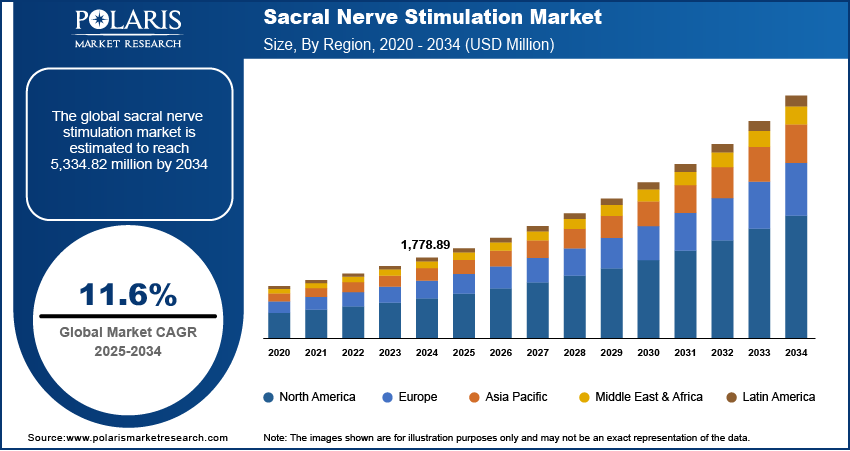
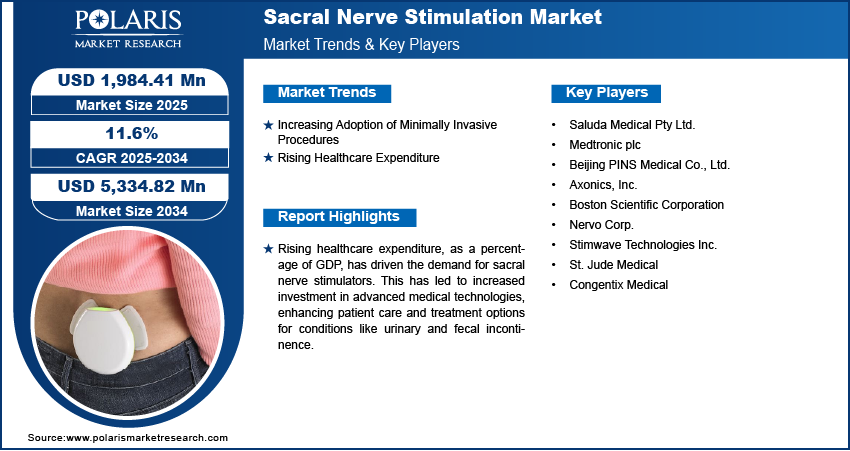
The global sacral nerve stimulation market size was valued at USD 1.84 billion in 2025, exhibiting a CAGR of 11.6% from 2026 to 2034. The market is driven by the increasing prevalence of urinary and fecal incontinence, advancements in technology, the growing adoption of minimally invasive procedures, and rising healthcare expenditures.
Market Statistics
Key Takeaways
-
North America accounted for 58.7% share of the market revenue in 2025, owing to the growing need for minimally invasive sacral nerve stimulation procedure
-
Asia Pacific is anticipated to witness a CAGR of 13.4% in 2026-2034 attributable to developing healthcare system and rising diagnosis on bladder disorders.
-
The devices segment is projected to register a CAGR of approximately 12.1% from 2026 to 2034 fueled by technological advancements.
-
The urinary and fecal incontinence segment accounted for the highest revenue share of 46.3% in 2025. The increasing prevalence of sacral neuromodulation when traditional treatment methods do not adequately control symptoms is driving the leading segment.
-
The urge incontinence segment is expected to grow at a CAGR of 12.2% during 2026-2034, attributable to the rising incidence and diagnosis of overactive bladder.
-
Based on end users, hospitals possessed the largest share of 57.8% in 2025 due to availability of urologists, colorectal experts, certified doctors, diagnostic services and the necessary facilities for sacral nerve stimulator implantation.
Industry Dynamics
- The increasing prevalence of urinary and fecal incontinence is driving demand for effective treatment options such as sacral nerve stimulation, boosting market growth.
- Technological advancements improving the affordability and performance of sacral nerve stimulators are making them more accessible to both healthcare providers and patients.
- Rising healthcare expenditures enable investment in advanced medical technologies, including sacral nerve stimulators, supporting the growth of the sacral nerve stimulation market.
- Increased demand for non-invasive treatments for conditions such as incontinence offers a chance to expand market reach for sacral nerve stimulation solutions.
- High treatment costs and complex reimbursement processes can limit accessibility for some patients, affecting the broader market penetration.
Source: Polaris Market Research Analysis
To Understand More About this Research: Download Sample Report
Sacral nerve stimulation is a medical procedure that involves implanting a device to deliver electrical impulses to the sacral nerves, which can help regulate bowel and bladder function. It's often used to treat conditions such as overactive bladder, urinary incontinence, and chronic constipation when other treatments have been ineffective.
The increasing prevalence of urinary and fecal incontinence is driving the sacral nerve stimulation market growth. For instance, according to the International Foundation for Gastrointestinal Disorders, urinary incontinence affects about 10% of men and a higher percentage of women. This growing incidence, particularly among aging populations, has raised the demand for effective treatment options. As awareness about the benefits of sacral nerve stimulation in managing these conditions increases, more patients and healthcare providers are pursuing this solution, leading to the growth of the market.
The sacral nerve stimulation market is likely to witness exponential growth during the forecast period, owing to advancements in technology that make the devices more effective, durable, and convenient for patients. As of 2026, Medtronic's InterStim portfolio also includes the InterStim X recharge-free neurostimulator, which boasts more than 10 years of battery life at the default therapy settings and it is capable of lasting up to 15 years based on low-energy settings. Medtronic’s InterStim Micro rechargeable system is the world’s smallest full-body 1.5T and 3T MRI conditional spinal cord stimulator, and is fully rechargeable with a 20 minutes per day recharge commitment. (Source: medtronic.com) In fact, InterStim therapy has been delivered to over 375,000 patients worldwide, demonstrating its increasing clinical acceptance. These improvements in battery life, device size, MRI compatibility, and patient-friendly programming are facilitating new treatment options and sacral nerve stimulation market growth.
Market Dynamics
Increasing Adoption of Minimally Invasive Procedures
The sacral nerve stimulation market is growing due to the increasing adoption of minimally invasive surgeries. For instance, according to the National Library of Medicine, so far, minimally invasive procedures have an adoption rate of 80% to 90%. Patients and healthcare providers are increasingly looking for less invasive treatment options that offer faster recovery times and fewer complications. Sacral nerve stimulation, which is a minimally invasive procedure, has become an attractive choice for managing conditions such as urinary and fecal incontinence. This shift in preference is encouraging more healthcare facilities to adopt advanced neuromodulation therapies, thereby driving the demand for sacral nerve stimulation devices and supporting market growth.
Rising Healthcare Expenditures
Rising healthcare expenditure is driving the development of the sacral nerve stimulation market by increasing the ability of healthcare systems to invest in advanced medical technologies and specialized treatment solutions. According to the OECD’s Health at a Glance 2025 report, healthcare spending across OECD countries was estimated to account for approximately 9.3% of GDP, compared with 8.8% before the COVID-19 pandemic. (Source: oecd.org) Higher healthcare spending supports investment in advanced neuromodulation systems, diagnostic infrastructure, and specialist care required for sacral nerve stimulation procedures. It also enables hospitals and specialty clinics to expand treatment access for conditions such as urinary incontinence, fecal incontinence, and overactive bladder. Thus, sustained healthcare expenditure and greater investment in innovative medical technologies are expected to increase the adoption of sacral nerve stimulators and positively influence market growth.
Source: Polaris Market Research Analysis
Segment Insights
Market Evaluation Based on Product Type
The global sacral nerve stimulation market segmentation, based on product type, includes devices and accessories. The devices segment is projected to register a CAGR of approximately 12.1% from 2026 to 2034. This growth is fueled by technological advancements in device design, such as miniaturization and enhanced functionality, improving patient outcomes and satisfaction. Additionally, the introduction of innovative products with rechargeable systems is attracting more patients and healthcare providers due to the convenience, cost-effectiveness, and sustainability these systems offer, further propelling the segment’s growth in the global market.
Market Assessment by End User Outlook
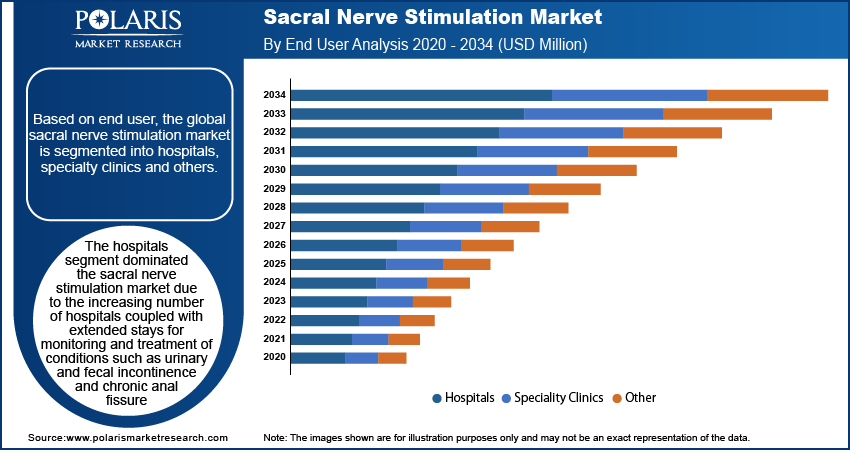
The sacral nerve stimulation market segmentation, based on end user, includes hospitals, speciality clinics, and others. The hospital segment possessed the largest share of 57.8% in 2025. This growth is attributed to the increase in hospital admissions and extended stays for monitoring and treatment of conditions such as urinary and fecal incontinence and chronic anal fissure. Hospitals are generally in high demand due to the availability of resources and skilled professionals. Also, they are backed by large investments in the procurement of expensive machines and a skilled workforce to handle advanced machinery.
Source: Polaris Market Research Analysis
Regional Analysis
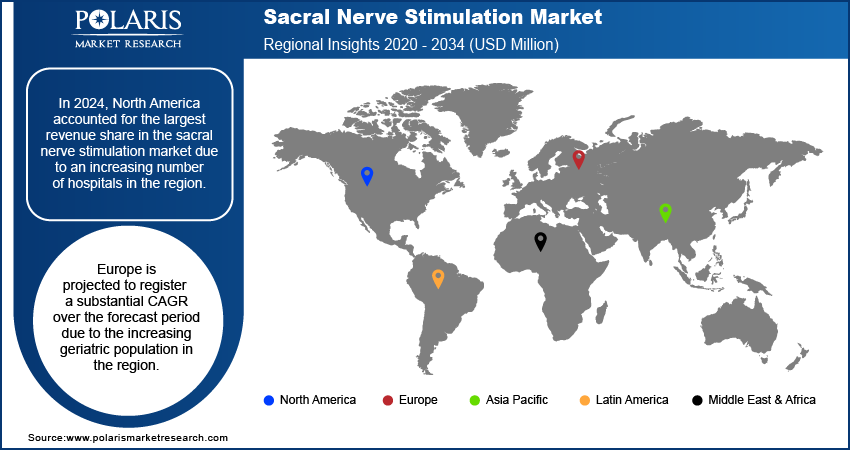
By region, the study provides the sacral nerve stimulation market insights into North America, Europe, Asia Pacific, Latin America, and the Middle East & Africa. North America accounted for 58.7% share of the market revenue in 2025, owing to its well-developed hospital infrastructure and high penetration of advanced neuromodulation technologies. The US Centers for Medicare & Medicaid Services CMS Fast Facts (published in April 2026) identifies 5,978 Medicare certified institutional hospitals in the US (short-stay, psychiatric, rehabilitation, children's, long-term acute care, and critical access hospitals). (Source: data.cms.gov) The CMS hospital data released in August 2026 includes 5,419 hospitals registered with Medicare in its Hospital General Information dataset. This large healthcare infrastructure allows for easy access to specialist physicians, implantation procedures, and follow-up care needed for sacral nerve stimulation, thus promoting the use of these devices throughout North America.
With the growing focus on the effective management of urinary and fecal incontinence, hospitals are increasingly integrating neuromodulation therapies into their services. The rise of specialized urology and gastroenterology departments within these hospitals further supports the demand for sacral nerve stimulation, positively impacting the growth of the sacral nerve stimulation market in North America.
Source: Polaris Market Research Analysis
The Europe sacral nerve stimulation market is projected to register a substantial CAGR 0f 10.8% during the forecast period due to the increasing geriatric population. For instance, according to the European Commission, in 2023, individuals aged 65 and older constituted 21% of Europe's total population, amounting to approximately 448.8 million people. This demographic shift is fueling demand for advanced medical therapies, especially for conditions like urinary incontinence and chronic pelvic pain. As the elderly population seeks effective treatment options, healthcare providers are increasingly adopting sacral nerve stimulation technologies. Additionally, the growing awareness and acceptance of sacral nerve stimulation therapies among healthcare professionals are driving the demand for sacral nerve stimulators, positively impacting the market growth in the region.
The German sacral nerve stimulation market is expected to witness substantial growth on account of increasing healthcare expenditure. The German Federal Statistical Office Destatis reported that Germany's total healthcare expenditure was projected to reach about USD 670.9 billion in 2025, a 7.7% increase over 2024. (Source: destatis.de) This steady increase in healthcare spending fuels hospitals and other specialty care providers' ability to invest in advanced medical technologies, such as sacral nerve stimulation systems. Increased healthcare funding also facilitates improved access to innovative treatment alternatives for urinary incontinence, fecal incontinence, and other pelvic floor conditions, which in turn drives the growth of the sacral nerve stimulation market in Germany.
Key Players and Competitive Insights
The sacral nerve stimulation market is always evolving, with numerous companies striving to innovate and distinguish themselves. Leading global corporations dominate the market by leveraging extensive research and development, advanced manufacturing technologies, and significant capital to maintain a competitive edge. These companies pursue strategic initiatives such as mergers and acquisitions, partnerships, and collaborations to enhance their product offerings and expand into new markets.
New companies are impacting the market by introducing innovative sacral nerve stimulation devices and meeting the needs of specific market sectors. This competitive environment is amplified by continuous progress in product offerings and new applications, greater emphasis on sustainability, and the rising requirement for tailor-made single-use products in diverse industries. Major players in the sacral nerve stimulation market include Saluda Medical Pty Ltd.; Medtronic plc; Beijing PINS Medical Co., Ltd.; Axonics, Inc.; Boston Scientific Corporation; Nervo Corp.; Stimwave Technologies Inc.; St. Jude Medical; and Congentix Medical.
Medtronic, based in Dublin, Ireland, is a global medical technology company dedicated to improving patient outcomes across various therapeutic fields. Founded in 1949, the company is known for its development and manufacture of a wide collection of advanced medical devices, including pacemakers, insulin pumps, spinal implants, robotic surgical systems, and deep brain stimulation systems. Medtronic’s innovations are crucial for managing cardiovascular conditions, diabetes, neurological disorders, and spinal issues. Operating in over 150 countries, the company combines its extensive expertise with advanced research to tackle major healthcare challenges. In February 2022, Medtronic plc announced the FDA approval of the InterStim X device, improving the InterStim portfolio. This recharge-free system was launched to provide long-term sacral neuromodulation therapy for conditions like overactive bladder and chronic fecal incontinence.
Boston Scientific Corporation is a medical technology company headquartered in Marlborough, Massachusetts. Established in 1979, the company specializes in developing, manufacturing, and marketing medical devices. Its operations are structured into several key segments, including cardiovascular, endoscopy, urology and pelvic health, neuromodulation, and interventional radiology. Each segment focuses on specific medical needs, such as interventional cardiology, gastrointestinal procedures, urological conditions, pain management, and minimally invasive interventions. The company's product portfolio includes over 15,000 devices. Among its most sold products are stents and balloons, including the widely recognized Taxus drug-eluting stent, defibrillators like the EMBLEM subcutaneous implantable defibrillator; advanced endoscopic devices for gastrointestinal interventions, and neuromodulation devices for chronic pain management. Boston Scientific operates across three primary regions, which include the Americas, Europe, Asia Pacific and Middle East and Africa.
List of Key Companies
- Abbott Laboratories
- Axonics, Inc.
- Beijing PINS Medical Co., Ltd.
- Boston Scientific Corporation
- Congentix Medical
- Curonix LLC
- Medtronic plc
- Nervo Corp.
- Saluda Medical Pty Ltd.
Industry Developments
March 2026: In March 2026, the FDA approved a design/components update to the external pulse generator trial system used with the Axonics Sacral Neuromodulation System, reflecting continued development of the acquired Axonics platform. (Source: accessdata.fda.gov)
July 2026, Boston Scientific highlighted its acquisition of Valencia Technologies, adding the eCoin tibial nerve stimulation system alongside its Axonics sacral neuromodulation portfolio and broadening treatment options for overactive bladder. (Source:news.bostonscientific.com)
June 2025: Neuspera Medical received FDA approval for its integrated sacral neuromodulation system designed to treat urinary urge incontinence. (Source: neuspera.com)
February 2025: Neuspera reported six-month pivotal data demonstrating that its percutaneous system achieved comparable efficacy to legacy devices while offering a more comfortable experience for patients. (Source: prnewswire.com)
Sacral Nerve Stimulation Market Segmentation
By Product Type Outlook (Revenue – USD Billion, 2021–2034)
- Devices
- Accessories
By Application Outlook (Revenue – USD Billion, 2021–2034)
- Urinary and Fecal Incontinence
- Chronic Anal Fissure
- Urge Incontinence
- Others
By End User Outlook (Revenue – USD Billion, 2021–2034)
- Hospitals
- Speciality Clinics
- Others
By Regional Outlook (Revenue – USD Billion, 2021–2034)
- North America
- US
- Canada
- Europe
- Germany
- France
- UK
- Italy
- Spain
- Netherlands
- Russia
- Rest of Europe
- Asia Pacific
- China
- Japan
- India
- Malaysia
- South Korea
- Indonesia
- Australia
- Rest of Asia Pacific
- Middle East & Africa
- Saudi Arabia
- UAE
- Israel
- South Africa
- Rest of Middle East & Africa
- Latin America
- Mexico
- Brazil
- Argentina
- Rest of Latin America
Report Scope
| Report Attributes | Details |
| Market Size Value in 2025 | USD 1.84 billion |
| Market Size Value in 2026 | USD 2.05 billion |
| Revenue Forecast by 2034 | USD 4.95 billion |
| CAGR | 11.6% from 2026–2034 |
| Base Year | 2025 |
| Historical Data | 2021–2024 |
| Forecast Period | 2026–2034 |
| Quantitative Units | Revenue in USD billion and CAGR from 2026 to 2034 |
| Report Coverage | Revenue Forecast, Market Competitive Landscape, Growth Factors, and Trends |
| Segments Covered |
|
| Regional Scope |
|
| Competitive Landscape |
|
| Report Format |
|
| Customization | Report customization as per your requirements with respect to countries, regions, and segmentation. |
Source: Polaris Market Research Analysis
Sacral Nerve Stimulation Market FAQ's
The sacral nerve stimulation market size was valued at USD 1.84 billion in 2025 and is projected to grow to USD 4.95 billion by 2034.
The global market is projected to register a CAGR of 11.6% from 2026 to 2034.
North America accounted for 58.7% share of the market revenue in 2025.
A few of the key players in the market are Abbott Laboratories, Axonics, Inc., Beijing PINS Medical Co., Ltd., Boston Scientific Corporation, Congentix Medical, Curonix LLC.
Market growth is fueled by the increasing incidence of overactive bladder, urinary and fecal incontinence, improving awareness about neuromodulation therapies, technological innovations and the increasing popularity of minimally invasive treatments.
The devices segment is projected to register a CAGR of approximately 12.1% from 2026 to 2034. This growth is due to an increase in the adoption of new devices due to miniaturization and enhanced functionality.
The hospitals segment is expected to dominate the sacral nerve stimulation market with 57.8% share.
Major trends have also been rechargeable and scaled-down implants,?with longer battery life available, MRI-compatible systems, patient-friendly programming, remote monitoring, and further advancement of minimally invasive neuromodulation systems.
Market growth is fueled by the increasing incidence of overactive bladder, urinary and fecal incontinence, improving awareness about neuromodulation therapies, technological innovations and the increasing popularity of minimally invasive treatments.
Download Sample Report of Sacral Nerve Stimulation Market
Please fill out the form to request a customized copy of the research report.


