
Shipment Tracking Platform Market Size, & Trend Analysis Report, 2026-2034
REPORT DETAILS
Shipment Tracking Platform Market Summary
The global shipment tracking platform market is estimated around USD 3.61 Billion in 2025,with consistent growth anticipated during 2026–2034. Rising demand for real-time supply chain visibility, increasing cross-border e-commerce activity, and rapid adoption of AI-powered logistics intelligence platforms are supporting market expansion. The market is projected to grow at a CAGR of 11.77% during the forecast period.
Market Statistics
Key Takeaways
- North America dominated the market in 2025, accounting for approximately 41.84% of the total market share supported by advanced logistics infrastructure and strong cloud technology adoption.
- The cloud-based segment dominated the market in 2025, holding nearly 63.27% market share owing to scalability, deployment flexibility, and lower implementation costs.
- The software segment accounted for approximately 54.16% market share in 2025 driven by increasing enterprise investments in freight visibility, supply chain analytics, and transportation management platforms.
- The SMEs segment is projected to register the fastest CAGR of nearly 14.38% during the forecast period owing to rising adoption of SaaS-based logistics visibility and supply chain monitoring tools.
Major companies operating in the market include Descartes Systems Group, FourKites, Oracle Corporation, project44, and SAP SE.
Industry Dynamics
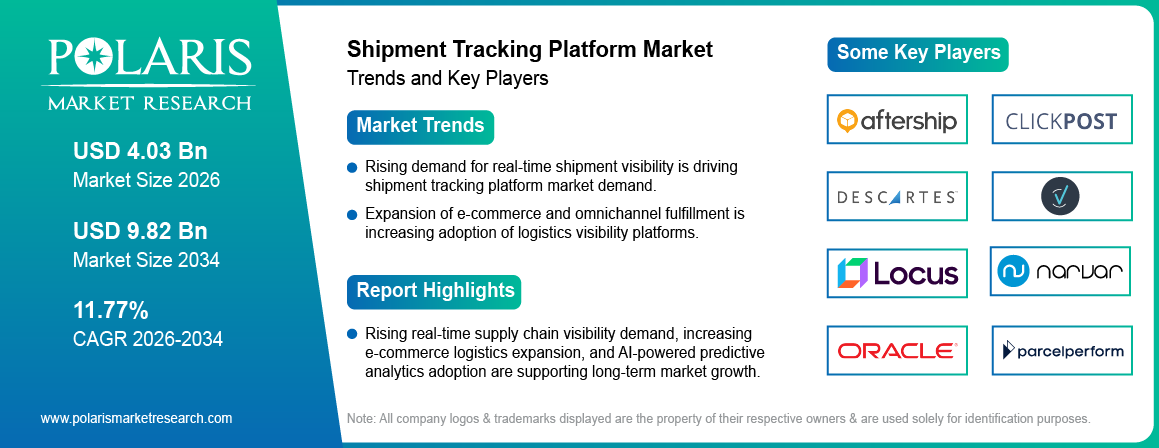
- Rising demand for real-time shipment visibility is driving market growth.
- Expansion of e-commerce logistics is increasing adoption of shipment tracking platforms.
- Integration complexity with legacy logistics systems is restraining market expansion.
- AI-powered predictive logistics intelligence is creating growth opportunities.
What is the Shipment Tracking Platform Market?
Shipment tracking platforms are digital logistics solutions designed to provide real-time visibility into freight movement across supply chain networks. These platforms enable enterprises to monitor shipments, predict estimated arrival times, optimize delivery routes, and improve transportation efficiency across multimodal logistics operations. Shipment tracking solutions are a widely used approach and are deployed across a range of industries like retail, manufacturing, healthcare, automotive, and transportation.
The shipment tracking system market value chain consists of software firms, cloud service providers, IoT devices manufacturers, telematics organizations, logistics firms, integration specialists, and end-users. Technologies such as GPS tracking technology, artificial intelligence analytics, API carriers, radio frequency identification (RFID), and transportation management systems are employed in the shipment visibility domain.
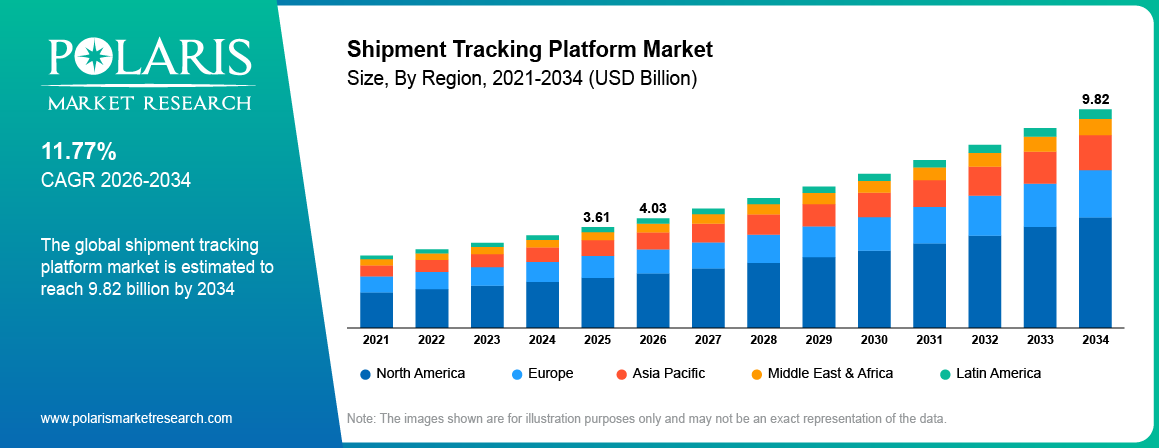
Source: Polaris Market Research Analysis
The increasing complexity involved in international business operations, rising demand from customers for increased transparency about deliveries, and the rapid digitization of logistics networks is contributing to the growth in the market. There is growing implementation by firms of logistics solutions, such as logistics analytics, real-time tracking solutions, and predictive ETAs to improve the operational performance and customer experience. The widespread use of cloud-based logistics software is driving the rapid growth of the market.
Drivers & Opportunities
Rising Demand for Real-Time Supply Chain Visibility: The rising number of supply chain disruptions, port congestion, and the increasing need for shipment visibility from the customers have been encouraging the use of real-time shipment visibility software applications. In March 2026, Shippo launched Shippo Intelligence product to offer AI shipment tracking and analysis services, including shipment performance mapping services and more cost visibility options for e-commerce businesses. Business organizations are making use of shipment tracking AI applications to ensure minimum delays.
Expansion of E-Commerce and Omnichannel Fulfillment: The emergence of cross-border online shopping and omnichannel commerce across countries has been creating an impetus for the need for an efficient shipment tracking system. According to the statistics of the International Trade Administration, global B2C ecommerce is projected to have a value of around USD 5.5 trillion in 2027 with a CAGR of 14.4%. With an objective of improving transparency in the last mile delivery and better communication with their customers, cloud-based shipment tracking systems are gaining popularity among retailers.
Restraints & Challenges
Integration Complexity with Legacy Systems: Complexities related to integration due to old versions of ERP, TMS, and warehouse management software have become the key constraint in the adoption of shipment tracking software. The current trend of enterprises operating with fragmented logistics processes that do not integrate data and transport connections is on the rise. Medium-sized companies are experiencing difficulties in their implementation due to complexity and costs associated with integrating software.
Opportunity
AI-Powered Predictive Logistics Intelligence: The emergence of AI and predictive analytics is providing considerable growth prospects for the shipment tracking platform market. In March 2026, ShipStation announced ShipStation Intelligence, which is AI-based predictive logistics solution, meant to address logistics, auto carrier, predictive analysis, and shipping insights. Advanced logistics visibility platforms increasingly provide predictive ETA calculations, automated exception management, disruption alerts, and risk-based route optimization capabilities.
Source: Polaris Market Research Analysis
Segmental Insights
The report provides a comprehensive analysis of the shipment tracking platform market by deployment, component, enterprise size, and end use to identify key revenue generating and high-growth segments.
By Deployment
-
Cloud-Based
The cloud segment led the market share in 2025 owing to reduced infrastructure costs, scalability, and speed of deployment. Organizations favor cloud-based shipment tracking solutions that offer logistics visibility, greater flexibility, and reduce the need for technical support.
-
On-Premise
On-premise segment is projected to witness steady growth during the forecast period owing to increasing demand from highly regulated industries including healthcare, defense, and government logistics operations. Organizations handling sensitive transportation data continue prioritizing private deployment infrastructure to improve data security and regulatory compliance.
By Component
-
Software
Software segment dominated the market in 2025 driven by increasing enterprise investments in freight analytics dashboards, predictive logistics platforms, and transportation visibility software. Shipment tracking software solutions have become common in companies using artificial intelligence-based tools to enhance transparency and logistics decisions.
-
Services
The services segment is estimated to exhibit the highest growth rate over the forecast period due to rising demand for implementation services, integration services, and logistics consulting services. Businesses are demanding third-party support to hasten their deployment process and enhance compatibility within the ecosystem.
By Enterprise Size
-
Large Enterprises
Large enterprises dominated the industry due to their broad logistics operations globally and significant investment in digital technologies for the purpose of enhancing their supply chains. Enterprises in retail, automotive, manufacturing, and healthcare sectors are increasingly employing enterprise shipment visibility systems in an attempt to improve efficiency.
-
SMEs
SMEs segment is projected to grow at the fastest CAGR during the forecast period owing to rising affordability of subscription-based cloud logistics platforms. Small and medium-sized businesses increasingly adopt SaaS shipment tracking solutions to improve delivery transparency and customer communication capabilities.
By End Use
-
Retail & E-Commerce
Retail & e-commerce segment dominated the market in 2025 due to rising shipment volumes and increasing customer demand for delivery transparency. World Trade Organization estimates that global merchandise and commercial services trade, calculated based on balance-of-payments criteria, grew by 7% in 2025, bringing its total to an estimated USD 34.65 trillion from 4% growth in the preceding year. Online retailers are increasingly implementing real-time shipment visibility systems in order to improve efficiency and foster customer relations.
-
Healthcare & Pharmaceuticals
Healthcare & pharmaceuticals are expected to register the highest CAGR during the forecast period, due to the growing need for monitoring cold chain visibility and compliance with regulatory requirements. The pharmaceutical industry uses IoT-based shipment tracking technologies to monitor temperature-sensitive shipments.
Source: Polaris Market Research Analysis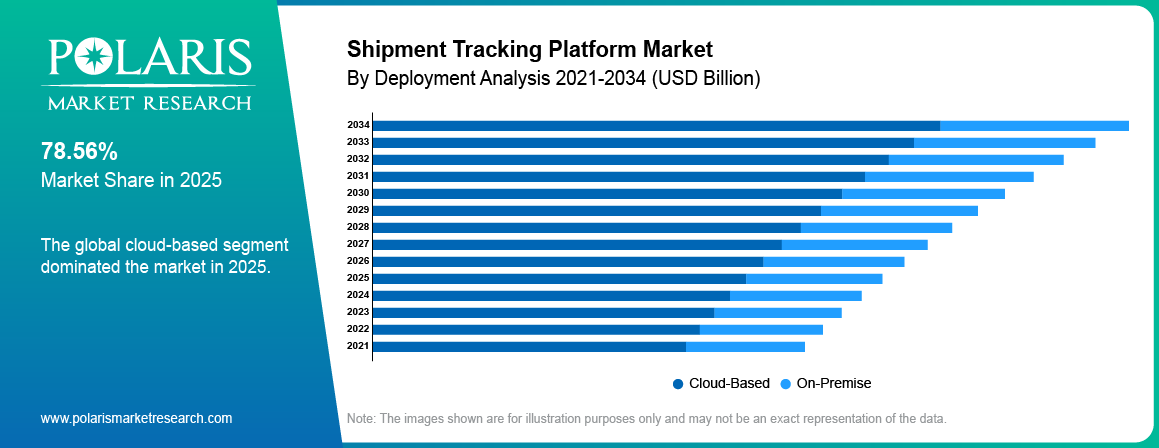
Regional Analysis
North America Shipment Tracking Platform Market Insights
North America shipment tracking platform market dominated the global market in 2025 driven by advanced logistics infrastructure and strong investments in AI-powered supply chain technologies across the US and Canada. In May 2026, Blue Yonder introduced new cognitive and AI-driven supply chain solutions at ICON 2026 in the US, focused on autonomous planning, predictive inventory management, and real-time logistics orchestration. The US is the dominant regional market attributed to the rapid growth of e-commerce and widespread adoption of predictive freight analysis software platforms.
Europe Shipment Tracking Platform Market Overview
Europe shipment tracking platform market is growing significantly owing to increasing adoption of sustainability practices, logistics digitization policies, and advanced transport infrastructure. The European Union has boosted its logistics digitization efforts with the implementation of the eFTI Regulation, which mandates EU countries to use certified electronic platforms to accept freight transport information by July 2027. Countries including Germany, France, and the UK are increasingly deploying digital freight visibility solutions to improve operational efficiency and support green logistics initiatives.
Asia Pacific Shipment Tracking Platform Market Assessment
Asia Pacific shipment tracking platform market is projected to grow at the fastest CAGR during the forecast period driven by expanding e-commerce logistics and increasing investments in digital supply chain infrastructure. According to China.org, China has remained the world’s largest online retail market for thirteen consecutive years, with digital consumption exceeding approximately USD 3.39 trillion. Countries including China, India, Japan, and Southeast Asian economies are witnessing increasing adoption of cloud-based shipment visibility solutions across retail and manufacturing industries.
Latin America Shipment Tracking Platform Market
Latin America shipment tracking platform market is witnessing gradual growth supported by improving transportation infrastructure and increasing digital transformation initiatives across regional logistics networks. Countries including Brazil and Mexico are increasingly investing in freight visibility technologies to improve delivery performance and supply chain efficiency. Rising e-commerce penetration is supporting regional market demand.
Middle East & Africa Shipment Tracking Platform Market
Middle East & Africa shipment tracking platform market is witnessing steady growth due to rising smart port development projects and increasing logistics diversification initiatives. Gulf countries are increasingly adopting AI-enabled freight visibility platforms to improve transportation monitoring and operational efficiency across regional trade corridors. Expansion of logistics digitization strategies is supporting regional market growth.
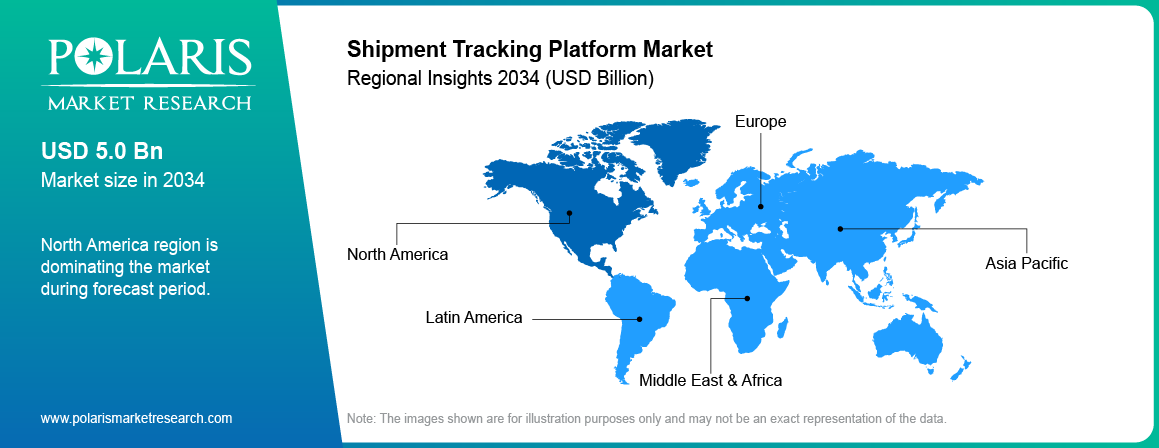
Source: Polaris Market Research Analysis
Competitive Landscape
Key Players & Competitive Strategies
The shipment tracking platform market is highly competitive due to the presence of global software vendors, logistics technology providers, and AI-powered freight visibility companies. Some of the competitive advantages for businesses are analytics, real-time visibility, integrations, pricing strategy, and AI-based logistics automation. Businesses are focusing on building cloud-native solutions, creating API communities, making alliances, and using AI-based logistics automation technology.
Major companies operating in the shipment tracking platform market include AfterShip Limited, ClickPost, Descartes Systems Group Inc., FourKites, Inc., FreightVerify, Locus.sh, Narvar Inc., Oracle Corporation, Parcel Perform, Project44 Inc., SAP SE, Sendcloud B.V., Shippo Inc., Shippeo SAS, and ShipStation Software, Inc.
Premium Insights
AI Becoming the Core Differentiator
The future generation of shipment tracking systems will see more competition based on predictive intelligence rather than shipment visibility alone. The application of AI-based shipment tracking systems by logistics firms and enterprises helps in making better decisions and avoids disruptions in the supply chain management in real-time.
AI-based shipment tracking technology is currently leveraged by firms for:
- Predicting disruptions before their occurrence
- Improving logistics operations and planning
- Automating logistics operation
- Assessing disruption risks in the global supply chain
The organizations that offer predictive logistics solutions along with autonomous elements within the supply chain is expected to gain an advantage as the data complexity of supply chains increases.
ESG and Carbon Visibility Emerging Rapidly
Shipment carbon visibility is gaining importance among businesses due to their need to meet certain requirements related to their sustainability goals, regulations, and ESG criteria. The carbon analytics capabilities are incorporated directly into the workflow process for managing and tracking shipments for better carbon emissions transparency.
Future technologies used for tracking shipments are designed not only to monitor movements but to provide information on emissions, fuel consumption, and sustainability reporting. Thus, sustainable logistics tracking is gaining prominence in supply chain management systems.
Key Players
- AfterShip Limited
- ClickPost
- Descartes Systems Group Inc.
- FourKites, Inc.
- FreightVerify
- Locus.sh
- Narvar Inc.
- Oracle Corporation
- Parcel Perform
- Project44 Inc.
- SAP SE
- Sendcloud B.V.
- Shippo Inc.
- Shippeo SAS
- ShipStation Software, Inc.
Industry Developments
- May 2026: Shiprocket offered an appointment-based delivery system for fast commerce services with 98% punctuality. The technology helped the merchants and logistics companies improve the visibility of the shipments and scheduling of deliveries. [source: www.business-standard.com]
- February 2026: Pinnacle Freight Systems introduced the PIFTrack system, which is a digital freight tracking solution running 24/7 to offer real-time tracking of the cargo, automation of shipments, and improved logistics monitoring services. [source: pinnaclefreight.com]
Shipment Tracking Platform Market Segmentation
By Deployment Outlook (Revenue, USD Billion, 2021–2034)
- Cloud-Based
- On-Premise
By Component Outlook (Revenue, USD Billion, 2021–2034)
- Software
- Services
By Enterprise Size Outlook (Revenue, USD Billion, 2021–2034)
- Large Enterprises
- SMEs
By End Use Outlook (Revenue, USD Billion, 2021–2034)
- Retail & E-Commerce
- Healthcare & Pharmaceuticals
- Manufacturing
- Transportation & Logistics
- Automotive
- Others
By Regional Outlook (Revenue, USD Billion, 2021-2034)
- North America
- US
- Canada
- Europe
- Germany
- France
- UK
- Italy
- Spain
- Netherlands
- Russia
- Rest of Europe
- Asia Pacific
- China
- Japan
- India
- Malaysia
- South Korea
- Indonesia
- Australia
- Vietnam
- Rest of Asia Pacific
- Middle East & Africa
- Saudi Arabia
- UAE
- Israel
- South Africa
- Rest of Middle East & Africa
- Latin America
- Mexico
- Brazil
- Argentina
- Rest of Latin America
Shipment Tracking Platform Market Report Scope
| Report Attributes | Details |
| Market Size in 2025 | USD 3.61 Billion |
| Market Size in 2026 | USD 4.03 Billion |
| Revenue Forecast by 2034 | USD 9.82 Billion |
| CAGR | 11.77% from 2026 to 2034 |
| Base Year | 2025 |
| Historical Data | 2021–2024 |
| Forecast Period | 2026–2034 |
| Quantitative Units | Revenue in USD Billion and CAGR from 2026 to 2034 |
| Report Coverage | Revenue Forecast, Competitive Landscape, Growth Factors, and Industry Trends |
| Segments Covered |
|
| Regional Scope |
|
| Competitive Landscape |
|
| Report Format |
|
| Customization | Report customization as per your requirements with respect to countries, regions, and segmentation. |
Source: Polaris Market Research Analysis
Shipment Tracking Platform Market FAQ's
The global market size was valued at USD 3.61 Billion in 2025 and is projected to reach USD 9.82 Billion by 2034 at a CAGR of 11.77%.
North America dominated the market in 2025 due to advanced logistics infrastructure and strong cloud technology adoption.
Cloud-based deployment dominated the market in 2025 owing to scalability, lower deployment costs, and faster implementation capabilities.
Major companies operating in the market include FourKites, project44, SAP SE, Oracle Corporation, and Descartes Systems Group.
Growing requirement for real-time shipment visibility, the rising e-commerce logistics sector, and increasing use of AI-based freight analytics are some factors driving market growth.
The use of AI in logistics provides more precise ETA predictions, better management of disruptions, enhanced route optimization, and better decision-making.
The market outlook remains positive due to increasing adoption of predictive logistics intelligence, autonomous supply chain technologies, and ESG-linked freight visibility solutions.
Download Sample Report of Shipment Tracking Platform Market
Please fill out the form to request a customized copy of the research report.


