
Synthetic Small Molecule API Market Size, Share, Trends & Forecast, 2026-2034
REPORT DETAILS
Synthetic Small Molecule API Market Summary
The global synthetic small molecule API market size was valued at USD 188.91 billion in 2025. The market is anticipated to grow at a CAGR of 5.55% from 2026 to 2034. The rising chronic disease prevalence and growing demand for generic medications are a few of the key factors driving market growth.
Market Statistics
Synthetic Small Molecule API Market Key Takeaways
- North America accounted for a 40.9% share in 2025. This is owing to favorable initiatives in the region.
- Asia Pacific is projected to grow at a 9.7% CAGR. This is due to the high adoption of over-the-counter (OTC) drugs.
- The in-house segment accounted for the largest share of 58.6% in 2025. The segment’s leading position is due to manufacturers' efforts to reduce their reliance on CDMOs and suppliers for raw materials.
- The cardiology segment accounted for the largest share of 23.8% in 2025. This is due to the increasing prevalence of cardiovascular diseases globally.
- The outsourced segment is projected to grow at a 10.4% CAGR. The shift of manufacturing companies towards contract research and development organizations for the production of API commercially is driving segmental growth.
Note: Figures and projections outlined in this report are the result of Polaris Market Research’s proprietary analytical processes, grounded in the latest available datasets and market observations.
What Is a Synthetic Small Molecule API? Definition, Examples & Market Scope
Synthetic small molecule API are active pharmaceutical ingredients that are commonly made up of 20-100 atoms. They are well-defined, purified, and studied quickly, and are extensively utilized in various biological and pharmaceutical procedures. They are effective inducible modifiers and enzyme inhibitors due to their typical physicochemical characteristics and tiny size. Furthermore, these molecules are highly effective in preventing, diagnosing, and treating diseases. Owing its numerous applications commonly in the healthcare industry have driven the industry’s growth.
The industry's expansion is further attributed to the low cost of manufacturing associated with synthetic small molecules and their incredible effectiveness. Around 78% of all APIs, most of the drugs patients take, are synthetic small molecules. This increases the demand for finished products and API formulation, which fuels the growth of the synthetic small molecule API market.
Even though numerous causes are driving the development of synthetic small APIs, there is still deficient public awareness of the same. This is especially true for developing nations with their poor economic standards. However, budgetary restrictions and the healthcare infrastructure in these countries could provide complicated challenges for the global industry.
How Does Synthetic Small Molecule API Manufacturing Work? Synthesis, Purification, Testing & Scale-Up
Choice of Raw Materials: The manufacturing process starts with the choice of appropriate chemical raw materials for API synthesis.
Synthesis Process: The chosen materials are exposed to a number of chemical processes, which help in making the API.
Purification: The API undergoes a purification process to ensure that there are no foreign substances in it.
Testing: The purified API undergoes a testing process to determine its purity, strength, stability, and uniformity before moving on to the next process.
Assessment: The documents used during the synthetic API manufacturing process are reviewed to ensure that all the requirements have been met.
Storage: The API is packaged and stored after approval for maintenance purposes.
Manufacture of Medicine: After that, the API is supplied to pharmaceutical firms to manufacture tablets, capsules, and injections.
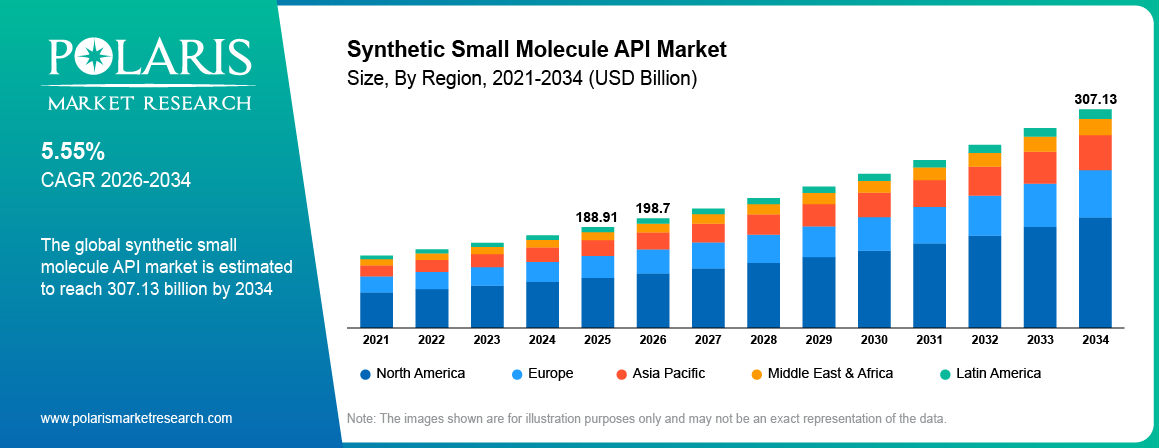
Source: Polaris Market Research Analysis
To Understand More About this Research: Download Sample Report
AI Impact on Synthetic Small Molecule API Manufacturing: Process Optimization, Quality & Supply Chains
- AI helps in drug discovery by identifying potential synthetic small molecule structures.
- AI helps in reducing time and cost in API production.
- AI ensures consistency, detecting impurities and improving regulatory compliance.
- AI helps in forecasting demand and manage raw material supply chains.
Synthetic Small Molecule API vs Biologic API: Manufacturing, Structure, Cost & Storage
| Attribute | Small Molecule API | Synthetic Biologic API |
| Production Technique | Synthesis of chemicals | Uses living cells/biological processes |
| Molecular Structure | Small and simple | Complex and large in size |
| Process of Production | Easier to scale | More complicated process |
| Cost of Production | Lower cost of production | Higher cost of production |
| Uses | Generic medicine and chronic disease treatments | Biologics, vaccinations, and targeted medications |
| Storage | Stable during normal conditions | Requires controlled storage conditions |
Source: Polaris Market Research Analysis
Market Dynamics
Dominance of Small Molecules Despite Rising Biologic API Adoption
Despite many prominent contract manufacturing organizations (CMOs) investing in advanced therapy medicinal product (ATMP) capabilities in recent years and increasing the use of biologic APIs in both the pipeline and among marketed drugs, the majority of marketed drugs are small molecules. With the rise of oncology pipeline drugs driving the increase in high potency, combined with synthetic small or virtual pharma companies being unable to acquire or access containment capabilities in-house, the demand for innovative specialized synthetic small molecule capabilities will remain high.
High Demand for Generic Drugs Fueling Market Growth
High demand for generic drugs is a crucial driver leading to market growth. API for these drugs generates high revenue for chemical and synthetic manufacturing companies. This factor is creating an opportunity for contract development and manufacturing companies working for it, owing to the growth in outsourcing trend as companies want to enhance profitability by reducing the cost of production, which is anticipated to influence the market's growth.
Ease of Production and Effectiveness of Synthetic Small Molecules
The market's growth is witnessed by the ease of production associated with synthetic small molecules and the high effectiveness possessed by these molecules. Furthermore, these represent a good amount of the total share representing the majority of medicines consumed, which amplifies the demand for finished products and formulation of API. Additionally, rapid growth in several corporate agreements has propelled the industry. For instance, BASF pharma sold its OMEGA 3 manufacturing facility to Marine Ingredients in Norway.
Digital Transformation in Small Molecule API Manufacturing: Automation, PAT & Digital Twins
The advancements in digital technology are transforming the manufacturing processes for synthetic small molecule APIs. Smart manufacturing allows manufacturers to track their manufacturing processes on a continuous basis and optimize efficiency. Data from the production process can be analyzed quickly to detect any problems that may affect production. Automation of the system ensures uniform quality of products and prevents human errors. In addition, some manufacturers make use of a digital twin to perform process testing before making changes to the manufacturing process. This helps ease the documentation process and meet the regulatory requirements.
Synthetic Small Molecule API Market Technology Trends: Flow Chemistry, HPAPIs, Green Chemistry & Digital Twins
The market is witnessing a transformation driven by innovations in advanced synthetic routes and green chemistry. High-potency APIs (HPAPIs) and complex molecule synthesis enable treatments for oncology, rare diseases, and other high-value therapeutics. Digitalization, including AI-based process optimization and digital twins, is enhancing reaction efficiency, reducing batch failures. Modular manufacturing and specialized CDMO services enable faster scale-up, multi-product flexibility, and regulatory-compliant production. Market players are adopting these innovations for efficiency, scalability, and quality in API production. The adoption helps them stay ahead in the competition. This factor boosts the industry expansion. The following table contains key innovations in the industry with their key features and impact:
| Innovation | Key Features | Market Impact |
| Advanced Synthetic Routes and Green Chemistry | Continuous flow chemistry, atom-efficient synthesis, and biocatalysis Eco-friendly solvents | Higher yields, reduced environmental impact, and lower cost |
| Novel Process Development and Modular Manufacturing | Modular units, Process Analytical Technology (PAT), and multi-product capabilities | Reproducible high-purity APIs, faster scale-up, and reduced time-to-market |
| High Potency API (HPAPI) and Complex Molecule Synthesis | Chiral molecules, oncology/rare disease HPAPIs, and stereoselective synthesis | Enables treatment of complex diseases and supports high-value therapeutic pipelines |
| Digitalization and AI-Enabled Process Optimization | Adoption of AI and ML for reaction optimization, predictive modeling, and digital twins | Reduced batch failures, cost efficiency, and faster development |
| Continuous Manufacturing and Flow Chemistry Adoption | Shift from batch to continuous flow and integrated with quality-by-design (QbD) | Improved control, consistency, scalability, and regulatory compliance |
| Regulatory-Driven Innovation | Controlled impurities, traceable supply chains, and validated analytics | Enhanced quality, compliance and a faster approval process |
| Specialized CDMO Services | End-to-end API development, scale-up expertise, and custom synthesis | Reduces internal R&D burden, enables complex chemistries, and mitigates risks |
Source: Polaris Market Research Analysis
Synthetic Small Molecule API Quality & Regulatory Compliance: GMP, Impurities & Validation
High quality level is considered an important requirement for API manufacture. As for the safety and efficacy of APIs, companies follow Good Manufacturing Practices (GMPs). Identity, purity, and efficacy tests are performed on each API batch prior to its release; impurities are analyzed, and quality control activities are performed during the process. Inspection of manufacturing plants by regulatory bodies is performed in order to make sure that the appropriate standards are followed. Quality management systems also promote trust between pharmaceutical firms and healthcare professionals.
Green Chemistry & Sustainable Synthetic Small Molecule API Manufacturing
Many pharmaceutical companies are adopting green chemistry to make API production more sustainable. The producers have become adept at minimizing chemical waste and optimizing their raw material usage. This helps in decreasing the ecological footprint left behind during production. Energy-efficient machinery is being used to save on power. Improved production processes increase efficiency and minimize waste generation. Such approaches help achieve environmental objectives as well as promote responsible production. With increasing significance of sustainability, green chemistry has become increasingly important in API production.
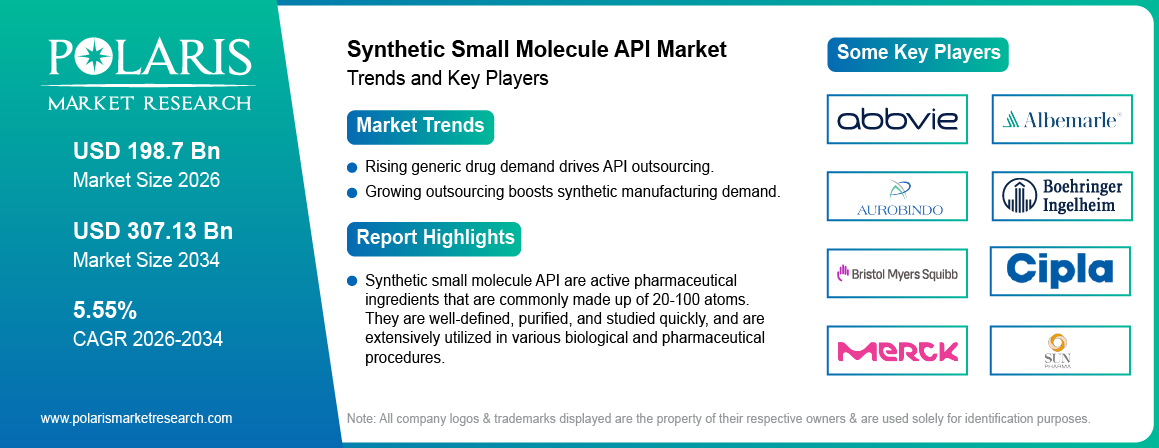
Source: Polaris Market Research Analysis
Synthetic Small Molecule API Market Segmentation Analysis
The market is primarily segmented based on manufacturer, application and region.
| By Manufacturer | By Application | By Region |
|
|
|
Source: Polaris Market Research Analysis
By Manufacturing Model
The in-house segment accounted for the largest share of 58.6% in 2025.The growth of the in-house segment is attributed to manufacturers' efforts to reduce their reliance on CDMOs and suppliers for raw materials and instead focus on developing their own API. For instance, Lonza launched a new synthetic small-molecule manufacturing complex to enhance future small-molecule technologies expansion in April 2024.
The outsourced segment is projected to grow at a 10.4% CAGR.The growing shift of manufacturing companies towards contract research and development organizations for the production of API commercially is increasing, showing the fastest growth of the segment. For instance, Curia, a CDMO, invested in expanding its commercial manufacturing capacity at its Rensselaer, New York facility. Furthermore, increasing demand for the requirement of complex manufacturing processes further drives the growth of the segment.
By Therapeutic Area (Application)
The cardiology segment accounted for the largest share of 23.8% in 2025 due to the increasing prevalence of target diseases worldwide owing to changes in lifestyles and food habits. Additionally, the rising number of patients from various cardiovascular diseases along with the increased implementation of treatment for cardiovascular conditions has driven the segment's growth. According to WHO, cardiovascular disorders are the most common cause of death worldwide.Overweight and obesity in people have raised their blood pressure and blood glucose level leading to cardiovascular disorders. According to WHO, significant cardiovascular deaths are due to heart attacks and strokes, and most of these deaths occur prematurely in people under the age of 70. Small-molecule synthesis is essential for the development and effectiveness of numerous pharmaceutical medicines, from over-the-counter analgesics to life-saving medications for cardiovascular disease. For instance, EUROAPI's current synthesis portfolio includes approximately 60 small-molecule API references with several therapeutic applications for both humans and animals.
Synthetic Small Molecule API Use Cases: Cardiovascular, Oncology, Generics & Chronic Disease Drugs
| Uses | How Synthetic Small Molecule APIs Are Used |
| Heart Disease Medications | Used in the production of drugs for hypertension, heart disease and treatment of cholesterol. |
| Cancer Drugs | Used to manufacture medicines that treat various forms of cancer. |
| Generic Drugs | Used to make cheap generic drug API market medicines after the expiration of their patents. |
| Neurological Drugs | Used in the production of drugs for treatment of conditions such as epilepsy and Parkinson's disease. |
| Chronic Disease Drugs | Used in production of medicines for treating various chronic diseases such as diabetes and respiratory diseases. |
| Oral Medications | Used in tablets, capsules and other oral medications for various diseases. |
| Pharmaceutical Studies | Used in the development and studies of pharmaceutical drugs. |
Source: Polaris Market Research Analysis
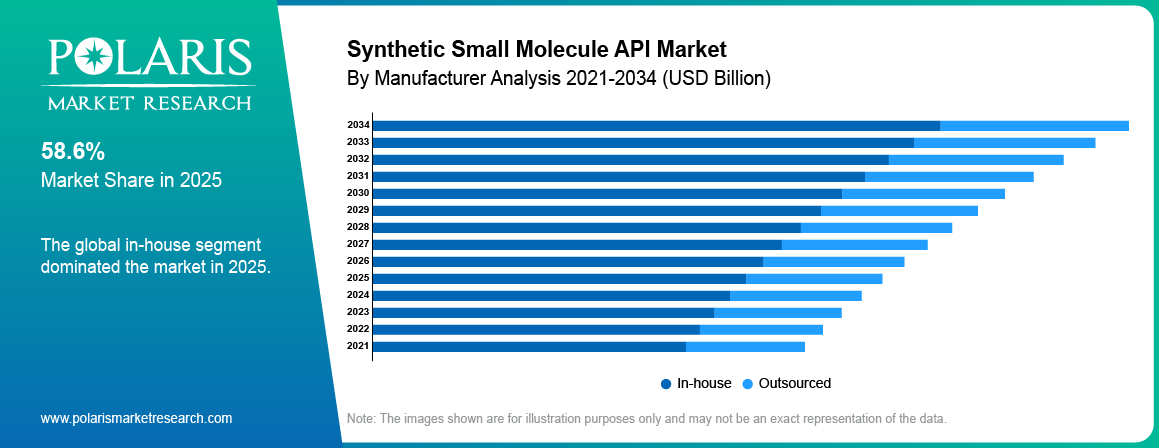
Source: Polaris Market Research Analysis
Synthetic Small Molecule API Market by Region
North America Dominated the Revenue Share in 2025
North America accounted for a 40.9% share in 2025, due to favorable initiatives, the growing support from the government, and players' interest in developing novel products. For instance, in 2021, AbbVie announced the U.S. FDA approval of Qulipta (atogepant) for episodic migraine in adults as the medication-only oral antagonist of the calcitonin gene-related peptide receptor. Furthermore, the government in this region is becoming supportive in terms of regulation of API production, which further has reduced the region's dependence on Asian manufacturers.
Asia Pacific is projected to grow at a 9.7% CAGR is expected to account for the fastest growth in the global market owing to the large patient population's, high adoption of over-the-counter (OTC) drugs coupled with the growing healthcare and pharmaceutical industry and intense research and development in API. According to IBEF, Indian pharmaceutical companies increased investment in R&D, driving the market growth in this region. Moreover, the growing aging population and increasing incidence of chronic diseases is propelling the market growth.
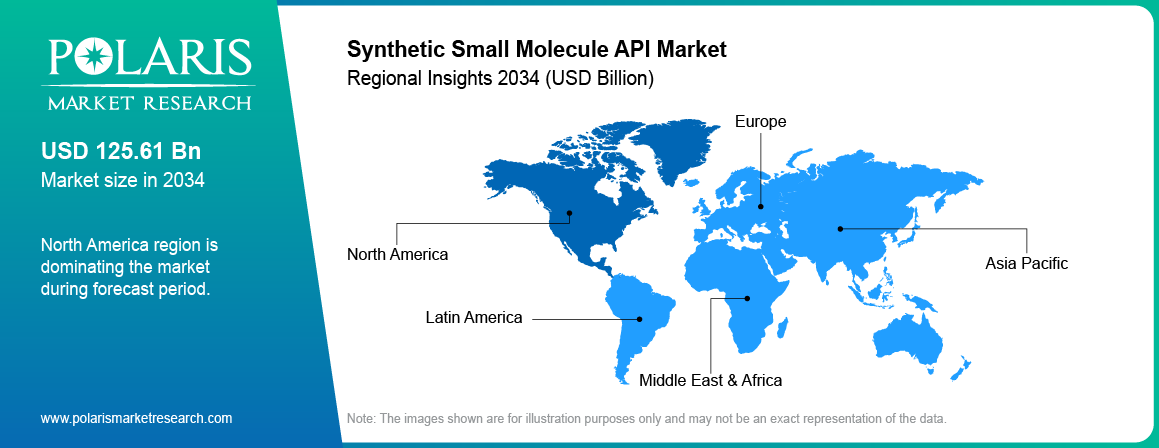
Source: Polaris Market Research Analysis
Synthetic Small Molecule API Supply Chain: Raw Materials, Dual Sourcing & Digital Visibility
Reliable supply chains play an integral role in ensuring on-time production and distribution of the synthetic small molecule APIs. Manufacturers collaborate with their suppliers to guarantee the supply of adequate materials needed for production. Several firms have started incorporating new suppliers into their operations to ensure there will be no interruptions in their supplies. The use of digital technology provides increased visibility of the supply chain for the manufacturer and quick responses to changes in demand. The reliable logistics system guarantees that the APIs will get to the pharmaceutical companies without any delay.
Synthetic Small Molecule API Competitive Landscape
The synthetic small molecule API market is projected t increase as demand for cost-effective medicines continues to rise. Large producers work on expanding their facilities, improving synthesis methods, and keeping pace with strict regulatory standards. Meanwhile, smaller and regional firms compete by offering lower-cost supply and flexible services. Partnerships with pharmaceutical companies and investments in emerging markets are becoming more common as businesses look to expand reach. Growth in pressure to reduce environmental impact is also pushing many manufacturers toward small API. With pricing, quality, and reliability all playing critical roles, competition remains intense.
Leading Synthetic Small Molecule API Manufacturers & CDMOs
- AbbVie Inc.
- Albemarle Corporation
- Aurobindo Pharma
- Boehringer Ingelheim International GmbH
- Bristol-Myers Squibb Company
- Cipla Inc.
- Dr. Reddy’s Laboratories Ltd.
- Merck & Co. Inc.
- Rhizen Pharmaceuticals
- Sun Pharmaceutical Industries Ltd.
- Teva Pharmaceutical Industries Ltd
- Viatris Inc.
Synthetic Small Molecule API Market Recent Developments: Capacity Expansion, CDMO Investment & Digital Manufacturing
- March 2026: Cambrex announced the completion of initial engineering studies for its new active pharmaceutical ingredient (API) manufacturing plant in Charles City, Iowa. The company stated that the milestone marks a major step towards its previously announced $120 million investment for the expansion of its U.S. API manufacturing capabilities.(source: prnewswire.com)
- February 2026: AbbVie announced an investment of $380 million to build two new active pharmaceutical ingredient (API) manufacturing facilities at its North Chicago campus. According to AbbVie, the facilities will integrate advanced manufacturing technologies with AI to support the production of next-gen medications.(source: abbvie.com)
- In May 2025, Lonza introduced its new Design2Optimize platform to enhance small-molecule API development and streamline manufacturing efficiency.
Synthetic Small Molecule API Market Future Outlook
The synthetic small molecule active pharmaceutical ingredients market is expected to continue growing with an increase in the need for pharmaceutical products. Increased manufacture of generic drugs and the growing needs for treating chronic conditions will fuel growth in the market. Technology is being used to improve production efficiency and quality. Automation and digital technologies have made the manufacturing process faster and more efficient. Sustainability practices in production are also being increasingly adopted by firms in the industry. Joint ventures between pharmaceutical firms and contract manufacturers are expected to increase production capabilities in the coming years.
Synthetic Small Molecule API Market Report Scope, Segmentation & Forecast Coverage
| Report Attributes | Details |
| Market size value in 2025 | USD 188.91 billion |
| Market size value in 2026 | USD 198.7 billion |
| Revenue forecast in 2034 | USD 307.13 billion |
| CAGR | 5.55% from 2026 - 2034 |
| Base year | 2025 |
| Historical data | 2021 - 2024 |
| Forecast period | 2026 - 2034 |
| Quantitative units | Revenue in USD billion and CAGR from 2026 to 2034 |
| Segments covered |
|
| Regional scope |
|
| Key companies | AbbVie, Inc., Albemarle Corporation, Aurobindo Pharma, Boehringer Ingelheim International GmbH, Bristol-Myers Squibb Company, Cipla, Inc., Dr. Reddy’s Laboratories Ltd., Merck & Co., Inc., Rhizen Pharmaceuticals, Sun Pharmaceutical Industries Ltd., Teva Pharmaceutical Industries Ltd., and Viatris Inc. |
Source: Polaris Market Research Analysis
Synthetic Small Molecule API Market FAQ's
• The global market size was valued at USD 188.91 billion in 2025 and is projected to grow to USD 307.13 billion by 2034.
• The global market is projected to register a CAGR of 5.55% during the forecast period.
North America dominated the global market share in 2025, accounting for a 40.9% share, owing to favorable initiatives in the region.
• A few of the key players in the market are AbbVie, Inc., Albemarle Corporation, Aurobindo Pharma, Boehringer Ingelheim International GmbH, Bristol-Myers Squibb Company, Cipla, Inc., Dr. Reddy’s Laboratories Ltd., Merck & Co., Inc., Rhizen Pharmaceuticals, Sun Pharmaceutical Industries Ltd., Teva Pharmaceutical Industries Ltd., and Viatris Inc.
By manufacturer, the in-house segment dominated the market revenue share in 2025, accounting for a 58.6% share, driven by manufacturers' efforts to reduce reliance on CDMOs and suppliers for raw materials.
• A synthetic small molecule API is a drug compound that acts as an active agent for treatment or managing diseases. They are produced by means of a synthesis process and are used in drugs used in curing infections, diabetes, heart diseases, cancer, and other diseases.
• The synthetic small molecule API is produced through chemical reaction, while the biologic API is developed through the use of live cells. A synthetic small molecule API is relatively smaller in size, easier to manufacture, and available in the form of capsules and tablets.
• Pharmaceutical companies outsource their API manufacturing to CDMOs since they save production time and costs and provide manufacturing plants and laboratories for the testing of the products.
Download Sample Report of Synthetic Small Molecule API Market
Please fill out the form to request a customized copy of the research report.


