
Smart Bathroom Market Size, Share & Trends Analysis Report, 2026-2034
REPORT DETAILS
Smart Bathroom Market Summary
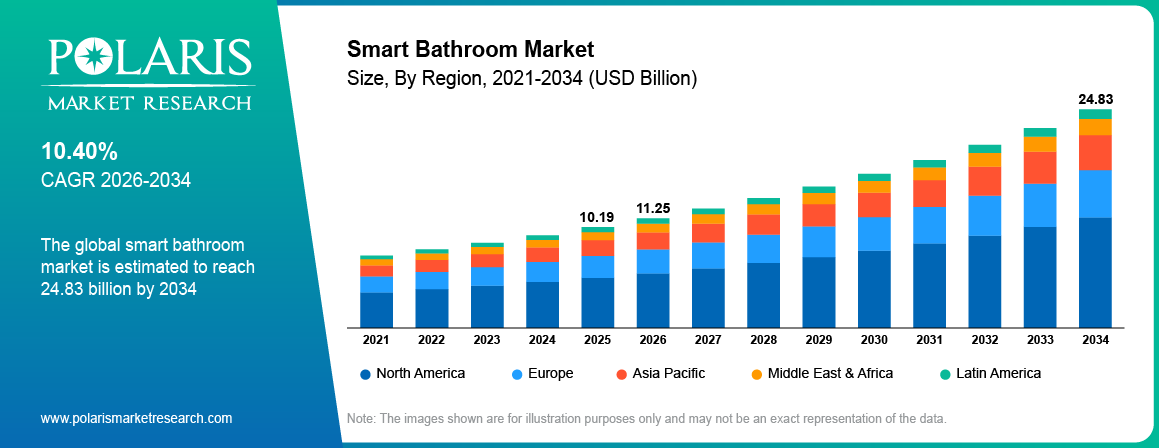
The global smart bathroom market size was valued at USD 10.19 billion in 2025. The market is anticipated to grow from USD 11.25 billion in 2026 to USD 24.83 billion by 2034, exhibiting a CAGR of 10.40% during 2026–2034.
Market Statistics
Smart Bathroom Market Key Takeaways
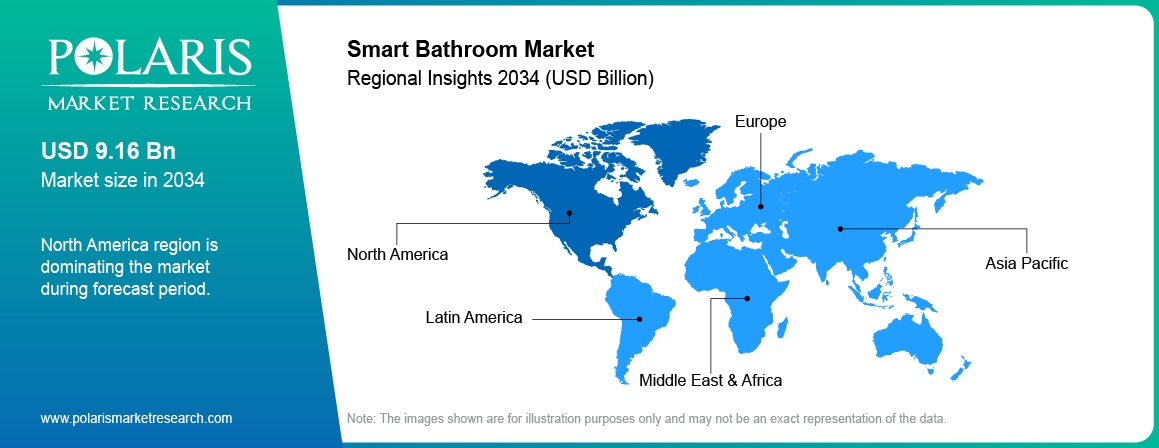
- North America led the global market with a 36.9% share in 2025. This is owing to the presence of several key market participants in the region.
- Asia Pacific is projected to account for a 11.2% CAGR. The rising spending power of consumers and increasing investments in smart cities drive the regional market growth.
- The smart toilet segment held the largest market share of 41.7% in 2025. The segment growth is ascribed to the advanced features of smart toilets.
- The smart faucets segment is expected to register a significant CAGR of 12.1%. The emerging concept of smart bathrooms has resulted in increased adoption of smart faucets across sectors.
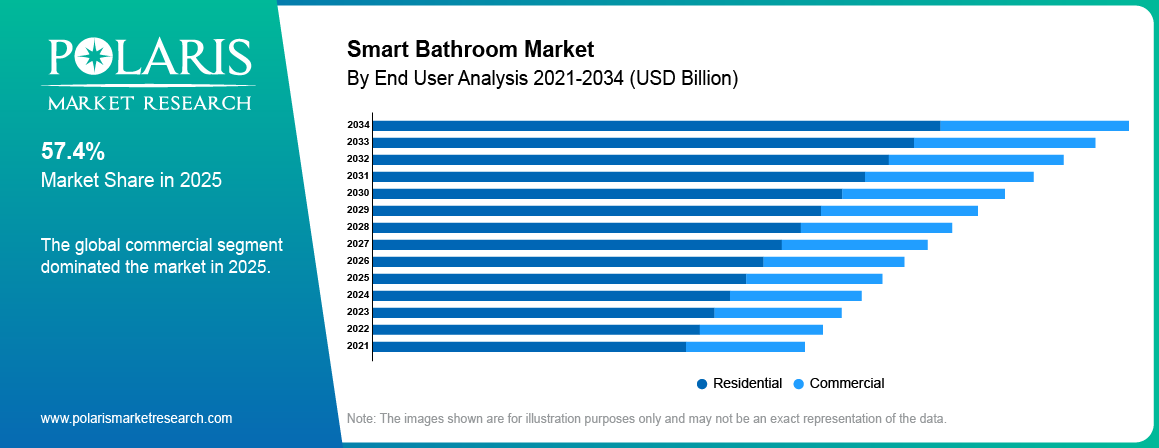
- The commercial sector dominated with a 57.4% share in 2025. The growing hotel industry and increasing number of eateries worldwide have contributed to the segment’s dominance.
Note: Figures and projections outlined in this report are the result of Polaris Market Research’s proprietary analytical processes, grounded in the latest available datasets and market observations.
Industry Dynamics
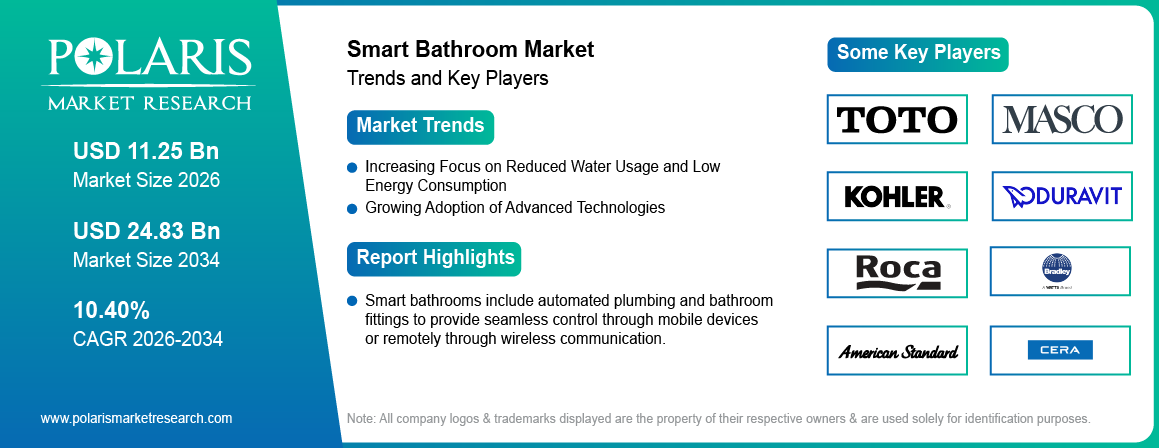
- Rising adoption of advanced technologies such as the Internet of Things (IoT) and artificial intelligence (AI) has led to the development of smart bathroom products.
- Increased emphasis on lower energy consumption and reduced water usage is another factor driving market adoption.
- Growing emphasis on sustainability and eco-consciousness is expected to create several market opportunities.
- High initial installation and hardware costs may present market challenges.
AI Impact on Smart Bathroom Market
- AI makes it possible to have personalized settings for light, heat, and water use in smart bathrooms.
- AI increases the efficiency of water and energy use due to the monitoring of the usage of both.
- AI ensures greater hygiene and convenience through hands-free operations.
- It enables predictive maintenance by identifying problems such as leakages.
Smart bathrooms include automated plumbing and bathroom fittings to provide seamless control through mobile devices or remotely through wireless communication. It offers centralized control of various functionalities such as lighting, air conditioning and heating, automatic doors, digital faucets, soaking tubs, hot gadgets, and automatic toilets. The growing adoption of smart homes in both developing and developed countries around the world is driving the demand for smart bathrooms. Also, as owners are willing to improve their spaces, there is an increasing demand for a range of smart bathroom solutions across the residential and commercial sectors, which is contributing to the smart bathroom market expansion.
Source: Polaris Market Research Analysis
To Understand More About this Research: Download Sample Report
The growing penetration of smartphones and other smart devices and increasing awareness regarding health hygiene are primarily driving the smart bathrooms market growth. Moreover, other factors propelling the market growth are increasing costs associated with energy consumption, rising disposable income of consumers, and improving lifestyles.
Smart Bathrooms vs Traditional Bathrooms
| Factor | Smart Bathroom | Traditional Bathroom |
| Hygiene | Hands-free and automatic | Mostly manual usage |
| Water Consumption | Optimized using sensors | Increased water consumption |
| Efficiency | Automatic energy management | Conventional systems |
| Experience | Personalized and connected | Basic functionality |
| Automation | Sensors based control systems | Minimal automation |
| Monitoring | Real-time monitoring | No connected monitoring |
Source: Polaris Market Research Analysis
Market Dynamics
Growing Adoption of Advanced Technologies
Various advanced technologies such as the Internet of Things (IoT), artificial intelligence (AI), and sensing technologies are being integrated into the development of innovative smart bathroom products. A bathroom with multiple smart systems and devices installed offers increased functionality, comfort, energy efficiency, and personalization. Smart bathroom products offer easy remote control for different functions in the bathroom, such as changing water temperature, altering lighting, or turning on/off certain features using voice commands. The smart bathroom market is expanding due to the increased use of touchless technologies in bathrooms, such as motion-sensor faucets, voice-activated controls, and UV sanitation for faucets and toilets. In February 2024, Kohler introduced the Numi 2.0 smart toilet. The smart toilet incorporates several advanced features such as voice commands, dual flush, and integrated flush cleaning to transform user experiences.
Increasing Focus on Reduced Water Usage and Low Energy Consumption
Water scarcity and environmental concerns have made water-saving measures a top priority for both governments and citizens. In order to promote eco-friendly practices and reduce water waste, smart bathroom solutions incorporate technology such as intelligent toilets, smart showers, and automatic faucets that monitor and regulate water usage. Energy efficiency also has a big impact on the smart bathroom market. The growing emphasis on reducing energy use and electricity costs has led to the inclusion of energy-efficient features in smart bathroom products. These include programmable settings that allow users to customize energy usage to their preferences, motion sensors that only activate lights when they are truly needed, and LED illumination. Thus, the rising focus on reducing water usage and energy consumption drives the smart bathroom market growth.
Emerging Smart Bathroom Advances
| Company / product area | Technological Advances | What’s new vs earlier tech | Key benefits / use cases |
| Kohler – intelligent toilets & smart seats | Tankless intelligent toilets and bidet seats with programmable heated seats, UV‑sanitized cleansing wands, deodorizing filters, warm‑air dryers and touch‑screen / remote or app control. | Moves beyond simple bidet seats to fully integrated, sensor‑rich toilets that store user profiles and automate cleansing, drying, and flushing for comfort and hygiene. | Personalized hygiene, contactless operation, improved cleanliness and accessibility, premium experience in residential and hospitality bathrooms. |
| TOTO – WASHLET+ integrated toilet–bidet systems (via brand sites) | Seamless toilet–bidet combos that hide hoses and cords, with features such as warm‑water cleansing, heated seats, automatic functions and self‑cleaning nozzles (EWATER+), anti‑stick glazes and pre‑mist functions. | Integrates bidet technology into the toilet design itself, focusing on a streamlined aesthetic plus multi‑layered self‑cleaning of bowl and nozzles to maintain hygiene with less manual cleaning. | Spa‑like cleansing experience, reduced toilet paper use, cleaner bowls and nozzles, and easier premium upgrades in smart bathroom remodels. |
| Kohler – smart showers & wellness baths (Anthem+, Stillness Experience) | Digital showering and bath systems that combine precise water temperature/flow control with integrated lighting, sound, steam, fog, aromatherapy and app/voice scenes for full‑body wellness “journeys.” | Evolves from basic thermostatic mixers to multi‑sensory, programmable experiences controlled via interfaces and apps, turning showers and baths into personalized therapy sessions. | Daily wellness routines, relaxation and recovery experiences at home, and high‑end hospitality wellness suites. |
| Kohler & Philips / Robern – smart mirrors and connected lighting | Lighted, often app‑connected mirrors with task and ambient lighting modes, dimming, preset scenes, and in some cases integration into wider smart‑home ecosystems (e.g., Hue for Philips Adore bathroom mirrors). | Enhances traditional mirrors with tunable, shadow‑reducing light and digital control, supporting grooming and mood‑based scenes rather than fixed single‑temperature lighting. | Better makeup and shaving visibility, circadian‑aligned light in bathrooms, and integrated smart‑home control from the vanity area. |
| Kohler – voice‑ and speaker‑enabled fixtures (Moxie, connected ecosystem) | Showerheads/handshowers with built‑in Bluetooth or smart speakers (including Alexa‑enabled options), plus voice‑integrated bathroom fixtures that respond to commands for water, light and music. | Transforms showers and other fixtures into connected devices that can stream audio, respond to voice assistants and join whole‑home smart ecosystems, rather than being purely mechanical. | Hands‑free control of music, news, lighting and water settings; safer, more convenient interaction in wet environments; more immersive and personalized bath/shower experiences. |
Source: Polaris Market Research Analysis
Source: Polaris Market Research Analysis
Market Analysis – by Segmental Insights
The smart bathroom market is segmented on the basis of product, component, end user, and region.
Smart Bathroom Market Insights by Product
The global smart bathroom market, based on product, is segmented into smart toilet, smart soap dispenser, smart faucets, smart showers, smart bathroom mirrors, smart bathtubs, and others. The smart toilet segment held the largest market share of 41.7% in 2025. The segment growth is ascribed to the advanced properties of the product, such as self-deodorizing and self-cleaning, which make it an environmentally friendly and favored product in the smart bathroom industry. Due to a number of features, such as hands-free flushing, heated seats, motion-activated seats, and integrated night lights, high-tech or smart toilets are becoming increasingly popular in both residential and commercial settings.
The smart faucets segment is expected to register at a significant CAGR during the forecast period. Smart faucets are rapidly gaining popularity across industries due to the emerging concepts of smart bathrooms. Hands-free faucets have emerged as a result of consumers' growing preference for convenience, particularly in the business sector.
Smart Bathroom Market Insights by End User
The global smart bathroom market, based on end user, is bifurcated into residential and commercial. The commercial sector dominated the market in 2025, accounting for 57.4% of the revenue share. The growing hotel industry and the rising number of restaurants and eateries across the globe are expected to fuel the demand for smart bathrooms in the upcoming years. The smart bathroom market growth prospects are also being contributed by the rising construction of commercial infrastructure in emerging economies.
The residential segment is expected to expand during the forecast period due to rising urbanization and expenditure on home remodeling. Consumer adoption of smart bathroom fixtures is rising as a result of smart, improved, and aesthetically pleasing product innovations made possible by the IoT and the modern urban lifestyle. High-tech toilets, smart showerheads, and smart mirrors are a few of the smart bathroom products that are in high demand due to the expanding trend of home remodeling.
Source: Polaris Market Research Analysis
Energy Management and Smart Consumption Trends
Energy-efficient technologies represent a key breakthrough in modern intelligent toilet room technologies, as electricity consumption is important to most people and companies. There is a range of systems people employ to ensure energy use is proportional to their presence and environmental conditions. One of the benefits of using intelligent, energy-efficient technologies is the automatic disconnection of electricity-consuming devices when they are not in use, enabling savings on electricity and heating. These technologies have brought comfort to residences and reduced utility costs.
Market Outlook by Regional Analysis
By region, the study provides the smart bathroom market insights into North America, Europe, Asia Pacific, Latin America, and the Middle East & Africa. North America dominated the global market in 2025. The region is dominated by the presence of significant industry players, growing consumer awareness of smart home technologies, and rising demand for energy-efficient solutions. Moreover, as more people are aware of the advantages of smart home technologies, the US smart bathrooms market is expanding. Customers are willing to spend money on these advances to improve energy efficiency, convenience, and hygiene.
Asia Pacific, on the other hand, is anticipated to register at a significant CAGR of 10.9% from 2026 to 2034. The Asia Pacific smart bathroom market is being driven by the rising spending power of consumers, increasing investments in creating smart cities, and rising construction activities due to rapid urbanization.
Source: Polaris Market Research Analysis
Key Players and Competitive Insights
Vendors in the smart bathroom industry are launching new products to meet the growing customer needs. In addition, the market leaders are acquiring and collaborating with tech companies to enhance their offerings in the market and expand their customer base. The smart bathroom industry is highly competitive with the presence of many small and large vendors. A few leading players in the market are Toto Ltd, Masco Corporation, Kohler Co., Duravit AG, Roca Sanitario S.A, Bradley Corporation, American Standard Brands, Cera Sanitaryware Ltd., Delta Faucet Company, and LIXIL Group Corporation.
List of Key Companies
- Toto Ltd
- Masco Corporation
- Kohler Co.
- Duravit AG
- Roca Sanitario S.A
- Bradley Corporation
- American Standard Brands
- Cera Sanitaryware Ltd.
- Delta Faucet Company
- LIXIL Group Corporation.
Industry Developments
-
February 2026: Kohler Co. launched “Step Into Possibility” at the KBIS 2026. The firm launched its health sensing technology named Dekoda. The device can be attached to the toilet bowl and helps in monitoring hydration, digestive health, and blood presence. (source: kohler.co.in)
-
February 2026: TOTO introduced its new vision for the modern bathroom at KBIS 2026. The company introduced its new INTEGRAVITY System gravity-fed flushing engine. It is designed to future-proof performance for stricter low-flow standards. It independently powers the rim wash and siphon jet for highly efficient and quieter bowl cleaning. (source: totousa.com)
Market Segmentation
By Product Outlook
- Smart Toilet
- Smart Soap Dispenser
- Smart Faucets
- Smart Showers
- Smart Bathroom Mirrors
- Smart Bathtubs
- Others
By Components Outlook
- Hardware
- Software
- Services
By End User Outlook
- Residential
- Commercial
- Hotels & Restaurants
- Gyms
- Spa & Wellness Centers
- Others
By Region Outlook
- North America
- US
- Canada
- Europe
- Germany
- UK
- France
- Italy
- Spain
- Russia
- Netherlands
- Rest of Europe
- Asia Pacific
- China
- India
- Japan
- Korea
- Thailand
- Malaysia
- Singapore
- Australia
- Philippines
- Indonesia
- Rest of Asia Pacific
- Latin America
- Brazil
- Mexico
- Argentina
- Rest of Latin Ameica
- Middle East and Africa
- Saudi Arabia
- UAE
- Oman
- South Africa
- Rest of Middle East and Africa
Report Scope
| Report Attributes | Details |
| Market Size Value in 2025 | USD 10.19 billion |
| Market Size Value in 2026 | USD 11.25 billion |
| Revenue Forecast by 2034 | USD 24.83 billion |
| CAGR | 10.40% from 2026 to 2034 |
| Base Year | 2025 |
| Historical Data | 2021–2024 |
| Forecast Period | 2026–2034 |
| Quantitative Units | Revenue in USD billion and CAGR from 2026 to 2034 |
| Report Coverage | Revenue Forecast, Market Competitive Landscape, Growth Factors, and Trends |
| Segments Covered |
|
| Regional Scope |
|
| Competitive Landscape |
|
| Report Format |
|
| Customization | Report customization as per your requirements with respect to countries, regions, and segmentation. In-depth analysis of annual sales and smart bathroom market forecast in USD billion/million from 2026 to 2034. |
Source: Polaris Market Research Analysis
Smart Bathroom Market FAQ's
The global smart bathroom market value reached USD 10.19 billion in 2025 and is projected to grow to USD 24.83 billion by 2034.
The global market is projected to register a CAGR of 10.40% during the forecast period.
North America dominated the smart bathroom market share in 2025.
• A few key players in the market are Toto Ltd, Masco Corporation, Kohler Co., Duravit AG, Roca Sanitario S.A, Bradley Corporation, American Standard Brands, Cera Sanitaryware Ltd., Delta Faucet Company, and LIXIL Group Corporation.
Download Sample Report of Smart Bathroom Market
Please fill out the form to request a customized copy of the research report.


